Quick access to information is crucial for development. The remarkable spread of information around the world via the internet has been one of the greatest achievements of the 21st century. The astounding take-up of mobile phones is another. For those who can afford it or get access to a computer and electricity, the new technology is a powerful tool for economic and social advancement. But what about people who are caught in the technology gap, or who are illiterate?
What about those who have a mobile phone, but are too poor to own a computer – or live in a village without electricity? Or those who can’t read or write? In India, there are 42 million Internet users, 3.7 per cent of the population. But the country is also home to the largest number of illiterate people in the world: 304.11 million (Human Development Report).
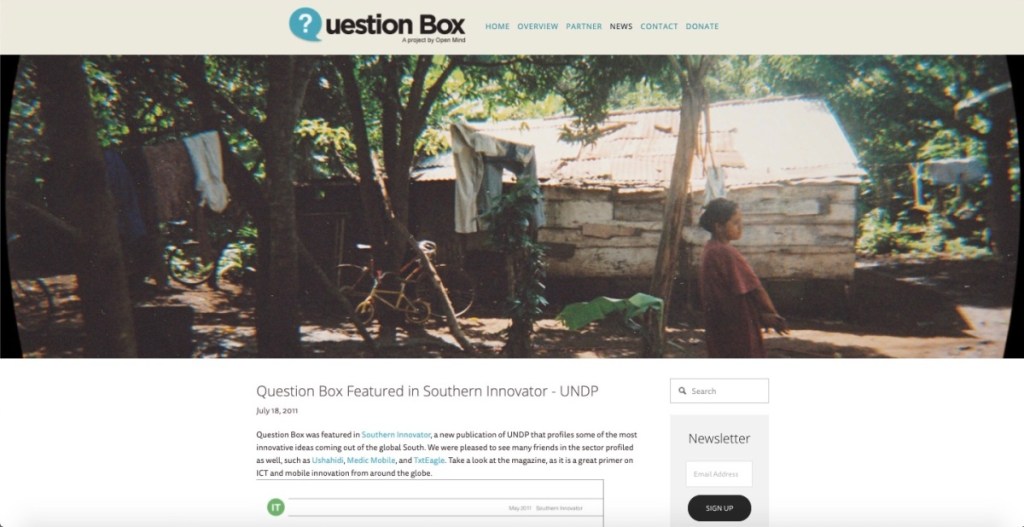
A unique solution in rural India is developing a way to connect the illiterate to the internet. The Open Mind Programme’s Question Box Project, opened its first Box in the village of Phoolpur in September 2007.
The idea is brilliantly simple. An intercom-like white tin box with a phone inside is placed in a village’s public areas. Using the existing phone networks, the user just has to hit a simple button to get an operator at the other end. The operator sits in front of an internet-enabled computer. The user just asks their question, and the operator turns these questions into search queries. When the computer’s search engine gives back answers, the operator selects the best one and then replies in the user’s native language and in layman’s terms.
The operator’s role goes beyond simply typing questions into Google – the operators use intelligent software that aggregates frequently asked questions (FAQs) to speed up time. FAQs include: school scores, job opportunities, football/cricket scores, and definitions and terms. Operators will also send emails for the users.
The service also has a role to play for the literate who lack Internet access. Students once had to travel to get their exam results, but now they can just ask the Question Box.
The Question Box operates in normal business hours for now. A second Question Box was put into operation at the beginning of 2008 in the village of Ethida, several hours’ drive from New Delhi, and there are plans to expand the Question Box to 30 units connected to 20 operators.
At present, organizers are looking into raising revenue for the service by advertising and sponsorship. Operators are typically homeworkers and well-educated. Mostly female, their parents are happy to have them work from home.
During this first phase, the project team analyzed the results and refined the structure of the service. They are also exploring viable business models to be able to take the service across India and keep it sustainable.
Professor of Psychology Ritu Dangwal from the NIIT Institute, is in charge of working with the villagers to monitor the project. She is also involved in a start-up called Hole in the Wall, which provides internet kiosks to rural villagers. Dangwal’s research has starkly correlated the relationship between distance from a big city and decreasing quality of education, a graphic example of the damage done by being cut off from good information resources.
The Question Box is based on an idea from Rose Shuman, a business and international development consultant. Shuman had become frustrated that with all the clever people and vast sums of money going into information technology, few were developing low-cost ways to take the power of computers to the people.
“The best thing about this project is that it’s very tangible,” she told the Daily Telegraph newspaper. “It’s not a big infrastructure. You have a box you can see and touch, and a call log of every question.”
Published: April 2008
Resources
Photographs of the project launch and the Question Box: www.flickr.com
Africa’s growing economy is meeting head-on an optimistic young population keen to start businesses. At least that is what a new poll of African youth says, finding that one in five Africans between the ages of 15 and 24 without a current business wants to start one in the next 12 months.
The Gallup surveys (www.gallup.com) of 27 African countries and areas also found young women were just as keen as young men to start a business.
Throughout the decade of the 2000s, Africa experienced an average economic growth rate of 5.4 percent (World Bank) – a big gain from the poor growth rates of the 1980s and early 1990s.
The turnaround in Africa’s economic growth prospects was the product of a number of trends and factors. One has been better policies and easier trade. Other factors include rising tourism, a growing service sector, rising commodity prices, greater demand for African exports in emerging economies and rapidly improving communications: the surge in mobile phone usage during the last five years has surprised many. Africans are also avid spenders on goods and services, spending US $860 billion on them in 2008, more than India’s US $635 billion or Russia’s US $821 billion (Economic Report on Africa 2011).
The African Development Bank predicts Africa’s growth rate for 2011 will decline to 3.7 percent from 2010’s 4.9 percent, largely as a result of turmoil in North Africa. East Africa is projected to grow the fastest this year at 6.7 percent, with West Africa close behind at 5.9 percent.
Africa as a continent collectively had a gross domestic product in 2009 of US $1.6 trillion: equal to Brazil’s or Russia’s. The continent is considered among the fastest-expanding economic regions in the world (McKinsey & Company).
In fact, while economic prospects are grim in many developed countries, Africa joined Asia as the only continents to grow during this recession.
But major problems still confront the continent, among them youth unemployment. Those between 15 and 24 make up more than 60 percent of the continent’s population and are 45 percent of the total labor force (African Economic Outlook). Sub-Saharan Africa is experiencing a youth explosion, with the proportion of youth there to rise to 75 percent of the population by 2015. Demographers forecast this rising youth trend will not stop for the next 20 years.
Getting these youth actively engaged in the economy and society is a major challenge for the continent. Already, 133 million African youth are illiterate. They have few skills and are marginalised from more productive sectors of the economy.
Even those with an education find their skills often don’t match the needs of the labor market. In sub-Saharan Africa, youth unemployment is believed to be 20 percent.
So even with better economic prospects and growing economies and incomes, youth unemployment looms large.
The Economic Report on Africa 2011 (www.uneca.org/era2011/) finds the “persistent high youth unemployment rate is a cause of concern and a potential source of political instability.” Job creation is still not adequate: “The growth rates are still below the levels needed to make a significant impact on unemployment and poverty reduction.”
While Africa will experience higher growth in 2011, for youth it is looking like a “jobless recovery,” according to the report. Overseas investors are mostly throwing their money at the resource sector, which doesn’t create many jobs in the economy.
But for young Africans looking to start a business, the opportunities are there in sectors such as retailing, telecommunications, banking, infrastructure-related industries, resource-related businesses, and all along the agricultural value chain.
The booming communications industry has added 316 million new subscribers since 2000, for example. And all those people now connected need new services.
And once a business is up and running, it is possible to make higher profits in Africa than on other continents, according to the UN. Africa leads the emerging market economies for returns for businesses. This is because competition isn’t as intense and there is still plenty of built-up consumer demand that needs to be met.
All of this means young people willing to start a business and put in the hard work, will have a better chance of reaping the rewards.
Published: July 2011
Resources
1) iHub Nairobi: iHub Nairobi’s Innovation Hub for the technology community is an open space for the technologists, investors, tech companies and hackers in the area. This space is a tech community facility with a focus on young entrepreneurs, web and mobile phone programmers, designers and researchers. It is part open community workspace (co-working), part vector for investors and VCs and part incubator. Website:http://ihub.co.ke/pages/home.php
4) 2011 Global Youth Economic Opportunities Conference: This 5th anniversary conference will provide a learning platform for the world’s leading funders, practitioners, technical assistance providers, policy makers, and academics working to increase and improve economic opportunities for young people. Join 400 professionals from over 60 countries to share lessons learned, promising practices, and innovative ideas through technical workshops, engaging plenary sessions, and interactive networking. The result? Higher-impact programming, breakthrough solutions, and proven approaches. This year’s theme, Breakthroughs, reflects the focus on the innovative ideas, proven practices, and visionary insights that are taking this emerging field to new heights. Website:http://www.youtheconomicopportunities.org/
5) Dutch Design in Development: DDiD is the agency for fair design, sustainable production and fair trade. They work with Dutch importers and designers and connect them to local producers in developing countries and emerging markets. Together products are made that are both profitable and socially and environmentally sustainable. Website:http://www.ddid.nl/english/index.html
6) Francophone Africa Hackathon: Taking place on 24 September 2011, a ‘hackathon’ to develop mobile phone applications will take place for Francophone Africans. Website:http://www.mobilehackaf.com/
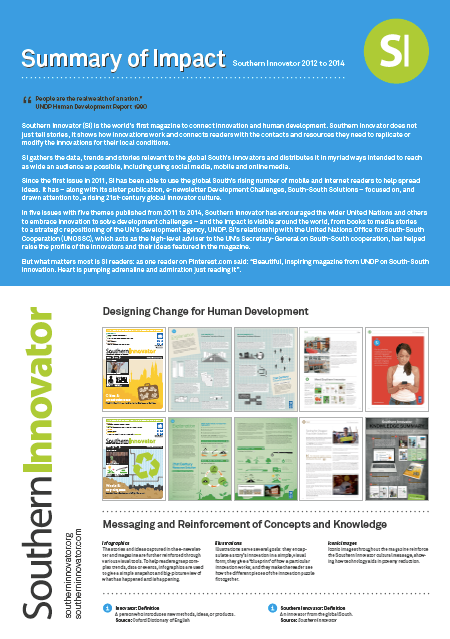
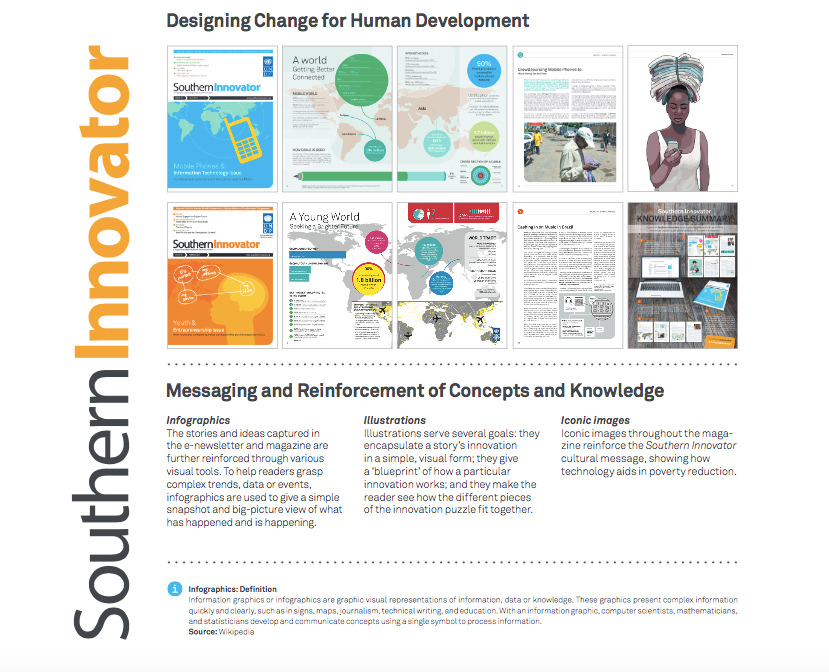
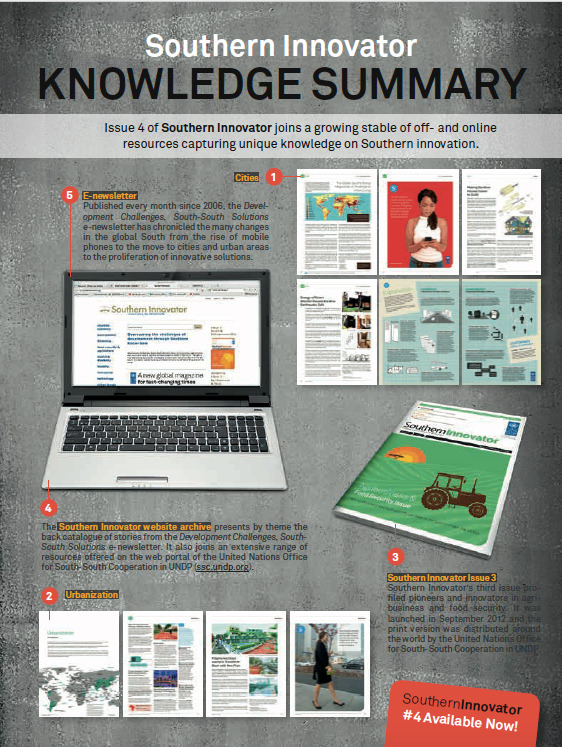
By 2012, Southern Innovator had completed its global reader impact study.
A new movie is generating excitement around life in the war-torn, chaotic and impoverished Democratic Republic of the Congo(http://en.wikipedia.org/wiki/Democratic_Republic_of_the_Congo – the central African nation – and proving how versatile and resilient a creative economy can be in a crisis.
Viva Riva! (http://www.vivarivamovie.com) is set in the capital, Kinshasa, and gives a raw portrayal of sex, violence and gangsters in the city. The film has already won a fistful of awards, and will now be released in 18 African countries.
Written and directed by Djo Tunda Wa Munga, it is being hailed as the first feature-length film to be made in the Democratic Republic of Congo in 25 years. The industry was shut down by long-serving dictator and President Mobutu Sese Seko, who was overthrown in 1997 in the First Congo War by Laurent-Désiré Kabila, who was supported by the governments of Rwanda, Burundi and Uganda.
Africa has a rich film history but its movies have struggled to reach commercial audiences – both on the continent and around the world – outside of showcases at film festivals. Without access to a wide audience, filmmakers are not able to make the sort of profits possible for films with a wide commercial distribution. It has also been hard to compete with the big budgets and the big publicity machines of traditional film centres like Hollywood or Europe. But it looks like Viva Riva! could change that situation.
Indigenous African filmmaking took off as countries became independent of their colonial European rulers in the 1960s and 1970s. One example is the Senegalese film comedy Xala (http://www.imdb.com/title/tt0073915/), directed by Ousmane Sembéne, and considered a classic. Previous portrayals of Africa have mostly been viewed through the cinematic lens of Europeans.
As the second largest country in Africa, the Congo has an estimated population of over 71 million (2011 estimate), with Kinshasa home to more than 8 million people (CIA – The World Factbook). It has suffered badly from war and chaos and has some of the world’s worst statistics for rape and sexual violence brought about by these conditions. The so-called Second Congo War began in 1998 and is considered the world’s deadliest conflict since the Second World War.
Filmmaking forms part of the creative economy, a vital and growing sector in many countries. As the Creative Economy Report 2010 states: “A new development paradigm is emerging that links the economy and culture, embracing economic, cultural, technological and social aspects of development at both the macro and micro levels. Central to the new paradigm is the fact that creativity, knowledge and access to information are increasingly recognized as powerful engines driving economic growth and promoting development in a globalizing world.”
For example,Nigeria’s US $2.75 billion annual film industry is the third largest in the world, following the U.S. and India. Nigeria’s ‘Nollywood’ produces more than 1,000 films a year, creating thousands of jobs, and is the country’s second most important industry after oil. In recognition of its importance, the country’s government has invested in the industry, reforming policies and providing training to promote film production and distribution.
The Creative Economy Report 2010 has highlighted a few key trends for the global South. It found that creative industry products, especially domestically consumed ones like videos, music, video games and TV programmes, are weathering the global economic crisis well. It also found the creative economy can help boost economies and bring countries out of recession if the right government policies are in place.
The exporting of creative goods and services continues to grow, doubling from 2002 to 2008. This represented a 14 percent per year growth rate. The global South’s exporting of creative goods reached a high of US $176 billion by 2008 and represented 43 percent of the world’s total creative industries trade.
The majority of the world’s mobile phones are now in developing countries, representing a vast, new platform for distributing, sharing and selling cultural products and services. Broadband Internet is also being rolled out to more countries and represents an enormous emerging opportunity waiting for enterprising people to seize.
The report also found more and more cities across the global South are placing creative economies at the centre of their urban development, emphasising culture and creative activities.
For Viva Riva!, the next stop is Africa-wide release in Botswana, Burkina Faso, Kenya, Lesotho, South Africa, Swaziland and Uganda. The film’s producers have their sights set on even more countries in central and West Africa.
“We want to show that you can release African films acrossAfrica,” co-producer Steven Markovitz told The Guardian. “As far as we can tell, it’s unprecedented. No one has tried to do an Africa-wide release in so many countries.”
There is more at stake with the film than just Congolese pride: it is about proving an African film can successfully take on the slick and well-funded film distribution machines deployed byAmerica’s Hollywood and European film distributers.
With the African middle class growing and a burgeoning African consumer class now clearly identified, many see this as the right time to make African film pay.
“African cinemas have been dominated by Hollywood and European cultural programmes catering to the intellectual elite, not tapping into a growing middle class who are interested in seeing films about themselves and their neighbours,” Markovitz told The Guardian.
“There is an audience, a real market for African films. They have disposable income and they want to be entertained. We hope that this will create a pipeline for further African titles on the continent.”
Viva Riva! is in French and Lingala (http://en.wikipedia.org/wiki/Lingala_language). The story revolves around a hustler who makes quick cash stealing oil and celebrates by going on a hedonistic romp through Kinshasa’s night clubs.
The film had its international debut at the 2010 Toronto International Film Festival and won the 2011 MTV Movie award for best African film.
Markovitz is from South African film production company Big World Cinema (http://www.bigworld.co.za). The producers hope the film will appeal to both French speakers and English speakers.
“There are distribution challenges in Africa but we thought this one presents an opportunity to make it happen,” he said. “Some African films have felt like homework but this is an entertaining action film and we think it can cross language barriers. We have to try things out.”
Critics have said good things about the film. The Nigerian actor and director Akin Omotoso told The Guardian: “I loved Viva Riva! Absolute breath of fresh air, an adrenalin rush from top to bottom, a great gangster flick.”
The film is unique as an African production that has “captured not just international attention but the continent’s attention”, he added.
“I think it stands a good chance; as we know, it’s up to the audience but either way it has made history.”
6) The Filmmakers Guide to South Africa is the most recognised, established and representative brand marketing the South African film industry locally and internationally. Website:http://www.filmmakersguide.co.za
7) Youth Filmmakers Africa: An initiative in Kenya to inspire the next generation of filmmakers. Website:http://www.indiegogo.com/Youth-Filmmakers-Africa
A film school in Bolivia shows how a creative hub can become the start of something much bigger. The school is inspiring a new generation of young people to get into filmmaking. And one of its lecturers is already experiencing global success acting in an award-winning new Spanish film.
Bolivia’s economy has grown over the last decade, and the country is beginning to shed its long-standing reputation for grinding poverty and political instability. Public spending has risen, and more money has been put into programmes to reduce poverty. More students are entering higher education and the country recognizes an urgent need for greater awareness and understanding of modern technology.
Film and media production have been targeted as an important way to advance Bolivia’s social and economic development.
Veteran Bolivian filmmaker Jorge Sanjines (http://en.wikipedia.org/wiki/Jorge_Sanjin%C3%A9s) has been one of the most passionate exponents of using film to spread the stories and wisdom of Bolivia’s indigenous people. He believes their stories understand the need to balance the demands of humanity with preservation of the environment. Film, to him, is a way to liberate Bolivian society and address its pervasive problems of poverty, hunger and marginalization.
This chimes with rising global awareness of the importance of the creative economy in future development. No longer seen as a frippery, the creative economy is the “interface between creativity, culture, economics and technology in a contemporary world dominated by images, sounds, texts and symbols” (UNCTAD). It is seen as a way for emerging economies to leapfrog into high-growth areas in the world economy.
It’s a formula that has worked well in many other places. A successful art gallery fosters a scene and draws in audiences, buyers and new businesses. Soon, a creative economy comes alive and that means serious money. Both New York and London have shown how this can work. By 2005, New York City’s creative economy employed over 230,899 people in 24,481 businesses (Americans for the Arts).
Creative economies tend to create excitement and pride in the country; creative businesses like advertising and design make it much easier to sell products and connect with customers. It is hard to imagine the Apple computer brand (http://www.apple.com/) being as successful as it is without intelligent and engaging design.
Regeneration – of poor neighbourhoods, districts, even whole countries – is both a challenge and a key to transforming lives. There is a strong track record of turning to artists and creative people to re-imagine neighbourhoods or a country’s culture, restoring pride and vitality to places beaten down by life’s hardships.
A graduate of the school and a lecturer on screenwriting, he got a big career boost by acting in a major new, award-winning film and is nominated as Best Newcomer by Spain’s top film awards, the Goyas (http://www.academiadecine.com/home/index.php). The nomination is for his role in the Spanish film Even the Rain (http://www.tambienlalluvia.com/) – set in the Bolivian city of Cochabamba, where protests a decade ago broke out over privatisation of water services. It stars well-known Mexican actor Gael Garcia Bernal, who plays a filmmaker set on making a movie about the Spanish conquest of the Americas. While making the film, the so-called “water wars” break out and the actor played by Aduviri must balance his film role with being a protest leader.
The protests against water privatisation in Cochabamba led to the election of Evo Morales (http://en.wikipedia.org/wiki/Evo_Morales) as Bolivia’s president in December 2005.
Cine Alto is one of four film schools in Bolivia but the only one that does not charge students tuition. Cash is tight for the school, which is a simple place and runs on thin resources. The classrooms have bare walls and broken windows, but the school is serious about transforming the lives of young people. The curriculum emphasises a strong theoretical foundation in combination with technical and practical training.
“Conditions in Bolivia to make a film are challenging and in El Alto, it’s even more difficult,” Aduviri told the BBC.
“Life is hard here in El Alto, and this film school is trying to rescue this talent, and support these young people.”
A member of Bolivia’s indigenous people, the Aymara (http://en.wikipedia.org/wiki/Aymara_people), Aduviri grew up in El Alto, a city known for its strong pride and resilience. It is home to almost a million people, most of whom are Aymara.
He studied screenwriting and turned to teaching at the school after graduating. He is passionate about filmmaking as an alternative to negative influences in the community: he wanted the film school “to give a voice to all the talent that we’re losing to alcohol, drugs, prostitution, homelessness and gangs.”
One student, Edson Chambiborque, told the BBC: “”He has taught us to value the little that we have in this school, and never drop our heads despite all the difficulties we may have.”
Aduviri comes from a poor family but now makes a good salary by Bolivian standards: US $200 a month. (The average monthly wage in Bolivia is around US $90). He still lives with his mother in a poor neighbourhood. His father, a miner, died of lung disease.
He wants to become a director and screenwriter and dreams of his film career taking him to the Cannes Film Festival in France (http://www.festival-cannes.com/).
He will continue acting to raise the money to be able to finance his own films. With the money he has made from appearing in the Spanish film, he has bought a computer with film editing software and a television. He has a goal to watch two movies a day on his new television and keep learning.
Appearing in the film has catapulted his career to the next level: the phone is always ringing and the world’s media keep asking for interviews. It has come with trips to Europe to promote the film and receive awards. He also won the best actor award from the Festival de Cinema Europeen des Arcs (http://www.lesarcs-filmfest.com/2010/programme/). An impressive journey for somebody from a poor family.
When he saw his first movie he was inspired by the magic of filmmaking. He told the BBC: “It was showing Rambo. And that day I realised what I wanted to do. When I left the cinema, I said: I want to make films.”
Bolivian film has had to fight for attention with other Central and South American countries. Brazil, Argentina and Chile all have experienced global success. The country has a rich – but little-known – film history, with significant Bolivian filmmakers including Pedro Sambarino, Jorge Ruiz, Oscar Soria, Jorge Sanjines, Antonio Eguino, Paolo Agazzi, Rodrigo Bellott, Juan Carlos Valdivia, Adriana Montenegro, Marcos Loayza.
Bolivia is looking to the digital age to rectify its relative anonymity, and Cine Alto may be ground zero for a Bolivian film new wave.
3) Global Creative Economy Convergence Summit 2009: The summit is about the successful and emerging creative technologies and initiatives that are driving economic growth locally, nationally and internationally. Website: http://www.gcecs2009.com/
6) Creative Economy Report 2008. An economic and statistical assessment of creative industries world-wide as well as an overview of how developing countries can benefit from trade in creative products and services, produced by UNCTAD and the Special Unit for South-South Cooperation in UNDP. Website: http://www.unctad.org/en/docs/ditc20082cer_en.pdf










 David South Consulting
You must be logged in to post a comment.