Categories
Archive Development Challenges, South-South Solutions Newsletters

The Battle for India’s Coffee Drinkers in Buzzing Economy

By David SouthDevelopment Challenges, South-South Solutions

SOUTH-SOUTH CASE STUDY

A showdown in India over coffee is creating new opportunities. It is also demonstrating how the country is changing, with rising incomes in some places and great disparities in others.

Finding the right place to have a coffee and meet with friends for a chat is important to many urban Indians. And the fight is on for these customers.

Older establishments like the legendary College Street Coffee House in Kolkata (http://en.wikipedia.org/wiki/College_Street_Coffee_House) – owned by a cooperative society – compete with new rivals modelled on the popular American chain Starbucks (http://www.starbucks.com/). This fierce competition takes place in an economic environment of rising food inflation of up to 16 percent this year and economic growth surpassing seven percent.

Coffee is the second most popular drink in India after tea. Its consumption has been steadily growing over the years, rising from 50,000 metric tonnes (MT) in 1995 to 94,400 MT in 2008 (Coffee Board of India). Once mainly drunk in the south of India, the taste for coffee has spread around the country with the rise of fast-paced modern lifestyles. The caffeine (http://en.wikipedia.org/wiki/Caffeine) jolt of a cup of coffee is attractive to people on the move and working hard.

India also holds its own as a coffee growing and exporting nation, accounting for about 4.5 percent of world coffee production and the industry provides employment to 600,000 people. The state of Karnataka accounts for 70 percent of country’s total coffee production followed by Kerala (22 percent) and Tamil Nadu (7 percent).

India has the domestic demand, and it has the product. And now a bitter battle for the nation’s coffee drinkers is underway. The difference between what is on offer at the cooperative-run coffee houses and the newer establishments is stark: at the older places, service is old-fashioned – waiters in white suits deliver coffee and food to tables – with a no-frills menu on offer. Coffee comes in simple forms: black, white, cold, hot for eight rupees (US 0.18 cents). At newer establishments, coffees come in many varieties and permutations, flavoured and with added extras. Menus also can be varied and establishments can include things like internet access.

The appeal of the older establishments is price.

“It’s good here because it’s cheap,” College Street Coffee House customer Arindam Chouwdhry, 19, told The Guardian newspaper. “We can’t go to these new places. We are from the middle class only.”

And turnover is brisk, according to manager, Deepak Gupta. “We serve up to 1,500 cups a day. Business is good.”

Owned by the India Coffee House chain (http://en.wikipedia.org/wiki/Indian_Coffee_House), a worker’s cooperative society with 400 outlets across the country, the Coffee House was established in the 1950s with the mandate to serve cheap food and drink and act as a meeting place. It attracts workers, intellectuals and political activists. But with the huge economic changes in India over the past decade, traditional coffee houses are facing fierce competition.

In the state of Kerala, home to avid coffee drinkers, 15 of the cooperative’s 50 branches are now losing money. In the capital, Delhi, a further 10 coffee houses have closed. Things are so bad for these traditional coffee houses that the most famous branch of the Indian Coffee House has not paid its rent for years and is waiting to be closed by the municipality.

“The younger crowd seems to go elsewhere,” said its resigned manager, Janak Raj.

In many countries, coffee houses have become essential tools for economic development. They not only offer a stimulating drink, but a place to hang out, meet friends and business partners, catch up on news and access the internet. This role in economic development can be found as far back as the coffee houses of Europe during the beginning of the industrial revolution: deals were struck and people could meet the like-minded to hatch business ideas.

Coffee houses and cafes also reflect the economic and social changes in Indian society. They have come to be status symbols, showing what economic power you have achieved. And as services and quality change, they show how the level of prosperity changes.

New competitors to the cooperative coffee houses’ are offering a more modern environment to lure in a trendier crowd. Café Coffee Day (http://www.cafecoffeeday.com/index.php), which claims to be India’s largest chain coffee shop, with the motto “where the young at heart unwind”, has air conditioning, mirrors, comfortable chairs and posters on the walls for decoration. And the price is different as well: choco-frappes go for 95 rupees (US $2.11).This price means the customers need higher incomes to afford to go there.

“McDonald’s is the cheapest hangout and everyone can go there,” said a customer, Sima. “This is much nicer and only a bit more expensive so we come here. But only a few people can go to Barista’s.”

The chain Barista’s (http://www.barista.co.in/users/index.aspx) is 10 years old with 230 outlets. It is growing fast with 65 more new outlets opening this year. According to its head of marketing, Vishal Kapoor, Barista’s does not simply offer coffee, but “an overall experience.”

They bill themselves as “crème” cafes: places where salads and smoothies are on offer beside the coffee.

“It’s very exciting what is happening in India,” Kapoor said. “The classic coffee houses are part of an era that is ending.”

“People use the cafes as places to meet for privacy. “It is a kind of private space,” says Ruchika, a bank worker.

Nonetheless, despite its success, Barista’s is still too expensive for most Indians.

Published: April 2010

Resources

1) 48 innovations in coffee culture: This eclectic mix of innovations, trends and tit bits on global coffee culture is sure to inspire any budding coffee entrepreneur. Website: http://www.trendhunter.com/trends/coffee-innovation

2) Watch a video report from the coffee houses. Website: http://www.guardian.co.uk/travel/video/2010/apr/01/india-coffee-house-kerala

3) Coffee Board of India: The Board focuses on research, development, extension, quality upgrades, market information, and the domestic and external promotion of Coffees of India. Website: http://www.indiacoffee.org/login.php

4) Practical advice and contacts on how to start a coffee shop. Website: http://www.howtostartacoffeeshop.co.uk/

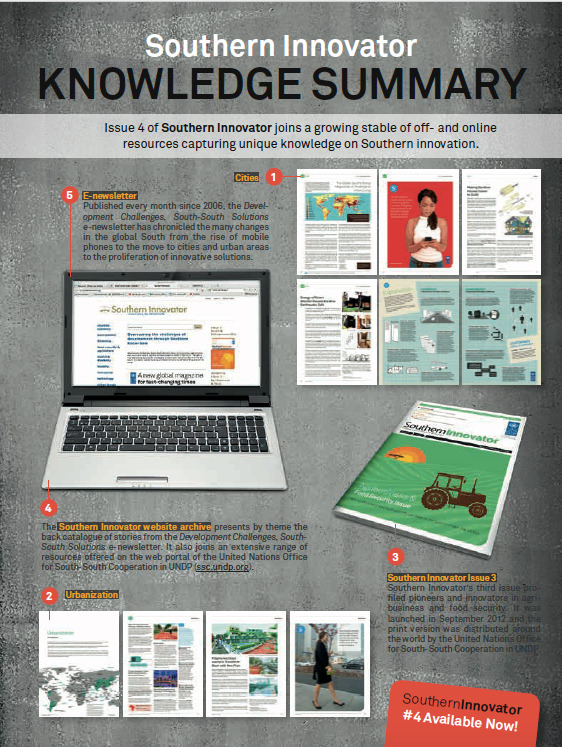
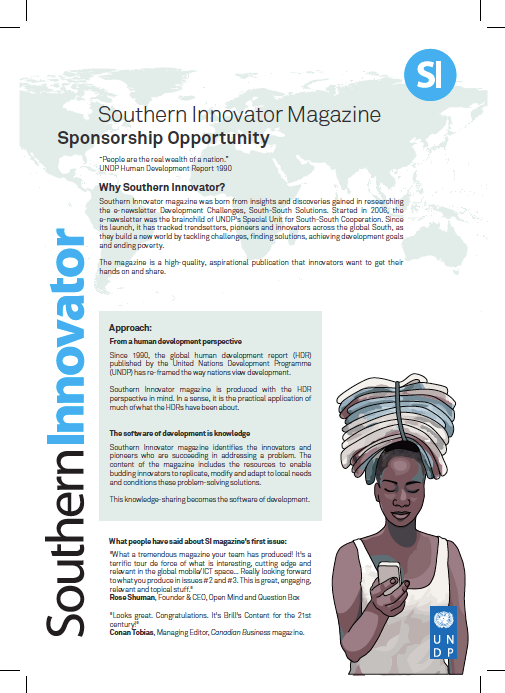
Development Challenges, South-South Solutions was launched as an e-newsletter in 2006 by UNDP’s South-South Cooperation Unit (now the United Nations Office for South-South Cooperation) based in New York, USA. It led on profiling the rise of the global South as an economic powerhouse and was one of the first regular publications to champion the global South’s innovators, entrepreneurs, and pioneers. It tracked the key trends that are now so profoundly reshaping how development is seen and done. This includes the rapid take-up of mobile phones and information technology in the global South (as profiled in the first issue of magazine Southern Innovator), the move to becoming a majority urban world, a growing global innovator culture, and the plethora of solutions being developed in the global South to tackle its problems and improve living conditions and boost human development. The success of the e-newsletter led to the launch of the magazine Southern Innovator.  

Creative Commons License

This work is licensed under a
Creative Commons Attribution-Noncommercial-No Derivative Works 3.0 License

ORCID iD: https://orcid.org/0000-0001-5311-1052.

© David South Consulting 2023

Categories
Archive Development Challenges, South-South Solutions Newsletters Southern Innovator magazine

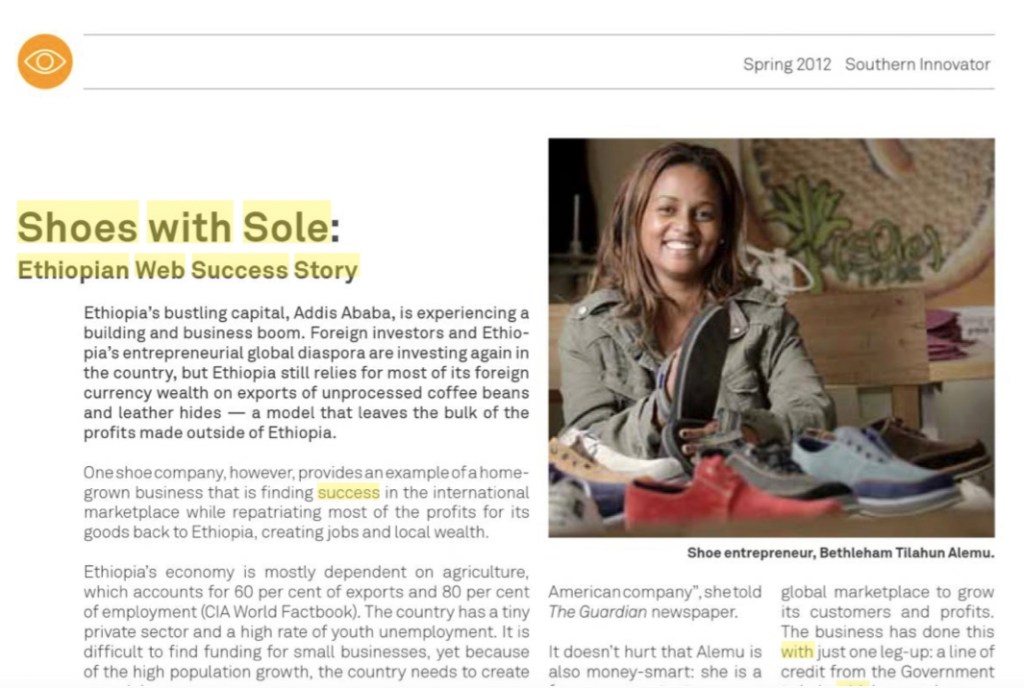
Shoes with Sole: Ethiopian Web Success Story

By David SouthDevelopment Challenges, South-South Solutions

SOUTH-SOUTH CASE STUDY

Ethiopia’s bustling capital, Addis Ababa, is experiencing a building and business boom. Foreign investors and Ethiopia’s entrepreneurial and widespread global diaspora are investing again in the country. But Ethiopia still relies for most of its foreign currency wealth on exports of unprocessed coffee beans and leather hides — a model that leaves the bulk of the profits made outside of Ethiopia.

But one shoe company provides an example of a home-grown business that is finding success in the international marketplace, while repatriating most of the profits for its goods back to Ethiopia, creating jobs and local wealth.

Ethiopia’s economy is mostly dependent on agriculture, which accounts for 60 percent of exports and 80 percent of employment (CIA World Factbook). The country has a tiny private sector and high youth unemployment. It is difficult to find funding for small businesses. Yet, because of the high population growth, the country needs to create more jobs.

The Economist magazine has forecast Ethiopia’s economy will grow by 7 percent in 2010, becoming the fifth fastest growing economy in the world, and on course to surpass Kenya to become East Africa’s biggest economy. While this sounds impressive, the country has to run hard to create enough jobs to meet its growing population and still faces significant food security problems.

One company, soleRebels, is combining a clever twist on a local tradition – recycling rubber from old truck tires into shoes, locally known as selate shoes – with sophisticated design concepts and high quality craftsmanship to make a global footwear hit.

Co-founder and managing director Bethleham Tilahun Alemu, a 30-year-old African web-vending entrepreneur, has turned this local craft into a global fashion design hit by adding colourful cotton and leather uppers to the tire shoes. The recycled rubber shoes come in many styles: from handmade flip-flops to boat shoes, loafers, and athletic trainers resembling the popular American sports shoe, Converse (http://www.converse.com/).

SoleRebels’ (http://solerebelsfootwear.weebly.com/index.html) shoe factory is on the outskirts of Addis Ababa in the historic village of Zenabework. Despite its location, it is reaching the international markets through online retailers like Amazon.com. Shipments take between three and five days to arrive in the United States.

And the secret to this small start-up’s success? Apart from great shoes and funky design, Alemu puts it down to this: “We are sitting in Addis Ababa but acting like an American company,” she told The Guardian newspaper.

It doesn’t hurt that Alemu is also money-smart: she is a former accountant.

Started five years ago, soleRebels now employs 45 full-time staff making 500 pairs of shoes a day. The shoes cost between US $33 and US $64. They are also being sold in Japan and the United Kingdom on Amazon’s shoe-selling website, http://www.javari.co.uk.

In 2010, Alemu hopes soleRebels will make US $481,000. But soleRebels has an even more ambitious goal: to become “the Timberland or Sketchers of Africa.”

Timberland (http://www.timberland.com/home/index.jsp), an American shoe and boot maker, has been a pioneer in high-quality leather footwear, breaking new ground in adopting green manufacturing processes and exploiting the power of the web by allowing customers to customise their footwear.

SoleRebels has cleverly exploited the advantages of the global marketplace to grow its customers and profits. The business has done this with just one leg-up: a line of credit from the government to help with large orders. With 6.2 million people out of a population of 80 million needing food aid, Ethiopia is still highly dependent on international aid. But Alemu is showing there is a way to build a sustainable successful business.

Inspiration for Alemu came about when she was thinking what Ethiopian product could be produced in a sustainable way. She remembered the sandals worn in the country.

“Recycling is a way of life here – you don’t throw things away that you can use again and again,” she said. “I wanted to build on that idea.”

Ethiopian shoe makers have had a difficult time in recent years, trying to compete with cheaper Chinese imports. But rather than just trying to come up with a shoe that was even cheaper than the Chinese ones, soleRebels decided to build a business selling shoes to the more lucrative export market.

Alemu reasoned that good design would attract a higher price. She did research on the internet to find out which designs worked well and what were the latest trends in footwear.

This research formed the basis of her range of shoes, which have catchy names like Class Act or Gruuv Thong. The sandals and flip-flops are either cotton-covered or leather covered. The Urban Runner shoe sells best and is inspired by the Converse All Star sneaker.

SoleRebels has a regular supplier of old truck tires and inner tubes and has women weave and dye the cotton, jute and hemp uppers for the shoes. Almost all materials are locally sourced. Old army uniforms are cannibalized for their camouflage pattern.

SoleRebels has also been canny in seeking Fair Trade certification (http://www.fairtrade.org.uk) to help with marketing and selling the shoes.

To increase the market for the shoes, Alemu bombarded American retailers with emails and shoe samples to pique their interest. Because of the U.S. African Growth and Opportunity Act (http://www.agoa.gov), soleRebels’ shoes can be imported into the United States duty-free: a big price advantage in the U.S. marketplace which has helped grab the interest of retailers like Whole Foods and Urban Outfitters.

This interest soon snowballed, and people were placing orders through the soleRebels website (http://solerebelsfootwear.weebly.com/index.html). Orders come by courier from Ethiopia in about a week to the United States.

With all this interest building, Amazon, the leviathan online retailer, decided to become a customer for the shoes. Online retailing has been a huge boost to the growth of soleRebels. According to Alemu, it has enabled the company “to understand the market needs and demands in real time” — a huge advantage to a start-up company far away from its markets.

There is another advantage to using the web to grow a business: it has enabled soleRebels to take greater control of the whole process. The company negotiates directly with retailers, handling orders and credit collection, and this makes sure most of the profits of the business return to Ethiopia.

Making soleRebels quickly profitable has been a benefit to its workers. Starters at the company make US $1.92 a day, while experienced shoe-makers earn US $11 a day (a good wage in Ethiopia).

“In Ethiopia we have become used to taking money from the West, to always getting help,” Alemu told the Guardian. “That does not make for a sustainable economy. We need to solve our own problems.” And what does success enable them to do? SoleRebels are now building a solar-powered factory to replace their current workshop. And there is a steely pride in the firm’s success: “People buy soleRebels because they are good, not just because they are green or from Ethiopia,” Alemu said. “Our product speaks for itself.”

Published: January 2010

Resources

1) The online service CafePress is a specially designed one-stop shop that lets entrepreneurs upload their designs, and then sell them via their online payment and worldwide shipping service. Website: http://www.cafepress.com/cp/info/sell/

2) Once inspired to get into the global fashion business, check out this business website for all the latest news, jobs and events. Website: http://us.fashionmag.com/news/index.php

3) iFashion: This web portal run from South Africa has all the latest business news on fashion in Africa and profiles of up-and-coming designers. Website: http://www.ifashion.co.za/index.php?option=com_frontpage&Itemid=1

4) The red dot logo stands for belonging to the best in design and business. The red dot is an internationally recognised quality label for excellent design that is aimed at all those who would like to improve their business activities with the help of design. Website: http://www.red-dot.de

5) Dutch Design in Development: As a matchmaker, DDiD puts together European clients, Dutch designers and small and medium-sized enterprises in developing countries. The designers share their knowledge of European consumer tastes, product development, design and quality standards. Website: http://www.ddid.nl

6) ShopAfrica53: Pledging in its motto to reach “every African nook and cranny,” ShopAfrica53is an online shopping portal similar to famous brands like Amazon or eBay, but focused entirely on giving African traders the ability to sell across the continent and to the world online. Website: http://www.shopafrica53.com/

7) Havianas: A Brazilian global fashion success with its rubber flip flops. Website: http://www.havaianas.com/

8) Arise Africa Fashion Week: The place to be seen and to see. Website: http://www.africanfashioninternational.com/africaFashionWeek/

As featured in Southern Innovator Issue 2: Youth and Entrepreneurship. Designed and laid out in Iceland using 100% renewable energy.

https://davidsouthconsulting.org/2022/11/19/african-culture-as-big-business/

https://davidsouthconsulting.org/2021/02/09/african-fashions-growing-global-marketplace-profile/

https://davidsouthconsulting.org/2021/01/05/afropolitan-african-fashion-scene-bursting-with-energy/

https://davidsouthconsulting.org/2021/01/25/creating-green-fashion-in-china/

https://davidsouthconsulting.org/2022/10/09/fashion-closes-gap-between-catwalk-and-crafts/

https://davidsouthconsulting.org/2022/11/17/fashion-recycling-how-southern-designers-are-re-using-and-making-money/

https://davidsouthconsulting.org/2022/11/16/favela-fashion-brings-women-work/

https://davidsouthconsulting.org/2022/10/24/made-in-africa-fashion-brand-pioneers-aim-for-global-success/

https://davidsouthconsulting.org/2022/06/27/new-swimwear-for-plus-size-women-in-brazil/

https://davidsouthconsulting.org/2021/10/04/putting-quality-and-design-at-the-centre-of-chinese-fashion/

https://davidsouthconsulting.org/2020/11/24/too-black/

Creative Commons License

This work is licensed under a
Creative Commons Attribution-Noncommercial-No Derivative Works 3.0 License.

ORCID iD: https://orcid.org/0000-0001-5311-1052.

© David South Consulting 2023
Categories
Archive Development Challenges, South-South Solutions Newsletters Southern Innovator magazine

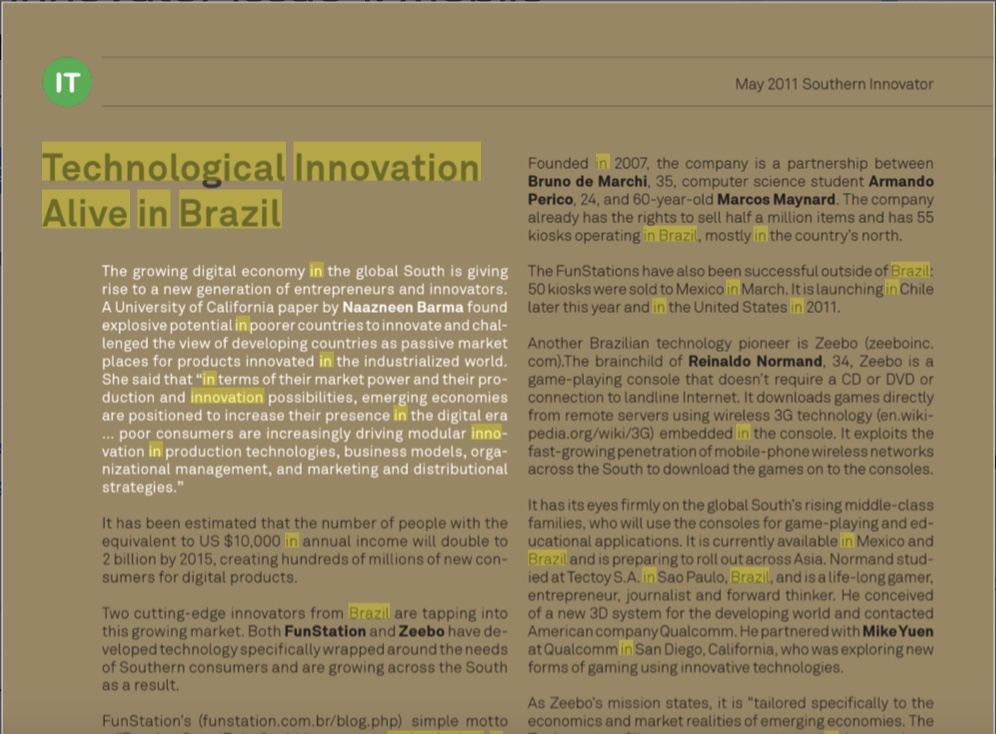
Technological Innovation Alive in Brazil

By David SouthDevelopment Challenges, South-South Solutions

SOUTH-SOUTH CASE STUDY

The growing digital economy in the global South is giving rise to a new generation of entrepreneurs and innovators.

A University of California paper by Naazneen Barma found explosive potential in poorer countries to innovate, and challenged the view of developing countries as passive market places for products innovated in the industrialized world. She said that “in terms of their market power and their production and innovation possibilities, emerging economies are positioned to increase their presence in the digital era … poor consumers are increasingly driving modular innovation in production technologies, business models, organizational management, and marketing and distributional strategies.”

It has been estimated that the number of people with equivalent to US $10,000 in annual income will double to 2 billion by 2015, creating hundreds of millions of new consumers for digital products.

Two cutting-edge innovators from Brazil are tapping into this growing market. Both FunStation and Zeebo have developed technology specifically wrapped around the needs of Southern consumers and are growing across the South as a result.

FunStation’s (http://www.funstation.com.br/blog.php)simple motto – “Touch – Get – Enjoy” – hides a savvy technological innovation aimed at the growing army of digital downloaders on the march across the South. Sao Paulo’s FunStation entertainment kiosk system serves up video, audiobooks, songs, and ringtones to mobile phones and MP3 (http://en.wikipedia.org/wiki/MP3) players. Customers just need to plug into one of the large futuristic white kiosks, scroll through the choices, select what they want, pay and download. By going to the kiosk, customers avoid the need to download from the internet, which can take a lot of time depending on the connection and bandwidth. The kiosk is speedy, with 14 musical tracks downloaded to a device in 10 seconds.

Apart from the convenience and speed of the kiosks, they also have other benefits: customers do not need to register with a download site like iTunes on the internet. This means they do not have to run the risks of giving away bank details or other personal information.

Customers buy something called a Funcard which is similar to a pre-pay phone plastic phone card, with a PIN number. Cards are sold with values ranging from US $2 to US $50. The user just punches the number into the kiosk to pay for the download.

The kiosks are being located in high-traffic places like festivals, airports, universities, retail shopping centres and transport systems.

Founded in 2007, the company is a partnership between Bruno de Marchi, 35, computer science student Armando Perico, 24, and 60-year-old Marcos Maynard. The company already has the rights to sell half a million items and has 55 kiosks operating in Brazil, mostly in the country’s north. “People are poorer in those places,”de Marchi told Monocle magazine. “Usually they have an MP3 player but no computer.”

The FunStations have also been successful outside of Brazil: 50 kiosks were sold to Mexico in March. It is launching in Chile later this year and in the United States in 2011. Always evolving, the business is also working with the University of Lugano in Switzerland to develop new software and keep the kiosks fresh and lively.

Another Brazilian technology pioneer is Zeebo (http://www.zeeboinc.com). The brainchild of Reinaldo Normand, 34, Zeebo is a game-playing console that doesn’t require a CD or DVD, or connection to landline internet. It downloads games directly from remote servers using wireless 3G technology (http://en.wikipedia.org/wiki/3G)embedded in the console. It exploits the fast-growing penetration of mobile phone wireless networks across the South to download the games on the consoles.

It has its eyes firmly on the global South’s rising middle-class families, who will use the consoles for game-playing and educational applications. It is currently available in Mexico and Brazil and is preparing to roll out across Asia. Normand studied at Tectoy S.A. in Sao Paulo, Brazil, and is a life-long gamer, entrepreneur, journalist and forward thinker. He conceived of a new 3D system for the developing world and contacted American company Qualcomm. He partnered with Mike Yuen at Qualcomm in San Diego, California, who was exploring new forms of gaming using innovative technologies.

As Zeebo’s mission states, it is “tailored specifically to the economics and market realities of emerging economies. The Zeebo system fills an enormous unmet need in these regions. At the same time it opens an immense new market for interactive content and products.”

Normand is ambitious and wants to reach a vast market of 340 million Chinese families. “By 2011, I want to close deals in China to manufacture televisions with this technology built in, therefore entering the homes of millions of families,” he told Monocle.

Zeebo makes some games for the console and also buys in other games from big-name game makers like Electronic Arts and Activision. The games are downloaded from the internet using a 3G mobile chip already built in to the consoles. The games are priced between US $5 and US $13.

The Zeebo system will roll out to China, the US and India in 2011, and Eastern Europe in 2012.

Published: August 2010

Resources

  • Afrinnovator: Is about telling the stories of African start-ups, African innovation, African made technology, African tech entrepreneurship and entrepreneurs. Their mission is to ‘Put Africa on the Map’ by covering these kinds of stories from all over Africa. As their website says, “if we don’t tell our own story, who will tell it for us?” Website: http://afrinnovator.com
  • AfricaUnsigned: This African alternative way of producing African music started this year. Unsigned artists record their music, funded by fans. Music fans from all over the world listen to the selection of artists, pick their favorite(s) and chip in a minimum of $1 dollar to the recording of a professional EP. The music is then distributed to the fans who backed the artist and sold on all major online stores (incl. Amazon & iTunes). Website: www.AfricaUnsigned.com
  • TechMasai: Pan-African start-up news and reviews. Website: www.techmasai.com
  • The Emerging Economies in the Digital Era: Market Places, Market Players, and Market Makers by Naazneen Barma, University of California. Website: http://tinyurl.com/3xjf2ps

https://davidsouthconsulting.org/2022/02/17/african-digital-laser-breakthrough-promises-future-innovation/

https://davidsouthconsulting.org/2022/10/05/african-innovation-eco-system-taking-shape/

https://davidsouthconsulting.org/2021/05/18/african-innovation-helps-make-banking-transactions-safer/

https://davidsouthconsulting.org/2022/11/16/brazils-agricultural-success-teaches-south-how-to-grow/

https://davidsouthconsulting.org/2022/11/10/brazilian-restaurant-serves-amazonian-treats/

https://davidsouthconsulting.org/2022/10/10/bringing-the-invention-and-innovation-mindset-to-young-kenyans/

https://davidsouthconsulting.org/2022/11/17/cashing-in-on-music-in-brazil/

https://davidsouthconsulting.org/2020/04/25/china-looking-to-lead-on-robot-innovation/

https://davidsouthconsulting.org/2022/10/24/flurry-of-anti-poverty-innovations/

https://davidsouthconsulting.org/2021/03/24/frugal-innovation-trend-meets-global-souths-innovation-culture/

https://davidsouthconsulting.org/2017/10/18/innovation-agenda-and-timeline-2007-2015/

https://davidsouthconsulting.org/2020/04/27/innovation-from-the-global-south/

https://davidsouthconsulting.org/2020/12/14/innovation-in-growing-cities-to-prevent-social-exclusion/

https://davidsouthconsulting.org/2022/11/11/innovation-cairos-green-technology-pioneers/

https://davidsouthconsulting.org/2021/03/04/innovation-villages-tackling-mdgs/

https://davidsouthconsulting.org/2021/10/22/innovations-in-green-economy-top-three-agenda/

https://davidsouthconsulting.org/2022/10/27/kenyan-mobile-phone-innovations/

https://davidsouthconsulting.org/2021/03/02/new-3d-technology-makes-innovation-breakthrough-and-puts-mind-over-matter/

https://davidsouthconsulting.org/2022/10/09/next-generation-of-innovation-for-the-grassroots/

https://davidsouthconsulting.org/2016/04/14/southern-innovator-and-the-growing-global-innovation-culture-14-april-2016/

https://davidsouthconsulting.org/2021/03/05/southern-innovator-issue-1/

Creative Commons License

This work is licensed under a
Creative Commons Attribution-Noncommercial-No Derivative Works 3.0 License.

ORCID iD: https://orcid.org/0000-0001-5311-1052.

© David South Consulting 2023

Categories
Archive data Development Challenges, South-South Solutions Newsletters digital ID

African Health Data Revolution

By David SouthDevelopment Challenges, South-South Solutions

SOUTH-SOUTH CASE STUDY

A pioneering tool for gathering health data now being used in Kenya could herald a revolution in the way diseases are tracked and defeated around the world. It uses mobile phones to better connect patients with medical and health personnel, and allows data to be gathered in real-time and used to track health and improve the delivery of services, especially to remote and under-serviced areas.

In the past couple of years, Kenya has become a hotbed of mobile phone and information technology innovation. The now-famous Ushahidi crisis-mapping platform (www.ushahidi.com) is just one example. Social enterprise Data Dyne (www.datadyne.org) – with offices in Washington DC and Nairobi, Kenya – is offering its EpiSurveyor application (www.episurveyor.org) free to all to aid health data collection. It bills itself as “the first cloud-computing application for international development and global health … Think of it as like Gmail, but for data collection!”

EpiSurveyor claims to have more than 2,600 users around the world and is currently being upgraded to a second version.

“With the touch of a button I can see what’s going on across the country in real time,” Kenyan civil servant Yusuf Ibrahim told Britain’s Daily Telegraph newspaper. “It is amazing.”

Ibrahim works in Nairobi as the Kenyan Ministry of Health liaison to Data Dyne.

He uses maps and charts on mobile phones to track deadly disease outbreaks and vulnerable pregnancies.

The EpiSurveyor application works simply: A user logs into the website and builds and creates the sort of form they want. They then download it to a phone and start collecting data straight away.

Ibrahim gathers this data from mobile phones used by health care workers across the country.

“It used to take days, weeks or even a couple of months to find out about an outbreak of polio on the other side of the country,” he said. “Now we know almost instantly. The speed with which we can now collect information has catapulted healthcare and prevention to another level. It has completely changed healthcare and saved countless lives.”

He proudly points out Kenya’s mobile phone data collection system is “probably better than what they’ve got in the West.”

“Although we are a third world country, I’m pretty sure we’ve done this before

Western countries. While they are still collecting information in hard copy on clipboards, we are getting it instantly.”

Packed with data processing power, mobile phones are capable of an immense range of tasks and applications. Some see phones as key to a revolution in how healthcare is provided: the mobile phone becomes one-part clinic, another part mobile hospital dispensing advice and transmitting vital information back to healthcare professionals and scientists in hospitals and labs.

Despite dramatic improvements to the quality of hospitals in Africa and the number of qualified doctors, the continent’s healthcare services are still a patchwork, with rural and slum dwellers poorly served and the stresses of treating patients with contagious diseases like HIV/AIDS and malaria pushing resources to the limit.

The United Nations has a number of initiatives partnering with mobile phone manufacturers, networks and software developers as part of a global campaign to reduce HIV/AIDS, malaria and deaths in childbirth.

EpiSurveyor is being used by more than 15 countries’ ministries of health and is the adopted standard for the World Health Organization (www.who.int) (WHO) for electronic health data collection.

It began as a partnership with the United Nations Foundation, The Vodafone Group Foundation, WHO and the ministries of health of Kenya and Zambia in 2006 to pilot test the software for EpiSurveyor.

At the United Nations Foundation (www.unfoundation.org), chief executive Kathy Calvin equates the impact of mobile phones on global healthcare to the discovery of the antibiotic penicillin.

“Instead of building clinics and roads to remote towns and villages so that people can access healthcare, we are bringing healthcare directly to the people via mobile phones. You get a lot more healthcare for your money,” Calvin told the Telegraph.

Published: November 2010

https://davidsouthconsulting.org/2022/10/06/african-technology-tackles-health-needs/

https://davidsouthconsulting.org/2020/12/04/big-data-can-transform-the-global-souths-growing-cities/

https://davidsouthconsulting.org/2021/01/18/cheap-paper-microscope-to-boost-fight-against-diseases/

https://davidsouthconsulting.org/2020/12/04/data-surge-across-global-south-promises-to-re-shape-the-internet/

https://davidsouthconsulting.org/2022/10/18/indians-fighting-inflation-with-technology/

https://davidsouthconsulting.org/2022/10/12/lagos-traffic-crunch-gets-a-new-solution/

https://davidsouthconsulting.org/2022/10/31/mapping-beirut-brings-city-to-light/

https://davidsouthconsulting.org/2022/10/17/mapping-to-protect-kenyas-environment-the-emazingira-solution/

https://davidsouthconsulting.org/2022/03/08/mobile-phone-microscopes-to-revolutionize-health-diagnostics/

Development Challenges, South-South Solutions was launched as an e-newsletter in 2006 by UNDP’s South-South Cooperation Unit (now the United Nations Office for South-South Cooperation) based in New York, USA. It led on profiling the rise of the global South as an economic powerhouse and was one of the first regular publications to champion the global South’s innovators, entrepreneurs, and pioneers. It tracked the key trends that are now so profoundly reshaping how development is seen and done. This includes the rapid take-up of mobile phones and information technology in the global South (as profiled in the first issue of magazine Southern Innovator), the move to becoming a majority urban world, a growing global innovator culture, and the plethora of solutions being developed in the global South to tackle its problems and improve living conditions and boost human development. The success of the e-newsletter led to the launch of the magazine Southern Innovator.  

https://davidsouthconsulting.org/2021/03/05/southern-innovator-issue-1/

Follow @SouthSouth1

Slideshare: http://www.slideshare.net/DavidSouth1/development-challengessouthsouthsolutionsnovember2010issue

Southern Innovator Issue 1: https://books.google.co.uk/books?id=Q1O54YSE2BgC&dq=southern+innovator&source=gbs_navlinks_s

Southern Innovator Issue 2: https://books.google.co.uk/books?id=Ty0N969dcssC&dq=southern+innovator&source=gbs_navlinks_s

Southern Innovator Issue 3: https://books.google.co.uk/books?id=AQNt4YmhZagC&dq=southern+innovator&source=gbs_navlinks_s

Southern Innovator Issue 4: https://books.google.co.uk/books?id=9T_n2tA7l4EC&dq=southern+innovator&source=gbs_navlinks_s

Southern Innovator Issue 5: https://books.google.co.uk/books?id=6ILdAgAAQBAJ&dq=southern+innovator&source=gbs_navlinks_s

Creative Commons License
This work is licensed under a
Creative Commons Attribution-Noncommercial-No Derivative Works 3.0 License.

ORCID iD: https://orcid.org/0000-0001-5311-1052.

© David South Consulting 2022