Categories
Archive Development Challenges, South-South Solutions Newsletters Southern Innovator magazine

Wireless Internet Culture Helping Zimbabwe Economy Recover

By David SouthDevelopment Challenges, South-South Solutions

SOUTH-SOUTH CASE STUDY

Zimbabwe’s turbulent descent into hyperinflation at the beginning of the 2000s – and the food crisis it caused as prices soared and purchasing power shrank – captured the world’s attention. From refugees fleeing the country to widespread hunger and poverty, the impact of hyperinflation was stark and distressing. Since the country’s economy stabilized in 2009, various signals are showing that Zimbabwe is slowly making its way back to growth and stability.

The scale of the hyperinflation is summed up by Zimbabwe’s eye-popping inflation rate. By December 2008, inflation was estimated at 6.5 quindecillion novemdecillion percent (or 65 followed by 107 zeros — 65 million googol) (Forbes Asia).

One recovery strategy is emerging in Zimbabwe’s booming eating and drinking establishments. It seems the urge to socialize and network has become the source of economic vitality where so much else has been damaged.

The proliferation of coffee shops with wi-fi (wireless internet access) (http://en.wikipedia.org/wiki/Wi-Fi) has spawned a new, connected business culture that is flexible and entrepreneurial.

Zimbabwe’s unity government was formed in September 2008. By the beginning of 2009, the government relented on the crippling hyperinflation and allowed business to be conducted in the US dollar. This made it possible to save again and do business with greater predictability. At this time, the country had the world’s highest inflation rate and the central bank printed a 100 trillion Zimbabwe dollar note.

The economic result of greater stability has been new shopping malls opening and a boom in new eating and drinking establishments.

During the hyperinflation, eating out was the last thing on most people’s minds. Just surviving was the paramount daily task.

In the capital, Harare (http://en.wikipedia.org/wiki/Harare), the shopping mall Sam Levy’s Village (http://samlevysvillage.com), in the prosperous Borrowdale area of the northern suburbs, is full of thriving coffee shops, restaurants and pubs.

Outside of the wealthy enclaves, coffee shops have sprung up in the city’s art gallery, in sports clubs and a local supermarket chain.

While the coffees are still expensive relative to local wages, the Zimbabwe Online Hotspots (ZOL) (http://www.zol.co.zw) in the coffee shops have proved a big attraction. Most people in Zimbabwe have unreliable or non-existent electricity or, if lucky, poor-quality phone and internet dial-up in their homes.

ZOL Hotspots typically offer the first half hour of internet use for free. To surf longer, users must buy a voucher.

The damage done to the economy from hyperinflation and the political crisis means the country is still on the mend. But people have now resorted to what they call “networking,” according to Bryony Rheam in the Daily Telegraph newspaper. The functioning economy is all about making deals. And coffee shops with wi-fi are the perfect place to meet with a potential business partner.

But while the coffee shops are buzzing with people doing business, the proprietors still need to work out how to make better profits. Sales are still poor as people are mostly fixated on the wi-fi. One owner told the Telegraph: “We need to start charging people who sit here all day surfing the net.”

It is the restaurants who seem to be enjoying the boost in incomes and better spirits after the economic troubles. Zimbabwe’s black middle class are enjoying big occasions and celebrating with friends and family in restaurants.

“We went without for so long, that a lot of people almost see it as their right to spend money on eating out,” one patron told the Telegraph.

More good news has come from outside investors as well: Amstel Securities NV (http://www.amstelsec.com), based in Amsterdam, Netherlands calls Zimbabwe’s economy “the final frontier market in Africa”. It believes the country has the potential to grow its GDP (gross domestic product) to US $12 billion by 2015. The International Monetary Fund says the economy jumped from US $4.4 billion in 2009 to US $9 billion now.

In Amstel Securities’ report, it pegs the dollarization of the economy as the reason for stability: “These improvements have made Zimbabwe a much more vibrant economy with good further recovery potential.”

And these good vibes are contagious: it has been reported that the American hamburger chain McDonald’s is revisiting the idea of setting up in Zimbabwe. McDonald’s is currently present in a handful of African countries: South Africa has 132 restaurants.

Published: September 2010

Resources

Development Challenges, South-South Solutions was launched as an e-newsletter in 2006 by UNDP’s South-South Cooperation Unit (now the United Nations Office for South-South Cooperation) based in New York, USA. It led on profiling the rise of the global South as an economic powerhouse and was one of the first regular publications to champion the global South’s innovators, entrepreneurs, and pioneers. It tracked the key trends that are now so profoundly reshaping how development is seen and done. This includes the rapid take-up of mobile phones and information technology in the global South (as profiled in the first issue of magazine Southern Innovator), the move to becoming a majority urban world, a growing global innovator culture, and the plethora of solutions being developed in the global South to tackle its problems and improve living conditions and boost human development. The success of the e-newsletter led to the launch of the magazine Southern Innovator. 

Creative Commons License

This work is licensed under a
Creative Commons Attribution-Noncommercial-No Derivative Works 3.0 License.

ORCID iD: https://orcid.org/0000-0001-5311-1052.

© David South Consulting 2023

Categories
Archive Development Challenges, South-South Solutions Newsletters Southern Innovator magazine

A Solution to Stop Garbage Destroying Tourism

By David SouthDevelopment Challenges, South-South Solutions

SOUTH-SOUTH CASE STUDY

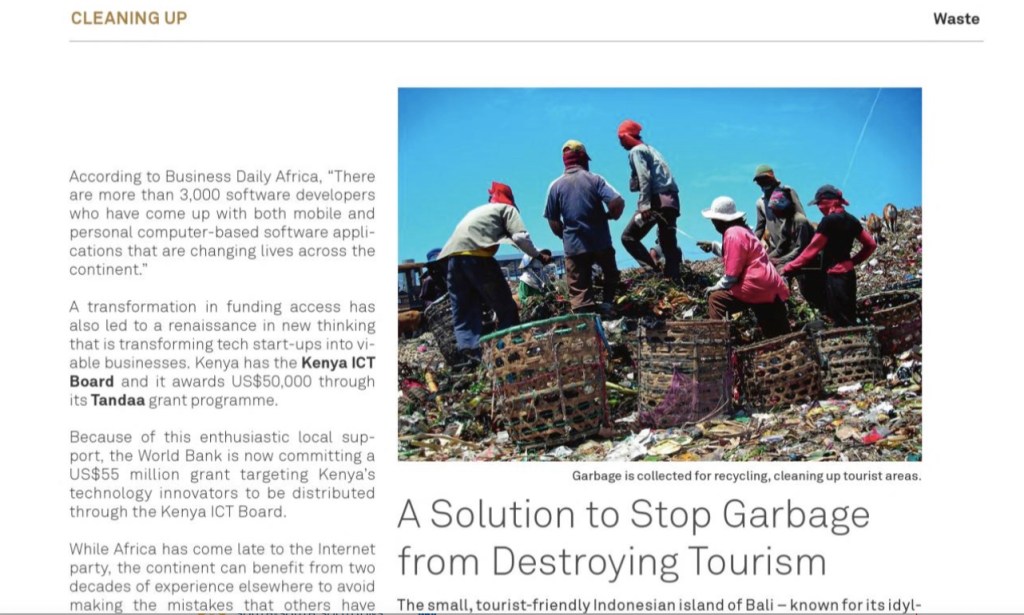
Tourism is an essential source of income for countries across the South. But many put that livelihood in jeopardy when they lose control of garbage collection. A popular tourist spot can represent a ‘paradise’ to visitors, but when it becomes too popular and local garbage collection systems collapse under the burden, ‘paradise’ can soon turn to an environmental hell.

The small, tourist-friendly Indonesian island of Bali (http://en.wikipedia.org/wiki/Bali) – known for its idyllic pleasures of spas, surf and serenity – is being overwhelmed by garbage. A survey of tourists found two-thirds would not return to the island because of the problem.

Tourism took off on the island in the 1970s. The economic benefits are clear: the island went from being economically marginal to ranking second only to the country’s capital, Jakarta, in wealth creation. The island received more than 2.38 million tourists in 2009, up 14.5 percent compared with 2008, according to Ida Komang Wisnu, head of the provincial statistics office. But tourism produces on average five kilograms of waste a day per tourist – 10 times what the average Indonesian produces (Bali Fokus).

In the past, the traditional way of serving food in Indonesia was to wrap it in, or serve it on, a palm leaf: a biodegradable approach. But with the huge expansion in use of plastics and non-biodegradable packaging, the waste disposal problem is out of control.

In Indonesia, government garbage disposal services tend to collect between 30 and 40 percent of solid waste, most of this from high income communities. The majority poor population are left to fend for themselves when it comes to waste disposal.

A solution by Yuyun Ismawati, an environmental engineer and consultant, has since 1996 focused on helping poor communities find ways to safely dispose of waste. In 2000, she started her own NGO – Bali Fokus (http://balifokus.asia/balifokus/) – and opened a waste management facility in the Bali village of Temesi. The recycling plant employs 40 people from the village, who sort garbage into recyclables, compost and residual waste. Income from the recycled waste and compost goes to helping local farmers.

She then expanded her concept to include households around Bali and elsewhere in Indonesia. She concentrated on housewives and targeted reducing the amount of household waste going to dump sites. A core team trains housewives in daily habits that separate waste and compost organic matter like vegetable and fruit scraps. Bali Fokus claims it has been able to reduce waste created by 50 percent in 500 homes. Some of the women sell their compost in local markets; recyclables are turned into sellable items.

From 2001 to 2003, Ismawati turned this approach into a replicable template called SANIMAS. By 2008, the SANIMAS template was being used in hundreds of communities across Indonesia.

Her solution to the deluge of tourist waste can be seen in the luxury Jimbaran Bay area of Bali. Traditionally, the area’s hotels would sell their waste to pig farmers. While the pigs feasted on the fancy scraps, the rest of the waste was put in plastic bags and thrown away in mangrove forests.

“I told hotels: Your job is to sell rooms, not to sell garbage,” Ismawati recalls. “We have to protect Bali or else tourists won’t want to come here anymore.”

Ismawati cleverly turned the relationship around: rather than a pig farmer paying for scraps, she convinced one of them there was money to be made recycling and sorting garbage. For this, the hotels would pay the farmer.

A network of 25 hotels now pays to have their garbage taken away and sorted by hand: an important source of full-time jobs.

The workers sort through paper, plastics, glass, aluminium, food scraps and vegetables. Each week, 140 trucks deliver waste to the facility. Only 10 leave with waste that has to go to a dump site.

Food leftovers are bought by local pig farmers and grass clippings and other organic matter is composted (http://www.recyclenow.com/home_composting/), and eventually makes its way back to the hotels and is distributed in the flower beds.

This system has created 400 jobs where the pig farmer once only employed 10 people.

“If you want a hi-tech solution in a developing country you will wait and wait and wait until you get the money, or big donors to fund it,” Ismawati told the Telegraph newspaper. “And even then it may not work.”

A graphic example of this is a donated waste recycling machine given by the local government. It can’t be used because the electricity to power it costs too much. Human labour is a cheaper option.

Bali Fokus’ successful approach has now been replicated in six other sites on the nearby island of Java. And the government of Indonesia has promised to help create 15 more each year.

In 2009 Ismawati won the Goldman Award (http://www.goldmanprize.org/), which honors grassroots environmental heroes from the six inhabited continental regions: Africa, Asia, Europe, Islands and Island Nations, North America, and South and Central America.

She is also working on using decentralized grassroots approaches to bringing sewage disposal and clean water to communities.

Published: March 2010

Resources

https://davidsouthconsulting.org/2022/11/19/african-culture-as-big-business/

https://davidsouthconsulting.org/2022/10/20/african-tourism-leads-the-world-and-brings-new-opportunities/

https://davidsouthconsulting.org/2022/10/20/africas-tourism-sector-can-learn-from-asian-experience/

https://davidsouthconsulting.org/2022/11/18/bolivia-grabs-world-media-attention-with-salt-hotel/

https://davidsouthconsulting.org/2022/02/07/boosting-tourism-in-india-with-surfing-culture/

https://davidsouthconsulting.org/2022/09/27/caribbean-island-st-kitts-goes-green-for-tourism/

https://davidsouthconsulting.org/2022/11/20/ecotourism-to-heal-the-scars-of-the-past/

https://davidsouthconsulting.org/2022/11/21/from-warriors-to-tour-guides/

https://davidsouthconsulting.org/2022/11/11/havanas-restaurant-boom-augers-in-new-age-of-entrepreneurs/

https://davidsouthconsulting.org/2022/11/15/indonesia-best-for-entrepreneurs/

https://davidsouthconsulting.org/2022/11/01/indonesian-food-company-helps-itself-by-making-farmers-more-efficient/

https://davidsouthconsulting.org/2022/11/15/indonesian-middle-class-recycle-wealth-back-into-domestic-economy/

https://davidsouthconsulting.org/2021/06/11/indonesian-wooden-radio-succeeds-with-good-design/

https://davidsouthconsulting.org/2022/11/23/kenyan-safari-begins-minutes-from-airport/

https://davidsouthconsulting.org/2022/10/26/south-gets-reading-bug-with-more-festivals/

https://davidsouthconsulting.org/2021/03/05/southern-innovator-issue-2/

https://davidsouthconsulting.org/2021/03/05/southern-innovator-issue-5/

https://davidsouthconsulting.org/2022/11/18/tourist-passion-for-quirky-holidays-helps-south/

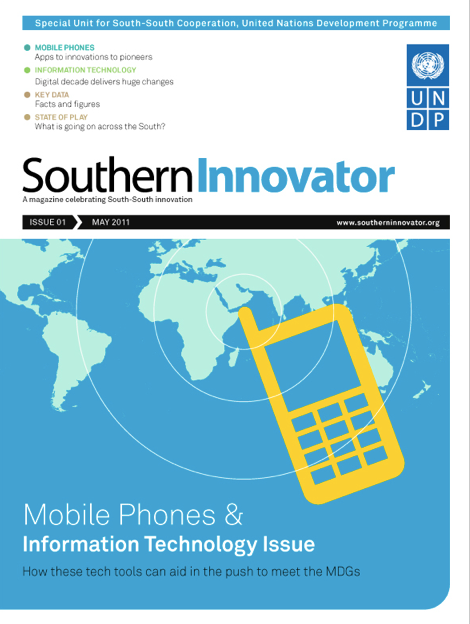
Development Challenges, South-South Solutions was launched as an e-newsletter in 2006 by UNDP’s South-South Cooperation Unit (now the United Nations Office for South-South Cooperation) based in New York, USA. It led on profiling the rise of the global South as an economic powerhouse and was one of the first regular publications to champion the global South’s innovators, entrepreneurs, and pioneers. It tracked the key trends that are now so profoundly reshaping how development is seen and done. This includes the rapid take-up of mobile phones and information technology in the global South (as profiled in the first issue of magazine Southern Innovator), the move to becoming a majority urban world, a growing global innovator culture, and the plethora of solutions being developed in the global South to tackle its problems and improve living conditions and boost human development. The success of the e-newsletter led to the launch of the magazine Southern Innovator.  
Creative Commons License

This work is licensed under a
Creative Commons Attribution-Noncommercial-No Derivative Works 3.0 License.

ORCID iD: https://orcid.org/0000-0001-5311-1052.

© David South Consulting 2023

Categories
Archive Development Challenges, South-South Solutions Newsletters Southern Innovator magazine

African Technology Tackles Health Needs

By David SouthDevelopment Challenges, South-South Solutions

SOUTH-SOUTH CASE STUDY

Africa is becoming a world leader in mobile phone applications for health and healthcare. Despite dramatic improvements to the quality of hospitals and the number of qualified doctors, the continent’s healthcare services are still a patchwork, with rural and slum dwellers poorly served and the stresses of treating patients with contagious diseases like HIV/AIDS and malaria pushing resources to the limit.

But innovative inventions are coming along to provide new tools to doctors and medical personnel and to better engage patients with remote services.

South Africa’s Afridoctor (http://twitter.com/afridoctor) mobile phone application claims to be Africa’s first personal mobile health clinic. It lets patients use its “SnapDiagnosis” system to submit photos of their ailments and in turn receive advice from a panel of medical professionals, or use the mapping feature to find doctors, clinics and health industry-related services nearby.

Afridoctor was conceived to fill the gap across Africa for basic health information that is reliable and trustworthy.

There is an emergency feature to notify next of kin during a medical emergency and provide a location. Other features include symptom checkers, first-aid information, health calculators and quizzes.

Expert feedback comes within 48 hours after submission of a request.

A winner of a Nokia competition, Afridoctor was developed by the labs of media company 24.com (http://20fourlabs.com) of Cape Town, South Africa.

“It is more for external use – like dermatology – for things like a bee sting or a snake bite and you don’t know what to do or how to diagnose it,” Werner Erasmus, who created the app, told the BBC.

The “find a doctor” system uses Google Maps to geo-locate local health services including doctors, hospitals and emergency clinics.

The distress feature enables users to contact a family member or friend at the touch of a button. It does this by storing the mobile phone number of a selected relative. When the distress button is pressed, they are notified of the phone’s location.

Developed in just three weeks, to enter mobile phone company Nokia’s contest (http://www.callingallinnovators.com) for mobile phone applications, Afridoctor went on to win the competition in 2009. It is now being expanded to be usable on most, if not all, smart phones.

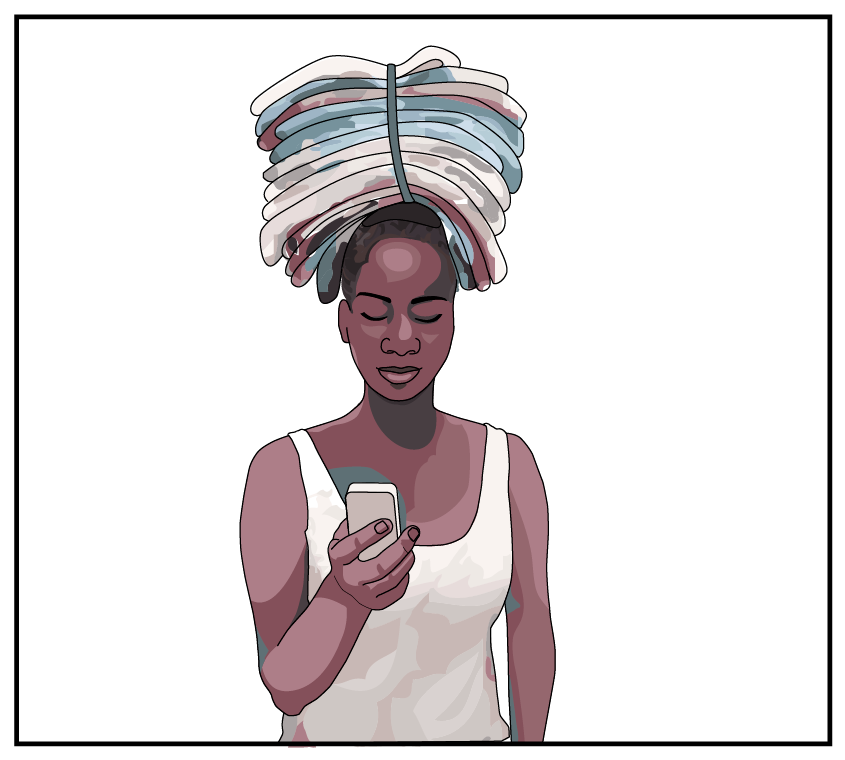
As in the rest of Africa, mobile phone use in South Africa has dramatically increased in the past 10 years. It is estimated that over 70 percent of South Africans now have access to one.

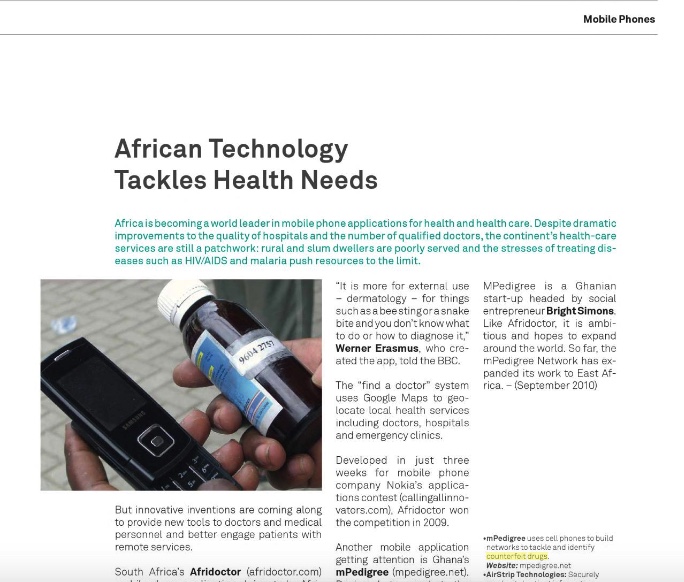
Another application getting attention is Ghana’s mPedigree (http://mpedigree.net). Designed to combat the damage done by counterfeit drugs in Africa and across the South, mPedigree works by letting a person send a text message by mobile phone to the mPedigree service to check a drug’s authenticity. A message comes back confirming whether the medicine is authentic or not.

The World Health Organization (WHO) has estimated that 25 percent of medicines sold around the developing world are counterfeit. Some contain no active ingredients, and others are even harmful.

MPedigree is a Ghanian start-up headed by social entrepreneur Bright Simons (http://www.worldpress.org/freelancers/index.cfm/hurl/page=freelancerDetails/id=7). Like Afridoctor, it is ambitious and hopes to expand around the world. So far, the mPedigree Network has expanded its work to East Africa.

Published: September 2010

Resources

Development Challenges, South-South Solutions was launched as an e-newsletter in 2006 by UNDP’s South-South Cooperation Unit (now the United Nations Office for South-South Cooperation) based in New York, USA. It led on profiling the rise of the global South as an economic powerhouse and was one of the first regular publications to champion the global South’s innovators, entrepreneurs, and pioneers. It tracked the key trends that are now so profoundly reshaping how development is seen and done. This includes the rapid take-up of mobile phones and information technology in the global South (as profiled in the first issue of magazine Southern Innovator), the move to becoming a majority urban world, a growing global innovator culture, and the plethora of solutions being developed in the global South to tackle its problems and improve living conditions and boost human development. The success of the e-newsletter led to the launch of the magazine Southern Innovator.  
Creative Commons License

This work is licensed under a
Creative Commons Attribution-Noncommercial-No Derivative Works 3.0 License.

ORCID iD: https://orcid.org/0000-0001-5311-1052.

© David South Consulting 2023

Categories
Archive Development Challenges, South-South Solutions Newsletters Southern Innovator magazine

Cool Food for the Poor

By David SouthDevelopment Challenges, South-South Solutions

SOUTH-SOUTH CASE STUDY

A whole wave of high-tech, innovative products are now being developed and marketed for the world’s poor. These products are designed to raise the quality of life of poor people and treat them as a market with real needs, rather than a mass of people to be ignored.

One of the major challenges of the 21st century is finding ways to make these products affordable for the poor – bringing significant development gains in health and quality of life – without increasing the burden on the world’s environment. In India, this vast new market is rapidly coming alive, with new marketing channels reaching deep into the country’s slums and aided by a lively media scene turning people on to new products.

India is turning its large number of well-trained engineers and product designers to the task of making relevant products for the country’s millions of rural poor.

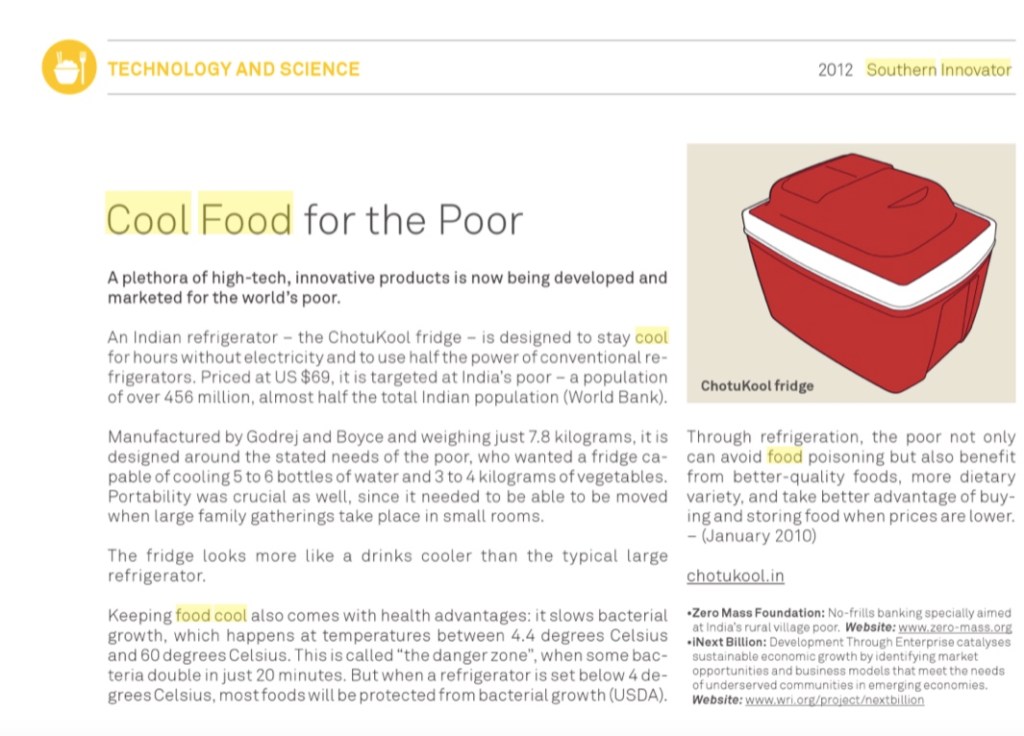
An Indian refrigerator – the ChotuKool fridge (http://www.new.godrej.com/godrej/godrej/index.aspx?id=1) – is designed to stay cool for hours without electricity and to use half the power of conventional refrigerators. Priced at US $69, it is targeted at India’s poor – a population of over 456 million, almost half the total Indian population (World Bank).

Manufactured by Godrej and Boyce and weighing just 7.8 kilograms, it is designed around the stated needs of the poor, who wanted a fridge capable of cooling 5 to 6 bottles of water and 3 to 4 kilograms of vegetables. Portability was crucial as well, since it needed to be moved when large family gatherings take place in small rooms.

As a video shows (http://www.youtube.com/watch?v=dtCRlynp0bM), the fridge looks more like a drinks cooler than the typical large refrigerator. It works by replacing the standard compressor motor found in most fridges with a battery-powered heat exchanger.

A group of village women was involved in the design process from the beginning. The fridges are being distributed by a microfinance group.

While people in developed countries take it for granted they will have both a refrigerator and a steady supply of electricity, the world’s poor have few options for keeping food cool.

There is a strong economic advantage to refrigeration: many farmers have to throw away vegetables or sell at high discounts because they are quickly spoiling in the heat. By refrigerating, they can keep them fresh and get the higher price. For somebody living on less than US $2 a day, this is a big economic boost.

Keeping food cool also comes with health advantages: it slows bacterial (http://en.wikipedia.org/wiki/Bacteria) growth, which happens at temperatures between 4.4 degrees Celsius and 60 degrees Celsius. This is called ‘the danger zone’, when some bacteria double in just 20 minutes. But when a refrigerator is set below 4 degrees Celsius, most foods will be protected from bacteria growth (USDA).

Through refrigeration, the poor not only can avoid food poisoning, but also benefit from better quality foods, more dietary variety, and better take advantage of buying and storing food when prices are lower. For example, eggs in a refrigerator can last for up to five weeks. Fresh fish can be stored unfrozen for up to two days.

The quality of life improvements from refrigeration are obvious. But with conventional refrigerators costly and dependent on a steady supply of electricity, the poor will not buy them.

An Indian government survey in 2007/08 found daily pay in rural areas ranged from 45 rupees a day (US $1) to 110 rupees a day (US $2.40). This means the ChotuKool fridge costs between one and two month’s wages for a rural worker.

Some argue even the cost of the ChotuKool is still too prohibitive to many poor people. And there are other initiatives out there to offer low-tech solutions to cooling food.

In Nigeria, grassroots inventor Mohammed Bah Abba has designed a cooler called the Zeer (http://practicalaction.org/?id=zeerpots). It works like this: two ceramic earthenware pots of different sizes are arranged one inside the other. The space between the pots is filled with wet sand and kept moist. The user then places their drinks or vegetables inside and covers with a damp cloth. As the water from the moist sand evaporates (http://en.wikipedia.org/wiki/Evaporation), the air inside the centre pot is cooled several degrees, enough to preserve some foods and drinks.

Another Indian innovation is also targeting the rural poor consumer: a water filter. Called the Swach water purifier (http://www.tata.com/article.aspx?artid=TtOdcdNuSRk=), it is aimed at households and stands just less than 1 metre (just over 3 feet) in height. The filter is designed to do bulk water purification and is the result of 10 years’ research. It is aimed at the one billion people in the world who do not have access to clean water. It will sell for 1,000 rupees (US $21.50).

It is very slick and modern in design, with a mix of white and clear plastic, resembling the commonly used Brita (http://www.brita.net/) water filters found in many homes. It works by using ash from rice milling to filter out bacteria. The ash is impregnated with silver particles to kill germs that cause diarrhoea, cholera and typhoid. It is able to purify 3,000 litres of water before the cartridge needs to be replaced.

It is manufactured by the Indian industrial giant Tata.

“It was the pressing need of people trapped by the effects of natural disasters such as the (2004 Indian Ocean) tsunami that saw the deployment of one of the earliest versions of this product,” said Tata vice chairman S. Ramadorai. “A key part was the insight that a natural material like rice husk can be processed to significantly reduce water-borne germs and odours when impure water is passed through it.”

Published: January 2010

Resources

1) Indian Firms Shift Focus to the Poor: An article in the Wall Street Journal on this new trend. Website: http://online.wsj.com/article/SB125598988906795035.html?mod=relevancy

2) Zero Mass Foundation: No-frills banking specially aimed at India’s rural village poor. Website: http://www.zero-mass.org/

3) iNext Billion: Development Through Enterprise catalyzes sustainable economic growth by identifying market opportunities and business models that meet the needs of underserved communities in emerging economies. Website: http://www.wri.org/project/nextbillion

Development Challenges, South-South Solutions was launched as an e-newsletter in 2006 by UNDP’s South-South Cooperation Unit (now the United Nations Office for South-South Cooperation) based in New York, USA. It led on profiling the rise of the global South as an economic powerhouse and was one of the first regular publications to champion the global South’s innovators, entrepreneurs, and pioneers. It tracked the key trends that are now so profoundly reshaping how development is seen and done. This includes the rapid take-up of mobile phones and information technology in the global South (as profiled in the first issue of magazine Southern Innovator), the move to becoming a majority urban world, a growing global innovator culture, and the plethora of solutions being developed in the global South to tackle its problems and improve living conditions and boost human development. The success of the e-newsletter led to the launch of the magazine Southern Innovator.  

Creative Commons License

This work is licensed under a
Creative Commons Attribution-Noncommercial-No Derivative Works 3.0 License.

ORCID iD: https://orcid.org/0000-0001-5311-1052.

© David South Consulting 2023