Categories
Archive Development Challenges, South-South Solutions Newsletters

South Gets Reading Bug with more Festivals

By David SouthDevelopment Challenges, South-South Solutions

SOUTH-SOUTH CASE STUDY

There is no better indicator of significant economic progress than the rise and rise of book festivals across the South. These symbols of intellectually curious and globally aware middle classes are also boosting economies and contributing to a bigger, more sophisticated creative economy – something that will drive future growth across many sectors.

The trend is most advanced in Asia, where according to the OECD, “large numbers of Asians are expected to become middle class in the next 10 years” (OECD Working Paper No. 285). But the rising middle class can also be found across the South – and so can the new book festivals.

According to Sanjoy Roy, managing director of New Delhi-based festival producer Teamwork Productions (www.teamworkfilms.com) ,” India’s rising economic growth has ensured that the great middle class is happy to travel and to spend.”

“More and more Indians are taking to tourism both local and international. India’s large middle-aged upper middle class and wealthy sector feeds occasions like the literature festival, ensuring attendance, making it a word of mouth must-be-seen, must-attend occasion on the social season calendar.”

Recognition of the importance of this trend can be seen in the recent growth in book festivals associated with the Hay Festival (www.hayfestival.com) based in Hay-on-Wye, Wales. There are now Hay festivals in Beirut, Lebanon; Bogota and Cartagena, Colombia; Zacatecas, Mexico; Nairobi, Kenya; the Maldives; and the Indian state of Kerala.

The festivals are part of the powerful global creative economy, which is seen as the “interface between creativity, culture, economics and technology in a contemporary world dominated by images, sounds, texts and symbols” (UNCTAD). The cultural sector has been shown to be an effective way for emerging economies to leapfrog into high-growth areas in the 21st century world economy.

Roy also confirms the economic impact of book festivals. He produces India’s Jaipur Literature Festival (www.jaipurliteraturefestival.org) , which attracted over 32,000 visitors this year. The hard numbers show the economic impact of the event: “Approximately 3,000 room nights were booked by visitors during this period at an average of US $100 per night,” Roy said. “Our own spend in Jaipur during this period was approximately US $500,000. Shopping, meals and transport spend I would peg at between US $200,000 and US $300,000.”

The OECD defines the global middle class as those living in households with daily per capita incomes of between US$10 and US$100. It calculates that Asia accounts for less than one-quarter of today’s middle class, but says that share could double by 2020. Within a decade, “more than half of the world’s middle class could be in Asia and Asian consumers could account for over 40 per cent of global middle class consumption.”

The World Bank takes an even more optimistic view, seeing this burgeoning middle class’ spending power as being triggered once people get out of the desperation of a subsistence existence. This means the “developing world’s middle class is defined as those who are not poor when judged by the median poverty line of developing countries, but are still poor by US standards. The “Western middle class” is defined as those who are not poor by US standards.” Although barely 80 million people in the developing world entered the Western middle class over 1990-2002, it found an extra 1.2 billion people joined the developing world’s middle class. Four-fifths came from Asia, and half from China (World Bank).

With the rise of the creative sector, significant innovation will come from the global South, according to the director of the Hay Festival, Peter Florence.

“The digital revolution will be absolutely essential to developing countries,” he told the Associated Press. “They are going to skip two levels of publishing industry tradition. The mobile phone is more important for writers in those societies than pen and paper is. That is a very interesting continuation of oral culture. At the same time the West has decided to start moving from audio editions to digital downloads, oral culture is just moving straight into digital culture in many places around the world.”

The impact of a growing middle class can be seen in fast-growing India, which is forecast to become the largest market for English language books within a decade.

A survey by Tehelka (www.tehelka.com) found Indians favour stories about local conditions and set in the places where they live.

India’s most popular current writer is Chetan Bhagat, a former investment banker. He has sold more than 3 million books in the last five years. His latest, Two States, sold a million copies in four months.

Bhagat writes about the country’s aspiring middle class. His publisher, Rupa (www.rupapublications.com/Client/home.aspx) , believes he appeals to a “pan-Indian, pan-age group.”

For Roy, it is still too early to tell how the new Hay Kerala festival in the state capital, Thiruvananthapuram, will affect the economy of the area (the first one is from November 12 to 14, 2010).

“In the long term we hope this too becomes like Jaipur, attracting an international and national audience from outside the state,” he said. “Kerala has a robust economy. What it may do is increase the total tourist influx into the city and divert some of the annual Goa traffic to its own benefit.”

Roy says the Hay Festival Kerala will follow the programming pattern of other Hay festivals, combining international authors with a strong local flavour.

“India is celebrating its golden age in the creative arts and literature not just in English but across all official and subsidiary Indian languages,” he said. “The depth, scope, extent and range of writing in both fiction and non-fiction is incredible.”

Drawing on his success with the festival in Jaipur, Roy has advice for others in the South looking for creative economy success.

“It’s all about location, location, location,” he said. “A festival city like that of Cannes, Venice, Edinburgh, Avignon, Hay are special. Choose the right location, be inclusive and bring the local community on board and have the power to sustain – and in due course with a strong programming base, the festival will grow.

“Every festival will have its own learning (curve) and those who take these on board will find it easier to be successful.”

Published: June 2010

Resources

Development Challenges, South-South Solutions was launched as an e-newsletter in 2006 by UNDP’s South-South Cooperation Unit (now the United Nations Office for South-South Cooperation) based in New York, USA. It led on profiling the rise of the global South as an economic powerhouse and was one of the first regular publications to champion the global South’s innovators, entrepreneurs, and pioneers. It tracked the key trends that are now so profoundly reshaping how development is seen and done. This includes the rapid take-up of mobile phones and information technology in the global South (as profiled in the first issue of magazine Southern Innovator), the move to becoming a majority urban world, a growing global innovator culture, and the plethora of solutions being developed in the global South to tackle its problems and improve living conditions and boost human development. The success of the e-newsletter led to the launch of the magazine Southern Innovator. 

Creative Commons License

This work is licensed under a
Creative Commons Attribution-Noncommercial-No Derivative Works 3.0 License.

ORCID iD: https://orcid.org/0000-0001-5311-1052.

© David South Consulting 2023

Categories
Archive Development Challenges, South-South Solutions Newsletters Southern Innovator magazine

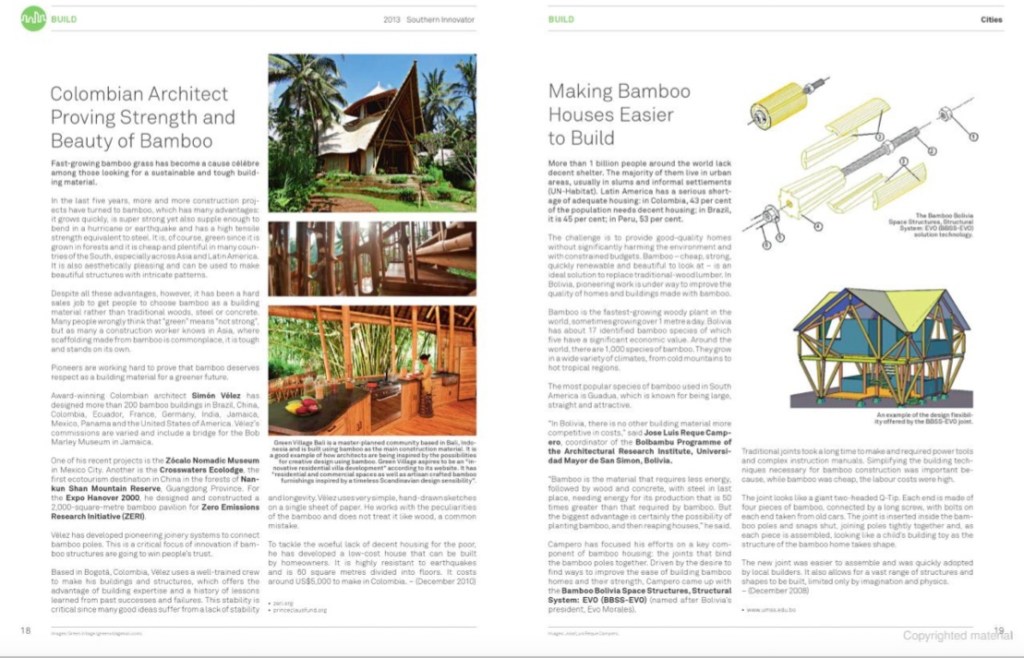
Colombian Architect Proving Strength and Beauty of Bamboo

By David SouthDevelopment Challenges, South-South Solutions

SOUTH-SOUTH CASE STUDY

Fast-growing bamboo grass (http://en.wikipedia.org/wiki/Bamboo) has become a cause celebre amongst those looking for a sustainable and tough building material.

In the last five years, more and more construction projects have turned to bamboo. It has many advantages: it grows quickly, is super-strong yet also supple enough to bend in a hurricane or earthquake and has a high tensile strength (http://en.wikipedia.org/wiki/Ultimate_tensile_strength) equivalent to steel. It is, of course, green since it is grown in forests, and is cheap and plentiful in many countries of the South, especially across Asia and Latin America.

It is also aesthetically pleasing and makes beautiful structures with intricate patterns.

But despite all these advantages, it has been a hard sales job to get people to choose bamboo as a building material rather than traditional woods, steel or concrete. Many people wrongly think green means not strong. But as many a construction worker knows in Asia, where scaffolding made from bamboo is commonplace, it is tough and stands on its own.

Pioneers are working hard to prove bamboo deserves respect as a building material for a greener future.

Award-winning Colombian architect Simón Vélez has designed more than 200 bamboo buildings in Germany, France, the United States, Brazil, Mexico, China, Jamaica, Colombia, Panama, Ecuador, and India.

Vélez’s commissions are varied, and include a bridge for the Bob Marley Museum in Jamaica.

One of his recent projects is the Zócalo Nomadic Museum (http://en.wikipedia.org/wiki/Nomadic_Museum) in Mexico City. Another is the Crosswaters Ecolodge (http://www.asla.org/2010awards/370.html), the first ecotourism destination in China in the forests of Nankun Shan Mountain Reserve, Guangdong Province. For the Expo Hanover 2000, he designed and constructed a 2000-square-meter bamboo pavilion for ZERI (Zero Emissions
Research Initiative) (http://www.zeri.org/).

Vélez has developed pioneering joinery systems to connect bamboo poles together. This is a critical focus of innovation if bamboo structures are going to win people’s trust.

Based in Bogotá, Colombia, Vélez uses a well-trained crew to make his buildings and structures. This has the advantage of building expertise and a history of lessons learned from past successes and failures. That stability is a critical insight: many good ideas suffer from a lack of stability and longevity. He uses very simple, hand-drawn sketches on a single sheet of paper. He works with the peculiarities of the bamboo and does not treat it like wood: a common mistake.

To tackle the woeful lack of decent housing for the poor, he has developed a low-cost house that can be built by home-owners. It is highly resistant to earthquakes and is 60 square metres divided on two floors. It costs
around US $5,000 to make in Colombia.

Winner of the Prince Claus Fund (http://www.princeclausfund.org/en/index.html), Vélez’s work promotes sustainable development, introducing new ideas on ecological issues and questions. The Fund calls him an architect “whose aesthetic and technical innovations have considerably expanded the possibilities of bamboo as a building material, providing a challenge to prevailing architectural trends.”

With more than 1 billion people around the world lacking decent shelter, many see plentiful bamboo as a key part of the solution. Most people with poor quality housing live in urban areas, usually in slums and informal settlements (UN-HABITAT). Latin America has a serious shortage of adequate housing: in Colombia, 43 percent of the population needs decent housing; in Brazil, 45 percent; Peru, 53 percent.

The challenge is to provide good quality homes without significantly harming the environment – and with constrained budgets. Bamboo – cheap, strong, quickly renewable and beautiful – is an ideal solution to replace traditional wood lumber.

Bamboo is the fastest growing woody plant in the world, sometimes growing over 1 metre a day. Around the world, there are 1,000 species of bamboo. They grow in a wide variety of climates, from cold mountains to hot tropical regions.

Once called the “poor man’s timber” – a temporary building material to replace once there is more money – bamboo is now getting the respect it deserves. Bamboo for housing has a long history in Latin America, stretching back 4,500 years to ancient civilizations. In Asia, it has long been a traditional construction material. But most of the existing bamboo dwellings in Latin America are 50 to 100 years old.

The most popular species of bamboo used in South America is Guadua, which is known for being large, straight and attractive.

Thoughtful and methodical pioneers like Vélez are proving bamboo has a viable future as a building material that will tackle the housing needs of the world’s poor and the fast-growing cities of the South.

Published: December 2010

Resources

Development Challenges, South-South Solutions was launched as an e-newsletter in 2006 by UNDP’s South-South Cooperation Unit (now the United Nations Office for South-South Cooperation) based in New York, USA. It led on profiling the rise of the global South as an economic powerhouse and was one of the first regular publications to champion the global South’s innovators, entrepreneurs, and pioneers. It tracked the key trends that are now so profoundly reshaping how development is seen and done. This includes the rapid take-up of mobile phones and information technology in the global South (as profiled in the first issue of magazine Southern Innovator), the move to becoming a majority urban world, a growing global innovator culture, and the plethora of solutions being developed in the global South to tackle its problems and improve living conditions and boost human development. The success of the e-newsletter led to the launch of the magazine Southern Innovator. 

Creative Commons License

This work is licensed under a
Creative Commons Attribution-Noncommercial-No Derivative Works 3.0 License.

ORCID iD: https://orcid.org/0000-0001-5311-1052.

© David South Consulting 2023
Categories
Archive Development Challenges, South-South Solutions Newsletters

Many Positive Trends for Africa in 2010

By David SouthDevelopment Challenges, South-South Solutions

SOUTH-SOUTH CASE STUDY

While 2009 saw the global economic crisis spread around the world, the story is more complex and more hopeful than many believe. For Africa, various trends are pointing to positive economic development in 2010, despite the continent’s numerous political, social and environmental challenges. Pragmatism is driving stronger economic ties between Africa and the rest of the world, while long-running trends are delivering opportunity to millions despite setbacks.

The Standard Chartered bank (http://research.standardchartered.com/Pages/home.aspx) believes sub-Saharan Africa will jolt itself out from the 1 percent growth it had in 2009, to reach 4.7 percent growth in 2010 and 5.7 percent in 2011 (http://research.standardchartered.com/researchdocuments/Pages/ResearchArticle.aspx?&R=66952). The reason? The world’s strong appetite for commodities and food, which will continue to draw in business. And much of this business will be done by that powerhouse of the global South, China.

The fact that China is trading better infrastructure – roads, rail and ports – for commodities means other businesses can also benefit from the improving environment. Throughout the downturn in 2009, China actually increased its investments in Africa.

The United States is also trying to increase its economic relationship with Africa. It wants a third of its oil imports to come from West Africa by 2015.

And the competition for food in the world, as countries address the global food crisis, has seen companies from the Middle East to Asia to Britain purchasing land in Africa to grow more food.

The Annansi Chronicles blog on African business and culture trends (www.annansi.com) has come up with a list of the big trends to watch out for on the continent in 2010. They build upon many of the patterns that have emerged in the past few years in Africa.

The blog predicts that Africa will increasingly be an innovation incubator. Concepts like the bottom of the pyramid – where the poor are seen as an unserved marketplace of needs – will draw more private companies in to innovate new products and services. Already, products and services trialled in Africa are then launched in other places in the world. One example has been mobile phone banking. The blog sees the challenge for Africa as finding ways to increase innovation and harness its economic benefits within the continent, and to direct resources to the African pioneers out there who need money and infrastructure support to grow their ideas.

Mobile phones will continue to be the source of opportunity in Africa in 2010. Get ready for more businesses to take advantage of the move from analog to digital in Africa, as fibre optic cables continue to expand. Just as the introduction of broadband internet in developed countries gave birth to new businesses like You Tube (www.youtube.com), so it will create new opportunities in Africa. The key to growing the prosperity from this is to see governments and the private sector better connect with African technology pioneers, as can be found in hot spot countries like Ghana.

Along with technology comes content. And the people to make the content interesting and attractive will be Africa’s so-called ‘creative class’: savvy young African entrepreneurs and thinkers. They have drawn on the rising urbanization of the continent and greater international travel to explore new ways of representing African culture. This has come forward in the explosion in media, fashion, music and design. The blog believes the 2010 FIFA World Cup in South Africa (http://www.fifa.com/worldcup) is going to thrust the world’s attention on to Africa’s creative class: a global media burst that will be an opportunity not to be missed.

And this will also challenge global perceptions of “brand Africa.” Already, the world’s tourists flow to Africa in greater numbers, defying decades of negative media publicity. Brand Africa will be up for grabs in 2010.

And finally, while China has been the big story in terms of economic investment in Africa, India will start to make more moves to catch up by flexing its information technology muscles. Look for more joint partnerships between African countries and Indian technology companies.

In short, Africa has as many positive trends for 2010 as negative ones. It is just a matter of focusing on the good so the negative will not have a fighting chance in 2010.

Published: January 2010

Resources

1) Design Indaba: See the latest on the catwalks in all-day fashion shows; attend short films, talks and product launches; be enticed to buy from more than 260 exhibitors and hobnob with the designers in person. Above all, be awed by the creative spirit of innovative South Africans. Website: http://www.mobileactive.org

2) Maker Faire Africa: African pioneers in grassroots innovation offer inspiring inventions. Website: http://makerfaireafrica.com/

3) Arise Africa Fashion Week: The place to be seen and to see. Website: http://www.africanfashioninternational.com/africaFashionWeek/

https://davidsouthconsulting.org/2020/12/15/development-challenges-south-south-solutions-newsletter-2007-2010-2/

https://davidsouthconsulting.org/2022/11/29/new-magazine-13-october-2010/

https://davidsouthconsulting.org/2022/11/28/new-website-on-the-way-16-september-2010/

https://davidsouthconsulting.org/2022/12/01/off-to-the-printers-with-a-new-name-southern-innovator-14-may-2010/

https://davidsouthconsulting.org/2022/11/01/southern-innovator-magazine-2010-2014/

https://davidsouthconsulting.org/2021/02/22/team-southern-innovator-phase-1-development-2010-2015/

https://davidsouthconsulting.org/2021/10/28/2010-development-challenges-south-south-solutions/

https://davidsouthconsulting.org/2022/10/25/2011-trends-for-the-south/

Development Challenges, South-South Solutions was launched as an e-newsletter in 2006 by UNDP’s South-South Cooperation Unit (now the United Nations Office for South-South Cooperation) based in New York, USA. It led on profiling the rise of the global South as an economic powerhouse and was one of the first regular publications to champion the global South’s innovators, entrepreneurs, and pioneers. It tracked the key trends that are now so profoundly reshaping how development is seen and done. This includes the rapid take-up of mobile phones and information technology in the global South (as profiled in the first issue of magazine Southern Innovator), the move to becoming a majority urban world, a growing global innovator culture, and the plethora of solutions being developed in the global South to tackle its problems and improve living conditions and boost human development. The success of the e-newsletter led to the launch of the magazine Southern Innovator. 

Creative Commons License

This work is licensed under a
Creative Commons Attribution-Noncommercial-No Derivative Works 3.0 License.

ORCID iD: https://orcid.org/0000-0001-5311-1052.

© David South Consulting 2023

Categories
Archive Development Challenges, South-South Solutions Newsletters Southern Innovator magazine

Kenyan Products a Global Success Story

By David SouthDevelopment Challenges, South-South Solutions

SOUTH-SOUTH CASE STUDY

The East African nation of Kenya has become synonymous with high-quality agricultural products, and offers lessons for other countries across the South. The country has been able to combine innovation in new technologies (it is a pioneer in mobile phone applications like m-banking), with quality control for its products like the Coffee Kenya Brand logo (http://www.coffeeboardkenya.org) and ease of access to information on Kenyan products and resources via the internet – crucial to drumming up international business – like the SME Toolkit Kenya (http://kenya.smetoolkit.org/kenya/en) .

There are several advantages to improving standards and productivity in agricultural products in Africa. The first is regional: greater productivity and efficiency will help in reducing malnutrition and food crises that have plagued the continent for decades. Secondly, it also allows Africa to export food to other countries with fast-growing economies and boost the continent’s wealth.

The dramatic changes taking place in African countries – especially rapid urbanization that has made the continent home to 25 of the world’s fastest growing cities (International Institute for Environment and Development) – means there is an urgent need to increase food production and stabilize rural economies to support farming.

Kenya is considered home to one of the continent’s most successful agricultural production zones, with multiple agricultural products and brands developing a solid global reputation for quality.

The country benefits from the fertile Great Rift Valley (http://en.wikipedia.org/wiki/Great_Rift_Valley) , where the country’s biggest crops – tea and coffee – are grown.

Agriculture is a key part of Kenya’s economy: 75 percent of the working population is employed in the sector. Farming sits behind tourism as the country’s second biggest contributor – 20 percent – to the gross domestic product (GDP).

Kenya has had a great deal of success with fruits, vegetables and flowers (Kenyan flowers are a mainstay of many European supermarkets). Kenya has been able to achieve this by using well the 10 percent of the country’s land that is suitable for farming.

Around Mount Kenya (http://en.wikipedia.org/wiki/Mount_Kenya) , the cool and wet climate is perfect for farming tea, coffee, flowers, vegetables, corn and sisal. Other products that have been successfully grown include sugar cane, pineapple, cashew nuts, cotton, and livestock-related products – dairy goods, meat, hides and skins.

Kenya’s main export markets are the United Kingdom, the Netherlands, Pakistan and the United States. This agricultural export success has had a knock-on effect of reinforcing a global reputation as one of Africa’s best countries for business.

In the tea market, James Finlay and Williamson have a strong reputation and sell to major supermarkets in the UK.

Another successful tea company is Kenya Tea Packers Limited (Ketepa) (http://www.ketepa.com) . A Kenyan-owned company, it enhances the standard of living of the small scale tea growers of Kenya who are the bulk of its shareholders.

Kenya is one of the world’s top 20 coffee producers and has a good reputation for its Arabica beans. Kenya produces 2 million bags of coffee a year and the coffee industry employs 6 million people (www.coffeeboardkenya.org) .

When it comes to exporting flowers (http://www.kenyan-flowers.com) , Kenya is a global powerhouse: 38 percent of the world’s exported flowers are grown there. The majority – 97 percent – are sent to the European Union. Its popular flowers include chrysanthemums, roses and carnations. This time-sensitive crop benefits from the air links of its capital, Nairobi.

Kenya even has a successful brand of beer, Tusker Lager (http://www.tuskerlager.co.uk) . It is a leading export and is proudly African, with its elephant logo and motto “My beer, my country.” It has a large market in the United Kingdom.

Published: June 2010

Resources

  • Small businesses looking to develop their brand can find plenty of free advice and resources here. Website: www.brandingstrategyinsider.com
  • Brandchannel: The world’s only online exchange about branding, packed with resources, debates and contacts to help businesses intelligently build their brand. Website: www.brandchannel.com
  • Just Food is a web portal packed with the latest news on the global food industry and packed with events and special briefings to fill entrepreneurs in on the difficult issues and constantly shifting market demands. Website: www.just-food.com
  • World Vegetable Center: The World Vegetable Center is the world’s leading international non-profit research and development institute committed to alleviating poverty and malnutrition in developing countries through vegetable research and development. Website: www.avrdc.org
  • Marketing African Leafy Vegetables: Challenges and Opportunities in the Kenyan Context By Kennedy M. Shiundu and Ruth. K. Oniang. Website: http://www.ajfand.net/Issue15/PDFs/8%20Shiundu-IPGR2_8.pdf
  • Olam: A global food supply company in ‘agri-products’ that got its start in Nigeria – shows how a Southern brand can grow and go global, and overcome the difficulties of cross-border trade. Website: www.olamonline.com
  • Dutch Design in Development will help Southern entrepreneurs and small enterprises to develop their brand and design identity and production processes by using experienced Dutch designers. Website: www.ddid.nl/english/index.html

Development Challenges, South-South Solutions was launched as an e-newsletter in 2006 by UNDP’s South-South Cooperation Unit (now the United Nations Office for South-South Cooperation) based in New York, USA. It led on profiling the rise of the global South as an economic powerhouse and was one of the first regular publications to champion the global South’s innovators, entrepreneurs, and pioneers. It tracked the key trends that are now so profoundly reshaping how development is seen and done. This includes the rapid take-up of mobile phones and information technology in the global South (as profiled in the first issue of magazine Southern Innovator), the move to becoming a majority urban world, a growing global innovator culture, and the plethora of solutions being developed in the global South to tackle its problems and improve living conditions and boost human development. The success of the e-newsletter led to the launch of the magazine Southern Innovator. 

Creative Commons License

This work is licensed under a
Creative Commons Attribution-Noncommercial-No Derivative Works 3.0 License.

ORCID iD: https://orcid.org/0000-0001-5311-1052.

© David South Consulting 2023