Categories
Archive Development Challenges, South-South Solutions Newsletters

Açaí Berry Brazil’s Boon

By David SouthDevelopment Challenges, South-South Solutions

SOUTH-SOUTH CASE STUDY

A formerly obscure berry from the Amazon rainforest in Brazil has become a global marketing success. The açaí berry – a dark, small fruit similar in appearance to blueberries – has surged in popularity around the world and brought newfound prosperity to poor communities.

The açaí berry (http://en.wikipedia.org/wiki/Açaí_Palm) has seen its popularity take off because of its purported antioxidant properties (http://en.wikipedia.org/wiki/Antioxidants). It is marketed as a way to reduce cancer and heart disease, although hype has sometimes portrayed the benefits to be higher than scientific studies have found. But whatever the truth of the berry’s overall health-giving properties, it has become an economic success story in Brazil.

A rapid success story – açaí was first exported from Brazil after 2000 – the berry is now sought by health-conscious consumers and the diet industry for its antioxidant properties and slimming effects.

Harvesting the berries is providing poor communities with an alternative source of income in the Amazon rainforest (http://en.wikipedia.org/wiki/Amazon_Rainforest). And the successful marketing and selling of the berries offers a good example to others trying to improve profits for agricultural products from the South.

Prior to its global popularity, a bowl of açaí berries was a staple for poor families in some parts of Brazil. The pulp is traditionally eaten as a side dish. It is a common sight in Brazil to see street vendors or shops selling crushed açaí pulp. Trendier places in Rio de Janerio sell sweetened açaí berry smoothies. In Belem, the capital of Para State, two ice cream chains sell açaí flavoured ice cream. A white and purple swirl of açaí and tapioca is a common favourite. Other treats include açaí candy and açaí tarts in bakeries.

Some claim the taste of the berry when sweetened is earthy, while left in a natural state it is more grassy. The berry grows wild on palm trees lining rivers or on farms.

Orisvaldo Ferreira de Souza is an açaí farmer on the island of Itanduba, an hour by boat from the town of Cametá, population 117,000. Açaí harvesting has become the main livelihood for many families in the area. Orisvaldo harvests açaí from 8,000 palm trees on a 14 hectare farm.

“Two or three years ago, we had a lot of trouble selling the product,” he told the New York Times. “We had to bring it to town, and sometimes we came back without selling it.”

But times have changed and the buyers now come to the farmers.
“Just yesterday, six buyers came by,” he said. “We sold 10 baskets each to two of them.”

At the CAMTA cooperative (http://www.camta.com.br/companyE.htm) in Tomé-Açu, a town with a population of 40,000, the berry is a significant source of income. The co-op’s director, Ivan Saiki, notes the boost to local incomes: “Before the boom, the harvest came and the açaí was worth practically nothing. Before, nobody had television, nobody had a motorized canoe. Now many have their own electricity at home. It’s greatly improved the life of the river communities.”

The co-op has a fruit pulp processing factory to improve the profits for the farmers and, by controlling quality, raise the reputation for their products. In order to avoid over-dependence on one commodity, the co-op members grow many other fruits as well, including papaya, mango, lemons, and local favourites abrico, uxi and bacuri.

Another initiative is Sambazon (Sustainable Management of the Brazilian Amazon) (www.sambazon.com). This small company, founded in 2000, combines business with a partnership to ensure local communities benefit from the berry’s success story. Sambazon buys the berries from over 10,000 people in the Amazon and is certified organic (http://www.organicfarmers.org.uk). Through its SAP (Sustainable Amazon Partnership), over 1,100 local family farmers are able to harvest açaí berries as an alternative income source to logging, cattle ranching and monoculture plantations – all of which are threats to the Amazon rainforest. The company sells a range of products, from sorbet to supplements to juices and energy drinks. It also uses athletes to promote the products and encourage a healthy lifestyle.

Other companies like Açaí Roots (www.acairoots.com) – founded by three Brazilians in Rio de Janerio – also associate the product with an overall healthy lifestyle. It sells drinks, smoothies, energy shots and liquid concentrate. Founded in 2005, it is selling the concept of the healthy Brazilian lifestyle and proudly claims its founders “were born and raised on açaí.”

Published: May 2010

Resources

1) Just Food is a web portal packed with the latest news on the global food industry and packed with events and special briefings to fill entrepreneurs in on the difficult issues and constantly shifting market demands. Website: www.just-food.com

2) International Cooperative Agricultural Organisation: The ICAO is the democratic organisation representing agricultural co-operatives and farmers worldwide. Website: http://www.agricoop.org

3) Waitrose Supermarket: It regularly sources fair trade and organic food products from the global South. Website: http://www.waitrose.com/index.aspx

4) Food Safety – From the Farm to the Fork is the European Commission’s guidelines on food safety and how to prepare food for import into the European Community. Website: http://ec.europa.eu/food/international/trade index_en.htm

5) An article about research into the berry. Website: http://www.sciencedaily.com/releases/2008/10/081006112053.htm

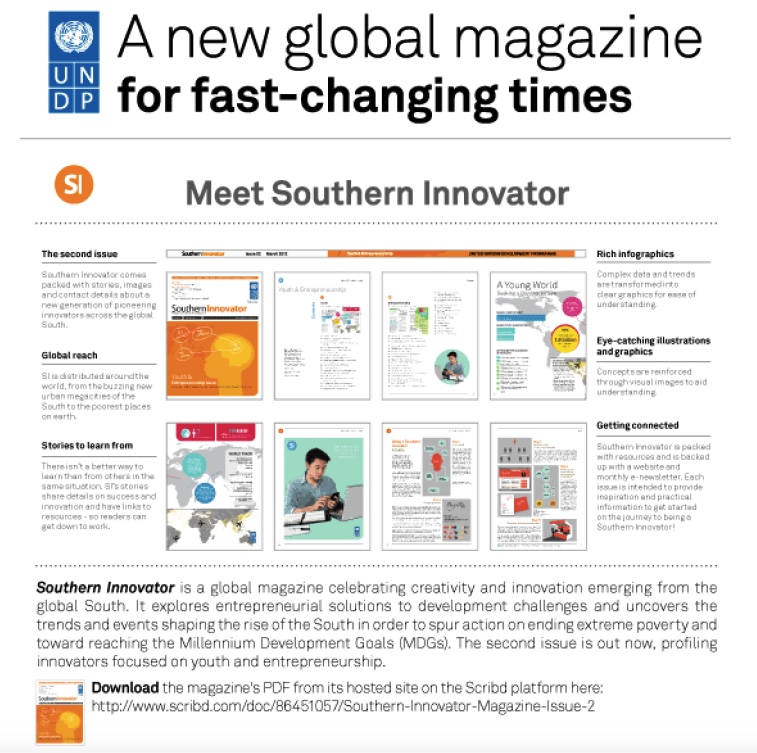
Development Challenges, South-South Solutions was launched as an e-newsletter in 2006 by UNDP’s South-South Cooperation Unit (now the United Nations Office for South-South Cooperation) based in New York, USA. It led on profiling the rise of the global South as an economic powerhouse and was one of the first regular publications to champion the global South’s innovators, entrepreneurs, and pioneers. It tracked the key trends that are now so profoundly reshaping how development is seen and done. This includes the rapid take-up of mobile phones and information technology in the global South (as profiled in the first issue of magazine Southern Innovator), the move to becoming a majority urban world, a growing global innovator culture, and the plethora of solutions being developed in the global South to tackle its problems and improve living conditions and boost human development. The success of the e-newsletter led to the launch of the magazine Southern Innovator. 

Creative Commons License

This work is licensed under a
Creative Commons Attribution-Noncommercial-No Derivative Works 3.0 License.

ORCID iD: https://orcid.org/0000-0001-5311-1052.

© David South Consulting 2023

Categories
Archive Development Challenges, South-South Solutions Newsletters

Indian Newspapers Thrive with Economy

By David SouthDevelopment Challenges, South-South Solutions

SOUTH-SOUTH CASE STUDY

The onslaught of digital media in the developed countries of the world regularly brings pronouncements of the death of the traditional newspaper. But this assumption of digital triumph misses out on the reality in countries across the global South.

As incomes rise and literacy levels go up, so does the desire to consume news and information. And while many are jumping straight to online and mobile phone sources, just as many are enjoying more traditional print media offerings like magazines and newspapers.

India boasts both a fast-growing economy and the largest number of paid-for newspapers in the world. The print media industry in India has seen phenomenal growth since 2005, with the number newspaper titles increasing by 40 percent to 2,700 (World Association of Newspapers). The two factors driving this growth in newspapers are rising literacy and a booming economy

The World Association of Newspapers found China leads the world for newspaper subscribers, with 93.5 million readers a day. India is second. It is estimated the Indian newspaper industry will generate US $3.8 billion in revenues in 2010, a 13 percent growth rate over the last five years.

Estimates place growth in the newspaper industry in the next four years at 9 percent a year, to US $5.9 billion (KPMG).

Part of the reason India is defying the decline in newspaper numbers and readership seen in developed countries is poor internet penetration across the country. Because of this, only 7 percent of the population uses the web for information. And the country’s high number of illiterates (just 65 percent of the population can read) means even if many could afford a newspaper, they couldn’t use it.

According to Amar Ambani, head of research at India Infoline Group, “Unlike the West where the internet publishing and advertising has significantly hit the print media, the Internet threat to print media is still in its nascent stage in India, given the low penetration of computers and adequate bandwidth across the country.”

Newspapers are also growing in a highly competitive market exploding with new television channels on cable and satellite and other media distractions like mobile phone applications.

The newspapers (http://www.world-newspapers.com/india.html) are a strong reflection of how much the economy has changed in the past decade. They contain advertisements for property, mobile phones, cars and dating services.

Cost is also a critical element in their success: at only four rupees each (US $0.09 cents), many Indians buy several newspapers at a time for their home. The publications are able to charge so little because of the health of the advertising revenue coming in. Newspaper advertising in India increased by 30 percent between January and Match 2010 alone, the quickest jump in ads for the Asia-Pacific region (Nielsen India).

There is a hierarchy in the newspaper industry: English-language newspapers attract wealthier readers and can charge the most for advertising. But rising literacy rates combined with increasing personal wealth is fuelling growth in regional papers written in local languages. India has 22 official languages and English as an associate language. The country as a whole has about 33 different languages and over 2,000 local dialects. Hindi newspaper circulation rose from 8 million in the early 1990s to over 25 million in 2009.

The Times of India (http://timesofindia.indiatimes.com) is now the world’s largest circulation English-language newspaper, with 4 million readers. It uses this success to charge 10 times what regional papers can for advertising. At present, the regional newspapers’ bread-and-butter is mostly government-paid advertising.

But if trends continue as they are, then the tables will turn on big beasts like the Times of India. Regional papers will grow as people look for an opportunity to read in their own local language.

Flush with cash and confidence, Indian newspapers are also innovating new ways to advertise untried in other countries. Talking ads attached to the actual newspaper’s back pages caused a great stir when they were trialled in India recently (http://www.guardian.co.uk/media/greenslade/2010/sep/28/newspapers-advertising). The talking ads for a car company delivered a sales pitch but also alarmed and annoyed many people because the talking ad wouldn’t stop talking.

Ambani puts the success of the Indian newspaper industry down to five factors: the economic boom in semi-urban and rural India; growing local content; more opportunity to grow the number of readers; rising advertising spending; and rising literacy as a result of rising secondary school enrolment. He believes students aged between 10 and 15 are getting the newspaper habit and they represent huge future growth in newspaper readers.

Published: October 2010

Resources

https://davidsouthconsulting.org/2022/11/17/book-boom-rides-growing-economies-and-cities/

https://davidsouthconsulting.org/2022/09/29/cheap-indian-tablet-seeks-to-bridge-digital-divide/

https://davidsouthconsulting.org/2022/10/20/the-e-reader-battle-reaches-india/

https://davidsouthconsulting.org/2022/10/12/free-magazine-boosts-income-for-rickshaw-drivers/

https://davidsouthconsulting.org/2022/05/26/kenyan-book-company-brings-online-sales-to-east-africa/

https://davidsouthconsulting.org/2022/10/12/rickshaw-drivers-prosper-with-new-services/

Development Challenges, South-South Solutions was launched as an e-newsletter in 2006 by UNDP’s South-South Cooperation Unit (now the United Nations Office for South-South Cooperation) based in New York, USA. It led on profiling the rise of the global South as an economic powerhouse and was one of the first regular publications to champion the global South’s innovators, entrepreneurs, and pioneers. It tracked the key trends that are now so profoundly reshaping how development is seen and done. This includes the rapid take-up of mobile phones and information technology in the global South (as profiled in the first issue of magazine Southern Innovator), the move to becoming a majority urban world, a growing global innovator culture, and the plethora of solutions being developed in the global South to tackle its problems and improve living conditions and boost human development. The success of the e-newsletter led to the launch of the magazine Southern Innovator. 

https://davidsouthconsulting.org/2021/03/05/southern-innovator-issue-1/

Creative Commons License

This work is licensed under a
Creative Commons Attribution-Noncommercial-No Derivative Works 3.0 License.

ORCID iD: https://orcid.org/0000-0001-5311-1052.

© David South Consulting 2024

Categories
Archive Development Challenges, South-South Solutions Newsletters Southern Innovator magazine

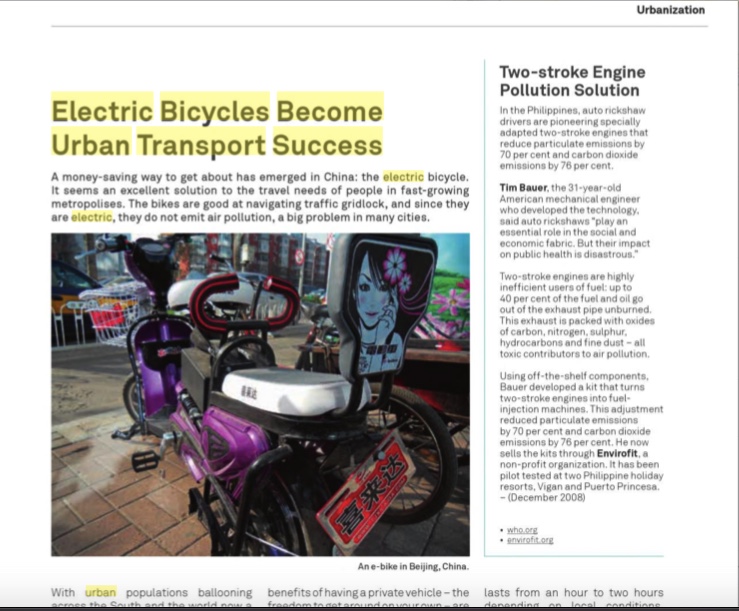
Electric Bicycles Become Urban Transport Success

By David SouthDevelopment Challenges, South-South Solutions

SOUTH-SOUTH CASE STUDY

A money-saving way to get about has emerged in China: the electric bicycle. It seems an excellent solution to the travel needs of people in fast-growing metropolises. The bikes are good at navigating traffic gridlock, and since they are electric they do not emit air pollution, a big problem in many cities.

With urban populations ballooning across the South – and the world now a majority urban place – the challenge of moving people around economically and cleanly is a big issue. While turning to cars seems an appealing option for people who have raised their incomes, the resulting traffic jams and pollution are a major drawback. Gridlock (http://en.wikipedia.org/wiki/Gridlock) is a daily reality in cities across Asia and Africa.

The success of e-bikes in China is striking: It is estimated there are four times more electric bikes than cars in the country, 120 million in all. According to the Electric Bikes website (www.electricbikee.com), the number of electric bicycles produced each year has grown from 200,000 eight years ago to 22 million in 2008. It is estimated to be a US $11 billion a year business: a true Southern success story that is going around the world.

A typical electric bicycle has a rechargeable power pack, with a battery that takes up to four hours to charge and lasts from an hour to two hours depending on local conditions, like hills. The batteries can range from heavy lead acid models (around only 100 charges) to nickel metal to lightweight, long-lasting lithium batteries. The batteries range from 12 volts to 36 volts. How long a battery lasts depends on its energy retention ability, road and temperature conditions and the rider’s weight.

And while some cities are turning to encouraging more peddle power with human-powered bicycles, this is an unappealing option in hot or humid climates. Who wants to turn up at work hot and sweaty?

In China, a highly competitive market of manufacturers has sprung up in the last 10 years to provide e-bikes for every taste and need.

China has a long tradition as a cycling nation: in the 1980s, four out of five commuters used bicycles. But that changed dramatically as people bought cars with their rising incomes.

In the capital, Beijing, rapid economic development and rising incomes have led to serious traffic congestion. There are over 4 million cars on Beijing’s roads. The pollution in the city is very bad and has led to various campaigns to ban high-polluting vehicles.

The ensuing traffic gridlock means the benefits of having a private vehicle – the freedom to get around on your own – are eroded as a driver wastes time in long commutes. So, many have turned to the nimble electric bicycles.

One resident, David Dai, told the BBC “It takes only 10 minutes to ride my electric bike from home to work.”

“If I took the bus, I’d have to spend time waiting for it, and then I could be trapped in a traffic jam. It could take me half an hour to make the same journey.”

Competition is fierce in the electric bike market, with shops sometimes sitting side-by-side.

A manager of a Beijing electric bicycle store, Zhang Zhiyong, puts the success down to this: “Beijing is not like other smaller cities – it’s big. If people ride their bicycles to work, they get really tired. If they drive to work, the roads are often congested,” he told the BBC.

“But an electric bike is environmentally friendly and convenient. Promoting the use of these bikes would benefit us all.”

And the price is a definite incentive: just 2,680 yuan (US $390), while cars sell for thousands of dollars.

The electric bicycles are so successful they are now growing faster than cars in a country that has become the fastest growing car market in the world.

Some believe the bikes are just a stop gap before people get enough money to buy automobiles. But the bigger trend of growing urban populations and the ensuing traffic jams will ensure they remain a practical option to get around the gridlock.

Published: April 2010

Resources

1) Electric Bike Website: Home to news and links to manufacturers. Also lots of resources on how to convert peddle bikes into electric bikes. Website:http://www.electricbikee.com/

2) The Luyuan Electric Vehicle Company of Jinhua City in China has been making the bikes for 10 years. They come fully equipped with lights, baskets, fenders and in many colours. Website: http://en.luyuan.cn/?gclid=CJXu_tr576ACFclr4wodG1GsGQ

3) Empowered Ebikes: An online retailer of e-bikes specializing in urban commuters. Website:http://www.empoweredebikes.com/index.php

4) Made-in-China.com: A large list of e-bike manufacturers in China and how to contact the dealers and manufacturers. Website: http://www.made-in-china.com/products-search/hot-china-products/E-bike.html

5) Pedego: An American company making high-end e-bikes. Website: http://www.pedegoelectricbikes.com/index.php

Development Challenges, South-South Solutions was launched as an e-newsletter in 2006 by UNDP’s South-South Cooperation Unit (now the United Nations Office for South-South Cooperation) based in New York, USA. It led on profiling the rise of the global South as an economic powerhouse and was one of the first regular publications to champion the global South’s innovators, entrepreneurs, and pioneers. It tracked the key trends that are now so profoundly reshaping how development is seen and done. This includes the rapid take-up of mobile phones and information technology in the global South (as profiled in the first issue of magazine Southern Innovator), the move to becoming a majority urban world, a growing global innovator culture, and the plethora of solutions being developed in the global South to tackle its problems and improve living conditions and boost human development. The success of the e-newsletter led to the launch of the magazine Southern Innovator. 

Creative Commons License

This work is licensed under a
Creative Commons Attribution-Noncommercial-No Derivative Works 3.0 License.

ORCID iD: https://orcid.org/0000-0001-5311-1052.

© David South Consulting 2023

Categories
Archive Development Challenges, South-South Solutions Newsletters

African Trade Hub in China Brings Mutual Profits

By David SouthDevelopment Challenges, South-South Solutions

SOUTH-SOUTH CASE STUDY

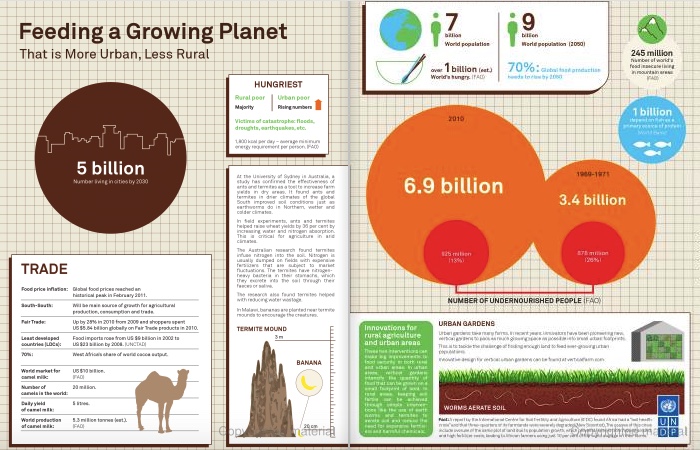
South-South trade is the great economic success story of the past decade. World Trade Organization (WTO) (www.wto.org) figures show South-South trade accounted for 16.4 percent of the US $14 trillion in total world exports in 2007, up from 11.5 percent of the total in 2000. While the global economic crisis has slowed things down, the overall trend is firmly established.

Trade between China and Africa has surged over the past decade since China joined the WTO in 2001, from around US $10 billion in 2000 to US $73.3 billion in 2007, registering a year-on-year increase of 32.2 percent. In 2008, it soared by 44.1 percent to reach a record high of US $106.84 billion, registering a year-on-year increase of 45.1 percent, according to Zhang Yongpeng of the Institute for West Asian and African Studies (IWAAS).

In the southern Chinese city of Guangzhou (http://en.wikipedia.org/wiki/Guangzhou) , a trading hub nicknamed “Africa Town” has emerged since 1998. A conglomeration of buildings around the Xiaobei road in Yuexiu district of the city, it has been equated to the famous Chungking Mansions of Hong Kong (http://en.wikipedia.org/wiki/Chungking_Mansions) . There are officially 20,000 African traders and entrepreneurs in the city of 18 million, but unofficial estimates put the number at more than 100,000. This African trading hub has emerged to the benefit of both the Chinese and Africans. It is a coming together of small traders matching Africa’s strong demand for consumer goods with China’s manufacturing powerhouse.

The traders export generators, toys, mopeds, construction equipment and other products back to Africa. The traders act as go-betweens, bringing their local knowledge of African market demands to the Chinese manufacturers.

Citizens from over 19 African countries are represented, the majority from Nigeria.

“Almost 90 per cent of goods in African markets come from China, Thailand and Indonesia,” Sultane Barry, president of Guangzhou’s Guinean community, told the Globe and Mail newspaper.

Barry has an entire floor for business in a 35-storey building packed with shops, offices, freight-forwarding companies, African restaurants, hairdressers and furnished apartments for rent by the week.

“We’re not here for fun,” said Ibrahim Kader Traore, an entrepreneur from Ivory Coast. “We work hard and do well. In Abidjan, people still swear by France, where you might be able to save US $13,000 over 25 years; in China, you can have US $130,000 in just five years.”

A trading success story, the hub has run into problems over visas and the upcoming November Asian Games in Guangzhou, which is increasing identity checks.

“I sell more than 50 per cent of the output of my brother-in-law’s TV factory to Africans,” one saleswoman told the Globe and Mail. “We need them and I’m worried there are going to be fewer of them.”

Brought together by trade and mutual interest, both communities still have much to learn about each other. Relations have had their ups and downs and Africans can face discrimination.

But the trading relationship is teaching both sides important lessons. “The arrival of the Africans taught the Chinese how to look for business opportunities,” said Barry. “The secretaries we had here didn’t speak a word of English. Our presence started a craze for learning languages: English and French. The Chinese didn’t know the basic rules of international trade. They knew nothing about documentary credit. They paid for everything cash in hand.

“The Chinese people will soon realize that it’s better for business to deal directly with ordinary Africans.”

And the pressure is on to see who will keep trading relations with Africa positive. “The door to the Chinese market has only opened a crack, mostly because visa requirements are so tough,” said Zango, a trader from Mali.

Published: July 2010

Resources

1) A Financial Times report on Africa-China trade in 2010. Website: http://www.ft.com/reports/africa-china-trade-2010

2) An article about “Africa Town” from the official Guangzhou website. Website: http://www.lifeofguangzhou.com

3) Trade Winds: Guangzhou’s African Community by Graeme Nicol is a photo book about the community. Website: http://graemenicol.com/?page_id=115

https://davidsouthconsulting.org/2022/06/02/afghanistans-juicy-solution-to-drug-trade/

https://davidsouthconsulting.org/2022/11/02/african-online-supermarket-set-to-boost-trade/

https://davidsouthconsulting.org/2022/11/21/chinese-trade-in-angola-helps-recovery/

https://davidsouthconsulting.org/2022/04/12/djibouti-re-shapes-itself-as-african-trade-hub/

https://davidsouthconsulting.org/2021/07/19/global-south-trade-boosted-with-increasing-china-africa-trade-in-2013/

https://davidsouthconsulting.org/2021/07/19/south-south-trade-helping-countries-during-economic-crisis/

https://davidsouthconsulting.org/2022/10/20/trade-to-benefit-the-poor-up-in-2006-and-to-grow-in-2007/

https://davidsouthconsulting.org/2022/10/05/women-empowered-by-fair-trade-manufacturer/

https://davidsouthconsulting.org/2022/06/16/women-mastering-trade-rules/

Development Challenges, South-South Solutions was launched as an e-newsletter in 2006 by UNDP’s South-South Cooperation Unit (now the United Nations Office for South-South Cooperation) based in New York, USA. It led on profiling the rise of the global South as an economic powerhouse and was one of the first regular publications to champion the global South’s innovators, entrepreneurs, and pioneers. It tracked the key trends that are now so profoundly reshaping how development is seen and done. This includes the rapid take-up of mobile phones and information technology in the global South (as profiled in the first issue of magazine Southern Innovator), the move to becoming a majority urban world, a growing global innovator culture, and the plethora of solutions being developed in the global South to tackle its problems and improve living conditions and boost human development. The success of the e-newsletter led to the launch of the magazine Southern Innovator. 

Creative Commons License

This work is licensed under a
Creative Commons Attribution-Noncommercial-No Derivative Works 3.0 License.

ORCID iD: https://orcid.org/0000-0001-5311-1052.

© David South Consulting 2022