Categories
Archive Development Challenges, South-South Solutions Newsletters

2010: Development Challenges, South-South Solutions

By David SouthDevelopment Challenges, South-South Solutions

SOUTH-SOUTH CASE STUDY

ISSN 2227-3905

December

Ghanaian Coffins Prove Design and Craftsmanship Boost Incomes Development Challenges: In many parts of the world, indigenous ingenuity and craft skills are finally getting the recognition they deserve. The quirky but very inventive gadgets and solutions featured on the Afrigadget blog (http://www.afrigadget.com) never fail to inspire and amaze.

Colombian Architect Proving Strength and Beauty of Bamboo Development Challenges: Fast-growing bamboo grass (http://en.wikipedia.org/wiki/Bamboo) has become a cause celebre amongst those looking for a sustainable and tough building material.

Djibouti Re-shapes Itself as African Trade HubDevelopment Challenges: Trade hubs can prove to be decisive in boosting regional growth. Trade hubs are places where commerce congregates, for a mix of geographical, cultural and economic reasons.

Food Diplomacy Next Front for South’s NationsDevelopment Challenges: The meal is a universal bonding ritual, a time for families or friends to socialize and catch up on the day’s activities. Food has the ability to transcend cultures and societies when humour, the arts, and diplomacy cannot. A person may know nothing about a particular country or culture, but they know what their appetite and palate likes.

November

African Health Data Revolution Development Challenges:A pioneering tool for gathering health data now being used in Kenya could herald a revolution in the way diseases are tracked and defeated around the world. It uses mobile phones to better connect patients with medical and health personnel, and allows data to be gathered in real-time and used to track health and improve the delivery of services, especially to remote and under-serviced areas.

African Megacity Makeovers Tackle Rising Populations Development Challenges: Nigeria’s largest, busiest and most congested city, Lagos, has long had a reputation for dynamism mixed with chaos. Its sprawling slums and ballooning population have for decades stretched governments’ ability to provide services.

Ugandan Project Pioneers Transparent Development Development Challenges: A pioneering experiment in the community of Katine (www.guardian.co.uk/katine) in the East African nation of Uganda recently came to its official end. A unique three-year project to try and transform the development outcomes of this rural community, it pioneered a new model of communicating aid and development.

Mongolian Enterprises Target Healthy Urban Lifestyles Development Challenges: In the Northeast Asian nation of Mongolia – landlocked between Russia and China – the traditional diet is based on the nomadic ways of its herders. Rich in meat and milk products, it is a diet that has evolved from the need to survive in a harsh climate doing hard physical labour – winter temperatures can drop below minus 50 degrees Celsius.

October

South African Wine Industry Uncorks Opportunities Development Challenges: Wine-making is one of South Africa’s oldest industries and plays a key part in the country’s economy. And now both wine making and production are being transformed and creating new economic opportunities. Once seen only as the preserve of the country’s white minority population, wine is slowly becoming a black thing too.

Chinese Trade in Angola Helps Recovery Development Challenges: Two-way trade between Africa and China has been an outstanding success story of the past decade. It has led to significant new investment in the continent and brought many new job opportunities. The Chinese community in Africa comprises a mix of entrepreneurs and workers. In formerly war-torn Angola, Chinese workers and investors have led an economic boom as the country recovers from decades of conflict.

Palestinian Olive Oil’s Peaceful Prosperity Development Challenges: The economic devastation of the conflict between Israel and the Palestinians (http://en.wikipedia.org/wiki/Palestine) has brought much hardship to the Palestinian people. The United Nations under the UNRWA mission has been working to lesson the hardship for over 60 years (http://www.unrwa.org). But there is only so much it can do.

Indian Newspapers Thrive with Economy Development Challenges: The onslaught of digital media in the developed countries of the world regularly brings pronouncements of the death of the traditional newspaper. But this assumption of digital triumph misses out on the reality in countries across the global South.

September

Maker Faire and the R&D Rise in the South Development Challenges: The majority of the world’s research and development (R & D) in science and technology is now shifting to the global South. Powerhouses like China boast vast numbers of published papers in peer-reviewed journals and hefty cash inputs into research and development.

Wireless Internet Culture Helping Zimbabwe Economy Recover Development Challenges: Zimbabwe’s turbulent descent into hyperinflation at the beginning of the 2000s – and the food crisis it caused as prices soared and purchasing power shrank – captured the world’s attention. From refugees fleeing the country to widespread hunger and poverty, the impact of hyperinflation was stark and distressing. Since the country’s economy stabilized in 2009, various signals are showing that Zimbabwe is slowly making its way back to growth and stability.

African Technology Tackles Health Needs Development Challenges: Africa is becoming a world leader in mobile phone applications for health and healthcare. Despite dramatic improvements to the quality of hospitals and the number of qualified doctors, the continent’s healthcare services are still a patchwork, with rural and slum dwellers poorly served and the stresses of treating patients with contagious diseases like HIV/AIDS and malaria pushing resources to the limit.

African Media Changing to Reach Growing Middle ClassDevelopment Challenges: Africa’s growing middle classes are being targeted by a new generation of media entrepreneurs. This growing group of Africans is ambitious and intelligent, and they want media that matches their aspirational ways. Clever media people are stepping up to feed this trend.

Brazil’s Agriculture Success Teaches South How to GrowDevelopment Challenges: Inflation, environmental stresses and population and economic growth are testing the world’s food supply systems. There is a strong need to boost yields and improve the quality of food. Between now and 2050 the world’s population will rise from 7 billion to 9 billion. Urban populations will probably double and incomes will rise. City dwellers tend to eat more meat and this will boost demand.

August

Indians Fighting Inflation with Technology Development Challenges: Despite the global economic downturn, many countries of the South are seeing rapid economic growth. That can have a down side: inflation (http://en.wikipedia.org/wiki/Inflation). Inflation can be caused by variety of factors – too much money chasing too few goods, deliberate government policies to increase demand for goods and services, environmental disasters creating scarcity, or poor investment in infrastructure straining against rapid economic growth. But when it gets out of control for life-essential goods like food, then people need solutions to survive.

Mobile Applications Market: Opportunities for SouthDevelopment Challenges: As the number of mobile phone users around the world mushrooms, so does the mobile phone applications market. Revenue from downloads of applications, or apps, topped US $10 billion in 2009, according to market analyst firm Juniper (http://juniperresearch.com).

Rwandan Coffee Brand Boost Development Challenges: A successful Rwandan company is using coffee shops to promote the nation’s high-quality coffee brands at home and abroad. Started by two Rwandan entrepreneurs three years ago, Bourbon Coffee (http://www.bourboncoffeeusa.com/) now has three shops in the country’s capital, Kigali, and a savvily positioned shop in Washington DC.

Technological Innovation Alive in Brazil Development Challenges: The growing digital economy in the global South is giving rise to a new generation of entrepreneurs and innovators. A University of California paper by Naazneen Barma found explosive potential in poorer countries to innovate, and challenged the view of developing countries as passive market places for products innovated in the industrialized world.

July

Mongolia Looks to Become Asian IT Leader Development Challenges: A Mongolian information technology company founded by a woman has shown a way to thrive in the country’s often-chaotic economic environment. With the global economic crisis moving into its third year, Intec’s strategies to survive and thrive offer lessons for other IT start-ups in the South.

African Trade Hub in China Brings Mutual ProfitsDevelopment Challenges: South-South trade is the great economic success story of the past decade. World Trade Organization (WTO) (www.wto.org)  figures show South-South trade accounted for 16.4 percent of the US $14 trillion in total world exports in 2007, up from 11.5 percent of the total in 2000. While the global economic crisis has slowed things down, the overall trend is firmly established.

Innovation in Growing Cities to Prevent Social ExclusionDevelopment Challenges: A new book launched during this year’s World Urban Forum in Rio de Janeiro, Brazil highlights ways in which people across the South are shaping how their cities evolve, insisting that they will not accept social exclusion and demanding a “right to the city”.

June

South Gets Reading Bug with more Festivals Development Challenges: There is no better indicator of significant economic progress than the rise and rise of book festivals across the South. These symbols of intellectually curious and globally aware middle classes are also boosting economies and contributing to a bigger, more sophisticated creative economy – something that will drive future growth across many sectors.

Housing Innovation in South’s Urban Areas Development Challenges: As urban populations around the South increase, the quality of city housing will be critical to the quality of life and sustainability of improvements to living standards.

Crowdfunding Technology Start-up Success in AfricaDevelopment Challenges: Technology is the future for the South, and South African start-up culture is trying to get a foothold on the African continent and forge a more supportive environment for entrepreneurs and innovators.

Kenyan Products a Global Success Story Development Challenges: The East African nation of Kenya has become synonymous with high-quality agricultural products, and offers lessons for other countries across the South. The country has been able to combine innovation in new technologies (it is a pioneer in mobile phone applications like m-banking), with quality control for its products like the Coffee Kenya Brand logo (http://www.coffeeboardkenya.org) and ease of access to information on Kenyan products and resources via the internet – crucial to drumming up international business – like the SME Toolkit Kenya (http://kenya.smetoolkit.org/kenya/en).

May

Indian Solar Economy Brings New Vocation for WomenDevelopment Challenges: India has started to make significant advances in developing solar power technologies for the poor. There are now whole villages using solar energy and improving their standard of living. Various companies and projects are selling inexpensive solar appliances – from cooking stoves to lanterns and power generators – across the country. This new solar power ‘grid’ is also bringing further economic opportunities: jobs for people to repair and maintain the new equipment.

Woman Wants African Farming to be Cool Development Challenges: Can farming be cool? Especially on a continent where it has long been associated with hardship and poverty, can agriculture be attractive to a young generation looking for big opportunities? A young woman in Nigeria thinks so and is on a mission to show farming is a great way to get ahead in modern Africa. And she hopes more people attracted to farming will boost the continent’s food security and reduce costly imports.

Açaí Berry Brazil’s Boon Development Challenges: A formerly obscure berry from the Amazon rainforest in Brazil has become a global marketing success. The açaí berry – a dark, small fruit similar in appearance to blueberries – has surged in popularity around the world and brought newfound prosperity to poor communities.

Book Boom Rides Growing Economies and Cities Development Challenges: Along with growing economies, the global South is seeing growing numbers of readers and a newly flourishing publishing industry. The creative economy – of which book publishing is part – is experiencing a jolt from a combination of expanding economies and urbanizing cities. Just as the first settled cities of ancient Mesopotamia (today’s Iraq) spawned literature and learning, so the rapidly urbanizing South is changing dynamics and creating the space and demand for books.

April

Kenyan Farmer Uses Internet to Boost Potato FarmDevelopment Challenges: The rise of social networking websites (http://en.wikipedia.org/wiki/List_of_social_networking_websites) during the past few years has swept across the internet. The popular Facebook (www.facebook.com) site alone has over 350 million users worldwide. In Africa, there are more than 67 million people with access to the internet – just over 6 percent of the population (http://www.internetworldstats.com/stats1.htm).

West African Chocolate Success Story Development Challenges: A Ghanaian chocolate company has become a big success in the United Kingdom and shown how it is possible to develop and market a high-quality product grown in West Africa. While the chocolate bars are manufactured in the Netherlands, the cooperative that owns the company initiated the push into producing a mass-market chocolate brand – and shares in the profits.

The Battle for India’s Coffee Drinkers in Buzzing EconomyDevelopment Challenges: A showdown in India over coffee is creating new opportunities. It is also demonstrating how the country is changing, with rising incomes in some places and great disparities in others.

Iranian Savings Funds to Tackle Loan DroughtDevelopment Challenges: For entrepreneurs around the world, acquiring finance to start or expand a small business has become harder and harder as the global financial crisis has bitten hard. Across the globe, people with good ideas or successful businesses that need funds to expand are finding the door closed by traditional banks.

Electric Bicycles Become Urban Transport SuccessDevelopment Challenges: A money-saving way to get about has emerged in China: the electric bicycle. It seems an excellent solution to the travel needs of people in fast-growing metropolises. The bikes are good at navigating traffic gridlock, and since they are electric they do not emit air pollution, a big problem in many cities.

March

A Local Drink Beats Global Competition Development Challenges: For many decades, strong American and multinational food brands have penetrated markets in the South. This is a global business success story for those companies, but the downside has been the marginalizing of local alternatives. This not only reduces wealth-creating opportunities for local entrepreneurs, but also leads to products like sugary soda pops (http://tinyurl.com/yzwal98) pushing aside healthier, local alternatives like tea.

Indonesian Middle Class Recycle Wealth Back into Domestic Economy Development Challenges: The global downturn and economic crisis is now into its third year. Economic growth has dropped across the South, as the knock-on effect of shrinking credit and slowing global markets took its toll.  One solution to re-starting growth and building up domestic industries is to target local products at the existing middle class, which in turn grows the middle class by creating better paying jobs.

Favela Fashion Brings Women Work Development Challenges: A highly successful cooperative of women in Brazil has shown that it is possible for outsiders to make it in the fast-paced world of fashion. Despite being based in one of Rio de Janerio’s slums, or favelas (http://en.wikipedia.org/wiki/Favela), the women have developed a reputation for high-quality merchandise and even put on fashion shows.

A Solution to Stop Garbage Destroying Tourism Development Challenges: Tourism is an essential source of income for countries across the South. But many put that livelihood in jeopardy when they lose control of garbage collection. A popular tourist spot can represent a ‘paradise’ to visitors, but when it becomes too popular and local garbage collection systems collapse under the burden, ‘paradise’ can soon turn to an environmental hell.

February

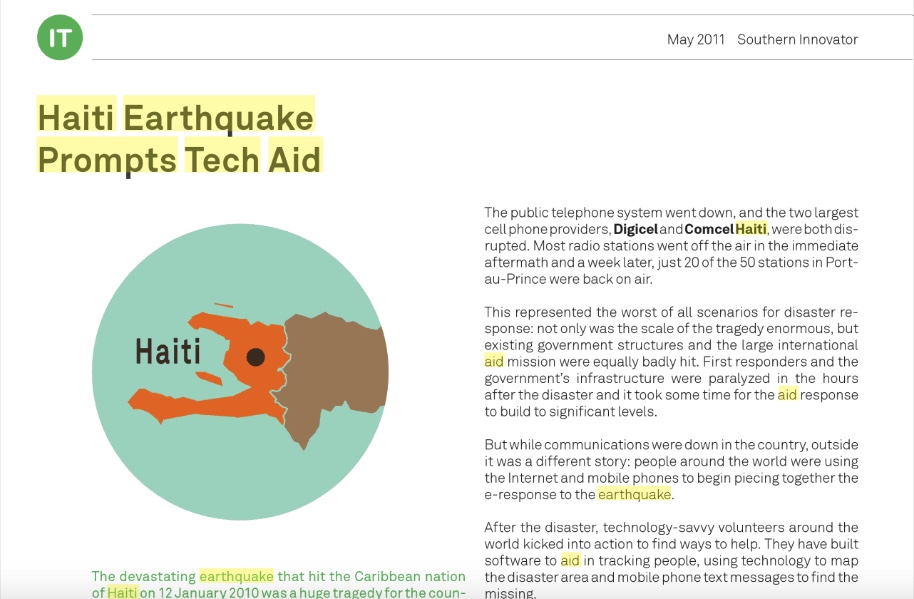
Haiti Earthquake Prompts Tech Aid Development Challenges: The devastating earthquake that hit the Caribbean nation of Haiti on January 12 was a huge tragedy for the country’s people and for the large international aid community, including the United Nations. But the disaster has seen the use of new information technologies – often assembled by volunteers – to bridge the gaps in critical information and bring a semblance of order to the chaos of a large disaster.

Housing Solution for World’s Growing Urban Population Development Challenges: Across the South, cities are expanding and urban populations growing at a phenomenal rate — the cities of Africa and Asia are growing by a million people a week. Megacities and sprawling slums will be the hallmarks of this majority urban world. In sub-Saharan Africa, 72 percent of the population already lives in slum conditions. How people will be housed is an urgent problem. There are many ways to build a dwelling, from scavenged materials, to labour-intensive and expensive custom-built construction, yet affordable and safe construction techniques for the poor are sorely needed.

Enormous Potential for Nigerian Software IndustryDevelopment Challenges: Nigeria has an unfortunate global reputation as the home of 419 scams (http://en..wikipedia.org/wiki/Advance-fee_fraud). A typical 419 scam involves sending emails to people around the world in order to extort money from them. Online scams may show an unexpected technical sophistication for a country associated with poverty, but are a sign that some of Nigeria’s plentiful talents are being turned to illegal activities rather than building legitimate businesses.

Indian Solar Power Pack Powers Villages Development Challenges: Developments in India are showing the way forward for low-cost solar power for the poor. The Duron Solar Home Power System (http://www.duronenergy.com/product_info/) is now enabling the rural poor to generate and store solar electricity. It is powerful enough to charge gadgets and appliances and run LED lights. It allows people to do their household chores into the dark hours and to study or earn extra income.

January

Shoes with Sole: Ethiopian Web Success Story Development Challenges: Ethiopia’s bustling capital, Addis Ababa, is experiencing a building and business boom. Foreign investors and Ethiopia’s entrepreneurial and widespread global diaspora are investing again in the country. But Ethiopia still relies for most of its foreign currency wealth on exports of unprocessed coffee beans and leather hides — a model that leaves the bulk of the profits made outside of Ethiopia.

Cool Food for the Poor Development Challenges: A whole wave of high-tech, innovative products are now being developed and marketed for the world’s poor. These products are designed to raise the quality of life of poor people and treat them as a market with real needs, rather than a mass of people to be ignored.

Innovation: Cairo’s Green Technology PioneersDevelopment Challenges: One thing is ubiquitous to every country, community and society: garbage. It’s a social and environmental problem, but far from being mere waste, rubbish has its uses. This by-product of the goods and foods consumed can also be a source of fuel. As such it has many advantages, including providing free fuel to cash-strapped households, independence from unreliable municipal services and a way to dispose of waste.

Many Positive Trends for Africa in 2010 Development Challenges: While 2009 saw the global economic crisis spread around the world, the story is more complex and more hopeful than many believe. For Africa, various trends are pointing to positive economic development in 2010, despite the continent’s numerous political, social and environmental challenges. Pragmatism is driving stronger economic ties between Africa and the rest of the world, while long-running trends are delivering opportunity to millions despite setbacks.

Back Issues

Development Challenges, South-South Solutions Newsletter | 2011-2014

Development Challenges, South-South Solutions Newsletter | 2007-2010

2013

2012

2011

2010

2009

2008

2007

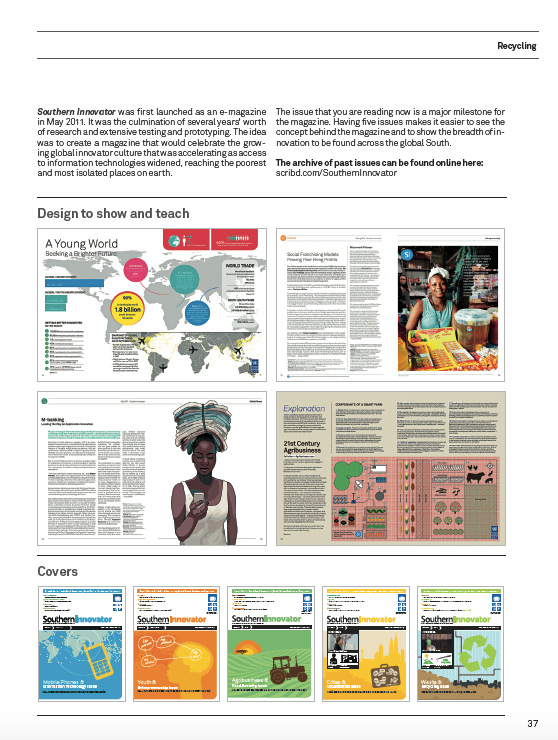
Development Challenges, South-South Solutions was launched as an e-newsletter in 2006 by UNDP’s South-South Cooperation Unit (now the United Nations Office for South-South Cooperation) based in New York, USA. It led on profiling the rise of the global South as an economic powerhouse and was one of the first regular publications to champion the global South’s innovators, entrepreneurs, and pioneers. It tracked the key trends that are now so profoundly reshaping how development is seen and done. This includes the rapid take-up of mobile phones and information technology in the global South (as profiled in the first issue of magazine Southern Innovator), the move to becoming a majority urban world, a growing global innovator culture, and the plethora of solutions being developed in the global South to tackle its problems and improve living conditions and boost human development. The success of the e-newsletter led to the launch of the magazine Southern Innovator.

Creative Commons License

This work is licensed under a
Creative Commons Attribution-Noncommercial-No Derivative Works 3.0 License.

ORCID iD: https://orcid.org/0000-0001-5311-1052.

© David South Consulting 2022

Categories
Archive Blogroll Development Challenges, South-South Solutions Newsletters The Global Urbanist

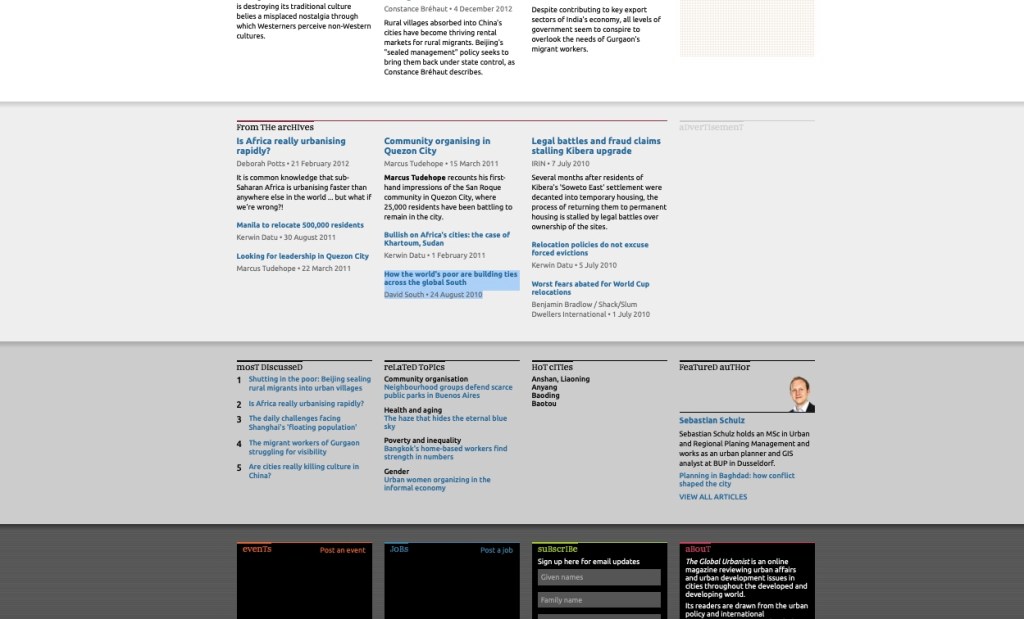
Cities For All Shows How The World’s Poor Are Building Ties Across The Global South

By David SouthDevelopment Challenges, South-South Solutions

SOUTH-SOUTH CASE STUDY

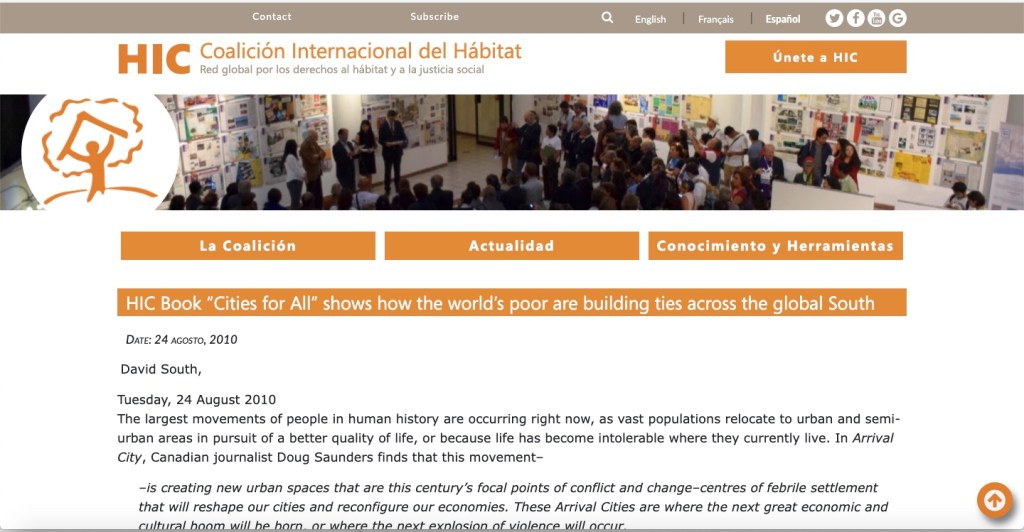
Cities for All, recently published by Habitat International Coalition, draws together thinkers and innovators in a compilation of case studies addressing the challenges of inclusive cities in the global South. The book seeks to articulate experiences of South-South cooperation and enhance the links between different regions. David South interviews the co-editor, Charlotte Mathivet.

Published: 24 August 2010

Global Urbanist (http://globalurbanist.com/2010/08/24/cities-for-all-shows-how-the-worlds-poor-are-building-ties-across-the-global-south)

The largest movements of people in human history are occurring right now, as vast populations relocate to urban and semi-urban areas in pursuit of a better quality of life, or because life has become intolerable where they currently live. In Arrival City, Canadian journalist Doug Saunders finds that this movement —

— is creating new urban spaces that are this century’s focal points of conflict and change — centres of febrile settlement that will reshape our cities and reconfigure our economies. These Arrival Cities are where the next great economic and cultural boom will be born, or where the next explosion of violence will occur.

For most, this process is chaotic, unplanned, and fraught with risk, hardship, poverty and stress; yet, because so many are also able to dramatically improve their life chances, many millions will continue to follow this path.

The speed of urbanisation makes the question of how to build liveable cities increasingly urgent. A new book hopes to help people get closer to solutions to these vexing problems.

Cities for All: proposals and experiences towards the right to the city, published by Habitat International Coalition (HIC) in Santiago, Chile, and co-edited by HIC’s Ana Sugranyes and Charlotte Mathivet, was launched during this year’s World Urban Forum in Rio de Janeiro, and highlights ways in which urban residents across the South are defining how they would like their cities to evolve, refusing to accept social exclusion and demanding a “right to the city”.

The book is published in three languages — EnglishSpanish and Portuguese.

“A lot of social initiatives based on the right to the city are coming from these ‘new cities of the South'”, says Mathivet. “The book highlights original social initiatives: protests and organising of the urban poor, such as the pavement dwellers’ movements in Mumbai where people with nothing, living on the pavements of a very big city, organise themselves to struggle for their collective rights, just as the park dwellers did in Osaka.”

“Another innovative experience came from the children’s workshops in Santiago, aimed at including children in urban planning in order to make a children-friendly city.”

The cities of Africa and Asia are growing by a million peole a week. If current trends continue, mega-cities and sprawling slums will be the hallmarks of this majority urban world. In sub-Saharan Africa, 72 per cent of the population lives in slum conditions. And by 2015, there will be 332 million slum-dwellers in Africa, with slums growing at twice the speed of cities.

“The consequences have produced a deeper gap between the city and countryside, and also within the city between the rich and poor,” said Mathivet.

Cities for All details African experiences from Nigeria, Cameroon, Ghana and South Africa. Mathivet believes “one common topic affecting these countries is the problem of forced evictions, due to the rural exodus and growing urbanisation. It is therefore very important for the right to the city to include a perspective of linking the struggle between rural and urban movements, because problems in cities and the countryside are closely connected, especially in Africa.”

And the current surge to cities in Africa raises the issue of what type of development will occur. The book argues that cities aren’t automatically a solution to the plight of the poor. Cities need to be worked on, and many of the problems faced by the South’s fast-growing cities stem from a power imbalance.

“A very important thing to realise is that a city life is not a synonym for a better life or a miracle solution for poor people, nor for the ‘capitalist’ way of life,” says Mathivet. “African nations and their people have to find effective solutions on their own to overcome poverty — which they are doing — without copying development models from the North.”

“In my understanding, urban growth is not haphazard or poorly planned in ‘developing’ countries. Rather, I think that urban ‘planning’ or lack of planning is done with a goal of generating more benefits for powerful interests and fewer benefits for poor people.”

The book argues for a two-way relationship with the people who make up the majority of these fast-growing cities. And it says each city will have to customise its solutions.

“It is very difficult to apply social innovations to other countries without understanding the history and the social, economic, cultural and political context,” says Mathivet.

“Hope comes from learning of different experiences. For example, if a social movement in South Africa succsesfully avoided an eviction from a slum, it may help another social movement in Brazil to strengthen its own strategy. One of the book’s goals was to articulate the various South-South experiences and enhance the links between different regions.”

In one chapter, contributor David Harvey argues that “the right to the city is not simply the right to what already exists in the city; it is also the right to transform the city into something radically different.”

“The right to the city itself will not stop the over-whelming phenomenon of urban growth,” believes Mathivet. “The consequences produced by implementing this collective right would rather change people’s daily lives by achieving more equality in cities as well as in the relationship between the city and coutnryside in regards to growing urban populations.”

Cities for All highlights the existence of ‘cities without citizens’: the vast numbers of slum dwellers and the poor who live mostly ignored by authorities (unless they are in the way of commercial development).

“The expression ‘cities without citizens’ means the exact opposite of the right to the city proposal,” Mathivet says. “This alternative to the present global paradigm proposes to allow people to participate in the process of creating the city in terms of urban planning, decision-making, budget, public policies, etc. It is possible for people to influence their own lives and the community.”

“There is no miracle solution, and the right to the city is a banner around which people can organise themselves to articulate their struggles and demand social justice.”

The book concludes by arguing for the advantages of a ‘slow city’ approach. But how does this work in fast-growing urban areas where people are looking to quickly escape poverty, or are seeking rapid improvements to their quality oflife? Would they not find a slow city approach frustrating?

Mathivet believes a leap of imagination is required: “Cities for All is not intended to be a recipe book. The slow city experience was chosen as a conclusion to the book in order to present a different approach, but not to propose a clear solution to follow. Concluding with the slow city experience, which is radically different and difficult to apply in African and Asian cities, where the spread of urbanisation is uncontrollable and leads to major problems, emphasises that the fight for the right to the city involves imagination and the desire for another possible city …

“Moreover, slow city experiences have been developed otuside of wealthy European countries, for example in some small Argentine and South Korean cities.”

And with the coming decade unfolding, what will cities in the South be like? Are we on the cusp of a new, dark age akin to the misery of Europe’s cities during the industrial revolution?

Mathivet acknowledges that “we can see a dark future where the interests of the most vulnerable will not be the priority. However, looking at the experiences by and for the people, we cannot consider them poor, but rich of knowledge, cognitive capital, and with courage to change their lives and their communities, through self-management and autonomy.

Cities for All aimed to show this richness … the challenges are for civil society to deepen links between different movements to build a stronger global strategy, during events like the next World Social Forum in Dakar, February 2011.”

David South is an international development consultant and writer. He writes the Development Challenges: South-South solutions e-newsletter for UNDP’s Special Unit for South-South Cooperation. He led the Communications Office for the UN in Ulaanbaatar from 1997 to 1999 and has worked for the UN in South Africa, Turkmenistan and Ukraine.

The Special Unit for South-South Cooperation is mandated to promote, coordinate and support South-South and triangular cooperation on a global and UN-systemwide basis.

This story is adapted from a piece in the July 2010 edition of Development Challenges.

http://globalurbanist.com/2010/08/24/cities-for-all-shows-how-the-worlds-poor-are-building-ties-across-the-global-south

https://www.hic-net.org/es/hic-book-cities-for-all-shows-how-the-worlds-poor-are-building-ties-across-the-global-south/

Development Challenges, South-South Solutions was launched as an e-newsletter in 2006 by UNDP’s South-South Cooperation Unit (now the United Nations Office for South-South Cooperation) based in New York, USA. It led on profiling the rise of the global South as an economic powerhouse and was one of the first regular publications to champion the global South’s innovators, entrepreneurs, and pioneers. It tracked the key trends that are now so profoundly reshaping how development is seen and done. This includes the rapid take-up of mobile phones and information technology in the global South (as profiled in the first issue of magazine Southern Innovator), the move to becoming a majority urban world, a growing global innovator culture, and the plethora of solutions being developed in the global South to tackle its problems and improve living conditions and boost human development. The success of the e-newsletter led to the launch of the magazine Southern Innovator. 

Creative Commons License

This work is licensed under a
Creative Commons Attribution-Noncommercial-No Derivative Works 3.0 License.

ORCID iD: https://orcid.org/0000-0001-5311-1052.

© David South Consulting 2021

Categories
Archive Development Challenges, South-South Solutions Newsletters Southern Innovator magazine

Haiti Earthquake Prompts Tech Aid

By David SouthDevelopment Challenges, South-South Solutions

SOUTH-SOUTH CASE STUDY

The devastating earthquake that hit the Caribbean nation of Haiti on January 12 was a huge tragedy for the country’s people and for the large international aid community, including the United Nations. But the disaster has seen the use of new information technologies – often assembled by volunteers – to bridge the gaps in critical information and bring a semblance of order to the chaos of a large disaster. And many of the technologies being used in Haiti now arose from past disasters and crises in the South.

Remarkable stories from the disaster include a woman who used her mobile phone to text message Canadian officials she was trapped and needed rescue, to a filmmaker who used an application on his iPhone (http://www.apple.com/iphone/) to treat his wounds: “I was able to look up treatment of excessive bleeding and compound fracture, so I used my shirt to tie my leg and a sock on the back of my head and later used it for other things like to diagnose shock,” claimed Dan Woolley to NBC Miami.

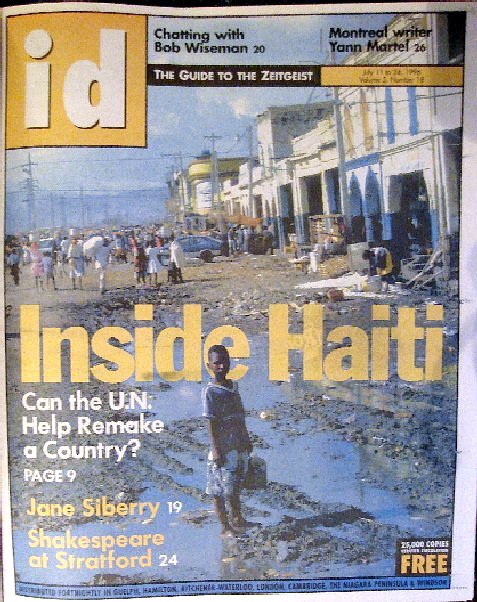
Measuring 7.0 in magnitude (http://en.wikipedia.org/wiki/2010_Haiti_earthquake), the quake killed over 212,000 people, injured 300,000 and affected more than 3 million out of Haiti’s population of 9 million. Hundreds of thousands have lost their homes and are now dependent on food aid to survive. Haiti is the poorest country in the western hemisphere, and is ranked 149th of 182 countries on the Human Development Index.

In the aftermath of the earthquake, communications were knocked out and it was difficult to grasp the scale of the disaster. Major infrastructure was either severely damaged or completely destroyed.

The public telephone system went down, and the two largest cell phone providers, Digicel and Comcel Haiti, were both disrupted. Most radio stations went off the air in the immediate aftermath and a week later, just 20 of the 50 stations in Port-au-Prince were back on air.

This represented the worst of all scenarios for disaster response: not only was the scale of the tragedy enormous, but existing government structures and the large international aid mission were equally badly hit. First responders and the government’s infrastructure were paralyzed in the hours after the disaster and it took some time for the aid response to build to significant levels.

But while communications were down in the country, outside it was a different story: people around the world were using the internet and mobile phones to begin piecing together the e-response to the earthquake.

After the disaster, technology-savvy volunteers around the world kicked into action to find ways to help. They have built software to aid in tracking people, using technology to map the disaster area and ways to use mobile phone text messages to find the missing.

Kenya’s Ushahidi (www.ushahidi.com) is a free software mashup (http://en.wikipedia.org/wiki/Mashup_%28web_application_hybrid%29) born after the post-election violence in Kenya in 2007 and 2008. It gathers citizen-generated crisis information – SMS (text messages), email or web resources – and then places the information on a map or timeline. It is put together by volunteers from Kenya, Ghana, South Africa, Malawi, the Netherlands and the United States.

Ushahidi’s founder is Kenyan Ory Okolloh, and the first version of the software for download is called “Mogadishu,” after the capital of Somalia.

It was put to use in Haiti (http://haiti.ushahidi.com/reports/submit) as users populated its online maps and timelines with information on the location of people in need of food and water, those trapped in rubble or those in need of medical attention. It is a real-time reporting system for people in a disaster, offering a way for people in need to broadcast to the outside world.

Sample reports on the timeline look like this (http://haiti.ushahidi.com/reports): ” SOS food, water and care needed in the Bertin Zone of Carrefour S.O.S. for the people of Carefour in the Bertin area, Titus Road, Froide River, these people haven’t recieved anything yet like water, food, care.”

“Alive under the Rubble of Bar Lakay Restaurant, Ave. Christophe 6633. Carole Joseph is alive under the rubble of the Bar Lakay restaurant on Avenue Christophe.”

The UN estimates there are more than 900 non-governmental organizations operating in Haiti. One of the best ways to try and coordinate this large aid response is through innovative information technology.

The Ushahidi software has spawned many creative variations to track a wide range of problems. In the Philippines, TXTpower (http://www.cp-union.com/ushahidi/) is put together by the Computer Professionals’ Union to keep an eye on mobile phone companies and their business practices. In Mexico, a mashup (http://www.cuidemoselvoto.org/) was put together for the 2009 federal elections. Stop Stockouts (http://stopstockouts.org/) keeps track of near real-time pharmacy and medical supplies in health facilities and pharmacies in Kenya, Uganda, Malawi and Zambia.

In San Diego, California, computer programmer Tim Schwartz quickly contacted his network of fellow programmers to address the problem of information being spread too widely across many web sources. In a few hours they put together http://www.haitianquake.com, a way for people to post and locate missing relatives.

It was online in less than 24 hours. It was followed by many other similar services and they were merged into a service eventually put together by Google called PersonFinder two days later. Google’s PersonFinder grew to have more than 32,000 missing people listed.

Another response has been Crisis Camps (http://crisiscampmiami.org/) in London England and cities across the United States. Technology workers got together to brainstorm relevant solutions to help the aid effort, and developed tools including Tweak the Tweet, Port Au Prince Basemap (up-to-date data on what his happening on the ground), The Haiti Timeline (developing a real-time history of events as they unfold), Family Reunification Systems, crisis wikis (http://crisiscommons.org/wiki/index.php?title=Crisis_Wiki), Mobile Applications 4 Crisis Response, translation (Creole to English for example), Mapping NGOs in Action (in the chaos of a crisis, this seeks to track what NGOs are working where), We Need, We Have Exchange (a way to post requests for resources or help).

“It really is amazing the change in the way crisis response can be done now,” Noel Dickover, a Washington, DC-based organiser of the Crisis Camp tech volunteer movement, told The Independent newspaper.

“Developers, crisis mappers and even internet-savvy folks can actually make a difference.”

Josh Nesbit is a co-creator of a text message service for mobile phones that is being used by international organizations like the United Nations and the Red Cross. Haitians are able to send free text messages from mobile phones on the country’s Digicel service. The messages include requests for water and food. The messages are organized and tagged with key words by volunteers in the Haitian community in New York City, and Haitian radio stations promote the service. It was developed based on similar systems already running in hospitals in Malawi.

In Haiti, mobile phone networks were back up and running within a few days – many within 24 hours. Haiti is poor, but it nonetheless has impressive mobile phone ownership rates: one-in-three people has one.

OpenStreetMap (http://www.openstreetmap.org/) is another excellent resource in a disaster and represents a significant step forward in helping people to respond. Real time data is uploaded to satellite photographs of the disaster area and people then can add updates on the location of working hospitals or where infrastructure has been damaged. The information comes in by many forms, from the micro-blogging service Twitter (www.twitter.com) to eyewitness reports.

Reports from Haiti have talked of rescue teams uploading the maps to their GPS (global positioning system) devices for easy access, or printing then in A4 form to carry around.

The utility of this service has been confirmed by many working on helping Haiti. “We have already been using their data in our initial post-disaster needs assessment,” Stuart Gill of the World Bank told The Independent.

Dutch mobile phone maker Intivation (http://www.intivation.nl/) is distributing for free solar-powered mobile phones in Haiti to help with aid efforts and is launching the phones for sale around the world as well.

Published: February 2010

Resources

1) SMS activism: A blog report on how people are using SMS text messaging in the developing world. Website: http://www.guardian.co.uk/katine/katine-chronicles-blog/2010/feb/02/mobile-phone-sms-uprising

2) The Magazine Popular Mechanics has excellent resources on how anyone can prepare their family and community for disasters. Website:http://www.popularmechanics.com/survival/

3) The US Government has extensive resources online on how to prepare for a wide variety of natural and man-made disasters. Website: http://www.fema.gov/areyouready/

4) UNICEF: Community-Based Disaster Preparedness Projects (CBDPs) in India have been helping communities restructure to survive when disaster strikes. Website:http://www.unicef.org.uk/campaigns

5) How to activate support from the global technology community in a disaster. Website: http://crisiscommons.org/

6) International Community on Information Systems for Crisis Response and Management: They will be having their conference on Defining Crisis Management 3.0 from May 2-5, 2010 in Seattle Washington USA. Website:http://www.iscram.org/

7) Telecoms Sans Frontiers: Focuses on providing communications in the first days after an emergency. Website: http://www.tsfi.org/

8) InSTEDD NGO: InSTEDD’s mission is to harness the power of technology to improve collaboration for global health and humanitarian action. An innovation lab for tools designed to strengthen networks, build community resilience and improve early detection and response to major health-related events and natural or human-caused disasters. Website: http://instedd.org/

9) Web mash-ups: Programmable Web website offers all the resources required to get started. Website: www.programmableweb.com/

https://davidsouthconsulting.org/2021/10/28/ending-gang-violence-while-cleaning-the-streets-in-haiti/

https://davidsouthconsulting.org/2021/01/08/haitian-coffee-becoming-a-hit-with-american-connoisseurs/

https://davidsouthconsulting.org/2021/10/28/milk-co-operatives-help-hungry-haiti/

https://davidsouthconsulting.org/2020/04/22/state-of-decay-haiti-turns-to-free-market-economics-and-the-un-to-save-itself/

Development Challenges, South-South Solutions was launched as an e-newsletter in 2006 by UNDP’s South-South Cooperation Unit (now the United Nations Office for South-South Cooperation) based in New York, USA. It led on profiling the rise of the global South as an economic powerhouse and was one of the first regular publications to champion the global South’s innovators, entrepreneurs, and pioneers. It tracked the key trends that are now so profoundly reshaping how development is seen and done. This includes the rapid take-up of mobile phones and information technology in the global South (as profiled in the first issue of magazine Southern Innovator), the move to becoming a majority urban world, a growing global innovator culture, and the plethora of solutions being developed in the global South to tackle its problems and improve living conditions and boost human development. The success of the e-newsletter led to the launch of the magazine Southern Innovator.  

Follow @SouthSouth1

Google Books: https://books.google.co.uk/books?id=p03–n51i44C&dq=development+challenges+april+2008&source=gbs_navlinks_s

Slideshare: http://www.slideshare.net/DavidSouth1/development-challengessouthsouthsolutionsapril2008issue

Southern Innovator Issue 1: https://books.google.co.uk/books?id=Q1O54YSE2BgC&dq=southern+innovator&source=gbs_navlinks_s

Southern Innovator Issue 2: https://books.google.co.uk/books?id=Ty0N969dcssC&dq=southern+innovator&source=gbs_navlinks_s

Southern Innovator Issue 3: https://books.google.co.uk/books?id=AQNt4YmhZagC&dq=southern+innovator&source=gbs_navlinks_s

Southern Innovator Issue 4: https://books.google.co.uk/books?id=9T_n2tA7l4EC&dq=southern+innovator&source=gbs_navlinks_s

Southern Innovator Issue 5: https://books.google.co.uk/books?id=6ILdAgAAQBAJ&dq=southern+innovator&source=gbs_navlinks_s

More on Haiti here: State Of Decay: Haiti Turns To Free-Market Economics And The UN To Save Itself

https://davidsouthconsulting.org/2022/11/01/southern-innovator-magazine-2010-2014/

Creative Commons License

This work is licensed under a
Creative Commons Attribution-Noncommercial-No Derivative Works 3.0 License.

ORCID iD: https://orcid.org/0000-0001-5311-1052.

© David South Consulting 2023

Categories
Archive data Development Challenges, South-South Solutions Newsletters Southern Innovator magazine

Enormous Potential for Nigerian Software Industry

By David SouthDevelopment Challenges, South-South Solutions

SOUTH-SOUTH CASE STUDY

Nigeria has an unfortunate global reputation as the home of 419 scams (http://en..wikipedia.org/wiki/Advance-fee_fraud). A typical 419 scam involves sending emails to people around the world in order to extort money from them. Online scams may show an unexpected technical sophistication for a country associated with poverty, but are a sign that some of Nigeria’s plentiful talents are being turned to illegal activities rather than building legitimate businesses.

Many argue that Nigeria is missing its potential to become an African legal software powerhouse. The Institute of Software Practitioners of Nigeria said the country’s annual consumption of software reached US $900 million in 2006, making it possibly Africa’s biggest market.

“Nigeria stands a good chance of dominating both the local and West African diaspora in a thriving global software market,” it argues.

Production of computer software is a major income earner for countries like the United States and India.

Many argue that Nigeria has enormous potential, if it can address some common problems: an absence of software quality assurance, poor investment in software development, poor product standards and a lack of proper documentation. In short: if Nigeria’s software industry takes on board global best practice, then it is sitting on a goldmine of legitimate business opportunities.

Chris Uwaje, president of the Institute of Software Practitioners of Nigeria (ISPON), told Business Day that the country’s software technology, if well retooled and strategically positioned for global competitiveness, could earn about US $10 billion annually from foreign software exchange.

He argued that developing the software industry would have many benefits for the population as a whole.

“Software has … become and will remain one of the fastest growing industries with power to enrich, and sustain national economies,” Uwaje said.

Some estimates put the world software industry and associated markets at US $1,300 billion, with 90 percent of the world’s software exports coming from the United States and Europe. Outside the U.S., U.K., Germany and Japan, the new and emerging countries within the software industry are India and China, and to a lesser extent Singapore and Malaysia.

According to market researcher DataMonitor, the worldwide software industry grew by 6.5 percent between 2007 and 2008.

DataMonitor forecasts that in 2013, the global software market alone will have a value of US $ 457 billion, an increase of 50.5 percent since 2008 (Datamonitor’s Software: Global Industry Guide).

Africa has a high proportion of entrepreneurs because people have next to no social supports to fall back on and need to do business to survive. Nigeria’s large youth population – 43.2 percent of the total – could be the driver of this new economy if used right.

Nigeria mostly imports software solutions despite having an extensive capacity in software development. If developed well, software could surpass oil as a revenue generator for the country.

According to A Profile of Nigeria’s Software Industry by H. Abimbola Soriyan and Richard Heeks, “A typical software company (in Nigeria) had between 11 and 50 customers (the average was 36 though a few firms involved with package installation had several thousand). There was a strong concentration among these customers. Almost all were private sector … There was a surprising lack of government/public sector organizations as customers (reflected above in the limited number of firms found in Abuja).”

Jimson Olufuye, president of the Information Technology Association of Nigeria (ITAN), believes that more needs to be done to support the software developers. And while on paper there is strong support for this sector in information technology policy, “In addition, we need to establish more IT parks with appropriate policies on infrastructure, human resources, incentives and business plan.”

Wahab Sarumi, chief executive officer of Wadof Software Consulting, explains the problem: “Indigenous software developers are an endangered species, abandoned by the government, neglected by its own people and bullied by the poachers from India, to whom Nigerian businesses rush to buy software applications to solve local business problems.”

Already, Nigerian software firms are offering existing off-the-shelf software that they custom package with local services. This recognizes software made in advanced countries isn’t entirely right for developing countries: and this is where business opportunities await for software developers.

But the key to success, at the end of the day, is to be the best solution on offer for the right price. James Agada, managing director of ExpertEdge Limited, believes people buy the best software for the task and don’t care where it comes from.

“If you want to sell software, the buyer does not buy the software alone, he buys the software, buys capacity to support the software, buys your capacity to improve on the software, he buys what he assumes is your mastery of the domain the software … the software must be able to compete favourably with its competitors.”

Published: February 2010

Resources

1) West Africa Trade Hub: A great resource for doing business in West Africa . Website:http://www.watradehub.com/index.php?option=com_content&task=view&id=1439

2) Rogue Economics: A website accompanying the book by Loretta Napoleoni on the illegal economic activities unleashed after the fall of communism. Website: http://www.lorettanapoleoni.com/

3) Towards an African E-Index: SMS e-Access and Usage Across 14 African Countries: A report from 2006 showing how small and medium African businesses increase income with ICTs. Website:http://mobileactive.org/research/towards-african-e-index-sms-e-access-and-usage-across-14-african-countries

4) Changing Dynamics of Global Computer Software and Services Industry: Implications for Developing Countries: A report from UNCTAD on how computer software can become the most internationally dispersed high-tech industry. Website:http://www.unctad.org/templates/webflyer.asp?docid=1913&intitemid=2529&lang=1

5) A Profile of Nigeria’s Software Industry by H. Abimbola Soriyan and Richard Heeks, Paper No 21, 2004, Development Informatics: Working Paper Series. Website: http://tinyurl.com/yh25dpa

6) Institute of Software Practitioners of Nigeria: A great contact point for finding legitimate software developers in Nigeria. Website: http://www.ispon.org/

7) Tech Soup: A great place to meet legitimate software developers and learn more. Website:http://home.techsoup.org/pages/default.aspx

https://davidsouthconsulting.org/2022/10/26/africa-to-get-own-internet-domain/

https://davidsouthconsulting.org/2021/03/20/computer-gold-farming-turning-virtual-reality-into-real-profits/

https://davidsouthconsulting.org/2020/12/11/cyber-cities-an-oasis-of-prosperity-in-the-south/

https://davidsouthconsulting.org/2020/12/04/data-surge-across-global-south-promises-to-re-shape-the-internet/

https://davidsouthconsulting.org/2020/12/11/false-data-makes-border-screening-corruptible/

https://davidsouthconsulting.org/2022/06/10/illiterate-get-internet-at-touch-of-a-button/

https://davidsouthconsulting.org/2022/10/04/popular-chinese-social-media-chase-new-markets/

Development Challenges, South-South Solutions was launched as an e-newsletter in 2006 by UNDP’s South-South Cooperation Unit (now the United Nations Office for South-South Cooperation) based in New York, USA. It led on profiling the rise of the global South as an economic powerhouse and was one of the first regular publications to champion the global South’s innovators, entrepreneurs, and pioneers. It tracked the key trends that are now so profoundly reshaping how development is seen and done. This includes the rapid take-up of mobile phones and information technology in the global South (as profiled in the first issue of magazine Southern Innovator), the move to becoming a majority urban world, a growing global innovator culture, and the plethora of solutions being developed in the global South to tackle its problems and improve living conditions and boost human development. The success of the e-newsletter led to the launch of the magazine Southern Innovator.  

Other stories from Development Challenges, South-South Solutions:

African Digital Laser Breakthrough Promises Future Innovation 

China Looking to Lead on Robot Innovation

Digital Mapping to put Slums on the Map

New Weapon Against Crime in the South

Follow @SouthSouth1

Google Books: https://books.google.co.uk/books?id=I_hcAwAAQBAJ&dq=development+challenges+october+2013&source=gbs_navlinks_s

Slideshare: http://www.slideshare.net/DavidSouth1/development-challenges-october-2013-issue

Southern Innovator Issue 1: https://books.google.co.uk/books?id=Q1O54YSE2BgC&dq=southern+innovator&source=gbs_navlinks_s

Southern Innovator Issue 2: https://books.google.co.uk/books?id=Ty0N969dcssC&dq=southern+innovator&source=gbs_navlinks_s

Southern Innovator Issue 3: https://books.google.co.uk/books?id=AQNt4YmhZagC&dq=southern+innovator&source=gbs_navlinks_s

Southern Innovator Issue 4: https://books.google.co.uk/books?id=9T_n2tA7l4EC&dq=southern+innovator&source=gbs_navlinks_s

Southern Innovator Issue 5: https://books.google.co.uk/books?id=6ILdAgAAQBAJ&dq=southern+innovator&source=gbs_navlinks_s

https://davidsouthconsulting.org/2021/03/05/southern-innovator-issue-1/

https://davidsouthconsulting.org/2021/03/05/southern-innovator-issue-2/

Creative Commons License

This work is licensed under a
Creative Commons Attribution-Noncommercial-No Derivative Works 3.0 License.

ORCID iD: https://orcid.org/0000-0001-5311-1052.

© David South Consulting 2023