Tag: 2009

  • Protecting Threatened Fruits and Nuts in Central Asia

    Protecting Threatened Fruits and Nuts in Central Asia

    By David SouthDevelopment Challenges, South-South Solutions

    SOUTH-SOUTH CASE STUDY

    Between 94,000 and 144,000 plant species — a quarter to a half of the world’s total — could die out in the coming years, according to an estimate by Scientific American (2002).  Among them are vital food crops, threatened by a world in which climate change is causing more weather turbulence and diseases and viruses can spread rapidly and destroy crops.

    This scale of plant loss risks leaving the world’s food security dependent on fewer – and more vulnerable – domesticated species. The hunt is on for hardy plant species that can survive these ups and downs while protecting the world’s food security for this and the next generation.

    In the Central Asian nations of Kyrgyzstan and Tajikistan, conservation of trees and their fruits and nuts are being placed at the centre of the economic lives of people who had been unwittingly destroying the trees’ habitat. Two projects, one to preserve walnut trees in Tajikistan, and the other to preserve apple trees in Kyrgyzstan, are beginning to bear fruit.

    The Red List of Trees of Central Asia published in April 2009 by the Global Trees Campaign (http://www.globaltrees.org/rl_centralasia.htm), identified the 44 species most at risk in Kyrgyzstan, Kazakhstan, Uzbekistan, Turkmenistan and Tajikistan. Growing in rugged, mountainous terrain, the plants have high genetic diversity and are thought to be critical in the development of disease-resistant and climate-tolerant fruit varieties.

    The diverse environments of Central Asia are host to over 300 wild fruit and nut species that are ancestors to the fruits and nuts we eat today, including wild apple, plum, pears, pistachios, cherry, apricot, and walnut.

    Many face extinction as local people — driven by the need for fire wood, or to earn an income — cut down this precious resource. The Red List estimates that over 90 percent of the trees in the fruit and nut forests across Central Asia have been destroyed in the past 50 years.

    The importance of these fruits and nuts can’t be over-emphasized: all the common varieties of apricot come from one living ancestor, the species Armeniaca vulgaris, now very rare in Central Asia. Central Asia’s Malus sieversii (http://en.wikipedia.org/wiki/Malus_sieversii) gave birth to today’s domestic apples. It spread its way around the world along the ancient Silk Road (http://en.wikipedia.org/wiki/Silk_Road). The name of Kazakhstan’s former capital city is Almaty (http://en.wikipedia.org/wiki/Almaty), which literally means ‘Grandfather of Apples’.

    Scientists have found genetic diversity and disease resistance greater in wild plant species that have not been domesticated, like Malus sieversii. Malus sieversii is highly resistant to Fire Blight (http://en.wikipedia.org/wiki/Fire_blight), a nasty disease that turns the fruits black (USDA).

    To stop this free-for-all in which resources are plundered to extinction and trees wiped out to be used for firewood, deals are being struck to guarantee local communities’ rights to exploit the trees as a resource, while also obligating them to preserve them.

    In Tajikistan, the walnut trade is a critical source of income for some villages, with most of the crop exported to Turkey. The country shares with Kyrgyzstan the world’s largest natural-growth walnut forest. But the use of short-term land leases discouraged long-term management, while local people were lacking any other sources of income and over-exploited the trees.

    Jilly McNaughton of British NGO Fauna and Flora International (www.fauna-flora.org), said the current situation “is not good, with use of the forest by local people both heavy and inadequately controlled.” “Collection of firewood and grazing are perhaps the biggest concerns,” she said. “There is very little natural regeneration of wild trees due to grazing and hay making in the forest. “As the walnut is valued as an income generating crop, other trees are cut for firewood and timber, meaning parts of the forest have become a park-like landscape with scattered large walnut trees.”

    Fauna and Flora International, which specializes in species preservation, is encouraging local people to work towards long-term leases and diversify their sources of income. The strategy includes encouraging other ways to make a living, including raising chickens, making clothes and bee keeping.

    As one villager said: “We have bought honey buckets and bees. Next year we will get a lot of honey – it will be a great income. We got a job.”

    The Red List of Trees found the causes of species’ destruction are multiple: over-exploitation, human development, pests and diseases, overgrazing, desertification and fires. Since the break up of the Soviet Union, funds have been short to help reverse these threats.

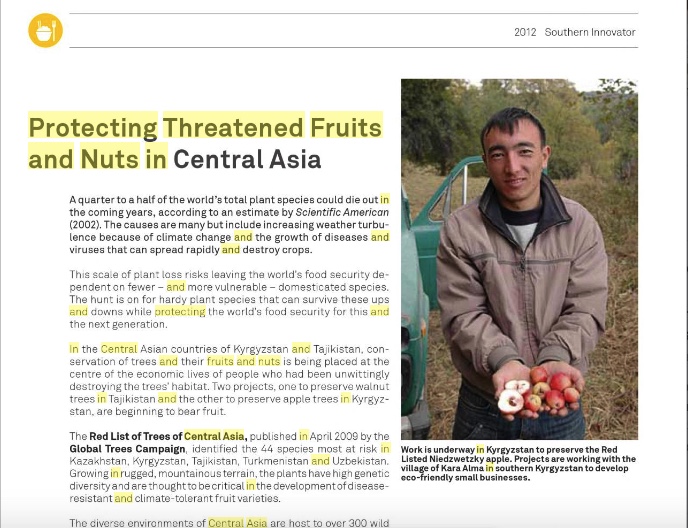
    The most threatened apple species in the Red List is the Niedzwetzky apple (Malus niedzwetzkyana) (www.globaltrees.org/kyrgyzstan_apple.htm).

    In Kyrgyzstan, work to preserve the Niedzwetsky apple is directly involving the community. Projects are working with the village of Kara Alma in southern Kyrgyzstan and government forest services to encourage eco-friendly small businesses to earn incomes and protect the forests.

    They have catalogued all 111 trees that still survive, and have set up a community-run nursery to grow more. The ambition is to expand this approach across the region, both preserving these great resources and bringing hope and employment to the people.

    Published: July 2009

    Resources

    • The Global Trees Campaign, a partnership between Fauna & Flora International, Botanic Gardens Conservation International and many other organisations around the world, aims to save threatened tree species through provision of information, conservation action and support for sustainable use. Website: www.globaltrees.org
    • The Red List of Trees of Central Asia: Has evaluated 96 of the region’s tree species, identifying 44 as globally threatened with extinction. Website: www.globaltrees.org/news_RLCA.htm
    • Association of Cities of Kyrgyz Republic. Website: www.citykr.kg/en/index.php
    • Planeta: One of the first ecotourism resources to go online (since 1994) and still offers plenty of information for those wanting to start a business. Website: www.planeta.com
    • Environmental Public Awareness Handbook: A thorough account with case studies of a successful two-year project in Mongolia to combine environmental protection with livelihoods. Website: http://tiny.cc/oZ9sA

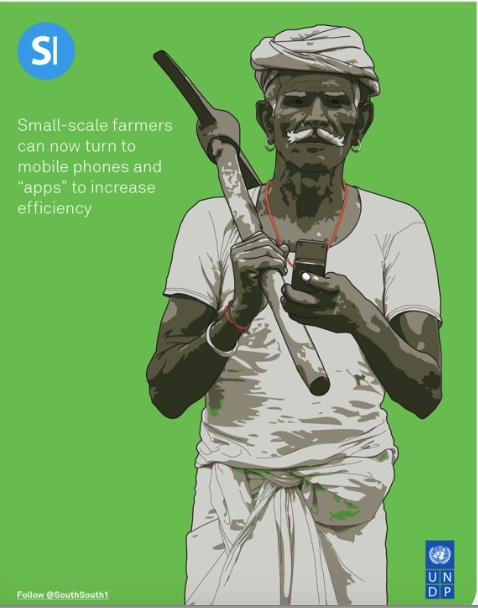
    Development Challenges, South-South Solutions was launched as an e-newsletter in 2006 by UNDP’s South-South Cooperation Unit (now the United Nations Office for South-South Cooperation) based in New York, USA. It led on profiling the rise of the global South as an economic powerhouse and was one of the first regular publications to champion the global South’s innovators, entrepreneurs, and pioneers. It tracked the key trends that are now so profoundly reshaping how development is seen and done. This includes the rapid take-up of mobile phones and information technology in the global South (as profiled in the first issue of magazine Southern Innovator), the move to becoming a majority urban world, a growing global innovator culture, and the plethora of solutions being developed in the global South to tackle its problems and improve living conditions and boost human development. The success of the e-newsletter led to the launch of the magazine Southern Innovator. 

    Creative Commons License

    This work is licensed under a
    Creative Commons Attribution-Noncommercial-No Derivative Works 3.0 License.

    ORCID iD: https://orcid.org/0000-0001-5311-1052.

    © David South Consulting 2023

  • New Appetite for Nutritious Traditional Vegetables

    New Appetite for Nutritious Traditional Vegetables

    By David SouthDevelopment Challenges, South-South Solutions

    SOUTH-SOUTH CASE STUDY

    Throughout the history of farming, around 7,000 species of plants have been domesticated. Yet everyday diets only draw on 30 percent of these plants and even this number has been going down as more people consume mass-market foods (FAO).

    One consequence has been poor nutrition resulting from the reduction in consumption of high-vitamin foods, leading to stunted mental and physical development across the global South.

    Once-rich culinary traditions have wilted and left many people not knowing what to do with formerly common vegetables and fruits, even if they can actually find them in markets.

    Between 94,000 and 144,000 plant species — a quarter to a half of the world’s total — could die out in the coming years, according to an estimate by Scientific American (2002). Among them are vital food crops, threatened by a world in which climate change is causing more weather turbulence and diseases and viruses can spread rapidly and destroy crops.

    This scale of plant loss risks leaving the world’s food security dependent on fewer – and more vulnerable – domesticated species.

    Despite being rich in vitamins, minerals and trace elements, African leafy vegetables have been overlooked in preference for cabbage, tomatoes, carrots, and other imported produce. But with rising food prices at local markets, people are looking again at these neglected African vegetables. In East Africa, this includes indigenous plants like amaranth (http://en.wikipedia.org/wiki/Amaranth), African eggplant, Ethiopian mustard, cowpea, jute mallow and spider plant.

    Like tomatoes and potatoes, some of these vegetables are members of the nightshade family — but unlike those imports, they are indigenous to Africa. According to Patrick Maundu of Bioversity International (http://www.bioversityinternational.org/), African nightshades provide good levels of protein, iron, vitamin A, iodine, zinc, and selenium at seven times the amounts derived from cabbage. The high levels of vitamins and micronutrients, he says, are especially important to people at risk of malnutrition and disease, particularly HIV/AIDS.

    As the cost for basic foodstuffs have shot up during the global economic crisis, growing food has become an increasingly lucrative source of income. Estimates of the number of people doing this across Africa range from hundreds of thousands to millions.

    In the bid to reduce the over-dependence on imported foods, urban farming is coming to the rescue and becoming an effective survival tactic in Africa’s fast-growing cities. Thousands of urban workers in Kenya’s capital, Nairobi, are supplementing their wages by investing in farms growing food.

    Eunice Wangari, a nurse in Kenya, supplements her US $350/month salary with money earned from growing food. “For too long our country has been flooded with imported food and westernized foods,” Wangari told The Guardian newspaper. “This is our time to fight back – and grow our own.”

    In Kenya, this type of agriculture usually involves an urbanite taking a stake in farmland outside the city. Relatives then do the farming. Mobile phones play a key role in this approach. The urban dweller can keep in touch with the farm by phone and receive updates on progress. They use their knowledge of urban food tastes to then adjust the crops and increase profits.

    An accountant, James Memusi in Nairobi, is growing mushrooms in a spare bedroom in his home and then selling them to hotels and supermarkets, according to The Guardian. Miringo Kinyanjui is selling unrefined maize and wheat. Loved for its nutritional qualities, the flour is also flavoured with amarathan, a common green vegetable in Kenya.It is a clever way to make the most of the fact that many urban dwellers have some access to land in the countryside.

    Pride is also returning to the topic of food, as people re-discover traditional foods and vegetables and fruits.

    In Liberia, president Ellen Johnson-Sirleaf has launched a “Back to the Soil” campaign to get urban dwellers to farm and help the country lose its dependence on foreign food imports.

    Liberia is trying to reduce the importing of rice and tomatoes.

    In Zambia, the embracing of traditional foods has been fuelled by recipes used by a chain of popular restaurants. This appetite has driven demand for dried pumpkins, ‘black jack’ leaves and fresh okra.

    The success of this revival of traditional foods has attracted big multinationals as well. Unilever Kenya ran a campaign in 2008 called ‘taste our culture,’ promoting African herbs and spices.

    Published: November 2009

    Resources

    1) The Global Trees Campaign, a partnership between Fauna & Flora International, Botanic Gardens Conservation International and many other organisations around the world, aims to save threatened tree species through provision of information, conservation action and support for sustainable use. Website: http://www.globaltrees.org

    2) World Vegetable Center: The World Vegetable Center is the world’s leading international non-profit research and development institute committed to alleviating poverty and malnutrition in developing countries through vegetable research and development. Website: http://www.avrdc.org/

    3) Sylva Professional Catering and College: A well-known Zambian food entrepreneur who runs a range of businesses, including restaurants, a cooking school and a guest house. Website: http://sadcbiz.com/countries/zambia/categories/index.htm

    4) Marketing African Leafy Vegetables: Challenges and Opportunities in the Kenyan Context By Kennedy M. Shiundu and Ruth. K. Oniang. Website: http://www.ajfand.net/Issue15/PDFs/8%20Shiundu-IPGR2_8.pdf

    Development Challenges, South-South Solutions was launched as an e-newsletter in 2006 by UNDP’s South-South Cooperation Unit (now the United Nations Office for South-South Cooperation) based in New York, USA. It led on profiling the rise of the global South as an economic powerhouse and was one of the first regular publications to champion the global South’s innovators, entrepreneurs, and pioneers. It tracked the key trends that are now so profoundly reshaping how development is seen and done. This includes the rapid take-up of mobile phones and information technology in the global South (as profiled in the first issue of magazine Southern Innovator), the move to becoming a majority urban world, a growing global innovator culture, and the plethora of solutions being developed in the global South to tackle its problems and improve living conditions and boost human development. The success of the e-newsletter led to the launch of the magazine Southern Innovator. 

    Creative Commons License

    This work is licensed under a
    Creative Commons Attribution-Noncommercial-No Derivative Works 3.0 License.

    ORCID iD: https://orcid.org/0000-0001-5311-1052.

    © David South Consulting 2023

  • African Countries Re-branding for New Economic Role

    African Countries Re-branding for New Economic Role

    By David SouthDevelopment Challenges, South-South Solutions

    SOUTH-SOUTH CASE STUDY

    Africa’s diverse countries have been subject to years of negative stories in the media. The effect on global audiences has left many to cast the whole continent in a bad light and to know little about the individual countries and cultures.

    This has damaged business confidence over the years. Just like products and people, nations need to have a strong and positive brand to do well in the global economy. Nation branding, the process by which countries alter people’s perceptions, has taken hold in Africa as the continent seeks to reverse the bad vibes.

    South Africa is the continent’s leader in nation-branding, and countries including Nigeria, Kenya and Ghana are newly pursuing it. South Africa’s ‘Proudly South African’ (http://www.proudlysa.co.za/) campaign is known around the world.

    The past decade has seen economic growth and rising tourism in many African countries. But the reality that many people around the world can’t tell the difference between most African countries, or have mostly negative impressions formed from news reports, means they are unaware of the positive developments and opportunities.

    Author and researcher Simon Anholt, in his book Brand New Justice, claims Africa’s biggest obstacle to growth is the image of the continent itself. He argues that in a globalized world it is the responsibility of good governments to understand, measure, and exercise control over a country’s reputation if it is to prosper. However, he has criticized nation-branding if it is just a marketing strategy without substantial changes to how things are done in a country.

    And it is clear the winners in nation re-branding will be the countries that prove on the ground that they are changing and living up to the fine words and catchy phrases.

    In Nigeria’s Lagos State (www.lagosstate.gov.ng), Governor Babtunde Fashola – known as ‘Nigeria’s Obama’ – has launched a campaign to turn around the country’s long-standing reputation for corruption. Using the slogan Good People, Great Country, the city of Lagos has set itself ambitious goals that are dependent on significant increases in investment.

    Lagos wants the city to be transformed into a place anyone can do business and be attractive to tourists.

    The city has seen its population triple in the last 50 years and is on track to be the third largest city in the world by 2015. Thinking long term, plans are in place for the city to eventually be home to 40 million people.

    Critics are blunt about their hostility to the re-branding exercise: “How do you re-brand a product when the content stinks?” asked Akinola M.A. on news website Mynaija News. “I can’t understand the meaning of this project when basic facilities like good roads, water and electricity are virtually not available.”

    Supporters say the governor’s strategy is based on action, not words. Investment is going into a Rapid Bus Transit (BRT) system, traffic management, security, street lighting, beautification, and public-private partnerships to improve services.

    “Nigeria cannot wait until it solves all her problems before it can stand to give serious thought to re-branding its battered image,” Nigeria’s information minister Dora Akunyili told Online Nigeria. “This is because our development is tied to our image. This negative perception has had destructive effects on our people and stymied our growth and national progress.”

    Showing the power of trans-African approaches, the Wisdom Keys Group, a Nigerian company founded in South Africa (http://www.wkg.co.za/network.html) and working in 16 countries with partners, was contracted to do the campaign.

    As the pioneer of brand power in Africa, South Africa’s International Marketing Council (http://www.imc.org.za/) heads a relentless campaign to engage an international audience and expatriate South Africans. It is a sharp, multi-media outfit tackling every aspect of South Africa’s domestic and international reputation. Products include e-newsletters, campaigns to lure back expert South Africans, a vast network of web content, and a highly targeted advertising and marketing campaign that lures businesses and tourists to the airport (via ads on taxis and in subways) and on to flights to South Africa.

    For Kenya (http://www.brandkenya.go.ke/), the focus is on instilling pride within the country. As Kenyan media consultant Kwendo Opanga told the Nation Branding website, “it is not branding Kenya for foreigners that is difficult. It is branding Kenyans for Kenya and Kenya for Kenyans that is a tough call.”

    “We even work with the school system to ensure that this is in the curriculum so that children are told that they need to start living dignified lives.”

    Rwanda, despite experiencing a horrific genocide in 1994, is gaining attention for turning its image around. It has taken a different approach and has targeted building powerful networks of support around the world to make deals. As Rwandan government adviser Elaine Ubalijoro told FastComany, “How do you take a country that’s been through hell and bring it to security and prosperity? This is about healing, and this is about hope. We think it can be done.”

    The Rwandan strategy is hinged on exploiting a global network of high-profile and powerful contacts that includes former British Prime Minister Tony Blair, Starbucks CEO Howard Schultz and Google chief Eric Schmidt. The results include a training programme where British civil servants work in Rwanda. Starbucks, meanwhile, has become one of the top purchasers of Rwandan coffee.

    Ghana’s newly launched Brand Ghana office was set up to coordinate the development of an engaging national image for the country. Its head, Mathias Akotia, told Nation Branding: “We are in competition with other nations for attention, wealth, tourism and for the export of products. Country branding is about the management of our national identity and values in a way that will take us forward.”

    Still in the early stages of re-branding, Ghana plans to hold a national summit to draft a plan and identify the country’s values and identity.

    Branding is not merely slogans and catch phrases. Word-of-mouth can radically change a country’s image, and its prospects. The international magazine Monocle (www.monocle.com), a publication that prides itself on spotting the next big thing, has highlighted the East African nation of Burundi (http://en.wikipedia.org/wiki/Burundi) as the place to watch. The magazine thinks that by reinventing itself as a place of tourism, coffee and oil, with some of Africa’s best inland beaches and a wealth of art-deco architecture recalling Miami’s South Beach area, Burundi can distance itself from past conflict and become a must-see destination. At present, 80 percent of its earnings come from coffee and tea exports. It is hoping to become a tourist and transport hub with a new port, linking central and east Africa.

    As the magazine says, “Bujumbura has got all the substance – and architecture – required to turn Burundi’s backwater capital into an African success story, and the country’s upcoming elections are a chance to create lasting peace after 15 years of civil war. But corruption could still derail the dream.”

    The Nation Branding website (http://www.nation-branding.info/) (“everything about nation branding and country brands”) is the place to visit for all those interested in nation branding, country brands and how countries can improve their image abroad. Upcoming nation branding events can be found here: http://www.nationbrandingevents.com/nationbranding.

    Published: November 2009

    Resources

    1) Monocle Magazine: Launched in February 2007, Monocle is a global briefing covering international affairs, business, culture and design. Developed for an international audience hungry for information across a variety of sectors, the magazine is a consistent champion of Southern countries and their economic opportunities. Website: http://www.monocle.com/

    2) A BBC radio documentary on Nigeria’s experience of nation branding. Website: http://www.bbc.co.uk/worldservice/documentaries/2009/html

    3) Brandchannel: The world’s only online exchange about branding, packed with resources, debates and contacts to help businesses intelligently build their brand. Website: www.brandchannel.com

    4) Small businesses looking to develop their brand can find plenty of free advice and resources here. Website: www.brandingstrategyinsider.com

    5) Catwalk for Africa: A fashion show taking place from December 4-6, 2009 in Tunisia. Website: http://www.catwalkforafrica.com/accueil/accueil_en.php

    https://davidsouthconsulting.org/2022/11/11/african-breakthroughs-to-make-life-better/

    https://davidsouthconsulting.org/2022/11/20/african-bus-to-tackle-african-roads/

    https://davidsouthconsulting.org/2022/11/19/african-culture-as-big-business/

    https://davidsouthconsulting.org/2022/10/20/african-hotel-boom-bringing-in-new-investment-and-creating-jobs/

    https://davidsouthconsulting.org/2022/11/17/african-ingenuity-attracting-interest/

    https://davidsouthconsulting.org/2022/11/15/african-innovators-celebrated-in-prize/

    https://davidsouthconsulting.org/2022/10/21/african-media-changing-to-reach-growing-middle-class/

    https://davidsouthconsulting.org/2022/11/02/african-online-supermarket-set-to-boost-trade/

    https://davidsouthconsulting.org/2023/01/16/african-theatre-becomes-european-success/

    https://davidsouthconsulting.org/2022/10/20/african-tourism-leads-the-world-and-brings-new-opportunities/

    https://davidsouthconsulting.org/2022/11/22/happy-nigeria-west-african-nation-has-good-attitude/

    https://davidsouthconsulting.org/2022/10/20/online-education-could-boost-african-development/

    https://davidsouthconsulting.org/2022/10/18/woman-wants-african-farming-to-be-cool/

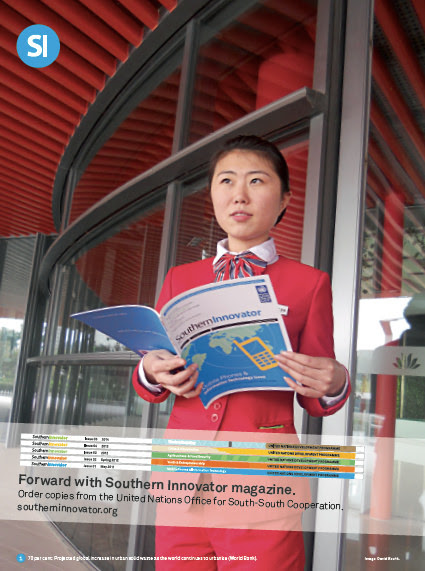
    Development Challenges, South-South Solutions was launched as an e-newsletter in 2006 by UNDP’s South-South Cooperation Unit (now the United Nations Office for South-South Cooperation) based in New York, USA. It led on profiling the rise of the global South as an economic powerhouse and was one of the first regular publications to champion the global South’s innovators, entrepreneurs, and pioneers. It tracked the key trends that are now so profoundly reshaping how development is seen and done. This includes the rapid take-up of mobile phones and information technology in the global South (as profiled in the first issue of magazine Southern Innovator), the move to becoming a majority urban world, a growing global innovator culture, and the plethora of solutions being developed in the global South to tackle its problems and improve living conditions and boost human development. The success of the e-newsletter led to the launch of the magazine Southern Innovator. 
    https://davidsouthconsulting.org/2021/03/05/southern-innovator-issue-2/

    Creative Commons License

    This work is licensed under a
    Creative Commons Attribution-Noncommercial-No Derivative Works 3.0 License.

    ORCID iD: https://orcid.org/0000-0001-5311-1052.

    © David South Consulting 2022

  • Rickshaw Drivers Prosper with New Services

    Rickshaw Drivers Prosper with New Services

    By David SouthDevelopment Challenges, South-South Solutions

    SOUTH-SOUTH CASE STUDY

    The rickshaw is the world’s oldest form of wheeled transportation and forms a significant part of India’s transport infrastructure. In large cities across Asia, 1 million three-wheeled auto-rickshaws form an important means of daily transportation and a vital source of income for their drivers. There are 8 million cycle rickshaws on the streets of India, the government says. They perform many tasks: as taxis, as couriers, as goods movers. And the Indian government promotes cycle rickshaws as a non-polluting alternative.

    But rickshaw drivers in India struggle with a bad image despite being a critical component of the transport infrastructure. They work 12 to 18 hour days, are paid poorly, and are subject to frequent abuse from passengers and other drivers in the crowded and stressful streets.

    Many of the men working as rickshaw drivers have left behind families in villages. Because their main home is elsewhere, many just eat, sleep and live next to the roadside.

    An innovative company is taking this important service into the 21st century, and in turn boosting income and benefits for the drivers and restoring their dignity. Based in Delhi, Sammaan (www.sammaan.org), meaning dignity, has developed a sophisticated business model that offers a wide range of services to rickshaw passengers – drinks for sale, mobile phone chargers, courier collections, music, magazines/newspapers, first aid and outdoor advertising and marketing – along with professional treatment of the drivers, providing them with a uniform, identity card, bank accounts, profit sharing and insurance. The drivers pay a small maintenance fee of 10 rupees a day (US 20 cents) for renting the rickshaws. It is common in the rickshaw industry in India for drivers to rent their vehicles on a daily basis – 95 percent do so.

    Drivers get the full fare from a ride, while they share the profits from the sales of goods with Sammaan (http://uk.youtube.com/watch?v=yUuP16fyTjM).

    Sammaan’s founder, 27-year-old Irfan Alam, from the Indian state of Bihar, had the inspiration for his business idea when he was thirsty and riding in a rickshaw. He knew the rickshaw driver made very little money after he paid his rent for the rickshaw. And so he thought about how drivers could increase their income. Why couldn’t they sell drinks, or newspapers or mobile phone cards, he thought?

    As well, since they travel more than 6 miles a day on average, why not deliver things and host advertisements on the rickshaws?

    Sammaan’s idea is to fully modernize the rickshaw business: an important goal considering it makes up 30 percent of urban transport in India. By turning rickshaws into mobile advertising and marketing vehicles, income is substantially increased, while offering services builds loyalty from passengers.

    In order to improve the quality of life for drivers, Sammaan also offers free evening classes for the drivers and their children.

    Sammaan’s rickshaws are custom designed to allow for ample space to display the paid-for advertisements. This has proved a highly competitive way to do outdoor advertisements: it is 90 percent cheaper than advertising billboards and other campaigns. The fact the rickshaws go everywhere – from urban back streets to rural areas – makes it an effective way to reach all corners of India.

    The rickshaws for the passengers are no more expensive than rickshaws with no services. And passengers are even covered by insurance if there is an accident.

    Sammaan currently has hundreds of rickshaws running in Noida, Ghaziabad , Patna , Agra , Meerut , Gurgaon and Chandigarh .

    The company also is planning to offer phone services in the rickshaws and the ability to pay utility bills while riding inside.

    “We are also in advanced talks with Zandu Pharmaceuticals, Coca Cola and Dabur, and are hopeful of getting advertising contracts from them,” Alam told The Economist magazine. Sammaan expects to make Rs 10,000 to 15,000 (US $204 to US $307) a year from a single rickshaw.
    Alam is part of a new breed in India: he is not from an established business family, but is nonetheless well educated. Many educated Indians are turning to entrepreneurship instead of becoming a corporate drone in a big company. This is being called a revolution in middle-class aspirations.

    India has long-standing entrepreneurial traditions: merchant community the Marwari baniyas (http://en.wikipedia.org/wiki/Marwaris) are famed for their business acumen. But the new entrepreneurs have different aspirations and inspirations. They look to technology pioneers like Infosys (http://www.infosys.com/) and hire people based on merit and professionalism, not family connections.

    The hot areas for this new breed of entrepreneur are technology, entertainment, human resources and education.

    Alam’s rickshaws are made out of fiberglass for tourist towns with paved roads, and a rugged version out of iron for places with poor road conditions.

    Another initiative to modernize the rickshaw business has come from India’s Centre for Scientific and Industrial Research (CSIR) (http://www.csir.res.in/), which has developed a state-of-the-art, solar powered version of the humble cycle-rickshaw.

    The “soleckshaw” is a motorized cycle rickshaw that can be pedalled normally or run on a 36-volt solar battery.

    The makeover includes FM radios and power points for charging mobile phones during rides.

    The “soleckshaw,” which has a top speed of 15 kilometres (9.3 miles) per hour, has a sturdier frame and foam seats for up to three people.

    The fully-charged solar battery will power the rickshaw for 50 to 70 kilometres (30 to 42 miles). Used batteries can be deposited at a centralized solar-powered charging station and replaced for a nominal fee.

    Published: January 2009

    Resources

    • India’s National Entrepreneurship Network (NEN) promotes the spirit of enterprise on the country’s campuses and has a contest to pick the top 30 Indian hot start-ups. Website: http://www.nenonline.org/
    • Indian venture capital firm Helion Ventures invests in start-ups. Website: www.helionvc.com
    • TATA NEN Hottest Startups — India’s first ever people’s choice awards. Hottest Startups will identify, showcase and support the highest-potential young companies in India. Websitehttp://www.hotteststartups.in/http://www.hotteststartups.in/shortlistedStartupsHome.do?        method=fetch&businessFn=shortlistedStartupsHome
    • Tukshop is a website selling auto rickshaws and tuk-tuks. Website: http://www.tukshop.biz/
    • A wide range of auto rickshaws for sale. Website: http://www.auto-rickshaw.com/
    • The Hybrid Tuk Tuk Battle is a competition to come up with less polluting auto rickshaws, clean up the air in Asian cities, and improve the economic conditions for auto rickshaw drivers. Website: http://hybridtuktuk.com/

    Citations:

    As cited in A Sociological Approach to Health Determinants by Toni Schofield (2015).

    https://davidsouthconsulting.org/2022/11/21/asia/

    https://davidsouthconsulting.org/2022/09/29/cheap-indian-tablet-seeks-to-bridge-digital-divide/

    https://davidsouthconsulting.org/2022/02/17/digital-mapping-to-put-slums-on-the-map/

    https://davidsouthconsulting.org/2022/10/20/the-e-reader-battle-reaches-india/

    https://davidsouthconsulting.org/2022/10/09/entrepreneurs-use-mobiles-and-it-to-tackle-indian-traffic-gridlock/

    https://davidsouthconsulting.org/2022/10/12/free-magazine-boosts-income-for-rickshaw-drivers/

    https://davidsouthconsulting.org/2022/06/10/illiterate-get-internet-at-touch-of-a-button/

    https://davidsouthconsulting.org/2022/09/27/india-2-0-can-the-country-make-the-move-to-the-next-level/

    https://davidsouthconsulting.org/2022/10/25/indian-city-slum-areas-become-newly-desirable-places-to-live/

    https://davidsouthconsulting.org/2021/03/04/indian-id-project-is-foundation-for-future-economic-progress/

    https://davidsouthconsulting.org/2022/06/15/indian-mobile-phone-application-innovators-empower-citizens/

    https://davidsouthconsulting.org/2022/11/01/indian-newspapers-thrive-with-economy/

    https://davidsouthconsulting.org/2022/10/06/indian-solar-power-pack-powers-villages/

    https://davidsouthconsulting.org/2022/10/18/indians-fighting-inflation-with-technology/

    https://davidsouthconsulting.org/2022/06/10/info-ladies-and-question-boxes-reaching-out-to-the-poor/

    https://davidsouthconsulting.org/2022/03/29/model-city-to-test-the-new-urbanism-concept-in-india/

    https://davidsouthconsulting.org/2022/10/09/a-new-mobile-phone-aimed-at-the-poor/

    https://davidsouthconsulting.org/2021/03/31/new-weapon-against-crime-in-the-south/

    Development Challenges, South-South Solutions was launched as an e-newsletter in 2006 by UNDP’s South-South Cooperation Unit (now the United Nations Office for South-South Cooperation) based in New York, USA. It led on profiling the rise of the global South as an economic powerhouse and was one of the first regular publications to champion the global South’s innovators, entrepreneurs, and pioneers. It tracked the key trends that are now so profoundly reshaping how development is seen and done. This includes the rapid take-up of mobile phones and information technology in the global South (as profiled in the first issue of magazine Southern Innovator), the move to becoming a majority urban world, a growing global innovator culture, and the plethora of solutions being developed in the global South to tackle its problems and improve living conditions and boost human development. The success of the e-newsletter led to the launch of the magazine Southern Innovator. 
    Creative Commons License

    This work is licensed under a
    Creative Commons Attribution-Noncommercial-No Derivative Works 3.0 License.

    ORCID iD: https://orcid.org/0000-0001-5311-1052.

    © David South Consulting 2023