Categories
Archive Development Challenges, South-South Solutions Newsletters Southern Innovator magazine

Tiny Homes to Meet Global Housing Crisis

By David SouthDevelopment Challenges, South-South Solutions

SOUTH-SOUTH CASE STUDY

More than 1 billion people around the world lack decent shelter. Of these, the majority live in urban areas, usually in slums and informal settlements (UN-HABITAT).

The world’s megacities – like Mumbai, India, where more than 22 million live in the metropolitan region – have to find a way to provide housing that is both affordable and does the minimum possible amount of harm to the environment.

About one-third of the world’s urban dwellers live in slums, and the United Nations estimates that the number of people living in such conditions will double by 2030 as a result of rapid urbanization in developing countries.

The fast pace of growth of India’s cities presents an enormous challenge: how to house so many people with dignity and to a good standard. India’s city slums are notorious and recently became the subject of the Oscar-winning film Slumdog Millionaire (http://www.slumdogmillionairemovie.co.uk/).

With a population of 1.2 billion, India needs to find 25 million homes a year to meet current demand, according to McKinsey and Co.

Housing prices have risen by 16 percent a year for the past four years. While the middle class – estimated at over 300 million people – has piled into high-end apartments and houses, it has been the country’s low-income people who have been frozen out of the option of quality homes.

The concept of targeting those at the ‘bottom of the pyramid’ (BOP) (http://en.wikipedia.org/wiki/The_Fortune_at_the_Bottom_of_the_Pyramid) has drawn attention to the estimated 23 million poor urban dwellers in India, and 180 million rural families, who have savings and want to own a home. Monitor India (http://www.monitor.com/in/) believes these people have annual earnings between US $1,400 and US $3,000.

The Indian manufacturing powerhouse Tata – which this year launched a BOP-focused car, the Tata Nano – has designed and is building, Nano Homes – small apartments outside Mumbai for US $8,600 (http://tatahousing.in/pages/home.php). It also hopes to expand to other major Indian cities as well.

The Nano homes are built on a modest scale: there are three sizes with the smallest measuring 67 square metres. They consist of a single room that doubles as a bedroom by night with a sink, bath and toilet behind a partition.

Criticisms include location – on the edges of major cities – where residents would have to commute long distances to get to their jobs.

Even so, Nano apartments are so popular buyers are being chosen by lottery.

“India’s housing crisis lies in the fact that the poor in the cities are priced out of the market,” Sundar Burra, an adviser to the Society for the Promotion of Area Resource Centre, a Mumbai-based housing rights organization, told Canada’s Globe and Mail newspaper.

“State supply of housing for the poor is woefully inadequate in relation to the need. Slums proliferate as a solution to this state of affairs.”

People can get a mortgage for the homes from Tata Home Finance.

Tata is not the only company targeting this market. India’s Matheran Realty (http://www.tmcity.in/) is building what it claim is India’s largest affordable housing project, Tanaji Malusare City, in the villages of Shirse and Akurle of Karjat (http://en.wikipedia.org/wiki/Karjat). The 15,000 homes would house 70,000 people and would sell for US $4,698.

Another developer, Godrej Properties (http://www.godrejproperties.com/), is building a BOP housing development outside the city of Ahmedabad with apartments costing US $11,749.

“(Property) developers have recognized that the real demand no longer lies in the premium segment and are opting to build smaller, no-frills apartments,” said Deepak Parekh of the Housing Development Finance Corporation (http://www.hdfcindia.com/).

It estimates the affordable housing market will be worth US$ 110 billion in India by 2013 and will account for 80 percent of India’s housing market.

“Affordable housing is not about box-sized, budget homes in far-flung places where there is no connectivity to workplaces and little surrounding infrastructure,” Parekh told HDFC’s shareholders. “Affordable housing has to be able to cut across all income segments and has to make economic sense in terms of proximity to the workplace.”

Published: November 2009

Resources

1) Building and Social Housing Foundation: BSHF is an independent organisation that works both in the UK and internationally to identify innovative housing solutions and to foster the exchange of information and good practice. Website: http://www.bshf.org/home.cfm

2) Tiny House Design Blog: The blog is full of ideas and plans for making small homes cheaply. Website: http://www.tinyhousedesign.com/

3) A blog detailing the Tata dwellings in diagrams and photographs. Website: http://www.tslr.net/2009/06/tatas-nano-homes.html

https://davidsouthconsulting.org/2022/05/23/debt-free-homes-for-the-poor/

https://davidsouthconsulting.org/2021/11/12/energy-efficient-wooden-houses-are-also-earthquake-safe/

https://davidsouthconsulting.org/2022/10/26/making-bamboo-houses-easier-to-build/

https://davidsouthconsulting.org/2021/02/12/rammed-earth-houses-china-shows-how-to-improve-and-respect-traditional-homes/

https://davidsouthconsulting.org/2021/02/12/rebuilding-after-chinese-earthquake-beautiful-bamboo-homes/

https://davidsouthconsulting.org/2022/11/19/securing-land-rights-for-the-poor-now-reaping-rewards/

https://davidsouthconsulting.org/2017/11/08/smart-cities-up-close-2013/

https://davidsouthconsulting.org/2022/05/23/solar-bottle-bulbs-light-up-dark-homes/

https://davidsouthconsulting.org/2022/09/26/3d-home-printing-landmark-10-houses-in-a-day/

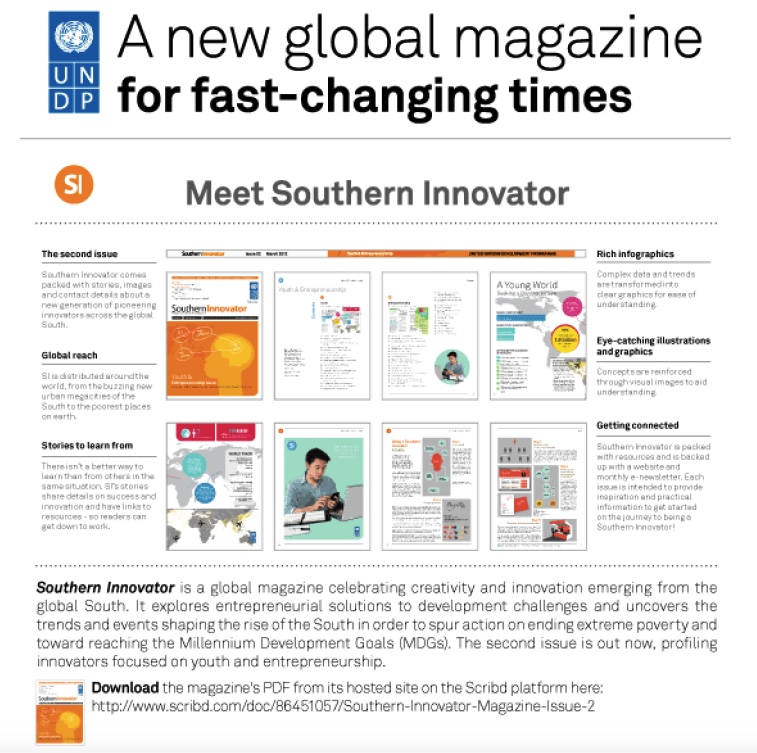
Development Challenges, South-South Solutions was launched as an e-newsletter in 2006 by UNDP’s South-South Cooperation Unit (now the United Nations Office for South-South Cooperation) based in New York, USA. It led on profiling the rise of the global South as an economic powerhouse and was one of the first regular publications to champion the global South’s innovators, entrepreneurs, and pioneers. It tracked the key trends that are now so profoundly reshaping how development is seen and done. This includes the rapid take-up of mobile phones and information technology in the global South (as profiled in the first issue of magazine Southern Innovator), the move to becoming a majority urban world, a growing global innovator culture, and the plethora of solutions being developed in the global South to tackle its problems and improve living conditions and boost human development. The success of the e-newsletter led to the launch of the magazine Southern Innovator. 

Creative Commons License

This work is licensed under a
Creative Commons Attribution-Noncommercial-No Derivative Works 3.0 License.

ORCID iD: https://orcid.org/0000-0001-5311-1052.

© David South Consulting 2023

Categories
Archive Development Challenges, South-South Solutions Newsletters Southern Innovator magazine

Berber Hip Hop Helps Re-ignite Culture and Economy

By David SouthDevelopment Challenges, South-South Solutions

SOUTH-SOUTH CASE STUDY

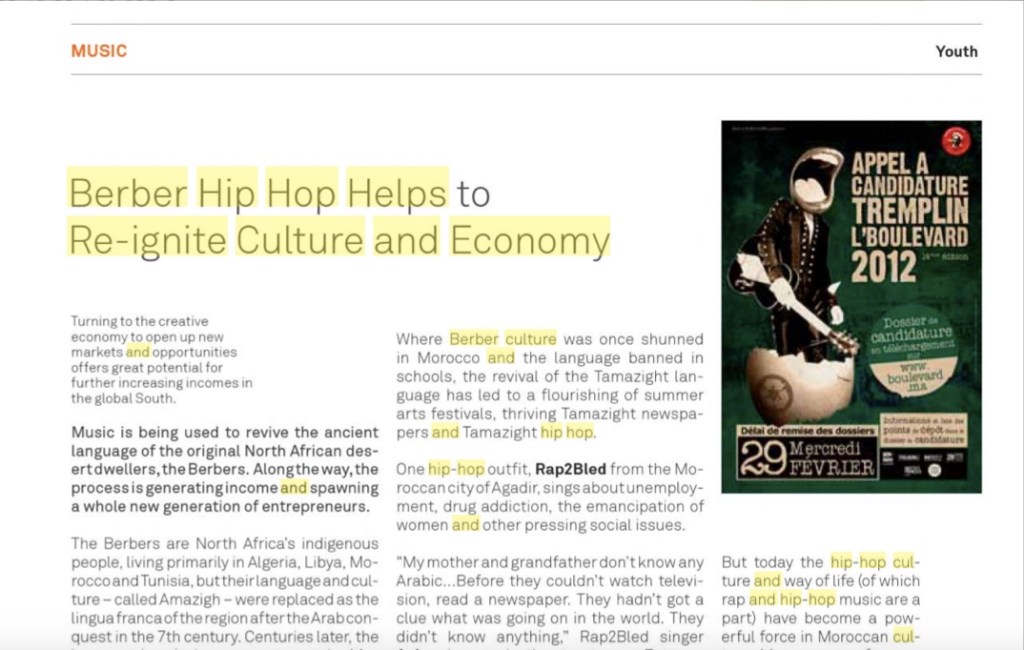
Music is being used to revive the ancient language of the original North African desert dwellers, the Berbers (http://en.wikipedia.org/wiki/Berber_people). And in the process, it is spawning a whole new generation of entrepreneurs and generating income. 

The Berbers are North Africa’s indigenous people, primarily living in Morocco, Algeria, Libya, and Tunisia, but their language and culture – called Amazigh – were replaced as the lingua franca of the region after the Arab conquest in the 7th century. But all these years later, the language is enjoying resurgence under Morocco’s king, Mohammed VI, who is helping to promote the language through television programming and a new law making teaching of the language compulsory in schools by 2010.

Amazigh people – the name means “free humans” or “free men” – total more than 50 million. Their group languages, called Tamazight, are spoken by several million people across North Africa, with the largest number in Morocco.

For young Moroccans, promoting the language is more interesting when hip hop (http://en.wikipedia.org/wiki/Hip_hop_music) is thrown into the mix. 

Where once Berber culture was shunned in Morocco and the language banned in schools, the revival of the Tamazight language has led to a flourishing of summer arts festivals, thriving Tamazight newspapers _ and Tamazight hip hop.

One hip-hop outfit, Rap2Bled from the Moroccan city of Agadir, stick to social issues, singing about unemployment, drug addiction and the emancipation of women.

“My mother and grandfather don’t know any Arabic…Before they couldn’t watch television, read a newspaper. They hadn’t got a clue what was going on in the world. They didn’t know anything,” Rap2Bled singer Aziz, who goes by the street name Fatman, told to Radio Netherlands Worldwide.

“But now there is a TV channel in our local dialect and a newspaper. But our aim is to put the language on the map by fusing it with hip hop. More than 60 per cent of young Moroccans only listen to rap and western music. So we thought why not fuse Berber with that and make it really accessible?”

Just 10 years ago, rap and hip hop were virtually unknown in Morocco, with only a small group of hip hop aficionados listening to big American stars like Dr Dre, Tupac Shakur and Notorious BIG.

But today hip hop culture and way of life (of which rap and hip hop music are a part) have become a powerful force in Moroccan culture. Moroccan rap focuses on local issues like unemployment and injustice and is ubiquitous on radio and TV.

The Casa Crew, from Casablanca, has become so successful since their beginnings in 2003 that their fan base stretches to Spain and Algeria.

“First of all, to designate rap simply as mere ‘music’ deprives it of its real impact,” Caprice from the Casa Crew (http://casa-crew-00.skyrock.com/), told the Arab Media News, Menassat. 

“Rap is a life style, and mainly a culture of convictions. The fact that rap is spreading in countries like Morocco is an excellent sign. On the one hand, it’s proof that the youth are starting to react, to think they have the right to express themselves in any way they see fit, without anyone judging them or denying them of that right. On the other hand, the development of rap means that the space for artistic freedom is growing particularly when considering that a majority of Arab rappers are dealing with subjects that we were forbidden to speak about a few years ago.”

The Amazigh revival industry centres around large music festivals. Timitar Festival in Agadir (http://www.moroccofestivals.co.uk/timitar.html) gets crowds surpassing 500,000, with more than 40 artists. Morocco’s biggest festival helps Amazigh artists meet world musicians and learn how to reach music fans outside of Morocco.

Another pioneer of Morocco’s music industry is Mohamed ‘Momo’ Merhari, a young music entrepreneur and winner of the British Council’s International Young Music Entrepreneur of the Year award in 2008 (http://www.creativeconomy.org.uk/).

Momo is a music consultant and co-founder of the “Boulevard des Jeunes Musiciens” (http://www.boulevard.ma/), the largest contemporary music festival in North Africa, featuring 50 bands over four days, and reaching a live audience of 130,000 people. The annual event showcases new talent from the worlds of hip hop, rock and jazz fusion from all over the region.

In January, Morocco’s culture minister Touriya Jabrane promised to introduce a range of measures to financially support Moroccan musicians, composers and the industry as whole.

Published: March 2009

Resources

https://davidsouthconsulting.org/2022/10/02/african-afro-beats-leads-new-music-wave-to-europe/

https://davidsouthconsulting.org/2022/11/17/cashing-in-on-music-in-brazil/

https://davidsouthconsulting.org/2022/12/18/disabled-congolese-musicians-become-world-hit/

https://davidsouthconsulting.org/2021/11/09/mauritanian-music-shop-shares-songs-and-friendship/

https://davidsouthconsulting.org/2020/12/17/mongolias-musical-entrepreneurs-led-way-out-of-crisis-2018/

https://davidsouthconsulting.org/2023/02/07/mongolian-rock-and-pop-book-mongolia-sings-its-own-song/

https://davidsouthconsulting.org/2021/11/09/ring-tones-and-mobile-phone-downloads-are-generating-income-for-local-musicians-in-africa/

https://davidsouthconsulting.org/2021/11/09/taxis-promote-african-music-beats/

https://davidsouthconsulting.org/2020/11/24/too-black/

Development Challenges, South-South Solutions was launched as an e-newsletter in 2006 by UNDP’s South-South Cooperation Unit (now the United Nations Office for South-South Cooperation) based in New York, USA. It led on profiling the rise of the global South as an economic powerhouse and was one of the first regular publications to champion the global South’s innovators, entrepreneurs, and pioneers. It tracked the key trends that are now so profoundly reshaping how development is seen and done. This includes the rapid take-up of mobile phones and information technology in the global South (as profiled in the first issue of magazine Southern Innovator), the move to becoming a majority urban world, a growing global innovator culture, and the plethora of solutions being developed in the global South to tackle its problems and improve living conditions and boost human development. The success of the e-newsletter led to the launch of the magazine Southern Innovator. 

Creative Commons License

This work is licensed under a
Creative Commons Attribution-Noncommercial-No Derivative Works 3.0 License.

ORCID iD: https://orcid.org/0000-0001-5311-1052.

© David South Consulting 2023

Categories
Archive Development Challenges, South-South Solutions Newsletters

African Online Supermarket Set to Boost Trade

By David SouthDevelopment Challenges, South-South Solutions

SOUTH-SOUTH CASE STUDY

Online retailing and marketing strategies are revolutionizing how people around the world buy products and services – but so far they have not benefited most of Africa’s small businesses and traders. On a continent where trading for survival is the norm, very few people are reaping the benefits of selling on the Internet.

Not only has limited access to the Internet and the lack of high bandwidth in Africa impeded communication within the continent, it has restricted African businesses from taking advantage of the most profound change in global business for decades: e-retailing (also known as e-tailing or e-commerce).

But the African information technology pioneers of Ghana – a country that has already gained a reputation as an IT leader in West Africa (www.ghanaictawards.com) – are setting out to change this situation, and in turn to change the way people access African goods and services.

Pledging in its motto to reach “every African nook and cranny,” ShopAfrica53 is an online shopping portal similar to famous brands like Amazon or eBay, but focused entirely on giving African traders the ability to sell across the continent and to the world online.

The one-stop shopping site – taking its name from the 53 countries on the continent – can be accessed by Internet users, or better still, by the enormous number of mobile phone users not only in Africa but around the world.

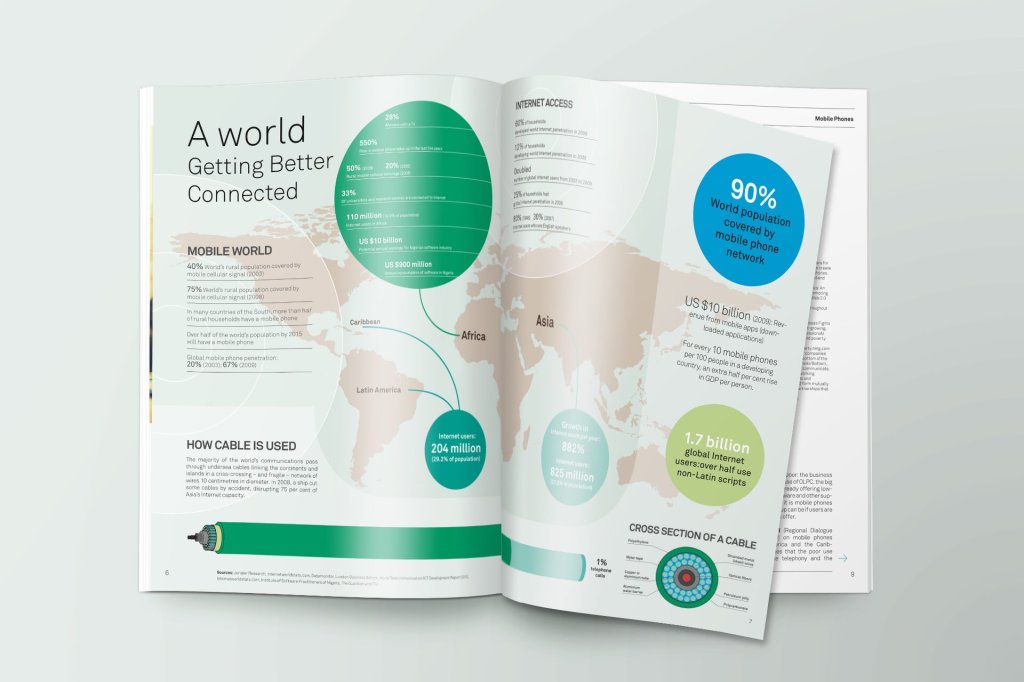
The number of mobile phone subscribers in Africa surpassed 300 million in 2008 (ITU), representing a significant market in their own right. Research group Informa Telecoms and Media estimates mobile networks now cover 90 per cent of the world’s population – 40 per cent of whom are covered but not connected.

ShopAfrica53 works like this: merchants first fill out an online form on the ShopAfrica53 website. They are then contacted by ShopAfrica, and an account is set up.

People wanting to buy goods and services on the website use the African Liberty Card to ensure the transactions are safe and not at risk from hackers and fraudsters. The disposable pre-paid scratch card can be used on mobile phones and the Internet and is purchased from store outlets.

ShopAfrica handles the logistical hassles of shipping to customers around the world, facilitates payment transfers, and helps with record keeping for merchants.

ShopAfrica offers an eclectic selection of goods: apparel and accessories, books and stationery, groceries, handicraft, health and personal care, home and garden, machinery and tools, technology and entertainment. It promises to offer the “best selection of African products, anywhere, worldwide” – everything from building supplies, household items and electronics to processed foods and fabrics.

One Ghanaian merchant, Mohammed Salifu, promises to deliver in two days a “large brown cow for delivery or collection. The size, colour and weight of animal will vary. This merchant provides live goats, sheep, cattle for special occasions and festivities and can also provide a slaughtering service for clients.”

Then there is Vera Ami Kpogli, who is selling a ‘Beyonce’ Electric Blue necklace. Tse-Lee Fashions offers Batik/Tie and Dye Print Shirt in aqua and navy. And for the ‘king’ of the house, Ama Afrique Designs is selling Men’s Royal Rulers, sandals “worn many centuries ago by African kings.”

The potential of this service to boost incomes is considerable: in the United Kingdom, online sales now make up 15 percent of all retail spending, reaching £43.8 billion (US $66.12 billion) in 2008 (IMRG).

As has been seen with other countries of the Global South, trade in high quality goods boosts incomes. South-South trade grew by an average of 13 percent per year between 1995 and 2007. By 2007, South-South trade made up 20 percent of world trade. And over a third of South-South commerce is in high-skill manufacturing. Making finished goods, rather than just selling raw materials, improves workers’ skill levels and increases the return on trade.

The rapid changes to African countries – the tilt to being more urban than rural, and being home to a larger urban population than North America, with 25 of the world’s fastest growing cities (International Institute for Environment and Development) – means there is an urgent need to boost incomes and better connect traders and manufacturers to the global economy.

ShopAfrica53 could be the start of a very big thing for African trade.

Published: May 2009

Resources

  • The red dot logo stands for belonging to the best in design and business. The red dot is an internationally recognised quality label for excellent design that is aimed at all those who would like to improve their business activities with the help of design.
    Website: www.red-dot.de
  • BOP Source is a platform for companies and individuals at the BOP (bottom of the pyramid) to directly communicate, ultimately fostering close working relationships, and for NGOs and companies to dialogue and form mutually valuable public-private partnerships that serve the BOP.
    Website: http://bopsource.ning.com/
  • Business Fights Poverty: Business Fights Poverty is the free-to-join, fast-growing, international network for professionals passionate about fighting world poverty through good business.
    Website: businessfightspoverty.ning.com
  • Dutch Design in Development: As a matchmaker, DDiD puts together European clients, Dutch designers and small and medium-sized enterprises in developing countries. The designers share their knowledge of European consumer tastes, product development, design and quality standards
    Website: www.ddid.nl
  • Afriville is a Web 2.0 service and an African Caribbean social network. Afriville is a community website along the lines of the famous MySpace. Users are free to message and post profiles. The difference is that the user is able to choose how closed or open the networks are. The site features a state of the art music management system which allows African and Caribbean artists to get straight in touch with their fans.
    Website: www.afriville.com
  • Business Action for Africa: Business Action for Africa is an international network of businesses and business organisations from Africa and elsewhere, coming together in support of three objectives: to positively influence policies for growth and poverty reduction, to promote a more balanced view of Africa, and to develop and showcase good business practice in Africa
    Website: www.businessactionforafrica.org
  • Interactive Media in Retail Group (IMRG) is a membership community for the e-retail industry, whose vision is to maximise the commercial potential of online shopping
    Website: www.imrg.org

https://davidsouthconsulting.org/2021/03/20/accessing-global-markets-via-design-solutions/

https://davidsouthconsulting.org/2022/06/02/afghanistans-juicy-solution-to-drug-trade/

https://davidsouthconsulting.org/2022/10/26/african-trade-hub-in-china-brings-mutual-profits-2/

https://davidsouthconsulting.org/2021/03/20/carbon-markets-need-to-help-the-poor/

https://davidsouthconsulting.org/2022/11/21/chinese-trade-in-angola-helps-recovery/

https://davidsouthconsulting.org/2021/03/20/computer-gold-farming-turning-virtual-reality-into-real-profits/

https://davidsouthconsulting.org/2022/04/12/djibouti-re-shapes-itself-as-african-trade-hub/

https://davidsouthconsulting.org/2021/07/19/global-south-trade-boosted-with-increasing-china-africa-trade-in-2013/

https://davidsouthconsulting.org/2020/12/12/mobile-phone-shopping-to-create-efficient-markets-across-borders/

https://davidsouthconsulting.org/2021/12/08/new-media-markets-and-screen-finance/

https://davidsouthconsulting.org/2022/10/26/perfume-of-peace-helps-farmers-switch-from-drug-trade/

https://davidsouthconsulting.org/2022/10/04/popular-chinese-social-media-chase-new-markets/

https://davidsouthconsulting.org/2021/07/19/south-south-trade-helping-countries-during-economic-crisis/

https://davidsouthconsulting.org/2022/11/17/sos-shops-keep-food-affordable-for-poor-unemployed/

https://davidsouthconsulting.org/2022/11/16/thai-organic-supermarkets-seek-to-improve-health/

https://davidsouthconsulting.org/2022/10/20/trade-to-benefit-the-poor-up-in-2006-and-to-grow-in-2007/

https://davidsouthconsulting.org/2020/04/17/virtual-supermarket-shopping-takes-off-in-china/

https://davidsouthconsulting.org/2022/10/05/women-empowered-by-fair-trade-manufacturer/

https://davidsouthconsulting.org/2022/06/16/women-mastering-trade-rules/

Development Challenges, South-South Solutions was launched as an e-newsletter in 2006 by UNDP’s South-South Cooperation Unit (now the United Nations Office for South-South Cooperation) based in New York, USA. It led on profiling the rise of the global South as an economic powerhouse and was one of the first regular publications to champion the global South’s innovators, entrepreneurs, and pioneers. It tracked the key trends that are now so profoundly reshaping how development is seen and done. This includes the rapid take-up of mobile phones and information technology in the global South (as profiled in the first issue of magazine Southern Innovator), the move to becoming a majority urban world, a growing global innovator culture, and the plethora of solutions being developed in the global South to tackle its problems and improve living conditions and boost human development. The success of the e-newsletter led to the launch of the magazine Southern Innovator. 

https://davidsouthconsulting.org/2021/03/05/southern-innovator-issue-2/

Creative Commons License

This work is licensed under a
Creative Commons Attribution-Noncommercial-No Derivative Works 3.0 License.

ORCID iD: https://orcid.org/0000-0001-5311-1052.

© David South Consulting 2023

Categories
Archive Development Challenges, South-South Solutions Newsletters Southern Innovator magazine

Rainforest Gum Gets Global Market

By David SouthDevelopment Challenges, South-South Solutions

SOUTH-SOUTH CASE STUDY

Mexico is home to the second largest rainforest in the Americas after the Amazon jungle. But the country’s forests face serious threats from logging, cattle ranching and agriculture. As much as 80 percent of Mexico’s original forests have already been lost.

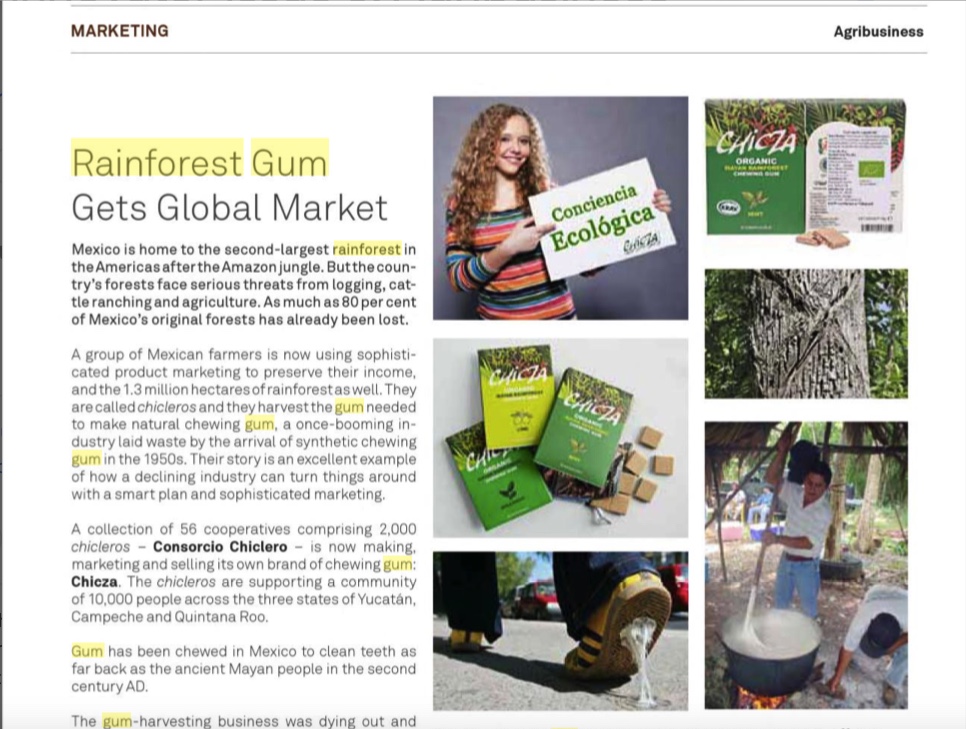
A group of Mexican farmers is now using sophisticated product marketing to preserve their income, and the 1.3 million hectares of rainforest as well. They are called chicleros and they harvest the gum needed to make natural chewing gum, a once-booming industry laid waste by the arrival of synthetic chewing gum in the 1950s. Their story is an excellent example of how a declining industry can turn things around with a smart plan and sophisticated marketing.

A collection of 56 cooperatives comprising 2,000 chicleros – called Consorcio Chiclero – is now making, marketing and selling its own brand of chewing gum: Chicza (http://www.chicza.com/index.php). The chicleros are supporting a community of 10,000 people across the three states of Yucatán, Campeche and Quintana Roo.

Gum has been chewed in Mexico to clean teeth as far back as the ancient Mayan people in the second century AD.

The gum harvesting business was dying out and young people, put off by the low pay, were leaving for jobs elsewhere. The adminstrators of the chiclero co-operative created Chicza Rainforest Gum brand to save the industry. They made a deal with Britain’s Waitrose supermarket chain, which specializes in fair trade products, and the gum is being launched in 100 stores.

The brightly coloured packages of chewing gum are now being sold as organic and a way to preserve the forest. Frustrated by the decades of decline and attendant poverty and community decay, the chicleros decided to take matters into their own hands. Five years ago they decided to avoid the middlemen who would buy their raw gum products, and instead manufacture and market the chewing gum themselves. And it is paying off: by adding value to the raw product, each farmer’s income has grown six times higher than he would earn as a mere provider of raw material.

The gum comes in three flavours: wild mint, heirloom lime and spearmint. Future flavours will blend tropical fruits, herbs and spices.

The Consorcio Chiclero coordinates the production, the logistics, the trade and the finances for the manufacture of gum from the chicozapote tree (Manilkara zapota).

Certified organic, the Chicza gum is completely natural and free of synthetic ingredients and also biodegrades when it is discarded – a boon to city governments who hate the mess and cost of traditional gum left on sidewalks.

The farmers work in the rainforest at the southern end of Mexico’s Yucatan peninsula (http://en.wikipedia.org/wiki/Yucat%C3%A1n_Peninsula), bordering Guatemala and Belize. It is a place with one of the most bio diverse ecosystems in the world, and an environment the farmers are in harmony with. The chicle gum (http://en.wikipedia.org/wiki/Chicle) is harvested from chicozapote trees – some living for more than 300 years – by hacking z-shaped cuts into the bark of the 100 foot trees. The harmless cuts zig zag down the tree and a bucket is placed at the bottom to collect the dripping sap.

Once collected, the sap is boiled, dried and made into a sticky paste, which is then kneaded and shaped into bricks called marquetas. Each marqueta is carefully marked by its maker. Since the sustainable management of their rainforests is certified by FSC (Forest Stewardship Council) (http://www.fsc.org/), these marks contain relevant information that tells the name of the chiclero who harvested it, and the exact location of the harvested tree in the rainforest. Few products offer such perfect traceability.

“I started following my dad around the rainforest when I was 10 and working when I was 12,” farmer Porfirio Banos told The Guardian newspaper. “I am a chiclero to my core.”

Working in a remote area of rainforest jungle with just spider monkeys for company, the chicleros are paid by the amount of chicle harvested

“We don’t kill the trees like farmers do when they clear land to grow corn or graze cattle,” says Roberto Aguilar, 60. “We leave a wound, it’s true, but eight years after it is healed and producing chicle again.”

The chicleros face two main risks while doing the job: falling from the trees if their rope gives out; and being bitten by poisonous snakes.

Chicle was once the basis of all commercial chewing gum. Beginning in New York 141 years ago, it was the only source for chewing gum until the 1950s, when synthetic substitutes destroyed the industry.

It was the economic desperation of a Mexican general, Antonio Lopez de Santa Anna, living in exile in the United States in 1869, that gave birth to gum-chewing as a global practice. Working with a local inventor, Thomas Adams, he tried to use the chicle to make a rubber substitute. But when this failed, Adams added sugar and flavouring, making chewing gum.

Apart from being a great chew, the natural gum’s unique selling point is saving money: local governments tight for cash are looking for other ways to deal with the menace of chewing gum on pavements. A small fortune is spent every year trying to keep streets clean of gum. The British alone spend over UK £150 million every year trying to clean their streets of chewing gum.

And despite the global recession, the chicleros are optimistic they can do well: during the Great Depression of the 1930s, chewing gum was an affordable treat and sold well.

Published: April 2009

Resources

https://davidsouthconsulting.org/2022/11/10/acai-berry-brazils-boon/

https://davidsouthconsulting.org/2022/11/10/brazilian-restaurant-serves-amazonian-treats/

https://davidsouthconsulting.org/2022/10/17/connoisseur-chocolate-from-the-south-gets-a-higher-price/

https://davidsouthconsulting.org/2022/11/01/indonesian-food-company-helps-itself-by-making-farmers-more-efficient/

https://davidsouthconsulting.org/2022/10/24/latin-american-food-renaissance-excites-diners/

https://davidsouthconsulting.org/2022/10/31/rainforest-rubbers-save-lives/

https://davidsouthconsulting.org/2022/11/10/saving-the-amazon-forest-while-making-a-living/

https://davidsouthconsulting.org/2022/10/17/west-african-chocolate-success-story/

Development Challenges, South-South Solutions was launched as an e-newsletter in 2006 by UNDP’s South-South Cooperation Unit (now the United Nations Office for South-South Cooperation) based in New York, USA. It led on profiling the rise of the global South as an economic powerhouse and was one of the first regular publications to champion the global South’s innovators, entrepreneurs, and pioneers. It tracked the key trends that are now so profoundly reshaping how development is seen and done. This includes the rapid take-up of mobile phones and information technology in the global South (as profiled in the first issue of magazine Southern Innovator), the move to becoming a majority urban world, a growing global innovator culture, and the plethora of solutions being developed in the global South to tackle its problems and improve living conditions and boost human development. The success of the e-newsletter led to the launch of the magazine Southern Innovator. 

https://davidsouthconsulting.org/2021/03/05/southern-innovator-issue-3/

Creative Commons License

This work is licensed under a
Creative Commons Attribution-Noncommercial-No Derivative Works 3.0 License.

ORCID iD: https://orcid.org/0000-0001-5311-1052.

© David South Consulting 2022