Tag: 2008

  • Decent and Affordable Housing for the Poor

    Decent and Affordable Housing for the Poor

    By David SouthDevelopment Challenges, South-South Solutions

    SOUTH-SOUTH CASE STUDY

    Urban populations across the South are growing fast: by 2030, some 5 billion people around the world will live in cities. This year will be the first year in which urban dwellers (3.3 billion people) will outnumber rural residents for the first time (UNFPA).

    Africa now has a larger urban population than North America and 25 of the world’s fastest growing big cities. Asia and Africa’s cities are growing by an incredible 1 million people a week, with 72 per cent of the population in sub-Saharan Africa living in slum conditions.

    How well people dwell is integral to their mental and physical health. Most squatters and slum dwellers – a category that includes half the urban population of Africa, a third in Asia and a fourth in Latin America and the Caribbean – live in makeshift homes made from whatever they can get their hands on. These dwellings are usually unsafe and vulnerable to fire, floods, and earthquakes. On top of this, these sprawling slums can be depressingly grim to look at for those living there.

    In Brazil’s Sao Paulo neighbourhood of Heliopolis – the largest of the city’s 400 favelas, or shantytowns – the majority of its dwellings are made from cement and brick. It is stigmatised as the ugliest part of the city, yet a unique initiative has transformed perceptions of the area – and brought pride to its residents. The project offers a model for slum areas looking to make the next leap up the ladder of development. Heliopolis first sprang up in the 1970s, wedged between highways and roads. Plagued by crime, there is a wide spread in incomes and urbanisation among the 120,000 residents packed into the one-and-a-half square mile. Older parts have many services, while newer areas lack basics like plumbing and electricity.

    Well-known Sao Paulo-based Brazilian architect Ruy Ohtake (http://www.geocities.com/capitolhill/3836/saopaulo.html) mobilised the 6,000 residents to use a fixed palette of six colours – from bright yellow to deep purples – to create a look described as akin to an Italian hill town.

    “Ohtake told a newspaper that Heliopolis was the ugliest part of the city, so we went to him and asked him to figure out how to make it beautiful,” Geronino Barbosa, director of the Heliopolis community group UNAS, told the design magazine Dwell.

    Ohtake, famous for his hotel designs and renovating former colonial areas, rose to the challenge: “I believe in beauty as a social function, so what better way to exercise that belief,” he said. To avoid the initiative feeling like something being imposed from on high, the plan did not go ahead until the residents were happy. And to make sure they felt they owned the results, they did all the painting themselves. The result is a river of colour running through a landscape of dreary, unfinished brick homes jammed between streets and factories. The Italian hill town-effect leaves pedestrians experiencing a surprise as they turn through the streets, happening upon hidden plazas and little bars.

    “Our dream is to expand this project to the entire favela,” said Barbosa. “People love their painted houses. One of our participants told me that her house has been transformed into a sort of Carnival parade.”

    “Who doesn’t want to live in a beautiful house?” said UNAS’ head, Joao Miranda, to Dwell. “We want the same things as everyone else.”

    Another architect has tackled the problem of how to create inexpensive but durable and beautiful homes for the poor. Iranian-born architect Nader Khalili (http://www.calearth.org/) has created what he calls ‘super adobe’ dwellings inspired by traditional Iranian rural homes. The cone-shaped homes are made from sandbags piled one on top of the other in a circular pattern. A basic home is three rooms of 400 square feet, and can be built by five people (with only one needing skills), within weeks. Being sandbags, the homes can easily be dismantled and moved or adapted to meet new space needs.

    Khalili first fell in love with the sand adobe homes of Iran in the 1970s. He had been on a journey to find a home design that was both environmentally harmonious and could be built anywhere in the world quickly and cheaply. But while the original Iranian sand adobe is easily destroyed by earthquakes and bad weather, the ‘super adobes’ are earthquake, hurricane and flood resistant. They are now being built across the Americas , Asia and Africa.

    “You can never build one of these that doesn’t look beautiful,” he said. “Just as you have never seen an ugly tree or an ugly flower.”

    Published: January 2008

    Resources

    • Builders Without Borders: Is an international network of ecological builders who advocate the use of straw, earth and other local, affordable materials in construction. Website: http://builderswithoutborders.org/
    • World Hands Project: An NGO specialising in simple building techniques for the poor. Website:http://www.worldhandsproject.org
    • Tsunami-Safe House: A design for Prajnopaya Foundation: a project coordinated by the SENSEable City Laboratory, a new research initiative between the Department of Urban Studies and Planning and the Media Lab at the Massachusetts Institute of Technology in Boston. Website:http://senseable.mit.edu/tsunami-prajnopaya/
    Creative Commons License

    This work is licensed under a
    Creative Commons Attribution-Noncommercial-No Derivative Works 3.0 License.

    ORCID iD: https://orcid.org/0000-0001-5311-1052.

    © David South Consulting 2021
  • Milk Co-operatives Help Hungry Haiti

    Milk Co-operatives Help Hungry Haiti

    By David SouthDevelopment Challenges, South-South Solutions

    SOUTH-SOUTH CASE STUDY

    The global food crisis has hit the impoverished Caribbean country of Haiti especially hard. Already suffering from decades of food crises brought on by the collapse of domestic farming, the country has become notorious for its people being reduced to eating cakes made of mud to stave off hunger pains. It is the poorest country of Latin America and the Caribbean and one of the poorest in the world.

    Haiti imports some 52 percent of its food, including over 80 percent of its rice. Local food production only covers 43 percent of the country’s demand and food aid supplies only 5 percent of its needs. Of the estimated 9.8 million Haitians, 5.1 million live on less than US $1 a day and 7.6 million on less than US $2 a day. At current prices, one dollar buys only half a meal per day (Source: United Nations Country Team in Haiti).

    Haiti’s problems are made worse by a global food crisis. So-called agflation (agricultural inflation) has seen spiralling food prices around the world, which in turn are causing food shortages, hunger and malnutrition. On international commodity markets, food prices have gone up 54 percent over the last year, with cereal prices soaring 92 percent (FAO – World Food Situation). U.N. Secretary General Ban Ki-moon has called for food production to increase 50 percent by 2030 just to meet rising demand – and right now there are 862 million people worldwide who are undernourished (FAO).

    In Haiti, most agriculture is done on a small scale by about 700,000 family farmers. Few belong to any production association or mechanism to market and distribute their products, and local produce has been pushed out of the market by imports.

    Subsidized U.S. rice began flooding in 30 years ago, becoming so cheap that Haitians began eating it instead of the corn, sweet potatoes, cassava and domestic rice they grew. The U.S. imports drove rice farmers out of business and incited a rural exodus that swelled the slums of the capital, Port-au-Prince. That dependence on imports has caused dangerous food insecurity. Today, the U.S. rice that is the staple of many Haitians’ diet has doubled in price in little more than a year.

    “The problem is that Haiti doesn’t have the land to give every peasant family enough to allow them to make a living,” said Bernard Etheart, head of the National Institute for Agrarian Reform. Etheart estimates that if all arable land was planted, each farmer would have no more than half a hectare, or 1.25 acres.

    A cooperative of dairy farmers is doing its bit to revive domestic production of milk products and reduce the crippling costs of importing milk for Haiti. Importing 85,000 tonnes of milk from Europe and the United States costs Haiti US $40 million a year. A walk through the capital, Port-au-Prince, will reveal how much milk is imported in one form or another: tiny cans of evaporated milk are sold in the street markets, while the wealthy can buy powdered and long-life milk in the air conditioned supermarkets of the upscale neighbourhood of Petionville.

    Dairy production in Haiti was in decline for 20 years until, in 2002, the country ceased to produce any milk at all. The urgent need for milk in Haiti is shown in the average consumption: per child, only 110 ml is consumed per day. In Uruguay, for example, it is 520 ml a day (190 litres per head of population per year).

    Lèt Agogo (Creole for Unlimited Milk) is a cooperative using small-scale farmers to bring milk to the hungry. Founded by the NGO Veterimed six years ago, it now has a network of 13 dairies across the island.

    Lèt Agogo is hoping to get Haiti’s milk production up to 145,000 tons a year from the current 45,000 tons. So far, the product’s single biggest client is the Haitian government. It buys bottles of sterilized milk below cost and distributes them to 130,000 school children in 44 government-funded schools. Dr. Michel Chancy told the Miami Herald that the government would like to expand the distribution to 800 schools.

    “Haiti is a country where we consume a lot of milk,” said Chancy, a veterinarian and one of the visionaries behind Lèt Agogo. “After rice, milk is the second-largest import.”

    At present, Haiti has 500,000 dairy cows out of more than a million head of cattle. The problem came down to marketing and distributing the dairy products. With no structure in place, few farmers bothered milking their animals. But by the end of 2007, 600 farmers had joined the network and 400 producers in dairy product making and grass pasture management. In 2007, they turned 540,000 litres into yoghurt and sterilised milk that can stay on the shelf for six to nine months without refrigeration. Made from sterilized milk, the yogurt comes in 280 ml bottles and sells in stores throughout the country and has a shelf life of nine months.

    The farmers have seen their income almost double, from 4 (US 10 cents) to 8 (US 20 cents) gourdes per litre, from 10 (US 25 cents) to 12 (US 30 cents) gourdes per litre.

    Farmers walk to processing centres with their litres of milk and receive US $2.20 for each US gallon (4.55 litres).

    “The milk is here,” Chancy said, but the lack of roads and electricity in the country pose huge challenges. “The problem is transporting it.”

    Haiti’s president, Rene Preval, has cited Lèt Agogo as an excellent example of how Haiti can recover its domestic food production capability. The scheme won a US $10,000 first prize in the W.K. Kellogg Foundation and Economic Commission for Latin America and the Caribbean Experiences in Social Innovation Award.

    Lèt Agogo believes it will take 100 dairies throughout Haiti’s rugged terrain to truly take over the import market, and would cost US $10 million to set up. ”Normally in five to ten years, a dairy would pay for itself. But you need the investments,” Chancy said.

    “It’s not the production of milk that is important here… It’s accomplishing it together,” said Philippe Mathieu, from Oxfam International in Quebec, Canada, who is working on helping the brand produce cheese, noting that Haiti is at a difficult crossroads with today’s global price hikes. “The goal is to show Haitians there is a way to do things — a way to construct something collectively.

    “Haitian peasants have always taken care of their cattle; tying them, feeding them and giving them water to drink,” Mathieu said. ”The cow has always been their bank book, something they could sell for money during hard times. Now it has become a revenue source for them.”

    Published: August 2008

    Resources

    Development Challenges, South-South Solutions was launched as an e-newsletter in 2006 by UNDP’s South-South Cooperation Unit (now the United Nations Office for South-South Cooperation) based in New York, USA. It led on profiling the rise of the global South as an economic powerhouse and was one of the first regular publications to champion the global South’s innovators, entrepreneurs, and pioneers. It tracked the key trends that are now so profoundly reshaping how development is seen and done. This includes the rapid take-up of mobile phones and information technology in the global South (as profiled in the first issue of magazine Southern Innovator), the move to becoming a majority urban world, a growing global innovator culture, and the plethora of solutions being developed in the global South to tackle its problems and improve living conditions and boost human development. The success of the e-newsletter led to the launch of the magazine Southern Innovator.  

    Follow @SouthSouth1

    Google Books: https://books.google.co.uk/books?id=oEP1Obs4gxYC&dq=development+challenges+august+2008&source=gbs_navlinks_s

    Slideshare: http://www.slideshare.net/DavidSouth1/development-challengessouthsouthsolutionsaugust2008issue

    Southern Innovator Issue 1: https://books.google.co.uk/books?id=Q1O54YSE2BgC&dq=southern+innovator&source=gbs_navlinks_s

    Southern Innovator Issue 2: https://books.google.co.uk/books?id=Ty0N969dcssC&dq=southern+innovator&source=gbs_navlinks_s

    Southern Innovator Issue 3: https://books.google.co.uk/books?id=AQNt4YmhZagC&dq=southern+innovator&source=gbs_navlinks_s

    Southern Innovator Issue 4: https://books.google.co.uk/books?id=9T_n2tA7l4EC&dq=southern+innovator&source=gbs_navlinks_s

    Southern Innovator Issue 5: https://books.google.co.uk/books?id=6ILdAgAAQBAJ&dq=southern+innovator&source=gbs_navlinks_s

    Creative Commons License

    This work is licensed under a
    Creative Commons Attribution-Noncommercial-No Derivative Works 3.0 License.

    ORCID iD: https://orcid.org/0000-0001-5311-1052.

    © David South Consulting 2023

  • Het wilde oosten : reizen in het moderne Mongolië

    Het wilde oosten : reizen in het moderne Mongolië

    Mongolië is voor veel mensen nog een mysterieus land dat vooral beelden oproept van woeste ruiters, uitgestrekte grasvlakten en nomaden. Het is een land waar de tijdstil lijkt te hebben gestaan. Als Jill Lawless arriveert in Mongolië treft ze een hoofdstad aan die veel westerser is dan ze had verwacht. De trendy geklede jongeren en moderne discotheken van Ulaanbaatar staan in schril contrast met de nomadische bevolking die nog in tenten op de ruige vlakten leven.

    Het wilde Oosten is het onthullende reisverslag van Lawless’ verblijf in Mongolië waarbij je als lezer alle wetenswaardigheden over de lokale politiek, de diverse tradities en de historie van dit intrigerende land leert kennen.

    De Canadese Jill Lawless werkte als redacteur in Mongolië bij de enige Engelstalige en onafhankelijke krant The UB Post. Zij schreef ook diverse artikelen over Mongolië voor internationale dagbladen. Momenteel woont en werkt ze als verslaggeefster in Londen.

    Het wilde Oosten, Jill Lawless, net exemplaar (naamstempel op schutblad)
    Rainbow Pocket. pocket, 255 pagina’s
    ISBN 9789041707291

    Amsterdam : Muntinga Pockets

    Translation: Gert-Jan Kramer

    ISBN: 9789041707291 9041707298

    OCLC Number: 230800521

    Published: 2008

    “Jill Lawless trof enkele jaren terug een land aan dat veel westerser is dan zij dacht: Mongolië. In Het wilde oosten beschrijft ze hoe het land uit een eeuwenoude isolatie probeert te geraken wat tot fascinerende contrasten leidt….” de Volkskrant

    s-Gravenhage: Rainbow Pocket

    Translation: Gert-Jan Kramer

    ISBN: 9055018597 9789055018598

    OCLC Number: 67082971

    Published: 2001

    For most of us, the name Mongolia conjures up exotic images of wild horsemen, endless grasslands, and nomads — a timeless and mysterious land that is also, in many ways, one that time forgot. Under Genghis Khan, the Mongols’ empire stretched across Asia and into the heart of Europe. But over the centuries Mongolia disappeared from the world’s consciousness, overshadowed and dominated by its huge neighbours — first China, which ruled Mongolia for centuries, then Russia, which transformed the feudal nation into the world’s second communist state.

    Jill Lawless arrived in Mongolia in the late 1990s to find a country waking from centuries of isolation, at once rediscovering its heritage as a nomadic and Buddhist society and simultaneously discovering the western world.

    The result is a land of fascinating, bewildering contrasts: a vast country where nomadic herders graze their sheep and yaks on the steppe, it also has one of the world’s highest literacy levels and a burgeoning high-tech scene. While trendy teenagers rollerblade amid the Soviet apartment blocks of Ulaanbaatar and dance to the latest pop music in nightclubs, and the rich drive Mercedes and surf the Internet, more than half the population still lives in felt tents, scratching out a living in one of the world’s harshest landscapes.

    Mongolia, it can be argued, is the archetypal 21st-century nation, a country waking from a tumultuous 20th century in which it was wrenched from feudalism to communism to capitalism, searching for its place in the new millennium.

    This is a funny and revealing portrait of a beautiful, troubled country whose fate holds lessons for all of us.

    • Publisher : ECW Press; Illustrated edition (1 Jan. 2000)
    • Language : English
    • Paperback : 230 pages
    • ISBN-10 : 1550224344
    • ISBN-13 : 978-1550224344
    • Dimensions : 15.24 x 1.6 x 22.86 cm
    •  Images © David South and Liz Lawless.

    Creative Commons License

    This work is licensed under a
    Creative Commons Attribution-Noncommercial-No Derivative Works 3.0 License.

    ORCID iD: https://orcid.org/0000-0001-5311-1052.

    © David South Consulting 2022

  • Icelandic Credit Crunch Demonstrations 2008

    Icelandic Credit Crunch Demonstrations 2008

    Icelandic Humour Targets UK PM
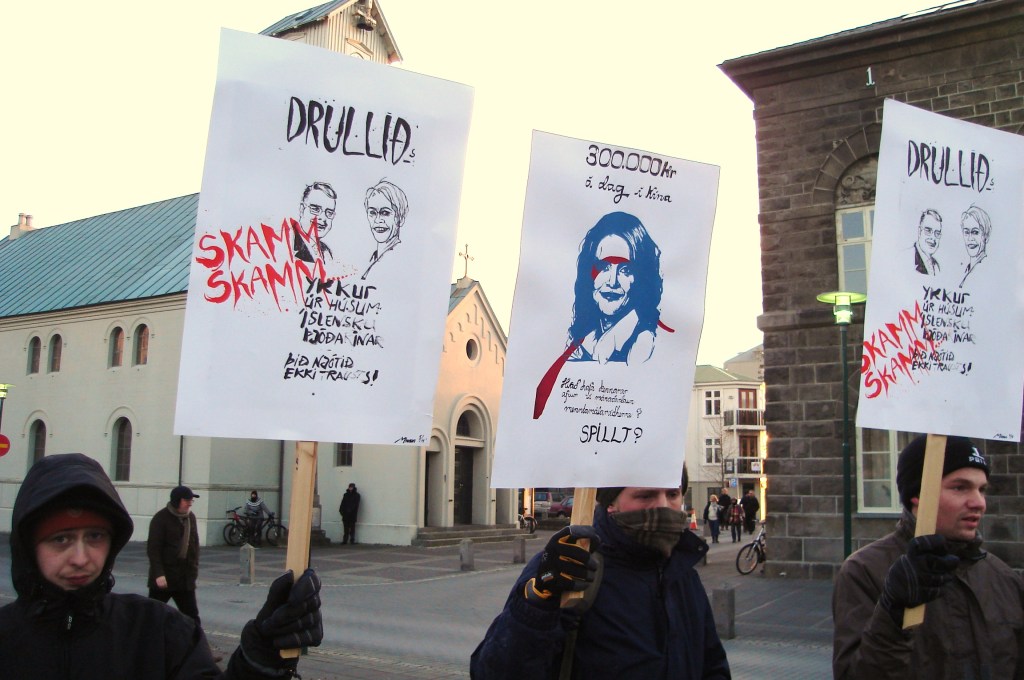
    Tensions were high as the Global Financial Crisis (2007-2008) roiled the world economy.

    The unfolding Global Financial Crisis (GFC) in 2008, while caused by the collapse of the financial system, also presented an opportunity to apply the lessons learned in the late 1990s. The crisis was a roller coaster ride and provided a front row seat to what happens when too much debt and fraud overwhelms the financial system. A conference in Switzerland on African trade opportunities in 2008 was disrupted by the crisis as participants received frantic calls from London and New York and grabbed their bags and fled. Later that year I joined Associated Press foreign correspondent Jill Lawless in Reykjavik, Iceland as demonstrations erupted resulting from the collapse of the country’s banks.

    Icelandic Humour Targets UK PM

    Further Reading:

    Learn more about the demonstrations and why they occurred (and find links to Jill Lawless’ on-the-ground reports from the demonstrations and the crisis) here: https://en.wikipedia.org/wiki/2009_Icelandic_financial_crisis_protests

    Icelandic police tear gas protesters

    By VALUR GUNNARSSON and JILL LAWLESS – Jan 22, 2009

    Crisis response media from David South Consulting:

    Team | Southern Innovator Phase 1 Development (2010 – 2015)

    More on the Global Financial Crisis response: A Report from the UN Conference on the Social and Political Dimensions of the Global Crisis: Implications for Developing Countries (12-13 November 2009)

    Just as now (2021) 2009 was a year in which the questions revolved around receiving a vaccine (for H1N1) and how best to affirm a person’s identity and citizenship.

    This work is licensed under a Creative Commons Attribution 4.0 International License.

    ORCID iD: https://orcid.org/0000-0001-5311-1052.

    © David South Consulting 2021