Tag: 2008

  • Mobile Phone Peacekeeping

    Mobile Phone Peacekeeping

    By David SouthDevelopment Challenges, South-South Solutions

    SOUTH-SOUTH CASE STUDY

    Last month UN secretary-general Ban Ki-moon pointed out the urgent need for interesting and relevant content to attract Africans to the internet. Official statistics can make for grim reading: the continent has less bandwidth than Ireland (World Economic Forum). While it is true Africa is restricted by serious technological and economic disadvantages, African ingenuity, creativity and hard work are bypassing these impediments to get things done nonetheless. While word has got out about the impressive take-up of mobile phones in Africa, the new world of Web 2.0 is also spawning a new generation of inspiring African technology whizzes transforming perceptions and grabbing the world’s attention.

    Alongside the combination of innovation and affordability that has made Africa the fastest growing mobile phone market in the world, there is a home-grown technology boom underway: “African firms are already participating in the forefront of technological developments and investment opportunities,” according to the Africa Competitiveness Report 2007.

    Powerful and easy-to-use Web 2.0 tools are being used by Africans during times of crisis. Among the most innovative are “mash-ups” – a term once used to refer to the musical style of combining two or more song tracks that has come to mean the blending together of various software programmes. These Web 2.0 software mashups combine weather information, maps, webcams, population figures, even restaurant locations – in fact any application that can be easily added to a website. The possibilities are limitless, and this is what is causing so much excitement for development in the South.

    In Kenya, a website called Ushahidi (Swahili for testimony), is using ICT (information and communications technology) and mobile phones to save lives in the post-election violence. People on the ground can send in live situation reports and alerts through the web and mobile phones to the website, which then maps violence in real time.

    According to the site’s originator, Kenyan Ory Okolloh, Ushahidi.com “is a tool for people who witness acts of violence in Kenya in these post-election times. You can report the incident that you have seen, and it will appear on a map-based view for others to see.”

    It has been put together by Kenyan web developer David Kobia (also the developer of Mashada, an online African community), and inspired by African blogger Erik “Hash” Hersman and other Kenyan bloggers and activists.

    At the start of the violence, Okolloh had put out a message for help on the web. “Google Earth supposedly shows in great detail where the damage is being done on the ground,” Okolloh said on the site. “It occurs to me that it will be useful to keep a record of this, if one is thinking long-term. For the reconciliation process to occur at the local level the truth of what happened will first have to come out. Guys looking to do something – any techies out there willing to do a mashup of where the violence and destruction is occurring using Google Maps?”

    The website came together quite quickly: after initial discussions amongst the team of five on January 5, it was live by January 9 (they estimate 40 hours for development and 20 to 30 hours for testing and promotion).

    For others who want to do the same, the key is good relationships, not necessarily technology, the Ushahidi team says. “My advice is to make sure you’re well networked with the right people before something like this is needed,” said Erik Hersman, who runs Afrigadget and White African blogs. “By the time you need a site like Ushahidi, it’s too late to start making connections, it’s time to build … everyone needs the passion to fulfill the vision of the project.”

    And to keep it going is not that time consuming, they say. The largest part of their time is spent keeping in contact with NGOs and a volunteer network in Kenya, and verifying the information.

    “My advice would be to keep things as simple as possible.,” said Kenyan David Kobia. “Mashups are basically methods of relaying data, so simplicity is absolutely key.”

    “The feedback has been phenomenal. Ushahidi’s graphical representation of events illustrates to some degree the magnitude of the events to people outside Kenya. The enormity of the situation can be understood better as events unfold, keeping everyone in the loop with a point of reference – people tend to become apathetic when regular news moves from the front page.”

    Ushahidi has been praised for providing NGOs, the international community and humanitarian agencies with vital information they can use to help people.

    Kobia has also launched a new mashup to promote Kenyan unity called  ihavenotribe.

    AfricaNews.com has also been turning to mobile phones to get the news out on the Kenyan crisis. The agency’s reporters use internet-enabled mobile phones with portable keyboards to transmit photos, video and text for reports. All of it is uploaded to the www.africanews.com website. Some are calling this the first use of mobile phone journalism in Africa.

    Published: February 2008

    Resources

    • Pambazuka News Action Alert blog for Kenya updates.
    • Web 2.0 tools that are for free and how to use them: an excellent resource from San Francisco’s  Techsoup.
    • An excellent set of links to Web 2.0 tools and which ones are free, is here:  directimpactnow.com
    • Mashups.com has the latest news and links to get involved in this new internet phenomenon:
    • Programmable Web: This outstanding website links to all active mashups on the web by category and gives real-time reports on progress and lots of links and support to get started.
    • African Web 2.0: 2007 was a busy year for African Web 2.0 sites, as they have grown in number and sophistication. Here you can see an at-a-glance collage of the sites’ logos and links to them:  flickr.com
    Creative Commons License

    This work is licensed under a
    Creative Commons Attribution-Noncommercial-No Derivative Works 3.0 License.

    ORCID iD: https://orcid.org/0000-0001-5311-1052.

    © David South Consulting 2023
  • Riverwood: Kenyan Super-fast, Super-cheap Filmmaking

    Riverwood: Kenyan Super-fast, Super-cheap Filmmaking

    By David SouthDevelopment Challenges, South-South Solutions

    SOUTH-SOUTH CASE STUDY

    The African film-making success story of Nigeria’s Nollywood has been joined by another fast-rising star: Kenya’s Riverwood. Both are beneficiaries of the digital revolution in filmmaking over the last decade, and both are using low-cost digital filmmaking and editing to tell local stories — in the process making money and creating thousands of jobs.

    The power of creative industries to create jobs and wealth has been a focus of UNESCO, through its Global Alliance for Cultural Diversity. UNESCO has been in the forefront in helping African countries re-shape their policies to take cultural industries into consideration. The promotion of cultural industries also has been incorporated into the New Partnership for Africa’s Development (NEPAD).

    What is particularly attractive about this phenomenon for the poor in the South is its rough-and-ready approach to filmmaking: combining low-cost digital cameras and film editing software on personal computers, with small budgets and fast turn-around times. Films are made on location using local people. These factors make getting into filmmaking accessible and within reach of more people.

    Riverwood is named after River Road, a bustling creative and business hub in Nairobi. Riverwood operates at a furious pace, with 20 to 30 films made every week. It adds up to 1,000 films a year selling 500,000 copies at 200 Kenyan shillings (US $2.60) a piece: 1 billion shillings (US $13 million) in the past two years.

    The whole industry is totally self-sufficient, and is following the well-trodden path laid down by Hollywood and India’s Bollywood.

    One of Kenya’s woman directors is leading the renaissance in filmmaking. “Movies are very important because I think they are the most important art in Kenya – in Africa,” said Wanjiru Kinyanjui in the film, “Riverwood, the Blooming of a Film Industry,” by the World Intellectual Property Organization (www.wipo.org). “Basically, because Africans have an oral tradition, and a visual one, there is a huge market for local films.”

    Riverwood films share a common characteristic of on-the-spot sets and a resourceful and cheap approach.

    “They are shot in two, three days and edited in a week,” she continued. “They are selling because people can identify with them. The films being in Riverwood are basically the lives of people, reflecting the Kenyan way of life and entertaining Kenyans. “

    And it is a new form of employment for many people:  “When I am making a movie, I need people: you employ very many people. And you also employ yourself. It is a real way of getting rid of poverty. Because all this talent, which is untapped, could be working.”

    And as Riverwood rising star director John E. Maina puts it: “Hollywood is the model for any society that wants to develop.”

    While still in its infancy compared to Nigeria’s Nollywood, Riverwood is already pioneering ways to protect the creative rights of filmmakers and build a financially-sustainable industry. Inspired by Hollywood’s ownership of creative material, Kenyan filmmakers have come up with some ingenious solutions. Each production company has a rubber stamp and signs on the sleeve of the DVD (digital video disc) – even if it is 1,000 copies.

    If a director finds a pirated copy, and even if pirates have forged the rubber stamp, the signature will look like a forgery.

    “It is based on a business model,” said director John E. Maina. ”It is commercial. So it is self-sustaining. This is how Bollywood is growing, this is how Nollywood is growing, this is how Hollywood developed.”

    As pioneers in copyright protection, Riverwood directors strongly believe they are an important part of the country’s development.

    “When you pirate a product, and the resources are not channelled back to the person who created that product, he is losing out on creating a new product for you tomorrow,” said Maina. “So you are the loser: tomorrow you will not have another product.

    “Riverwood, Nollywood, Hollywood, are the model for any society that wants to develop. No society will develop without an audiovisual industry. And I think the way to protect an audiovisual industry is through strong copyright laws,” he said.

    “If you go to most of the cafes and the pubs in Kenya, people only turn to TV at 7 o’clock, watch the news, after the news is over, they tell the management to put for them the local DVDs from Riverwood. Because they see themselves, they identify with those images. They don’t identify with the foreign American films, the soaps from South America.<

    “The audiovisual industry is a mirror. If you don’t have a mirror to see yourself, you don’t know who you are. If you don’t have that mirror to see yourself, you are lost.”

    Published: November 2008

    Resources

    • The global charity Camfed (dedicated to eradicating poverty in Africa through the education of girls and empowerment of women) has projects to teach women filmmaking skills. Website: http://uk.camfed.org
    • Festival Panafricain du Cinéma et de la Television de Ouagadoogou 2009: Africa’s biggest film festival. Website: http://www.fespaco.bf/
    • Naijarules: Billing itself as the “largest online community of lovers and critics of Nollywood”, an excellent way to connect with all the players in the business.Website: http://www.naijarules.com/vb/index.php
    • A film by the World Intellectual Property Organization about the Riverwood phenomenon and an introduction to its up-and-coming directors. Website: http://uk.youtube.com/watch?v=OwSu5kcUErE

    Citations

    Cited in The Liverpool Companion to World Science Fiction Film by Sonja Fritzsche (2014).

    Accentuating the positive: Building capacity for creative industries into the development agenda for global intellectual property law by Sean A. Pager, Michigan State University College of Law, American University International Law Review, 2012

    Cinema as cultural discourse: A study of cultural symbols in selected contemporary Gikuyu comedies by Stanley Mbugua Njoroge, School of Creative and Performing Arts, Film and Media Studies, Kenyatta University, 2019

    Other Film Stories

    https://davidsouthconsulting.org/2022/03/30/angolan-film-grabs-attention-at-film-festival/

    https://davidsouthconsulting.org/2022/04/01/bolivian-film-schools-film-scene-paying-off/

    https://davidsouthconsulting.org/2022/10/21/local-animation-a-way-out-of-poverty/

    https://davidsouthconsulting.org/2021/02/04/new-cuban-film-seeks-to-revive-sector/

    https://davidsouthconsulting.org/2020/11/30/nollywood-booming-nigerian-film-industry/

    Creative Commons License

    This work is licensed under a
    Creative Commons Attribution-Noncommercial-No Derivative Works 3.0 License.

    ORCID iD: https://orcid.org/0000-0001-5311-1052.

    © David South Consulting 2023

  • Innovative Stoves to Help the Poor

    Innovative Stoves to Help the Poor

    By David SouthDevelopment Challenges, South-South Solutions

    SOUTH-SOUTH CASE STUDY

    Half of the world’s population cook with a fuel-burning stove, and this figure rises to 80 per cent of households in rural areas in developing countries. Typical fuels burned include wood, coal, crop leftovers and animal dung. The indoor pollution from smoke and carbon monoxide is a top health hazard in the developing world, ranking just behind dirty water, poor sanitation and malnutrition. The World Health Organization (WHO) estimates that 1.6 million people die each year as a result of toxic indoor air.

    A landmark five-year study comparing Guatemalans cooking on open fires, to those using improved stoves, has brought more evidence forward of the damage done by indoor air pollution: “It’s been shown that children living in houses using open fires with solid fuels will have more pneumonia than children living in houses that are using cleaner fuels,” said Dr. Kirk R. Smith, an environmental health scientist at the University of California, Berkeley.

    The research, combined with studies in Asia, suggests additional health problems from indoor air pollution, including higher frequency of cataracts, partial blindness, tuberculosis, low birth weights and high blood pressure. The researchers found that cleaner stoves had larger effects than reducing salt in the diet or lowering blood pressure in women, with the results published last July in Environmental Health Perspectives.

    But Southern innovators are finding practical ways to curb pollution from indoor cooking and the burning of trash in slums.

    In Yunnan Province, China, entrepreneur Hao Zheng Yi’s Yunnan Zhenghong Environmental Protection Co. has been selling clean-burning stoves to rural farmers. One fifth of rural China has no electricity (UN), and 80 per cent rural dwellers burn wood or straw in ovens for heating and cooking. This creates heavy indoor air pollution, damaging health.

    The so-called Efficient Gasification Burning system combines traditional fuel and natural gas: a hybrid that helps low-income households to affordably use the stove and not pollute their indoor air.

    The stoves are sold for a profit in Yunnan Province, and so far 50,000 have been sold. Because the ovens are sold for a profit, Zhenghong had to consult extensively with the farmers in the design phase to make sure the ovens meet their needs.

    The result has been that Zhenghong ovens run for five to eight years using the same amount of wood and hay a conventional oven burns in one year.

    Another source of air pollution is burning trash in slums. The lack of formal trash removal services in slums has two bad consequences: one is the pollution and poison from rotting rubbish leaching into the soil and water table; the other is ad-hoc burning of the trash to get rid of it, which pollutes the air with a toxic, acrid stench. In Nairobi’s Kibera slum – the second biggest in Africa – over 60 per cent of the city’s residents live in the slum, and are bypassed by garage collection services. Garbage is piled up along the muddy roads and paths, or hangs in the trees.

    The Kenyan NGO Umande Trust, which specialises in water and sanitation projects, has developed a home-grown method to burn trash and avoid having to turn to very expensive and complicated incinerators from Europe. The sheer quantity of trash that needs to be burned in the slum means smaller solutions will not be able to handle the problem.

    Its “community cooker” re-uses garbage from the community as fuel for a boiler and oven attached to it. The heat generated by burning the rubbish provides hot water and cooking facilities – and also jobs for unemployed youths who collect the rubbish and stock the incinerator. It was developed by a Kenyan architect, and it is hoped the “community cooker” will be taken up across Africa.

    The community cooker’s inventor, Kenyan architect Jim Archer, took eight years to design and build it: “My thinking was how do we get rid of the rubbish and …how can we induce people to pick it up. Then I thought, well if we can convert it to heat on which people can cook…” he told Australia’s ABC News.

    Similar industrial scale trash incinerators can cost between US $50 million to US $280 million (World Bank) – “…when applying waste incineration, the economic risk of project failure is high…”. The community cooker on the other hand, will sell for US $10,000.

    The idea was to create an incinerator that was simple to use and repair: something that the commercially available, computer-controlled incinerators were not able to do. As the cooker gets up to speed, it will be able to burn 60 per cent of the slum’s trash.

    Local youth go house-to-house collecting trash. They get money from the slum residents for this. Rubbish is then exchanged for cooking time or hot water for washing.

    “The trash has started to help us a bit after the cooker came. There are fewer diseases like diarrhea and the environment has improved. … I think burning the rubbish will bring good health to this community,” said Patricia Ndunge, as she fried onions on the cooker.

    And it looks like the community cooker has a future: Kenya’s largest supermarket, Nakumatt, has pledged to pay for 20 more slum cookers.

    Published: March 2008

    Resources

    • Envirofit: A Shell Foundation supported project to produce 300,000 clean, wood-burning stoves for the developing world (starting with India, Brazil, Kenya and Uganda). Envirofit will offer a variety of sleek ceramic stoves from single to multipot, with and without chimneys, and with colors like apple red, baby blue and gold. The cost is to start at $10 to $20 and run to $150 to $200.
      Website: http://www.envirofit.org/

    Follow @SouthSouth1

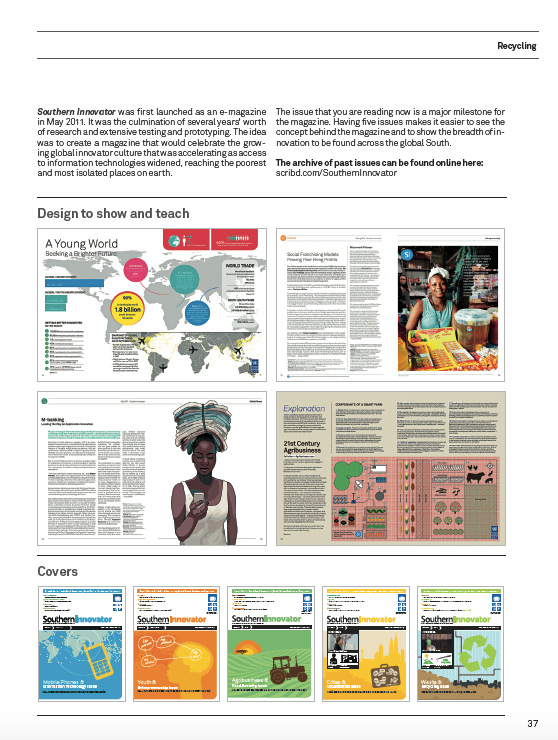
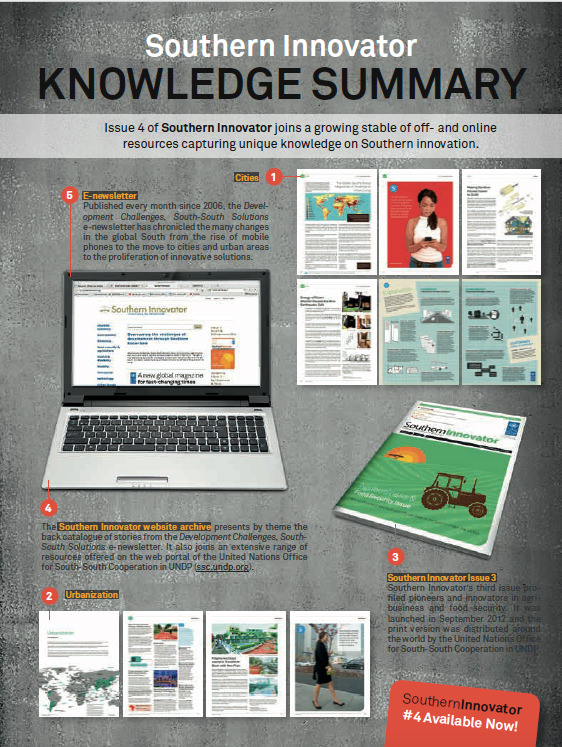
    Slideshare: http://www.slideshare.net/DavidSouth1/development-challengessouthsouthsolutionsnovember2010issue

    Southern Innovator Issue 1: https://books.google.co.uk/books?id=Q1O54YSE2BgC&dq=southern+innovator&source=gbs_navlinks_s

    Southern Innovator Issue 2: https://books.google.co.uk/books?id=Ty0N969dcssC&dq=southern+innovator&source=gbs_navlinks_s

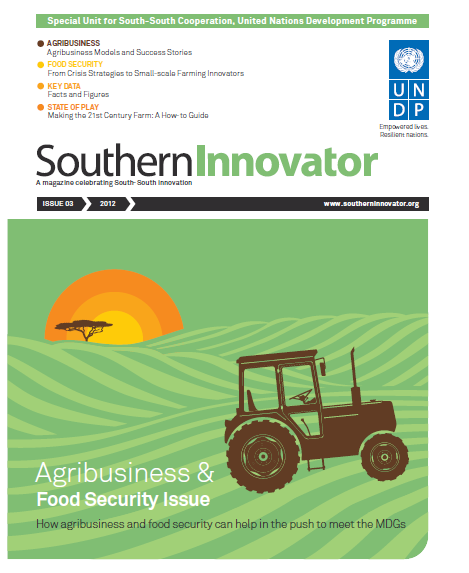
    Southern Innovator Issue 3: https://books.google.co.uk/books?id=AQNt4YmhZagC&dq=southern+innovator&source=gbs_navlinks_s

    Southern Innovator Issue 4: https://books.google.co.uk/books?id=9T_n2tA7l4EC&dq=southern+innovator&source=gbs_navlinks_s

    Southern Innovator Issue 5: https://books.google.co.uk/books?id=6ILdAgAAQBAJ&dq=southern+innovator&source=gbs_navlinks_s

    Creative Commons License

    This work is licensed under a
    Creative Commons Attribution-Noncommercial-No Derivative Works 3.0 License.

    ORCID iD: https://orcid.org/0000-0001-5311-1052.

    © David South Consulting 2023
  • Urban Farmers Gain from Waste Water

    Urban Farmers Gain from Waste Water

    By David SouthDevelopment Challenges, South-South Solutions

    SOUTH-SOUTH CASE STUDY

    The global food crisis continues to fuel food price inflation and send many into hunger and despair. Around the world, solutions are being sought to the urgent need for more food and cheaper food. U.N. Secretary General Ban Ki-moon has called for food production to increase 50 percent by 2030 just to meet rising demand – and right now there are 862 million people undernourished (FAO).

    One fast-growing solution is bringing farming to urban and semi-urban spaces, where the majority of the world’s population now lives.

    Urban farmers can take advantage of their close proximity to consumers, keeping costs down and profits up. They can also solve one of agriculture’s enduring problems – where to find water for irrigation by using existing waste water. Waste water is plentiful in urban environments, where factories usually pump out waste water into streams, rivers and lakes.

    The amount of urban farmed agriculture is still small, about 10 percent of the world’s agricultural production, but is a potential growth area if handled well. In 53 cities surveyed by the International Water Management Institute, 1.1 million farmers – some 200 million worldwide – are now using recycled or waste water to irrigate their crops.

    In Accra, Ghana, more than 200,000 people depend on food grown with wastewater. In Pakistan, a full quarter of the grown vegetables use wastewater.

    The use of waste water comes with its ups and downs. While the World Health Organization rightfully points out that waste water can be a source of disease and pollution, cities also face a dilemma: diverting fresh water to irrigate crops means less for people to drink. Out of the 53 cities surveyed by the International Water Management Institute, 85 percent dumped their raw sewage and wastewater into streams and lakes. With this in mind, the WHO has altered its stance on wastewater, and now supports its use for irrigating farmland as long as all efforts are made to treat wastewater and that people are warned to thoroughly wash food before eating it.

    Pay Drechsel, who heads the IWMI’s research division based in Accra, Ghana, studying safe and productive use of low-quality water, says sophisticated systems to use waste water have developed in Vietnam, China and India, “where this practice has been going on for centuries.”

    “People know how to avoid health risks, like thorough cooking of vegetables,” he said. “In Vietnam and China, waste from households (fecal waste, solid waste and wastewater from household use) have always been effectively recycled in ‘closed systems’ at a household level where the waste/nutrients are recycled into the food chain and so return for human consumption.”

    Drechsel cites examples like Calcutta, where a large wetland is being used for treating and recycling wastewater for beneficial uses such as fish farming. In Northern Ghana, fecal sludge from septic tanks is spread on fields that are later used to grow cereals.

    “The risk for the consumer is extremely low, a waste product is productively recycled, the farmer has a good harvest and the city gets rid of their waste,” Drechsel said. “A multiple win-win situation.

    “Depending on the local situations such models can be widely used, provided they are documented and the risk factors are controlled,” he added.

    Farmers use various methods to reduce the risk of contamination, including drip irrigation where the water does not touch the crop.

    The risks for both farmers and consumer can be managed with the right protocols. For farmers, Drechsel recommends wearing of rubber boots and careful hand washing to avoid skin diseases. He points out that these farmers usually make more money than those who do not use waste water, and thus can afford the extra cost of precautionary measures, like de-worming tablets. They can quickly get out of poverty by using this water.

    For consumers, the risk is from diarrhoea, typhus or cholera if raw food is eaten unwashed or poorly washed. The best solution is to turn to the WHO’s guidelines and proven local practices and tested techniques developed by researchers.

    “Here more awareness creation on invisible risks through pathogens is needed. Perception studies in West Africa showed that nearly all households wash vegetables but they target visible dirt. Thus, the methods used are not effective. Best would be therefore a combination of risk reducing interventions from farm to fork, as none alone is 100 percent efficient. This is also what the new WHO guidelines promote: a flexible approach, reducing in each country the health risks as far as it is possible and feasible.”

    Drechsel sees an opportunity for water treatment plants to seize: “What is missing so far is a ‘design for reuse.’ If treatment plants would be designed to serve farmers they could be less sophisticated and easier to maintain. Farmers could be involved in this, maybe a win-win situation.

    “The environment benefits too. Spreading wastewater over fields, and allowing it to leach back through the soil into local waterways, turns out to be a reasonable way to purify it. The process filters out all the organic contaminants, and much of the nitrogen and phosphates that would otherwise contribute to algal blooms and dead zones further downstream. It is certainly preferable to dumping wastewater straight into the nearest big river or lake.”

    Published: September 2008

    Resources

    • Vertical farming, where hothouses are piled one on top of the other, is an option being promoted as a solution to the food needs of urban dwellers.
      Website: http://www.verticalfarm.com/
    • Extensive photographs of vertical farm project concepts by Chris Jacobs in cooperation with the grandfather of skyscraper farm concepts: Dr. Dickson Despommier of Columbia University. His ideal: all-in-one eco-towers would actually produce more energy, water (via condensation/purification) and food than their occupants would consume. His mission: to gather architects, engineers, economists and urban planners to develop a sustainable and high-tech wonder of ecological engineering.
      Website: weburbanist.com
    • Urban Gardening News, a news service providing a review of daily news targeting everyone involved in planning & practicing alternative farming in cities. Great updates on how things are progressing across the South.
      Website: http://www.urbanagriculture-news.com

    Follow @SouthSouth1

    Slideshare: http://www.slideshare.net/DavidSouth1/development-challengessouthsouthsolutionsnovember2010issue

    Southern Innovator Issue 1: https://books.google.co.uk/books?id=Q1O54YSE2BgC&dq=southern+innovator&source=gbs_navlinks_s

    Southern Innovator Issue 2: https://books.google.co.uk/books?id=Ty0N969dcssC&dq=southern+innovator&source=gbs_navlinks_s

    Southern Innovator Issue 3: https://books.google.co.uk/books?id=AQNt4YmhZagC&dq=southern+innovator&source=gbs_navlinks_s

    Southern Innovator Issue 4: https://books.google.co.uk/books?id=9T_n2tA7l4EC&dq=southern+innovator&source=gbs_navlinks_s

    Southern Innovator Issue 5: https://books.google.co.uk/books?id=6ILdAgAAQBAJ&dq=southern+innovator&source=gbs_navlinks_s

    Creative Commons License

    This work is licensed under a
    Creative Commons Attribution-Noncommercial-No Derivative Works 3.0 License.

    ORCID iD: https://orcid.org/0000-0001-5311-1052.

    © David South Consulting 2023