Tag: 2008

  • Brazil Preserves Family Farms and Keeps Food Local and Healthy 

    Brazil Preserves Family Farms and Keeps Food Local and Healthy 

    By David SouthDevelopment Challenges, South-South Solutions

    (Havana, Cuba), November 2008

    SOUTH-SOUTH CASE STUDY

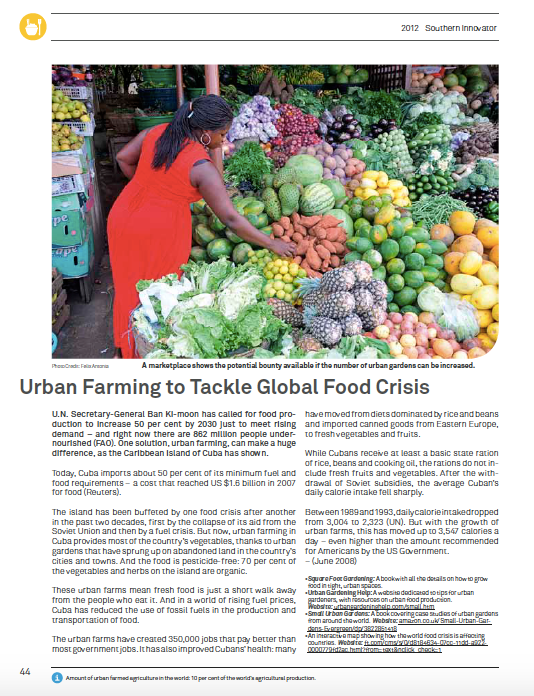
    Today’s global food crisis sparked by a toxic mix of events – high oil and commodity prices, food scarcity, growing populations, and environmental catastrophes – has woken many up to the urgent need to secure food supplies and help those who grow the world’s food. More and more countries are turning to local and small farms – or family farms – to offer food security when times get rough.

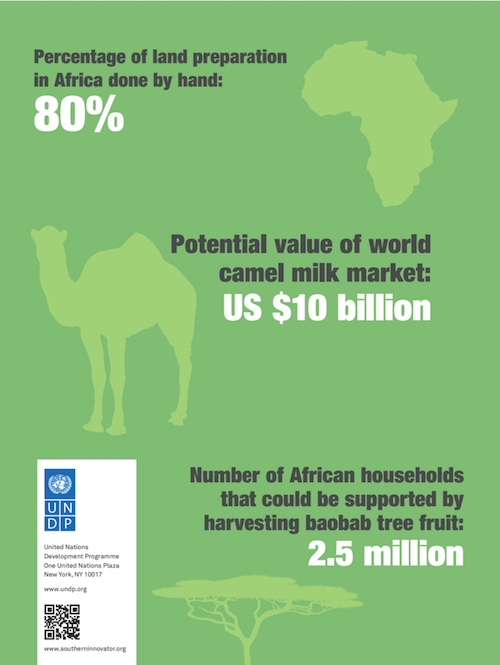
    Right now there are more than 862 million undernourished people around the world (FAO), and U.N. Secretary- General Ban Ki-moon has called for food production to increase 50 percent by 2030 just to meet rising demand. Three-quarters of the world’s poorest people living on less than US $1 a day live in rural areas in developing countries and 85 percent of the world’s farms are of less than two hectares in size.

    There has long been a tension between those who believe in very large farms, agribusiness and mono-crops (http://en.wikipedia.org/wiki/Mono-cropping), and those who believe in having a large number of smaller farms with a wide variety of crops and animals.

    Family farming has been seen as doomed for a long time. In the 19th century, figures like philosopher Karl Marx believed they would be split into capitalist farms and proletarian labour. Most modern economists regard family farming as an archaic way to grow food, destined to give way to agribusiness. Most family farms refute this, saying family farmers have been able to operate with success in both developed and developing countries.

    And small farms have endured. The livelihoods of more than 2 billion people depend on the 450 million smallholder farms across the world. With their families, they account for a third of the world’s population.

    Family farms are critical to weathering economic crises and ensuring a steady and secure food supply. The International Fund for Agricultural Development (IFAD) (www.ifad.org) called earlier this year for small family farms to be put at the heart of the global response to high food prices and to improve food security. And in Brazil, this call is being answered by a bold initiative to create what they call a “social technology”, combining a house building programme with diverse family farms.

    Brazil is currently buying up unused land and distributing it to people making land claims, including Brazil’s Landless Workers Movement (http://www.mstbrazil.org). When they receive land, family farmers often find there is no house on the land, or just a very basic dwelling.

    This is where the Brazilian farmer’s cooperative Cooperhaf: Cooperativa de Habitacao dos Agricultores Familiares (http://www.cooperhaf.org.br/), steps in. It has put together what it calls a “social technology” combining housing and farm diversification to support family farmers.

    “We see the house as the core issue,” said Adriana Paola Paredes Penafiel, a projects adviser with the Cooperhaf. “The farmers can improve their productivity but the starting point is the house.

    “Family farming is very important for the country – 70 percent of food for Brazilians comes from family farming,” said Penafiel. “The government wants to keep people in rural areas.”

    Started in 2001 by a federation of farmers unions, the Cooperhaf works in 14 Brazilian states with family farmers.

    “Family farmers had to organize themselves to deal with housing,” said Penafiel. “The cooperative was formed to mediate between farmers and the government. The farmers have a right in the law to a house.

    “We promote diversification to make farmers less vulnerable: if they lose a crop in macro farming, they lose everything. We encourage diversification and self-consumption to guarantee the family has food everyday. We help to set up a garden.”

    The concept is simple: a good quality home acts as an anchor to the family farm, making them more productive as farmers. The farmers receive up to 6,000 reals (US $2,290) for a house, and can choose designs from a portfolio of options from the Cooperhaf.

    As in other countries, the Cooperhaf and other coops encourage markets and certification programmes to promote family farmed food and raise awareness. Penafiel says promoting the fact that the food is family farmed is critical: to the consumer it is healthier, fresher and contains fewer chemicals than imported produce.

    “We sell a livelihood not a product. If you get to know the product, you are more conscious of what you eat.”

    In the US, there are almost 2 million farms, 80 percent of which are small farms, a large percentage family-owned. More and more of these farmers are now selling their products directly to the public.

    In the UK, family farms are on course to provide 10 percent of the country’s food and drink and be worth £15 billion a year.

    “If we forget them, we actually may get a situation where, while meeting the world’s immediate supply targets, we wind up with an even greater imbalance in the global supply system and greater food insecurity,” said IFAD President Lennart Båge.

    “Most agri business is for export,” said Penafiel. “If we don’t have food in the country, food for poor communities would not be available. This enables farmers to be more autonomous, not having to buy fertilizers and equipment and take on too much debt. That approach is not sustainable as we saw with the so-called Green Revolution.”

    Published: December 2008

    https://davidsouthconsulting.org/2020/12/14/african-farming-wisdom-now-scientifically-proven/

    https://davidsouthconsulting.org/2022/11/16/brazils-agricultural-success-teaches-south-how-to-grow/

    https://davidsouthconsulting.org/2022/10/10/cheap-farming-kit-hopes-to-help-more-become-farmers/

    https://davidsouthconsulting.org/2022/11/18/farmers-weather-fertilizer-crisis-by-going-organic/

    https://davidsouthconsulting.org/2022/11/01/indonesian-food-company-helps-itself-by-making-farmers-more-efficient/

    https://davidsouthconsulting.org/2022/11/23/kenyan-farmer-uses-internet-to-boost-potato-farm/

    https://davidsouthconsulting.org/2021/11/09/pocket-friendly-solution-to-help-farmers-go-organic/

    https://davidsouthconsulting.org/2021/09/16/small-fish-farming-opportunity-can-wipe-out-malnutrition/

    https://davidsouthconsulting.org/2022/11/11/urban-farming-to-tackle-global-food-crisis/

    https://davidsouthconsulting.org/2022/10/18/woman-wants-african-farming-to-be-cool/

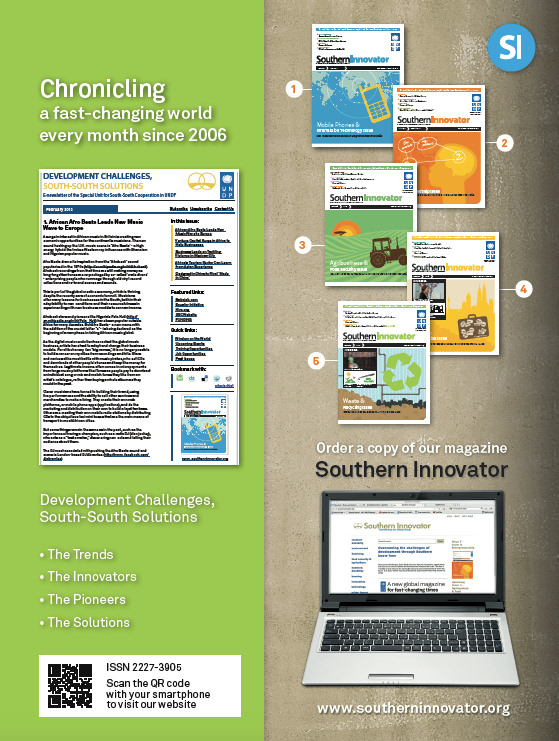
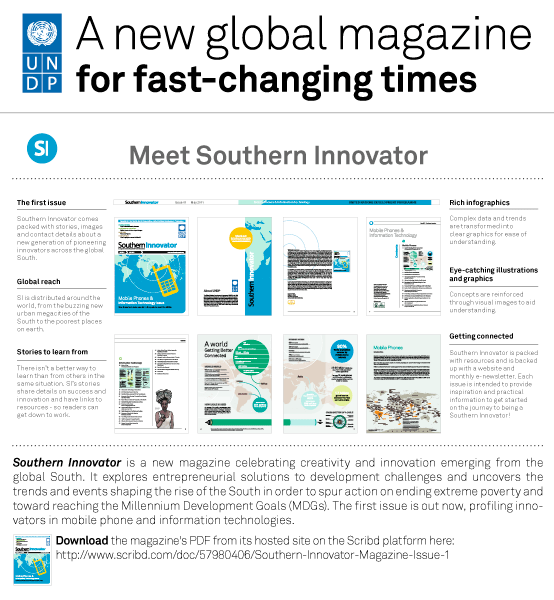
    Development Challenges, South-South Solutions was launched as an e-newsletter in 2006 by UNDP’s South-South Cooperation Unit (now the United Nations Office for South-South Cooperation) based in New York, USA. It led on profiling the rise of the global South as an economic powerhouse and was one of the first regular publications to champion the global South’s innovators, entrepreneurs, and pioneers. It tracked the key trends that are now so profoundly reshaping how development is seen and done. This includes the rapid take-up of mobile phones and information technology in the global South (as profiled in the first issue of magazine Southern Innovator), the move to becoming a majority urban world, a growing global innovator culture, and the plethora of solutions being developed in the global South to tackle its problems and improve living conditions and boost human development. The success of the e-newsletter led to the launch of the magazine Southern Innovator.  

    Follow @SouthSouth1

    Google Books: https://books.google.co.uk/books?id=YtEgTdyZioUC&dq=development+challenges+december+2008&source=gbs_navlinks_s

    Slideshare: http://www.slideshare.net/DavidSouth1/development-challengessouthsouthsolutionsdecember2008issue

    Southern Innovator Issue 1: https://books.google.co.uk/books?id=Q1O54YSE2BgC&dq=southern+innovator&source=gbs_navlinks_s

    Southern Innovator Issue 2: https://books.google.co.uk/books?id=Ty0N969dcssC&dq=southern+innovator&source=gbs_navlinks_s

    Southern Innovator Issue 3: https://books.google.co.uk/books?id=AQNt4YmhZagC&dq=southern+innovator&source=gbs_navlinks_s

    Southern Innovator Issue 4: https://books.google.co.uk/books?id=9T_n2tA7l4EC&dq=southern+innovator&source=gbs_navlinks_s

    Southern Innovator Issue 5: https://books.google.co.uk/books?id=6ILdAgAAQBAJ&dq=southern+innovator&source=gbs_navlinks_s

    https://davidsouthconsulting.org/2021/03/05/southern-innovator-issue-3/

    Creative Commons License
    This work is licensed under a
    Creative Commons Attribution-Noncommercial-No Derivative Works 3.0 License.

    ORCID iD: https://orcid.org/0000-0001-5311-1052.

    © David South Consulting 2023

  • The South has a Good Story to Tell

    The South has a Good Story to Tell

    By David SouthDevelopment Challenges, South-South Solutions

    SOUTH-SOUTH CASE STUDY

    The fast-changing modern world is raising the living standards of billions in the South – China alone has lifted 400 million people out of poverty since the 1980s – but it is also risking the loss of many rich cultural traditions. One of them is storytelling.

    Oral storytelling is a critical tool for passing on history, while teaching morals and ethics, especially in societies with low rates of literacy and little formal education. But with the rise of modern media and advertising, few traditional storytellers – many of whom are old – stand a chance. Populations are on the move like never before. As more and more people end up in sprawling cities, many are becoming disconnected from their roots.

    Yet across the South, people are finding ways to re-invent story telling — and also to make money, preserve cultural pride and feed the appetite for novelty in hungry, modern media and business.

    In 1997, storytelling was acknowledged by UNESCO, which pledged to back humanity’s oral and immaterial heritage, and to protect a vast number of oral and musical traditions, crafts and knowledge – plus the “living human treasures” who possess them. It backed this up in 2003 with the Convention for the Safeguarding of Intangible Cultural Heritage. It supports storytelling through its International Programme for the Development of Communication.

    But what about the young – the most important generation for storytelling to have a future? In Bogota, Colombia, students have started a movement of urban storytellers. Aged between 17 and 35, they draw on the things they have learned in university. They eschew linear narration and instead adopt the popular language of films and advertising. Inspired by one television commercial, a story revolves around a drop of tomato sauce falling from a high-rise building, sparking a gun battle. The staccato narrative takes inspiration from post-modern authors like Italo Calvino. It is also the perfect narrative to capture modern, urban audiences who live in a world saturated with media.

    By blending together ancestral and post-modern tales, these student storytellers are luring Latin Americans back to listening to stories. Live storytelling, when done well, has an ability to connect with other people like no other medium. This new generation also is helping make Colombia a gathering place for storytellers in Latin America, expressed in events like the Hay Festival Cartegena, a literary event that draws authors from around the world.

    But is there any money in storytelling? Tale-spinners like Argentinian Juan Moreno say yes. Moreno quit teaching 17 years ago to tell stories for money in theatres, bars, universities and libraries, tapping into a contemporary marketplace for storytelling.

    In fact, it is better paid than acting in the theatre, he claims, and if you are good, it comes with lots of travel. There is a global round of congresses, festivals and seminars to keep storytellers connected, inspired – and paid.

    Moreno now makes money teaching many professions how to use stories to be more powerful communicators. He told the UNESCO Courier, “the value of the spoken word, words that heal and restore, that can give life but also take it away,” are key to many fields, like law and social work.

    The world centres of storytelling are very much focused on the South. The International Congress of Oral Storytelling, part of the Buenos Aires Book Fair, has been running every year since 1995. At the Congress, tips are exchanged over the subtle tricks of timing and voice, gestures and facial expressions. Other Southern cities with storytelling events, include Bucaramanga, Colombia, Monterrey, Mexico and Agüimes, in the Canary Islands.

    While young people are breathing new life into storytelling, Morocco’s legendary storytellers have been facing a common dilemma seen across the developing and developed world: how can they compete with flashier and more distracting pastimes like computer games and TV?

    Illiteracy in Morocco affects 40 per cent of the population, so telling stories is an excellent way to reach this non-reading group. Stories and parables have long been seen as a great way to convey ideas, values and philosophies.

    But Morocco’s storytelling sages, or halakis, are using their heads and turning to computers to get their stories told, and prevent their thousand-year tradition from dying out. With the help of UNESCO, the halakis have created a digital archive of their stories in audio and video.

    Based in Marrakesh’s famous main square, Jemaa al-Fna, they compete in a hury burly of street entertainers and aromatic foods; it is a place where men with monkeys vie with snake charmers for your attention. Morocco’s storytellers would set up in the public squares of the cities of Fes, Meknes and Marrakesh to entertain crowds and educate about morality. These would include the ethical values of kindness, honour and chivalry. But Marrakesh is now the only place where a half dozen old men (there used to be 20 in Marrakesh) still practice this ancient art form.

    UNESCO declared the square in 2001 part of the world’s “Oral and Intangible Heritage of Humanity.” Video recorders have been documenting the storytellers and chronicling them on the internet.

    Spanish writer Juan Goytisolo, who spends part of his year in Marrakesh, has championed the halakis in his book, Marrakesh Tales, and in bringing UNESCO in to help them. He has defended their corner against the plans of city planners and developers.

    Seventy-one-year-old Moulay Mohammed is blunt about the current state of storytelling: “Young Moroccans would rather watch TV soap operas than listen to a storyteller, much less become one themselves,” he told the BBC. Mohammed’s stock-in-trade is the Old Testament and all of A Thousand and One Nights: both tales of sultans, thieves, wise men and fools, mystics, genies, viziers and belly dancers. And he has been telling these tales for 45 years.

    In South Africa, digital technology is also breathing new life into storytelling – and infusing the stories with urgent, contemporary issues like HIV, and domestic and sexual violence. South African women are using digital technology to preserve traditional storytelling: A collection of 15 digital stories – called “I Have Listened, I Have Heard” – made in 2006 are being distributed along with books. They assembled the stories using audio recorders and made movies of the readings with digital cameras. It was funded by the Foundation for Human Rights and made at the Women’s Net Computer Training Centre in Johannesburg.

    The storytellers worked together on each script, taking a day. They would tell the group a story focusing on particular experiences or meaningful moments in their lives. The group would comment and draw out the best bits of the story. The whole process helps the story teller to flesh out the story with metaphors, narrative techniques and milestones.

    Published: April 2008

    Resources

    • The basics of story telling are answered in this webpage: www.timsheppard.co.uk
    • Singapore International Story Telling Festival 2008: This year’s festival also includes a new addition: Asian Digital Storytelling Festival
    • International Congress of Oral Storytelling: Held from 2-4 May 2008 in Buenos Aires, Argentina. Website: www.el-libro.org.ar
    • Folk Tales: Online project where Pakistani students and their teachers share folklore and fables with students around the world. Website: www.edutopia.org
    • Thirsty-Fish: Story and Strategy: A consultancy that helps businesses build their brands based on age-old practices of storytelling. Website: www.thirsty-fish.com

    “I think you [David South] and the designer [Solveig Rolfsdottir] do great work and I enjoy Southern Innovator very much!” Ines Tofalo, Programme Specialist, United Nations Office for South-South Cooperation

    Creative Commons License

    This work is licensed under a
    Creative Commons Attribution-Noncommercial-No Derivative Works 3.0 License.

    ORCID iD: https://orcid.org/0000-0001-5311-1052.

    © David South Consulting 2023

  • Women Mastering Trade Rules

    Women Mastering Trade Rules

    By David SouthDevelopment Challenges, South-South Solutions

    SOUTH-SOUTH CASE STUDY

    Market trading is a vital lifeline for most people in the South. Plenty of delights usually await people in the market, where live animals, herbs and spices, fresh fruits and vegetables, and life’s necessities compete for customers’ money. The formal and informal food sector plays a crucial role in empowering women and providing food to the poor. Women are often those mostly responsible for selling fresh products and street food, and running small catering operations. By being a vendor and getting food at a lower cost, they are able to contribute to their families’ food security.

    Trading and selling in the marketplace can be one of the best options for poor women. By trading, women gain economic independence, learn vital business skills and enjoy the social benefits of interacting with others. But the highly individualistic nature of market trading has its downside: traders must do everything themselves and a day not spent at market is a day’s income lost. They also can only buy in small quantities, and usually pay a higher price. Or don’t know what the competitive price is, so are in a weaker bargaining position with wholesalers.

    Making market trading more efficient has huge advantages, the primary one being more money for the trader.

    Women market traders in Nigeria are improving their efficiency and income with mobile phones. Rural women market traders in the Obiaruku market are using mobile phones to call their suppliers, access information like commodity prices, and contact customers. A survey of the traders found 95 per cent thought mobile phones had a big impact on their business. This has included fewer trips to suppliers, a quicker way to get help when they have been robbed, and opportunities to top-up incomes by selling airtime, handsets or mobile phone accessories.

    In Nigeria, mobile phone use has shot up at a rate of 25 per cent a year. A recent study found that out of a population of 140 million, 12.1 million now have mobile phones and 64 million use mobile phones through street-side phone centres. Phones are also helping women market traders to keep tabs on price fluctuations – giving them an advantage when bargaining with crafty – mostly male – suppliers. A weak bargaining position is a common problem: In Ghana, for example, product producers are forced to sell through “market queens” who take advantage of the lack of price transparency and do not always pay producers fairly (De Lardemelle, 1995).

    In the Madurai region in southern India, women market traders are using a system called CAM. It allows them to record all their business transactions. CAM uses a Nokia 6600 mobile phone to record daily transactions. This includes small loans, buying livestock, or operating tiny retail businesses. The phone’s camera takes pictures of bookkeeping forms to identify and track all documents. The phone then asks the user to input numbers to the data fields. At the last key, the data is sent via text message to a central server. According to Tapan Parikh, a professor at the University of California at Berkeley School of Information in the United States, the most successful technological solutions work because they include village leaders, customers, NGOs, and others in the design process. “This is the only way to ensure long-term sustainability and benefit,” he said.

    In Soweto, South Africa a simple solution to a chronic problem for women market traders has emerged. After seeing hundreds and sometimes thousands of women selling their goods in the marketplace, it became clear they all had one thing in common: they closed on Mondays. They did this because they needed to go to the wholesaler to buy their goods. And they mostly did this by piling into taxis to get there. It hurt the profitability of their businesses in many ways: there was the cost of the taxi, the fact they could only buy small amounts to squeeze in the taxi, a day’s business was lost, and the lack of a discounted, bulk price.

    But the solution to this problem is a bright one: the women place a bulk, wholesale order with a go-between who works with a computer out of a former shipping container. He logs the orders into his computer and sends one big order. The wholesaler is happy with the big order, and delivers it and gives him a 15 per cent discount. This is his profit. The women pay the same price as before, but do not have to pay for the taxi and the goods are delivered directly to them. On top of this, the women can stay open on Monday and make more money!

    Published: May 2008

    Resources

    Creative Commons License

    This work is licensed under a
    Creative Commons Attribution-Noncommercial-No Derivative Works 3.0 License.

    ORCID iD: https://orcid.org/0000-0001-5311-1052.

    © David South Consulting 2023

  • Web 2.0 to the Rescue! Using Web and Text to Beat Shortages in Africa

    Web 2.0 to the Rescue! Using Web and Text to Beat Shortages in Africa

    By David SouthDevelopment Challenges, South-South Solutions

    SOUTH-SOUTH CASE STUDY

    The beep-beep of a received text on a mobile phone is now becoming a much-needed lifeline to Africans. Zimbabweans, who continue to struggle every day with inflation that has shot to 3,731 percent (Zimbabwe Central Statistical Office), have usd African ingenuity and 21st century technology to survive another day.

    New website services have become a literal lifeline for millions suffering from economic and social hardships. At least four new web-based services have stepped in to link expatriate Zimbabweans working outside the country with their relatives back home. All share a common service: people can log into the websites and shop and select what they like to purchase or transfer to their relativs. Once a purchase has been made, a message is sent by mobile phone text to Zimbabwe, either transferring money credits or credits for fuel, food or medical services.

    Mukuru.com is the most elaborate and ambitious of the services, and is expanding across Africa (currently in Zimbabwe and South Africa, it is expanding to Kenya, Malawi and Zambia). Started in 2006, it now boasts 8,000 customers and is averaging 1,200 orders per month, ranging from money transfers to fuel and digital satellite television subscriptions. A voucher number sent by mobile phone also allows the recipient to swap a PIN (personal identification) number for coupons redeemable at certain garages.

    One of the great advantages of this new technology is its ability to give real-time updates and tracking throughout the transaction. Senders are informed about every stage of the transaction, right up until the gas is gushing into the car’s tank.

    “Basically anybody who is able to work will do their best to support family back home,” said Mukuru’s UK-based Nix Davies. “Mukuru’s birth is the result of our inability to sit back and watch, as well as the desperate need to help those back home. The power of an instant SMS being able to provide value to its recipient is inspiring.

    “Launching Mukuru.com has not been without its hurdles,” continues Davies. “Promoting a brand with one foot in the first world and having to deal with third world inconsistencies is always challenging.” Mukuru also has plans to expand into travel, freight, mail (letters are printed out and sent within Zimbabwe), and music to help local musicians.

    Over at another website, Zimbuyer.com, expatriate Zimbabweans can buy groceries for their relatives at home and make sure that the money is not spent on the wrong thing.
    “They’re a lot of people who left Zimbabwe and, for example, have left their children over there,” a spokesman told the BBC’s website. “But sometimes the money they have sent home for the care of the children is diverted into other things. With our service, people buy the stuff – and we deliver them to the recipients so they know what they’re buying.”

    Zimbuyer’s website is similar to food shopping websites in developed countries. Prices are listed in British pounds, but the food items are Zimbabwean staples like sadza maize, Cashel Valley Baked Beans and Ingrame Camphor Cream – all delivered to people living in Harare, Chitungwiza and Bulawayo.Zimbuyer’s most popular products are cooking oil and sugar, while “power generators are proving popular because the electricity always goes off nearly every day.”

    Another service is Zimland.com, which has a network of 52 supermarkets nationwide. As it starkly boasts on its website, it gives Zimbabweans abroad “a quick and efficient way of ensuring their families do not starve in Zimbabwe.”

    The Zimland Superstore offers a variety of hampers of food and essentials for families, from the Madirativhange to the Mafidhlongo to the Hotch Potch Delux, and boys and girls ‘Back to School’ hampers.

    Yet another service has taken on the problem of paying for medical and health services. Beepee Medical Services allows Zimbabweans to pay for doctors’ appointments, prescription drugs and surgery for relatives.

    Launched in September 2006 by Dr Brighton Chireka and his wife Prisca, a nurse, the business is small but growing.

    “Mostly we’re running it as a service to help people,” said Dr Chireka, adding he gets about two consultation bookings a day (US $30 an appointment). “It should be able to pay for itself… We’ve employed people who are working full-time in Zimbabwe. This side (the UK), it’s on a part-time basis to answer the calls.”

    Please visit the following link for more information:

    An up-to-date report from The Economist magazine on the country situation in Zimbabwe: www.economist.com

    Published: November 2008

    https://davidsouthconsulting.org/2022/10/14/anti-bribery-website-in-india-inspires-others/

    https://davidsouthconsulting.org/2022/06/24/dabbawallahs-use-web-and-text-to-make-lunch-on-time/

    https://davidsouthconsulting.org/2022/03/07/david-south-consulting-ranked-in-the-top-10-million-websites/

    https://davidsouthconsulting.org/2021/05/25/ger-mongolias-first-web-magazine-and-a-pioneering-web-project-for-the-united-nations-12-january-2016/

    https://davidsouthconsulting.org/2022/06/25/shoes-with-sole-ethiopian-web-success-story/

    https://davidsouthconsulting.org/2022/10/21/social-networking-websites-a-way-out-of-poverty/

    https://davidsouthconsulting.org/2021/05/14/un-ukraine-web-development-experience-2000/

    https://davidsouthconsulting.org/2022/11/18/web-2-0-networking-to-eradicate-poverty/

    Creative Commons License

    This work is licensed under a
    Creative Commons Attribution-Noncommercial-No Derivative Works 3.0 License.

    ORCID iD: https://orcid.org/0000-0001-5311-1052.

    © David South Consulting 2023