Categories
Archive Development Challenges, South-South Solutions Newsletters

Traditional Healers can Heal the Mind, as well as Body

By David SouthDevelopment Challenges, South-South Solutions

SOUTH-SOUTH CASE STUDY

Mental healthcare is critical to physical health and overall wellbeing, yet it is seriously neglected around the world – and especially in poorer countries.

Often seen as a luxury for the wealthy or an indulgence for the weak, mental health services are often left at the bottom of any list of development priorities. Yet Professor Martin Prince of King’s College London in the United Kingdom found that an estimated 14 percent of the global burden of disease is due to neuropsychiatric disorders, mostly depression, alcohol- and substance-use disorders, and psychoses.

Since the contribution of mental disorders to physical illness is inadequately appreciated, the actual global burden of mental disorders is probably higher than this. Dr. Shekhar Saxena of the World Health Organization has reported that a scarcity of resources for mental health is compounded by inequities and inefficiencies in the delivery of mental healthcare.

As a result, people who need care get none. “The treatment gap – the proportion of those who need but do not receive care – is too high for some mental disorders,” Saxena said. As many as one in three people with schizophrenia and one in two with other mental disorders do not receive any treatment. The WHO has reported that the treatment gap for serious disorders is 76 percent to 85 percent for low- and middle-income countries. And the organization says shortages of healthcare professionals have been shown to be the main limiting factor in delivering mental healthcare in most low- and middle-income countries.

But an ingenious solution to this problem has emerged in the South American country of Ecuador. It involves turning to the traditional healers who are already well-established in communities. They are both cheaper and faster than waiting for medical psychiatrists to turn up in poor communities, and they can start right now to provide the support people need in a culturally tolerant way. Their effectiveness has been proven by Dr. Mario Incayawar, director of the Runajambi Institute for the Study of Quichua Culture and Health in Otavalo.

“Poor countries where you find numerous traditional healers could benefit the most,” he said.

In findings published in the prestigious British Journal of Psychiatry (The British Journal of Psychiatry (2008) 192: 390-391. doi: 10.1192/bjp.bp.107.046938), Incayawar found there are just 800 psychiatrists in Ecuador, and most live in the cities and speak Spanish. The native population on the other hand, mostly speak the local Quechua language and are served by only one psychiatrist, but thousands of traditional healers.

In the Andean mountain city of Otavalo, most people are descendents of the ancient Inca people. Health conditions are poor and far worse than in Spanish-speaking regions. Over 3 million of Ecuador’s 12 million residents speak Quechua, many of them living in indigenous communities high up in the mountains, bypassed by development. Roughly 90 percent of indigenous communities live below the poverty level, a fact reflected in high maternal and infant mortality rates. In some remote communities, maternal mortality reaches 250 deaths per 100,000 live births, compared to the national average of 130, and one in 10 infants does not live to see his or her first birthday.

For 5 million Indigenous people in Ecuador, for example, there is not one single mental professional paid to work within the Indigenous communities.

Traditional healers’ practices are widespread around the world, yet their diagnostic skills have rarely been investigated. Incayawar’s study found the yachactaitas (Quichua healers) in the Andes were able to identify cases of psychiatric illness in their communities. During the study over 18 months, 10 yachactaitas participated in the identification of 50 individuals with a condition. None of the participants was found to be healthy in biomedical or psychiatric terms when reviewed by psychiatrists. The results suggest yachactaitas can be an early warning system for identifying general psychiatric cases in their communities through their powers of observation.

“From the Quichua perspective, it is a matter of common sense,” said Incayawar. “We have a sizable number of traditional healers, why not promote their clinical skills for taking care of our communities.”

“Healers are paid in cash or by gifts such as a bag of potatoes, a basket of eggs, or a couple of chickens. The Quichua people are not familiar with psychiatrists or mental health professionals.”

He also sees a bright future for the role of the traditional healer: “Young people feel less threatened to pursue a career as a traditional healer. Currently, the trend points to an increase of traditional healers.”

In the future, Incayawar would like to see a happy co-habitation between the scientifically-trained psychiatrists, and the traditional healers: “We would like to see traditional healers working in a respectful partnership with biomedically trained mental health workers. The collaboration between equals … could be something to work on for the coming decade.”

Published: August 2008

Resources

  • Dr Mario Incayawar has new book coming out in February 2009 called “Psychiatrists and Traditional Healers: Unwitting Partners in Global Mental Health,” Publisher: John Wiley & Sons.
    It can be pre-ordered here: Amazon.co.uk And the draft chapters read here: www.mediafire.com
  • An innovative UNFPA project has managed to give the Quecha-speaking descendents of the Incas the benefits of both traditional and modern medicines in a culturally sensitive manner.
    Website: http://www.unfpa.org

https://davidsouthconsulting.org/2020/12/15/development-challenges-south-south-solutions-newsletter-2007-2010-2/

https://davidsouthconsulting.org/2022/11/18/finding-fortune-in-traditional-medicine/

https://davidsouthconsulting.org/2017/10/18/hannah-institute-for-the-history-of-medicine-1992-1994/

https://davidsouthconsulting.org/2022/04/28/health-care-in-danger/

https://davidsouthconsulting.org/2022/10/19/south-africa-innovates-healthcare-with-prepay-phone-vouchers/

https://davidsouthconsulting.org/2021/03/05/southern-innovator-issue-1/

https://davidsouthconsulting.org/2021/03/05/southern-innovator-issue-2/

https://davidsouthconsulting.org/2020/04/17/taking-medicine-to-the-people-four-innovators-in-community-health/

https://davidsouthconsulting.org/2022/11/19/traditional-medicine-is-now-a-proven-remedy/

Development Challenges, South-South Solutions was launched as an e-newsletter in 2006 by UNDP’s South-South Cooperation Unit (now the United Nations Office for South-South Cooperation) based in New York, USA. It led on profiling the rise of the global South as an economic powerhouse and was one of the first regular publications to champion the global South’s innovators, entrepreneurs, and pioneers. It tracked the key trends that are now so profoundly reshaping how development is seen and done. This includes the rapid take-up of mobile phones and information technology in the global South (as profiled in the first issue of magazine Southern Innovator), the move to becoming a majority urban world, a growing global innovator culture, and the plethora of solutions being developed in the global South to tackle its problems and improve living conditions and boost human development. The success of the e-newsletter led to the launch of the magazine Southern Innovator.

Creative Commons License

This work is licensed under a
Creative Commons Attribution-Noncommercial-No Derivative Works 3.0 License.

ORCID iD: https://orcid.org/0000-0001-5311-1052.

© David South Consulting 2023
Categories
Archive Development Challenges, South-South Solutions Newsletters Southern Innovator magazine

Agricultural Waste Generating Electricity

By David SouthDevelopment Challenges, South-South Solutions

SOUTH-SOUTH CASE STUDY

Agriculture around the world produces a great deal of waste as a by-product. It can be animal faeces, or the discarded plant husks thrown away when rice, grains or maize are harvested. When this waste meets the urgent need for electricity, something special can happen.

The number of people still without electricity in the South is vast. The failure of major electricity generating power stations to reach so many people has spurred entrepreneurs to come to the rescue. Power is critical to so many things: small businesses need it, anyone wanting access to computers and the Internet needs it, and modern appliances like refrigerators run on it. During the past 25 years, electricity supplies have been extended to 1.3 billion people living in developing countries. Yet despite these advances, roughly 1.6 billion people, a quarter of the global population, still have no access to electricity and some 2.4 billion people rely on traditional biomass fuels, including wood, agricultural residues and dung, for cooking and heating. More than 99 percent of people without electricity live in developing regions, and four out of five live in rural areas of South Asia and sub-Saharan Africa (International Energy Agency, IEA).

Power outages in Africa are a serious and frequent problem and a significant force holding back development. With global oil prices on the rise, turning to diesel generators is an expensive option.

According to the IEA, the lack of electricity leaves poor countries “trapped in a vicious circle of poverty, social instability and underdevelopment.”

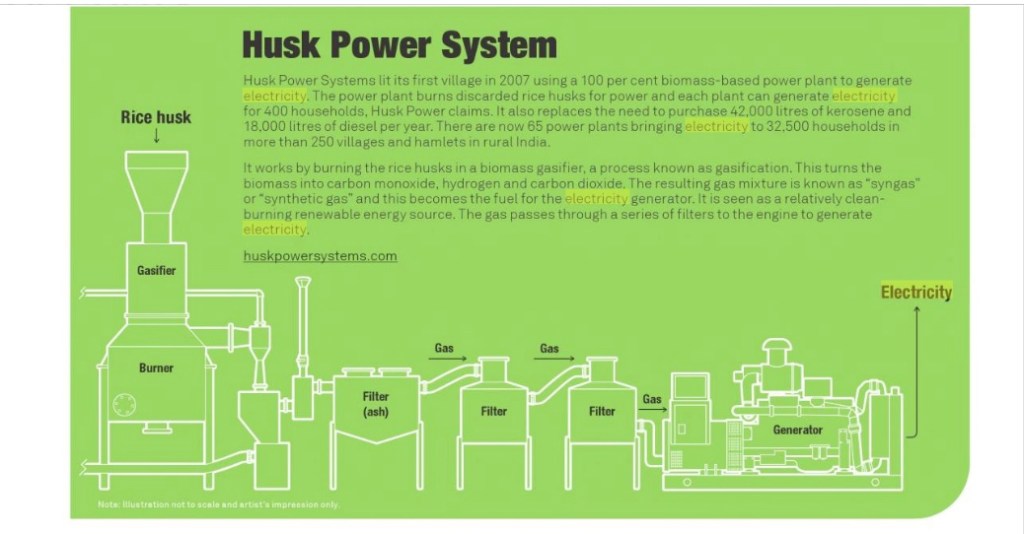
In India, 80,000 of the country’s half a million villages lack electricity. Two students, Charles Ransler and Manoj Sinha, have started a business providing electricity to some of these villages by turning rice husks – a by-product of rice milling – into gas that then powers an electricity generator.

Already, two of their rice-burning generators are providing electricity to 10,000 rural Indians. The hope is to rapidly expand the business to hundreds of small village power plants.

The business, Husk Power Systems, was started while the two were at the University of Virginia’s Darden School of Business.

While the generator burns the rice husks to make a gas to produce electricity, it also leaves behind a waste product of ash that is sold as an ingredient in cement.

This technology can provide off-grid power to rural Indian villages of 200 to 500 households. Using the husk-powered mini power plant, the team plans to offset close to 200 tons of carbon emissions per village, per year in India.

The idea for the rice husk generators was originally conceived by Sinha and Gyanesh Pandey, the third partner in Husk Power, who left an engineering career in Los Angeles to return to India and oversee the rice husk project. Sinha and Pandey went to college together in India and both come from rural Indian villages that struggle with a lack of electricity.

“We grew up in those areas,” said Sinha. “Our relatives still do not have electricity. We wanted to give back to those areas.” Originally they envisioned refining the generator concept and raising enough money to donate rice-husk generators for two or three villages near where they grew up, said Sinha.

But instead, after some research, they realised it could be a financially viable business expandable to hundreds of villages. There are 480 million Indians with no power and 350 million of them live in rural villages, concentrated in eastern India’s “Rice Belt,” where the villagers are “rice rich and power poor,” said Ransler.

The project has already won a fistful of prizes, including US$50,000 from the Social Innovation Competition at the University of Texas.

They think that each rice husk generator is to break even in about two and a half years.

And they like to think this is the Starbucks of off-grid electricity generation, potentially as successful as the globe-spanning US coffee shop chain. “You can put one of these in 125,000 locations, hire local people, and turn a raw material into money – just substitute rice husks for coffee beans,” said Ransler.

Another maker of biomass mini power plants in India is Decentralised Energy Systems India (DESI power). It is a New Delhi-based non-profit company specialising in building a decentralised power network for rural India. It was formed by Development Alternatives, India’s largest sustainable development NGO. It is able to provide a megawatt of electricity to a village for the cost of 44 million rupees, rather than 57 million rupees from the central grid.

Published: June 2008

Resources

https://davidsouthconsulting.org/2022/10/06/battery-business-brings-tanzanians-cheap-electricity/

https://davidsouthconsulting.org/2023/02/03/environmental-public-awareness-handbook-case-studies-and-lessons-learned-in-mongolia/

https://davidsouthconsulting.org/2021/02/01/kenya-turns-to-geothermal-energy-for-electricity-and-growth/

Development Challenges, South-South Solutions was launched as an e-newsletter in 2006 by UNDP’s South-South Cooperation Unit (now the United Nations Office for South-South Cooperation) based in New York, USA. It led on profiling the rise of the global South as an economic powerhouse and was one of the first regular publications to champion the global South’s innovators, entrepreneurs, and pioneers. It tracked the key trends that are now so profoundly reshaping how development is seen and done. This includes the rapid take-up of mobile phones and information technology in the global South (as profiled in the first issue of magazine Southern Innovator), the move to becoming a majority urban world, a growing global innovator culture, and the plethora of solutions being developed in the global South to tackle its problems and improve living conditions and boost human development. The success of the e-newsletter led to the launch of the magazine Southern Innovator.

https://davidsouthconsulting.org/2021/03/05/southern-innovator-issue-5/

Creative Commons License

This work is licensed under a
Creative Commons Attribution-Noncommercial-No Derivative Works 3.0 License.

ORCID iD: https://orcid.org/0000-0001-5311-1052.

© David South Consulting 2022

Categories
Archive Development Challenges, South-South Solutions Newsletters

Web 2.0: Networking to Eradicate Poverty

By David SouthDevelopment Challenges, South-South Solutions

SOUTH-SOUTH CASE STUDY

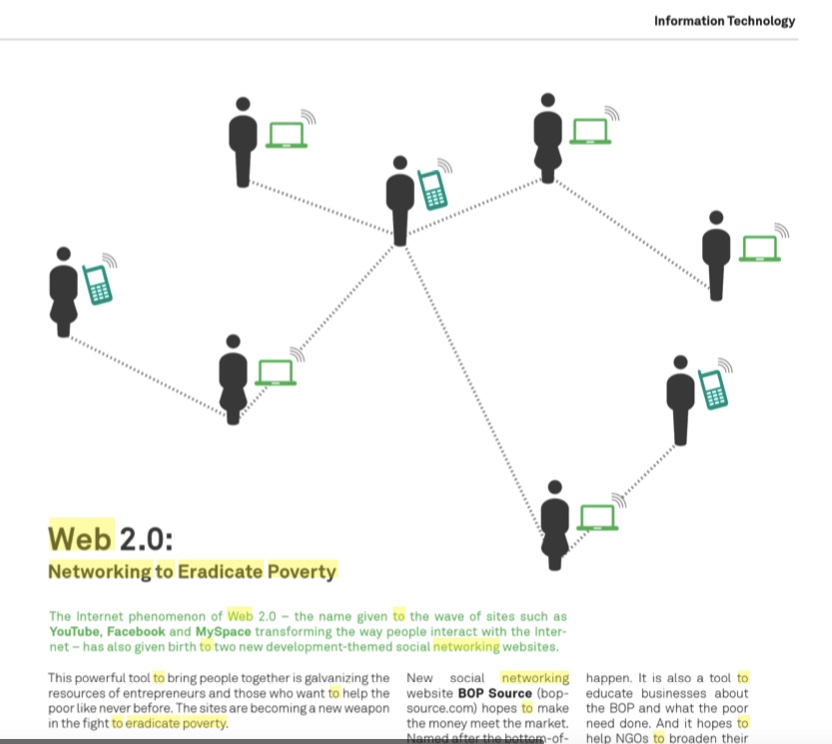
The internet phenomenon of Web 2.0 (http://en.wikipedia.org/wiki/Web_2.0) – the name given to the wave of internet businesses and websites such as YouTube (www.youtube.com), Facebook and MySpace transforming the way people interact with the ‘Net – has also given birth to two new development-themed social networking websites.

This powerful tool to bring people together is galvanizing the resources of entrepreneurs and those who want to help the poor like never before. The sites are becoming a new weapon in the fight to eradicate poverty.

Social networking websites use various tools and applications (or ‘apps’ for short) to enhance the ability of users to connect and get things done. By bringing together a community of like-minded people, they are able to shorten the time it takes to organize and kick-start events. Web 2.0 can be used to build communities and social and business networks. By being able to store vast quantities of information online, it becomes faster to work and reduces the painful delays brought on by slow connections.

All these new tools are making it easier and easier for entrepreneurs to work from home, in internet centres, or anywhere there is a wireless connection – and it is slashing the costs of managing a business. All the applications are online so there is no need to be hidebound by one operating system or hardware capability.

Two newly launched social networking sites are targetting the poverty-eradication community.

One is named after the Bottom of the Pyramid (BOP) concept as conceived by C.K. Prahalad. The BOP is the 4 billion people at the base of the global economic pyramid. As Prahalad sees it, they represent a vast market of unmet needs for entrepreneurs to tackle.

New social networking website BOP Source hopes to make the money meet the market. Started by Jenara Nerenberg, BOP Source wants to put social networking tools into the hands of the world’s poor. It is a place to post business ideas and collaborate with others to make them happen. It is also a tool to educate businesses about the BOP and what the poor need done. And it hopes to help NGOs broaden their relationships with their constituencies and companies.

While marketers can learn about the needs of the BOP, individuals can directly express their needs on the website and seek out the right people to solve problems.

Another social networking website is Business Fights Poverty. Already at 1,000 members, it is a multimedia offering, with podcasts, videos, interviews and discussions about the role of business in addressing development goals.

Published: November 2008

Resources

  • BOP Source is a platform for companies and individuals at the BOP to directly communicate, ultimately fostering close working relationships, and for NGOs and companies to dialogue and form mutually valuable public-private partnerships that serve the BOP. Website: http://bopsource.ning.com/
  • Business Fights Poverty: Business Fights Poverty is the free-to-join, fast-growing, international network for professionals passionate about fighting world poverty through good business. Website: http://businessfightspoverty.ning.com/
  • Afriville is a Web 2.0 service and an African Caribbean social network. Afriville is a community website along the lines of the famous MySpace. Users are free to message and post profiles. The difference is that the user is able to choose how closed or open the networks are. The site features a state of the art music management system which allows African and Caribbean artists to get straight in touch with their fans.
  • Both Yahoo! And Google offer extensive free online tools for entrepreneurs and businesses that integrate seamlessly with their email services.
  • Kabissa: Space for Change in Africa: An online African web community promoting and supporting the transition to Web 2.0 services in Africa. Offers lots of opportunities to meet people throughout Africa and learn more.
  • Global Voices: An initiative from the Reuters news agency to aggregate the global conversation online from countries outside the US and Western Europe.
  • Information, Knowledge and Communication: Web 2.0 in Development Cooperation Bonn, Germany, 27-28 November 2008, Gustav Heinemann Haus. Website: http://www.eadi.org/index.php?id=994
  • 3rd IEEE/ACM International Conference on Information and Communication Technologies and Development (ICTD2009). Website: http://www.ictd2009.org

https://davidsouthconsulting.org/2022/10/14/anti-bribery-website-in-india-inspires-others/

https://davidsouthconsulting.org/2022/06/24/dabbawallahs-use-web-and-text-to-make-lunch-on-time/

https://davidsouthconsulting.org/2022/03/07/david-south-consulting-ranked-in-the-top-10-million-websites/

https://davidsouthconsulting.org/2021/05/25/ger-mongolias-first-web-magazine-and-a-pioneering-web-project-for-the-united-nations-12-january-2016/

https://davidsouthconsulting.org/2022/06/25/shoes-with-sole-ethiopian-web-success-story/

https://davidsouthconsulting.org/2022/10/21/social-networking-websites-a-way-out-of-poverty/

https://davidsouthconsulting.org/2021/05/14/un-ukraine-web-development-experience-2000/

https://davidsouthconsulting.org/2022/06/16/web-2-0-to-the-rescue-using-web-and-text-to-beat-shortages-in-africa/

Development Challenges, South-South Solutions was launched as an e-newsletter in 2006 by UNDP’s South-South Cooperation Unit (now the United Nations Office for South-South Cooperation) based in New York, USA. It led on profiling the rise of the global South as an economic powerhouse and was one of the first regular publications to champion the global South’s innovators, entrepreneurs, and pioneers. It tracked the key trends that are now so profoundly reshaping how development is seen and done. This includes the rapid take-up of mobile phones and information technology in the global South (as profiled in the first issue of magazine Southern Innovator), the move to becoming a majority urban world, a growing global innovator culture, and the plethora of solutions being developed in the global South to tackle its problems and improve living conditions and boost human development. The success of the e-newsletter led to the launch of the magazine Southern Innovator. 

Southern Innovator’s online archive portal was launched in New York City, U.S.A. (home to the UN’s headquarters) in 2011 (southerninnovator.org).
Creative Commons License

This work is licensed under a
Creative Commons Attribution-Noncommercial-No Derivative Works 3.0 License.

ORCID iD: https://orcid.org/0000-0001-5311-1052.

© David South Consulting 2023

Categories
Archive Development Challenges, South-South Solutions Newsletters Southern Innovator magazine

Fashion Recycling: How Southern Designers are Re-using and Making Money

By David SouthDevelopment Challenges, South-South Solutions

SOUTH-SOUTH CASE STUDY

With the rising awareness of the importance of doing fashion in an ethical and sustainable way, more and more fashion designers in the South are getting very creative. Fashion earns big money around the world: The global clothing industry is estimated to be worth US $900 billion a year.

In Paris, the Ethical Fashion Show, now in its fifth year, showcases fashion that respects people and the environment while still being glamorous, luxurious and trendy. It has attracted designers from around the world, including Mongolia, Thailand, China, Peru and Bolivia. The show demands that all participants adhere to International Labour Organization conventions – including banning forced and child labour – respect for the environment, creating local employment and working with craftspeople to ensure skills are retained and the fashion reflects the diversity of the world’s cultures.

In Abidjan, Ivory Coast, Felicite Mai is using pride in her nation’s top export commodity, cocoa (Ivory Coast is the world’s number one exporter of cocoa), to make smart fashion wear at affordable prices. She has turned the beige-coloured jute sacks used to ship cocoa beans around the world into clothes for men and women.

“Ivory Coast’s economy is based on agriculture, especially cocoa and coffee. So I decided to promote these crops by creating these fashion designs,” Mai, whose real name is Maimouna Camara Gomet, told the Reuters news agency.

“For me, it’s a way of drawing the whole world’s attention to cocoa and coffee,” she said

Mai comes from a family of cocoa planters and is a graduate of a sewing school. She works out of a studio-cum-shop in the Treichville suburb of Abidjan.

The clothes are usually beige, but some are dyed dark brown or blue. They include skirts, tops, trousers, shirts, waistcoats, caps, bags and accessories; she gets the sacks – most emblazoned with “Product of Ivory Coast, Cocoa” — from the city’s port warehouses. She cleans the jute cloth first, before creating the fashions.

“I had this idea from when I was still at sewing school in 1987. Then I opened my own workshop in 1996 and I first launched these kind of designs in 2003 during a fashion contest at Divo (in the south of Ivory Coast)” said Mai, who has several assistants at her shop.

She has been able to attract as clients local celebrities, artists and musicians and even a few from abroad.

In Brazil, it is footwear that is getting the recycled-look treatment. The brand Melissa specializes in plastic shoes that are eco-friendly and made from 100 percent recycled materials. They use a plastic called melflex made from recovered plastic. The shoes are made in injection molds and the factory is so efficient, it has next to no waste as a byproduct. It recycles all the waste and water used in the production process. And as a plus, they make a point of paying the workers well, and supporting social and environmental causes in Brazil.

Their secret to putting zing into recycled plastic shoes is to have high-profile, celebrity designers design some of the shoes. So far, they have had UK fashion mistress Vivienne Westwood, the Campana Brothers, and the UK-based, Iraqi-born architect Zaha Hadid. Hadid is a controversial figure who always stirs up debate, and her rubber shoes have brought attention to the brand.

The Chilean studio Modulab has turned to recycled rubber from the car industry to make bags. The rubber comes in sheets so it is easy to cut and shape into bags, thus reducing the amount of time and energy used to make the bags. The line is called RTA (ready to assemble) and includes three types of bags: an envelope, a handbag and a messenger bag. Each sheet of recycled rubber comes with the specific slots and pins for the consumer to put the bag together at home, without any glue or sewing involved. Energy used in the making of the entire bag is 100 percent human, except in the production of the material itself.

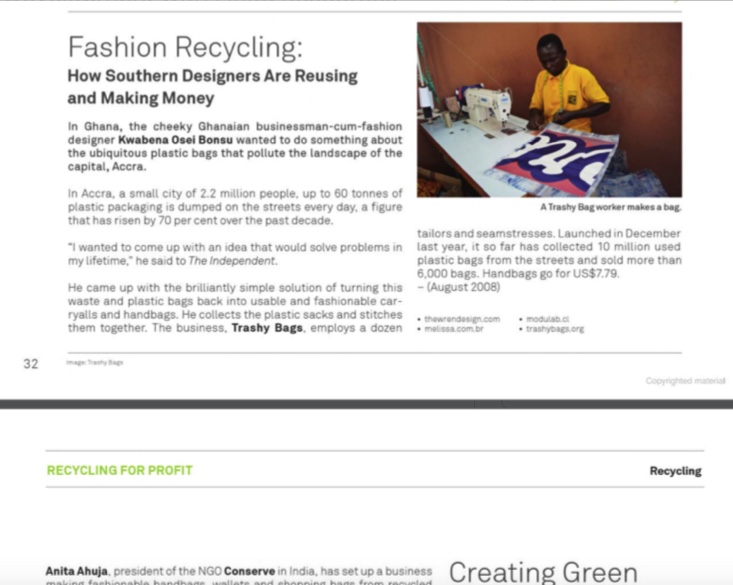
In Ghana, the cheeky Ghanaian businessman-cum-fashion designer Kwabena Osei Bonsu wanted to do something about the ubiquitous plastic bags that pollute the landscape of the capital, Accra.

In Accra, a small city of 2.2 million people, up to 60 tons of plastic packaging is dumped on the streets every day, a figure that has risen by 70 per cent over the past decade.

“I wanted to come up with an idea that would solve problems in my lifetime,” he said to the Independent.

He came up with the brilliantly simple solution of turning these wasted and damaging plastic bags back into usable and fashionable carryalls and handbags. He collects the plastic sacks and stitches them back together. The business, Trashy Bags, employs a dozen tailors and seamstresses. Launched in December last year, it so far has collected 10 million used plastic sachets from the streets, and sold more than 6,000 bags. Handbags go for US $7.79.

Ghana’s huge quantity of discarded plastic water bottles are gathered up for recycling too. A storage room overflows with more than 3 million sachets that have been collected and cleaned ready for recycling.

Bonsu’s business has turned into a source of income for local people, who receive US $3.89 for 1,000 sachets – a good return where the average yearly income is US $495

“I collect sachets because I am jobless and this gives me money,” said Hadiza Ishmael, a 55-year-old grandmother who has delivered 4,000 plastic bags. “It also makes the place look nicer.”

Published: August 2008

Resources

  • The Re: Fashion Awards show is a brand new fashion phenomenon, set to transform social and environmental standards in the fashion industry within a decade. The RE:Fashion Awards will take place in London in November 2008. The glittering event will see major faces from the fashion world come together to recognise the most significant development in the fashion industry of the 21st century. The deadline for budding fashion designers to enter their contest is August 20th.
    Website: http://www.refashionawards.org/
  • A photogallery of the cocoa fashions:
    here: Photogallery 1
    and here: Photogallery 2
    And a video of Mai making the garments here: Video
  • Ethical Fashion Show: Isabelle Quehe, who established the event, said “You almost never see designers from developing countries doing shows in Paris, so this brings together natural products, local fair labour, respect for the environment and finding sales outlets in Paris.” Potential designers and exhibitors can contact the Ethical Fashion Show by sending collection photos and a brief explanation on how the fashions contribute to the ethical fashion movement.
    Send contributions to: 4, rue Trousseau 75011 Paris
    Email: unilove@wanadoo.fr
  • Once inspired to get into the global fashion business, check out this business website for all the latest news, jobs and events.
    Website: http://us.fashionmag.com/news/index.php
  • A creative agency specialising in the promotion of African culture to the world. They organise RUNWAY AFRICA—Africa’s annual Fall Fashion Show featuring five of Africa’s most promising rising design stars on the runway.
    Website: http://inspirationafrica.org/aboutus.html
  • Green fashion must really be making an impact–the BBC, Britain’s venerable public broadcaster, has started an on-line fashion magazine. Called Thread. Fashion Without Victim, it is dedicated to bringing the “latest of eco-fabulous style”. Through a “unique mix of affordable fashion, exclusive videos, photo galleries and thought-provoking features” the site is committed to promoting all aspects of ethical fashion.
    Website: http://www.bbc.co.uk/thread/
  • Traidcraft fights poverty through trade, helping people in developing countries to transform their lives. Established in 1979 as a Christian response to poverty, we are the UK’s leading fair trade organisation.
    Website: http://www.traidcraftshop.co.uk/default.aspx

Development Challenges, South-South Solutions was launched as an e-newsletter in 2006 by UNDP’s South-South Cooperation Unit (now the United Nations Office for South-South Cooperation) based in New York, USA. It led on profiling the rise of the global South as an economic powerhouse and was one of the first regular publications to champion the global South’s innovators, entrepreneurs, and pioneers. It tracked the key trends that are now so profoundly reshaping how development is seen and done. This includes the rapid take-up of mobile phones and information technology in the global South (as profiled in the first issue of magazine Southern Innovator), the move to becoming a majority urban world, a growing global innovator culture, and the plethora of solutions being developed in the global South to tackle its problems and improve living conditions and boost human development. The success of the e-newsletter led to the launch of the magazine Southern Innovator. 

Creative Commons License

This work is licensed under a
Creative Commons Attribution-Noncommercial-No Derivative Works 3.0 License.

ORCID iD: https://orcid.org/0000-0001-5311-1052.

© David South Consulting 2023