The digital revolution in filmmaking over the last decade has given birth to an African success story: Nollywood – Nigeria’s answer to Hollywood, uses low-cost digital filmmaking and editing to tell local stories — in the process making money and creating thousands of jobs.
This do-it-yourself (DIY), straight-to-DVD and video market has in just 13 years ballooned into a US $250 million-a-year industry employing thousands of people. In terms of the number of films produced each year, Nollywood is now in third place behind India’s Bollywood and America’s Hollywood. Despite rampant pirating of DVDs and poor copyright controls, directors, producers, actors, stars, vendors and technicians are all making a living in this fast-growing industry.
The power of creative industries to create jobs and wealth has been a focus of UNESCO, through its Global Alliance for Cultural Diversity. UNESCO has been in the forefront in helping African countries re-shape their policies to take cultural industries into consideration. The promotion of cultural industries also has been incorporated into the New Partnership for Africa’s Development (NEPAD).
What is particularly attractive about Nollywood to the poor in the South is its rough-and-ready approach to filmmaking: combining low-cost digital cameras and film editing software on personal computers, with small budgets and fast turn-around times. Films are made on location using local people. These factors make getting into filmmaking accessible and within reach of more people.
Nollywood grew out of frustration, necessity and crisis: in the late 1980s and early 1990s, Nigerian cities became crime hotbeds. People were terrified to go out on the streets, and this led to the closing down of many movie theatres. Desperate for entertainment at home – and unsatisfied with foreign imports from India and the West – Nigerians turned to telling their own stories to stave off the boredom of staying in.
The film credited with sparking off the industry is 1992’s Living in Bondage – a huge financial hit credited with raising the level of professionalism and production values in Nigerian cinema.
Now, between 500 and 1,000 feature-length movies are made each year, selling well across the continent of Africa. Average productions take 10 days and cost around US $15,000 (www.thisisnollywood.com). Nollywood stars are famous throughout Africa – and Nigeria culturally dominates West Africa just as the US does the world. It is estimated there are 300 producers and that 30 titles go to shops and market stalls every week. On average, a film sells 50,000 copies: a hit will sell several hundred thousand. With each DVD costing around US $2, it is affordable to most Nigerians and very profitable for the producers.
“These are stories about Africa, not someone else’s,” well-known actor Joke Silva told the Christian Science Monitor.
Focused on Africa, the films’ themes revolve around AIDS, corruption, women’s rights, the occult, crooked cops and prostitution. They do so well because they speak directly to the lives of slum-dwellers and rural villagers.
“We are telling our own stories in our way, our Nigerian way, African way,” said director Bond Emeruwa. “I cannot tell the white man’s story. I don’t know what his story is all about. He tells his story in his movies. I want him to see my stories too.”
The big brands – Sony, Panasonic, JVC and Canon – all produce cameras capable of high-definition digital filmmaking and these have become the staple tools of this filmmaking revolution.
More and more, the films are capitalising on the large African diaspora around the world, on top of Africa’s large internal market. And this is offering a step-up into the global marketplace for Nigerian directors and producers.
The Nollywood phenomemon has been documented in the documentary This is Nollywood, directed by Franco Sacchi, a teacher from the Center of Digital Imaging Arts at Boston University.
The prospects for the industry are only looking up: the Nigeria in the Movies project has been launched to help grow the industry, establish standards, improve distribution and broaden its international appeal and awareness. It also offers filmmaking grants for neophyte filmmakers.
Of course, filmmaking can be a tricky business: authorities in largely Muslim northern Nigeria have imposed 32 restrictions on the local film industry — nicknamed “Kannywood” after the city of Kano. A six-month ban lost the industry US $29 million and put thousands out of work: a sign of the economic importance of this DIY filmmaking business. The message is clear: filmmakers need to be sensitive to the cultural norms of the communities in which they work.
Kannywood, started in 1992, has 268 production companies and 40 editing studios, employing over 14,000 people.
Adim Williams is one Nigerian director who is getting an international audience. He spends about US $40,000 on films that take two weeks to shoot. He has already secured an American release of a comedy, Joshua. Another director, Tunde Kelani, is regularly featured at international film festivals, where Nollywood screenings are more common.
And some, like young director Jeta Amata, believe Nollywood’s cheap, fast-production, DIY approach has a lot to teach Hollywood, with its expensive filmmaking and ponderous production cycles.
The global charity Camfed (dedicated to eradicating poverty in Africa through the education of girls and empowerment of women) has projects to teach women filmmaking skills. Website:http://uk.camfed.org
Festival Panafricain du Cinema et de la Television de Ouagadoogou 2009: Africa’s biggest film festival. Website:http://www.fespaco.bf/
Naijarules: Billing itself as the “largest online community of lovers and critics of Nollywood”, an excellent way to connect with all the players in the business. Website: http://www.naijarules.com/vb/index.php
Nollywood Foundation: Based in the US, aims to bring Nigerian films and culture to an international audience and to promote new films and new media. Website:http://www.nollywoodfoundation.org/home.php
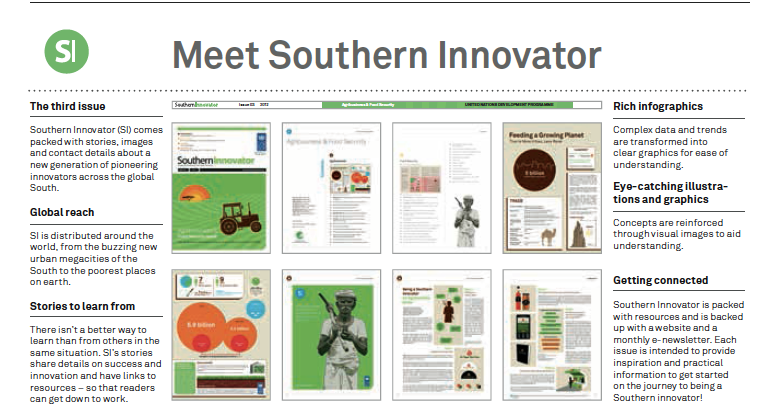
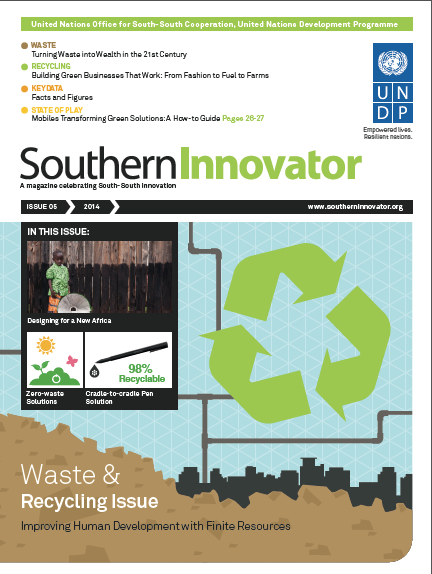
Development Challenges, South-South Solutions was launched as an e-newsletter in 2006 by UNDP’s South-South Cooperation Unit (now the United Nations Office for South-South Cooperation) based in New York, USA. It led on profiling the rise of the global South as an economic powerhouse and was one of the first regular publications to champion the global South’s innovators, entrepreneurs, and pioneers. It tracked the key trends that are now so profoundly reshaping how development is seen and done. This includes the rapid take-up of mobile phones and information technology in the global South (as profiled in the first issue of magazine Southern Innovator), the move to becoming a majority urban world, a growing global innovator culture, and the plethora of solutions being developed in the global South to tackle its problems and improve living conditions and boost human development. The success of the e-newsletter led to the launch of the magazine Southern Innovator.
One of the many stories we covered on Africa’s fast-growing cities from 2007. It was witnessing first-hand Africa’s innovators and their adaptive use of mobile and information technologies that inspired us to give birth to Southern Innovator’s first issue.
Making Bamboo Houses Easier to BuildDevelopment Challenges: More than 1 billion people around the world lack decent shelter. Of these, the majority live in urban areas, usually in slums and informal settlements (UN-HABITAT). Latin America has a serious shortage of adequate housing: in Colombia, 43 percent of the population needs decent housing; in Brazil, 45 percent; Peru, 53 percent.
Two-stroke Engine Pollution SolutionDevelopment Challenges: Cities across the South choke on the pollution made by the small two-stroke engines (http://www.howstuffworks.com/two-stroke.htm) powering motor scooters, motorcycles, auto rickshaws, tuk-tuks and other vehicles. People choose these vehicles to get around because they are cheap, powerful and easy to fix. But the environment – and human health – suffers as a result. And as cities balloon and populations grow, the number of journeys and two-stroke engines grows with it.
Rammed-Earth Houses: China Shows how to Improve and Respect Traditional Homes Development Challenges: The pace of change across the South has been blistering. Over the past decade, the overall population has moved from being primarily rural to majority urban. In the process, rural communities have suffered, as they have seen their young and ambitious leave in droves seeking a better life in cities.More than 200 million Chinese farmers have moved to cities in recent years. It’s easy to see why. Chinese farms are tiny, with the average rural household farming just 0.6 hectares. And incomes are low compared to the cost of living: average annual income was just US$606 in 2007, a third of city salaries.
Clay Filters are Simple Solution for Clean WaterDevelopment Challenges:Access to clean water is critical to good health. It is a basic human need that when met, leads to the biggest improvements in health and well-being. Dirty water causes diarrhoea (http://en.wikipedia.org/wiki/Diarrhea),cholera and typhoid. Diseases caused by dirty drinking water kill almost 5,000 children a day around the world (WHO).
Brazil Preserves Family Farms and Keeps Food Local and Healthy Development Challenges: Today’s global food crisis sparked by a toxic mix of events – high oil and commodity prices, food scarcity, growing populations, and environmental catastrophes – has woken many up to the urgent need to secure food supplies and help those who grow the world’s food. More and more countries are turning to local and small farms – or family farms – to offer food security when times get rough.
November
Riverwood: Kenyan Super-fast, Super-cheap FilmmakingDevelopment Challenges: The African film-making success story of Nigeria’s Nollywood has been joined by another fast-rising star: Kenya’s Riverwood. Both are beneficiaries of the digital revolution in filmmaking over the last decade, and both are using low-cost digital filmmaking and editing to tell local stories — in the process making money and creating thousands of jobs.
Model Indian Villages to Keep Rural Relevant Development Challenges:The world’s rush to urban centres is the great challenge of the 21st century. In 2007, the world became a majority urban place. The consequences of this shift can be seen in the blight of urban poverty, with its slums and squalor, environmental degradation, and rising social tensions. But there are people working on keeping rural areas relevant and pleasant places to live. These rural advocates see a vibrant countryside as part of the solution to the world’s plethora of crises.
Brazilian Solar-powered WiFi for Poor SchoolsDevelopment Challenges:There is a pressing need to spread access to the internet to the world’s poor – but also many obstacles. Often it is something as basic as a lack of electricity that brings progress to a halt. But a Brazilian innovator has come up with a solar power supply that is helping to bring internet access to schools serving the poor.
Web 2.0: Networking to Eradicate Poverty Development Challenges: The internet phenomenon of Web 2.0 (http://en.wikipedia.org/wiki/Web_2.0) – the name given to the wave of internet businesses and websites such asYouTube(www.youtube.com), Facebook and MySpace transforming the way people interact with the ‘Net – has also given birth to two new development-themed social networking websites.
October
Local Fashions Pay Off for Southern Designers Development Challenges:Fashion earns big money around the world: The global clothing industry is estimated to be worth US $900 billion a year. For many decades, strong American brands have been the desired commodity for those looking to be cool and contemporary. People were willing to pay high premium prices to get the cache of American cool that the brands conveyed.
Rats a Solution in Food Crisis Development Challenges: The global food crisis continues to fuel food price inflation and send many into hunger and despair. Around the world, solutions are being sought to the urgent need for more and cheaper food. Right now there are 862 million undernourished people around the world (FAO), and U.N. Secretary General Ban Ki-moon has called for food production to increase 50 percent by 2030 just to meet rising demand.
Mobile Phones: New Market Tools for the PoorDevelopment Challenges:Bangladesh’s poor can now buy and sell goods and services with their mobile phones, thanks to a Bangladeshi company’s pioneering mobile phone marketplace. The company, CellBazaar, serves as a useful role model for other Southern entrepreneurs and companies looking to develop and market mobile phone applications for the poor that really help them.
Picking Money from the Baobab TreeDevelopment Challenges: The fruit of the highly revered African baobab tree is being seen as a great new opportunity for the poor, after a recent decision by the European Commission to allow its importation. According to one study, gathering the fruit has the potential to earn an extra US $1 billion a year for Africa, and bring work and income to 2.5 million households, most of them African bush dwellers (Britain’s Natural Resources Institute).
September
Solar Power Bringing Light and Opportunity to the Poor Development Challenges: Meeting the South’s energy needs will be crucial to achieving radical improvements in quality of life and human development. It is estimated that 1.7 billion people around the world lack electricity (World Bank), of whom more than 500 million live in sub-Saharan Africa.
Computer ‘Gold Farming’ Turning Virtual Reality into Real Profits Development Challenges: The rapid spread of the internet around the global South is bringing with it new forms of work. One of these trends is so-called “gold farming”: making money in the virtual world of computer gaming by trading in virtual money, prizes and goods for busy gamers who don’t have time to do it themselves. This work now employs 400,000 people – mostly men and mostly in China, but also elsewhere in the South, according to a new report.
Farmers Weather Fertilizer Crisis by Going OrganicDevelopment Challenges: Around the world, large-scale agriculture relies on the use of chemical fertilizers. But increasing expense and decreasing supply of fertilizer is driving up the cost of food, and in turn contributing to the overall food crisis.
Urban Farmers Gain from Waste Water Development Challenges: The global food crisis continues to fuel food price inflation and send many into hunger and despair. Around the world, solutions are being sought to the urgent need for more food and cheaper food. U.N. Secretary General Ban Ki-moon has called for food production to increase 50 percent by 2030 just to meet rising demand – and right now there are 862 million people undernourished (FAO).
August
Cash Machines for the Poor Development Challenges: Access to basic banking services for the poor is weak at the best of times. Many are openly discriminated against as a ‘bad risk’ by banks, and denied the sort of banking services middle and higher income people take for granted. Yet it is a myth that the poor do not have money or do not wish to save and invest for their future or for business.
Milk Co-operatives Help Hungry Haiti Development Challenges: The global food crisis has hit the impoverished Caribbean country of Haiti especially hard. Already suffering from decades of food crises brought on by the collapse of domestic farming, the country has become notorious for its people being reduced to eating cakes made of mud to stave off hunger pains. It is the poorest country of Latin America and the Caribbean and one of the poorest in the world.
Traditional Healers can Heal the Mind, as well as BodyDevelopment Challenges:Mental healthcare is critical to physical health and overall wellbeing, yet it is seriously neglected around the world – and especially in poorer countries.
Fashion Recycling: How Southern Designers are Re-using and Making Money Development Challenges: With the rising awareness of the importance of doing fashion in an ethical and sustainable way, more and more fashion designers in the South are getting very creative. Fashion earns big money around the world: The global clothing industry is estimated to be worth US $900 billion a year.
July
Pay for Pee Keeps Indian Town CleanDevelopment Challenges: The task is huge: 2.6 billion people, or 41 percent of the world’s population, is without access to basic sanitation. As a result, most have to make do and defecate or urinate wherever they can. In crowded urban areas, the result is an unpleasant source of disease and filth that fouls living spaces and sickens or kills many people.
Sex Workers’ Savings Help Make a Better Life Development Challenges:Prostitution is called the world’s oldest profession, and can be found in one form or another in every country and society. And where poverty is rife and women have few economic choices, it flourishes. But it also flourishes in societies and economies undergoing rapid change, and where people move around more and more, as in the South’s fast-growing cities.
Urban Youth: A Great Source of Untapped GrowthDevelopment Challenges: The world’s growing urbanization means that a whole generation of youth will have a dramatically different life than their parents. The world’s 3.3 billion urbanites now outnumber rural residents for the first time (UNFPA’s State of the World Population 2007 Report). And the vast majority live in slums or periurban areas, places of sprawl, where public services are poor and housing conditions unhealthy.
Innovative Mobile Phone Applications Storm SouthDevelopment Challenges: The pace of change in information technology in the South is impressive, and nowhere has it been more rapid than in the take-up of mobile phones. In the past three years China has become the world’s largest exporter of information and communications technology (ICT), and home to the same number of mobile-phone users (500 million) as the whole of Europe. According to India’s telecoms regulator, half of all urban dwellers now have mobile- or fixed-telephone subscriptions and the number is growing by eight million a month.
Small-scale Farmers Can Fight Malaria BattleDevelopment Challenges:Malaria is one of Africa’s biggest killers. Each year globally 300 to 500 million people are infected, and around 1 million die from the disease (theglobalfund). Ninety percent of malaria deaths occur in sub-Saharan Africa – mostly to children under the age of five. The disease costs African countries US$12 billion a year in lost gross domestic product.
June
Urban Farming to Tackle Global Food Crisis Development Challenges: The world’s population is becoming more urban by the day. By 2030, some five billion people around the world will live in cities. This year is the tipping point: urban dwellers (3.3 billion people) now outnumber rural residents for the first time (UNFPA’s State of the World Population 2007 Report).
Connoisseur Chocolate from the South Gets a Higher PriceDevelopment Challenges: Like coffee beans, cocoa beans are grown around the world and are a major commodity, highly prized in wealthy countries. West Africa accounts for 70 percent of the world’s output, with the rest grown either in Indonesia and Brazil (20 percent), or on a smaller scale in countries across the South, from Belize to Madagascar.
Agricultural Waste Generating ElectricityDevelopment Challenges:Agriculture around the world produces a great deal of waste as a by-product. It can be animal faeces, or the discarded plant husks thrown away when rice, grains or maize are harvested. When this waste meets the urgent need for electricity, something special can happen.
The Disabled in the South can Make Money, Restore Dignity Development Challenges: The South’s disabled are a large population and often suffer more than even the poorest residents. It is estimated that there are 500 million disabled people in the world, with either mental, physical or sensory impairment. As many as 80 percent of all disabled people live in isolated rural areas in developing countries, and in some countries more than 20 percent of the population is classed as disabled (UN).
May
Women Mastering Trade Rules Development Challenges: Market trading is a vital lifeline for most people in the South. Plenty of delights usually await people in the market, where live animals, herbs and spices, fresh fruits and vegetables, and life’s necessities compete for customers’ money. The formal and informal food sector plays a crucial role in empowering women and providing food to the poor.
Combating Counterfeit Drugs Development Challenges: Access to good quality drugs is a serious problem across the South. The International Narcotics Control Boardestimates that up to 15 per cent of all drugs sold around the world are fake or counterfeit, and in parts of Africa and Asia this figure jumps to 50 per cent. The US Food and Drug Administration estimates counterfeit drugs make up 10 per cent of the global medicine market.
Rainforest Rubbers Save LivesDevelopment Challenges: Two development goals are being achieved with one innovative business in Brazil. By using natural rubber tapped from trees in the Amazon rainforest to make condoms, Brazil is able to afford the cost of distributing condoms to tackle its HIV/AIDS crisis. Brazil currently imports more than 120 million condoms every year from China, Republic of Korea and Thailand, making it the world’s biggest single buyer of condoms.
New Weapon Against Crime in the SouthDevelopment Challenges: Crime in the South’s fast-growing cities has a negative affect on economic development and social and community harmony. In Africa, with one fifth of the world’s population, for example, data is very poor on crime and its victims. The absence of good data means prevention and detection of crime is poor, and resources to fight it can’t be allocated effectively.
April
Tapping the Power of Child Play Development Challenges: Children are an amazing source of energy. Each generation fizzes with the restlessness and optimism of youth. But all that energy is expended in the playground, leaving behind nothing but the sound of laughter. What if that energy could actually be harnessed and turned into electricity? And electricity to power the cash-strapped school the children need to attend to get a good head start in life?
Illiterate Get Internet at the Touch of a Button Development Challenges:Quick access to information is crucial for development. The remarkable spread of information around the world via the internet has been one of the greatest achievements of the 21st century. The astounding take-up of mobile phones is another. For those who can afford it or get access to a computer and electricity, the new technology is a powerful tool for economic and social advancement. But what about people who are caught in the technology gap, or who are illiterate?
The South has a Good Story to Tell Development Challenges: The fast-changing modern world is raising the living standards of billions in the South – China alone has lifted 400 million people out of poverty since the 1980s – but it is also risking the loss of many rich cultural traditions. One of them is storytelling. Oral storytelling is a critical tool for passing on history, while teaching morals and ethics, especially in societies with low rates of literacy and little formal education. But with the rise of modern media and advertising, few traditional storytellers – many of whom are old – stand a chance.
Insects Can Help in a Food CrisisDevelopment Challenges: For many years it was a given that the world’s problem was not a lack of food, but that it was unfairly shared. But as the switch to biofuels gathers pace, farmland is being diverted away from growing food for people, to food for fuel. On top of this, growing prosperity in many countries in the South has boosted demand for better quality food, including grain-devouring meat diets – it takes 10 kilograms of grain to get one kilogram of meat from a cow. The crisis has deeply alarmed the UN’s World Food Programme and the World Bank. In the economic battle for food, the poor are the most vulnerable.
March
From Warriors to Tour GuidesDevelopment Challenges: In the wake of conflict, demobilizing combatants is as critical as ending the fighting if there is hope for the peace to last. When conflict ends, former fighters usually find themselves unemployed. But tourism is proving a viable way to deal with the social and political dangers of neglecting former fighters post-conflict.
Carbon Markets Need to Help the PoorDevelopment Challenges: The global carbon credit trading schemes emanating from the Kyoto Protocolhave created a multi-billion dollar market – the global carbon market was worth US $30 billion in 2007 (World Bank) – and represents one of the fastest growing business opportunities in the world. The bulk of this trading is with the European Union’s emissions trading scheme, some US $25 billion. But the big problem to date has been most of this investment is enriching stock brokers, and not the poor.
Nollywood: Booming Nigerian Film IndustryDevelopment Challenges: Thedigital revolution in filmmaking over the last decade has given birth to an African success story: Nollywood – Nigeria’s answer to Hollywood, uses low-cost digital filmmaking and editing to tell local stories — in the process making money and creating thousands of jobs.
Innovative Stoves to Help the PoorDevelopment Challenges: Half of the world’s population cook with a fuel-burning stove, and this figure rises to 80 per cent of households in rural areas in developing countries. Typical fuels burned include wood, coal, crop leftovers and animal dung. The indoor pollution from smoke and carbon monoxide is a top health hazard in the developing world, ranking just behind dirty water, poor sanitation and malnutrition. The World Health Organization (WHO) estimates that 1.6 million people die each year as a result of toxic indoor air.
February
Cashing in on Old Wisdom Development Challenges: India’s traditional weavers, heirs to a 2,000-year-old textile industry, are turning to the ancient practice of ayurvedic medicine to make their products more appealing and boost sales. Drawing on recipes once used by weavers to the Indian royal courts, clothes are woven and infused with ayurvedic, herb-and-spice medicinal recipes to address various health problems. Strange as it may sound, the health-giving properties of the clothes have been backed up by clinical trials at the Government Ayurveda College in Thiruvanathapuram, southern India.
Prisons with Green Solutions Development Challenges: An ingenious solution is helping Rwanda reduce the cost of running its bursting prisons, while improving conditions for the prisoners and helping protect the environment.
Envisioning Better Slums Development Challenges: More than 900 million people – almost a sixth of the world’s population – now live in urban slums (UN). Improving conditions for these people is a critical Millennium Development Goal target. And the scale of the problem is vast: this year half the world’s population will live in cities, and already in developing countries 43 per cent of urban dwellers live in slums. In the least-developed countries the figure is 78 per cent.
Mobile Phone Peacekeeping Development Challenges: Last month UN secretary-general Ban Ki-moon pointed out the urgent need for interesting and relevant content to attract Africans to the internet. Official statistics can make for grim reading: the continent has less bandwidth than Ireland (World Economic Forum). While it is true Africa is restricted by serious technological and economic disadvantages, African ingenuity, creativity and hard work are bypassing these impediments to get things done nonetheless. While word has got out about the impressive take-up of mobile phones in Africa, the new world of Web 2.0 is also spawning a new generation of inspiring African technology whizzes transforming perceptions and grabbing the world’s attention.
January
Putting Worms to Work Development Challenges: Overuse of pesticides is now acknowledged as one of the gravest mistakes of the Green Revolution, launched in the 1970s to dramatically increase food production in the developing world. Pesticides have polluted the environment, poisoned fertile soil, contaminated ground water and damaged human health.
Cyber Cities in the South: An Oasis of Opportunity Development Challenges: The future is arriving in the South even faster than many think: so-called “cyber cities” are being created to become this century’s new Silicon Valleys. Well-known ‘cyber cities’ like India’s Hyderabad and Bangalore have been joined by many other cities across the global South. But two places are set to make big waves with their ambition and drive in 2008: Mauritius and China.
Decent and Affordable Housing for the Poor Development Challenges:Urban populations across the South are growing fast: by 2030, some 5 billion people around the world will live in cities. This year will be the first year in which urban dwellers (3.3 billion people) will outnumber rural residents for the first time (United Nations Population Fund [UNFPA]). Africa now has a larger urban population than North America and 25 of the world’s fastest growing big cities. Asia and Africa’s cities are growing by an incredible 1 million people a week, with 72 per cent of the population in sub-Saharan Africa living in slum conditions.
Development Challenges, South-South Solutions was launched as an e-newsletter in 2006 by UNDP’s South-South Cooperation Unit (now the United Nations Office for South-South Cooperation) based in New York, USA. It led on profiling the rise of the global South as an economic powerhouse and was one of the first regular publications to champion the global South’s innovators, entrepreneurs, and pioneers. It tracked the key trends that are now so profoundly reshaping how development is seen and done. This includes the rapid take-up of mobile phones and information technology in the global South (as profiled in the first issue of magazine Southern Innovator), the move to becoming a majority urban world, a growing global innovator culture, and the plethora of solutions being developed in the global South to tackle its problems and improve living conditions and boost human development. The success of the e-newsletter led to the launch of the magazine Southern Innovator.
Fashion earns big money around the world: The global clothing industry is estimated to be worth US $900 billion a year. For many decades, strong American brands have been the desired commodity for those looking to be cool and contemporary. People were willing to pay high premium prices to get the cache of American cool that the brands conveyed.
But the decline in popularity suffered by American brands in recent years has become a boost for local brands. And this is creating a whole new opportunity for canny Southern entrepreneurs. It is being called ‘fashionalism’ or fashion nationalism – a pop culture trend blending patriotism with fashion.
One of fashionalism’s pioneers is Italian-educated Filipino designer Rhett Eala. He is credited with coming up with the snappy name fashionalism, after launching his My Pilipinas clothing line. Its signature logo is the Philippine archipelago on collared shirts and cotton polo shirts. An experienced designer who has worked in Hong Kong and for a major department store, Eala joined Collezione C2 as creative director two years ago.
He started with just three styles sporting the map. But now he has expanded the design to cover almost his entire range of clothing.
“It’s a fun way to show your pride in being Filipino, without a lot of words. Filipinos have today become global citizens,” said Eala.
Eala’s design talent stretches to pop art paintings as well, with an art exhibit called My Pilipinas Series, 18 Filipino pop art paintings that transcend flag-waving notions of nationalism.
But Eala is no parochialist: he is very much inspired by global artists and trends. His work is a blend of foreign concepts and patriotic ideals. Common Filipino iconography gets the high-design treatment, as Eala draws inspiration from Damien Hirst, David Hockney and Andy Warhol. He tries to challenge his customers, taking the complicated and oblique Rorschach Test patterns, and blending them with other designs.
The fashionalist logoed clothing not only sells well domestically, but also amongst the large diaspora of Filipino expatriates around the world.
“Fashionalism has a very positive impact on our business,” said Joey Qua, the Managing Director of Collezione C2. “We’ve always wanted to highlight the ingenuity of Philippine artistry and what it feels like to be proud to be a Filipino.”
“More importantly, we want to make Filipinos proud to wear our brand here and abroad, since the Filipinos of today are more global in nature, we have so many Filipinos who are more exposed globally.”
“We want to make nationalism hip and relevant to today’s generation,” said Eala.
Supporters of fashionalism say it is about restoring pride in the country’s development and achievements, not in stirring up negative xenophobia and other negative aspects of nationalism.
Another group of Manila fashion designers, Team Manila and Analog Soul, are marking the 25th anniversary of the death of Filipino nationalist hero, Ninoy Aquino – who was assassinated at the airport after returning to the Philippines from his self-imposed exile in the United States on August 21, 1983. Their t-shirts include sayings like: “I am Ninoy.”
The clever designers have turned Aquino’s signature old-school eye glass frames into an iconic logo.
“Ever since our humble beginnings as a Design Studio in 2001, we’ve made it a point to celebrate the Philippines and the Filipino people in our designs,” said Team Manila’s chief operating officer, Nico Bacani. “It was only natural that when we established our clothing and apparel line in 2005, the messages would remain the same – positive messages about the country, the culture and the people, be it explicitly or through subtle means in design.”
Underground t-shirt designers had been selling yellow Ninoy t-shirts to the young and trendy urbanites. But it is the professional design flair that has taken the trend to the next level and created an industry in its own right, with the fashionalism branding spreading beyond clothes to coffee mugs and other everyday items.
“We started as a design studio working from our Macs (Macintosh Computers) at home,” said Bacani. “and when we did start selling merchandise, this would be done literally in our garage and obscure spaces throughout the apartment we were renting. We then participated in bazaars, until such time as we raised enough capital and loyal clientele to expand into a stand-alone store.
“So the obstacles we faced were more towards asset capitalization and recruiting people well-versed in the retail industry. We were, however, luckier than most, as the media would frequently feature our products, which was a big boost.”
And Bacani hopes for a big payoff for the Phillippines as a whole.
“We really wouldn’t say there’s anything negative about it, but we would say that it would be quite disappointing if it ended up just being that – wearing the clothes and not living the message. We would be quite pleased if Fashionalism were a trigger, a catalyst for something bigger, such as a more active participation in the development of the country as a whole. And we see that people starting to think and feel proud of being Filipino and representing the Filipino well, whether it be at the workplace here or abroad, or in everyday living around the world.”
As for other fashion designers thinking of going down the fashionalism path, Eala said: “My advice is being honest with your design. Try to design from your heart and your mind. Be inspired with what’s around you. Design for your environment and if you have a chance, travel to places that you haven’t been to. ”
Development Challenges, South-South Solutions was launched as an e-newsletter in 2006 by UNDP’s South-South Cooperation Unit (now the United Nations Office for South-South Cooperation) based in New York, USA. It led on profiling the rise of the global South as an economic powerhouse and was one of the first regular publications to champion the global South’s innovators, entrepreneurs, and pioneers. It tracked the key trends that are now so profoundly reshaping how development is seen and done. This includes the rapid take-up of mobile phones and information technology in the global South (as profiled in the first issue of magazine Southern Innovator), the move to becoming a majority urban world, a growing global innovator culture, and the plethora of solutions being developed in the global South to tackle its problems and improve living conditions and boost human development. The success of the e-newsletter led to the launch of the magazine Southern Innovator.
Cities across the South choke on the pollution made by the small two-stroke engines (http://www.howstuffworks.com/two-stroke.htm) powering motor scooters, motorcycles, auto rickshaws, tuk-tuks and other vehicles. People choose these vehicles to get around because they are cheap, powerful and easy to fix. But the environment – and human health – suffers as a result. And as cities balloon and populations grow, the number of journeys and two-stroke engines grows with it.
In large cities across Asia, 1 million three-wheeled auto-rickshaws form an important means of daily transportation, and a source of income for their drivers. And the Asian Development Bank estimates there are over 100 million vehicles using two-stroke engines in Southeast Asia. But these vehicles cause serious air pollution and emissions of carbon dioxide (CO2), which contributes to global warming.
Because two-stroke engines burn an oil-gasoline mixture, they also emit more smoke, carbon monoxide, hydrocarbons and particulate matter than the gas-only, four-stroke engines found in newer vehicles.
In the Philippines, auto rickshaw drivers are pioneering specially adapted two-stroke engines that reduce particulate emissions by 70 percent and carbon dioxide emissions by 76 percent.
Tim Bauer, the 31-year-old American mechanical engineer who developed the technology, said auto rickshaws “play an essential role in the social and economic fabric. But their impact on public health is disastrous.”
Motorized tricycles produce an astonishing amount of pollution: each one is equivalent to 50 cars. In Bangkok, Thailand, two-stroke engines contribute 47 percent of pollution particulates in the air.
The World Health Organization (www.who.org) ranks urban outdoor air pollution as the 13th greatest contributor to disease burden and death worldwide. It has been estimated that the air pollution leads to the deaths of more than half a million people a year. About two-thirds of the residents of Delhi and Calcutta suffer from respiratory symptoms such as common cold and dry and wet cough, much of this caused by two-stroke engine emissions.
Two-stroke engines are highly inefficient users of fuel: up to 40 percent of the fuel and oil goes out of the exhaust pipe unburned. This exhaust is packed with oxides of carbon, nitrogen, sulphur, hydrocarbons and fine dust – all toxic contributors to air pollution.
But the attraction of these engines remains strong. “They are powerful, simple, reliable and robust,” said Bauer, “and spare parts are easy to find. They also have a long lifetime.”
Bauer faced some strict constraints in developing the technology.
“It had to substantially reduce emissions without impairing the engine’s performance. It had to be installed without machining the engine crankcase, and with only a basic tool set. Of course, it also had to be affordable for Filipino drivers.”
Using off-the-shelf components, Bauer developed a kit that turns two-stroke engines into fuel-injection machines. This adjustment reduced particulate emissions by 70 percent and carbon dioxide emissions by 76 percent. He now sells the kits through Envirofit, a non-profit organization (http://www.envirofit.org/). It has been pilot tested at two Filipino holiday resorts, Vigan and Puerto Princesa.
Auto-rickshaw drivers tend to be poor and earn on average US $3 to US $4 a day. The cost of fitting vehicles with Bauer’s new technology is met by microcredit.
“Drivers earn money daily, so it’s easy for them to pay back their loan, and 90 percent of them do it in less than a year,” he said. Over 260 taxi drivers have already installed the new kit.
“These drivers are at the base of the economic pyramid and these tricycles are a testament to their ingenuity and work ethic. At the end of the day, we can improve their lives with a cylinder head, a few brackets and, of course, hard work.”
Bauer pioneered his solution while working on fuel injection in snowmobiles at the Engines and Energy Conservation Lab at Colorado State University. He started to market the solution in Asia in 2004. Bauer has won a Rolex Award for Enterprise to pay for the distribution of the kits throughout Asia.
There is, of course, another solution: an outright ban or measures to push the vehicles off the road. In the Philippines’ San Fernando City, economic incentives were what drove the transition from two-stroke to four-stroke (less polluting) tricycles. In 2001, three-quarters of the city’s 1,600 registered tricycles ran on two-stroke engines. But after a city council mandate to totally phase out the vehicles by 2004, and offers of interest-free loans for down-payments on four-stroke models, more than 400 four-stroke tricycles had replaced the older two-stroke models.
When Bangkok toughened up vehicle inspections and emissions standards in 2000, two-wheelers made up over 96 percent of the city’s traffic. But by March 2004, they made up only 40 percent, according to Supat Wangwongwatana, deputy director general of Thailand’s Pollution Control Department.
The Hybrid Tuk Tuk Battle is a competition to come up with less polluting auto rickshaws, clean up the air in Asian cities, and improve the economic conditions for auto rickshaw drivers. Website:http://hybridtuktuk.com/
The Clean Air Initiative for Asian Cities promotes and demonstrates innovative ways to improve the air quality of Asian cities through partnerships and sharing experiences. It is run by the Asian Development Bank together with the World Bank and the US Agency for International Development. Website:http://www.cleanairnet.org/
A new book launched in April 2019 by journalist Beth Gardiner (@Gardiner_Beth), “Choked: The Age of Air Pollution and the Fight for a Cleaner Future” (Granta) (University of Chicago Press), explores today’s global air pollution crisis in the world’s cities. Gardiner is an environmental journalist who writes for The New York Times, The Guardian and other publications (bethgardiner.com).
Called “One of the Guardian’s Best Books of 2019“. The UK cover for Choked: The Age of Air Pollution and the Fight for a Cleaner Future (Granta, 2019).








 David South Consulting
You must be logged in to post a comment.