It was the late 1990s. Mongolia was still recovering from “one of the biggest peacetime economic collapses ever” (Mongolia’s Economic Reforms: Background, Content and Prospects, Richard Pomfret, University of Adelaide, 1994). But it was the country’s young musicians who were showing the way out of the crisis, setting an example for entrepreneurship in the new, free-market economy that emerged in the country after 1990.
As UNDP Communications Officer N. Oyuntungalag wrote in the Blue Sky Bulletin (BSkyB) newsletter, “A thriving pop and rock scene has emerged over the last four years. .. The energy of these musicians and singers has not gone unnoticed by the burgeoning advertising market. Pop bands are promoting many things, from face creams to beer. … [but] there has been little serious writing on the business of popular music.”
As the book’s author, American ethnomusicologist Peter Marsh, said in an interview with UNDP’s Blue Sky Bulletin newsletter, “we thought our book would provide important ideas about the direction and nature of the nation’s development.
“My impression about Mongolian pop-rock is that it is a lively, diverse and at times innovative Mongolian art form that closely reflects many of the hopes, fears and aspirations of its primary audience, Mongolian youth.”
The book still stands as an unusual and innovative contribution to thinking around the role played by youth in development and business and in crisis recovery.
Google Books Key Words: авдаг адил аль англи аялан байж байлаа байх байхад байхгүй бараг барууны бас бензин Бид нар бидний биз бизнес бий биш болох бөгөөд бусад бүжиг бүр бүтээлчид бүх гадаад гадаадад
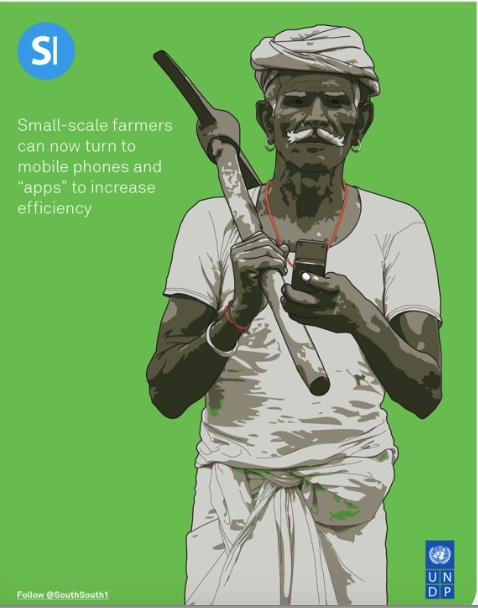
Bangladesh’s poor can now buy and sell goods and services with their mobile phones, thanks to a Bangladeshi company’s pioneering mobile phone marketplace. The company, CellBazaar, serves as a useful role model for other Southern entrepreneurs and companies looking to develop and market mobile phone applications for the poor that really help them.
CellBazaar is simple to use: A user begins the process by texting the word “buy” to short message (SMS) code 3838. They then are offered a list of all the items for sale and scroll through them to find what they want. When they have found something, they send another SMS. In response, an SMS comes back telling the seller’s phone number. And from that point, business is underway between the buyer and the seller.
“It’s a far more efficient way of finding things. In the past you have to go to newspapers, magazines, and find the best match,” founder Kamal Quadir told MobileActive.
The categories run from used cars and motorcycles, to new laptops, agricultural products like corn, chickens and fish, educational tutors, jobs, and places for sale and rent.
“I was surrounded by technologically sophisticated people,” he said. “I saw all this technological possibility and heard one top-notch scientist mentioning that a very cheap mobile phone had the same capabilities as a NASA computer in 1968. A country like Bangladesh has 35 million NASA-type computers, and most importantly, they’re in people’s pockets.”
Quadir saw all this power going to waste, and realized how business was being held back by the lack of information. Absence of market intelligence – or what is available for sale and what is a good price – was a big impediment to more profitable and efficient business transactions.
Quadir first created the idea at MIT Media Labs and eventually signed a contract with GrameenPhone. CellBazaar launched in July of 2006, and, after a year of beta testing, the team started to actively market the service in August 2007.
CellBazaar can also be accessed through its website. This has the advantage of making what is a very local market an international market.
Partnering with Grameen Phone, Bangladesh’s leading telecommunications service provider with more than 18 million subscribers, had its advantages. With 60 percent of the Bangladesh market, “their network is larger than others,” Quadir said.
Just as web applications like Google and the powerful social networking website Facebook (www.facebook.com) transformed the way people work and socialize, so CellBazaar has needed to encourage a change in behaviour for it to work. At first, people didn’t think they had anything worth selling, or that they could use the text messages to connect to a marketplace.
“In the past, a rural village person couldn’t even imagine that they wanted to sell something and the whole world would be willing to buy it,” Quadir said. “The biggest challenge we have is people blocking that audacity and courage.”
To date, over 1 million people have used the service out of a country of 150 million people. “Fundamentally the real issue is about changing people’s patterns,” he said. “But once they learn how to use it, people start doing it really frequently.”
The CellBazaar experience also shows how critical clever marketing is to business success. The company has been marketed through tastefully designed stickers placed in the windows of cars, taxis and microbuses — ubiquitous and continuous publicity for low cost.
CellBazaar also has launched educational booklets for four target audiences: villagers and farmers, the elderly and retired, young professionals, and tech-savvy teenagers. There are detailed booklets for those who want step-by-step instructions, as well as short leaflets for customers who want to carry a “quick guide” in their pocket.
CellBazaar launched its first television campaign during the Muslim festival of Eid in 2007. The ads featured a newspaper seller called Shamsu Hawker, and show how he begins a new career buying and selling used televisions with the help of CellBazaar. The advertisement’s unusual setting on a train, as well as positive imagery of Bangladesh, created a sensation among TV viewers. The character “Shamsu Hawker” has become a nationally recognized icon and popular cultural figure.
As the service grows, the demographic that uses it has also expanded. “Young people were the early adopters,” said Quadir. “Initially urban people used it more, because we didn’t market very aggressively. Word of mouth spread faster because of the higher concentration of people in cities. But now it has spread to rural areas as well.”
CellBazaar has won many awards for its innovation in social and economic development.
The ambitious Quadir wants to expand CellBazaar into East Africa, Eastern Europe, and South Asia. Unlike the web, CellBazaar has to make deals with local mobile phone providers. He can’t just offer the service through the internet. “The Internet belongs to everybody — like highways and like fresh air,” said Quadir. “Mobile networks are privately owned.”
“So far the operators we have worked with have been very good,” he said. “We are very selective in terms of what operator we work with.” As CellBazaar looks to expand, Quadir is focusing efforts on places that have high mobile penetration rates and low web penetration. “We’re looking at any place that has less internet. No matter how good the application is, having internet and high computer penetration doesn’t help us,” he said. “And mobile is everywhere.”
The same lesson is being learned around the world. A study of grain traders in Niger found that “cell phones reduce grain price dispersion across markets by a minimum of 6.4 percent and reduce intra-annual price variation by 10 percent.” According to the study, “The primary mechanism by which cell phones affect market-level outcomes appears to be a reduction in search costs, as grain traders operating in markets with cell phone coverage search over a greater number of markets and sell in more markets.”
Mobile phones are now the fastest growing consumer product in history. Portio Research estimates that between 2007 and 2012 the number of mobile subscribers will grow by another 1.8 billion, mostly in emerging economies like India and China.
Informa Telecoms and Media estimates mobile networks now cover 90 per cent of the world’s population – 40 per cent of whom are covered but not connected. With such reach, finding new applications for mobile phones that are relevant to the world’s poor and to developing countries is a huge growth area. It is estimated that by 2015, the global mobile phone content market could be worth over US $1 trillion, and basic voice phone calls will account for just 10 per cent of how people use mobile phones.
Leonard Waverman of the London Business School has estimated that an extra 10 mobile phones per 100 people in a typical developing country, leads to an extra half a percentage point of growth in GDP per person.
The experience in the Philippines has shown that the best way to drive fast take up of mobile phone services is to offer something very practical and connected to personal income.
“The most significant lesson learned so far,” said Shawn Mendes, lead author on the report, The Innovative Use of Mobile Applications in the Philippines: Lessons for Africa, “is that m-Banking, rather than more altruistic applications such as m-Health and m-Education, has delivered the greatest benefits to people in developing countries.”
SME Toolkit: A free online resource aimed at the South to help entrepreneurs and small businesses access business information, tools, and training services to be able to implement sustainable business practices. Website:http://www.smetoolkit.org/smetoolkit/en
Entrepreneurial Programming and Research on Mobiles: EPROM, part of the Program for Developmental Entrepreneurship within the MIT Design Laboratory, aims to foster mobile phone-related research and entrepreneurship. Key activities include development of new applications for mobile phone users worldwide. Website:http://eprom.mit.edu/
The innovative use of mobile applications in the Philippines Lessons for Africa: A paper from the Swedish International Development Cooperation Agency (Sida) on mobile phone innovation. Website:http://www.sida.se/sida/jsp/sida.jsp?d=118&a=33306&language=en
Development Challenges, South-South Solutions was launched as an e-newsletter in 2006 by UNDP’s South-South Cooperation Unit (now the United Nations Office for South-South Cooperation) based in New York, USA. It led on profiling the rise of the global South as an economic powerhouse and was one of the first regular publications to champion the global South’s innovators, entrepreneurs, and pioneers. It tracked the key trends that are now so profoundly reshaping how development is seen and done. This includes the rapid take-up of mobile phones and information technology in the global South (as profiled in the first issue of magazine Southern Innovator), the move to becoming a majority urban world, a growing global innovator culture, and the plethora of solutions being developed in the global South to tackle its problems and improve living conditions and boost human development. The success of the e-newsletter led to the launch of the magazine Southern Innovator.
The future is arriving in the South even faster than many think: so-called “cyber cities” are being created to become this century’s new Silicon Valleys. Well-known ‘cyber cities’ like India’s Hyderabad and Bangalore have been joined by many other cities across the global South. But two places are set to make big waves with their ambition and drive in 2008: Mauritius and China.
Mauritius, an island in the Indian Ocean strategically close to Africa, better known for tourism and luxury hotels, wants to become the world’s “cyber island”. Armed with the first 3G network in Africa (the third generation of mobile phone technology – offering high-speed internet access and video telephony), Mauritius is moving fast to make good on this advantage. And it is even moving to the next level of mobile-phone speed, something called High-speed Download Packet Access (HSDPA) – allowing even greater quantities of information to be exchanged.
Mauritius joins a select few countries, including Japan and South Korea, at the forefront of access to 3G. Wireless – or wi-fi – computer access is available in three-quarters of the island.
Outside the capital of Port Louis, former sugar cane plantations are being turned into a “cyber city”. The centrepiece of the development is the 12-story Cyber Tower, home to young technology start-ups. The country is also investing heavily in education from primary school to university, to make sure the country’s 1.2 million people are cyber-ready.
Computer novices in remote villages are being visited by a Cyber Caravan with a classroom teaching housewives, children, the unemployed and the disabled basic computing and world processing.
Mauritius built its wealth on tourism, sugar plantations and textile manufacturing. But it is worried that trading arrangements that helped the sugar and textile industries to flourish, will be taken away. So it is focusing on the future: it sees itself as the world centre for disaster recovery computing services for the world’s companies in event of a disaster in their own country that destroys computer networks.
In China, its largest Cyber Park is under construction in Wujin New and High-tech Development Zone of Changzhou. It will be a technology incubator, a research and development centre, and a place for small and medium-sized enterprises to innovate.
What is truly making people stop and think is another far-reaching project: the Beijing Cyber Recreation District (CRD) – China’s most ambitious digital media industry development: a virtual worlds’ initiative with digital media academies and company incubators. It is spread over 100 square kilometres, creating the world’s largest virtual world development. It is already home to more than 200 game and multimedia content producers in western Beijing.
The CRD says its goal is “to create a virtual economy providing infrastructure and platforms through which any business – not just those based in China – can come in and sell their real-world products and services. While a concerted effort will be placed on bringing Chinese businesses and consumers in, the effort is worldwide and open to businesses and consumers from any country.”
The idea is to create a vast virtual economy for commerce where manufacturers can directly connect with billions of customers – bypassing middlemen.
It claims it will be “the world’s one-stop shop for customers and producers.” It will host billions of avatars – or virtual people – surpassing the capability of the very popular Second Life virtual world game’s 40,000.
Published: January 2008
Resources
The Atlas of Ideas is an 18-month study of science and innovation in China, India and Republic of Korea Korea, with a special focus on new opportunities for collaboration with Europe. It is a comprehensive account of the rising tide of Asian innovation. Special reports on China, India and Korea, introducing innovation policy and trends in these countries can be downloaded for free.
The Cyber Cities Reader: the first book to bring together a vast range of debates and examples of ICT-based city changes.
Development Challenges, South-South Solutions was launched as an e-newsletter in 2006 by UNDP’s South-South Cooperation Unit (now the United Nations Office for South-South Cooperation) based in New York, USA. It led on profiling the rise of the global South as an economic powerhouse and was one of the first regular publications to champion the global South’s innovators, entrepreneurs, and pioneers. It tracked the key trends that are now so profoundly reshaping how development is seen and done. This includes the rapid take-up of mobile phones and information technology in the global South (as profiled in the first issue of magazine Southern Innovator), the move to becoming a majority urban world, a growing global innovator culture, and the plethora of solutions being developed in the global South to tackle its problems and improve living conditions and boost human development. The success of the e-newsletter led to the launch of the magazine Southern Innovator.
The world’s rush to urban centres is the great challenge of the 21st century. In 2007, the world became a majority urban place. The consequences of this shift can be seen in the blight of urban poverty, with its slums and squalor, environmental degradation, and rising social tensions. But there are people working on keeping rural areas relevant and pleasant places to live. These rural advocates see a vibrant countryside as part of the solution to the world’s plethora of crises.
In India, a pioneering initiative is reviving impoverished rural villages. Drawing on self-organizing methods used in India since 1200 BC, the Model Village India (www.modelvillageindia.org.in) is based around India’s democratic system of Panchayats: a village assembly of people stemming back to pre-colonial times.
“Decentralizing is necessary if development is to reach the grassroots,” said the concept’s founder, Rangeswamy Elango, a head of the village of Kuthampakkam, 20 kilometres (12 miles) from the bustling city of Chennai, and one of the 12,600 Panchayats in the Indian state of Tamil Nadu.
While all villages have the ability to use the Panchayat system to improve their lives, few are making the most of this system. The model villages are about showing other villages the true power they have at their disposal. And that with a plan and determination, they can increase their income and improve their quality of life, attracting more money from government and other sources to do so.
The concept has now expanded to 30 model villages. At its core it is about being positive, eschewing griping about problems and instead getting down to work to solve them.
“We demonstrate the basic infrastructure, sustainable housing, food security,” said Elango. “If the government is not bothering, maybe through the local people’s efforts, we can try to demonstrate a variety of development models.”
As India’s economy has boomed, its small towns and villages have withered. Home to the majority of the country’s population, they are in crisis, with declining populations and high suicide rates. India’s urban slums are where people are going – they are growing 250 percent faster than the country’s population. India is a country in danger of neither having a viable rural economy, nor viable cities, but just vast tracts of slums.
Originally left out of the first draft of India’s constitution, Panchayats became legitimized in 1992. They are now elected in every one of the 260,000 villages in India. If they use them, the local Panchayats have extensive powers to transform the destiny of a village, with control of budgets, and decision-making power on how services are to be delivered. This ranges from the provision of clean water, to burying the dead and building roads. The trick is in getting people to realize the power they wield over their destiny and how it can transform their economic situation.
“The village-level local governments are constitutionally important bodies,” said Elango, “but the way it is implemented is not good. The system is unable to deliver the goods to the people.”
The model village approach has revived once-declining villages plagued with high unemployment, chronic alcohol abuse, and domestic violence. The residents are involved in the building of new and healthier homes, providing clean drinking water, waste facilities, education services – including an academy dedicated to teaching the skills and lessons leaned by the villagers to other villages – and even trying to break down the barriers between people because of India’s caste social hierarchy.
“Instead of having a big college, this is a practical people’s model,” Elango said. “It is not done by an academic but by a layman. The learning is spontaneous and emotional.”
Elango is driven by making his village a model that works, and in turn, becoming a magnet for others wishing to improve their lives and their villages.
Elango’s village was not able to support itself with its two crop harvests a year and the villagers resorted to illegal alcohol production instead to make a living. Despite being well connected by highway with nearby Chennai, the village was socially and economically dying.
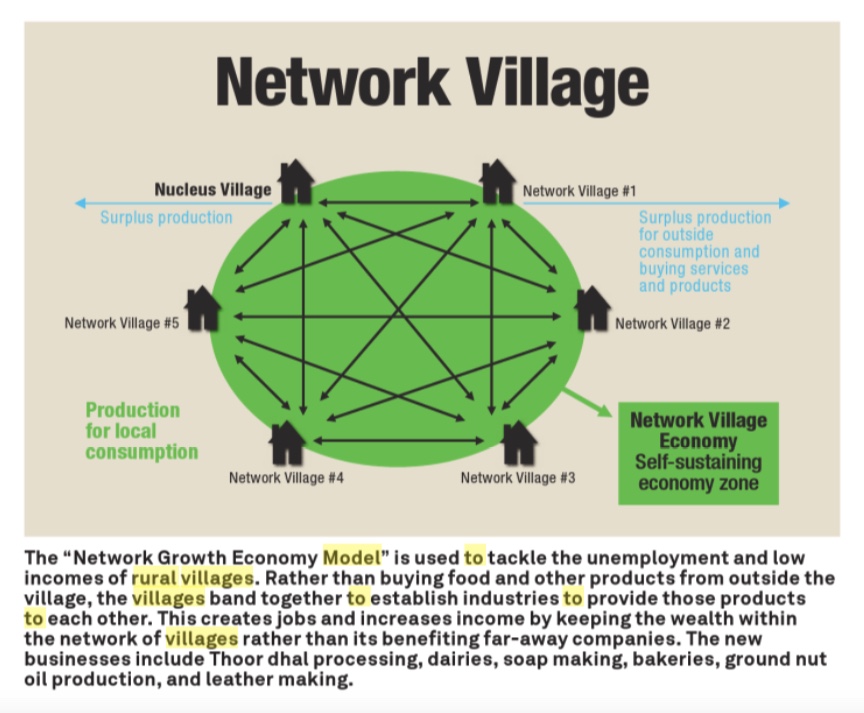
Like a spreading ink spot, the concept is to create a network of like-minded villages that act as self-reinforcing positive role models, spreading the prosperity and stability outwards. The “Network Growth Economy Model” is a direct challenge to the “special economic zones that benefit only capitalist owners,” said Elango.
Ambitious, Elango is hoping to draw in 2,000 villages over the next 10 years, until a tipping point is reached, and the model explodes across India.
A native of the village, Elango became saddened by the community’s decline, including widespread domestic violence against women. The booming city of Chennai’s prosperity had not rippled out to the village, and it was still lacking good infrastructure and sanitation. A trained chemical engineer, he was elected the President of the Kuthambakkam Panchayat in 1996, and set about using his engineer’s perspective to draft the village’s five-year plan from 1996 to 2001.
But the budget was tight. And he had to turn to innovative solutions: recycling building materials, conserving water and reducing electricity consumption. But the resourcefulness paid off, and the state of Tamil Nadu provided the money to upgrade roads, drains, build a community centre, child care facilities, 200 low cost toilets, and work sheds for the village’s industries. By the end of 2001, most basic needs were being met. He then turned to providing good quality housing for the villagers still living in thatch huts.
He has used the “Network Growth Economy Model” to tackle the unemployment and low incomes. It works like this: rather than buying food and other products from outside the village, the villages band together to establish industries to provide those products to each other. This creates jobs and increases income by keeping the wealth within the network of villages, rather than it benefiting far-away companies. The new businesses include Thoor dhal processing, dairies, soap making, bakeries, ground nut oil production, and leather making.
“India was strong when this model was in place – we had strong villages,” said Elango. “Globalization’s trickle down is not working for India.”
NextBillion.net: Hosted by the World Resources Institute, it identifies sustainable business models that address the needs of the world’s poorest citizens. Website:http://www.wri.org
CIDEM and Ecosur specialise in building low-cost community housing using eco-materials. They have projects around the world and are based in Cuba. Website:http://www.ecosur.org
Sponsored by BSHF. BSHF is now called World Habitat and it aims to seek out and share the best solutions to housing problems from around the world.
Development Challenges, South-South Solutions was launched as an e-newsletter in 2006 by UNDP’s South-South Cooperation Unit (now the United Nations Office for South-South Cooperation) based in New York, USA. It led on profiling the rise of the global South as an economic powerhouse and was one of the first regular publications to champion the global South’s innovators, entrepreneurs, and pioneers. It tracked the key trends that are now so profoundly reshaping how development is seen and done. This includes the rapid take-up of mobile phones and information technology in the global South (as profiled in the first issue of magazine Southern Innovator), the move to becoming a majority urban world, a growing global innovator culture, and the plethora of solutions being developed in the global South to tackle its problems and improve living conditions and boost human development. The success of the e-newsletter led to the launch of the magazine Southern Innovator.








 David South Consulting
You must be logged in to post a comment.