Tag: 2008

  • Rammed-Earth Houses: China Shows how to Improve and Respect Traditional Homes

    Rammed-Earth Houses: China Shows how to Improve and Respect Traditional Homes

    By David SouthDevelopment Challenges, South-South Solutions

    (Havana, Cuba), November 2008

    SOUTH-SOUTH CASE STUDY

    The pace of change across the South has been blistering. Over the past decade, the overall population has moved from being primarily rural to majority urban. In the process, rural communities have suffered, as they have seen their young and ambitious leave in droves seeking a better life in cities.

    More than 200 million Chinese farmers have moved to cities in recent years. It’s easy to see why. Chinese farms are tiny, with the average rural household farming just 0.6 hectares. And incomes are low compared to the cost of living: average annual income was just US$606 in 2007, a third of city salaries.

    But it is possible to improve the quality of life in rural areas and in turn boost economic fortunes.

    In China, projects that upgrade homes to modern standards while respecting traditional designs and architecture are breathing new life into rural communities. A return to the age-old technique of using earth as the principal building material is saving energy and keeping house costs low.

    The tradition of packing earth to build a wall dates back to some of the earliest stretches of the Great Wall of China in 220 BC.

    Currently it is estimated that half the world’s population-approximately 3 billion people on six continents – lives or works in buildings constructed of earth.

    This traditional building technique is being used in the reconstruction effort to build new homes after the May 12, 2008 earthquake in Sichuan Province. The earthquake left millions of people homeless in the country’s worst natural disaster in 30 years, and has made low-cost but efficient house building critical.

    In western China, villages have been entirely rebuilt from scratch. The application of research and science to the traditional designs – roofs in the pagoda style, with buildings arranged around courtyards – enabled the development of homes that are energy efficient to run, and are more hygienic and earthquake safe. In Yongren County of Yunnan Province, over 7,000 mountain dwellers were moved to better farming land and over 2,000 homes were built in the new village of BaLaWu. Over 30 of the homes were built using rammed earth by the Xi-an team. 

    “The original homes had very low living quality,” said team member Hu Rong Rong of the Green Building Research Centre of Xi’an University of Architecture and Technology (http://www.xauat.edu.cn/jdeg/about.html), which oversees building of the new homes. “The architecture layout of the indoor space and courtyard was not reasonable. In the courtyard the areas for living, raising livestock, storing and processing crops were mixed up. The indoor environment was not comfortable. It was cold in the houses during winter and hot during summer. Most of the rooms lacked natural lighting and were dark in the daytime.

    “In the poor areas, many people still live in earth houses because of the low cost. However, most of the earth houses have low living quality.

    “After we finished the project, through our design, the living quality was improved very much. The dwellers were satisfied with their new houses.”

    Land reform in China has brought more hope to the country’s 750 million rural poor, many of whom live on less than US$1 a day. It is hoped that giving the rural poor more control over their lives will bring an improvement in agricultural production, food security and economic prosperity. Reforms also mean the poor have more secure land rights.

    Hu said gaining the trust and buy-in of the villagers was critical to the success of the project.

    “We built the first home as a demonstration. After we finished, the villagers could experience the advantages of the new home. Most of them decided to use our design and they could choose the one they liked from several proposals.”

    Poverty is a big problem in the villages. Incomes are very low, at 2000 RMB per year (US $290). Hu said “families were given a house-building allowance of 8000 RMB (US $1,160) to meet the cost of building materials – and the land was free for them to use.”

    “The villagers built the houses by self-help. We helped them to design and build the houses for free,” Hu said.

    The houses are pioneering in using natural sources to provide light, heat, waste disposal and gas for cooking and heating.

    “We used natural material like earth as a main building material to get good thermal mass and also to reduce CO2 emission,” Hu said.

    “We designed a simple family sewage-purge-pool and marsh-gas-well system to reduce pollution and get energy from wastes.”

    Using rammed earth has a long history in China. Across Western China, there are many buildings constructed with rammed earth. And using earth has many advantages when resources are scarce or expensive: “Earth buildings avoid deforestation and pollution, and can achieve low energy costs throughout their lifetime,” said Hu.

    “With living standards increasing, more and more people would like to use burned bricks and concrete to build new houses, which will consume more energy and bring pollution,” said Hu.

    But like any technology, the application of modern science and environmental knowledge to the traditional designs, can reap huge improvements in the quality of the homes and comfort levels. And win people back to the benefits of rammed earth dwellings.

    “Building with earth materials can be a way of helping with sustainable management of the earth’s resources,” said Hu.

    And Hu is adamant the new, environmentally designed homes respect the wisdom of traditional design.

    “The new earth house design should consider the local culture. It should be proved that both the house style and the construction technique can be accepted by the users.”

    Published: December 2008

    Resources

    • The Rural Development Institute focuses on land rights for the poor and has a series of articles on China’s land reforms. Website: www.rdiland.org
    • Rural DeveIopment Institute has recently been given an award from the World Bank’s Development Marketplace competition to create Legal Aid and Education Centres in China’s countryside. Website:www.rdiland.org/PDF/092808_WorldBankComp.pdf
    • A blog gives more details on the Chinese rammed earth project. 
      Website:www.51xuewen.com
    • Earth Architecture, a book and blog on the practice of building with earth, including contemporary designs and projects. 
      Website: www.eartharchitecture.org

    https://davidsouthconsulting.org/2022/05/23/debt-free-homes-for-the-poor/

    https://davidsouthconsulting.org/2021/11/12/energy-efficient-wooden-houses-are-also-earthquake-safe/

    https://davidsouthconsulting.org/2022/10/26/making-bamboo-houses-easier-to-build/

    https://davidsouthconsulting.org/2021/02/12/rebuilding-after-chinese-earthquake-beautiful-bamboo-homes/

    https://davidsouthconsulting.org/2022/05/23/solar-bottle-bulbs-light-up-dark-homes/

    https://davidsouthconsulting.org/2022/09/26/3d-home-printing-landmark-10-houses-in-a-day/

    https://davidsouthconsulting.org/2022/11/17/tiny-homes-to-meet-global-housing-crisis/

    Sponsored by BSHF. BSHF is now called World Habitat and it aims to seek out and share the best solutions to housing problems from around the world.

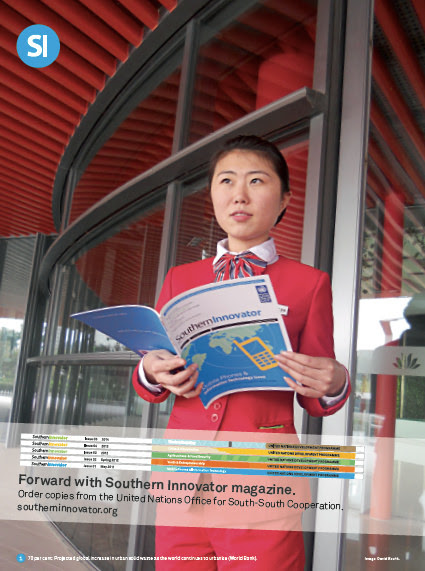
    https://davidsouthconsulting.org/2021/03/05/southern-innovator-issue-4/

    Creative Commons License

    This work is licensed under a
    Creative Commons Attribution-Noncommercial-No Derivative Works 3.0 License.

    ORCID iD: https://orcid.org/0000-0001-5311-1052.

    © David South Consulting 2023
  • Cuban Entrepreneurs Embracing Changes to Economy

    Cuban Entrepreneurs Embracing Changes to Economy

    By David SouthDevelopment Challenges, South-South Solutions

    SOUTH-SOUTH CASE STUDY

    The Caribbean island of Cuba has gone its own way economically and socially since its revolution in 1959. The country has seen significant gains in its human development in the decades since, and can boast impressive education levels and good public health care.

    Cuba enjoys a good ranking on the Human Development Index (HDI) – 59 out of 187 countries – and it has been rising since 1980. For Latin America and the Caribbean, Cuba is above the regional average (http://hdrstats.undp.org/en/countries/profiles/CUB.html).

    But the country has also had a turbulent economy with periods of severe economic contraction. This has increased poverty levels and hunger, in particular during the Special Period beginning in 1990 (http://www.historyofcuba.com/history/havana/lperez2.htm) when the significant subsidies enjoyed by the country from the Soviet Union were pulled and the country saw a steep drop in its ability to import fuel and other goods. Cuba is still trying to repair the economic damage.

    In the book Cuba: Between Reform and Revolution, Louis A. Perez, Jr. explains: “The old socialist bloc Council of Mutual Economic Assistance (CMEA) had accounted for almost 85 percent of Cuban trade, transactions conducted almost entirely in nonconvertible currency. Commercial relations with the former Soviet Union declined by more than 90 percent, from $8.7 billion in 1989 to $4.5 billion in 1991 and $750 million in 1993. Trade with eastern European countries ended almost completely.

    “Soviet oil imports decreased by almost 90 percent, from 13 million tons in 1989 to 1.8 million tons in 1992. Shipments of capital grade consumer goods, grains, and foodstuff declined and imports of raw materials and spare parts essential for Cuban industry ceased altogether.”

    Conducting private business in Cuba was discouraged after the revolution as the state became the dominant arbiter of all economic transactions. Since the fall of the Soviet Union, Cuba has experimented at various times with moving to a mixed economy, only to pull back and return to the old ways. But now things are changing significantly after economic reforms that have accelerated since Cuban President Raul Castro took over from his brother Fidel in 2008.The reforms began in 2008 with the liberalizing of access to mobile phones, and accelerated between 2010 and 2013, when the number of people working in small businesses tripled.

    Cuentapropistas – the Cuban term for entrepreneurs, named after “cuenta propria,” the ability to do business for oneself – have flocked to be officially registered as small businesses, with the number shooting up from 143,000 in 2010, to 429,000 by June 2013 (Report on Business).

    Gustavo Kouri told the Report on Business magazine, “Although I enjoyed the work I was doing before – at an information centre in specialized health sciences – it wasn’t possible to earn enough to support my family.

    “And then the state opened more opportunities to develop private businesses, for cuenta propia.”

    He now owns the Rio Mar restaurant (https://www.facebook.com/restauranteriomar).

    Artists and athletes have also been attracted to the opportunities that have opened up.

    One is former volleyball Olympic gold medalist Mireya Luis (http://en.wikipedia.org/wiki/Mireya_Luis), who now owns Las Tres Medallas (http://www.alamesacuba.com/en/la-habana/restaurant/las-tres-medallas/), a pizza-and-pasta restaurant.

    For Luis, becoming an entrepreneur means the chance to “realize a dream.”

    “Being able to open a place – a restaurant, a bar, a cafeteria, whatever – is a good opportunity for self-development, for people to demonstrate a capacity for business, and for them to grow personally,” she said. “It’s something incredible.”

    Gilberto Valladares owns a hair salon in Old Havana, Arte Corte Studio, and has been able to employ others.

    “Initially, it was a dream of dignifying and recovering a certain degree of respect for the trade of hairdresser and barber,” he told the Report on Business. “As my business grew, so did the dream.” He now employs a half dozen people from the neighborhood.

    Cuba is attempting to reform and modernize its economy while holding on to the things people hold dear and see as the good achievements of the revolution: free healthcare, education and other public services.

    Gregory Biniowsky is a Canadian-trained lawyer and political scientist who has spent more than 15 years living and working in Cuba and works for Havanada Consulting, a firm that focuses on sustainable development projects and social enterprise initiatives. “The irony is those that will save the Revolution are the emerging small- and medium-sized private businesses,” he said. “And those that could destroy it are those elements in the bureaucracy that resist those changes.”

    The entrepreneurial spirt gripping the island is infectious. At one time, much of the only reading material available in bookshops were works with a communist or socialist theme.
    But Cubans now have an alternative: an English-language bookshop called Cuba Libro (https://www.facebook.com/cubalibroHAV). It is filing an urgent gap in the marketplace for English-language books and foreign works in general.

    Set up by an American writer and journalist Conner Gorry (connergorry.com), who has been living in Havana, Cuba since 2002, the bookshop has become a hub for free thinking and new ideas.

    “I know how hard it is to get English-language sources here,” she told The Associated Press. “So I started cooking this idea.”

    Libro is the Spanish word for book and the play on words is meant to evoke a Cuba Libre, a rum-and-cola drink named for the country’s liberation from colonial Spain. The store bills itself as a “cafe, bookstore, oasis,” and  its logo features a woman reclining with a cup of coffee and a good book for reading.

    The idea came about when a friend of Gorry could not find a place to unload 35 books she had. In time, Gorry amassed a collection of 300 English-language books, and this embryonic library became the book shop. The store also carries magazines, including U.S. titles The New Yorker and Rolling Stone.

    So far, the store faces little competition. Government book shops feature the occasional Cuban novel translated into English or the English-language versions of state-run newspapers such as Granma (http://www.granma.cu/ingles/).

    Cubans are enjoying the slow thaw and what it could bring. “It is increasing in Cuba, the possibility to have different alternatives,” said Carlos Menendez, a 77-year-old retired economist Menendez.

    Cuba Libro has two licenses to operate – one for selling food and one for selling used books – and is run as a type of cooperative, a group-owned private enterprise with five Cubans.

    Doing business in Cuba is not without challenges. The bookshop needs to steer a steady path and avoid selling anything that would be considered “counterrevolutionary.” Gorry also needs to avoid problems with the U.S. government, which bans Americans from any financial transactions with the Cuban government.

    “I’ve had to tread extremely carefully, everything above-board and legal, because I’m an American, I’m a North American, I am beholden to U.S. laws,” she said. “And so I’m not in agreement with those laws, but I abide by them.”

    The bookshop has the benefit of a well-educated pool of potential customers; the annual Havana book festival is a popular draw in the country (http://feriadellibro.cubaliteraria.cu/).
    There is a strong thirst for self-improvement in Cuba, and to gain knowledge is to get a better paying job. To widen access to the shop, there will be a lending library for those who can’t afford to buy the books on offer, and there will also be English classes.

    And how will the bookshop get restocked in a country that still exercises a lot of control over information?

    “Getting donations is going to be another interesting piece of it, because importing books here is very difficult,” Gorry said.

    Published: October 2013

    Resources

    1) Cuba Research Center: The Cuba Research Center is a nonprofit organization based in Alexandria, Virginia.  Founded in 2013, its purpose is to provide information about Cuba and U.S.-Cuba relations, to participate in public debate about those subjects, and to build bridges between Americans and Cubans interested in those topics. Website: http://www.us-crc.org/

    2) Havanada Consulting: Havanada Consulting is a consulting firm which focuses on sustainable development projects and social enterprise initiatives in Cuba. Website: havanada.com

    3) Havana Cuba Business: If you are engaged in or would like to learn more about Cuba-related business or travel activities, Havana Cuba Business offer a customized consulting service that will address your questions and concerns. Website: cuentapropistas.com

    4) A business-friendly Cuba gets a hand from Canada (Report on Business). Website: http://www.theglobeandmail.com/report-on-business/rob-magazine/a-business-friendly-cuba-gets-a-hand-from-canada/article14006239/?page=all

    https://davidsouthconsulting.org/2021/02/04/cubas-hurricane-recovery-solution/

    https://davidsouthconsulting.org/2021/02/04/new-cuban-film-seeks-to-revive-sector/

    https://davidsouthconsulting.org/2022/11/11/urban-farming-to-tackle-global-food-crisis/

    https://davidsouthconsulting.org/2021/03/05/southern-innovator-issue-3/


    This work is licensed under a Creative Commons Attribution 4.0 International License.

    ORCID iD: https://orcid.org/0000-0001-5311-1052.

    © David South Consulting 2023

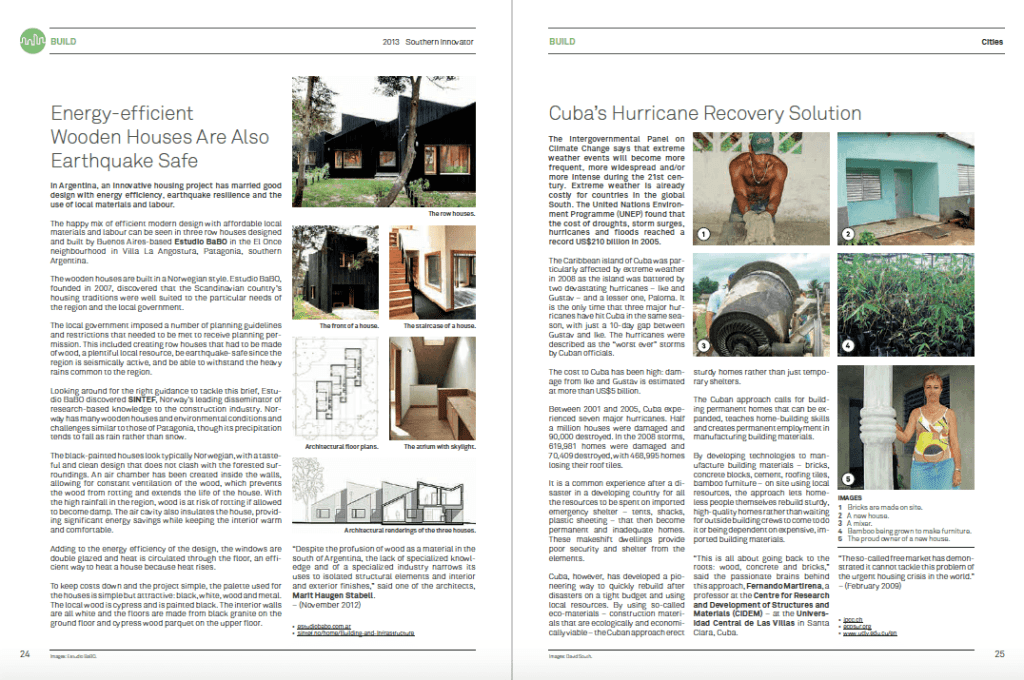
  • Cuba’s Hurricane Recovery Solution

    Cuba’s Hurricane Recovery Solution

    By David SouthDevelopment Challenges, South-South Solutions

    (Havana, Cuba), November 2008

    SOUTH-SOUTH CASE STUDY

    The frequency of extreme weather in the past decade has been attributed to global warming (http://tinyurl.com/5peel). Many scientists believe the future will bring even more turbulent weather events and disasters. The devastation and hardship brought by natural disasters can eradicate development gains, and destroy livelihoods and health. It is critical countries help people to get back to their normal lives as fast as possible.

    The Intergovernmental Panel on Climate Change (http://www.ipcc.ch) says extreme weather events will become more frequent, more widespread and/or more intense during the 21st century. Extreme weather is already costly for countries in the global South. The United Nations Environment Program (UNEP) found that the cost of droughts, storm surges, hurricanes and floods reached a record US$210 billion in 2005.

    The Caribbean island of Cuba (http://en.wikipedia.org/wiki/Cuba) was particularly affected in 2008 by extreme weather, as the island was battered by two devastating hurricanes – Ike and Gustav – and a lesser one, Paloma.  It was the only time that three major hurricanes have hit Cuba in the same season, with just a 10 day gap between Gustav and Ike. The hurricanes were described as the “worst ever” storms by Cuban officials

    The cost to Cuba has been high: Damages from Ike and Gustav are estimated at more than US$5 billion (http://tinyurl.com/ba7xny).

    Between 2001 and 2005, Cuba experienced seven major hurricanes. Half a million houses were damaged, and 90,000 destroyed. In the 2008 storms, 619,981 homes were damaged and 70,409 destroyed, with 468,995 homes losing their roof tiles.

    But Cuba has developed a pioneering way to quickly rebuild after disasters on a tight budget and using local resources. By using so-called ecomaterials – construction materials that are ecologically and economically viable – the Cuban approach erects sturdy homes, rather than just temporary shelters.

    It is a common experience after a disaster in a developing country for all the resources to be spent on imported emergency shelter – tents, shacks, plastic sheeting – that then become permanent and inadequate homes. These makeshift dwellings provide poor security and shelter from the elements. For Cuba, the enormous scale of the repair and reconstruction job is especially difficult because of the fuel shortages and building supply restrictions brought on by the United States’ embargo on the country (http://tinyurl.com/4alwrb). In turn, Cubans are adaptable and creative with their solutions.

    The Cuban approach builds permanent homes that can be expanded, teaches homebuilding skills and creates permanent employment in manufacturing building materials.

    By developing technologies to manufacture building materials – bricks, concrete blocks, cement, roofing tiles, bamboo furniture – on site using local resources, the approach lets homeless people themselves rebuild sturdy, high-quality homes, rather than waiting for outside building crews to come and do it, or being dependent on expensive, imported building materials. By doing this, jobs are created and wealth and gets the community back on its feet after the disaster.

    “This is all about going back to the roots: wood, concrete and bricks,” said the passionate brains behind this approach, Fernando Martirena, a professor at CIDEM  — the Centre for Research and Development of Structures and Materials — at the Universidad Central de Las Villas, in Santa Clara , Cuba (www.ecosur.org).

    “The so-called free market has demonstrated it can not tackle this problem of the urgent housing crisis in the world.”

    At the heart of the Cuban approach are easy-to-use machines that produce the building materials. They range from hand-cranked presses that make mud and clay bricks, to vibrating presses for concrete brick making.

    Training the homeless population to do the building themselves allows reconstruction work to begin straight away, rather than waiting for professional building crews to arrive on the scene. It is also psychologically more empowering for the people to be active participants in the rebuilding of their lives. The pride the people have in their new homes is visible.

    And quality has been critical for the programme so it can become sustainable and long-lasting:

    “The driving force for this project is need,” Martirena said. “If we want to obtain sustainability, we must go beyond need. After disaster, need is the driving force. But after two years, when most things have been completed, it must be a business. Good, beautiful, cheap. Normally, this technology is cheaper than industrial technology.”

    To stay prepared for future natural disasters that destroy or damage homes, the Cubans have established strategic reserves of micro-concrete roofing tiles. The lightweight but strong tiles can be used to quickly erect a small module home, and then the home can be expanded and built on as resources and time allow.

    Martirena, a former UNHABITAT award-winner, believes this approach to building materials brings prosperity back to rural areas and helps stem the flood of people to cities and urban sprawl seen across the global South.

    “You have to go back to the origin of the problem: people are looking for money and better jobs. It is not because they like the cities; they hate the cities!”

    “Bamboo harvesting (for furniture making) can bring people three times more income than they would make in the cities. They are really making money.”

    For Cuba, this has been a journey from a highly centralised and fuel-dependent approach to house building, to a decentralised, low-fuel approach. From 1959, the year of the revolution, until 1988, Cuba built housing using a centralised factory method to make building materials. Prefabricated houses were erected across the country. The materials were delivered by road and rail, all fuelled by cheap oil from the former Soviet Union.

    After the collapse of the Soviet Union in the early 1990s, oil became scarce and the transport network the building industry depended on fell apart. This time was called the “special period.”

    Apart from natural disasters, Cuba’s housing stock has suffered under the US embargo. The country’s housing began to decay as repairs were not happening and new houses were not being built. When people did want to do the repairs themselves, the lack of building supplies made it difficult for them to do so. Cuba realized it had to do things differently: the solutions had to be local, energy-efficient, and easy to use.

    CIDEM oversees workshops, training and building teams across the country. It tests new materials and designs in its labs before they are deployed as building solutions. The ecomaterials are chosen for low energy use and the ability to recycle waste. Being inexpensive, they offer a sustainable solution for the poor.

    In the community of Jatibonico, single mothers make up 40 percent of those who have benefited from the building projects. One woman proudly showed off the home she had built in the Spanish style, complete with Greco-roman columns on the porch. It has a clean, modern bathroom with shower and toilet.

    Martirena is currently working on a book of case studies about CIDEM’s projects helping Cubans cope with reduced oil dependency.

    CIDEM collaborates with universities around the world and has 19 workshops employing over 200 people in Cuba, and 15 in other countries in Latin America and Africa. It works with the Ecosur initiative and all the machines and advice on how to use them is available from the Ecosur website (www.ecosur.org).

    Published: November 2008

    Resources

    • “How Cuba Survived Peak Oil” is an award-winning film on how Cuba transitioned from a highly mechanized, industrial agricultural system to one using organic methods of farming and local, urban gardens. It is an unusual look into the Cuban culture during this economic crisis, which they call “The Special Period.” Website:http://www.powerofcommunity.org/cm/index.php
    • Global Greenhouse Warming is a website that tracks extreme weather events around the world: drought, flooding, severe storms, severe winter, tropical cyclone, wildfires, and extreme heat waves.Website:http://www.global-greenhouse-warming.com/extreme-weather.html
    • Cuba Hurricanes: Real-time reports of current hurricane threats to Cuba provided by an office in Old Havana. Also information on hurricanes of historical significance to Cuba. Website: http://www.cubahurricanes.org/
    • Gerd Niemoeller has developed flat pack, cardboard homes that can be deployed quickly after a disaster and can become permanent homes. Website: http://tinyurl.com/6t6jtf and the company website: http://www.wall.de/en/home
    • CIDEM and Ecosur specialise in building low-cost community housing using eco-materials. They have projects around the world and are based in Cuba. Website: http://www.ecosur.org

    https://davidsouthconsulting.org/2021/10/03/a-new-house-kit-for-slum-dwellers-that-is-safe-and-easy-to-build/

    https://davidsouthconsulting.org/2022/05/23/debt-free-homes-for-the-poor/

    https://davidsouthconsulting.org/2021/11/11/decent-and-affordable-housing-for-the-poor/

    https://davidsouthconsulting.org/2022/11/16/housing-innovation-in-souths-urban-areas/

    https://davidsouthconsulting.org/2021/11/11/housing-solution-for-worlds-growing-urban-population/

    https://davidsouthconsulting.org/2021/02/12/rammed-earth-houses-china-shows-how-to-improve-and-respect-traditional-homes/

    https://davidsouthconsulting.org/2021/02/12/rebuilding-after-chinese-earthquake-beautiful-bamboo-homes/

    https://davidsouthconsulting.org/2022/05/23/solar-bottle-bulbs-light-up-dark-homes/

    https://davidsouthconsulting.org/2022/09/26/3d-home-printing-landmark-10-houses-in-a-day/

    https://davidsouthconsulting.org/2022/11/17/tiny-homes-to-meet-global-housing-crisis/

    https://davidsouthconsulting.org/2021/03/05/southern-innovator-issue-4/

    Sponsored by BSHF. BSHF is now called World Habitat and it aims to seek out and share the best solutions to housing problems from around the world.

    Creative Commons License

    This work is licensed under a
    Creative Commons Attribution-Noncommercial-No Derivative Works 3.0 License.

    ORCID iD: https://orcid.org/0000-0001-5311-1052.

    © David South Consulting 2023

  • Development Challenges, South-South Solutions Newsletter

    Development Challenges, South-South Solutions Newsletter

    By David SouthDevelopment Challenges, South-South Solutions

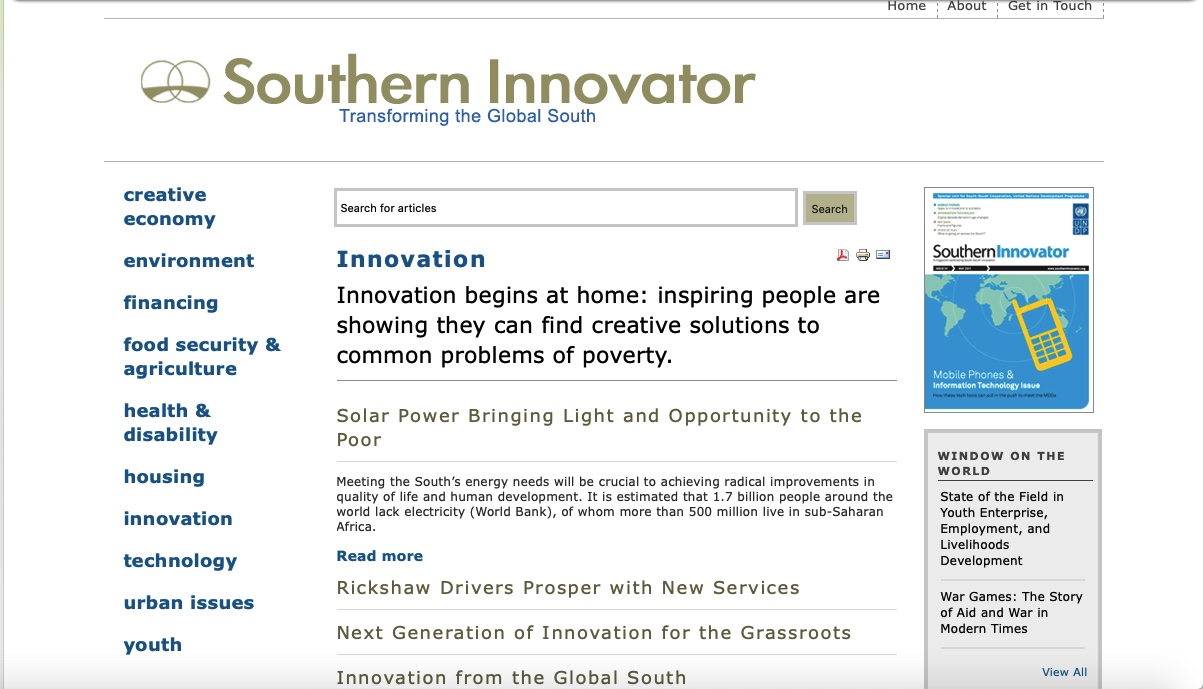
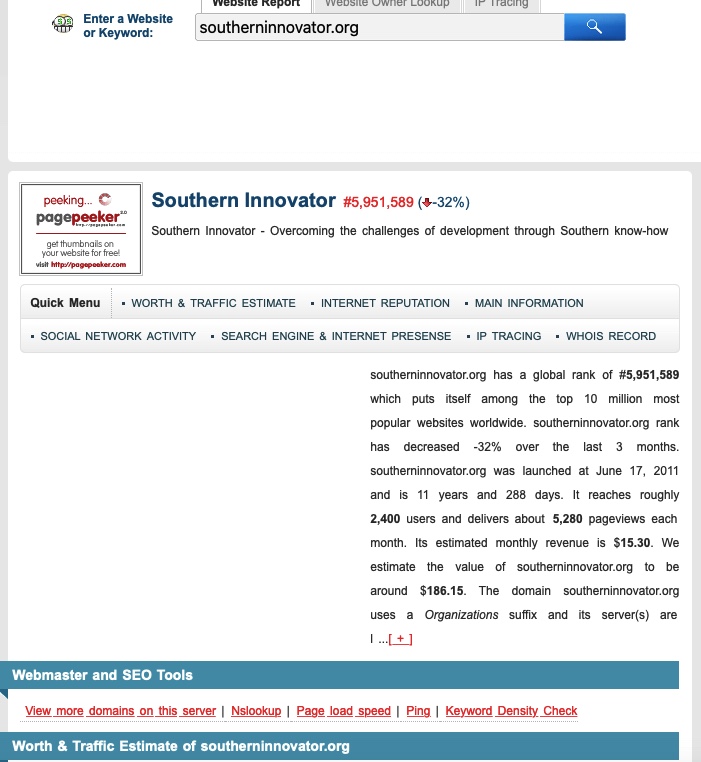
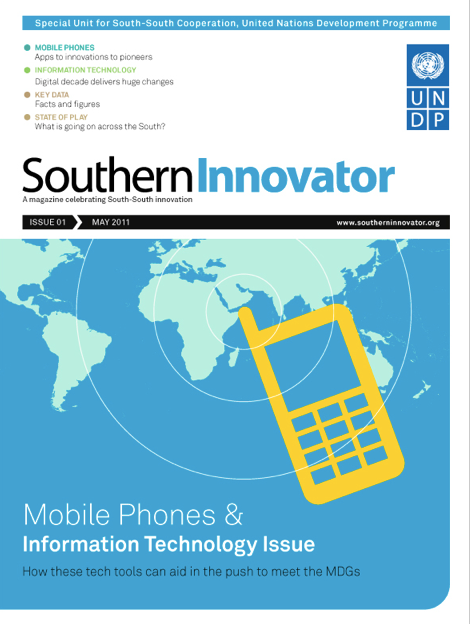
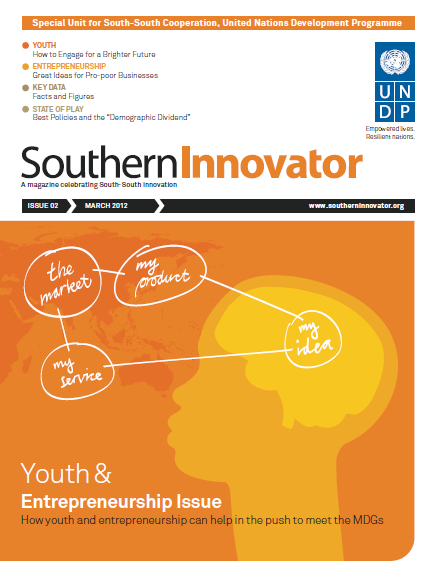
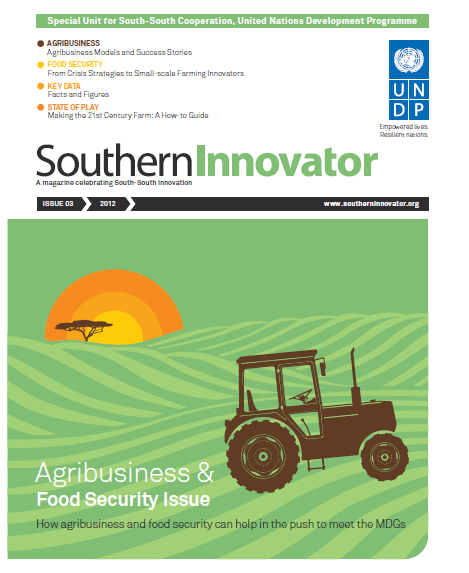
    The original southerninnovator.org website launched in 2011, in tandem with the first issue of Southern Innovator Magazine, and ranked midway in the top 10 million most popular websites in the world. Its content has been cited in books, scholarship and strategic plans.

    ISSN 2227-3905

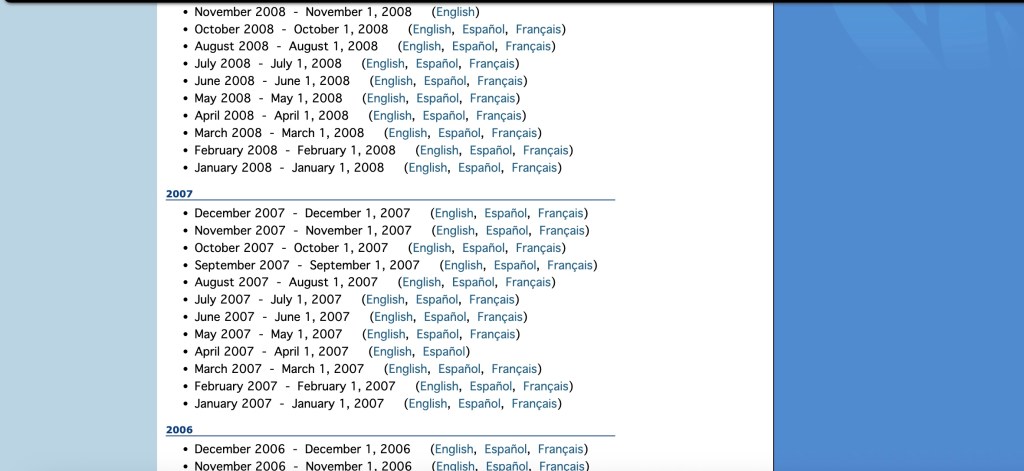
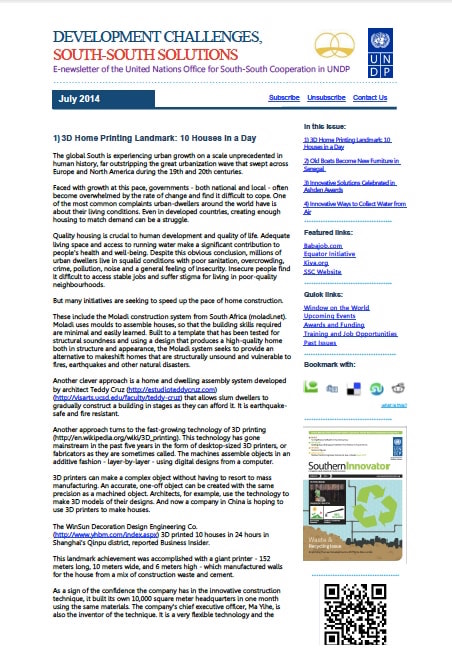
    Development Challenges, South-South Solutions is the monthly e-newsletter for the United Nations Office for South-South Cooperation in UNDP (formerly the United Nations Development Programme’s South-South Cooperation Unit). I research and write all stories (since January 2007). You can view the original website here. The stories are in English, French and Spanish.

    The original WordPress website for Development Challenges, South-South Solutions (southsouthnews.wordpress.com). It was launched in 2006 and eventually became southerninnovator.org in 2011. The magazine Southern Innovator was also launched in New York in 2011.
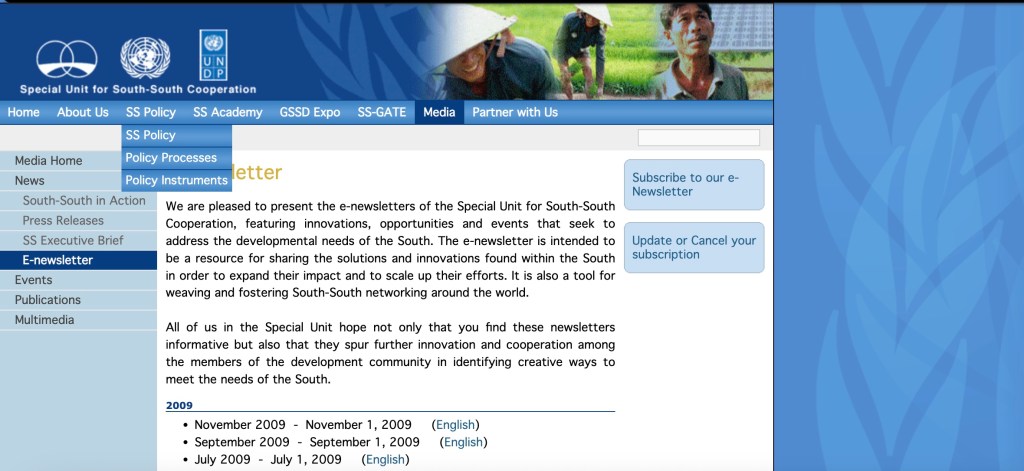
    The newsletter archive on the website for UNDP’s Special Unit for South-South Cooperation circa 2011 (including issues in English, French and Spanish). 2011 was an important year as the e-newsletter Development Challenges, South-South Solutions scaled into a dedicated web archive, http://southerninnovator.org, a sister magazine, Southern Innovator (https://unsouthsouth.org/2014/12/25/southern-innovator-magazine/), and pollinated its content across multiple platforms, capitalising on the platform and social media explosion of the time.

    Here is a good background article on the rise of South-South cooperation, how it is altering global trade and power relationships, and what the future holds: South-South Cooperation Defies the North. And here is some historical background from Wikipedia: South-South Cooperation.

    Development Challenges, South-South Solutions reaches a global audience of influential decision-makers on the frontlines of international development in the South. More than 2,000 subscribers read the newsletter every month (academic institutions, UN agencies, private sector companies, UNDP Country Offices, financial institutions including the IMF and World Bank, inter-governmental organisations, UNDP knowledge networks around the world, and all South-South focal points in West Africa).

    Remember to think of Development Challenges, South-South Solutions when you have a Southern innovation to share with the world. You can read our archive of stories online here: http://ssc.undp.org/index.php?id=66

    From Special Unit for South-South Cooperation: 2008 Reflections: “As part of the strategy to foster South‐South cooperation within and across regions, the Division has continued to invigorate and re‐enforce a South‐South cooperation focal point system. These efforts included the publication and distribution of a monthly e‐newsletter, Development Challenges: South-South Solutions, which presents a briefing for South‐South focal points, Southern academics and development professionals on practical solutions to development challenges found throughout the South. Over the course of 2008, twelve e‐newsletters were released via e‐mail and published on the website of the Special Unit.”

    What are people saying about Development Challenges, South-South Solutions? Read some comments here.

    Contact me by email about the newsletter here: developmentchallenges@googlemail.com.

    Contact me by email about the new global magazine Southern Innovator here: southerninnovator@yahoo.co.uk

    July 2014 issue of Development Challenges, South-South Solutions: The last issue is available online for download. Support the e-newsletter for 2017: we are seeking additional funding so we can improve the reader experience and frequency of the e-newsletter. Since first launching in 2006, we often heard from readers how they valued the stories in the e-newsletter and how it has helped in raising the profile of innovators across the global South (“Congratulations on another great newsletter that’s packed with fascinating information! I really enjoy getting it each month.”). Additional resources would enable us to improve the way readers can access and receive the e-newsletter, enable the e-newsletter’s contributors to travel and report on developments, and allow us to offer daily and weekly updates and a wider range of resources online and on mobile platforms. Additional funds help in maintaining the quality of the e-newsletter, something that has been appreciated by readers (“Great economic and business reporting! Very helpful for us.” Africa Renewal). It will also allow the e-newsletter to spin-off quality resources for innovators, such as the influential magazine Southern Innovator. Contact the United Nations Office for South-South Cooperation if you wish to support the e-newsletter for 2017: UNOSSC.

    “What a tremendous magazine your team has produced! It’s a terrific tour de force of what is interesting, cutting edge and relevant in the global mobile/ICT space… This is great, engaging, relevant and topical stuff.” Rose Shuman, Founder & CEO, Open Mind and Question Box, Santa Monica, CA, U.S.A.

    “Great economic and business reporting! Very helpful for us.” Africa Renewal, Africa Section, Strategic Communications Division, United Nations Department of Public Information

    “The reviewer observed that, although the Policy and UN Coordination Unit had produced all of the reports requested by intergovernmental bodies, especially for the High-level Committee, it had not been able to produce many of the publications (evidence-based analytical reports) that had previously been within its purview. Such publications included Southern Innovator magazine and the monthly e-newsletter “Development Challenges, South-South Solutions”. In the case of Southern Innovator, one issue (No. 5 on waste and recycling) was published during the four-year period of the framework but did not have wide online distribution, and issue No. 6 was awaiting funds for publication. The e-newsletter was last issued in July 2014 even though the reviewer found it a good way to communicate with focal points at the national and inter-agency levels. In fact, the shortage of funds for those knowledge products was the main reason that they had ceased being produced during the evaluation period.”  Final evaluation of the performance of the United Nations Office for South-South Cooperation  under its strategic framework, 2014-2017, in light of the adoption of the 2030 Agenda for Sustainable Development

    Note: Unfortunately, the reason for “the shortage of funds” was down to suspension of funding to the UNOSSC in 2015 and 2016 pending two internal UN audit investigations after arrests made in 2015 by the Federal Bureau of Investigation (FBI) revealed a bribery and money laundering network targeting the United Nations via various NGOs, including the UN-based news organisation South-South News. The case eventually made its way to the Supreme Court of the United States.

    Back Issues

    Development Challenges, South-South Solutions Newsletter | 2011-2014

    2014

    Development Challenges, South-South Solutions Newsletter | 2007-2010

    2013

    https://www.slideshare.net/DavidSouth1/development-challenges-july-2013-issue

    2012

    https://www.slideshare.net/DavidSouth1/development-challenges-july-2012-issue

    2011

    https://www.slideshare.net/DavidSouth1/development-challengessouthsouthsolutionsdecember2011issue

    2010

    2009

    2008

    https://www.slideshare.net/DavidSouth1/development-challenges-may-2008-issue

    2007

    “Beautiful, inspiring magazine from UNDP on South-South innovation. Heart is pumping adrenaline and admiration just reading it.”

    This work is licensed under a Creative Commons Attribution 4.0 International License.

    ORCID iD: https://orcid.org/0000-0001-5311-1052.

    © David South Consulting 2025