Tag: 2007

  • Afro Coffee: Blending Good Design and Coffee

    Afro Coffee: Blending Good Design and Coffee

    By David SouthDevelopment Challenges, South-South Solutions

    SOUTH-SOUTH CASE STUDY

    The importance of good design and a strong brand in the success of a business cannot be emphasised enough. That extra effort and thought can take a business from local success to regional and even global success. As consultants KPMG make clear, “For many businesses, the strength of their brands is a key driver of profitability and cash flow “. Yet the majority of small businesses fail to think about their brand values or how design will improve their product or service.

    The case of Afro Coffee from Cape Town, South Africa shows how a small and humble café can raise its ambitions and its profits. It re-vamped its modestly successful café into a brand with global ambitions. By undertaking a thorough and comprehensive brand development inspired by the colourful vibe of Africa, Afro Coffee has built a consistent image from the design of its café and shop to its wide range of branded teas, coffees and fashion wear – all sold in the café, on the web and through distribution deals with other shops.

    “It started out as a café in downtown Cape Town,” said founder Grant Rushmere. “Our concept was to harness a Pan African view of contemporary urban Africa. The pop art nature of African design inspired us to create our own brand of coffee instead of the usual Italian coffee that most cafes use. Our goal was to refocus people to the origins of coffee – that it in fact originated in Africa before being discovered by the Arabs and from Yemen, exported around the world. Many people don’t know this, so we attempt to capture and celebrate this African spirit in our packaging and all we do.”

    Afro Coffee had started out as a simple café. But after a major re-design and adoption of a new concept, the café has become a global brand and expanded into a branch in Europe. By infusing the spirit of Africa and its design aesthetics into all aspects of the café and its products – coffee, tea, fabrics, fashion – Afro Coffee has been able to develop a seamless image that is unforgettable.

    Rushmere was joined by two Austrian partners to help with building the new brand and facilitating its global launch. “Design and branding have been a passion of mine,” said Rushmere. “and these are realized through the Afro Coffee brand and the fun merchandising we develop. One of my partners has an international network of advertising agencies and the other has developed and owns a world-leading brand. With their experience, I will continue to guide the development of Afro Coffee.”

    Afro Coffee’s website includes a video tour of the café and introduction to the ‘Afro dude’ character and a short cartoon video adventure. To help develop customer loyalty, the café has live bands three times a week from across Africa.

    “Our mission is to communicate the joys of Africa through our Afro Cafes and our Afro-branded products. The fact that the African people are so wonderfully not self-conscious at all, with their humour and freedom and their style and design. Hopefully we can convey this spirit and enhance the lives of people who consume our product and sip coffee listening to Afro Tunes at our cafes. For South Africa, we try to show just how cool Afro culture actually is and instil a sense of confidence into people to make them realize what they already are – lofty ideals but we’ll have a go!”

    As the brand developed, a range of teas were produced using only African teas like Rooibos, a non-caffeine root. The next to come was fabrics based on West African religious clothing. They became table cloths and were so popular, they moved into combining them with leather to make Afro Bags – all part of expressing the lifestyle that inspires the brand.

    Distribution deals have been done to distribute the teas and coffees throughout South Africa and in Europe. The clothing range is now available on their online store (www.afrocoffee.com).

    Its African-infused design for its coffee stand won the Design Indaba 2007 Award, South Africa’s design magazine and exhibition. Also designed by Peet Pienaar, it is inspired by Ghanaian woodwork and Kenyan coffee. The stand is a giant stiletto shoe stacked with tins of teas and coffees and an over-sized radio that doubles as a counter top.

    Afro Coffee is proof a small business can grasp a bigger concept and in turn become a bigger success. It has been so successful, it has opened a new branch in Austria, begging the question: maybe this once-humble café is on the road to being an African Starbucks?

    Published: July 2007

    Resources

    • Afro Coffee’s award-winning display stand can be viewed at http://www.designindaba.com/
    • Brandchannel: The world’s only online exchange about branding, packed with resources, debates and contacts to help businesses intelligently build their brand.
    • Small businesses looking to develop their brand can find plenty of free advice and resources here: www.brandingstrategyinsider.com
    • Dutch Design in Development: Dutch designers are able to offer free support to new and small businesses in developing countries looking to export products to Europe.

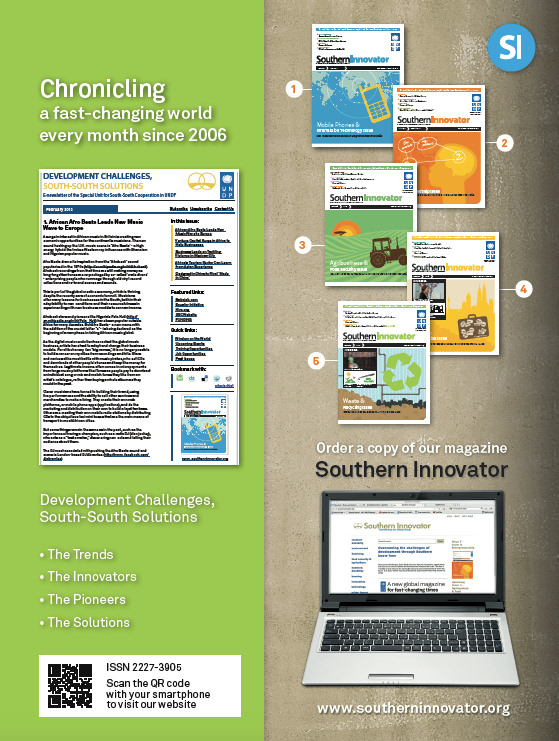
    Each issue of Southern Innovator shows the role design has played in the success of the innovators profiled.

    Baker Cookstoves – Designing for the African Customer

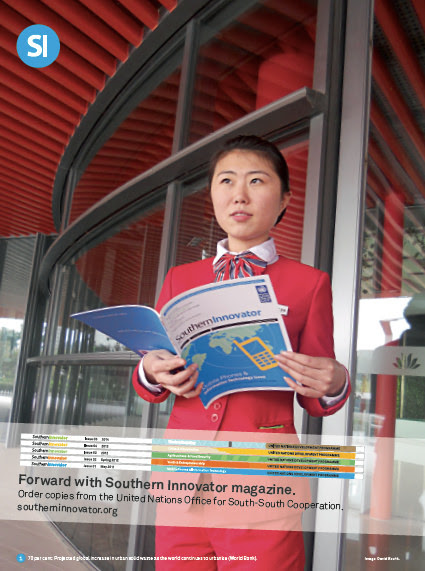
    Contact me if you wish to receive a copy/copies of the magazine for distribution. Follow @SouthSouth1.

    Southern Innovator Issue 1

    Southern Innovator Issue 2

    Southern Innovator Issue 3

    Southern Innovator Issue 4

    Southern Innovator Issue 5

    Southern Innovator Issue 6

    Innovator Stories and Profiles

    Citing Southern Innovator

    Finding Southern Innovator

    Press Release 1

    Press Release 2

    Press Release 3

    Southern Innovator Impact Summaries | 2012 – 2014

    “The e-newsletter Development Challenges, South-South Solutions proved to be a timely and prescient resource on the fast-changing global South, tracking the rise of an innovator culture driven by the rapid adoption of mobile phones and information technology …

    “In 2010, work began on the development of the world’s first magazine dedicated to the 21st-century innovator culture of the global South. My goal was to create a magazine that would reach across countries and cultures, meet the UN’s standards, and inspire action. Southern Innovator was the result. Mr. [David] South played a vital role in the magazine’s development from its early conception, through its various design prototypes, to its final global launch and distribution.

    “Both the e-newsletter and magazine raised the profile of South-South cooperation and have been cited by readers for inspiring innovators, academics, policy makers and development practitioners in the United Nations and beyond.

    “I highly recommend Mr. [David] South as a thoughtful, insightful, analytical, creative and very amicable person who has the unique ability to not only grasp complex problems but also to formulate a vision and strategy that gets things done. … ” Cosmas Gitta, Former Assistant Director, Policy and United Nations Affairs at United Nations Office for South-South Cooperation (UNOSSC) in UNDP

    “I think you [David South] and the designer [Solveig Rolfsdottir] do great work and I enjoy Southern Innovator very much!” Ines Tofalo, Programme Specialist, United Nations Office for South-South Cooperation

    Team | Southern Innovator Phase 1 Development (2010 – 2015)

    https://davidsouthconsulting.org/2021/03/20/accessing-global-markets-via-design-solutions/

    https://davidsouthconsulting.org/2022/09/29/the-battle-for-indias-coffee-drinkers-in-buzzing-economy/

    https://davidsouthconsulting.org/2021/10/03/civet-cat-coffee-brews-filipino-opportunity/

    https://davidsouthconsulting.org/2021/01/08/haitian-coffee-becoming-a-hit-with-american-connoisseurs/

    https://davidsouthconsulting.org/2022/10/24/kenyan-products-a-global-success-story/

    https://davidsouthconsulting.org/2022/10/24/made-in-africa-fashion-brand-pioneers-aim-for-global-success/

    https://davidsouthconsulting.org/2022/10/14/rwandan-coffee-brand-boost/

    https://davidsouthconsulting.org/2022/11/11/woman-restaurant-entrepreneur-embraces-brand-driven-growth/

    https://davidsouthconsulting.org/2021/03/05/southern-innovator-issue-2/

    Creative Commons License

    This work is licensed under a
    Creative Commons Attribution-Noncommercial-No Derivative Works 3.0 License.

    ORCID iD: https://orcid.org/0000-0001-5311-1052.

    © David South Consulting 2023
  • The Power of the Word: African Blogging and Books

    The Power of the Word: African Blogging and Books

    By David SouthDevelopment Challenges, South-South Solutions

    SOUTH-SOUTH CASE STUDY

    “Culture is not a luxury … Culture is the spiritual backbone of society”: with these words Jan Kees van de Werk, the Dutch poet and long-standing advocate of African literature, summed up the importance of culture to Africa’s development. Two trends could significantly alter the prospects for African writers in 2007: the new wave of African bloggers and websites that are now emerging, and the increasing awareness of African literature. More traditional writing is now being joined in 2007 by a surge in African blogging. As internet access has increased, and awareness of free blogging websites like WordPress has also shot up, Africans are jumping online to express themselves (see also Development Challenges, March issue).

    African literature is gaining an ever-greater audience through high-profile prize-winning. From veteran Nigerian writer and UNFPA Goodwill Ambassador Chinua Achebe winning this year’s Man Booker International Prize, to best-selling French language authors like Ivorian Ahmadou Kourouma (Allah is not Obliged) and Albert Memmi, winner of the French Academy’s Grand Prix de la Francophonie. They are joined by many others gaining international acclaim, including Uganda’s Monica Arac de Nyeko – winner of the prestigious Caine Prize for African Writing – Nigeria’s Chris Abani (Graceland), Cameroon’s Calixthe Beyala (Lost Honor), Congolese writer Daiel Biyaoula (Alley Without Exit) and Mauritius’s Carl de Souza. The Salon International du Livre et de la Presse de Geneva has established the Ahmadou Kourouma Prize, and the new Book Show for African Literature, Press and Culture is scheduled for 2008.

    Increasingly, the creative industries are gaining respect as a key part of a vibrant economy. The power of a successful author or musician to generate awareness and excitement about a country and its products, has gained the respect of many governments. And they are also learning to respect the wealth that can be generated. For example, in Britain the creative industries earn almost as much as the powerful financial sector (Work Foundation). The World Bank’s private sector arm, the International Finance Corporation, has singled out Africa’s creative sector for its future investment.

    Blogger Titilayo Soremi in Abuja, Nigeria, is typical of the new wave. A business development officer for an NGO, her blog is a vivid snapshot of life in her country. Obed Sarpongin Accra, Ghana is a budding poet and does not shy away from thorny issues. In his current blog, he tackles domestic politics and writes about the on-again, off-again electricity supply. The secretive Kenyan banker known by the name Bankelele is a lover of new ideas judging by his blog. The content is a mix of financial tip-offs and upcoming business investment opportunities in the region, all stirred up with some rather frank thoughts on politics. He has also gone the extra mile and acquired sponsors for his blog (that banking experience is not going to waste).

    The Internet age has also given birth to a new phenomenon: the so-called ”long tail” This is best explained by Kelvin Smith in his paper ‘African Publishers and Writers in British and International Markets’: “What now emerges is that more than half the revenue of Amazon is in the ‘bottom’ two million books on the list.

    “So, the ‘Long Tail’ principle goes, we are now looking at a technology that can service the needs not of dozens of markets of millions, but millions of markets of dozens. This has great significance for the small publisher, whether that publisher is in a large publishing nation or in a country where publishing is a smaller scale activity.”

    It looks as if getting creative is not only fun, it can be the next goldmine for Africa’s entrepreneurs.

    Published: August 2007

    Resources

    Creative Commons License

    This work is licensed under a
    Creative Commons Attribution-Noncommercial-No Derivative Works 3.0 License.

    Update: There is no better proof of concept than impact.

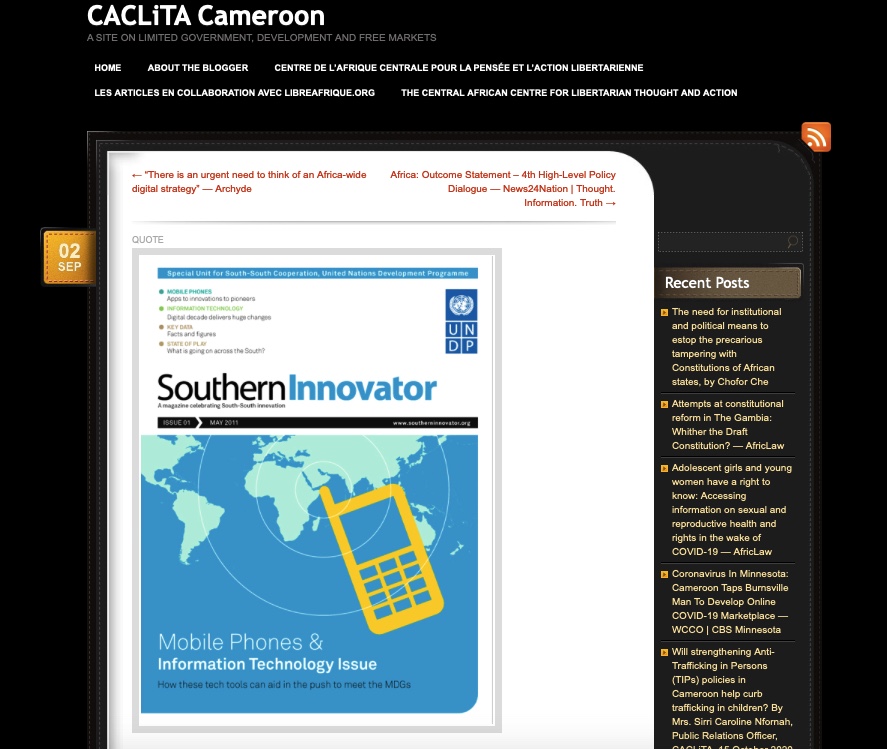
    One of the many African blogs and websites to share content from UN e-newsletter Development Challenges, South-South Solutions (2006-2014) and Southern Innovator Magazine (2011-2014).

    “Great economic and business reporting! Very helpful for us.” Africa Renewal, Africa Section United Nations Department of Public Information

    The story Nollywood: Booming Nigerian Film Industry, from UNDP e-newsletter Development Challenges, South-South Solutions, cited in Innovation Africa: Emerging Hubs of Excellence edited by Olugbenga Adesida, Geci Karuri-Sebina, Joao Resende-Santos (Emerald Group Publishing, 2016).

    Southern Innovator was published from 2011 to 2015 by the United Nations.

    Team | Southern Innovator Phase 1 Development (2010 – 2015)

    Development Challenges, South-South Solutions was launched as an e-newsletter in 2006 by UNDP’s South-South Cooperation Unit (now the United Nations Office for South-South Cooperation) based in New York, USA. It led on profiling the rise of the global South as an economic powerhouse and was one of the first regular publications to champion the global South’s innovators, entrepreneurs, and pioneers. It tracked the key trends that are now so profoundly reshaping how development is seen and done. This includes the rapid take-up of mobile phones and information technology in the global South (as profiled in the first issue of magazine Southern Innovator), the move to becoming a majority urban world, a growing global innovator culture, and the plethora of solutions being developed in the global South to tackle its problems and improve living conditions and boost human development. The success of the e-newsletter led to the launch of the magazine Southern Innovator.  

    Follow @SouthSouth1

    Google Books: https://books.google.co.uk/books?id=uXWUyfb4MacC&dq=development+challenges+september+2009&source=gbs_navlinks_s

    Slideshare: http://www.slideshare.net/DavidSouth1/development-challengessouthsouthsolutionsseptember2009issue

    Southern Innovator Issue 1: https://books.google.co.uk/books?id=Q1O54YSE2BgC&dq=southern+innovator&source=gbs_navlinks_s

    Southern Innovator Issue 2: https://books.google.co.uk/books?id=Ty0N969dcssC&dq=southern+innovator&source=gbs_navlinks_s

    Southern Innovator Issue 3: https://books.google.co.uk/books?id=AQNt4YmhZagC&dq=southern+innovator&source=gbs_navlinks_s

    Southern Innovator Issue 4: https://books.google.co.uk/books?id=9T_n2tA7l4EC&dq=southern+innovator&source=gbs_navlinks_s

    Southern Innovator Issue 5: https://books.google.co.uk/books?id=6ILdAgAAQBAJ&dq=southern+innovator&source=gbs_navlinks_s

    ORCID iD: https://orcid.org/0000-0001-5311-1052.

    © David South Consulting 2023

  • Turning Street Children into Entrepreneurs

    Turning Street Children into Entrepreneurs

    By David SouthDevelopment Challenges, South-South Solutions

    SOUTH-SOUTH CASE STUDY

    The UN estimates that 500 million people around the world are homeless, and UNICEF estimates India alone has 11 million homeless children on its streets (though it is difficult to pin down the figure). In order to survive another day, these children will work in one way or another. While there are many campaigns to ban children from working, and charities dedicated to getting them off the streets and into shelter, the raw fact remains: many of these children slip through the cracks and remain vulnerable, poor and neglected.

    Most street children suffer from malnutrition, hunger, health problems, and abuse. They make ends meet by working various jobs or by stealing. While they have dreams, there is no mechanism for them to save for the future. It is a live-for-now existence that, if they survive to adulthood, means they will probably remain homeless and vulnerable.

    Street and working children have money: it is a natural consequence of having to be resourceful to survive. But what they don’t have is access to banking services or trustworthy financial advice that can help them to gain wealth and move out of poverty and into a brighter future.

    The Children’s Development Bank in India is one initiative that seeks to turn these neglected children into the next generation of entrepreneurs. The bank works on banking and co-operative principles, where savers are members and joint owners of the bank. Any child can save money with the bank and earn interest, as well as take out loans if they are over 15 years old. It was started in 2001 and was inspired by the Youth Bank in the UK. Interest made by the bank is shared by its members, as with many co-operative banks and credit unions.

    The bank is managed jointly by children and adults. The children have a say in how the bank is run and on what conditions it should lend money. They also keep an eye on borrowers to prevent them from running off without repaying loans.

    For these vulnerable children, it has many advantages: they can put money aside without fear of it being stolen or lost, save for important things like clothes, or pay for their education.

    A key part of the bank’s mandate is helping the children build entrepreneurial skills for business. Mentors help the children choose a business model, select an occupation with minimal risk and more benefits, get training and solve business problems.

    The bank has branches in India, Afghanistan, and Sri Lanka.

    Ten-year-old Deepak Prahlad, a street child in Delhi, dreams of being a doctor.

    “I know what it takes to be a doctor. I need to study hard and need to save a lot of money,” he told the Hindustan Times. For now, he works as a rag picker but has started saving 30 to 40 rupees a day in the Children’s Development Bank. The bank has 1,300 members in the city. It pays 3.5 per cent interest on savings accounts.

    “Some of them want to fly very high,” said Rita Panicker, who helped set up the bank in 2001. “We have been working with street children for the past two decades. Some of these children are very talented and have entrepreneur qualities. One of the biggest problems facing these children was that they did not have a safe place to keep their hard-earned money. In fact, it was the children who came up with the idea of the children’s bank. It started with 20 members in 2001 – and now it has 1,300 members in Delhi.”

    Sudesh, a 15-year-old manager who looks after the bank’s current accounts, said: “We are extremely careful about whom to offer loans since we do not want to see our members’ savings lost because of bad loans. The skills I have learnt here are going to stand me in good stead in life.” Managers are chosen every six months by the children and they compete for the job.

    Published: November 2007

    Resources

    • Making Cents International: “It inspires youth, practitioners, policy makers and funders to more effectively share and develop parnerships, programmes and policies that support youth entrepreneurs.”
    Southern Innovator Issue 2 focused on youth and entrepreneurship. https://g.co/kgs/6kZAg4

    https://davidsouthconsulting.org/2022/12/18/the-disabled-in-the-south-can-make-money-restore-dignity/

    https://davidsouthconsulting.org/2021/10/28/ending-gang-violence-while-cleaning-the-streets-in-haiti/

    https://davidsouthconsulting.org/2023/01/16/hip-driven-pump-brings-water-to-parched-fields/

    https://davidsouthconsulting.org/2022/05/02/landmark-study-finds-simple-toys-key-to-boosting-educational-development-and-meeting-mdgs/

    https://davidsouthconsulting.org/2021/03/05/southern-innovator-issue-2/

    https://davidsouthconsulting.org/2020/12/09/study-finds-simple-toys-key-to-boosting-educational-development-january-2007/

    https://davidsouthconsulting.org/2022/10/27/tapping-the-power-of-child-play/

    https://davidsouthconsulting.org/2022/07/19/traffic-signs-bring-safety-to-the-streets/

    Development Challenges, South-South Solutions was launched as an e-newsletter in 2006 by UNDP’s South-South Cooperation Unit (now the United Nations Office for South-South Cooperation) based in New York, USA. It led on profiling the rise of the global South as an economic powerhouse and was one of the first regular publications to champion the global South’s innovators, entrepreneurs, and pioneers. It tracked the key trends that are now so profoundly reshaping how development is seen and done. This includes the rapid take-up of mobile phones and information technology in the global South (as profiled in the first issue of magazine Southern Innovator), the move to becoming a majority urban world, a growing global innovator culture, and the plethora of solutions being developed in the global South to tackle its problems and improve living conditions and boost human development. The success of the e-newsletter led to the launch of the magazine Southern Innovator. 

    Creative Commons License

    This work is licensed under a
    Creative Commons Attribution-Noncommercial-No Derivative Works 3.0 License.

    ORCID iD: https://orcid.org/0000-0001-5311-1052.

    © David South Consulting 2023

  • Ethiopia and Djibouti Join Push to Tap Geothermal Sources for Green Energy

    Ethiopia and Djibouti Join Push to Tap Geothermal Sources for Green Energy

    By David SouthDevelopment Challenges, South-South Solutions

    SOUTH-SOUTH CASE STUDY

    Ethiopia and Djibouti are the latest global South countries to make a significant commitment to developing geothermal energy – a green energy source that draws on the heat below the earth’s surface (http://en.wikipedia.org/wiki/Geothermal_energy) – to meet future development goals.

    Ambitiously, Ethiopia also hopes to build Africa’s largest geothermal power plant.

    It joins Kenya, which in 2012, announced projects to expand its geothermal capacity further. Currently, Kenya is Africa’s largest geothermal producer and has geothermal resources concentrated near a giant volcanic crater in the Great Rift Valley with 14 fields reaching from Lake Magadi to Lake Turkana. There are also low temperature fields in Homa Hills and Massa Mukwe (http://www.gdc.co.ke/index.php?option=com_content&view=article&id=191&Itemid=163). Around 1,400 steam holes are being drilled.

    Cooperating with Reykjavik Geothermal (rg.is), a US-Icelandic private developer, Ethiopia will spend US $4 billion to build a 1,000 megawatt geothermal plant at Corbetti (http://www.volcano.si.edu/volcano.cfm?vn=221290). It is expected to be ready in eight to 10 years. The country wants to be carbon neutral by 2025.

    Drilling will need to go down as deep as 3 kilometers to tap the source. This is expensive and a technological challenge, thus the need for international expertise. The country hopes to develop this source of energy and then export electricity to neighboring African countries.

    Another plant, Aluto Langano 7, is being built 201 kilometers south of Addis Ababa, the capital, by a partnership between the Japanese government, Ethiopia and the World Bank.

    Ethiopia has enormous potential for geothermal energy, according to a paper in the journal Geothermics: “Ethiopia holds an enormous capacity to generate geothermal energy in the volcano-tectonically active zones of the East African Rift System (http://www.sciencedirect.com/science/article/pii/S0375650513000023).”

    At present, 70 per cent of people in sub-Saharan Africa, some 600 million, are without a domestic electricity supply (USAID). Electricity and other sources of energy are required if living standards are to be raised for millions of the world’s poor. The danger of this, however, is to the planet if the energy comes from polluting sources.

    In March 2013 the World Bank announced a significant push to increase development of geothermal resources around the world, and in particular in energy-hungry, fast-developing countries.

    “Geothermal energy could be a triple win for developing countries: clean, reliable, locally produced power,” the bank says. “And once it is up and running, it is cheap and virtually endless.”

    The bank joined forces with Iceland to make a pledge to secure US $500 million in financing to get geothermal projects up and running. The announcement was made at the Iceland Geothermal Conference (http://geothermalconference.is/) in Reykjavík, the Icelandic capital.

    Few countries have such easy access to geothermal energy as Iceland, with its plentiful volcanoes, geysers and hot springs bursting through the surface. But it is there, under the ground, and through the Global Geothermal Development Plan (GGDP), it is hoped this plentiful energy source will become the norm for countries around the world.

    The World Bank believes at least 40 countries can get into geothermal on a significant scale with the correct investment. Many developing world regions are rich in geothermal resources, including East Africa, Southeast Asia, Central America, and the Andean region.

    Just 11 gigawatts of geothermal capacity is currently being tapped in the world. Nuclear power, for example, generates 370 gigawatts a year (2012) (EIA). What has held back many countries has been the high upfront costs involved in getting projects going. A site must be found, drilled and tested to see if it is viable.

    The GGDP plan is to raise US $500 million from donors and others to fund geothermal exploration and development. The GGDP will identify promising sites and then acquire funding to pay for drilling to identify commercially viable projects.

    The World Bank has increased financing for geothermal development from US $73 million in 2007 to US $336 million in 2012. It comprises 10 per cent of the Bank’s renewable energy lending.

    The Icelandic International Development Agency (iceida.is) signed a partnership in September 2013 with the government of Ethiopia to undergo geothermal surface exploration and to build Ethiopia’s capacity to develop this energy source. The World Bank estimates that Ethiopia has the potential to generate 5,000 megawatts (MW) of energy from geothermal sources.

    The Geological Survey of Ethiopia (GSE) and the Ethiopian Electric Power Corporation (EEPCO) will undertake exploration at sites in Tendaho Alalobeda and Aluto Langano.

    It fits in with a wider push by Ethiopia to develop its renewable energy resources. The country is also increasing investment in hydro-electric power.

    The Ethiopia project is part of the wider World Bank-Iceland compact to develop global geothermal energy capacity. It is the second such arrangement, with the first already underway in Rwanda.

    Djibouti is also moving into geothermal, with a new agreement with the World Bank to develop a site at Lake Assal. The World Bank will provide US $6 million to evaluate its commercial potential. Djibouti tried to develop its geothermal resources privately but was not successful.

    Overall, geothermal power has the potential to help reduce Djibouti’s electricity production costs by 70 per cent, boost access to electricity for the population and alleviate the country’s energy dependency. The country hopes to have 100 per cent green energy by 2020.

    Joining forces on helping boost geothermal in Africa is USAID’s Power Africa fund, which is providing US $7 billion in financial support and loan guarantees for energy projects.

    Apart from generating electricity, what else can this powerful resource do? Countries such as Iceland now use hot geothermal water to heat homes and provide domestic hot water. Iceland also has an extensive network of swimming pools and spas in each town. The Blue Lagoon (bluelagoon.com) is a good example of how geothermal power generation can have lots of side benefits. The giant, steamy blue-colored lagoon is the consequence of an accident in 1976 at the nearby geothermal power plant; it’s now a spa and one of the country’s main tourist attractions.

    The geothermal-heated pools and spas play a key role in keeping the cold north Atlantic country healthy – Iceland ranked number one on the UNDP human development index in 2007 – and provide a recreational source even in the depths of winter.

    Published: December 2013

    Resources

    1) Iceland Review: A great way to learn about life on an island powered by geothermal energy. Website: icelandreview.com

    2) Nordic Development Fund: The Nordic Development Fund (NDF) is the joint development finance institution of the five Nordic countries. The objective of NDF’s operations is to facilitate climate change investments in low-income countries. Website: ndf.fi

    3) Icelandic International Development Agency (ICEIDA): The Icelandic International Development Agency (ICEIDA) is an autonomous agency under the Ministry of Foreign Affairs and is responsible for the implementation of official Icelandic bilateral development cooperation.  It follows the Icelandic government’s Act on Development Cooperation No 121/2008, which is in keeping with the UN Millennium Development Goals and other international commitments, such as the Monterrey Consensus on Financing for Development and the Paris Declaration on Aid Effectiveness. Website: iceida.is

    4) Geothermal Exploration Project, NDF: The main objective of the Geothermal Exploration Project is to assist countries in East Africa to enhance geothermal knowledge and capacity in order to enable further actions on geothermal energy development in the respective countries. The project could extend to 13 countries in the East Africa Rift Valley: Burundi, Comoros, Djibouti, DR Congo, Eritrea, Ethiopia, Kenya, Malawi, Mozambique, Rwanda, Tanzania, Uganda and Zambia. Website: http://www.iceida.is/iceida-projects/nr/1488

    5) Power Africa: Power Africa – an initiative to double the number of people with access to power in sub-Saharan Africa. Power Africa will achieve this goal by unlocking the substantial wind, solar, hydropower, natural gas, and geothermal resources in the region to enhance energy security, decrease poverty, and advance economic growth. Website: http://www.usaid.gov/powerafrica

    6) Geological Survey of Ethiopia: The GSE has been generating , collecting  and managing geoinformation of the country for the last 4 decades. Website: http://www.gse.gov.et/index.php

    7) Home geothermal: A feature from Popular Mechanics on how geothermal can work in the home. Website: http://www.popularmechanics.com/science/energy/hydropowergeothermal/4331401

    Like geothermal energy? Then we think you will like our Southern Innovator Magazine. Designed and laid out in Iceland using 100% renewable energy (much of which is geothermal). 


    This work is licensed under a Creative Commons Attribution 4.0 International License.

    ORCID iD: https://orcid.org/0000-0001-5311-1052.

    © David South Consulting 2023