Tag: 2007

  • Local Animation: A Way Out of Poverty

    Local Animation: A Way Out of Poverty

    By David SouthDevelopment Challenges, South-South Solutions

    SOUTH-SOUTH CASE STUDY

    One of the more remarkable creative developments since 2000 has been the explosion in animation production in the developing world, in particular Asia. Once seen as frivolous or unnecessary, animation is now acknowledged as a high-growth area and a critical component in the emerging economies being shaped by information technology.

    The demand for more animation is being fuelled by several trends. Lucrative outsourcing contracts with major global film studios like Walt Disney and Warner Brothers get much of the attention. But even more importantly for small entrepreneurs, the rapid growth of information technology and mobile phones is fuelling demand for animation with a local flavour, which is an excellent way to make applications more attractive to users. As computers and animation software become cheaper, it is easier for entrepreneurs to compete with the bigger studios. It all started with the popularity of Japanese anime animation, which kicked the door open in the West, sparking an appetite for fresh, new styles unseen before.

    The animation leaders in Asia are Japan, Republic of Korea, Philippines and Taiwan Province of China, with India rising quickly. As animation production is very lucrative and a labor-intensive business (labor takes up 70 to 80 percent of business costs), other Asian countries such as India, China, Vietnam, Malaysia and Singapore have recently started their own industries.

    The National Association of Software and Service Companies (NASSCOM) has forecast the Indian animation sector to gross overall turnover of US $950 million in 2009, while its gaming industry will reach US $300 million in 2009 (from US $30 million in 2005). The global industry is huge: it is estimated that games will gross US $11 billion and animation US $35 billion by 2009. In the Philippines, growth has been 25 per cent a year since 2005 (National Statistics Office), and the government has been heavily promoting animation as a viable career and business opportunity. China was able to make US $604 million in 2005. The AWN’s Animation Industry Database lists 48 studios operating in the Philippines alone. Others benefiting are Thailand, Taiwan Province of China and Republic of Korea. And even in Africa, there have been attempts to get things going.

    Ambitiously, China hopes to raise its home-made share of the animation pie from 10 per cent and to increase its overall animation programming from 5,000 hours/year to 16, 7000/year. In 2004, the Chinese government set up four animation schools: Communication University of China, Beijing Film Academy, China Academy of Art, and Tianjin Sorun Digital Media School. More than 200 animated films were produced in 2004.

    Indian animation feature productions have exploded in the past few years. In 2005, animated feature Jai Hanuman started the current boom. Its quality marked a departure from past Indian productions and heralded in a new era. Importantly, it out-grossed any Disney film in India, and proved films featuring local topics could be commercially successful. It is a difficult market with 14 official languages and 1,400 dialects. At present, the huge Indian market has little locally produced animation to feed its needs. But by 2007, 71 Indian animation films were announced to be in production.

    Productions in development draw heavily on India’s culture and love of gods. They include Epiphany Films’ The Dream Blanket, a Tibetan fairy tale, and Graphiti studios’ Action Hero BC, a teenager who fights evil.

    The world’s animation producers scour India for talent to outsource. Global films with some Indian production in them include Finding Nemo, The Lion King and The Adventures of Tenali Raman. Toonz Animation Studio based at the Technopark in Kerala, was called by Animation Magazine one of the top ten studios in the world.

    In Africa, South Africa has by far the most dynamic and sophisticated animation sector. Ten years after the birth of democracy, hundreds of production companies and several 2D animation houses were established. In turn, South Africa advertises itself as a cheaper place to produce animation.

    The highly successful South African 3D animated series Magic Cellar by Morula Pictures – the first of its kind based on African culture – was successfully sold to the US Home Box Office channel this year. Based on 20 folk tales, the stories were collected through interviews with elders in African villages. Mfundi Vundla, 58, who owns Johannesburg’s Morula Pictures, South Africa’s largest black-led studio, said his productions are meant to counter the perception of “Africans as unsophisticated, superstitious idiots who visited witch doctors to solve problems.” It employs 60 people and dozens of actors.

    In 2004, UNESCO’s Africa Animated! was launched, with East Africa’s first animation project. The participants undertook animation, drawing techniques, scriptwriting for animation and storyboarding. The project was launched to assemble resources and expertise for the production of culturally relevant children’s animated cartoons and programmes in Africa. It sought to create a high-quality “African branded” training and production model, in order to make African animation competitive for regional organizations to produce animated TV series, Public Service Announcements (PSA) and short films.

    The Nairobi office is seeking to establish a Regional Training and Production Centre for Animation in Kenya in 2008.

    Moustapha Alassane of Niger and one of Africa’s film pioneers, said: “The good thing about animation is that you can do it on a shoe-string budget. With the computer, animation is getting easier and anyone can do it now. I want to encourage young Africans to use new technologies for animation.”

    Published: December 2007

    Resources

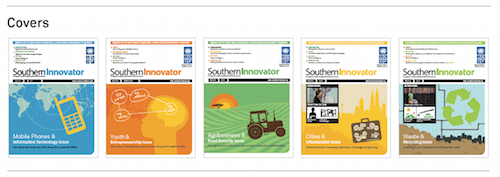
    Development Challenges, South-South Solutions was launched as an e-newsletter in 2006 by UNDP’s South-South Cooperation Unit (now the United Nations Office for South-South Cooperation) based in New York, USA. It led on profiling the rise of the global South as an economic powerhouse and was one of the first regular publications to champion the global South’s innovators, entrepreneurs, and pioneers. It tracked the key trends that are now so profoundly reshaping how development is seen and done. This includes the rapid take-up of mobile phones and information technology in the global South (as profiled in the first issue of magazine Southern Innovator), the move to becoming a majority urban world, a growing global innovator culture, and the plethora of solutions being developed in the global South to tackle its problems and improve living conditions and boost human development. The success of the e-newsletter led to the launch of the magazine Southern Innovator. 

    Creative Commons License

    This work is licensed under a
    Creative Commons Attribution-Noncommercial-No Derivative Works 3.0 License.

    ORCID iD: https://orcid.org/0000-0001-5311-1052.

    © David South Consulting 2023

  • Social Networking Websites: A Way Out of Poverty

    Social Networking Websites: A Way Out of Poverty

    By David SouthDevelopment Challenges, South-South Solutions

    SOUTH-SOUTH CASE STUDY

    Social networking websites also known as, Web 2.0 – the name given to the new wave of internet businesses and websites such as YouTube and MySpace that are transforming the way people interact with the Web – has been dubbed the social web for its power to bring people together. The label has been derided as a marketing gimmick by some, but many argue there are a number of characteristics to Web 2.0 that make it something different and a valuable tool for entrepreneurs seeking ways out of poverty.

    The new Web 2.0 applications offer many free software tools stored online, from accounting and business related tools, to new multimedia ways to communicate for free. Unlike Web 1.0 sites, which offered information to passive users, Web 2.0 sites allow interaction and comment. These qualities have meant Web 2.0 can be used to build communities and social and business networks. By being able to store vast quantities of information online, it becomes faster to work and reduces the painful delays brought on by slow connections.

    All these new tools are making it easier and easier for entrepreneurs to work from home, in internet centres, or anywhere there is a wireless connection, and is slashing the costs of managing a business. All the applications are online so there is no need to be hidebound by one operating system or hardware capability. The number of internet centres has increased significantly all over Asia and Africa, bringing the power of Web 2.0 to millions more people.

    Linking mobile phones and the internet is also remarkable. It is becoming more and more possible in Africa to send messages to weblogs via text messaging, to post photos and videos, or to stay connected with a community, advocacy or business group via messaging to its website.

    “Web 2.0 is a pre-occupation of ours that can be beneficial in fighting poverty,” said Tobias Eigan, founder and co-executive director of Kabissa.org, a web portal dedicated to promoting Web 2.0 in Africa. “It is really relevant for Africa. It makes the internet a read and write function, it is more user-friendly – that dynamic is going to make a big difference. It is so much easier to upload content with Web 2.0. It will build the capacity of local institutions and society and that will improve the lives of people – it will be much easier to fight poverty with this connectivity.”

    Two other champions of the Web 2.0 way out of poverty are Waleed al-Shobakky, science and technology reporter for alJazeera.net, and Jack Imsdahl, a consultant and technology commentator. While they admit subsistence farmers and the illiterate will not directly benefit, those who are students or are working in proximity to computers will definitely benefit. They point out how rapidly mobile phones have been taken up by the poor and that this is being driven by the new services they offer.

    There are still profound obstacles to more rapid take-up, however. Internet connection speeds will have to get better and more will need to be invested in this area. Web 2.0 tools will also need to be adapted to local languages if they hope to get past those who speak major web languages like English.

    Entrepreneurs in the global South can now easily sign up to a vast array of e-newsletters that are sent to email accounts and keep on top of trends and innovations in their field. The relative anonymity of these email lists mean subscribers are less likely to be judged on their physical circumstances.

    Published: March 2007

    Resources

    Afriville is a Web 2.0 service and an African Caribbean social network started by two Nigerian web entrepreneurs in their twenties, Folabi Ogunkoya and Lawrence Bassey-Oden.

    Afriville is a community website along the lines of the famous MySpace. Users are free to message and post profiles. The difference is that the user is able to choose how closed or open the networks are. The site features a state of the art music management system which allows African and Caribbean artists to get straight in touch with their fans.

    “We have created a solid app(lication) with features that will give the big players a run for their money,” said Ogunkoya.

    African entrepreneurs have already stepped in with other Web 2.0 offerings. These include: Mooziko.com (an African YouTube), Afribian.com (news sharing), Afriqueka.com (social networking), Yesnomayb (online dating).

    Both Yahoo! And Google offer extensive free online tools for entrepreneurs and businesses that integrate seamlessly with their email services.

    Kabissa: Space for Change in Africa: An online African web community promoting and supporting the transition to Web 2.0 services in Africa. Offers lots of opportunities to meet people throughout Africa and learn more.

    Alexa: Here can be found a detailed break down by country in Africa of web use and site popularity and trends.

    Digital Divide Network: A website linking together initiatives and offering opportunities to debate current issues and problems.

    Global Voices: An initiative from the Reuters news agency to aggregate the global conversation online from countries outside the US and Western Europe.

    Free Web 2.0 tools for entrepreneurs:

    Wikis: Here is a detailed article on wikis – collaborative websites that allow authorised users to rapidly and easily change the content of pages – and a detailed list of free or low-cost wiki services.

    >> Blogging (an online diary):

    Blogger.com – A free, easy-to-use, online service owned by Google.

    BlogPlanet.net – Blog from your mobile phone, free.

    Blogsome.com – An easy-to-use, free service with good support for photos.

    Movable Type – An open-source, free, easy to use, online publishing system popular with bloggers.

    WordPress – Another easy, free, and popular online publishing system popular with bloggers.

    >> Aggregators (these are programmes that gather links and resources off the web):

    AmphetaDesk – One of the first news aggregators to really catch on, it’s still popular.

    Bloglines – Allows bloggers and webmasters to search, subscribe to, publish, and share RSS news feeds online.

    Del.icio.us – Aggregate content from your favorite Web sites and share them with others.

    Feed Demon – The news you want delivered to your desktop.

    Technorati – A real-time search engine that keeps track of what is happening in the world of blogs.

    Techsoup.org is an excellent resource for all the latest developments in Web 2.0 and how to access free or low-cost resources. Being based in the US, it gets the inside scoop on cutting edge developments in Silicon Valley.

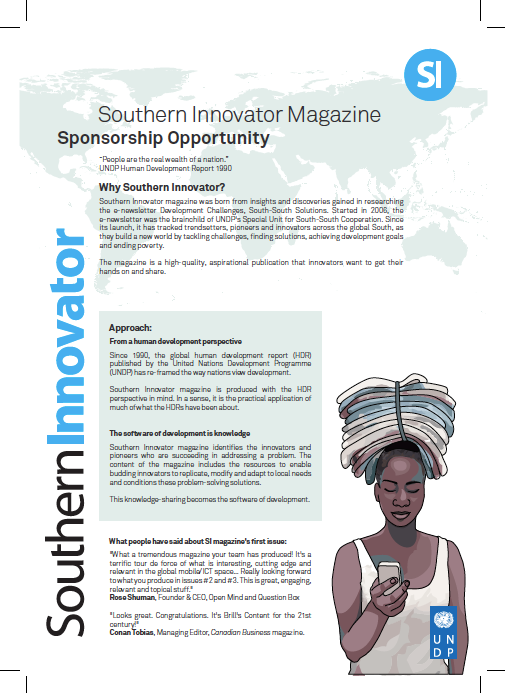
    Development Challenges, South-South Solutions was launched as an e-newsletter in 2006 by UNDP’s South-South Cooperation Unit (now the United Nations Office for South-South Cooperation) based in New York, USA. It led on profiling the rise of the global South as an economic powerhouse and was one of the first regular publications to champion the global South’s innovators, entrepreneurs, and pioneers. It tracked the key trends that are now so profoundly reshaping how development is seen and done. This includes the rapid take-up of mobile phones and information technology in the global South (as profiled in the first issue of magazine Southern Innovator), the move to becoming a majority urban world, a growing global innovator culture, and the plethora of solutions being developed in the global South to tackle its problems and improve living conditions and boost human development. The success of the e-newsletter led to the launch of the magazine Southern Innovator. 
    Creative Commons License

    This work is licensed under a
    Creative Commons Attribution-Noncommercial-No Derivative Works 3.0 License.

    ORCID iD: https://orcid.org/0000-0001-5311-1052.

    © David South Consulting 2023

  • Trade to Benefit the Poor Up in 2006 and to Grow in 2007

    Trade to Benefit the Poor Up in 2006 and to Grow in 2007

    By David SouthDevelopment Challenges, South-South Solutions

    SOUTH-SOUTH CASE STUDY

    The global fair trade market – in which goods and services are traded under the Fairtrade logo, guaranteeing a minimum fair price to producers experienced unprecedented growth in 2006. In the UK alone, 2006 sales totalled £290 million – a jump of 46 percent from 2005. The Fairtrade Foundation predicts sales will reach UK £300 million in 2007.

    In 2005 Fairtrade sales were € 1.1 billion in the brand’s main markets of Switzerland, the UK, New Zealand, Australia and the US. At present fair trade works with 5 million farmers in the global South, and it represents an ever-increasing opportunity for Southern entrepreneurs.

    A tipping point has been reached in Western awareness of and demand for the Fairtrade brand and concept, and it is now being adopted by major supermarkets. In the UK, 62 percent of consumers know the logo and understand what it means.

    The concept of fair trade began in the Netherlands in 1988, when the Max Havelaar Foundation launched the Fairtrade consumer label with coffee from Mexico. Unlike conventional businesses, where the price paid to a producer is what the market dictates, fair trade guarantees the producer a minimum price for their product. This amount is set at a level that ensures the producer can live a life with dignity and meet all the essentials. A portion of the profits is also kept in a communal fund which the producers democratically elect to spend as they wish (many choose to spend it on community projects).

    Fair trade has been criticized for a number of reasons. It has been seen as too small and marginal to really make inroads on poverty, and has been accused of privileging a small number of producers while ignoring the rest. It has also been criticized for not focusing enough on innovation and increasing production to really eradicate poverty in the developing world.

    For all its faults and shortcomings, it is a fact that the Fairtrade brand is a runaway success and offers a wide range of opportunities for entrepreneurs.

    In the UK, fair trade now includes 2,500 products, ranging from footballs, to tea, cotton and honey – up from just 150 in 2003, an astonishing rate of growth. Where fair-trade products were once confined to co-operative and charity shops, they are now widely sold in major supermarkets.

    The success of fair trade is not confined to Europe and the US. It is growing in Japan, where, says fair trade retailer Sonoko Iwasa, “the concept of using trade to equalize the world by buying goods from developing countries from Asia and Africa was a notion that had no connection with everyday lives.”

    Iwasa’s Rumaba Goods store just outside Tokyo sells organic chocolates from Africa, woollen gloves and hats from Nepal, and elegant clothes from Thailand. Iwasa found that the key in the highly competitive Japanese consumer market was to focus on quality, not fairness. This, she says, has made these products fashionable.

    At present, the fair trade market is worth only about US $6 to $7 million a year in Japan and includes 1,500 products. But according to Michiko Ono of Japan’s best-known fair trade label, People Tree, the trend is catching on among the country’s socially aware youth.

    To start a fair trade business, entrepreneurs or producers need first to contact the international body that certifies fair trade products and ensure that production meets the ethical standards required.

    Published: January 2007

    Resources

    https://davidsouthconsulting.org/2022/06/02/afghanistans-juicy-solution-to-drug-trade/

    https://davidsouthconsulting.org/2022/11/02/african-online-supermarket-set-to-boost-trade/

    https://davidsouthconsulting.org/2022/10/26/african-trade-hub-in-china-brings-mutual-profits-2/

    https://davidsouthconsulting.org/2022/11/21/chinese-trade-in-angola-helps-recovery/

    https://davidsouthconsulting.org/2022/11/19/cooking-up-a-recipe-to-end-poverty/

    https://davidsouthconsulting.org/2022/04/12/djibouti-re-shapes-itself-as-african-trade-hub/

    https://davidsouthconsulting.org/2022/10/24/flurry-of-anti-poverty-innovations/

    https://davidsouthconsulting.org/2021/07/19/global-south-trade-boosted-with-increasing-china-africa-trade-in-2013/

    https://davidsouthconsulting.org/2022/10/21/local-animation-a-way-out-of-poverty/

    https://davidsouthconsulting.org/2022/10/26/perfume-of-peace-helps-farmers-switch-from-drug-trade/

    https://davidsouthconsulting.org/2022/10/21/social-networking-websites-a-way-out-of-poverty/

    https://davidsouthconsulting.org/2021/07/19/south-south-trade-helping-countries-during-economic-crisis/

    https://davidsouthconsulting.org/2021/03/05/southern-innovator-issue-2/

    https://davidsouthconsulting.org/2021/01/23/a-steppe-back-economic-liberalisation-and-poverty-reduction-in-mongolia/

    https://davidsouthconsulting.org/2021/01/23/the-sweet-smell-of-failure-the-world-bank-and-the-persistence-of-poverty/

    https://davidsouthconsulting.org/2022/11/18/web-2-0-networking-to-eradicate-poverty/

    https://davidsouthconsulting.org/2022/10/05/women-empowered-by-fair-trade-manufacturer/

    https://davidsouthconsulting.org/2022/06/16/women-mastering-trade-rules/

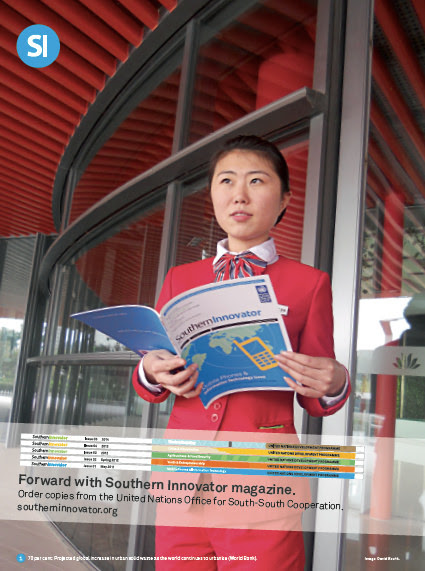
    Development Challenges, South-South Solutions was launched as an e-newsletter in 2006 by UNDP’s South-South Cooperation Unit (now the United Nations Office for South-South Cooperation) based in New York, USA. It led on profiling the rise of the global South as an economic powerhouse and was one of the first regular publications to champion the global South’s innovators, entrepreneurs, and pioneers. It tracked the key trends that are now so profoundly reshaping how development is seen and done. This includes the rapid take-up of mobile phones and information technology in the global South (as profiled in the first issue of magazine Southern Innovator), the move to becoming a majority urban world, a growing global innovator culture, and the plethora of solutions being developed in the global South to tackle its problems and improve living conditions and boost human development. The success of the e-newsletter led to the launch of the magazine Southern Innovator. 
    Creative Commons License

    This work is licensed under a
    Creative Commons Attribution-Noncommercial-No Derivative Works 3.0 License.

    ORCID iD: https://orcid.org/0000-0001-5311-1052.

    © David South Consulting 2023

  • Safe Healthcare is Good Business and Good Health

    Safe Healthcare is Good Business and Good Health

    By David SouthDevelopment Challenges, South-South Solutions

    SOUTH-SOUTH CASE STUDY

    Many people have been shocked by recent stories about the proliferation of counterfeit drugs and the rate at which they are killing and harming people in Nigeria. The International Narcotics Control Board found that up to 50 percent of medicines in developing countries are counterfeit. This has driven home the point that without the presence of legitimate players in the African drug market, the illegal sharks will step in to make large profits – and a literal killing.

    To counter this negative trend, what is most needed is support for reliable Africa-based companies: businesses that are long-term, sustainable and not living from one grant to the next. But as experience has shown around the world, nurturing businesses requires certain fundamentals: they must work to be profitable, they must find a market and exploit it, and they need cash infusions that are timed to the company’s growth, not to the cycle of international donors. This role, often served in developed countries by venture capitalists, who want a fast return of 35 percent – is too onerous a burden for most African businesses. What African companies need is a more conservative, long-term approach; one that expects returns of between five and 10 percent.

    Kenyan company Advanced Bio-Extracts (ABE) is one good example. Only 18 months old and based in Nairobi, the company produces one of a new generation of low-cost anti-malarials known as artemisinin-based combination therapies (ACTs). The drug is produced from the green leafy plant Artemisia, or sweet wormwood. The company is the first in Africa to make this drug, and employs 7,000 local farmers in Kenya, Tanzania and Uganda, as well as scientists.

    ABE has received two infusions of cash from non-profit social venture capitalists Acumen, as well as investment from Swiss drug giant Novartis. Acumen has so far invested US $9.6 million in 11 active investments focused on a diverse set of health challenges, including basic healthcare access in rural areas and treatment for malaria and HIV/AIDS.

    “We are commercializing a product that had never been commercialized,” said ABE’s owner, Doug Henfrey, to the New York Times. “Those little windows of support make these things happen. We could not have done it otherwise.”

    Acumen’s Kenya country director, Nthenya Mule, said “there are positive things happening in Africa, but they are not happening overnight, and some are happening quietly. ABE is exemplary. You will not see it as front-page news, but in 18 months they set up a factory with 160 people interfacing with 7,000 farmers and supplying one of the major pharma companies in the world.”

    Stimulating private sector solutions to African healthcare problems is receiving an additional boost from a new fund established by the World Bank’s private sector arm, the International Finance Corporation. To be launched later in 2007, it will offer cash and loans totaling US $500 million to commercial healthcare projects in Africa. According to its own statistics, 60 percent of health expenditure in sub-Saharan Africa is privately funded, and the market, excluding South Africa, is worth US $19 billion.

    Published: May 2007

    Resources

    • Roll Back Malaria Partnership: Launched in 1998 by the World Health Organization. UNICEF, UNDP and the World Bank to coordinate the global campaign, to fight malaria.
    • Malaria Atlas Project (MAP): An online map showing up-to-date information on high-risk areas for malaria.
    • A paper on the global threat of counterfeit drugs: Click here

    Development Challenges, South-South Solutions was launched as an e-newsletter in 2006 by UNDP’s South-South Cooperation Unit (now the United Nations Office for South-South Cooperation) based in New York, USA. It led on profiling the rise of the global South as an economic powerhouse and was one of the first regular publications to champion the global South’s innovators, entrepreneurs, and pioneers. It tracked the key trends that are now so profoundly reshaping how development is seen and done. This includes the rapid take-up of mobile phones and information technology in the global South (as profiled in the first issue of magazine Southern Innovator), the move to becoming a majority urban world, a growing global innovator culture, and the plethora of solutions being developed in the global South to tackle its problems and improve living conditions and boost human development. The success of the e-newsletter led to the launch of the magazine Southern Innovator. 

    Creative Commons License

    This work is licensed under a
    Creative Commons Attribution-Noncommercial-No Derivative Works 3.0 License.

    ORCID iD: https://orcid.org/0000-0001-5311-1052.

    © David South Consulting 2023