Categories
Archive UNDP Mongolia 1997-1999 United Nations Development Programme

High Impact Communications In A Major Crisis: UNDP Mongolia 1997-1999 | 18 February 2016

I was head of communications for the United Nations mission in Mongolia from 1997 to 1999. The mission had to primarily tackle three major crises: the country’s turbulent transition from Communism to free markets and democracy, the social and economic crash this caused, and the Asian Financial Crisis (Pomfret 2000) (Quah 2003)*.
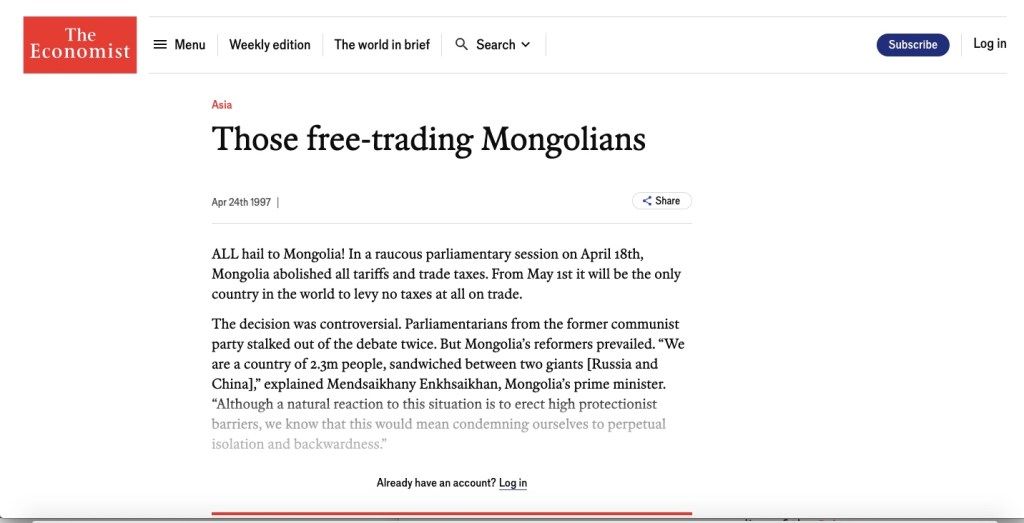
The Economist: “Those free-trading Mongolians” was published Apr 24th 1997. I arrived in May of 1997 to find a country on the cusp of great and turbulent change.

Richard Pomfret said in 1994 “In 1991 Mongolia suffered one of the biggest peacetime economic collapses ever (Mongolia’s Economic Reforms: Background, Content and Prospects, Richard Pomfret, University of Adelaide, 1994).”

From Curbing Corruption in Asia: A Comparative Study of Six Countries by Jon S. T. Quah: “The combined effect of these three shocks was devastating as ‘Mongolia suffered the most serious peacetime economic collapse any nation has faced during this century’. Indeed, Mongolia’s economic collapse ‘was possibly the greatest of all the (peaceful) formerly'” Communist countries. 

“The years 1998 and 1999 have been volatile ones for Mongolia, with revolving door governments, the assassination of a minister, emerging corruption, a banking scandal, in-fighting within the ruling Democratic Coalition, frequent paralysis within the Parliament, and disputes over the Constitution. Economically, the period was unstable and rife with controversies.” Mongolia in 1998 and 1999: Past, Present, and Future at the New Millennium by Sheldon R. Severinghaus, Asian Survey, Vol. 40, No. 1, A Survey of Asia in 1999 (Jan. – Feb., 2000), pp. 130-139 (Publisher: University of California)

Writing in 2018, author John West  found, in a chapter titled Mongolia’s Corruption Curse (Transparency International and the World Bank had found corruption worsened in Mongolia after 2001), “In many ways, Mongolia has everything going for it. After being a satellite state of the former Soviet Union for much of the twentieth century, Mongolia regained its independence with the end of the Cold War. A relatively peaceful political revolution in the early 1990s ushered in a multi-party democracy and open society which have remained in place. … And it is blessed with vast reserves of copper, gold, coal, molybdenum, fluorspar, uranium, tin and tungsten deposits. True, Mongolia experienced great upheavals as the breakup of the Soviet Union saw its trade decline by 80%. But Mongolia was also perfectly placed to benefit from the commodity super cycle driven by China, which is now the destination for the vast majority of its exports.

“However, despite much hype about the Mongolian “wolf economy”, this country of so much promise is being dragged down by massive corruption. …

“Mongolia’s corruption is greatly weakening its attractiveness as an investment destination, is fracturing society and weakening its fragile political institutions. Its culture of corruption has also fed its love-hate relationship with foreign investors, which has destabilized the economy.” Asian Century … on a Knife-edge: A 360 Degree Analysis of Asia’s Recent Economic Development by John West, Springer, 24 January 2018.  

In this role, I pioneered innovative use of the Internet and digital resources to communicate the UN’s work and Mongolia’s unfolding crises. The UN called this work a “role model” for the wider UN and country offices. A survey of United Nations country office websites in 2000 ranked the UN Mongolia website I launched in 1997 and oversaw for two years (1997-1999), third best in the world, saying: “A UN System site. A very nice, complete, professional site. Lots of information, easily accessible and well laid out. The information is comprehensive and up-to-date. This is a model of what a UNDP CO web site should be.” (https://www.scribd.com/document/35249986/United-Nations-2000-Survey-of-Country-Office-Websites)

As part of a strategic plan to raise awareness of Mongolia’s development challenges and to spur action on meeting them, a Communications Office was established for the UN mission in 1997. Acting as a strategic hub, the Communications Office and its dynamic and talented team, were able to leverage the existing budget to spur action on many fronts, including: 

Media

Working with journalists and media both within Mongolia and outside – including organising frequent cross-country media tours – the Communications Office was able to significantly raise awareness of Mongolia and its development challenges. This was reflected in a substantial increase in media coverage of the country and in the numerous books and other publications that emerged post-1997. The book In Their Own Words: Selected Writings by Journalists on Mongolia, 1997-1999 (ISBN 99929-5-043-9) archived the stories by theme.  

Top journalists covering Asia in the late 1990s contributed to the book.
The BBC’s Charu Shahane joined other journalists on a UNDP Mongolia media tour in 1998.

Ger Magazine

Ger Magazine (the Mongolian word for home and traditional tent dwelling) was published as the country’s first e-magazine in 1998. There were four issues in total from 1998 to 2000. The launch issue was on the theme of youth in the transition. Mongolia was transitioning from Communism to free markets and democracy and this had been both an exhilarating time and a wrenching time for young people. The magazine drew on talented journalists from Mongolia and the handful of international journalists based there to create a mix of content, from stories about life adapting to free markets to stories on various aspects of Mongolian culture and life. 

The second issue of the magazine proved particularly effective, with its modern life theme and cover story on a thriving Mongolian fashion scene.

Archived issues of the magazine can be found at the Wayback Machine here: https://archive.org/. Just type in the UN Mongolia website address for the years 1997 to 1999: http://www.un-mongolia.mn.


Blue Sky Bulletin

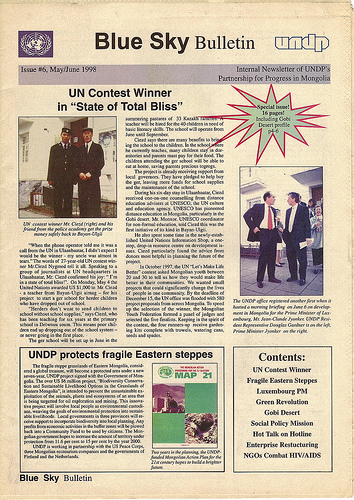
The Blue Sky Bulletin newsletter was launched in 1997 initially as a simple, photocopied handout. It quickly founds its purpose and its audience, becoming a key way to communicate what was happening in the country and a crucial resource for the global development community, scholars, the media and anyone trying to figure out what was happening in a crazy and chaotic time. Blue Sky Bulletin was distributed via email and by post and proved to be a popular and oft-cited resource on the country. The quality of its production also paralleled Mongolia’s growing capacity to publish to international standards, as desktop publishing software became available and printers switched to modern print technologies. Blue Sky Bulletin evolved from a rough, newsprint black and white publication to becoming a glossy, full-colour, bilingual newsletter distributed around Mongolia and the world.

Archived issues can be found online here:
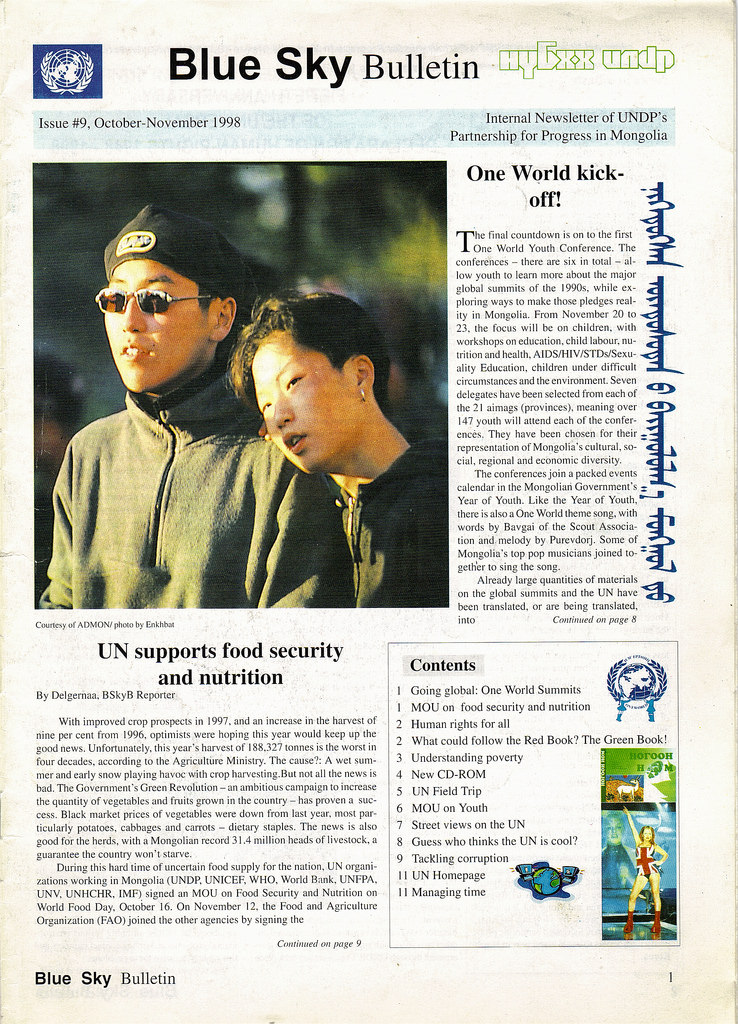
Blue Sky Bulletin Issue 1

Blue Sky Bulletin Issue 2

Blue Sky Bulletin Issue 3

Blue Sky Bulletin Issue 4

Blue Sky Bulletin Issue 5

Blue Sky Bulletin Issue 6 

Blue Sky Bulletin Issue 7 

Blue Sky Bulletin Issue 8

Blue Sky Bulletin Issue 9

Blue Sky Bulletin Issue 10


Publishing

MHDR 1997

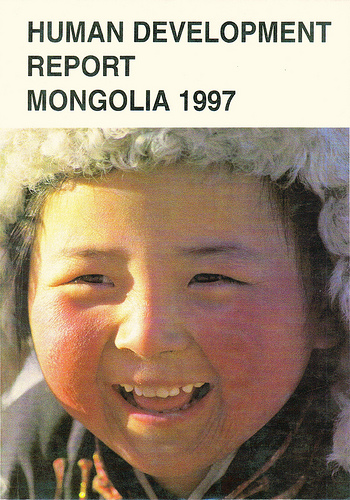
The Mongolian Human Development Report 1997 (MHDR), the country’s first, placed the story of the Mongolian people during the transition years (post-1989) at its heart, using photographs, stories and case studies to detail the bigger narrative at play.

This groundbreaking Mongolian Human Development Report went beyond just chronicling Mongolia’s state of development in statistics and graphs. Designed, laid out and published in Mongolia, the report broke with the practices of many other international organisations, who would publish outside of Mongolia – denying local companies much-needed work and the opportunity to develop their skills. The report’s costs helped to kick-start a publishing boom in the country and significantly raised standards in design and layout in the country. The foundations laid down by the project producing the report ushered in a new age in publishing for Mongolia.

The report’s launch was innovative, not only being distributed for free across the country, but also part of a multimedia campaign including television programming, public posters, town hall meetings and a ‘roadshow’ featuring the report’s researchers and writers.

The initial print run of 10,000 copies was doubled as demand for the report increased. To the surprise of many, once hearing about the free report, herders would travel to the capital, Ulaanbaatar, to pick up their copy. The report proved people cared passionately about the development of their country and that development concepts are not to be the secret domain of ‘development practitioners’. The report also became an English language learning tool as readers compared the Mongolian and English-language versions. 

You can read the report’s pdf here: http://www.mn.undp.org/content/mongolia/en/home/library/National-Human-Development-Reports/Mongolia-Human-Development-Report-1997.html

Mongolian AIDS Bulletin

Assembled by a team of health experts after the Fourth International Congress on AIDS in Asia and the Pacific, the Mongolian AIDS Bulletin was published in 1997 in the middle of an HIV/AIDS crisis. It provided timely information and health resources in the Mongolian language and was distributed across the country.
 
“Mongolia’s first AIDS Bulletin marked the beginning of the UNDP Response to HIV/AIDS/STDs Project back in the autumn of 1997. Over 5,000 copies of the magazine were distributed across the country, offering accurate information on the HIV/AIDS situation. The project has been pivotal in the formulation of a national information, education and communication (IEC) strategy, bringing together NGOs, donors, UN agencies and the government.”
 
Source: YouandAids: The HIV/AIDS Portal for Asia Pacific 

Green Book

In the Mongolian language, the Mongolian Green Book details effective ways to live in harmony with the environment while achieving development goals. Based on three years’ work in Mongolia – a Northeast Asian nation coping with desertification, mining, and climate change – the book presents tested strategies.  

EPAP Handbook

The Environmental Public Awareness Handbook was published in 1999 and features the case studies and lessons learned by UNDP’s Mongolian Environmental Public Awareness Programme (EPAP). The handbook draws on the close to 100 small environmental projects the Programme oversaw during a two-year period. These projects stretched across Mongolia, and operated in a time of great upheaval and social, economic and environmental distress. The handbook is intended for training purposes and the practice of public participation in environmental protection.

In its 2007 Needs Assessment, the Government of Mongolia found the EPAP projects “had a wide impact on limiting many environmental problems. Successful projects such as the Dutch/UNDP funded Environmental Awareness Project (EPAP), which was actually a multitude of small pilot projects (most costing less than $5,000 each) which taught local populations easily and efficiently different ways of living and working that are low-impact on the environment.”

Mongolia Updates 1997, 1998, 1999

Mongolia Update 1998 detailed how the country was coping with its hyperinflation and the Asian economic crisis.

The mission simultaneously had to deal with the 1997 Asian Crisis (http://en.wikipedia.org/wiki/1997_Asian_Financial_Crisis) and the worst peacetime economic collapse in post-WWII history (http://www.jstor.org/pss/153756).  

Mongolia Update 1998 – Political Changes

1998 proved a tumultuous year for Mongolia. The country’s existing economic crisis caused by the transition from Communism to free markets was made worse by the wider Asian Crisis. The government was destabilised, leading to an often-confusing revolving door of political figures. In order to help readers better understand the political changes in the country, a special edition of Mongolia Update was published that year.  

UNDP Mongolia: The Guide

The Guide, first published in 1997, provided a rolling update on UNDP’s programmes and projects in Mongolia during a turbulent time (1997-1999). The mission simultaneously had to deal with the 1997 Asian Crisis (http://en.wikipedia.org/wiki/1997_Asian_financial_crisis) and the worst peacetime economic collapse in post-WWII history.

Each edition came with short project and context summaries, key staff contacts, and facts and figures on how the country was changing. For the first time, any member of the public could grasp what the UN was up to in the country and be able to contact the project staff. An unusual level of transparency at the time for a UN mission.

Memoranda of Understanding

Three Memoranda of Understanding were negotiated with the Mongolian Government to help focus efforts and aid the attainment of internationally-agreed resolutions. This was affirmed by a series of youth conferences, One World, held in 1998 and 1999.

Strategy and Leadership in a Crisis

The scale and gravity of the crisis that struck Mongolia in the early 1990s was only slowly shaken off by the late 1990s. The economic and social crisis brought on by the collapse of Communism and the ending of subsidies and supports from the Soviet Union, led to a sharp rise in job losses, poverty, hunger, and family and community breakdowns. 

The challenge was to find inspiring ways out of the crisis, while building confidence and hope. The sort of challenges confronted by the UNDP Mongolia Communications Office included: 

1) A food crisis: agricultural production was down sharply, and the traditional nomadic herding economy, while at peak herd, was failing to get the meat to markets and to a high enough standard to restore export levels to where they once were. As a result, a cross-border trading frenzy became the solution to falling domestic food production and availability.

2) HIV/AIDS/STDs crisis

3) A major banking crisis

4) Both the Asian Financial Crisis and the Russia Crisis.

5) An ongoing political crisis and an inability to form stable governments.

“Mongolia is not an easy country to live in and David [South] showed a keen ability to adapt in difficult circumstances. He was sensitive to the local habits and cultures and was highly respected by his Mongolian colleagues. … David’s journalism background served him well in his position as Director of the Communications Unit. … A major accomplishment … was the establishment of the UNDP web site. He had the artistic flare, solid writing talent and organizational skills that made this a success. … we greatly appreciated the talents and contributions of David South to the work of UNDP in Mongolia.” Douglas Gardner, UN Resident Coordinator and UNDP Resident Representative Mongolia

UNDP: Country Cooperation Frameworks and Related Matters – First Country Cooperation Framework for Mongolia (1997-2001).

Citations

The response by the Communications Office has been cited in numerous articles, stories, publications and books. It has also contributed to the development of the human development concept and understanding of human resilience in a crisis and innovation in a crisis. Book citations include: 

Modern Mongolia: From Khans to Commissars to Capitalists

Wild East: Travels in the New Mongolia

A more detailed list of citations can be found here: http://www.davidsouthconsulting.com/about/

For research purposes, key documents were compiled together and published online here: https://books.google.ca/books?id=K76jBgAAQBAJ&dq=undp+mongolia+key+documents&source=gbs_navlinks_s

In 2001, the UN won the Nobel Peace Prize for “their work for a better organized and more peaceful world” and its communications innovations, with work such as that in Mongolia being cited as a contributing factor to the awarding of the Prize

In 2000, the Millennium Development Goals (MDGs) were launched in a 15-year bid to use a focused approach to development centred around eight goals to accelerate improvements to human development. From 2000 to 2005, work was undertaken in various UN missions (Mongolia, South Africa, Turkmenistan, Ukraine) to communicate the goals and to reshape communications activities around the goals.

*Curbing Corruption in Asia: A Comparative Study of Six Countries by Jon S. T. Quah, Eastern Universities Press, 2003 

Transition and Democracy in Mongolia by Richard Pomfret, Europe-Asia Studies, Vol. 52, No. 1 (Jan., 2000), pp. 149-160, published by Taylor & Francis, Ltd. (http://www.jstor.org/stable/153756?seq=1#page_scan_tab_contents


UNDP Mongolia team photo in 1997. I am sitting front row centre left of the UN Resident Coordinator Douglas Gardner.
Creative Commons License

This work is licensed under a
Creative Commons Attribution-Noncommercial-No Derivative Works 3.0 License.

ORCID iD: https://orcid.org/0000-0001-5311-1052.

© David South Consulting 2023

Categories
Archive UNDP Mongolia 1997-1999 United Nations Development Programme

Human Development Report Mongolia | 1997

This groundbreaking Mongolian Human Development Report – the country’s first – went beyond just chronicling Mongolia’s state of development in statistics and graphs. It placed the story of the Mongolian people during the transition years (post-1989) at its heart, using photographs, stories and case studies to detail the bigger narrative at play.

Designed, laid out and published in Mongolia, the report broke with the practices of many other international organisations, who would publish outside of Mongolia – denying local companies much-needed work. The report’s costs helped to kick-start a publishing boom in the country and significantly raised standards in design and layout. The foundations laid down by the project producing the report ushered in a new age in publishing for Mongolia.

The report’s launch was innovative, not only being distributed for free across the country, but also part of a multimedia campaign including television programming, public posters, town hall meetings and a ‘roadshow’ featuring the report’s researchers and writers.

The initial print run of 10,000 copies was doubled as demand for the report increased. To the surprise of many, once hearing about the free report, herders would travel to the capital, Ulaanbaatar, to pick up their copy. The report proved people cared passionately about the development of their country and that development concepts are not to be the secret domain of ‘development practitioners’.

You can read the report’s pdf here: books.google.co.uk/books?id=dx7Q-yJot_cC&printsec=fro…

The MHDR 1997 was so popular it had two print runs. It has been cited in many books, journals and publications. It was the first exhaustive account of the country’s turbulent transition years and mapped the extent of poverty in the country.
The Human Development Report Mongolia 1997 is available in many library collections around the world. In this case, the Oulu University Library Finland.
The award-winning UN/UNDP Mongolia Development Portal was launched in 1997. It quickly became the go-to source on Mongolia’s development challenges.
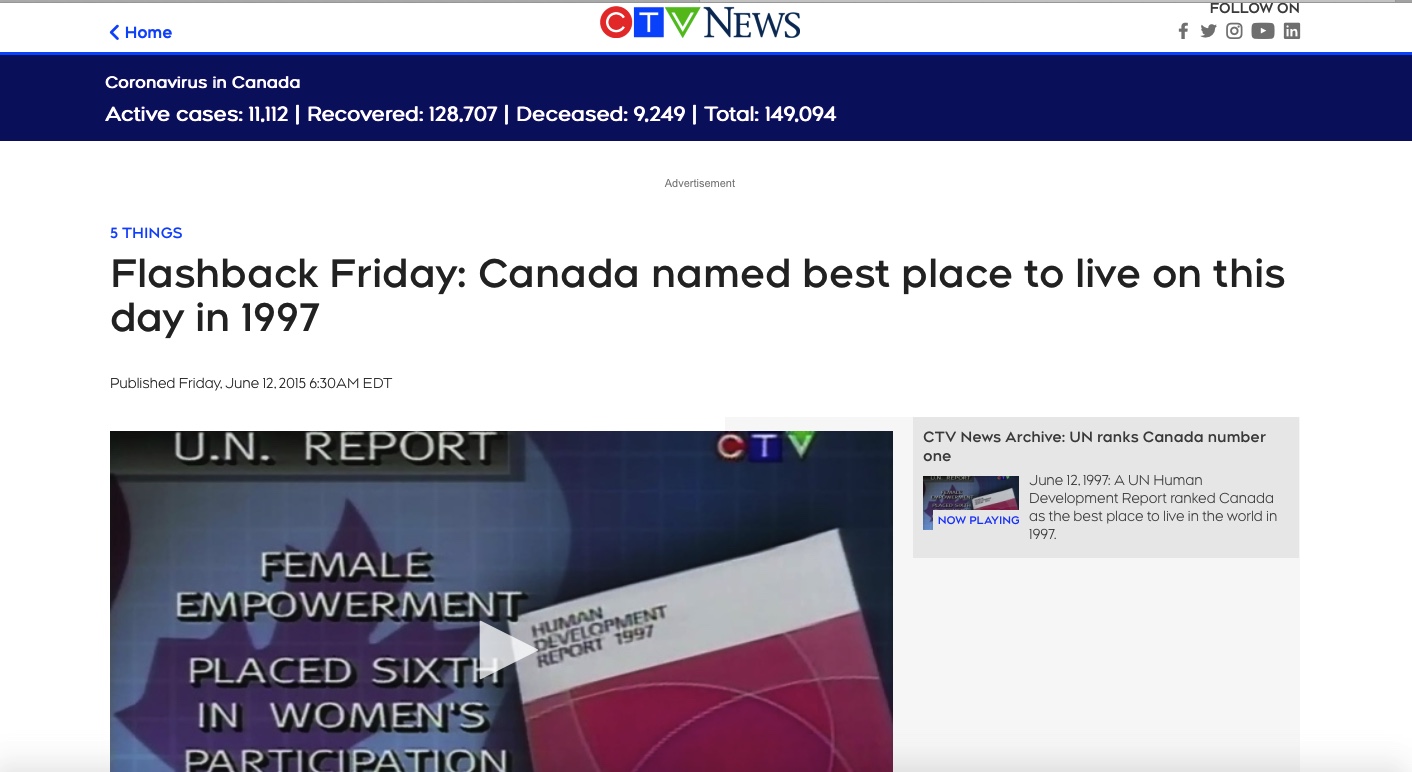
CTV News: “Canada named best place to live on this day in 1997”. I considered it an enormous privilege to be given the opportunity to work with fellow Canadians on sharing our experiences with Mongolia during the 1990s crisis.

“On this day in 1997, Canada was on top of the world. Or at least, on top of the United Nations’ annual ranking of the best places to live in the world.

“CTV News archival footage captured a proud moment for Canada on June 12, 1997, as then-National News anchor Lloyd Robertson hailed the UN ranking as a “report card to be proud of.”

“It’s not quite straight As but Canada is still at the head of the class,” Robertson said. “In fact, it’s No. 1 in the world.”

Related Links

“Canada beat out France, Norway, the United States and Iceland for top spot on the UN human development list, which ranks countries based on a variety of factors linked to quality of life.

“It was the fourth straight year Canada topped the list.

“Canada earned top marks in the life expectancy, health, education and income categories, which helped propel the country’s overall Human Development Index score to No. 1 in the world.”

This work is licensed under a Creative Commons Attribution 4.0 International License.

ORCID iD: https://orcid.org/0000-0001-5311-1052.

© David South Consulting 2023
Categories
Annex Gleaner Archive

An Abuse Of Privilege?

Police say the wealthy and eccentric owner of a Bedford Road museum and rooming house sexually assaulted young men over a period of 17 years. Others say he is a victim of unfair persecution. Norman Elder isn’t saying anything.

By David South

Annex Gleaner (Toronto, Canada), May 1997

The tattered sign on the door is barely noticeable, and its message gives little away: “Dr Elder has moved to Fort Torrance, Ontario. Sorry no tours.”

I peek in the window of the Norman Elder Museum on Bedford Road and see the eyes of a zebra staring back at me. To the left are formaldehyde jars filled with oddly shaped objects.

While Norman Elder, amateur anthropologist and full-time Annex eccentric, may be hiding at his Muskoka cottage, he has left behind a community stunned by police allegations that he sexually abused young men. His story is one of a man born into wealth who cultivated an image of eccentricity as carefully as he surrounded himself with the things he loved.

According to police, the assaults took place at Elder’s 140 Bedford home – a brooding Victorian mansion that’s one part rooming house, another part museum holding his large collection of artifacts plucked from the world’s tribes.

Detective Robert Mann of Metro’s 32 Division Youth Bureau says Elder has been charged with 12 counts of indecent assault/male, spanning 1972 to 1989.

“Some were minors, some were adults over the age of 16. Most were adolescent and teenage males between the ages of 15 and 19.” While the charges laid were at the end of February, police have still not disclosed the details. Without that information, Elder hasn’t entered a plea.

Last Wednesday, I walked past the gravestone that marks the front yard and approached three young men having a cigarette outside the house. Two of them said they lived in the house. One man with a skinhead hairstyle who looked to be in his mid-20s nervously said, “I don’t want to talk about it.” He admitted he was taking messages for Elder from the answering machine and had passed on my numerous calls. Calls to his cottage weren’t answered, and none of Elder’s friends and acquaintances contacted by The Gleaner wished to comment on the charges.

Mann alleges that Elder’s modus operandi was to offer homeless youths a place to stay in return for sexual favours. The multiple charges stem from men contacting police after reading articles in Toronto’s two dailies about the first charge, which was laid in February.

Elder’s trip to the cottage isn’t a case of spring fever; he is out on bail and has been court-ordered to not return to his house.

Off the record, several sources suspected that some of the young men living at the house were involved in the sex trade and weren’t innocent of trading sexual favours for a place to stay. In the language of the street, they say, Elder was a sugar daddy. Some acquaintances of Elder felt he was being unfairly persecuted by police for sexual acts that took place between consenting adults (though, legally, the homosexual age of consent is 18, while for heterosexuals it’s 16). They also questioned the validity of charges that are in some cases 25 years old and only ferreted out by police during the Maple Leaf Gardens scandal.

Elder may be an eccentric, but he is not a loner; nor did he keep a low profile. Elder was born into wealth and attended Upper Canada College with the likes of Conrad Black, whom he once called a friend. He is listed in the Who’s Who in the World and Who’s Who in Canada. He financed his globe-trotting expeditions by selling artifacts collected in the Amazon, Africa and Borneo to museums, including Ripley’s Believe It or Not. He filled his house with exotic animals, including a 20-foot, 400-pound python called Peter.

As a one-man National Geographic magazine, Elder has self-published several books on his travels and made documentaries. His house served as location for David Cronenberg’s The Naked Lunch. He once told a journalist. “What bothers me most about going to zoos is that I’ve tasted most of the animals in there.”

In 1979, an article in The Toronto Star weekend magazine described Elder as a “slightly balding, surprisingly genial guy, who looks a bit like Jack Nicholson … and speaks a bit mezzo forte for a 20th-century Victorian.”

The former Olympic equestrian rider has had a long association with running rooming houses for youth that dates back to the 60s. When he was a social worker in Yorkville’s hippie days, Elder boasted of having 6,000 kids crash at his place in 1969.

In the 70s, he had political aspirations, running for city council and for the provincial NDP. He was friends with late New Brunswick premier Richard Hatfield, who was also dogged by rumours about his relationships with young men.

Update: “In 1998, Elder pleaded guilty to indecently assaulting 10 young men between 1970 and 1980. On March 12, 1998, Judge Faith Finnestad sentenced Elder to two years less a day in jail.” 

“Elder died on Wednesday, October 15, 2003 in Toronto of an apparent suicide by hanging.” (Source: Wikipedia).

Other stories from the Annex Gleaner

Artists Fear Indifference from Megacity 

https://davidsouthconsulting.org/2020/04/22/artists-fear-indifference-from-megacity/

https://davidsouthconsulting.org/2021/06/14/case-study-1-investigative-journalism-1991-1997-2/

Will the Megacity Mean Mega-Privatization? 

https://davidsouthconsulting.org/2020/04/22/will-the-megacity-mean-mega-privatization/

https://davidsouthconsulting.org/2020/06/11/safety-at-stake/

Creative Commons License

This work is licensed under a
Creative Commons Attribution-Noncommercial-No Derivative Works 3.0 License.

ORCID iD: https://orcid.org/0000-0001-5311-1052.

© David South Consulting 2022

Categories
Archive Watch Magazine

CASE STUDY 2: Watch Magazine | 1994 And 1996

Expertise: Editing, start-ups, youth media, content development, art direction, design and layout, investigative journalism.

Location: Toronto, Ontario, Canada 1994 and 1996

Editor-in-Chief: David South

Abstract

In 1994 I was hired by start-up Youth Culture to be Editor-in-Chief of Toronto’s Watch Magazine, a bi-weekly distributed to the city’s high schools and to all youth hang-outs. In 1996 I was hired again to help with preparing the magazine for its national launch. 

About

In 1994, the Internet had not arrived in any great form (though Watch Magazine was on top of its emergence as Internet cafes popped up in the city) and the digital economy was still minimal. There was no such thing as ‘start-up culture’ for youth. There was an urgent need to create opportunity for youth, to create new markets, and to change the business culture of the city of Toronto, which had been hit hard by an economic crash and austerity. 

Watch Magazine had had a brief false start prior to my arrival in 1994. The previous format had not worked and the magazine needed a vision and somebody with the experience and dedication to see it through. It was also entering a competitive marketplace for readers, with already existing free magazines capturing most of the advertising spend for youth-oriented marketing in Toronto (though failing to offer a genuine youth content experience as could be found in Europe – the UK especially – at that time). As an example, Toronto lacked sharp and credible coverage of youth popular culture in the early 1990s. Drawing on my extensive experience as a journalist (including at Toronto’s established alternative weekly, Now Magazine) and editor, I assembled a team of youth editors and writers to work on making the content and magazine’s design appealing to the youth demographic in Toronto. The magazine needed to turn a profit in short order and become credible to advertisers, its main source of income (in Canada, 64 per cent of magazine revenues come from advertisers)*. The design and content needed to appeal to a youth audience but work with a tight (but increasing) budget. It was doing this in a tough economy with high unemployment, austerity, business failures, and a generally negative business environment.

By having an actual youth editorial team, Watch Magazine quickly developed an authentically young 1990s voice. The magazine also benefited from its youth team’s ability to spot trends bubbling under the surface ready to explode into mainstream society. As an example, they had this to say on the Internet in a piece on Toronto’s coffee shops, “Some mean places for bean”: “The powers-that-be think we should cocoon in our houses and rent videos, play with the Internet and order in food …” 

Youth unemployment was high in the early to mid 1990s in Canada. It reached 19.3 per cent for those 15 to 19 years old in 1993. “It should be noted, however, that youth unemployment relative to that of adults has worsened since the 1990-91 recession (Youth Unemployment in Canada by Kevin B. Kerr, 2000).”

The Canadian economy overall severely contracted and unemployment was at 11.4 per cent by 1993 (Statistics Canada), and as Statistics Canada said, “Because employment recovered at a snail’s pace after the recession of the early 1990s, the decline in the unemployment rate was delayed until 1994”.

As the Bank of Canada also said: “In early 1994, Canada’s economic situation was not that favourable—our economy was facing some rather serious problems. … the recession here was more severe than in the United States.

“Working their way out of these difficulties was disruptive and painful for Canadian businesses. Defaults, restructurings, and downsizings became the order of the day. With all this, unemployment took a long time to recover from the 1990–91 recession …” *

And the media in general could not avoid the crisis. According to the book The Missing News: Filters and Blind Spots in Canada’s Press (Robert A. Hackett and Richard S. Garneau, Canadian Centre for Policy Alternatives, University of Toronto Press 2000), Canada’s media was also in a crisis throughout the 1990s, as declining resources, staff layoffs and media closures reduced the breadth and depth of news coverage.

In less than a year, Watch Magazine had gone from being an unknown quantity, to being a fast-growing and profitable youth publication, significantly increasing its advertising revenue: a key metric for a magazine reliant on this as its main source of income. It had expanded in size and audited distribution and was able to make a move to new digs (the Watch Magazine “crib” – a studio and work space) at innovative “arts-and-culture hub” start-up space 401 Richmond Street in Toronto – at the centre of Toronto’s emerging media and design neighborhood in its former fashion district.  All the contributors were high-school-age youth drawn from talent across the city; many had already shown their ability by starting their own publications and media. They gained first-hand experience in investigative journalism skills, business skills in a start-up, and magazine and media production skills. 

“… thanks to David [South] for all his hard work on Watch magazine! I learned a lot from him and it was a great experience.” William White

In 1996, I was hired again to help with preparing the content format for Watch’s expansion to a national magazine – further proof of its success as a publication and a business. 

* (Bank of Canada: Canada’s Economic Future: What Have We Learned from the 1990s?)

* The Missing News: Filters and Blind Spots in Canada’s Press (Robert A. Hackett and Richard S. Garneau, Canadian Centre for Policy Alternatives, University of Toronto Press 2000)

Brief descriptions of sample issues are below: 

Youth Gangs Cover

In 1994, with Canada’s economy still in the doldrums, Watch Magazine exploded into Toronto’s high schools. Staffed by talented youth, it shook up the staid publishing scene and proved young people did have something to say. This first issue still remains relevant, with its exploration of youth gangs and violence in the school system.  

Therapy Cover

After its successful launch, Watch Magazine was grabbing readers and getting the attention of advertisers and television. It was time to improve the design and introduce the latest in graphic design software. The results paid off: the magazine looked sharper and quickly ran from its cheeky launch, when we had basically avoided all traditional approaches to a launch (like actually having a designer).

For anoraks out there, this photo shoot with Irish band Therapy took place outside the former Wellesley Hospital emergency department in Toronto. And, yes, that is a genuine restraining ‘straitjacket’ used by psychiatric hospitals to restrain mental health patients. 

Digable Planets Cover

By this issue, Watch had hit its stride: we were the first to seriously review the ballooning zine culture, get immersed in the rave and late-night party scene, and dig deep into “chopsocky world”: Hong Kong and Asian film fans. But “Hip-Hop Comb-munism”? What were we thinking?

It was also the biggest issue to date. 

Beck Cover

Highly talented Beck gave Watch his eloquent thoughts on the media’s infatuation with Generation X and how it always desperately needs to sell young people more stuff. Watch took on Ontario’s film censors over the GG Allin documentary, Hated: GG Allin and the Murder Junkies, and let students across the city blow off steam on life in the 1990s. 

Bass is Base Cover

By October 1994 the magazine’s investigative powers were in full flow. Two investigations – a sex scandal at an alternative school, and whether the Battle of the Bands contests, a fixture at most high schools, are really worth it – joined a profile of the band Bass is Base and more coverage on the growing rave scene in Toronto. 

Oasis Cover

In 1994, Oasis were still an indie band with a lot of bottle and big mouths. Riding a tsunami of hype from the UK, they washed up in North America to face their biggest challenge: could they become as big as The Beatles or The Rolling Stones? Lead singer Liam Gallagher does not disappoint, as he gives me an expletive-laden exposition on everything under the sun.

This was the first published print interview with the band in Canada.

Sloan Cover

Canada’s answer to the ‘Madchester’ scene of the early 1990s, Sloan, played the pop game with gusto. In the photo shoot for the feature, it was pants down and prayer hands to an unseen religious icon.

Timeline 

1994: Hired to re-launch and expand Watch Magazine in Toronto.

1996: Hired to re-develop editorial content for Watch Magazine’s national launch.  

Testimonials 

“As one of those high school kids and the guy who wrote (most of) this article, I’d like to say thanks to David [South] for all his hard work on Watch magazine! I learned a lot from him and it was a great experience.” William White

Impact

Micro 

  •  Toronto’s first youth culture media start-up. Introduced ‘youth culture’ concept to Canada
  •  oversaw two format re-launches of the magazine as it expanded and grew
  •  assembled talented youth editorial team
  •  grew magazine and its profile as the main media source for reaching Toronto’s youth
  •  writers trained and appeared on TV as youth commentators
  •  first profile in Canada of British band Oasis, among many other story firsts
  •  became first stop for anyone wishing to target the youth market, or seeking intelligence on the youth market 

Macro

  • created youth culture market in Toronto
  • first magazine to be based at new start-up hub in Toronto – pioneering concept at the time 

A sample of published stories is below:  

Freaky – The 70s Meant Something

Oasis Has Arrogance, A Pile of Attitude and the Best Album of 1994

Citations 

Other Resources 

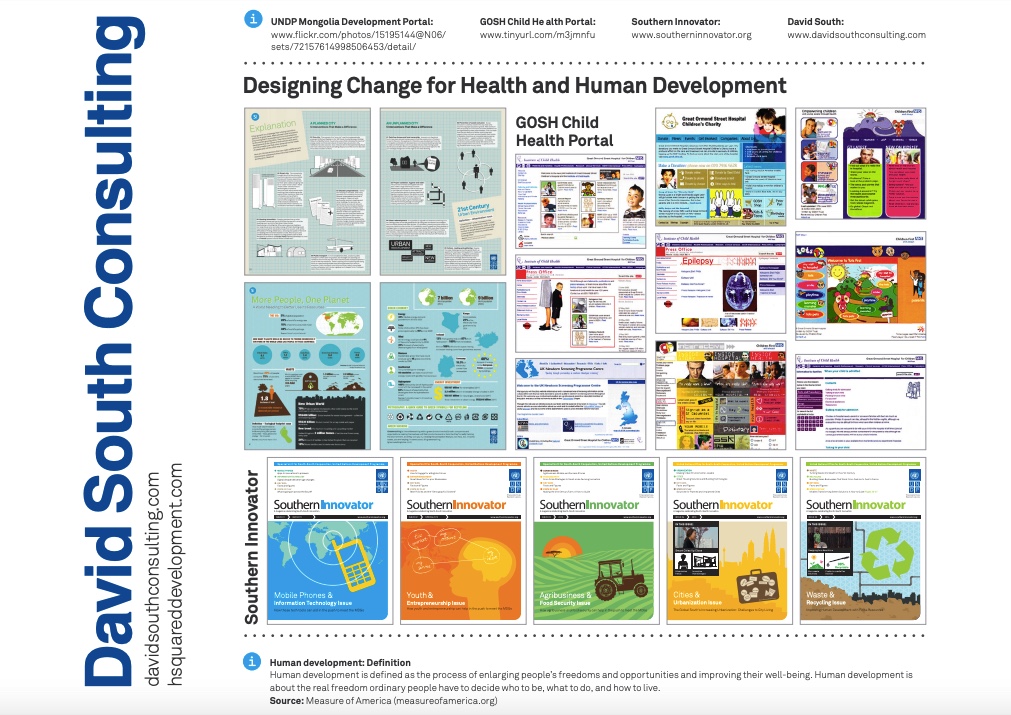
GOSH Child Health Portal 2001 to 2003 Resources

Note: Complete issues of the magazine’s first year await professional digital scanning. This could be of interest to a library, scholar or university interested in archiving this authentic artefact of 1990s youth culture. Please send an email if you would like to get in touch or share a thought: mailto: davidsouthconsulting@gmail.com.  

Media

Youth culture magazine Watch goes national, Wendy Cuthbert, September 1, 1997, Strategy, Canada

“Free teen publication Watch Magazine is going national this month – promising to more than double its high school penetration. 

The self-described youth culture magazine, which last year at this time went province-wide – delivering copies to 350 high schools across Ontario – plans to send out 125,000 copies to 800 participating high schools across Canada. 

Going national only four years after its inception (the magazine started as a Toronto-only vehicle in 1993) could make national advertisers interested in reaching the elusive teen market very happy.”

“The self-described youth culture magazine, which last year at this time went province-wide – delivering copies to 350 high schools across Ontario – plans to send out 125,000 copies to 800 participating high schools across Canada.”

Ryerson Review of Journalism, Page 34, 2003, Toronto, Canada

By Mindy Bell, Published June 23, 2003.

Selling Students Short

“Owned by marketing company Youth Culture Group, these gender – specific magazines attempt to construct a teen image that is built on spending.”

“Youth Culture originally produced a younger, unisex magazine called Watch, which eventually became Bang.”

By Dimetre Alexiou, Published April 4, 1995. Some context on poor youth representation in Canadian media in the early to mid 1990s.
Watch Magazine Editor-in-Chief David South
Watch Magazine Editor-in-Chief David South photographed at Toronto’s Beaches neighbourhood in 1994. Watch Magazine was Toronto’s first youth culture media start-up and led the way on Toronto’s revival after the economic crisis of the early 1990s. Photo: Margaret South.

Note: Complete issues of the magazine’s first year await professional digital scanning. This could be of interest to a library, scholar or university interested in archiving this authentic artifact of 1990s youth culture. Please send an email if you would like to get in touch or share a thoughtmailto: davidsouthconsulting@gmail.com. You can also fund this goal through our PayPal account here:

https://davidsouthconsulting.org/2021/07/20/case-study-3-id-magazine-1996-1997-2/

https://davidsouthconsulting.org/2021/05/25/ger-mongolias-first-web-magazine-and-a-pioneering-web-project-for-the-united-nations-12-january-2016/

https://davidsouthconsulting.org/2021/03/12/southern-innovator-magazine/

We accept payments and donations. We use any funds received to keep content online, or to create new content. Thank you! https://www.paypal.me/davidsouthconsulting
Creative Commons License

This work is licensed under a
Creative Commons Attribution-Noncommercial-No Derivative Works 3.0 License.

ORCID iD: https://orcid.org/0000-0001-5311-1052.

© David South Consulting 2025