Categories
Archive id magazine

From Special Report: Sexual Dealing: Today’s Sex Toys Are Credit Cards & Cash: A Report On The Sex-For-Money Revolution

Porn Again: More Ways to Get Off, But Should We Regulate the Sex Industry?

By David South

Id Magazine (Canada), October 3-16, 1996

“Wang thinks the internet is the way forward for porn distribution.”

Meet Steven Wang. The young Toronto distributor of porn magazines and videos is jerking his arm up and down as he describes what sells adult videos.

“Explicit boxes – dick in the mouth, cum in the face makes it sell,” says Wang as he tells me about packaging the videos he distributes.

Wang doesn’t fit the stereotype of a smut dealer. He is wiry, well-groomed and fits in easily amid Toronto’s army of yuppies. Despite the topic of our conversation, he isn’t shy about being graphic in a public place.

Wang admits his parents aren’t too keen about his success as a smut dealer, but he proudly tells me about his latest project, Cybercafe (located on Toronto’s main goodtime drag, Yonge Street). Banks of computers line the walls of the cafe, and a few customers bang away on keyboards and swivel mouses. Blinders on video terminals are quickly jerked forward by shy internet users as each new customer walks by.

Wang thinks the internet is the way forward for porn distribution.

“It’s heading more to bondage, violence – anything that is weird. Haven’t seen it, want to see it. You can only find penetration on VHS (video), though fisting is allowed.” continues Wang, who prides himself on foreseeing trends. “Now that people have seen these things, they want to go to the next step. Because you can only get these things on the internet, 80 per cent of the people are there for the adult material. Internet is the future, period.”

“Because you can only get these things on the internet, 80 per cent of the people are there for the adult material. Internet is the future, period.”

Wang got into distributing porn videos in 1990, just as the Ontario government began to relax the restrictions on hardcore porn movies, as long as they didn’t contain sex involving violence, coercion, bondage, sado-masochism, degradation, incest, animals, or minors under the age of 18.

Wang says he has made some good money, but it’s time to start looking to the next trend. He says those who consume his products have an insatiable appetite for sex in all its forms.

Money-for-sex revolution

The 90s have seen a quiet revolution in the sale of sex. While paying for sex is nothing new, never before has such a plethora of choices been so openly peddled in Ontario’s newspapers and magazines, mostly at a male audience. There are escort services, so-called massage parlours, phone sex, adult videos, sadism and masochism shops and clubs, strip clubs and swingers’ clubs. On the internet, 127 sex news groups compete with over 200 sex services on the World Wide Web, many charging for the privilege to peek at sex photos. And the sex trade comes at a price, with evidence showing lack of regulation means youths continue to be drawn into the business, while users search for bigger and better thrills.

Toronto weekly Now Magazine has been a pioneer in sex advertising. In September, 1989 the magazine’s back pages of classified ads contained around 130 “business personals,” ads placed by the city’s working prostitutes.

In the September 26, 1996 issue of Now, in seven pages of telephone personals and phone sex ads, there were 514 “Adult Classified” ads, a cornucopia of “massage” parlours, prostitutes, and escort agencies offering shemales, “hot Asian” and “Swedish” beauties.

While there isn’t any one source for accurate information on the size of Ontario’s sex industry, it is obvious it has not only grown in visibility, but in size.

“There definitely seems to be more of everything,” says Detective-Constable Austin Ferguson of the Metro Toronto Police’s vice section. “Look at how pornography video stores have blossomed – the spas, whatever you want to call them. Look through the yellow pages for strip bars, escort agencies.

“You got Now, Eye, pink pages, green pages, you can pick up the Toronto Star, The Sun. The phone lines are everywhere you look. I love it, it’s a great business,” says Ferguson sarcastically.

“Even five years ago, there were only a few massage parlours. Now there are 400 to 500 massage parlours in Toronto alone. It has quadrupled since 1990.”

“It’s an underground revolution,” says Sue McGarvie, a sex therapist and Ottawa talk-radio personality. “You go out on the street and see how many prostitutes there are, and how much more open it is, how many more night clubs there are that are gender neutral, that are fetish.”

McGarvie doesn’t think it necessarily means more people are turning to commercial sex.

“We are having as much sex as we ever had, we have as much sexual desire as we ever had,” says McGarvie. “I think the outlets are changing, so that we are going to have to be flexible about that.”

Steven Wang estimates 3,000 out of 5,000 Metro Toronto video stores carry adult videos. Another 1,250 exclusively carry adult videos. A manager at Toronto’s Adult Video Superstore says, “Sales and rentals have gone up in the last three years.” The Adults Only Video chain, founded by Kitchener-Waterloo resident Randy Jorgensen, now spans Canada with 51 stores, 12 in Toronto. And what internet user hasen’t taken a few minutes (or hours) to play voyeur on the many adult web sites or chat lines?

An Adults Only Video survey found, out of 2,000 customers, 56 per cent watch adult videos with a partner. It also claims 20 per cent of renters are women. Many are skeptical about these claims.

Barking through what sounds like a speaker phone, Larry Gayne, president of sex toy mail-order company Lady Calston, says “It’s all men who look at the back of Now. Some claim as much as 50 per cent of adult video watchers are women. I don’t know if I believe that figure.

“Sex is a US $40-billion business in North America alone. In 1992, more sex aids were sold than breakfast cereal.”

The businesses manufacturing sex try to distance themselves from the more visibly seedy porn stores.

“The explosion in triple X video stores is the only seedy end,” continues Gayne. “The sad part is you take away those triple X stores, there is no seedy part to this industry. Not behind the scenes, not in front. It doesn’t exist. There is nobody seedy at our level. Those people don’t exist, they are just normal businesses. There is in fact a downside to the triple X stores.”

Sue McGarvie is an enthusiastic supporter of greater sexual liberation, even if its expression is through the sex industry.

Speaking between clients from her Ottawa office, she says 36 new adult video stores have opened in Ottawa in the past five years.

“Some are small sections of regular video stores,” says McGarvie. “I’m a big believer, I’m still under 30, my generation is one of the first generations that is no longer attending church as a regular part of what we do. Sex is no longer a moral issue. But people are saying ‘wait a minute, because of STDs I’m going to be stuck with my partner for the rest of my life? I better make it the best damn sex we possibly can have.’ Vibrators are outselling any other appliance.

“I’m poised on the industry of the next decade, the next millennium. Sexuality as an expression is the second most powerful drive after food.”

McGarvie doesn’t think that what is in the adult video stores is unhealthy. “Porn as a term is not right, either. Porn is illegal, but the stuff in the video stores is not illegal.”

McGarvie also doubts adult videos are contributing to an atomised world, similar to Aldous Huxley’s Brave New World, where the government controls a population anaesthetized by the buzz of orgasms and drugs.

“I don’t necessarily think it is causing people to be less intimate. The industry needs to stop being in the shadows. Our lives are busy. People are having a hard time connecting with others, but I think that is a separate issue. I think there is a new sexual revolution going on, and if our reality checks catch up with our sex drive, we’ll be okay. We don’t have socially acceptable ways of meeting people that isn’t in a bar when people are drinking.”

Toronto swinger and strip club DJ Ron Michaels thinks the tables are turning on the money-for-sex industry.

“A lot of adult video stores are closing. A lot of strip clubs are on the verge of going under,” says Michaels. “It is like a ghost town in there. I don’t see it is a growing trend. Perhaps it is more front page, more visible. I don’t think it’s any larger than is has been before. I think our society in general is far more sexually liberated than we were 50 years ago. Certainly more than 100 years ago.

“A lot of people thought they could make a fast buck off of it. The market can’t support that number,” according to Michaels.

Child porn

But is this really just good fun? Unfortunately, there is too much evidence showing a direct connection between a robust sex industry, and the sexual exploitation of minors and demand for degrading sex. A booming sex industry just can’t be disconnected from the exploitation of youths and an absorption in degrading, freaky sex, like defecation or bestiality. The industry may not be directly connected to the much-publicized paedophile rings in the news, but the mainstream sex industry is not adverse to exploiting youths and an appetite for sex with minors to sell videos and magazines.

“We have laid charges on people who were initially operating a reputable business,” says Ferguson, “until they found there was a demand for the seedier stuff.”

Sue Miner, the head of Toronto’s Street Outreach Services, says high unemployment rates amongst youth feeds the sex industry with a steady supply of desperate teens.

“It’s indicative of people needing to survive and not having jobs. I’ve heard enough young people saying they needed some money to pay the rent. A lot of young people do it to survive – survival sex.”

“I have yet to come across an escort agency that uses minors,” claims Ferguson, admitting that because he hasn’t, doesn’t mean it isn’t happening. “It’s usually a bit more classier than that. You don’t get your Parkdale hooker types. Pimps don’t run escort agencies.”

A 1984 government study on prostitution, the Badgley Committee on Sexual Offences Against Children and Youth, found one-half of prostitutes had entered the sex trade under the age of 16, 96 per cent had become prostitutes before the age of 18.

The overwhelming majority of prostitutes have run away from home at least once. Street prostitutes leave home at an earlier age than other children, at an average age of 13.7 years, compared to 17.3 years.

The most difficult porn to regulate, as most governments know, is on the internet.

Detective-Constable Ferguson says having photos of bestiality and paedophilia, for a few seconds on a harddrive, is considered by the law to be possession. He also admits because of the ethereal nature of computers, the law is totally unenforceable.

“You would have to get online with that person. Get to know them, chat with them.”

He does warn any internet cafes to stay clear of the stuff. “They are totally nuts to have obscene or child pornography available because somebody would spill the beans pretty quick.”

Escorts

As for prostitution, the police have a harder time controlling escort agencies because they are careful to never make a deal on the phone, says Ferguson.

“They are only going out for dinner and dance, eh?,” chuckles Ferguson. “Somebody sees a business opportunity to run prostitutes. They are harder to crack. It’s a long, long process to take one of these places down because of all the undercover work involved. What you can, can’t do. It’s no easy task.

“They won’t make a deal over the phone. They might say ‘you can have my service for $150/$200 an hour,’ as soon as you say ‘what do you get for that?’…click.”

McGarvie says she wouldn’t be too happy if her husband went to a prostitute to cope with sexual stress if they were too busy to have sex. On the other hand, she thinks the escort industry would decline if there were more healthy outlets for sexual release.

“Business goes up when we get pickets, negative reviews are always positive for the business – automatically sales go up that day,” says Wang smiling.

Toronto feminist and author Susan G. Cole, in her book Power Surge: Sex, Violence and Pornography, and ironically a Now Magazine editor, has called for greater regulation of pornography, arguing the industry really has no claim on freedom of expression. The public, Cole says, can accept a regulatory role for government when it comes to other industries, so why the exception for the smut trade?

This should be extended to the rest of the sex trade, she argues. Body-rub parlours, escort services, street prostitutes, strip clubs and phone sex, should not be allowed to remain in regulatory limbo, only subject to police attention when community groups kick up a storm.

Back at the Cybercafe, Steven Wang is trying to be heard over the Pet Shop Boys’ pounding dance beats.

If anybody wants to protest outside one of Wang’s two Toronto stores, or any other adult stores his videos are distributed in, he would probably make the placards. “Business goes up when we get pickets, negative reviews are always positive for the business – automatically sales go up that day,” says Wang smiling.

Source: statista

Swing Shift: Sexual liberation is back in style

By David South

Id Magazine (Canada), October 3-16, 1996

Deep in the bedrooms (and livingrooms) of the home-owning classes, the sexual liberation movement marches on: swingers’ parties are back. Those libidinous libertines many thought were lost in a 70s disco haze, according to a Toronto swinger, are back in greater numbers than in those polyester days. 

In contrast to the many people (mostly men) looking for the anonymous and on-demand buzz of escort agencies, porn videos and sex toys, it seems to me swinging is the most idealistic camp in the army of sexual liberation. There isn’t any sneaking around behind your spouse’s back – in fact, you bring them along for the good times. 

Swingers were usually the subject of the porn movies I watched at the base cinema during my army days. They weren’t real people, but some sort of myth from more electric times. 

Ron Michaels, 41, is an unabashed proselytizer for swinging. A strip-club DJ and erotic and commerical photographer, he’s also co-owner, along with his wife, of swingers’ club Eros. A confident and articulate spokesperson, he has been swinging since he was 17. 

“We believe honesty is the cornerstone of our lifestyle – that makes it work,” he says. “The people engaging in back-alley sex are being dishonest. It’s the same with having an affair – wanting your cake but not being able to share it with the rest of us. 

“Swinging is a moral alternative to having affairs.” 

The divorce rate among swingers, Michaels maintains, is only five per cent, compared to 51 per cent for the general population. The one wrinkle in this impressive “fact” is Michaels’ other admission that many swingers are on their second “married relationship”.

Interviewing Michaels, I feel like I’m talking to a Rotary Club member or a boy scout leader, not a swinger. The talk is about clubs, memberships ($69 a year per couple), trips. It’s a hobby, sport and lifestyle to many swingers, claims Michaels. 

“We have regular weekly functions throughout the year. Some of them are organized by the members. We organize trips and holidays. Weekends in the Caribbean. Like any other social club.”

That can’t be wife/husband swapping he’s talking about, can it?

Michaels’ Toronto Beaches home leaves no doubt as to its occupant’s lifestyle choices: “If you don’t swing, don’t ring,” says a brass plaque nailed to the door. 

Michaels is very proud of swinging’s growth in the 90s. His group has grown from 300 member-couples 14 years ago to 1,800 today. Michaels ambitiously estimates that between 100,000 and 200,000 Southern Ontarians are into swinging, between 20 and 25 million across North America. 

So, how does swinging in the 90s work?

Michaels says most clubs operate more as matchmaking parties than full-out orgies. Couples get to know each other and make the arrangements to meet away from the club’s party. Michaels is quick to disassociate his club from drop-in style swingers parties. 

“Canadians are much more conservative than Americans. In New York they are more hardcore, less selective of their partners. When they get there they are more like, ‘let’s find the first available body and get to it,’ whereas people at social clubs want to get to know you. We are talking about four-way compatability here.”

According to Michaels, the big victory for Canadian swingers took place in 1992. “Our Mississauga club was raided back in ’92 and we took it through the courts for a year. We were acquitted and set a legal precedent, making swingers’ clubs legal.”

To many men, the whole swinging thing seems like the best of both worlds: you keep your wife and get to taste the fruits of other trees at the same time. But Michaels says this male teenage fantasy doesn’t pan out in reality. 

“That wears off pretty quickly. Let’s face it, men have a much lower capacity for sex than women do. Men need a longer recovery period and don’t have as many orgasms in a night. Women can just go and go. Guys can’t compete with that. After a while the fantasy wears thin, and it’s the guy that wants to drop out of the lifestyle.” 

And what about that oher most-asked-question: what’s it like to see your spouse having the time of their life with your neighbour?

“They don’t get into those kinds of comparisons. How can I describe this? It’s not a competitive thing where you try to outperform each other. Most swingers appreciate each other as being unique and different, rather than this is bigger, this is harder, this is faster, this is better. Each new experience is taken at face value, ‘Hey, it’s a good time’. You move on to the next one or you go back to your regular partner.”

“Cock Tales” too much for Hamilton

By David South

Id Magazine (Canada), October 3-16, 1996

Steeltown is a little less hot now that View, Hamilton’s alternative weekly, has dropped a controversial sex columnist in the face of complaints from distributors. The fracas has raised a thorny issue: to what extent should a newspaper stand behind a controversial writer?

My Messy Bedroom, a weekly column by Montreal journalist Josey Vogels, mixes graphic language and humour in its look at sexuality. The dispute erupted over a column in the August 22 issue entitled Cock Tales 1 (Cock Tales 2 will not run in View). 

A surprised and angry Vogels says she only found out her column had been dropped when id called her in September. Vogels believes the problem was with the frank discussion by men of their sexual tastes. “Maybe it was the opening line. ‘Mouth on my cock, finger in my butt, looking me in the eyes,’ then a joke: ‘Would you like fries with that?’”

Vogels maintains View knew what it was getting into when it picked up the syndicated column in June, 1995. “You can’t say you want a column because of its nature, then say you don’t like it.”

Vogels says she co-operated in the past when the magazine asked her to tone down a column. “But there is a line where my integrity is at stake.”

Tucked away among five pages of classified ads, My Messy Bedroom was the only piece of journalism with a sexual theme in View

Editor Veronica Magee says View received complaints that children were reading the column, and some distributors refused to carry the paper. In a rambling editorial in the September 5 issue, Magee defends the decision to drop the column, saying it was time the paper made some changes. 

Magee writes that Vogels’ column taught “sexuality is something clean, not dirty,” but admits some urban weeklies aren’t so urban, and must cater to a more conservative, suburban readership. “Hamilton is a conservative city,” she claims. 

In an interview with id, Magee admitted View’s attitude towards the column was “what can we get away with – let’s push the limit.

“Some people argue she should have known better. Although I’m sure people will believe we are making the writer suffer for a decision we made, that is not the intent.”

But the publisher and editor of View offer conflicting explanations of who actually pulled the column. “It was a collective decision,” says Magee. 

Sean Rosen, one of View’s two publishers, told id the magazine had been considering dropping the column for some time. But Rosen says the decision was solely Magee’s. “The editor decided it had run its course, trying to be sensational for the sake of being sensational.” 

Other stories from the special feature: 

“Barely Legal”: Scummy New Generation of Mags Evades Anti-paedophilia Laws by Nate Hendley

Randy for the People: Conservative Ontario City Home to Porn Empire by Nate Hendley

Is Stripping Worth It? by Cynthia Tetley

Those Old Crusaders: Pornography and the Right by Eric Volmers

Feminists for Porn by Nate Hendley

The Sex Trade Down the Ages by Fiona Heath

Update: It is over 20 years since this Special Report was published. It forecast the significant role the Internet was to play in the growth of sex content and the sex industry and vice versa. Here is an interesting overview of the situation in 2020. The Internet is for Porn – It always was, it always will be.

“One of the biggest and most interesting things happening in the consumer web right now is running almost completely under the radar. It has virtually zero Silicon Valley involvement. There are no boastful VCs getting rich. It is utterly absent from tech’s plethora of twitters, fora and media (at least, as they say, “on main”). Indeed, the true extent of its incredible success has gone almost completely unnoticed, even by its many, many, many customers.

I’m talking, of course, about OnlyFans.”

Id Magazine (Canada), October 3-16, 1996

Read more on the 1990s sex economy here: From Special Report: NMM (New Media Markets) Spotlight On The Emergence Of Satellite Porn Channels In The UK

ORCID iD: https://orcid.org/0000-0001-5311-1052.

© David South Consulting 2021
Categories
Archive Blogroll Now Magazine

New Student Group Seeks 30 Percent Tuition Hike

Coalition hoping to be the “responsible” campus alternative

By David South

Now Magazine (Toronto, Canada), December 17-23, 1992

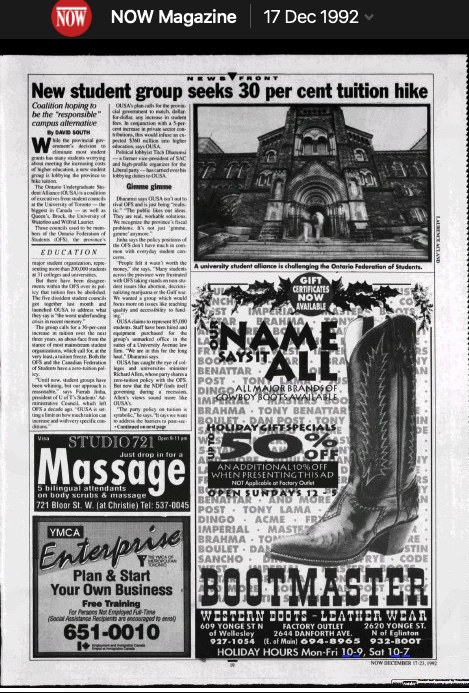
While the provincial government’s decision to eliminate most student grants has many students worrying about meeting the increasing costs of higher education, a new student group is lobbying the province to hike tuition.

The Ontario Undergraduate Student Alliance (OUSA) is a coalition of executives from student councils at the University of Toronto – the biggest in Canada – as well as Queen’s, Brock, the University of Waterloo and Wilfred Laurier.

Those councils used to be members of the Ontario Federation of Students (OFS), the province’s major student organization, representing more than 200,000 students at 31 colleges and universities.

But there have been disagreements within the OFS over its policy that tuition fees be abolished. The five dissident student councils got together last month and launched OUSA to address what they say is “the worst underfunding crisis in recent memory.”

The group calls for a 30-per-cent increase in tuition over the next three years, an about-face from the stance of most mainstream student organizations, which call for, at the very least, a tuition freeze. Both the OFS and the Canadian Federation of Students have a zero-tuition policy.

“Until now, student groups have been whining, but our approach is reasonable,” says Farrah Jinha, president of U of T’s Students’ Administrative Council, which left OFS a decade ago. “OUSA is setting a limit on how much tuition can increase and with very specific conditions.”

OUSA’s plan calls for the provincial government to match, dollar-for-dollar, any increase in student fees. In conjunction with a 5-per-cent increase in private sector contributions, this would infuse an expected $360 million into higher education, says OUSA.

Political lobbyist Titch Dharamsi – a former vice-president of SAC and high-profile organizer for the Liberal party – has carried over his lobbying duties to OUSA.

Gimme gimme

Dharamsi says OUSA isn’t out to rival OFA and is just being “realistic.” “The public likes our ideas. They are real, workable solutions. We recognize the province’s fiscal problems. It’s not just ‘gimme, gimme’ anymore.”

Jinha says the policy positions of the OFS don’t have much in common with everyday student concerns.

“People felt it wasn’t worth the money,” she says. “Many students across the province were frustrated with OFS taking stands on non-student issues like abortion, decriminalizing marijuana or the Gulf war. We wanted a group which would focus more on issues like teaching quality and accessibility to funding.”

OUSA claims to represent 85,000 students. Staff have been hired and equipment purchased for the group’s unmarked office in the suites of a University Avenue law firm. “We are in this for the long haul,” Dharamsi says.

OUSA has caught the eye of colleges and universities minister Richard Allen, whose party shares a zero-tuition policy with the OFS. But now that the NDP finds itself governing during a recession, Allen’s views sound more like OUSA’s.

“The party policy on tuition is symbolic,” he says. “It says we want to address barriers to post-secondary education.”

Student quits

One student representative on U of T’s Students’ Administrative Council, Jason Zeidenberg, resigned when SAC decided to join OUSA.

“The process hasn’t involved students,” says Zeidenberg. “It is a policy for student politicians, not students. OUSA has no constitution, no financial structure, no mechanism for individual students to bring questions forward. It is an undemocratic, fly-by-night institution.

“Until they justify their expenditures, they are under suspicion of being a front group to legitimize policies like raising tuition.”

OUSA isn’t legally obliged to incorporate itself or provide a constitution or accountable executive. The group operates much like a club, with member council executives making decisions collectively, and funds coming out of member unions’ budgets.

Joining OFS requires a student referendum, but because of OUSA’s quasi-ad-hoc status, no such vote is needed to join the new group.

Dharamsi says this approach is cost-effective and flexible. He says OUSA has spent around $10,000 to date, but can’t offer a fixed budget.

Zeidenberg hs organized several college and faculty student unions at U of T to demand that SAC hold a referendum about membership in OUSA.

Craft doesn’t feel that OUSA is a threat. “I’m not losing sleep over it,” he says. “We’re considered the representatives of students in Ontario.”

Recently, however, the University of Western Ontario pulled out of OFS and is currently negotiating with OUSA about joining. Western’s departure takes another 20,000 students and precious dollars with them, and funding cuts have led OFS to lay off staff.

This cover is by great Canadian political cartoonist and illustrator Jack Lefcourt. Always funny, Jack captures well the corporate take-over of the country’s universities and the introduction of the catastrophic debt culture that leaves so many students in a financial pickle. It was also Id’s first student issue. Id Magazine: Student Issue, “The guide to the zeitgeist”, Ontario, 1996, Features Editor: David South.

https://davidsouthconsulting.org/2021/01/26/aid-organization-gives-overseas-hungry-diet-food-diet-giant-slim-fast-gets-tax-write-off-for-donating-products/

https://davidsouthconsulting.org/2022/11/16/canadian-magazines-newspapers-1990s/

https://davidsouthconsulting.org/2021/06/01/case-study-2-watch-magazine-1994-and-1996-2/

https://davidsouthconsulting.org/2021/07/20/case-study-3-id-magazine-1996-1997-2/

https://davidsouthconsulting.org/2020/12/18/counter-accusations-split-bathurst-quay-complex-issues-of-sexual-assault-racism-at-centre-of-local-dispute/

https://davidsouthconsulting.org/2020/12/11/false-data-makes-border-screening-corruptible/

https://davidsouthconsulting.org/2020/12/10/one-world-youth-conferences-mongolia-1998-1999/

https://davidsouthconsulting.org/2022/11/11/online-free-knowledge-sharing/

https://davidsouthconsulting.org/2020/12/18/peaceniks-questioning-air-raid-strategy-in-bosnia/

https://davidsouthconsulting.org/2020/12/12/somali-killings-reveal-ugly-side-of-elite-regiment/

https://davidsouthconsulting.org/2021/02/05/study-says-jetliner-air-quality-poses-health-risks-cupe-takes-on-airline-industry-with-findings-of-survey/

https://davidsouthconsulting.org/2020/12/11/top-reporters-offer-military-media-handling-tips/

Creative Commons License

This work is licensed under a
Creative Commons Attribution-Noncommercial-No Derivative Works 3.0 License.

ORCID iD: https://orcid.org/0000-0001-5311-1052.

© David South Consulting 2023

Categories
Archive Blogroll id magazine

TV’s Moral Guide In Question – Again

By David South

Id Magazine (Canada), November 28-December 11, 1996

Television programmers are under attack once again. Thanks to Guelph activist Patricia Herdman’s Coalition for Responsible Televsion (CORT), two violent television shows – Poltergeist (CTV) and Millennium (Fox/Global) – have lost several advertisers in recent weeks due to pressure from CORT. It’s just another wave in a new assault on the immorality of television.

Positive Entertainment Alternatives for Children Everywhere (PEACE), a Montreal group founded after the murder of 14 young women in that city in 1989, staged a press conference last week, complete with sweet-faced children, to announce its “Toxic TV” list. Who is toxic? Old favourites like Bugs Bunny, Batman and Robin and The Simpsons. PEACE also produced a list of “Positive” TV shows. It included a wrist-slashing selection of insipid programming, such as Barney and Friends, Fresh Prince of Bel-Air and Kratt’s Creature.

But critics of television overlook the strong and often simplistic moral messages that infuse most programming. Some even argue the mostly Judeo-Christian morality comes at the expense of atheistic and agnostic perspectives.

University of Guelph philosophy professor Jay Newman argues that religious moralists are making television the scapegoat for all of society’s ills.

He argues television, rather than being a moral vacuum, is heavily influenced by Judeo-Christain values – often in shows many people don’t suspect.

Newman sharply criticizes religious moralists, who he says, neglect to observe the same contradictions in their own beliefs that they see in television.

In Newman’s view, religion shares many sins with television. Religion promotes passivity (“The meek shall inherit the earth”), disrupts family life (who needs to talk to that “immoral” gay brother/sister?), does a questionable job of moral education, invents celebrities (the saints), sacrifices spiritual wisdom for meaningless ritual and entertainment (the Mass), and promotes violent behaviour (who can forget the Crusades or the Spanish Inquisition?).

Leaning back in his chair at his University of Guelph office, the irascible New York-born Newman enthusiastically defends television.

“When we assess TV as bad,” he says, “I’m not convinced religion is the only moral teacher, and it has not been the best moral teacher. Religion has been a very important force of hatred, whereas Star Trek teaches us to respect other cultures.

“TV has been of great value in promoting pluralism and an increase in tolerance.”

Newman isn’t talking about gore-soaked TV like Poltergeist and Millennium, shows he says speak more about their producers than about the medium of television. “Wanton slaughter can’t be blamed on TV. But I do agree with psychologists that some television inures us to violence.”

He sees Star Trek as a moral force for both pluralism and tolerance, strong values that are essential to democracies with many ethnic, cultural and racial groups. “This show promotes tolerance towards people who appear different. It shows aliens have aspirations and desires just like us.”

Newman does take offence to one race of aliens on the popular series: the Ferengi. While the Ferengi are supposed to be the equivalent of used car dealers in Star Trek’s universe, they draw criticism from Newman for their anti-semitic undertones. But even here, says Newman, TV can’t beat the pantheon of Christain anti-semites.

As for the bumbling antics of Bart Simpson and his dad Homer, Newman says The Simpsons also contain positive morals. “The Simpsons teaches us to accept the foibles of others and empathize. It does it in a gentle way without passing a very austere judgement.”

Newman even sees hope in the dreamy world of daytime soap operas. They teach people to develop empathy. They also use negative role models to show that hatred and contempt backfire on people; that promiscuity and adultry don’t come without a cost.”

As for Seinfeld, a sitcom about a group of friends who seem to never do anything, Newman says, “I’m a New Yorker and I can’t sit through it.”

Newman, an expert on religious fanaticism and hypocrisy, has responded to religious critics of television in his new book, appropriately titled Religion vs. Television. Newman sees religious critics of television as at best hypocrites, at worst specious claimants to higher moral ground.

“[Religious leaders] make judgements to show the usefulness of their institutions in an attempt to restore the lustre of religious authority.”

Newman believes the debate surrounding violence on TV is misguided. He believes the root causes of violence should be dealt with first.

“Television is a convenient scapegoat. Its criticism parallels religious bigotry. They don’t focus on the individual, just the medium. And this is accepted by people who call themselves liberal!”

TV immoral?

But critics of TV say any decent moral messages that slip through are undermined by television’s subservience to a higher God: consumerism. For Rose Anne Dyson of Canadians Concerned About Violence in Television (C-CAVE), this corrupted morality can’t be ignored. “There is only one over-riding religion today: consumerism. Its main purveyor is TV.

“Television is a major socializer today. Parents and teachers are key to modifying that influence. But most of television is very bad and just teaches consumer-driven values. There isn’t a single children’s programme that isn’t infused with commercial values.”

Dyson believes the negative effects aren’t just psychological. “Watching too much TV is bad – it causes obesity and hyperactivity.”

Dyson’s claims were recently backed up by a new study showing unhealthy minds may lead to unhealthy bodies. A study conducted by Columbia University claimed the more that children watched TV, the fatter they got. Researcher Dr Barbara Dennison found children who watched 14 hours of television a week had diets with 35 per cent of their calories from fat. The study blamed the high representation of junk food in television ads and the fact they promoted couch potato dining. Canadian children on average watch 18 hours a week of television.

Dyson does agree with Newman’s criticism of organized religions’ spurious claims to higher ground. “Judeo-Christian religions have gotten us into a lot of trouble!”

To control this morally wayward TV, Dyson looks forward to more entertainment conglomerates self-regulating their programming. “The cornerstone of democracy is to obey rules.

“A lot of cultural studies people tend to underestimate the impact of TV – there is too much of a value-free approach.”

Id was published in Guelph, Ontario, Canada in the 1990s.

Further Reading:

Channel Regulation: Swedes Will Fight Children’s Advertising All The Way

From Special Report: NMM (New Media Markets) Spotlight On The Emergence Of Satellite Porn Channels In The UK

Undercurrents: A Cancellation At CBC TV Raises A Host Of Issues For The Future

https://davidsouthconsulting.org/2021/02/05/channel-regulation-swedes-will-fight-childrens-advertising-all-the-way/

https://davidsouthconsulting.org/2021/02/03/do-tv-porn-channels-degrade-and-humiliate/

https://davidsouthconsulting.org/2021/03/03/kommunikation-total-der-siebte-kontinent/

https://davidsouthconsulting.org/2021/12/08/new-media-markets-and-screen-finance/

https://davidsouthconsulting.org/2022/04/21/nsd-partners-in-bitter-row-over-choice-of-satellite-as-brussels-deadline-nears/

https://davidsouthconsulting.org/2021/02/01/playboy-is-not-for-sad-and-lonely-single-men/

https://davidsouthconsulting.org/2022/11/22/popular-characters-re-invent-traditional-carving/

https://davidsouthconsulting.org/2022/10/27/reality-television-teaches-business-skills-in-sudan/

https://davidsouthconsulting.org/2021/01/14/from-special-report-nmm-new-media-markets-spotlight-on-the-emergence-of-satellite-porn-channels-in-the-uk/

https://davidsouthconsulting.org/2021/02/01/uk-laws-on-satellite-porn-among-toughest-in-europe/

https://davidsouthconsulting.org/2020/12/11/undercurrents-a-cancellation-at-cbc-tv-raises-a-host-of-issues-for-the-future/

Creative Commons License

This work is licensed under a
Creative Commons Attribution-Noncommercial-No Derivative Works 3.0 License.

ORCID iD: https://orcid.org/0000-0001-5311-1052.

© David South Consulting 2023

Categories
Archive Blogroll id magazine

Land Of The Free, Home Of The Bored

Underwhelmed by Bill Clinton’s Democrats

By Nate Hendley and David South

Id Magazine (Canada), November 14 – 27, 1996

Toronto – It’s Tuesday, November 5 – American election night. A crisp autumn evening greets our search for the political philosophy buried in the US Democratic Party. Is it really the liberal heart of the United States as legend has it, or is it, as critics charge, a carbon copy of the arch-rival Republicans?

Inside the University of Toronto Women’s Club, the 80s chintz has given way to stars and stripes. A broad-mouthed woman with a bright red suit jacket and big, blonde hair greets the arrivals to the election party sponsored by Democrats Abroad, a group of expatriate American citizens living in Canada. Flags hang from the ceiling, political posters and Clinton/Gore in ’96 buttons are scattered throughout the club’s rooms. The dull cocktail party ambience contrasts with tonight’s occasion: a victory party to celebrate the rare re-election of a Democratic president. The wealthy looking and nearly all-white supporters of the Toronto chapter of Democrats Abroad – the organization boasts 600 members Canada-wide – spend the evening sipping wine and politely cheering as election results flash on three TV screens.

The tepid atmosphere is subdued in the extreme: nobody gives out war whoops, dances on tables or misbehaves as the election results trickle in. The reaction to Clinton’s win reflects a tepid Democratic campaign notable for conservative proposals, silly promises and an abandonment of the kind of liberalism the Democrats once stood for.

Conservative Clinton

Clinton’s enemies might accuse him of being a leftist, but in truth he’s been one of the most conservative Democrats to occupy the White House this century. Clinton’s less-than-liberal achievements in his first term include more crimes punishable by the death penalty, a promised additional 100,000 police on the streets, “V-Chip” technology in television sets, an intensification of the war on drugs and an abandonment of federal responsibility for welfare. Clinton’s re-election campaign featured promises to encourage school kids to wear uniforms, a vow to get even tougher on drug use by such measures as forcing teenagers to pass urine tests before issuing them driver’s licenses, and a recommitment to eliminating the US federal deficit.

The mostly monied professionals at the party are well aware of Clinton’s rightward turn since taking office in 1992, but put the president’s conservative leanings down to pragmatic politics.

“Am I disappointed in Clinton?” asks Bill Cronau, the past chair of Democrats Abroad and self-professed liberal. “Sure, but I’m not surprised that Clinton became more conservative. He is a Southerner after all.”

Arkansas-born Clinton used law and order issues “to chop GOP off,” adds Cronau, an insurance manager for Manulife, on the president’s theft of the Republican’s thunder.

The closest thing at the party to an actual living American politician is Tom Ward. Ward, with a detached air and the glow of a politician, soon attracted an audience when he entered the room. Ward twice ran unsuccessfully to become a Democratic congressman for Indiana, and agrees that overall Clinton has been “a disappointment as a liberal.”

He also agrees the president has moved far more to the right than previous Democratic presidents such as Jimmy Carter or Lyndon Johnson. Still, Ward, who has lived in East York since 1989, gives Clinton liberal kudos for his attempted passage of health care reforms. Yet Clinton’s proposed health care plan fell apart in 1994 following intense debate and criticism from the Republicans. Ward says he would try to introduce Canadian political ideas such as universal health care and stricter gun control were he to return to Indiana for a third run at Congress.

Canada or Clinton?

Joan Sumner, a psychologist originally from New York City, says she was initially impressed by Canada’s health care system, and by Clinton’s attempt at passing similar legislation in the US. But now she’s having second thoughts.

The Republicans, under Ronald Reagan and George Bush “decimated the health care system in the United States,” she says. “To run a medical practice became like running a business. It became difficult to collect from the insurance companies, who were reluctant to pay for psychiatric care.”

Sumner, who works with people who have “closed-head injuries,” has lived in Canada for 11 years. At the time she arrived, she found Canada’s health care system in good shape. “Now it’s a disaster and going from bad to worse. Truth be told, I am thinking of looking back across the border, especially with Clinton’s second term. The federal Liberals and the provincial government have no commitment to the people of Ontario.”

She complains about the extent of America’s influence on the Canadian political system.

Mike Harris, she fears, is borrowing his ideas from conservative Republican governor Christine Todd Williams in New Jersey. She would prefer Harris to look to liberals like former New York governor Mario Cuomo for inspiration. Unfortunately, Cuomo’s version of liberalism is out of fashion in both Canada and the United States these days.

While nearly everyone at the party expresses displeasure with Clinton’s turn to the right, few can explain why they supported him over his Republican challenger, Bob Dole.

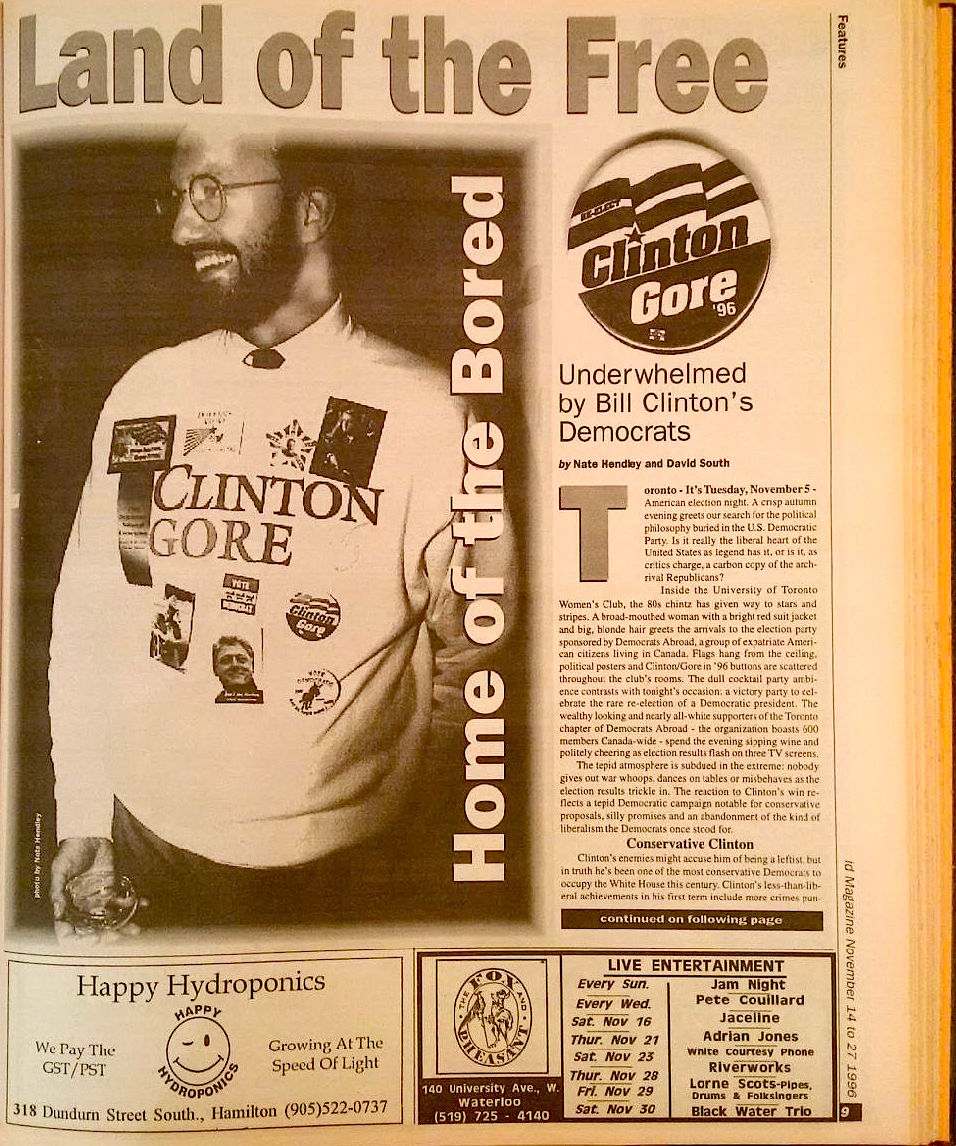
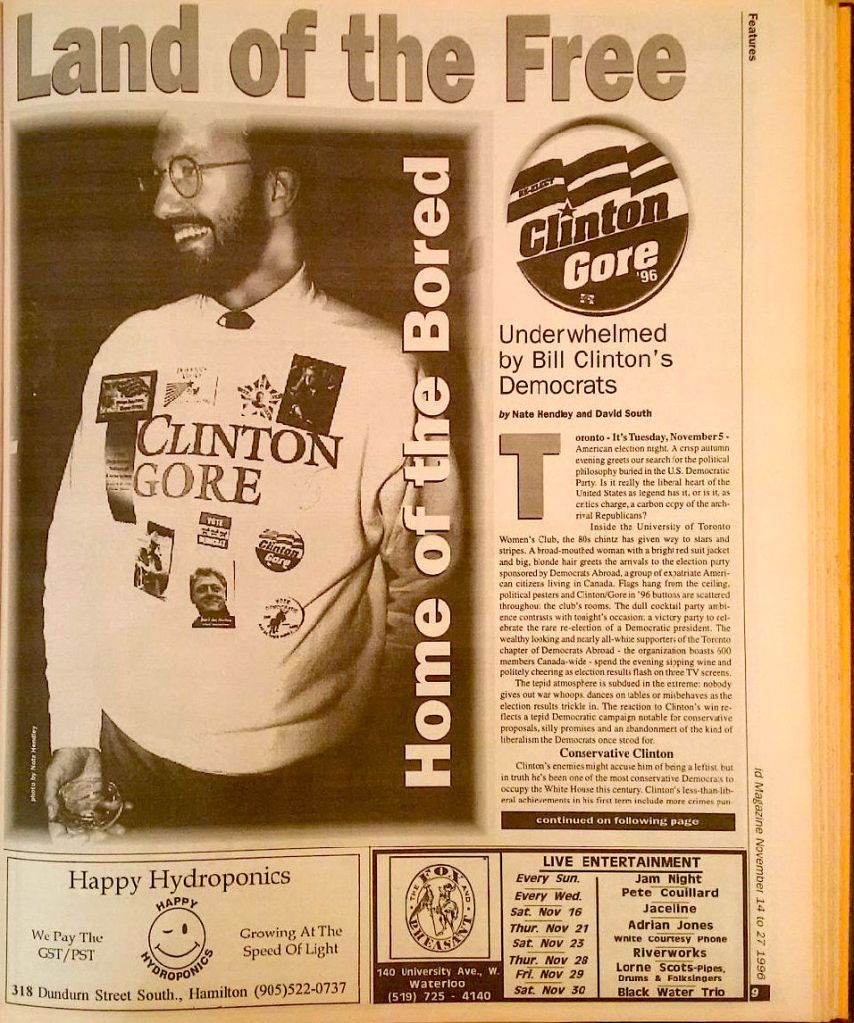
In one corner is a bearded man in a white sweatshirt littered with Clinton/Gore campaign buttons. This super-supporter is Tim Wilkins, a Toronto social worker originally from Florida. When asked what policies attracted him to support the Democrats, Wilkins becomes flustered and unable to give any specifics.

“Been with the Democrats since 1988,” says Wilkins. “I could not identify with the Republicans at all. I think Bush was a very poor selection, and when he selected Dan Quale as his running mate, I thought ‘my Lord, you’ve just blown that ticket.’ The Republicans are just too right-wing, completely out of touch with Americans. And that’s an example of what’s happening tonight. Bob Dole and (running mate) Jack Kemp are completely out of touch. They have no agenda, no economic plan.”

Clinton and Chretien

Byron Toben, a Montreal Democrat, thinks a Clinton win will cement the close personal relationship between Clinton and prime minister Jean Chretien.

“Clinton and Chretien have something of a mutual admiration society going,” says Toben, who does immigration work, helping US citizens to move to Canada. “Clinton and Chretien are both on the same wavelength.”

Anne Kerr, the Canadian-born wife of Tom Ward, also agrees. She says Clinton’s victory is important to Canada because Liberals have more in common with the Democrats than the Republicans.

True enough, both Chretien and Clinton represent parties traditionally viewed as left-of-centre. Both men ran on vaguely liberal platforms for election, and both turned sharply conservative after deciding that deficit-reduction was more important than social spending or government activism. The federal Liberals in Canada and the Democrats in the United States now support conservative agendas that aren’t too much different than the platforms of their right-wing rivals. The biggest difference between the two nations, as Ward points out, is that the United States now lacks any major left-wing party such as the New Democrats. The Greens, running as a left-wing alternative to the Democrats, with consumer crusader Ralph Nader as their candidate, pulled in slightly more than a half-million votes on November 5. That is more than other minor parties such as the Libertarians or US Taxpayers Party, but hardly enough to convince Clinton to turn sharply leftwards in his second term.

Disappointment with Clinton’s first term aside, the Democrats Abroad party briefly jolts awake towards the end of the evening when Clinton’s re-election is confirmed. Champagne corks are popped by the club’s wait staff, but nobody is in a hurry to grab a glass. The mood becomes slightly effervescent as tipsy Democrats grow more animated, only to be hit with some mind-numbing post-victory speeches by the group’s executive. After a few toasts, the moment passes and a steady stream of Democrats slips out, thankful their man had won over Bob Dole, becoming the first Democratic president to win a second consecutive term in office since Franklin Roosevelt in 1936.

Id Magazine was published in Guelph, Canada in the 1990s.

https://davidsouthconsulting.org/2021/07/20/case-study-3-id-magazine-1996-1997-2/

https://davidsouthconsulting.org/2020/06/16/casino-calamity-one-gambling-guru-thinks-the-province-is-going-too-far/

https://davidsouthconsulting.org/2021/02/07/cock-tales-too-much-for-hamilton/

https://davidsouthconsulting.org/2020/12/22/man-out-of-time-the-world-once-turned-on-the-ideas-of-this-guelph-grad-but-does-the-economist-john-kenneth-galbraith-know-the-way-forward/

https://davidsouthconsulting.org/2022/09/23/opinion-canada-is-allowing-u-s-to-dictate-haitis-renewal-more-news-and-opinion-on-what-the-un-soldiers-call-the-haitian-vacation/

https://davidsouthconsulting.org/2021/03/17/province-for-sale-step-right-up-for-an-opportunity-to-buy-what-you-already-paid-for/

https://davidsouthconsulting.org/2021/01/20/pulling-the-plug-on-hate-rock-1996/

https://davidsouthconsulting.org/2021/01/16/redneck-renaissance-a-coterie-of-journalists-turn-cracker-culture-into-a-leisure-lifestyle/

https://davidsouthconsulting.org/2021/01/14/from-special-report-sexual-dealing-todays-sex-toys-are-credit-cards-cash-a-report-on-the-sex-for-money-revolution/

https://davidsouthconsulting.org/2020/04/22/state-of-decay-haiti-turns-to-free-market-economics-and-the-un-to-save-itself/

https://davidsouthconsulting.org/2021/02/03/swing-shift-sexual-liberation-is-back-in-style/

https://davidsouthconsulting.org/2022/08/13/truckus-maximus-the-big-boys-with-the-big-toys-do-some-hardcore-pogo-at-monster-truck-show/

https://davidsouthconsulting.org/2020/12/11/tvs-moral-guide-in-question-again/

https://davidsouthconsulting.org/2021/01/26/u-s-elections-update-clinton-is-using-canada-to-keep-control-of-haiti/

https://davidsouthconsulting.org/2021/09/13/will-niagara-falls-become-the-northern-vegas/

Books by Nate Hendley: 

Al Capone: Chicago’s King of Crime, Five Rivers Chapmanry, 2010

American Gangsters, Then and Now: An Encyclopedia, ABC-CLIO, 23 Dec. 2009 

The Big Con: Great Hoaxes, Frauds, Grifts, and Swindles in American History, ABC-CLIO, 2016

Black Donnellys: The Outrageous tale of Canada’s deadiest feud, James Lorimer & Company, 2018

Bonnie and Clyde: A Biography, Greenwood Publishing Group, 2007

The Boy on the Bicycle: A Case of Wrongful Conviction in Toronto, Five Rivers Publishing, 2018

Crystal Death: North America’s Most Dangerous Drug, Five Rivers Chapmanry, 2011

Dutch Schultz: The Brazen Beer Baron of New York, Five Rivers Chapmanry, 2011

Edwin Alonzo Boyd: Life and Crimes of Canada’s Master Bank Robber, James Lorimer & Company, 2013

Motivate to Create: A Guide for Writers, Five Rivers Chapmanry, 2010

Publications by David South: 

Southern Innovator Magazine Issue 1: Mobile Phones and Information Technology 

Southern Innovator Magazine Issue 2: Youth and Entrepreneurship

Southern Innovator Magazine Issue 3: Agribusiness and Food Security

Southern Innovator Magazine Issue 4: Cities and Urbanization

Southern Innovator Magazine Issue 5: Waste and Recycling 

Creative Commons License

This work is licensed under a
Creative Commons Attribution-Noncommercial-No Derivative Works 3.0 License.

ORCID iD: https://orcid.org/0000-0001-5311-1052.

© David South Consulting 2023