

By David South
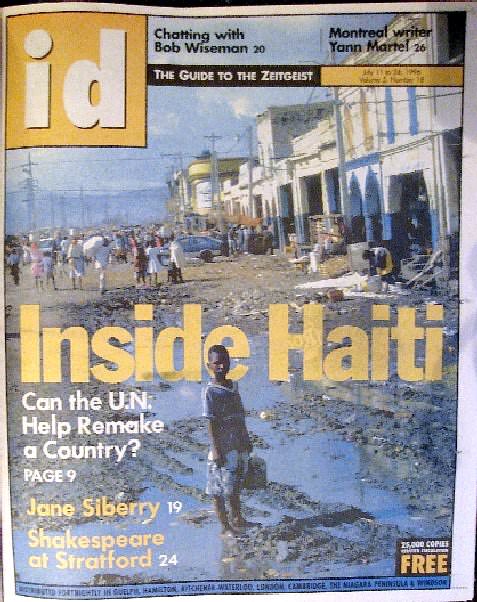
Id Magazine (Canada), May 16-29, 1996
Will Ontario become saturated with gambling? It is a question being asked more and more as the provincial government moves to allow unprecedented choice for gamblers.
Bars and hotels will soon have video one-armed bandits (known as video lottery terminals and slammed by the Addiction Research Foundation as video crack) and permanent charity casinos will be set up throughout the province.
Finance minister Ernie Eves’ budget may have brought joy to the hearts of the province’s gambling fanatics, but whether this is sound economic policy is less certain. Eves hopes to reap $60 million this year from the VLTs, or fruit machines.
Speaking to id under anonymity due to the sensitivity of his work, a private gambling consultant to the provincial government says the extended gambling could monkey-wrench the government’s on-going plans to build casinos to attract American tourists.
He says, “There is a maximum to any market area, to the number of people who will come. In Ontario, the idea was to have monopoly markets to create jobs and revenue for government. Spreading casinos out on the border areas would maximize jobs. But the introduction of VLT machines and permanent charity casinos means there will be a narrowing of the market. As soon as you set up the VLTs, there will be a permanent impact.”
He believes littering the province with casinos – both large and small – and VLTs, will be the equivalent of pissing in the wind for the government, arguing tourists will only be attracted to Ontario casinos if they consist of only a few, flashy must-see attractions based on the Las Vegas model.
Tourist temptation
The focus on tourists is key. Research has shown that gambling aimed at residents living near casinos can actually harm other local businesses like restaurants and movie theatres, as people spend more of their entertainment budgets on gambling. Add to this equation the fact that most of the profits go out of the community to Queen’s Park, and a casino can hurt local economies.
Knowing this, the government has instead focused on attracting tourists. In the case of the Windsor casino, it has worked – 80 per cent of gamblers there come from the US. The economic equation is simple: every dollar sucked in by the casino is a net gain for Canada that doesn’t hurt any other Canadian businesses (as for Detroit, that is anther story).
If the government keeps on its current course, Ontario could have 10 working government-owned casinos in the near future. By year’s end, the Windsor casino will be joined by Niagara Falls and the Rama First Nations casino near Orillia.
According to Anne Rappe of the government-owned Ontario Casino Corporation public outrage could change plans. “The government has been clear in its commitment to letting voters voice their view on casinos for other sites.”
Just a fad
Governments, like people, follow fads. The trend towards harder forms of gambling, like casinos and VLTs, as opposed to softer gambling like lotteries, represents a desperate move by local governments to hang on to tax revenues.
Even more than flashy schemes to build theme parks, art galleries and museums, casinos are seen as a sure-fire way to revive ailing communities by attracting tourists. Throughout North America, consultants and casino companies are telling government to turn to gambling if they hope to boost public treasuries and generate jobs. The pitch in these hard economic times goes down a treat with governments beseiged by voters to, on the one hand, reduce debt and deficits, and on the other be seen to be creating economic opportunity in the age of downsizing.
Casinos also serve another purpose. While taxes seem punitive, making money off of gamblers appears on the surface to be a win-win situation. The government gets the money it wants,while gamblers get the adrenaline rush they crave, and maybe some cash. The whole arrangement seems to be victimless – if you want to gamble, you pay the price.
For their part, gambling advocates envision Ontario as a Mecca for American gamblers chasing our low dollar, low crime, no tax casinos. They say we can have it both ways: a safe, low-crime Ontario in which islands of gambling fever suck in much-needed American dollars to prop up the provincial government treasury.
Gambling has been legal in Canada since 1969 (though the oldest casino is the gold rush-era Diamond Gerties in Dawson City, Yukon), but it wasn’t until the New Democrat government of Bob Rae that the idea of government-run or sanctioned permanent casinos became an option in Ontario.
The gambling consultant says the appeal of casinos is that they offer a sure-fire anchor to a local economy. He criticizes other developments like theme parks for being “too risky.” To make the most money, he says, casinos should avoid any pretensions to be slick, high-society affairs and instead go after the folks with “the family restaurant-style dress code.”
While the casino in Windsor is a lucrative success for the government – taking in a “win” of $500 million – local businesses have yet to report any of that money coming their way. Gambling experts say that isn’t about to change. With $400 million going directly to the government, and the rest covering expenses and the management fee paid to an American consortium running the casino, there will be little left for anyone else.
The Windsor casino is also drawing criticism for being a social parasite on Detroit, which supplies 80 per cent of the casino users. The influx of $1 million into Windsor means between 2,000 and 3,000 jobs are lost in Detroit, according to gambling expert William Thompson of the University of Nevada. Because of this, it is believed Detroit will soon set up a casino if voters say so.
A 1993 Coopers and Lybrand study commissioned by the government estimated Windsor’s win would be reduced by 60 per cent if Detroit were to open a casino.
That same study strangely found comfort in its findings that the average “pathological gambler” is male, under 30, non-Caucasian, unmarried and without a high school diploma.
It then goes on to say, “The typical US casino gaming patron earns thirty per cent more than the average of the US population, is between the ages of 40-64, is college educated and lives in a household of two or more members.” Just the kind of market that sends corporations into ecstasy.
Quebec example
The Quebec experience offers some valuable lessons for Ontario. Quebec’s three casinos were also looking to be a success until recently. The Quebec government and gambling advocates maintained the casinos (located in Montreal, Pointe-au-Pic and Ottawa’s sin-bin, Hull) were squeaky clean. Just like in Ontario, they remarked upon the impressive revenues – $1 million a day – and the huge influx of tourists. But closer scrutiny reveals the three casinos have not come without a cost.
Both Montreal and Pointe-au-Pic casinos have been criticized for preying on poor locals who spend the pittance out of their entertainment budgets on gambling. The casinos have also been involved in high-profile drug busts, money laundering scams and even murders committed by gambling addicts trying to extort money from relatives. At the Montreal casino, enterprising youth gangs targeted winners as they left the casino when it closed at three am. The robberies worked like this: A confidant would spot winners in the casino and then use a cellphone to tell accomplices waiting outside to mug the unsuspecting “lucky” ones still intoxicated by their good fortune.
All the rosy projections about casinos reviving the Ontario economy are based on several key assumptions: Americans will be the main users of the casinos, casinos in Ontario will not compete with each other or other sectors of the economy (restaurants, movie theatres, etc.), the social costs will be low and crime will not increase significantly, and most importantly, American casinos won’t lure away gamblers.
As for the gambling consultant, he doesn’t think the casinos slated to open later this year in Niagara Falls will drag the city down any farther. “Niagara Falls isn’t the nicest place now. The casino will finally give an economic reason to upgrade these places (hotels, motels and restaurants).”
And while the Niagara Falls casino will most certainly be popular, it will not be able to operate free of competition for long. Across the Rainbow Bridge at Niagara Falls, New York, preparations are being made to open a casino by 1997.
Windsor will also face competition from the American side. Voters in the state of Michigan will be asked to vote on whether to allow casinos at the next state elections. Several groups, including a local Indian band, have been pushing for a casino to be located in downtown Detroit. Canadian casinos must also compete with river boats from Illinois and Indiana.
The government has reached a watershed in its gambling policy, leaving it with few choices. It can either allow unfettered growth in casinos as more and more communities scramble to find any means necessary to generate jobs and tax revenues, or it can recognize there is a limit to gambling as a solution to economic woes.
As the source says, “The government is in a quandry: they like the revenue but hate the way it is raised.”
https://davidsouthconsulting.org/2021/07/20/case-study-3-id-magazine-1996-1997-2/
Citations
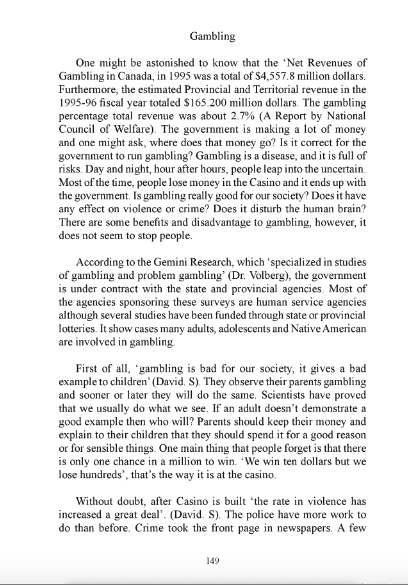
Story cited in Schizophrenia: A Patient’s Perspective by Abu Sayed Zahiduzzaman (Author House), 2013.

https://davidsouthconsulting.org/2020/11/17/land-of-the-free-home-of-the-bored/
https://davidsouthconsulting.org/2020/06/14/psychiatric-care-lacking-for-institutionalised-seniors/
https://davidsouthconsulting.org/2021/01/20/pulling-the-plug-on-hate-rock-1996/
https://davidsouthconsulting.org/2021/02/03/swing-shift-sexual-liberation-is-back-in-style/
https://davidsouthconsulting.org/2020/12/11/tvs-moral-guide-in-question-again/
https://davidsouthconsulting.org/2021/09/13/will-niagara-falls-become-the-northern-vegas/

This work is licensed under a
Creative Commons Attribution-Noncommercial-No Derivative Works 3.0 License.
ORCID iD: https://orcid.org/0000-0001-5311-1052.
© David South Consulting 2023




 David South Consulting
You must be logged in to post a comment.