Categories
Archive id magazine

Will Niagara Falls Become The Northern Vegas?

By David South

Id Magazine (Canada), May 16-29, 1996

Niagara Falls – Niagara Falls has always been a town that attracted big dreamers with even bigger schemes. The beauty of the Falls has intoxicated many with grand ideas. Towards the turn of the century, the inventor of the Gillette safety razor, King Camp Gillette, tried to transform the American side into a Utopian paradise, planning to house most of the US population in a community of beehive-style high-rises covering an area 135 miles long and 45 miles wide.

Given the long history of grand schemes to remake both sides of Niagara Falls, it is hard not to see the hyperbole surrounding the planned casnio, slated to open by the end of the year, as another over-hyped dream. Just as Gillette spoke of untold riches, the government-owned Ontario Casino Corporation also sees Utopia ready to be born at the edge of the Falls. As provincial tourism minister Doug Saunderson said last month, “The casino and tourist development will provide Niagara with a kick start into the 21st century… I believe they will move Niagara to the very top of the list of destinations for world travellers.”

Those expectations sound even more impressive if you believe the government’s estimates for job creation. In a city of 76,000, the government projects between 3,000 and 9,000 jobs will result from the casino and its spin-offs. With numbers like that, it is hard to find many people who will say no.

Everywhere in Niagara Falls’ tourist district roads are being ripped up. Tourists from New York, Japan and Quebec tread through the clouds of gravel dust to see the Falls. But it isn’t just the government which is dreaming big for Niagara Falls.

Three dreams are fighting in this town for the hearts and souls of its residents, and depending on your perspective, have their merits. One, a scheme being championed by a group of local church leaders, is to build a wholesome theme park based around the exploits of local heroine Laura Secord during the War of 1812. Another more flamboyant scheme that has been on and off again since 1993, involves building a $1.4 billion theme park dedicated to transcendental meditation. So far, the casino is winning hands down.

The casino on its own is helping to raise another dream, phoenix-like, from the ashes. In 1979, the DiCenzo family built Maple Leaf Village as a joint shopping mall/theme park attraction. Now it sits derelict, waiting for renovations by the Buttcon construction company to turn it into the temporary site for the casino.

The run-down Maple Leaf Village, with its old-world European facade resembling a castle, became known for tacky attractions like the JFK Assassination Museum, the Elvis Presley Museum and the Nightmares Therapy Centre.

Judy MacCarthy has fought plans to build a casino since they were first discussed. She helped put together a coalition of church groups called the Try Another Way Committee. MacCarthy’s dream involves a theme park extolling the virtues of Laura Secord, whose claim to fame was snitching on the American invaders, having them ambushed by Indians near Niagara Falls.

MacCarthy says the provincial government has shown some interest in the project, even sending officials from Toronto to meet with her.

As for the more ambitious transcendental meditation theme park, it looks as if the whole project hangs on securing enough funds to get it off the ground.

In 1993, Maharishi Veda Land’s chair, the effervescent magician Doug Henning, told the media that Niagara Falls had to make up its mind: choose between the transcendental theme park, with its centre-piece floating bridge, or the moral decadence of a casino.

Three years later, what many thought to be a project even less tangible than Henning’s metaphysical musings, seems to still have some life left. Tucked away on the 13th floor of a Bay Street office tower in Toronto, Maharishi Veda Land Inc. – Enlightenment, Knowledge, Entertainment – continues to run with a handful of staff. As three office workers scatter behind closed doors, a secretary tells me the theme park is still a go, but refuses to give any more details. But MVL has told a Florida newspaper it isn’t going to build a theme park on property the company owns there.

Tucked away on the 13th floor of a Bay Street office tower in Toronto, Maharishi Veda Land Inc. – Enlightenment, Knowledge, Entertainment – continues to run with a handful of staff. As three office workers scatter behind closed doors, a secretary tells me the theme park is still a go, but refuses to give any more details.

Ted Cook, the former vice-president of PCL Eastern, the construction company Henning contracted to build the park, says there was a change in attitude: “Henning’s position softened as time passed (over the casino). He became less opposed on moral grounds, and it was now ‘maybe we can make it work’.”

If there was an epicentre to the Niagara dream machine, it is the office of its mayor, Wayne Thompson.

Dean Iorfida is the mayor’s executive assistant. For Iorfida, the casino is a matter of turning a seasonal economy dependent on summer-time tourists into a viable year-round attraction. Even when they do come to Niagara Falls, he says, the average tourist’s stay is just four hours.

Iorfida is dreaming large, imagining the permanent site will include an auditorium, convention centre and amusement park. “Vegas has gone that way,” he says.

But he also wants to see the whole city transformed by the casino. “We have to spread it around or you get a black hole effect: too much in one location.”

As for the complaints that the casino will only add to the tacky reputation of Niagara Falls, Iorfida believes “the city doesn’t want anything that turns people off, but we can’t stop private enterprise. We are talking about one location, I don’t think it will be like Vegas where casinos try to out-garish each other.”

Many associated with the traditional tourist attractions in Niagara are banking on seeing some of the casino cash. Merchants on Clifton Hill, “The street of fun at the falls,” are hoping they can complement the casino rather than compete.

So far, the tourist trap, despite the shabby strip of Clifton Hill with its wax museums and fudge shops, or even the block after block of cheap hotels and motels, has been able to avoid turning into a seedier form of sleaze – it is still a family atmosphere. In fact, the declasse’ tone of the city hides an impressive stability and prosperity that makes the residents of Niagara Falls, New York jealous. For many opposed to the casino, it is this stability that is at stake.

Overhead is the dayglo pink and turquoise marquee of the Movieland Wax Museum, where one can see wax likeness’ of such luminaries as Jim Carrey. Guy Paone, the general manager of the museum, says he is happy about the casino, hoping it will bring year-round business.

“We get families down here,”he says. “If dad wants to go to the casino, then mom and the kids can come here.”

Paone isn’t expecting any business from the die-hard gamblers though. “The hard-core gamblers didn’t come here any way. You know how it is – in Vegas some people don’t eat or sleep.”

As for some of the doom and gloom about increasing crime scaring off the family tourists, Paone doesn’t buy it. “We are pretty tight on petty crime here. I don’t think the casino will affect the family reputation.”

Paone does have a sobering thought he leaves me with, “we are the suicide capital.”

All the hope has already spawned new jobs teaching the unemployed how to gamble. Frank Cricenti, black jack course co-ordinator at the National Casino Academy, joins a growing number of people employed in the lucrative business of teaching the unemployed casino skills. According to Cricenti, casino schools “are just popping up.” At government employment centres, staff are anticipating more than 100,000 applications to flood in chasing the 3,000 jobs being offered. Such a yawning chasm between expectations and reality means times are good for the adult education business.

At the 47-room Cataract Motel, the casino is an excuse to spiff the place up. “We have painted and renovated the rooms so that they look like they’re brand new,” says the motel’s manager, who will only give his name as B. John.

Other property owners are banking on the casino rescuing them from the slump. Eva Klein of Klein Developments, wants to especially unload her pricier properties. “There has been a little bit of change in the rental market, some casino people are moving into town,” Klein tells id. “We’ve had a high vacancy of higher-end rentals in Niagara Falls and we’re expecting these to be filled by a new influx from the casino.”

For Niagara Falls, the casino looks set to turn the city into a smaller, more Canadian Las Vegas. For a city desperate for more work, that doesn’t sound too bad. For the provincial government’s travelling road show, the next stop is to move the existing Windsor casino’s management over to staff the new casino at Niagara Falls.

Casino Calamity: One Gambling Guru Thinks The Province Is Going Too Far

https://davidsouthconsulting.org/2020/06/16/casino-calamity-one-gambling-guru-thinks-the-province-is-going-too-far/

CASE STUDY 3: Id Magazine | 1996 – 1997

https://davidsouthconsulting.org/2021/07/20/case-study-3-id-magazine-1996-1997-2/

A visionary ahead of his time, we now see the Channel Zero concept everywhere, from You Tube to Tik Tok.

https://davidsouthconsulting.org/2021/02/07/cock-tales-too-much-for-hamilton/

https://davidsouthconsulting.org/2020/11/17/land-of-the-free-home-of-the-bored/

https://davidsouthconsulting.org/2020/12/22/man-out-of-time-the-world-once-turned-on-the-ideas-of-this-guelph-grad-but-does-the-economist-john-kenneth-galbraith-know-the-way-forward/

https://davidsouthconsulting.org/2021/01/20/pulling-the-plug-on-hate-rock-1996/

https://davidsouthconsulting.org/2021/01/16/redneck-renaissance-a-coterie-of-journalists-turn-cracker-culture-into-a-leisure-lifestyle/

https://davidsouthconsulting.org/2021/01/14/from-special-report-sexual-dealing-todays-sex-toys-are-credit-cards-cash-a-report-on-the-sex-for-money-revolution/

https://davidsouthconsulting.org/2020/12/11/tvs-moral-guide-in-question-again/

Creative Commons License

This work is licensed under a
Creative Commons Attribution-Noncommercial-No Derivative Works 3.0 License.

ORCID iD: https://orcid.org/0000-0001-5311-1052.

© David South Consulting 2023

Categories
Archive id magazine

CASE STUDY 3: Id Magazine | 1996 – 1997

Expertise: Editing, investigative journalism, art direction, managing teams, strategy, content development.

Location: Guelph, Ontario, Canada 1996 to 1997

ISSN : 1208-4468

Features Editor: David South  

Abstract

In 1996 I was hired as Features Editor for Id Magazine, a bi-weekly alternative magazine in Guelph, Ontario, Canada. 

About 

In 1996 Id Magazine, an Ontario, Canada alternative biweekly, was expanding and needed to improve the quality of its journalism, while also making the difficult shift to being a more consistently professional offering. I was hired as Features Editor and set about swiftly assembling a team of investigative journalists. My strategy involved targeting stories overlooked by Canadian newspapers and TV news. In the 1990s, it was often the case the best journalism and the best investigative journalism in Canada could be found in the country’s alternative media. This led to a number of firsts, including an extensive investigation into Canada’s flourishing sex industry, the government’s addiction to casinos to boost revenues, unearthing a plot by neo-nazis to infiltrate Ontario high schools with hate rock, university students’ catastrophic debt culture, reporting from the streets of Port-au-Prince, Haiti on Canada’s UN mission, and probing the government’s public services privatisation plans (including being invited to debate this topic on CBC TV’s programme, Face Off). With a keen eye for new media trends, the magazine covered the fast-rising Internet economy, early experiments with digital currencies and smart cards (Mondex) (Canadian Town Tries Out Cash Cards) being carried out in Guelph, Ontario, and concerns about data privacy.

There clearly was a gap in the news marketplace Id could better fill with solid investigative journalism and features writing aimed at a younger demographic. 

How large a market gap can be confirmed by various analyses on the state of the Canadian media at the time and since. According to the book The Missing News: Filters and Blind Spots in Canada’s Press (Robert A. Hackett and Richard S. Garneau, Canadian Centre for Policy Alternatives, University of Toronto Press 2000), Canada’s media was in a mess in the 1990s resulting from declining resources, staff layoffs and media closures reducing the breadth and depth of news coverage.  

My challenge: Could I bring together a talented, young team and improve the quality and consistency of journalism for a start-up magazine seeking to grow? The proof came in the form of improved audited pick-up of the magazine by readers, the magazine’s confident push to expand on the Internet, and the fact many from that original team have gone on to not only have successful careers in the media and film, but also to be influential in their own right – proof the original belief in their talent was correct.  

Pressure on journalists to toe the line and not upset advertisers was also increasing in the context of ongoing high unemployment, a stagnant economy in a recession, and government austerity. Canadian media as whole also has a “great dependence on advertising, which accounts for more than 70% of daily newspaper revenues, about 64% of magazine revenues,” which means there is enormous pressure to only publish stories that do not upset advertisers. And monopolies exert great control over news content in Canada: “In the United States, ten companies control 43.7% of total daily newspaper circulation. By contrast, in Canada since 1996, one single company controls a comparable share of the media pie.” 

Quoting Jeffrey Simpson in the book, newspapers are “shrinking in size, personnel, ambition and, as a consequence, in their curiosity,” …. “I believe the result has been a diminution in quality.” (p64) 

Fast forward to “Today, we have a crisis in the journalism industry unprecedented in scope. A media implosion. Newspapers being reduced to digital editions, large numbers losing their jobs, circulation falling, ad revenues plunging, near monopoly ownership of big-city dailies, the old business model in a state of collapse.” (Canada’s media: A crisis that cries out for a public inquiry by Lawrence Martin, The Globe and Mail, Feb. 02, 2016). 

Brief descriptions of sample issues are below: 

Can Harris be Stopped? Cover 

My first Id Magazine cover. It was thrown together in a few days after being hired. While a work of resourcefulness under pressure, it did capture the spirit of the times as multiple demonstrations and strikes tried to bring down the much-hated Conservative government in Ontario. 

“Can the UN Help Remake a Country?” Cover 

This cover photo by Phillip Smith was taken in the market area of Port-au-Prince, Haiti. I had never seen such squalor and desperation in my life. It got worse as we visited the city’s morgue, packed to the rafters with the dead and mutilated bodies of children and adults. It was a tough assignment and one that was captured with professionalism by Phillip’s camera.  

Christmas Issue Cover 

Back in 1996, the Thatcher thirst for privatisation came to Ontario with a vengeance. In this issue, we asked if it showed a lack of imagination to just sell publicly paid for assets to wealthy investors. We offered other ownership models and I debated this topic on CBC TV’s Face Off.  

“Pulling the Plug on Hate Rock” Cover 

This excellent cover by Gareth Lind was, as far as I know, the first use of pop art on a biweekly magazine cover in Ontario at that time (I certainly hadn’t seen anyone else do it). It sold the excellent investigation into skinhead rock bands infiltrating Ontario high schools very well. It was timed for release during the North-by-Northeast music festival in Toronto, and had zero returns (as in all issues were picked up). 

Sarah Polley Cover 

A regular contributor to Id, Canadian actor and director Sarah Polley challenged the stale Canadian left with her spiky views. In this issue we tackled the decline in the quality of TV programmes and asked if it was a moral vacuum being hoovered up by consumerism.  

Student Issue Cover 

This cover is by great Canadian political cartoonist and illustrator Jack Lefcourt. Always funny, Jack captures well the corporate take-over of the country’s universities and the introduction of the catastrophic debt culture that leaves so many students in a financial pickle. It was also Id’s first student issue.  

“The Great Education Swindle: Are Reforms Destroying Your Future?”

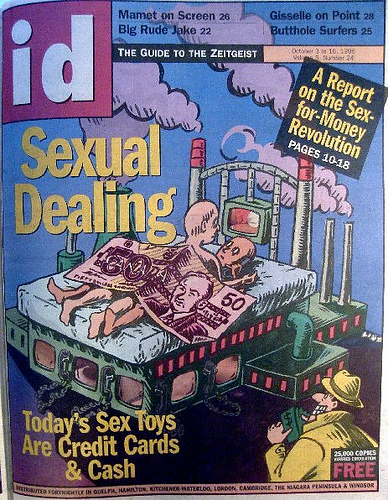
“Today’s Sex Toys are Credit Cards and Cash” Cover 

As Ontario’s economy experienced year-after-year of high unemployment and stagnant salaries, its sex economy flourished. In another first, the Id team tackled all aspects of the growth of the sex economy and changing attitudes to sexual behaviour. Beating the big papers to this story, they wrote with honesty and verve and made a refreshing break from the limp journalism of most Canadian newspapers. 

Timeline

1996: Hired as Features Editor and assembled editorial and creative team.

1997: Id Magazine begins to simultaneously publish its content online, a pioneering move at the time. 

Impact 

Micro 

  • reducing returns and boosting audited pick-ups of the free magazine – a key metric for a publication reliant on local advertising
  • assembled talented investigative team and graphic design and photo team
  • introduced pop art front covers
  • increased news coverage, especially impact of austerity in Canada
  • increased foreign coverage, including on Canada’s United Nations mission in Haiti
  • introduced high-profile contributors, including actor and director Sarah Polley
  • debated stories on other media, including CBC TV’s Face Off 

Macro

  • most of the team have gone on to very successful careers in the media
  • magazine still receives good comments on Facebook many years after its closure
  • one of the first Canadian magazines to embrace the Internet and publish simultaneously online

A sample of published stories is below:  

Casino Calamity: One Gambling Guru Thinks The Province Is Going Too Far 

Will Niagara Falls Become the Northern Vegas? 

Land of the Free, Home of the Bored 

Man Out Of Time: The World Once Turned On the Ideas of this Guelph Grad, But Does the Economist John Kenneth Galbraith Know the Way Forward? 

Porn Again: More Ways to Get Off, But Should We Regulate the Sex Industry? 

Redneck Renaissance: A Coterie of Journalists Turn Cracker Culture into a Leisure Lifestyle

Swing Shift: Sexual Liberation is Back in Style 

State of Decay: Haiti Turns to Free-market Economics and the UN to Save Itself 

TV’s Moral Guide in Question – Again 

Citations 

Political Governance of Capitalism: A Reassessment Beyond the Global Crisis by Helmut WillkeGerhard WillkeEdward Elgar, 2012

Schizophrenia: A Patient’s Perspective by Abu Sayed Zahiduzzaman, Publisher: Author House, 2013 

Other Resources 

Freedom of Expression: Introducing Investigative Journalism to Local Media in Mongolia 

Ger Magazine Issue 1 

Ger Magazine Issue 2 

In Their Own Words: Selected Writings by Journalists on Mongolia, 1997-1999 (ISBN 99929-5-043-9) 

The back issues of id magazine reside at the Bibliothèque et Archives Canada / Library and Archives Canada [has v.5(1995)-v.8(1999)] collection.

OCLC Number/Unique Identifier: 1082496695

ISSN: 1208-4476

https://davidsouthconsulting.org/2021/06/01/case-study-2-watch-magazine-1994-and-1996-2/

https://davidsouthconsulting.org/2021/05/25/ger-mongolias-first-web-magazine-and-a-pioneering-web-project-for-the-united-nations-12-january-2016/

https://davidsouthconsulting.org/2021/03/12/southern-innovator-magazine/

Creative Commons License

This work is licensed under a Creative Commons Attribution 4.0 International License.

ORCID iD: https://orcid.org/0000-0001-5311-1052.

© David South Consulting 2025

Categories
Archive Blogroll id magazine

TV’s Moral Guide In Question – Again

By David South

Id Magazine (Canada), November 28-December 11, 1996

Television programmers are under attack once again. Thanks to Guelph activist Patricia Herdman’s Coalition for Responsible Televsion (CORT), two violent television shows – Poltergeist (CTV) and Millennium (Fox/Global) – have lost several advertisers in recent weeks due to pressure from CORT. It’s just another wave in a new assault on the immorality of television.

Positive Entertainment Alternatives for Children Everywhere (PEACE), a Montreal group founded after the murder of 14 young women in that city in 1989, staged a press conference last week, complete with sweet-faced children, to announce its “Toxic TV” list. Who is toxic? Old favourites like Bugs Bunny, Batman and Robin and The Simpsons. PEACE also produced a list of “Positive” TV shows. It included a wrist-slashing selection of insipid programming, such as Barney and Friends, Fresh Prince of Bel-Air and Kratt’s Creature.

But critics of television overlook the strong and often simplistic moral messages that infuse most programming. Some even argue the mostly Judeo-Christian morality comes at the expense of atheistic and agnostic perspectives.

University of Guelph philosophy professor Jay Newman argues that religious moralists are making television the scapegoat for all of society’s ills.

He argues television, rather than being a moral vacuum, is heavily influenced by Judeo-Christain values – often in shows many people don’t suspect.

Newman sharply criticizes religious moralists, who he says, neglect to observe the same contradictions in their own beliefs that they see in television.

In Newman’s view, religion shares many sins with television. Religion promotes passivity (“The meek shall inherit the earth”), disrupts family life (who needs to talk to that “immoral” gay brother/sister?), does a questionable job of moral education, invents celebrities (the saints), sacrifices spiritual wisdom for meaningless ritual and entertainment (the Mass), and promotes violent behaviour (who can forget the Crusades or the Spanish Inquisition?).

Leaning back in his chair at his University of Guelph office, the irascible New York-born Newman enthusiastically defends television.

“When we assess TV as bad,” he says, “I’m not convinced religion is the only moral teacher, and it has not been the best moral teacher. Religion has been a very important force of hatred, whereas Star Trek teaches us to respect other cultures.

“TV has been of great value in promoting pluralism and an increase in tolerance.”

Newman isn’t talking about gore-soaked TV like Poltergeist and Millennium, shows he says speak more about their producers than about the medium of television. “Wanton slaughter can’t be blamed on TV. But I do agree with psychologists that some television inures us to violence.”

He sees Star Trek as a moral force for both pluralism and tolerance, strong values that are essential to democracies with many ethnic, cultural and racial groups. “This show promotes tolerance towards people who appear different. It shows aliens have aspirations and desires just like us.”

Newman does take offence to one race of aliens on the popular series: the Ferengi. While the Ferengi are supposed to be the equivalent of used car dealers in Star Trek’s universe, they draw criticism from Newman for their anti-semitic undertones. But even here, says Newman, TV can’t beat the pantheon of Christain anti-semites.

As for the bumbling antics of Bart Simpson and his dad Homer, Newman says The Simpsons also contain positive morals. “The Simpsons teaches us to accept the foibles of others and empathize. It does it in a gentle way without passing a very austere judgement.”

Newman even sees hope in the dreamy world of daytime soap operas. They teach people to develop empathy. They also use negative role models to show that hatred and contempt backfire on people; that promiscuity and adultry don’t come without a cost.”

As for Seinfeld, a sitcom about a group of friends who seem to never do anything, Newman says, “I’m a New Yorker and I can’t sit through it.”

Newman, an expert on religious fanaticism and hypocrisy, has responded to religious critics of television in his new book, appropriately titled Religion vs. Television. Newman sees religious critics of television as at best hypocrites, at worst specious claimants to higher moral ground.

“[Religious leaders] make judgements to show the usefulness of their institutions in an attempt to restore the lustre of religious authority.”

Newman believes the debate surrounding violence on TV is misguided. He believes the root causes of violence should be dealt with first.

“Television is a convenient scapegoat. Its criticism parallels religious bigotry. They don’t focus on the individual, just the medium. And this is accepted by people who call themselves liberal!”

TV immoral?

But critics of TV say any decent moral messages that slip through are undermined by television’s subservience to a higher God: consumerism. For Rose Anne Dyson of Canadians Concerned About Violence in Television (C-CAVE), this corrupted morality can’t be ignored. “There is only one over-riding religion today: consumerism. Its main purveyor is TV.

“Television is a major socializer today. Parents and teachers are key to modifying that influence. But most of television is very bad and just teaches consumer-driven values. There isn’t a single children’s programme that isn’t infused with commercial values.”

Dyson believes the negative effects aren’t just psychological. “Watching too much TV is bad – it causes obesity and hyperactivity.”

Dyson’s claims were recently backed up by a new study showing unhealthy minds may lead to unhealthy bodies. A study conducted by Columbia University claimed the more that children watched TV, the fatter they got. Researcher Dr Barbara Dennison found children who watched 14 hours of television a week had diets with 35 per cent of their calories from fat. The study blamed the high representation of junk food in television ads and the fact they promoted couch potato dining. Canadian children on average watch 18 hours a week of television.

Dyson does agree with Newman’s criticism of organized religions’ spurious claims to higher ground. “Judeo-Christian religions have gotten us into a lot of trouble!”

To control this morally wayward TV, Dyson looks forward to more entertainment conglomerates self-regulating their programming. “The cornerstone of democracy is to obey rules.

“A lot of cultural studies people tend to underestimate the impact of TV – there is too much of a value-free approach.”

Id was published in Guelph, Ontario, Canada in the 1990s.

Further Reading:

Channel Regulation: Swedes Will Fight Children’s Advertising All The Way

From Special Report: NMM (New Media Markets) Spotlight On The Emergence Of Satellite Porn Channels In The UK

Undercurrents: A Cancellation At CBC TV Raises A Host Of Issues For The Future

https://davidsouthconsulting.org/2021/02/05/channel-regulation-swedes-will-fight-childrens-advertising-all-the-way/

https://davidsouthconsulting.org/2021/02/03/do-tv-porn-channels-degrade-and-humiliate/

https://davidsouthconsulting.org/2021/03/03/kommunikation-total-der-siebte-kontinent/

https://davidsouthconsulting.org/2021/12/08/new-media-markets-and-screen-finance/

https://davidsouthconsulting.org/2022/04/21/nsd-partners-in-bitter-row-over-choice-of-satellite-as-brussels-deadline-nears/

https://davidsouthconsulting.org/2021/02/01/playboy-is-not-for-sad-and-lonely-single-men/

https://davidsouthconsulting.org/2022/11/22/popular-characters-re-invent-traditional-carving/

https://davidsouthconsulting.org/2022/10/27/reality-television-teaches-business-skills-in-sudan/

https://davidsouthconsulting.org/2021/01/14/from-special-report-nmm-new-media-markets-spotlight-on-the-emergence-of-satellite-porn-channels-in-the-uk/

https://davidsouthconsulting.org/2021/02/01/uk-laws-on-satellite-porn-among-toughest-in-europe/

https://davidsouthconsulting.org/2020/12/11/undercurrents-a-cancellation-at-cbc-tv-raises-a-host-of-issues-for-the-future/

Creative Commons License

This work is licensed under a
Creative Commons Attribution-Noncommercial-No Derivative Works 3.0 License.

ORCID iD: https://orcid.org/0000-0001-5311-1052.

© David South Consulting 2023

Categories
Archive Blogroll Scan Magazine

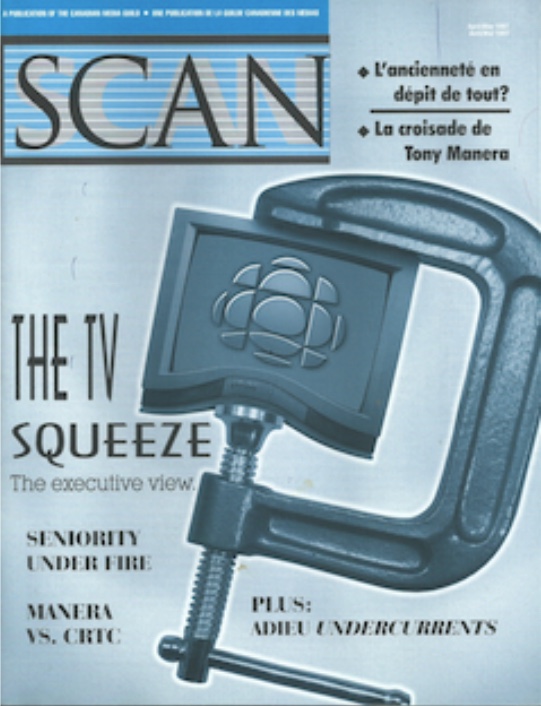
Undercurrents: A Cancellation At CBC TV Raises A Host Of Issues For The Future

By David South

Scan Magazine (Canada), April/May 1997

The screensaver on an Undercurrents researcher’s computer terminal bears a maxim that might strike a chord in a lot of CBC units these days: “Only the paranoid survive.”

The quirky media and technology show will fade to black at the end of March. Its cancellation raises a host of issues for a CBC deeply troubled by budget cuts, an ageing audience, a dearth of alternative programme concepts and an inability to plan for a future.

In the show’s pilot, Wendy Mesley – Undercurrents’ host and progenitor – set the tone for this accessible look at the relationship among technology, media and society: “Like it or not we are living in a wired world where OJ Simpson, Big Brother, even your bank machine, all converge … we’ll explore all the issues, the undercurrents of the information age.”

To those who loved it, Undercurrents was a program that satisfied a vital public need, and an ambitious concept for a public broadcaster that some say had grown a little musty. The show promised avant-garde production and investigative journalism that critically explored today’s new media and technology culture. Youngish researchers and producers were hired from outside the CBC. They brought with them experience and new ideas from specialty channels, TV Ontario and CTV. Some came straight out of journalism school.

Critical reaction to the first programs was mixed. John Doyle, a critic with the Globe and Mail’s Broadcast Week, lauded Undercurrents when it launched, calling it “a superb example of  solid CBC-TV journalism and original reporting.” Others were less flattering. The Toronto Star’s Greg Quill accused the show of “flirting with infotainment.” At the Vancouver Sun, Alex Strachan wasn’t impressed by a report on a weekend conclave of computer geeks in the California desert for a kind of Hackerstock. “It sounds interesting,” he wrote, “but it isn’t.”

What hurt more was schedulers playing musicial chairs with the show’s slot. Switching Undercurrents from Tuesday at 7 pm to Friday at 7 pm midway through its life left viewers confused and sent ratings plummeting just as network programmers were casting about for places to apply a whopping 30 percent budget cut. As a result, some feel the show never had a fighting chance.

In the end, it was the show’s precarious financial arrangement that killed it. Undercurrents was never funded from the general current affairs budget. Instead, it drew on a special reserve of cash created by the network. When it came time to mete out the cuts in December, the special funding bubble burst. Rather than cut further into the budgets of flagship current affairs programs, executives chose to drop Undercurrents.

Executive producer Frances Mary (FM) Morrison acknowledges that gratitude for her program’s special funding obscured a recognition of its fragility. “That was really our Achilles heel,” she says. “We were just this little orphan that didn’t have its own money. We weren’t adopted into the larger family.”

With the network funding gone, Undercurrents’ budget (rumoured to be over a million dollars per season) was nowhere to be found. Discussions about chasing a corporate sponsor went nowhere because the show needed more money than any sponsor could have provided. “It was never an issue of $100,000 or $200,000,” says Morrison. “It was the issue of our entire budget. [CBC] would still have had to come up with the rest of it.”

CBC TV’s news, current affairs and Newsworld director Bob Culbert and former current affairs head Norm Bolen both say they wanted the show to stay on the air but couldn’t find a way to fund it withou seriously hurting programs like The Fifth Estate, Marketplace and Venture.

Bolen, now VP of programming at the History and Entertainment Network, says it came down to choosing between The Health Show and Undercurrents. The Health Show won because it had a “bigger audience, a broader demographic and was bringing in revenue from sales of programming to the specialty channels.”

Mesley has another theory. “The majority of people who worked on this programme are not traditional CBCers… They can’t bump, they don’t get huge severance packages. Of course, if you want a future, those are the wrong reasons for letting people go.”

With its intensive focus on issues like the abuse of computer-morphed images, surreptitious “data-mining” of consumer purchase records, or media “freebies,” there’s no question that Undercurrents has met a need in this media-saturated world. But controversy over the cancellation centres on the age-old question of CBC and the youth audience.

Morrison and Mesley both say they intended the show to appeal to a younger-than-usual CBC audience. But CBC executives weren’t convinced it was an audience the network could, or should, go after. According to Culbert, a youth mandate was something the production team brought to Undercurrents. “It started as a media ethics show targeted at a classic CBC audience. Nobody sat around one day and said ‘let’s invent the show that will go after younger viewers.’”

Bolen expresses a profound lack of faith in the under-30 audience. “People under 30 don’t watch information programming, okay? Let’s get that straight. I sure wouldn’t spend the rest of my life trying to get an audience that doesn’t watch a certain genre of programming. This is a business where you pay attention to reality. People under 30 watch trashy American sitcoms, which I’m not in the business of doing, and which the CBC isn’t in the business of doing.”

“I think that’s bullshit,” says Reid Willis, producer and director of CityTV’s Media Television. “People under 30 are interested in what’s going on in the media. The 20 to 30 group is more media savvy than the generation that preceded them.” But Willis thinks the lack of information programming pitched at a young audience is down to a lack of interest from advertisers.

Mesley and Morrison remain convinced Undercurrents did appeal to a younger audience, but felt it was sabotaged by the schedule shuffling. In the show’s first slot, Tuesdays at 7 pm, its average audience was 499,000. The biggest night came on Sunday, October 22, 1995 when a repeat aired at 9:30 pm got an audience of 865,000. But Undercurrents’ debut in the 96/97 season in its new 7 pm slot on Fridays was demoralizing for the crew. Morrison reports the audience for the season opener at 438,000 and 434,000 for a strong programme the following week.

She says the numbers built as audiences found the programme’s new location, peaking at 678,000 on December 6. According to CBC audience research figures, average minute audience for the 96/97 season to February 2 stood at 518,000 viewers.

“Friday at seven was not a good place for Undercurrents,” claims Morrison. “It’s an older audience. In fact the audience for Air Farce [which followed Undercurrents at 7:30] is quite old, surprisingly old. I was actually astonished to find out how old that audience was.”

CBC audience research bears Morrison out, reporting that the 18-34 demographic for both Air Farce and Undercurrents has been identical this season – a mere 14 percent of the total audience.

Fridays at seven is also a heavily competitive slot packed with overhyped American tabloid TV shows like Entertainment Tonight, Inside Edition, Hard Copy and A Current Affair. Morrison says focus groups told her that audiences in that time period surf around looking for stories they like and then switch around with no loyalty to a particular programme.

“People build a menu. We took a leaf out of the tabloid book in terms of our presentation in order to survive in the seven o’clock environment.”

Undercurrents’ jerky camera work and flashy graphics didn’t endear itself to everyone, a fact the show’s producers recognized early on. “I can point to stories where we sabotaged ourselves with stylistic extremes,” admits Morrison.

But Mesley bristles at accusations the show was all style and no content, or a clone of Media Television. “We are the antithesis of Media Television. Obviously everyone has adopted their style from rock videos.  But they get nearly all their video as handouts. We are not saying, ‘This is hip.’ We are not saying, ‘This is the latest consumer thing you can add to your collection.’ We are saying ‘Think about this.’”

Undercurrents’producers express pride in the show’s innovations. They cite its lead role in web page design at the corporation., its efforts at promoting a more playful visual presentation, and its success in promoting an acceptance of media stories elsewhere in news and current affairs. But what seemed to enliven everyone interviewed for this story was a love of the public broadcasting ethos, where stories are told because they are important, not because advertisers say they are important. Many of the young researchers and producers at Undercurrents had done time at the privates, and appreciated the freedom and extensive resources offered by the CBC. But they felt they had come to a CBC whose values were in peril.

“It will be like C-SPAN here,” quipped an Undercurrents freelancer who has done time at the specialty channels.

Others who thrived in the upbeat atmosphere at Undercurrents say they’re not too keen to look for work elsewhere in the CBC. One such is 25-year-old researcher Bret Dawson. “It’s not a happy place,” he says.

It’s not clear what, if any, programming will replace Undercurrents. If the current trend prevails, it looks like any new programming will have to survive on a smaller budget, generate outside income and prove it can draw in viewers in short order. Under those conditions, people at Undercurrents and elsewhere wonder how long CBC’s commitment to innovative new programming  can hold out.

CBC TV’s Undercurrents host Wendy Mesley. Scan Magazine was published in the 1990s for Canadian media professionals.

In 2021 Wendy Mesley commented on the story in a Tweet.

More from Scan Magazine:

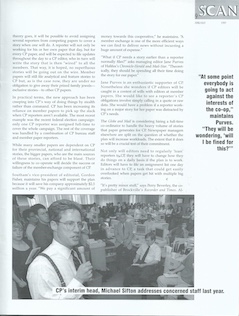
The Big Dump: CP’s New Operational Plan Leaves Critics With Questions Aplenty

https://davidsouthconsulting.org/2021/02/05/channel-regulation-swedes-will-fight-childrens-advertising-all-the-way/

https://davidsouthconsulting.org/2021/02/03/do-tv-porn-channels-degrade-and-humiliate/

https://davidsouthconsulting.org/2021/01/14/from-special-report-nmm-new-media-markets-spotlight-on-the-emergence-of-satellite-porn-channels-in-the-uk/

https://davidsouthconsulting.org/2022/04/21/nsd-partners-in-bitter-row-over-choice-of-satellite-as-brussels-deadline-nears/

https://davidsouthconsulting.org/2022/10/27/reality-television-teaches-business-skills-in-sudan/

https://davidsouthconsulting.org/2020/12/11/tvs-moral-guide-in-question-again/

https://davidsouthconsulting.org/2021/02/01/uk-laws-on-satellite-porn-among-toughest-in-europe/

Creative Commons License

This work is licensed under a
Creative Commons Attribution-Noncommercial-No Derivative Works 3.0 License.

ORCID iD: https://orcid.org/0000-0001-5311-1052.

© David South Consulting 2023