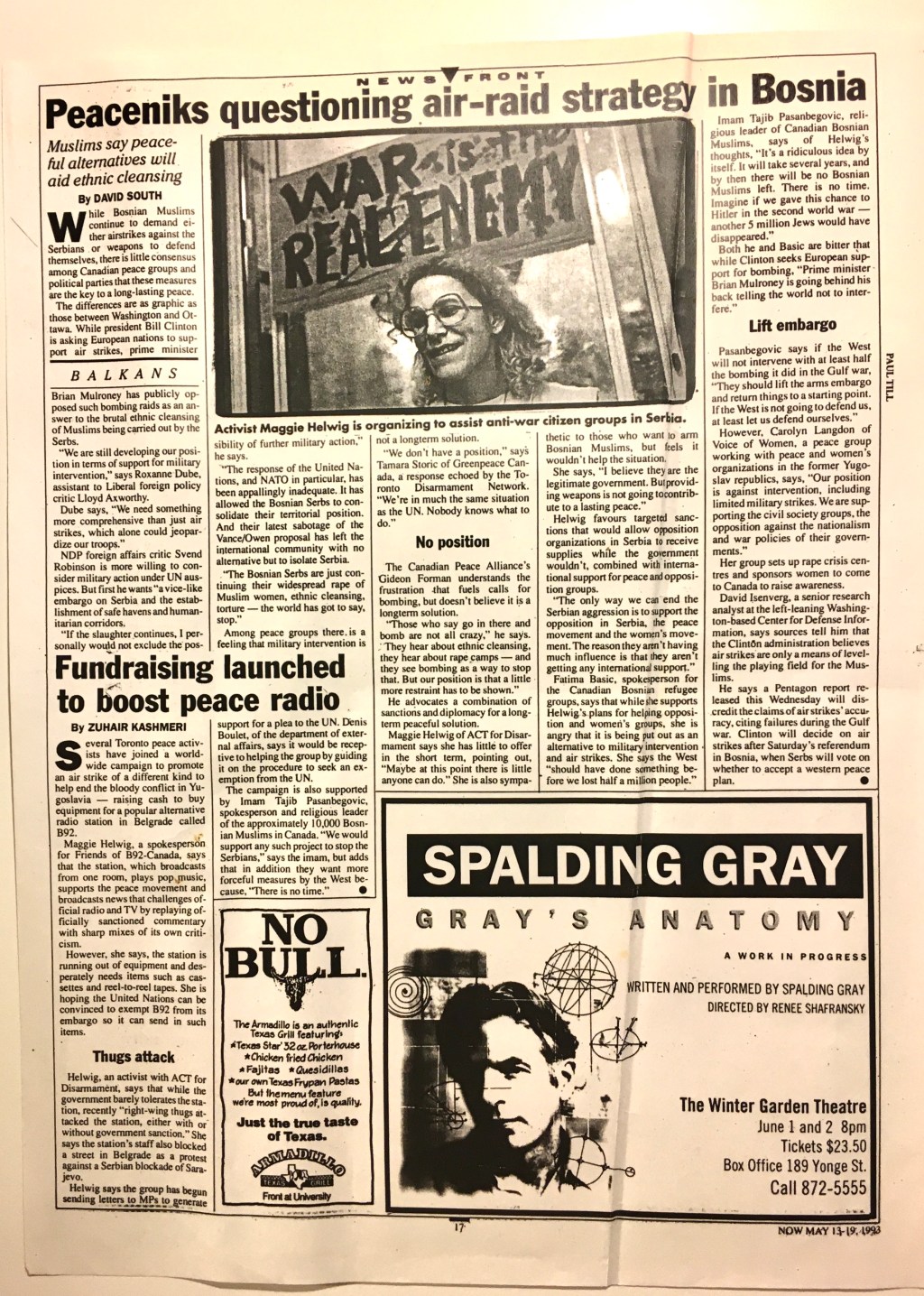
While Bosnian Muslims continue to demand either airstrikes against the Serbians or weapons to defend themselves, there is little consensus among Canadian peace groups and political parties that these measures are the key to a long-lasting peace.
The differences are as graphic as those between Washington and Ottawa. While president Bill Clinton is asking European nations to support air strikes, prime minister Brian Mulroney has publicly opposed such bombing raids as an answer to the brutal ethnic cleansing of Muslims being carried out by the Serbs.
“We are still developing our position in terms of support for military intervention,” says Roxanne Dube, assistant to Liberal foreign policy critic Lloyd Axworthy.
Dube says, “We need something more comprehensive than just airstrikes, which alone could jeopardize our troops.”
NDP foreign affairs critic Svend Robinson is more willing to consider military action under UN auspices. But first he wants “a vice-like embargo on Serbia and the establishment of safe havens and humanitarian corridors.
“If the slaughter continues, I personally would not exclude the posibility of further military action,” he says.
“The response of the United Nations, and NATO in particular, has been appallingly inadequate. It has allowed the Bosnian Serbs to consolidate their territorial position. And their latest sabotage of the Vance/Owen proposal has left the international community with no alternative but to isolate Serbia.
“The Bosnian Serbs are just continuing their widespread rape of Muslim women, ethnic cleansing, torture – the world has got to say, stop.”
Among peace groups there is a feeling that military intervention is not a longterm solution.
“We don’t have a position,” says Tamara Storic of Greenpeace Canada, a response echoed by the Toronto Disarmament Network. “We’re in much the same situation as the UN. Nobody knows what to do.”
No position
The Canadian Peace Alliance’s Gideon Forman understands the frustration that fuels calls for bombing, but doesn’t believe it is a longterm solution.
“Those who say go in there and bomb are not all crazy,” he says. “They hear about ethnic cleansing, they hear about rape camps – and they see bombing as a way to stop that. But our position is that a little more restraint has to be shown.”
He advocates a combination of sanctions and diplomacy for a longterm peaceful solution.
Maggie Helwig of ACT for Disarmament says she has little to offer in the short term, pointing out, “Maybe at this point there is little anyone can do.” She is also sympathetic to those who want to arm Bosnian Muslims, but feels it wouldn’t help the situation.
She says, “I believe they are the legitimate government. But providing weapons is not going to contribute to a lasting peace.”
Helwig favours targeted sanctions that would allow opposition organizations in Serbia to receive supplies while the government wouldn’t, combined with international support for peace and opposition groups.
“The only way we can end the Serbian aggression to to support the opposition in Serbia, the peace movement and the women’s movement. The reason they aren’t having much influence is that they aren’t getting any international support.”
Fatima Basic, spokesperson for the Canadian Bosnian refugee groups, says that while she supports Helwig’s plans for helping opposition and women’s groups, she is angry that it is being put out as an alternative to military intervention and air strikes. She says the West “should have done something before we lost half a million people.”
Imam Tajib Pasanbegovic, religious leader of Canadian Bosnian Muslims, says of Helwig’s thoughts, “It’s a ridiculous idea by itself. It will take several years, and by then there will be no Bosnian Muslims left. There is not time. Imagine if we gave this chance to Hitler in the second world war – another 5 million Jews would have disappeared.”
Both he and Basic are bitter that while Clinton seeks European support for bombing, “Prime minister Brian Mulroney is going behind his back telling the world not to interfere.”
Life embargo
Pasanbegovic says if the West will not intervene with at least half the bombing if did in the Gulf War, “They should life the arms embargo and return things to a starting point. If the West is not going to defend us, at least let us defend ourselves.”
However, Carolyn Langdon of Voice of Women, a peace group working with peace and women’s organizations in the former Yugoslav republics, says, “Our position is against intervention, including limited military strikes. We are supporting the civil society groups, the opposition against the nationalism and war policies of their governments.”
Her group sets up rape crisis centres and sponsors women to come to Canada to raise awareness.
David Isenverg, a senior research analyst at the left-leaning Washington-based Center for Defense Information, says sources tell him that the Clinton administration believes air strikes are only a means of levelling the playing field for the Muslims.
He says a Pentagon report released this Wednesday will discredit the claims of air strikes’ accuracy, citing failures during the Gulf War. Clinton will decide on air strikes after Saturday’s referendum in Bosnia, when Serbs will vote on whether to accept a Western peace plan.
HIV-tainted blood transfusions given in the early 1980s have left some seniors with AIDS, but it is feared many are unaware of their HIV-positive status.
Between 1979 and 1985 – before testing of blood products for HIV became mandatory – 266 transfusion recipients and over 677 hemophiliacs are known to have been infected in Canada, according to the Centre for AIDS Statistics.
But the final numbers are unkown – estimates range from 400 to 1,000 cases of HIV transmission among the 1.5 million Canadians given blood products during this time.
This uncertainty is fueling public concern. With such a serious public health danger, many are shocked by the confusing messages being sent by governments, the Canadian Red Cross Society and hospitals.
But it took the report of an all-party Parliamentary subcommittee on health, released at the end of May, to shock the federal government into calling for a public inquiry into the blood system. The report is highly critical of the decision-making process involved in blood collection and distribution.
“We have members of our group who are seniors,” says Jerry Freise, spokesperson for advocacy organization HIV-BT (Blood Transfusion) Group, whose wife was infected with HIV due to a blood transfusion. “And many of them went for years being misdiagnosed and treated for something other than HIV. Others have gotten sick, and one died without knowing it because nobody told him.
“A classic case is Kenneth Pittman who was infected in 1984. The Red Cross found out in 1985 and they allegedly took two years to tell The Toronto Hospital. The hospital took two years to tell his doctor, and his doctor decided not to tell anybody.
Infected
“Another couple, a lady of 59 and a man of 64, called us April 1. She found she was infected, and the reason she took a test is because her husband turned out to be HIV-positive three weeks before a transfusion in 1983. He had gone for years without a diagnosis from doctors.”
This runs counter to the Red Cross’s story.
“Whenever a blood donor tests positive for HIV antibodies, we go back and trace the prior donations,” says spokesperson Angela Prokoptak at the Society’s national office. “The Red Cross supplies blood to hospitals, so we know which units went to which hospital. But the hospital must go through their records to find who they transfused.
“After identifying the recipient, the hospital contacts the recipient’s physician, and then they have them tested. There are of course limitations.
“Since 1987, the Red Cross has been advising people who may be concerned to consult their physician for counselling and advice.”
But subcommitte member Chris Axworthy, an NDP MP, found that hospitals and the Red Cross hesitated to notify former patients for fear of lawsuits. He says the federal government should show some leadership and stop passing the buck to other agencies and departments.
Only two hospitals in Ontario – Toronto’s Hospital for Sick Children and Princess Margaret Hospital – have tried systematically to contact former patients.
Ontario health ministry spokesperson Layne Verbeek says it is a laborious and costly task for hospitals to notify former patients. “We’ve always informed people if they are thought to be at risk, but many hospitals aren’t in the position to trace. If people are at risk or have doubts, they should be tested.”
Verbeek says recent media coverage has caused an increase in the number of people seeking HIV blood tests – requests for the test doubled after the Sick Kids hospital went public. The provincial government’s lab went from 700 tests per day to 1,300, but Verbeek says that has started to taper off.
The ministry of health is happy with the number of people coming forward to be tested, says Verbeek.
But Friese says the different players are more concerned about lawsuits than informing the public. He is especially upset at the Red Cross for not taking a leadership role in disseminating information.
“The Red Cross and the medical system have failed miserably to contact people. Even today they are reticent to tell people they were part of a risk group and should get treated.” Friese feels the various governments and the Red Cross are leaving the job of informing the public to his group and the Canadian Hemophiliacs Society.
Beat the drums
“It’s my job to beat the drums for the media while I’m dealing with my wife being infected? That’s my job, when these are the ministers of health?”, Friese says with anger.
The effect of AIDS on seniors isn’t new to US-based National Institute on Aging researcher Marcia Ory. She and colleagues helped sound the alarm back in 1989 with the book “AIDS In An Aging Society: What We Need To Know.” In the US, over 10 per cent of AIDS cases have occurred in people over 50.
“Surprisingly, people have ignored older people and the AIDS issue,” says Ory. “You had older people in hospitals who might have complained about fatigue which was thought to be age-related. Older people aren’t as likely to be diagnosed as early because of the assumption that they are not at risk from AIDS.
“We don’t want older people in general to be overly fearful, but we want them to acknowledge the possibility, and to engage in good preventative practices if they are at risk.”
Ron deBurger, director of AIDS prevention for the Canadian Public Health Association, would like assurances that the security of the blood supply has improved.
“The subcommittee came to the right conclusion asking for a public inquiry,” says deBurger. “I would hope the terms of reference are broad enough to take a look at the whole issue of the safety of the blood supply, not only in terms of what happened in the past, but, more importantly, what’s happening today.”
Other than hemophiliacs, who require large quantities of blood, deBurger believes anybody who received one transfusion has a small risk. “If you had blood once, I think the odds are pretty long that you are going to end up with tainted blood. But AIDS does take eight to 10 years to manifest itself, and we might still be picking up pieces for the next four to five years that we don’t know about yet.”
Friese recommends that anybody who received blood or blood products between 1979 and 1985 get an HIV test. If their doctor says it isn’t necessary, they should call the AIDS Hotline about anonymous testing.
Anybody who has tested positive for HIV and would like support and counselling can call Robert St-Pierre of the Canadian Hemophilia Society at 1-800-668-2686.
For information on anonymous testing call the Ontario government’s AIDS Hotline in Toronto at 416-392-2437. For support write HIV-BT Group, 257 Eglinton Avenue W., Suite 206, Toronto, Ont., M4R 1B1.
Read more of David South’s 1990s health and medical journalism here:
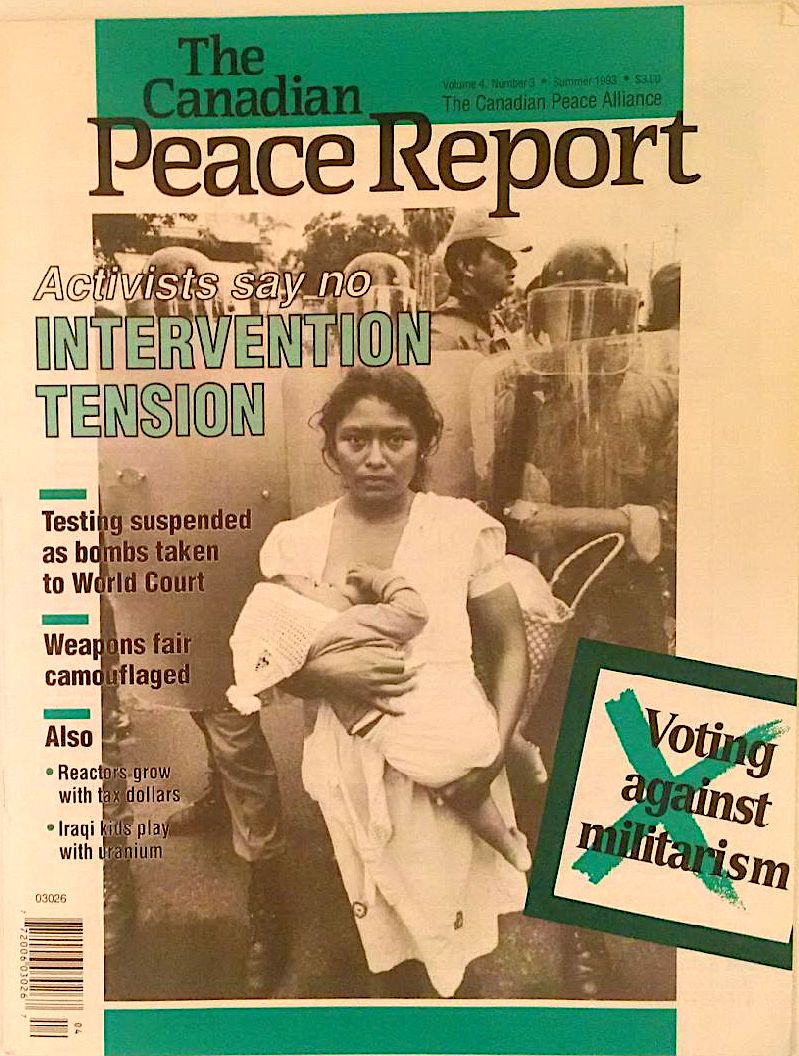
A cornerstone of the Conservative government since 1984 has been the Free Trade Agreement (FTA) between the United States and Canada, soon to be followed by a North American version (NAFTA), which adds Mexico.
Peace researchers differ over how much the deals could further militarize Canada’s economy.
“The Canadian government can invest in any military-related pursuit without fearing the U.S. or Mexico will say it is an unfair subsidy,” Kaye says.
Under the Canada-US deal, articles 907, 1308 and 2003 immunize trade that fosters “national security” from charges of unfair subsidies. A free trade tribunal could deem subsidies to farmers or toilet-seat manufacturers as unfair competition – but not subsidies to weapons manufacturers. Articles 1018 and 2102 of NAFTA maintain the exemptions.
CPA membership coordinator Gary Kaye argues that FTA, and NAFTA even more so, bind Canadian governments at all levels to military regional development. The United States has relied on investment in military industries as a regional development tool more than any other Western country, he says.
“The Canadian government can invest in any military-related pursuit without fearing the U.S. or Mexico will say it is an unfair subsidy,” Kaye says.
Ken Epps, a researcher with Project Ploughshares in Waterloo, Ont., agrees one reason the government insists on buying $5.8 billion helicopters in the face of overwhelming public opposition is that it’s a regional development program protected under the FTA.
“Any other [subsidy] program of that size could well be protested by the Americans. The whole thing has been set up with new plants being built in different parts of Canada to build parts for the helicopters.”
But Epps disagrees that the trade agreements will integrate Canada much further into the U.S. war machine. De facto free trade in arms has existed since Canada and the U.S. signed the Defence Production Sharing Agreement in 1959, he points out, following the scrapping of Canada’s Avro Arrow jet plane. There-after Canada specialized in making military components rather than complete systems.
Epps and others say Ottawa’s high-tech hardware binge – including the 50 high-ticket EH-101 helicopters – and the Canadian military industries’ desire to sell to booming Pacific Rim and Middle East markets would exist even without the trade agreements. Epps sees the U.S. favouring its own defence industry at the expense of Canadian suppliers, which will increase Canadian businesses’ desire for foreign sales.
Retired U.S. admiral Eugene Carroll, director of the Washington-based Center for Defense Information, says every nation is interested in boosting its own national prestige throught the military, and Western industrialized countries are looking to sustain exports by selling weapons to the Third World.
“That’s just plain old profit-driven commercial activity,” says Carroll. “I don’t think trade agreements extend control onto military-related activities.”
Kaye, however, stresses that NAFTA will ensure the bilaterial agreements between Canada and the United States on military trade will continue untouched. “Under those agreements, we are committed to balance military imports and exports with the United States. 1992 figures show a $4-billion deficit; therefore we will be buying much more in the way of arms than anyone could imagine would be needed for Canada’s direct security.”
Many peace groups are worried about the implications.
“NAFTA reveals an agenda for the military and the transnational corporations that binds the Canadian economy more to the U.S. military machine,” Marion Frank wrote for the Peace Alliance in Action Canada Network’s Action Dossier (Dec. 1992), drawing on a position reached by the CPA Steering Committee last fall.
“Under NAFTA, as under FTA, the only areas where government subsidies are allowed are in the military and energy sectors … Wide-ranging expansion of ‘intellectual property rights’ in NAFTA increases monopoly product protection for the transnationals here in Canada, and aids in the privatization of high-tech capacity, all of which ties us more closely to the U.S. military-industrial complex …
“In the U.S., trade strategy is linked to security strategy,” Frank adds, “The military tells U.S. industry what equipment to plan for and buy in order to meet U.S. strategic objectives. As we become more integrated into the North American [trading] bloc, our ability to develop our own strategies will disappear.”
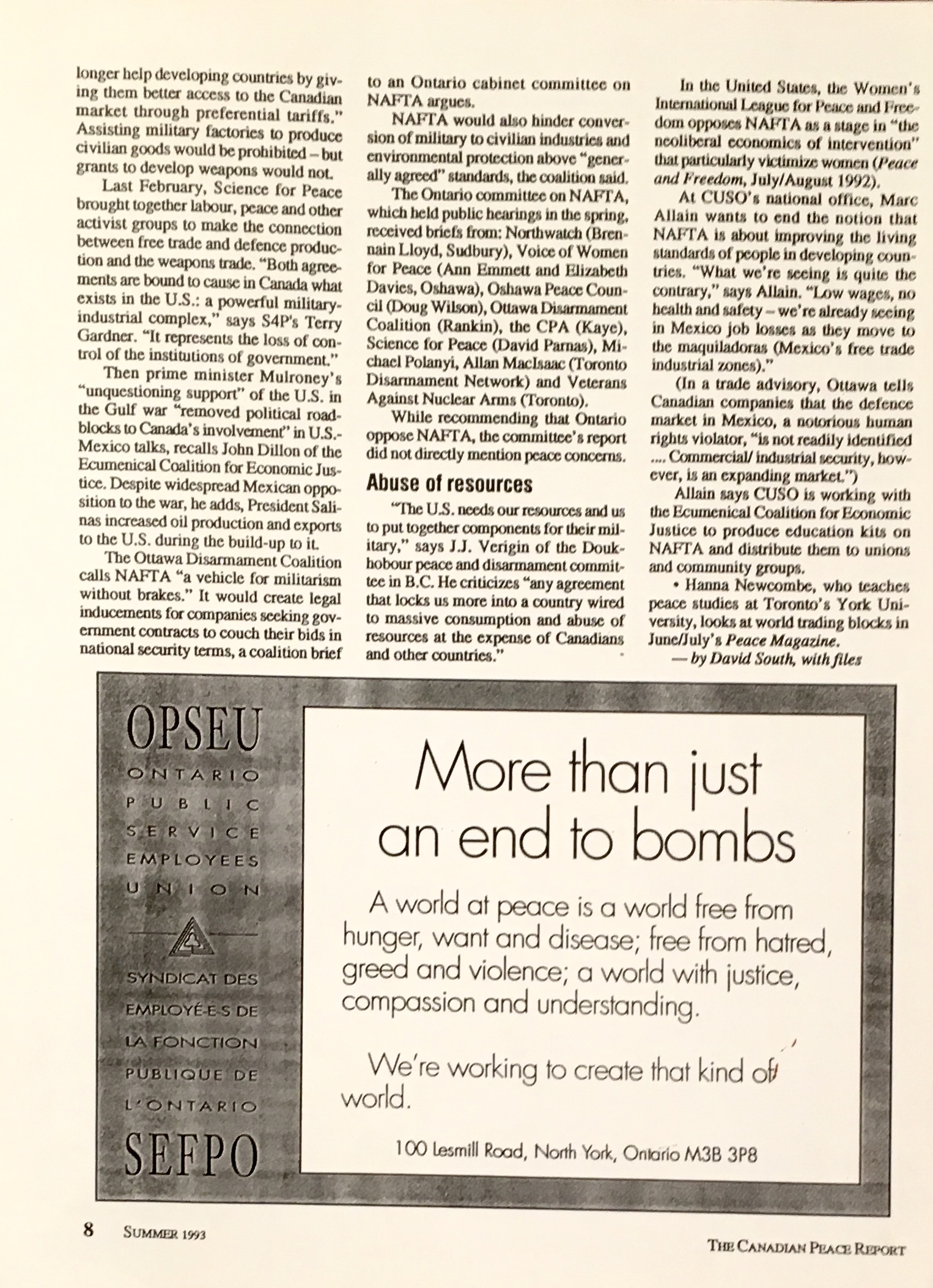
Recommendations from the Peace Alliance-facilitated Citizens’ Inquiry into Peace and Security would be difficult to implement under NAFTA, contends Darrell Rankin of the Ottawa Disarmament Coalition. “Canada could no longer help developing countries by giving them better access to the Canadian market through preferrential tariffs.” Assisting military factories to produce civilian goods would be prohibited – but grants to develop weapons would not.
Last February, Science for Peace brought together labour, peace and other activist groups to make the connection between free trade and defence production and the weapons trade. “Both agreements are bound to cause in Canada what exists in the U.S.: a poweful military-industrial complex,” says S4P’s Terry Gardner. “It represents the loss of control of the institutions of government.”
Then prime minister Mulroney’s “unquestioning support” of the U.S. in the Gulf War “removed political roadblocks to Canada’s involvement” in U.S.-Mexico talks, recalls John Dillon of the Ecumenical Coalition for Economic Justice. Despite widespread Mexican opposition to the war, he adds, President Salinas increased oil production and exports to the U.S. during the build-up to it.
The Ottawa Disarmament Coalition calls NAFTA “a vehicle for militarism without brakes.” It would create legal inducements for companies seeking government contracts to couch their bids in national security terms, a coalition brief to an Ontario cabinet committee on NAFTA argues.
NAFTA would also hinder conversion of military to civilian industries and environmental protection above “generally agreed” standards, the coalition said.
The Ontario committee on NAFTA, which held public hearings in the spring, received briefs from: Northwatch (Brennain Lloyd, Sudbury), Voice of Women for Peace (Ann Emmett and Elizabeth Davies, Oshawa), Oshawa Peace Council (Doug Wilson), Ottawa Disarmament Coalition (Rankin), the CPA (Kaye), Science for Peace (David Parnas), Michael Polanyi, Allan MacIssac (Toronto Disarmament Network) and Veterans Against Nuclear Arms (Toronto).
While recommending that Ontario oppose NAFTA, the committee’s report did not directly mention peace concerns.
“The U.S. needs our resources and us to put together components for their military,” says J.J. Verigin of the Doukhobour peace and disarmament committee in B.C.
Abuse of resources
“The U.S. needs our resources and us to put together components for their military,” says J.J. Verigin of the Doukhobour peace and disarmament committee in B.C. He criticises “any agreement that locks us more into a country wired to massive consumption and abuse of resources at the expense of Canadians and other countries.”
In the United States, the Women’s International League for Peace and Freedom opposes NAFTA as a stage in “the neoliberal economics of intervention” that particularly victimize women (Peace and Freedom, July/August 1992).
At CUSO’s national office, Marc Allain wants to end the notion that NAFTA is about improving the living standards of people in developing countries. “What we’re seeing is quite the contrary,” says Allain. “Low wages, no health and safety – we’re already seeing in Mexico job losses as they move to the maquiladoras (Mexico’s free trade industrial zones).”
(In a trade advisory, Ottawa tells Canadian companies that the defence market in Mexico, a notorious human rights violator, “is not readily identified … Commercial/industrial security, however, is an expanding market.”)
Allain says CUSO is working with the Ecumenical Coalition for Economic Justice to produce education kits on NAFTA and distribute them to unions and community groups.
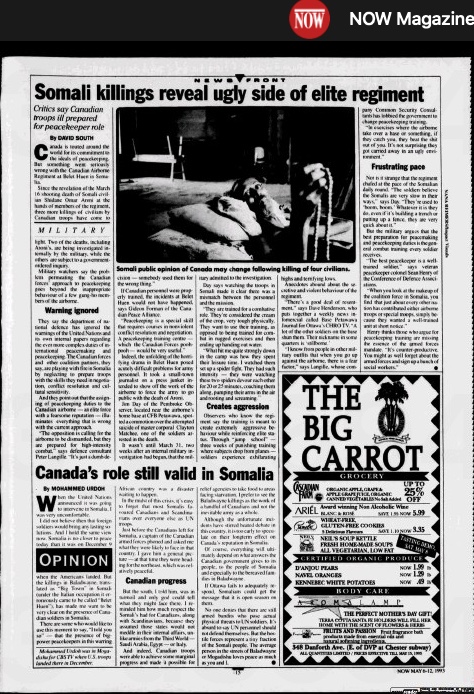
Canada is touted around the world for its commitment to the ideals of peacekeeping. But something went seriously wrong with the Canadian Airborne Regiment at Belet Huen in Somalia.
Since the revelation of the March 16 shooting death of Somali civilian Shidane Omar Aroni at the hands of members of the regiment, three more killings of civilians by Canadian troops have come to light. Two of the deaths, including Aroni’s, are being investigated internally by the military, while others are subject to a government-ordered inquiry.
Military watchers say the problem permeating the Canadian Armed Forces’ approach to peacekeeping goes beyond the inappropriate behaviour of a few gung-ho members of the airborne.
Warning ignored
They say the department of national defence has ignored the warnings of the United Nations and its own internal papers regarding the ever more complex duties of international peacemaking and peacekeeping. The Canadian forces and other coaltion partners, they say, are playing with fire in Somalia by neglecting to prepare troops with the skills they need in negotiation, conflict resolution and cultural sensitivity.
And they point out that the assigning of peacekeeping duties to the Canadian airborne – an elite force with a fearsome reputation – illuminates everything that is wrong with the current approach.
“The opposition is calling for the airborne to be dismantled, but they are prepared for high-intensity combat,” says defence consultant Peter Langille. “It’s just a dumb decision – somebody used them for the wrong thing.”
“The opposition is calling for the airborne to be dismantled, but they are prepared for high-intensity combat,” says defence consultant Peter Langille. “It’s just a dumb decision – somebody used them for the wrong thing.”
If Canadian personnel were properly trained, the incidents at Belet Huen would not have happened, says Gideon Forman of the Canadian Peace Alliance.
“Peacekeeping is a special skill that requires courses in non-violent conflict resolution and negotiation. A peacekeeping training centre – which the Canadian Forces pooh-pooh – would be very useful.”
Indeed, the unfolding of the horrifying drama in Belet Huen posed acutely difficult problems for army personnel. It took a small-town journalist on a press junket intended to show off the work of the airborne to force the army to go public with the death of Aroni.
Jim Day of the Pembroke Observer, located near the airborne’s home base at CFB Petawawa, spotted a commotion over the attempted suicide of master corporal Clayton Matchee, one of the soldiers arrested in the death.
It wasn’t until March 31, two weeks after an internal military investigation had begun, that the military admitted to the investigation.
Day says watching the troops in Somalia made it clear there was a mismatch between the personnel and the mission.
“They are trained for a combative role. They’re considered the cream of the crop, very tough physically. They want to use their training, as opposed to being trained for combat in rugged exercises and then ending up handing out water.
“What hit me quite strongly down in the camp was how they spent their leisure time. I watched them set up a spider fight. They had such intensity – they were watching these two spiders devour each other for 20 or 25 minutes, coaching them along, pumping their arms in the air and rooting and screaming.”
Creates aggression
Observers who know the regiment say the training is meant to create extremely aggressive behaviour while reinforcing elite status. Through “jump school” – three weeks of punishing training where subjects drop from planes – soldiers experience exhilarating highs and terrifying lows.
Anecdotes abound about the secretive and violent behaviour of the regiment.
“There’s a good deal of resentment,” says Dave Henderson, who puts together a weekly news infomercial called Base Petawawa Journal for Ottawa’s CHRO TV. “A lot of the other soldiers on the base shun them. Their nickname in some quarters is ‘stillborne.’
“I know from people in other military outfits that when you go up against the airborne, there is a fear factor,” says Langille, whose company Common Security Consultants, has lobbied the government to change peacekeeping training.
“In exercises where the airborne take over a base or something, if they catch you, they bet the shit out of you. It’s not surprising they got carried away in an ugly environment.”
Frustrating pace
Nor is it strange that the regiment chafed at the pace of the Somalian daily round. “The soldiers believe the Somalis are very slow in their ways,” says Day. “They’re used to ‘boom, boom.’ Whatever it is they do, even if it’s building a trench or putting up a fence, they are very quick about it.”
But the military argues that the best preparation for peacemaking and peacekeeping duties is the general combat training every soldier receives.
“The best peacekeeper is a well-trained soldier,” says veteran peacekeeper colonel Sean Henry of the Conference of Defence Associations.
“When you look at the make-up of the coalition force in Somalia, you find that just about every other nation has contributed either airborne troops or special troops, simply because they wanted a well-trained unit at short notice.”
“When you look at the make-up of the coalition force in Somalia, you find that just about every other nation has contributed either airborne troops or special troops, simply because they wanted a well-trained unit at short notice.”
Henry thinks those who argue for peacekeeping training are missing the essence of the armed forces’ mandate. “It’s counter-productive. You might as well forget about the armed forces and sign up a bunch of social workers.”
Does the UN know what it’s doing?
Now Magazine (Toronto, Canada), July 22-28, 1993. This incident was the basis of the 2001 film Black Hawk Down.
The United Nations’ bloody hunt for elusive Mogadishu warlord general Mohamed Farah Aideed has many observers wondering whether the world body is making up the rules as it goes along.
Some critics, such as George Cram of the Canadian Council for International Cooperation, an influential umbrella group for Canadian non-governmental organizations of NGOs, question if the obsession with Aideed isn’t just burying the UN in a deeper image problem with the Third World.
Critics point to the fallout of growing resentment from the July 12 attack on Aideed’s compound – killing more than 70 civilians – boding ill for a peaceful reconstruction of Somali society.
The fact that among those killed within the compound were clan elders who were negotiating a peace has upset Somalis even more, says Cram, a Horn of Africa researcher.
“The UN has lost its credibility, its moral authority, lost its blue-beret neutrality,” says Cram bluntly.
The degree to which Aideed should be the main focus of current UN actions has some relief agencies scratching their heads. Aideed has become Somalian bogey man number one with UNOSOM’s (United Nations Operations in Somalia) head, US Admiral Johnathon Howe. He has placed a $25,000 price on Aideed for an arrest.
“I don’t recall the UN ever going out and actually attempting to arrest individuals – they certainly haven’t done it in other conflict zones,” says reverend David Hardy of Saskatoon-based Lutheran Relief, who has organized relief flights into Somalia.
Cambodian example
He cites the example of Cambodia, where the UN brokered a controversial peace with those purveyors of the genocidal killing fields, the Khmer Rouge, in order to secure free elections.
David Isenverg of the Center for Defense Information, a liberal Washington-based think tank, worries that doggedly going after Aideed while ignoring the other factions will paint the UN as siding with one faction over another.
“The protracted effect is to turn the US and UN into partisans to the conflict.”
Hardy believes Aideed, who is adept at seeing which way the wind blows, has inflated his stature as an opponent of the UN as foreign invader.
Then there are other criticisms. Some observers wonder whether the UN is too proud or too blind, or simple oblivious when it comes to seeking advice from the locals it went in to protect.
Even Canada, while supporting the UN’s military effort since Aideed “is obstructing relief supplies,” believes that national reconciliation should be a main focus, says external affairs spokesperson Rodney Moore.
He says Canada continues to urge the UN to move quickly on national reconciliation, bringing together women’s groups, clan elders and other non-warlord groups.
“One of the areas where the UN operation went wrong is the tendency to deal with the ‘superpowers’ of Somalia while ignoring groups like women’s collectives,” says World Visions’ Philip Maher, who has just returned from Somalia.
“Part of the problem is misunderstanding,” Maher says. “The UN hasn’t done a great job of telling Somalis what they are doing.”
Many point to the peaceful north, where the as yet internationally unrecognized Somaliland offers a successful model, combining women’s groups and elders to wrest control.











 David South Consulting
You must be logged in to post a comment.