Categories
Archive Blogroll Today's Seniors

Health Care On The Cutting Block: Ministry Hopes For Efficiency With Search And Destroy Tactics

By David South

Today’s Seniors (Canada), August 1993

It’s search and destroy time at Ontario’s ministry of health: search out savings and destroy inefficiency and waste. But many remain apprehensive that not all the cuts are going to be logical and fear the province’s health and well-being will be affected. 

As part of the social contract deal, the Ontario Medical Association must find $20 million in cuts from the list of services covered by OHIP. The OMA and the provincial government are currently haggling over which procedures and examinations will be cut. 

“We look at services that aren’t medically necessary,” says health ministry spokesperson Layne Verbeek. “Because we were wealthier in the past, we were able to cover some services. We aren’t in that position now. But I don’t see how eliminating medically unnecessary treatments will affect the population.”

The fallout of the Rae government’s attempts to reign in costs and recover lost revenues may take years to unfold, but it is already apparent that Ontarians will be paying more. 

“Access to necessary treatment should not depend on a person’s ability to pay,” says health policy critic Carol Kushner. “What disturbs me about any delisting program is that virtually every medical service could be termed medially necessary. There are very few services that are an out-and-out waste of time.

“We often point to the fact that Ontario spends $200 million a year treating the common cold. Well, most of that is a waste of time. But delisting even that kind of service would be a detriment to the public’s health, because a small group of patients really do need to see a doctor when they have a cold.”

OMA spokesperson Jean Chow says it’s too early to pin down the exact cuts that will be made. “It’s a little premature to try and speculate what the final list will be.”

The newly-created Non-Tax Revenue Group is hard at work finding fees, fines and penalities the government can add or hike to boost revenue from this source from $5 billion to $10 billion a year. 

The spring budget saw the first hit, with the addition of $240 million in non-tax revenue. 

A radical reshaping of medicare is taking place. Private sector services – for which consumers pay directly or through insurance companies – now make up 34 per cent of Ontario’s health care funding, compared to 42 per cent in the United States, according to a recent study by the Canadian Medical Association. 

Health minister Ruth Grier has also floated the idea of widespread hospital closures. Both the Toronto and Windsor district health councils (DHCs) are carrying out feasibility studies on “reconfiguration.” The ministry is remaining tight-lipped about which hospitals will get the chop. 

“One suspects there’s room for efficiency – there are a lot of empty beds in a number of different places,” says ministry spokesperson Verbeek. 

“All hospitals are being reviewed, with a view to closing one or two hospitals,” says health planner Lisa Paolatto, who is working on a feasibility study on “reconfiguration” for the Essex County District Health Council, along with Toronto’s DHC. 

Closing hospitals could present a serious political hot potato for the government. In Britain, the Conservative government is still recovering from the bad feelings surrounding proposals to close world-renowned hospitals in the London area. The public feels great loyalty to local hospitals, a feeling that has been further fostered by hospital charities that raise millions a year from the communities’ good will. 

“This is going to open up new discussions of money between doctors and patients,” says Kushner. “Seniors are a unique group in Canada because they remember what it was like before medicare – what it was like not to be able to pay for the doctor, to forgo treatment that they thought was necessary. They understand the financial hardship that could occur if they were unlucky enough to have a family member who needs expensive medical treatment.” 

All Posts

More from Canada’s Today’s Seniors

Feds Call For AIDS, Blood System Inquiry: Some Seniors Infected

Government Urged To Limit Free Drugs For Seniors

Health Care On The Cutting Block: Ministry Hopes For Efficiency With Search And Destroy Tactics

New Seniors’ Group Boosts ‘Grey Power’: Grey Panthers Chapter Opens With A Canadian Touch

Seniors Falling Through The Health Care Cost Cracks

ORCID iD: https://orcid.org/0000-0001-5311-1052.

© David South Consulting 2021

Categories
Archive Blogroll Now Magazine

US Health Care Businesses Chasing Profits Into Canada

Some fear corporate health care will kill equality of treatment

By David South

Now Magazine (Toronto, Canada), April 8-14, 1993

American-style private health care is slipping across the Canadian border under the noses of three provincial NDP governments, say researchers representing an association of health care workers.

Jackie Henwood and Colleen Fuller of the 7,500-member Health Sciences Association of British Columbia charge in a recent report that a combination of free trade and tightfisted government spending is undermining the universality of medicare and ushering in the beginnings of a two-tier system.

While the health care industry created more jobs than any other sector of the economy between 1984 and 1991, they point out, things have changed dramatically since the Canada-US free trade agreement came into effect in 1989. Now much of this growth is clustering in the private sector.

And they expect that this trend will continue under the forthcoming North American free trade agreement.

“NAFTA will accelerate trends towards a privatized, nonunion and corporate dominated system of health care in Canada,” says the report.

Binding provisions

Chapter 14 of the Canada-US free trade agreement opened competition for health-care facilities management services to US companies. Certain NAFTA provisions will bind all levels of government to consider for-profit health care companies on equal footing with public providers when bidding for services, and entitles them to compensation if they can prove to an arbitration board that they’ve been wronged.

“That represents a substantial encroachment on the democratic right of local, provincial and federal governments to make decisions,” says Cathleen Connors, who chairs the Canadian Health Coalition, which includes labour activists, nurses, doctors and other health-care workers.

This, in combination with health care cutbacks – both federal and provincial – is resulting in service and job cuts, bed closures, increased drug costs and an increase in privatization, the report says.

In the area of home care, for example – visiting nurses, physiotherapists, homemakers and other services – private firms now take in close to half of all OHIP billings. Many of their clients pay out of their own pockets for services.

The Ontario ministry of health doesn’t keep statistics on the private home health care sector in the province, but the Ontario Home Health Care Providers’ Association, a trade group, estimates that private firms in the industry now employ 20,000 people.

The industry is dominated by a small number of large firms, including Paramed, Comcare and Med+Care.

“It’s a market situation,” says Henwood. “If the services aren’t available to people within the public sector, they will go outside of it.

“We’ve seen this in other countries like England, where they had a public system and now have a parallel private system. If you erode a system enough that people get pissed off, they are going to start to look for alternatives, and the people with the greatest liberty are those with money.”

Connors says that because the Canada Health Act only covers the provision of hospital and physician services, the prinicples of universality and comprehensiveness don’t extend down to community-based services like home care.

The study also found that giant US private health insurers are positioning themselves to reap profits in the fertile Canadian market.

Last week, Wisconsin-based American Medical Security Inc. announced it will begin offering American hospital insurance to Ontario residents this month, citing a demand in Canada to bypass lengthening waiting lists for medical treatment.

Giant US west-coast insurer Kaiser Permanente declared in the March 1992 issue of Fortune magazine that they have targeted Canada as the next growth market. And American Express membership now offers the privilege of health insurance.

With private health care services sprouting up like spring weeds, says Henwood, provinces are placing yearly limits on the number of private services covered under provincial health plans, thus preventing people shopping around for services, no matter what their income.

Sheila Corriveau, corporate relations coordinator at Toronto-based Dynacare, Canada’s largest full-range private health care company – which operates labs, retirement homes, homecare services and consulting services – is enthusiastic about expansion plans, and says that removing patients from hospitals into their homes has been a boon for private health-care services.

“I think the health system will benefit, because what you are really doing is off-loading the cost from the public sector and from the treasury to private enterprise,” says Harry Shapiro of Dynacare. “Private enterprise depends on its own ingenuity for survival and its own levels of efficiency.”

But advocates of the public system say the free-market option now looming is being ushered in by the very parties that Canadians have come to rely on to defend medicare.

Medicare stance

Ontario’s new health minister, Ruth Grier, however, denies her government is jeopardizing medicare.

“I want to disagree with that as profoundly as I can,” she says, fidgeting with an ashtray during a recent interview. “Our government has reaffirmed its commitment to medicare. Over the last decade, under conservative and liberal governments, health care costs have increased in double-digit figures. The system would have collapsed at that rate of growth.

“I guess I haven’t found a way of blaming free trade for failures of the health care system at this point,” she says.

But critics say in the last year alone, Ontario’s ministry of health has capped health coverage for travellers abroad, removed coverage for physical exams requested by employers, chopped hospital beds and cut back the number of drugs covered on the provincial drug plan.

Grier says that the government’s vision relies on a new view of medical care seekers as consumers who are going to take more responsibility for their own health care

“Government can’t do it all,” she says.

Now Magazine (Toronto, Canada), April 8-14, 1993.

More investigative journalism by David South for Toronto’s Now Magazine:

Now Magazine (Toronto, Canada), November 12-18, 1992.

More healthcare reporting by David South from Canada’s Today’s Seniors

Feds Call For AIDS, Blood System Inquiry: Some Seniors Infected

Government Urged To Limit Free Drugs For Seniors

Health Care On The Cutting Block: Ministry Hopes For Efficiency With Search And Destroy Tactics

New Seniors’ Group Boosts ‘Grey Power’: Grey Panthers Chapter Opens With A Canadian Touch

Seniors Falling Through The Health Care Cost Cracks

ORCID iD: https://orcid.org/0000-0001-5311-1052.

© David South Consulting 2021

Like our content? Help contribute to the costs of keeping it online.

Scan code with your phone and help us out.
Creative Commons License

This work is licensed under a
Creative Commons Attribution-Noncommercial-No Derivative Works 3.0 License.

ORCID iD: https://orcid.org/0000-0001-5311-1052.

© David South Consulting 2022

Categories
Archive Blogroll Today's Seniors

Cut Services To Elderly, Says Doctors’ Survey… But Leave Our Salaries Alone!

“With a guaranteed income and job security, I don’t know one doctor who has suffered in the recession…”

By David South

Today’s Seniors (Canada), January 1993

If the results of a nation-wide survey of doctors are right, Canadian physicians love medicare but abhor government attempts to make them accountable for its costs. It also suggests that doctors are more willing to talk about cutting services to seniors and people with “unhealthy lifestyles” than to discuss cutting their own wages to save money. 

However, according to some doctors, physicians’s anger with the provincial government is founded on ignorance and poor analysis of the larger forces affecting health care. 

The survey, Breaking the Wall of Silence: Doctors’ Voices Heard at Last, was commissioned by The Medical Post, a national newspaper for doctors. It sent questionnaires to 12,000 doctors, receiving 3,087 responses. The Post also conducted in-person interviews to better gauge the mood of doctors. 

The survey’s title is somewhat misleading, considering that doctors have been making noise over a number of issues this year; targets included proposed right-to-treatment legislation, cuts to the Drug Benefit Plan, capping of yearly billings at $450,000, and inquiries into charges of sexual abuse by doctors. And most significantly, the last conference of the Canadian Medical Association passed a resolution calling for a two-tier health system in which those with money can hop the queue. 

Post editor Diana Swift says the poll shows fairly strong support for limiting services to the elderly, although the survey question is short on details: “I feel it is reasonable that access to high-cost services such as transplants should be rationed according to such parameters as the patient’s age and/or unhealthy habits.”

Yet just under 70 per cent of doctors opposed any capping of their salaries, despite 56 per cent of the public supporting this measure according to a 1991 Globe and Mail-CBC poll. 

When questioned, Health Minister Francis Lankin expressed surprise that doctors felt so strongly, and denied the government is considering rationing services to seniors. Lankin feels the volatile mood of doctors is a reaction to the rapid changes taking place in health care. 

Dr. Michael Rachlis, health care critic and author of the book Second Opinion, says the survey’s low response rate means that the answers reflect “redneck physicians, who are more likely to respond.” Swift admits to a high response rate from young male physicians, who since the 1986 doctors’s strike in Ontario, have been considered the profession’s most militant. 

One response which some may find alarming was towards the “Oregon model.” In that American state, medical procedures are rationed to seniors and individuals covered by medicare. Anybody needing uncovered emegency treatment has to pay for it themselves. A disturbing 65 per cent of survey respondents supported such a move. 

Dr. Gerry Gold, associate registrar at the College of Physicians and Surgeons of Ontario, feels that some doctors lack perspective. “The complaints are a reflection of frustration with increasing involvement of government. But if physicians understood the role of the government in the U.S., they would realize they, along with insurance companies, intervene far more.”

Gold says doctors have had the same complaints ever since the beginnings of medicare. “Many front-line doctors lack the information to make informed comment,” he says. “They aren’t being consulted or informed by the government.”

Rachlis says many doctors fail to realize how privileged they are. “Canadian physicians don’t realize medicare has protected their autonomy more than in the U.S.,” he says. “Doctors are always angry because they have large chips on their shoulders from being brutalized in their training. They don’t realize the government has given them a privileged monopoly over health services. With a guaranteed income with job security, I don’t know one doctor who has suffered in this recession.”

Gold doesn’t foresee strikes or job actions by doctors, but predicts further government cuts, and more services being de-insured by OHIP. A recent example involved removing coverage for third-party medical exams such as those requested by employers or insurance companies. As medical procedures end up outside of OHIP, Gold foresees physicians charging whatever they like. 

A perennial idea is the user fee. This is one of the few ideas that gathers support from a majority of doctors and the general population alike. But Rachlis feels these measures are meanspirited and avoid the real problems plaguing health care. “When Saskatchewan introduced user fees for physician and hospital care in 1968,” he says, “health costs remained the same and it discouraged the elderly, the poor and people with large families from seeking service. 

“When providers are allowed to charge users for care, as in the United States, where more than 20 per cent of health care costs are paid our of pocket, overall costs go up.” 

More from Canada’s Today’s Seniors

Feds Call For AIDS, Blood System Inquiry: Some Seniors Infected

Government Urged To Limit Free Drugs For Seniors

Health Care On The Cutting Block: Ministry Hopes For Efficiency With Search And Destroy Tactics

New Seniors’ Group Boosts ‘Grey Power’: Grey Panthers Chapter Opens With A Canadian Touch

Seniors Falling Through The Health Care Cost Cracks

ORCID iD: https://orcid.org/0000-0001-5311-1052.

© David South Consulting 2021

Categories
Archive Blogroll Now Magazine

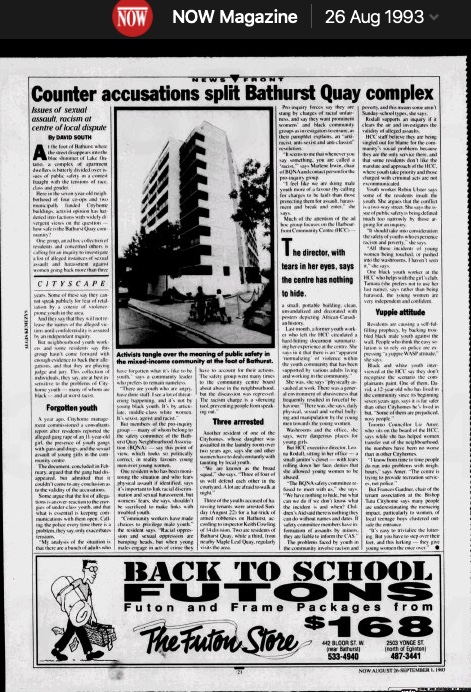
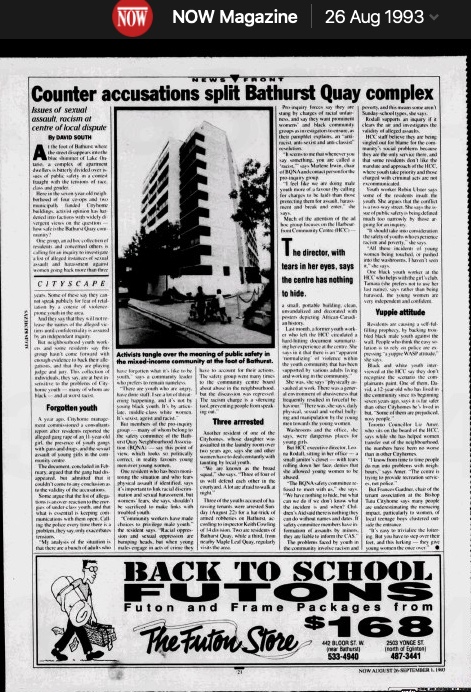
Counter Accusations Split Bathurst Quay Complex: Issues Of Sexual Assault, Racism At Centre Of Local Dispute

By David South

Now Magazine (Toronto, Canada), August 26-September 1, 1993

At the foot of Bathurst where the street disappears into the blue shimmer of Lake Ontario, a complex of apartment dwellers is bitterly divided over issues of public safety in a contest fraught with the tensions of race, class and gender.

Here in the seven-year-old neighbourhood of four co-ops and two municipally funded Cityhome buildings, activist opinion has hardened into factions with widely divergent views on one question – how safe is the Bathurst Quay community?

One group, an ad hoc collection of residents and concerned others is calling for an inquiry to investigate a list of alleged instances of sexual assault and harassment against women going back more than three years. Some of these say they cannot speak publicly for fear of retaliation by a coterie of violence-prone youth in the area.

And they say that they will not release the names of the alleged victims until confidentiality is assured by an independent inquiry.

But neighbourhood youth workers and some residents say this group hasn’t come forward with enough evidence to back their allegations, and that they are playing judge and jury. This collection of individuals, they say, are at best insensitive to the problems of Cityhome youth – many of whom are black – and at worst racist.

Forgotten youth

A year ago, Cityhome management commissioned a consultants report after residents reported the alleged gang rape of an 11-year-old girl, the presence of youth gangs with guns and drugs, and the sexual assault of young girls in the community centre.

The document, concluded in February, argued that the gang had disappeared, but admitted that it couldn’t come to any conclusion as to the validity of the accusations.

Some argue that the list of allegations is an over-reaction to the energies of under-class youth, and that what is essential is keeping communications with them open. Calling the police every time there is a problem, they say, only exacerbates tensions.

“My analysis of the situation is that there are a bunch of adults who have forgotten what it’s like to be youth,” says a community leader who prefers to remain nameless.

“There are youth who are angry, have done stuff, I see a lot of threatening happening, and it’s not by young black youth. It’s by articulate, middle-class white women. It’s sexist, ageist and racist.”

But members of the pro-inquiry group – many of whom belong to the safety committee of the Bathurst Quay Neighbourhood Association (BQNA) – say this point of view, which looks so politically correct, in reality favours young men over young women.

One resident who has been mintoring the situation and who fears physical assault if identified, says it’s important to link racial discrimination and sexual harassment, but women’s fears, she says, shouldn’t be sacrificed to make links with troubled youth.

“Community workers have made choices to privilege male youth,” the resident says. “Racial oppression and sexual oppression are bumping heads, but when young males engage in acts of crime they have to account for their actions. The safety group went many times to the community centre board about abuse in the neighbourhood, but the discussion was repressed. The racism charge is a silencing tool, preventing people from speaking out.”

Three arrested

Another resident of one of the Cityhomes, whose daughter was assaulted in the laundry room over two years ago, says she and other women have to deal constantly with taunting by local youth.

“We are known as the broad squad,” she says. “Three or four of us will defend each other in the courtyard. A lot are afraid to walk at night.”

Three of the youths accused of harassing tenants were arrested Sunday (August 22) for a hat-trick of armed robberies on Bathurst, according to Keith Cowling of 14 Division. Two are residents of Bathurst Quay, while a third, from nearby Maple Leaf Quay, regularly visits the area.

Pro-inquiry forces say they are stung by charges of racial unfairness, and say they want prominent womens’ and black community groups as investigators to ensure, as their pamphlet explains, an “anti-racist, anti-sexist and anti-classist” resolution.

“It seems to me that whenever you say something, you are called a ‘racist’,” says Marlene Irwin, chair of BQNA and contact person for the pro-inquiry group.

“I feel we are doing male youth more of a favour (by calling for charges to be laid) than those protecting them for assault, harassment and break and enter,” she says.

Much of the attention of the ad hoc group focuses on the Harbourfront Community Centre (HCC) – a small, portable building, clean, unvandalized and decorated with posters depicting African-Canadian history.

Last month, a former youth worker who left the HCC circulated a hard-hitting document summarizing her experience at the centre. She says in it that there is an “apparent ‘normalizing’ of violence within the youth community that has been supported by various adults living and working in the community.”

She was, she says “physically assaulted at work. There was a general environment of abusiveness that frequently resulted in forceful behaviour.” There was, she says, daily physical, sexual and verbal bullying and manipulation by the young men towards the young women.

Washrooms and the office, she says, were dangerous places for young girls.

But HCC executive director, Leona Rodall, sitting in her office – a small janitor’s closet – with tears rolling down her face, denies that she allowed young women to be abused.

“The BQNA safety committee refused to meet with us,” she says. “We have nothing to hide, but what can we do if we don’t know what the incident is and when? Children’s Aid said there is nothing they can do without names and dates. If safety committee members have information of assaults by minors, they are liable to inform the CAS.”

The problems faced by youth in the community involve racism and poverty, and this means some aren’t Sunday-school types, she says.

Rodall supports an inquiry if it clears the air and investigates the validity of the alleged assaults.

HCC staff believe they are being singled out for blame for the community’s social problems because they are the only service there, and that some residents don’t like the mandate and approach of the HCC, where youth take priority and those charged with criminal acts are not excommunicated.

Youth worker Robin Ulster says some of the residents insult the youth. She argues that the conflict is a two-way street. She says the issue of public safety is being defined much too narrowly by those arguing for an inquiry.

“It should take into consideration the safety of youths who experience racism and poverty,” she says.

“All these incidents of young women being touched, or pushed into the washrooms, I haven’t seen it,” she says.

One black youth worker at the HCC who helps with the girl’s club, Tamara (she prefers not to use her last name), says rather than being harassed, the young women are very independent and confident.

Yuppie attitude

Residents are causing a self-fulfilling prophecy, by backing troubled black male youth against the wall. People who think the easy solution is to rely on police are expressing a “yuppie WASP attitude”, she says.

Black and white youth interviewed at the HCC say they don’t recognize the scenario the complainants paint. One of them, David, a 12-year-old who has lived in the community since its beginning seven years ago, says it is far safer than other Cityhomes he’s lived in, but “Some of them are prejudiced, nosy people.”

Toronto Councillor Liz Amer, who sits on the board of the HCC, says while she has helped women transfer out of the neighbourhood, the numbers have been no worse than in other Cityhomes.

“I know from time to time people do run into problems with neighbours,” says Amer. “The centre is trying to provide recreation services, not police.”

But Francis Gardner, chair of the tenant association at the Bishop Tutu Cityhome says many people are underestimating the menacing impact, particularly for women, of local teenage boys clustered outside the entrance.

“It’s easy to trivialize the loitering. But you have to step over their feet, and this lurking – they give young women the once over.”

Creative Commons License

This work is licensed under a
Creative Commons Attribution-Noncommercial-No Derivative Works 3.0 License

ORCID iD: https://orcid.org/0000-0001-5311-1052.

© David South Consulting 2022