Categories
Archive Blogroll Now Magazine

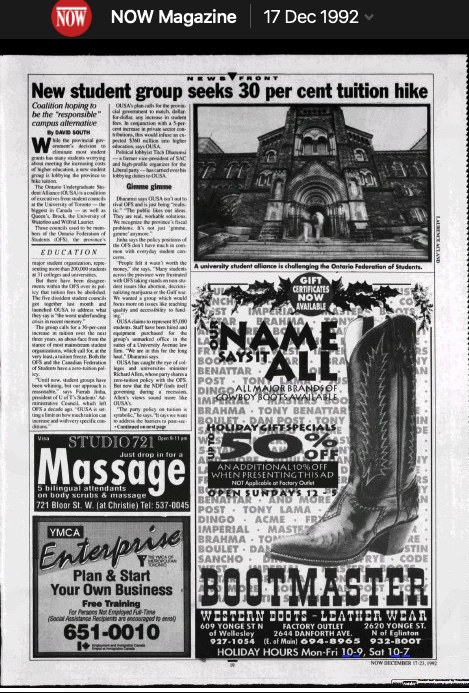
New Student Group Seeks 30 Percent Tuition Hike

Coalition hoping to be the “responsible” campus alternative

By David South

Now Magazine (Toronto, Canada), December 17-23, 1992

While the provincial government’s decision to eliminate most student grants has many students worrying about meeting the increasing costs of higher education, a new student group is lobbying the province to hike tuition.

The Ontario Undergraduate Student Alliance (OUSA) is a coalition of executives from student councils at the University of Toronto – the biggest in Canada – as well as Queen’s, Brock, the University of Waterloo and Wilfred Laurier.

Those councils used to be members of the Ontario Federation of Students (OFS), the province’s major student organization, representing more than 200,000 students at 31 colleges and universities.

But there have been disagreements within the OFS over its policy that tuition fees be abolished. The five dissident student councils got together last month and launched OUSA to address what they say is “the worst underfunding crisis in recent memory.”

The group calls for a 30-per-cent increase in tuition over the next three years, an about-face from the stance of most mainstream student organizations, which call for, at the very least, a tuition freeze. Both the OFS and the Canadian Federation of Students have a zero-tuition policy.

“Until now, student groups have been whining, but our approach is reasonable,” says Farrah Jinha, president of U of T’s Students’ Administrative Council, which left OFS a decade ago. “OUSA is setting a limit on how much tuition can increase and with very specific conditions.”

OUSA’s plan calls for the provincial government to match, dollar-for-dollar, any increase in student fees. In conjunction with a 5-per-cent increase in private sector contributions, this would infuse an expected $360 million into higher education, says OUSA.

Political lobbyist Titch Dharamsi – a former vice-president of SAC and high-profile organizer for the Liberal party – has carried over his lobbying duties to OUSA.

Gimme gimme

Dharamsi says OUSA isn’t out to rival OFA and is just being “realistic.” “The public likes our ideas. They are real, workable solutions. We recognize the province’s fiscal problems. It’s not just ‘gimme, gimme’ anymore.”

Jinha says the policy positions of the OFS don’t have much in common with everyday student concerns.

“People felt it wasn’t worth the money,” she says. “Many students across the province were frustrated with OFS taking stands on non-student issues like abortion, decriminalizing marijuana or the Gulf war. We wanted a group which would focus more on issues like teaching quality and accessibility to funding.”

OUSA claims to represent 85,000 students. Staff have been hired and equipment purchased for the group’s unmarked office in the suites of a University Avenue law firm. “We are in this for the long haul,” Dharamsi says.

OUSA has caught the eye of colleges and universities minister Richard Allen, whose party shares a zero-tuition policy with the OFS. But now that the NDP finds itself governing during a recession, Allen’s views sound more like OUSA’s.

“The party policy on tuition is symbolic,” he says. “It says we want to address barriers to post-secondary education.”

Student quits

One student representative on U of T’s Students’ Administrative Council, Jason Zeidenberg, resigned when SAC decided to join OUSA.

“The process hasn’t involved students,” says Zeidenberg. “It is a policy for student politicians, not students. OUSA has no constitution, no financial structure, no mechanism for individual students to bring questions forward. It is an undemocratic, fly-by-night institution.

“Until they justify their expenditures, they are under suspicion of being a front group to legitimize policies like raising tuition.”

OUSA isn’t legally obliged to incorporate itself or provide a constitution or accountable executive. The group operates much like a club, with member council executives making decisions collectively, and funds coming out of member unions’ budgets.

Joining OFS requires a student referendum, but because of OUSA’s quasi-ad-hoc status, no such vote is needed to join the new group.

Dharamsi says this approach is cost-effective and flexible. He says OUSA has spent around $10,000 to date, but can’t offer a fixed budget.

Zeidenberg hs organized several college and faculty student unions at U of T to demand that SAC hold a referendum about membership in OUSA.

Craft doesn’t feel that OUSA is a threat. “I’m not losing sleep over it,” he says. “We’re considered the representatives of students in Ontario.”

Recently, however, the University of Western Ontario pulled out of OFS and is currently negotiating with OUSA about joining. Western’s departure takes another 20,000 students and precious dollars with them, and funding cuts have led OFS to lay off staff.

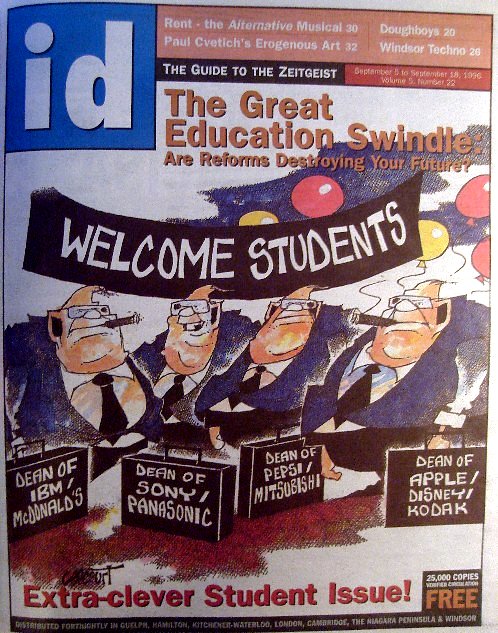
This cover is by great Canadian political cartoonist and illustrator Jack Lefcourt. Always funny, Jack captures well the corporate take-over of the country’s universities and the introduction of the catastrophic debt culture that leaves so many students in a financial pickle. It was also Id’s first student issue. Id Magazine: Student Issue, “The guide to the zeitgeist”, Ontario, 1996, Features Editor: David South.

https://davidsouthconsulting.org/2021/01/26/aid-organization-gives-overseas-hungry-diet-food-diet-giant-slim-fast-gets-tax-write-off-for-donating-products/

https://davidsouthconsulting.org/2022/11/16/canadian-magazines-newspapers-1990s/

https://davidsouthconsulting.org/2021/06/01/case-study-2-watch-magazine-1994-and-1996-2/

https://davidsouthconsulting.org/2021/07/20/case-study-3-id-magazine-1996-1997-2/

https://davidsouthconsulting.org/2020/12/18/counter-accusations-split-bathurst-quay-complex-issues-of-sexual-assault-racism-at-centre-of-local-dispute/

https://davidsouthconsulting.org/2020/12/11/false-data-makes-border-screening-corruptible/

https://davidsouthconsulting.org/2020/12/10/one-world-youth-conferences-mongolia-1998-1999/

https://davidsouthconsulting.org/2022/11/11/online-free-knowledge-sharing/

https://davidsouthconsulting.org/2020/12/18/peaceniks-questioning-air-raid-strategy-in-bosnia/

https://davidsouthconsulting.org/2020/12/12/somali-killings-reveal-ugly-side-of-elite-regiment/

https://davidsouthconsulting.org/2021/02/05/study-says-jetliner-air-quality-poses-health-risks-cupe-takes-on-airline-industry-with-findings-of-survey/

https://davidsouthconsulting.org/2020/12/11/top-reporters-offer-military-media-handling-tips/

Creative Commons License

This work is licensed under a
Creative Commons Attribution-Noncommercial-No Derivative Works 3.0 License.

ORCID iD: https://orcid.org/0000-0001-5311-1052.

© David South Consulting 2023

Categories
Archive Blogroll Now Magazine

Top Reporters Offer Military Media Handling Tips

Ryerson’s course on handling media has raised eyebrows

By David South

Now Magazine (Toronto, Canada), November 12-18, 1992

The whimsical Certificate of Military Achievement hanging in the offices of the Ryersonian newspaper at Ryerson journalism school is testament to the warm relationship between the armed forces and one of Canada’s top journalism schools.

But a two-month crash course in journalism for military public affairs officers hosted by Ryerson this summer has left a bad taste in the mouths of some participants and critics.

The course, which involved 18 soldiers, included two weeks of classes in each of print, radio and TV journalism, wrapping up with two weeks of “crisis management” training. The 60 instructures included such prominent journalists as Ann Medina and Pamela Wallin.

According to an administration newsletter, the course netted Ryerson more than $350,000. Organizers say the course was merely an exercise in familiarizing soldiers with the needs of working journalists. But given the often conflicting roles of the military and the media, some fear journalistic ethics may have taken some collateral damage.

“The course had nothing to do with national defence or the armed forces,” says course teacher and organizer Shelley Robertson. “They just wanted to understand the roles of journalists from the other side. The military didn’t ask us to teach what we teach our students.”

Robertson says the course also benefited the participating journalists by giving them contacts in the military.

But according to media critic Barrie Zwicker, the exercise blurs what should be the distinctly different interests of journalists and the military. “It’s similar to press and politicians. By getting close to the politician, journalists can get information they couldn’t normally obtain. The negative side is that the media can get sucked in and lose a larger perspective. The same tensions exist with covering the military.

Managing media

“It’s up to the media to break the rules and try and get the story. The military always wants to hide its victims. If a Ryerson journalist strikes up a friendship with a public affairs officer, will the reporter be true to their journalistic tradition?”

Colloquially known as spin doctors, hype-meisters and flak catchers, public affairs officers perform much the same tasks in the military as their civilian counterparts in industry and government – including managing information that gets to the public or media.

In the past, Canadian soldiers had to go to the US for special training at the Defense Information School at Fort Benjamin Harrison. But, according to Robertson, the armed forces were looking for a Canadian spin.

With 4,600 Canadian peacekeepers now stationed around the world, including a contingent in the dangerous and volatile former Yugoslav republics, the chances for conflict – and casualties – have increased.

Lieutenant-commander Glen Chamberlain, who helped coordinate the course, says the military’s increased profile means that the forces have to become more adept at media relations. “There is a great desire among Canadians to know what troops on peacekeeping duties are up to. We have a wonderful story to tell.”

Chamberlain says he works on journalists’ behalf with stubborn military commanders. “The armed forces are finding there is a real benefit to having specialized PA officers. We want to help journalists to tell our story well.”

The crisis management section of the course offered participants a hands-on approach to managing journalists. The officers were presented with two scenarios – a murder at Moss Park armoury and a highway helicopter crash – and then practised handling a group of journalists investigating the events.

Course lecturer Kevin Donovan, who covered the Gulf war for the Toronto Star, remembers the effectiveness and sophistication of PA officers in the field.

“When I was in Riyadh, Saudi Arabia, I walked into a hotel and on the wall were pool reports – news briefs written by US military public affairs officers – that journalists were encouraged to use for stories. There were some journalists going out into the field to cover stories, but a huge number just sat in this beautiful hotel.”

“Canadian journalists are ignorant of the military and could do with getting closer. You almost never find a full-time journalist in Canada who knows anything about them. The more you know about the military, the less you will be manipulated.”

Stop information

Donovan feels uncomfortable about teaching on the course.

“I was asked by Ryerson to give a talk on my experiences in Saudi Arabia, Kuwait and Iraq,” he says. “My initial reaction was no. I hate the existance of public affairs people with a passion. Their job is to stop information.

“I’m uncomfortable with Ryerson being hired by the department of national defence. One officer in the course got very upset when I told them to make contacts with the media and leak stories.”

Course organizer Clive Vanderburgh admits organizers had concerns about conflicts between the role of journalists and military officers. “There was a lot of discussion concerning the potential for conflict – especially that the people hired to teach might think they were there to help the department of national defence to avoid the media

“But we were trying to give a general understanding of the media’s needs. We didn’t sell the country down the drain.”

Another teacher was Robert Fulford, the well-known writer and lecturer on journalistic ethics. “I don’t have a problem with Ryerson teaching the military,” says Fulford. “It’s a way of spreading journalistic technique to people in the DND. It seems to be a natural extension of the work of Ryerson.

“Canadian journalists are ignorant of the military and could do with getting closer. You almost never find a full-time journalist in Canada who knows anything about them. The more you know about the military, the less you will be manipulated.”

But Gideon Forman, coordinator of the Canadian Peace Alliance, fears Ryerson may be helping the military mislead the public.

“Why do these guys practise handling the media so much of there’s nothing to hide? This is just better packaging for the military so they can get what they want from the public.

“I have problems with public money being spent teaching the military to be more effective with the media, while other organizations have their budgets cut or eliminated.

“Is there a similar program for food banks or women’s shelters?”

Note on story context: This story was researched and written after two key events involving Canada’s military: the first Gulf War from 1990-1991; and the Oka Crisis in 1990, where the Canadian Armed Forces confronted an armed group of Mohawk “Warriors” in Oka, Quebec.

More investigative journalism here: 

Peaceniks Questioning Air-Raid Strategy In Bosnia

Somali Killings Reveal Ugly Side Of Elite Regiment

Study Says Jetliner Air Quality Poses Health Risks: CUPE Takes On Airline Industry With Findings Of Survey

Creative Commons License

This work is licensed under a
Creative Commons Attribution-Noncommercial-No Derivative Works 3.0 License.

ORCID iD: https://orcid.org/0000-0001-5311-1052.

© David South Consulting 2023

Categories
Archive Blogroll data digital ID Now Magazine

False Data Makes Border Screening Corruptible

“Big Brother” system could violate rights of Canada’s visitors

By David South

Now Magazine (Toronto, Canada), May 21-27, 1992

New technology that can spew out a person’s life history in less than six seconds is now available to Canada’s customs and immigration officials.

And while Canada customs and immigration officers say this toy is a boon – replacing the need to memorize names of so-called undesirables – civil rights workers and refugee activists point out that the gizmo could have serious consequences, with little recourse.

The technology is called PALS, or primary automated look out system, and is already in operation at airports in Toronto, Montreal, Calgary, Winnipeg, Ottawa and Vancouver.

PALS’ operation is based on the use of computer-readable passports. Canada is one of several countries that have started including computer strips on passports and identity cards. Officers use PALS by either keying in a special number printed on the passport or identity card or using a scanning machine to read the strip.

The system went into effect at Toronto’s Pearson airport on January 20, after a three-year pilot project in Vancouver, adding Canada to the 11 countries that have machine readers for passports. Under the old system, customs officers combined judgement, questioning and the most-wanted list to decide if a passenger required further interrogation and search.

During a demonstration of the system, customs officials at Pearson airport boast about the system’s role in apprehending a drug smuggler in PALS’ first week of operation.

Sinister sign

But to civil libertarians with experience of such systems in other countries, PALS hasa sinister implication. Many say that PALS spews out what is fed into it. And depending on the country involved, what is fed into it may not necessarily be true.

While customs emphasizes PALS’ role in apprehending popular targets like drug smugglers, terrorists and child kidnappers, its reach also includes people who have smuggled in too many cigarettes or bottles of alcohol, convicted criminals who have finished serving their time, immigrants, refugees and a range of petty offenders.

All of these face a second interrogation and detention based on what their governments have decided to incorporate into the computer strip. And it is this that worries civil libertarians and refugee workers.

Consider the case of a legally sponsored Portuguese immigrant who arrived at Pearson just after PALS had been introduced. He was detained based on information stored in PALS. His immigration lawyer Ali Mohideen recalls how the man was held because of a cheque that he bounced in his native Portugal about eight years ago.

Ed Lam, director of research for the Canadian Ethnocultural Council, feels customs and immigration already have “too many powers.” He regularly receives complaints from visible minorities and immigrants who feel they are singled out for harassment at the airport.

“This is big brother. Legal protection is not enough,” he argues. “It leads to costly court battles with the government. I would like to see an ombudsperson or complaints bureau set up. As for refugees turned back at the border, we will never hear from them.”

False data

Other critics, especially those in the US, where a PALS-type system has been in operation for more than a decade, worry that the system will simply accept information given by tyrannical governments.

“It is hard to trace false information to a foreign government,” says Jeanne Woods, legislative counsel to the American Civil Liberties Union, which monitors abuse under the United States system.

“People have been accused of being communists or terrorists who have denied it. The El Salvadoran government is one example of a regime which has called prominent human rights activists and lawyers terrorists.”

She would like the Canadian Parliament to pass a law similar to one passed last November in the US requiring the state department to report to Congress when somebody is denied access because they have been called a terrorist, so that the origin of the information can be tracked.

“People have been accused of being communists or terrorists who have denied it. The El Salvadoran government is one example of a regime which has called prominent human rights activists and lawyers terrorists.”

The Canadian database draws its information from several sources, according to customs spokesperson Suzanne Bray. The sources include immigration records and the Police Information Retrieval System, which is a database shared between customs and the RCMP.

Bray refuses to divulge any other sources, citing security, but both RCMP and customs operate their own intelligence services, sharing information with their counterparts all over the world, especially the US. Information is also drawn from the Canadian Security Intelligence Service (CSIS) and its sister organizations such as the CIA. However, CSIS spokesperson Ray Boisvert says they have adequate safeguards against false information provided by countries known to be human rights abusers.

“CSIS does look at bias in intelligence reports,” he says.

The US equivalent of PALS has been criticized after several cases of abuse were detected. Gara LaMarche, executive director of the Fund for Free Expression, a project of US-based Human Rights Watch, has documented abuse on political and ideological grounds.

“The US public has a right to hear dissenting views under the first amendment of the Constitution,” he says. “I don’t think improving the technology of border control violates civil liberties, but keeping a massive database of information which includes people’s political associations is bad.”

Similar concerns are expressed by John Tackaberry of Amnesty International in Ottawa, which is only now beginning its own analysis of PALS. “We have concerns over data input, who controls information and basic civil liberties.”

Even as Canadian civil rights activists take stock of PALS, Canada customs is planning to use it to check cross-border shopping by expanding the system to all land entry points.

As for those visitors who feel wronged by PALS, they may have a problem seeking redress from such organizations as the Canadian Human Rights Commission. A spokesperson says the CHRC can only help those who have been admitted to Canada. And visitors turned back at the border are not considered admitted.

Sherry Gerstl, a customs superintendent responsible for the implementation of PALS at Pearson, says that people can also appeal to the Privacy Act to see information that is kept on them. But two fact sheets explaining how this can be done are located in a corner, pretty much out of public view.

Bray acknowledges that “honest” passengers could face the prospect of a search with PALS, but given its positive attributes, she says, passengers involved in such delays should simply “grin and bear it.”

Facial recognition AI software triangulates facial features to produce a recognition match.
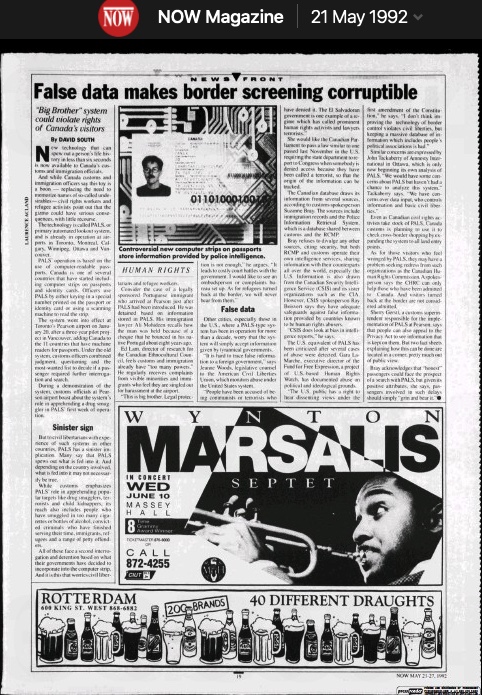
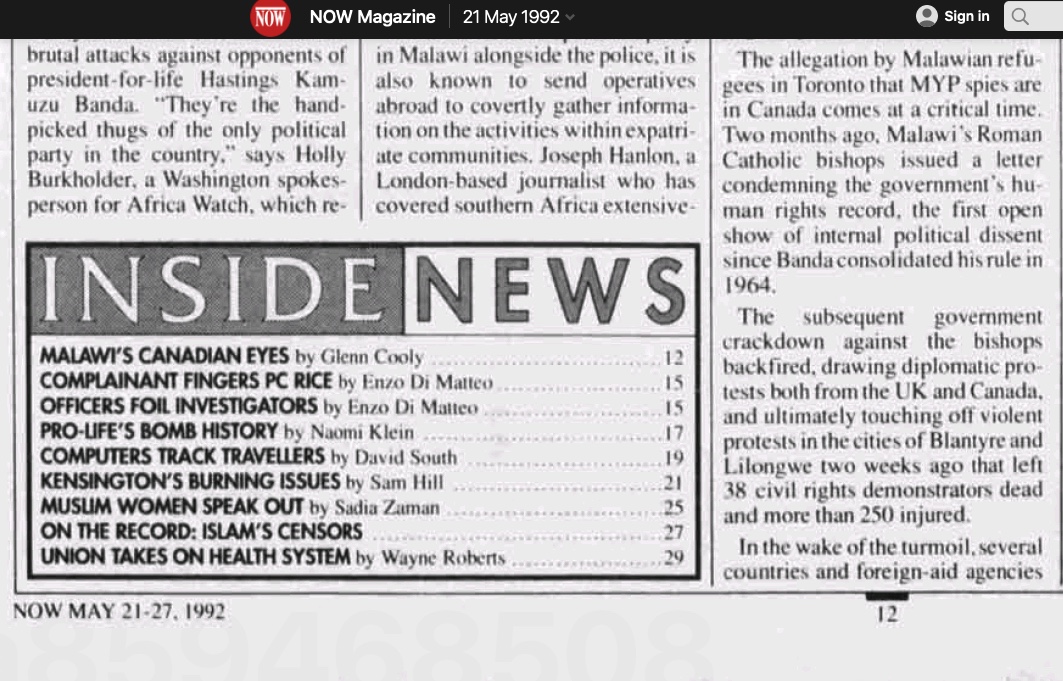
“Computers Track Travellers” by David South. Now Magazine published investigative journalism from David South, Naomi Klein and others in the early 1990s.

More on biometrics:

https://davidsouthconsulting.org/2022/02/09/african-health-data-revolution/

https://davidsouthconsulting.org/2020/12/04/big-data-can-transform-the-global-souths-growing-cities/

https://davidsouthconsulting.org/2020/12/04/data-surge-across-global-south-promises-to-re-shape-the-internet/

https://davidsouthconsulting.org/2021/03/04/indian-id-project-is-foundation-for-future-economic-progress/

https://davidsouthconsulting.org/2021/03/31/new-weapon-against-crime-in-the-south/

Creative Commons License

This work is licensed under a
Creative Commons Attribution-Noncommercial-No Derivative Works 3.0 License.

 ORCID iD: https://orcid.org/0000-0001-5311-1052.

© David South Consulting 2023

Categories
Archive Blogroll The Financial Post Magazine

Too Black

By David South

The Financial Post Magazine (Toronto, Canada), May 1992

They’ve sold their hip clothing designs out of their basement and out of the back of their car. Now the young designers and marketers behind Toronto’s Too Black Guys can boast that their wares are being sold out of film-maker Spike Lee’s shop in Brooklyn, as well as five other funky U.S. stores from Washington to L.A.

Neither of the co-owners studied fashion – Adrian, 24, holds a BA in economics and Robert, 23, studied marketing at community college. Still, they have designed their own T-shirts, jeans, baseball caps and sweatshirts, and the message is at least as important as the medium. 

“They forgot to ask my name and called me negro,” reads a typical shirt. Earl Smith, the manager at Lee’s Brooklyn shop, says he loves the clothes but adds that customers often ask his staff to explain what the thought-provoking garments mean.

The Financial Post Magazine (Toronto, Canada), May 1992.

More fashion and culture stories here:

Afropolitan: African Fashion Scene Bursting with Energy

Shoes with Sole: Ethiopian Web Success Story

Nollywood: Booming Nigerian Film Industry

Creative Commons License

This work is licensed under a
Creative Commons Attribution-Noncommercial-No Derivative Works 3.0 License.

ORCID iD: https://orcid.org/0000-0001-5311-1052.

© David South Consulting 2021