While many designers are telling us to don platform shoes and love beads, the man behind London-based Hi-Tek watches is looking even further back in time – drawing his inspiration from classic visions of the future.
Hi-Tek’s stainless steel timepieces bring to mind early futuristic films such as Lang’s Metropolis and Chaplin’s Modern Times with their grotesque exaggerations of modern machinery. That era’s confusion, fear, or simple wonderment at new technology influenced everything from toasters to steam trains.
For the equally economically and technologically turbulent ‘90s, Hi-Tek designer Alexander has captured this sense of techno-wonder with watches, sunglasses, and other hip accessories. One watch looks as if a Cuisinart hit it, leaving gears strewn across the face. Another has a retractable lid like an astronomer’s observatory. Yet another tells time with the blinker of a radar screen. Despite their made-exclusively-for-James-Bond appearance, all cost less than $190. Available at Possessions in Montreal, Body Body in Toronto, and D and R in Vancouver.
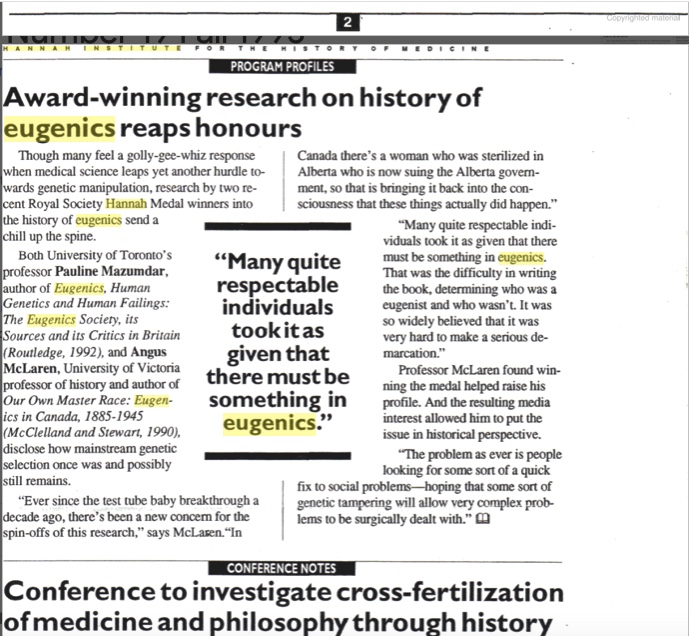
Though many feel a golly-gee-whiz response when medical science leaps another hurdle towards genetic manipulation, research by two recent Royal Society Hannah Medal winners into the history of eugenics sends a chill up the spine.
Both University of Toronto’s professor Pauline Mazumdar, author of Eugenics, Human Genetics and Human Failings: The Eugenics Society, its Sources and its Critics in Britain (Routledge, 1992), and Angus McLaren, University of Victoria professor of history and author of Our Own Master Race: Eugenics in Canada, 1885-1945 (McClelland and Stewart, 1990), disclose how mainstream genetic selection once was – and possibly still remains.
“Ever since the test tube baby breakthrough a decade ago, there’s been a new concern for the spin-offs of this research,” says McLaren. “In Canada there’s a woman who was sterilized in Alberta who is now suing the Alberta government, so that is bringing it back into the consciousness that these things actually did happen.”
“Many quite respectable individuals took it as given that there must be something in eugenics. That was the difficulty in writing the book, determining who was a eugenist and who wasn’t. It was so widely believed that it was very hard to make a serious demarcation.”
Professor McLaren found winning the medal helped raise his profile. And the resulting media interest allowed him to put the issue in historical perspective.
“The problem as ever is people looking for some sort of a quick fix to social problems – hoping that some sort of genetic tampering will allow very complex problems to be surgically dealt with.”
They’ve sold their hip clothing designs out of their basement and out of the back of their car. Now the young designers and marketers behind Toronto’s Too Black Guys can boast that their wares are being sold out of film-maker Spike Lee’s shop in Brooklyn, as well as five other funky U.S. stores from Washington to L.A.
Neither of the co-owners studied fashion – Adrian, 24, holds a BA in economics and Robert, 23, studied marketing at community college. Still, they have designed their own T-shirts, jeans, baseball caps and sweatshirts, and the message is at least as important as the medium.
“They forgot to ask my name and called me negro,” reads a typical shirt. Earl Smith, the manager at Lee’s Brooklyn shop, says he loves the clothes but adds that customers often ask his staff to explain what the thought-provoking garments mean.
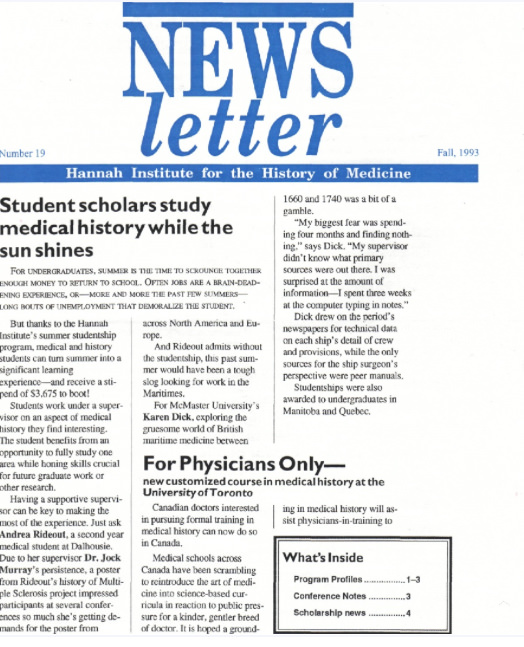
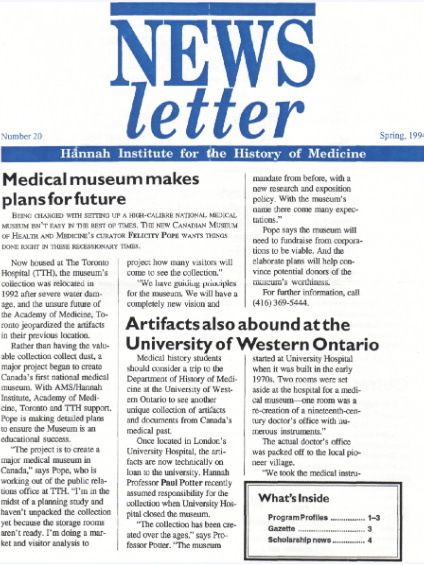
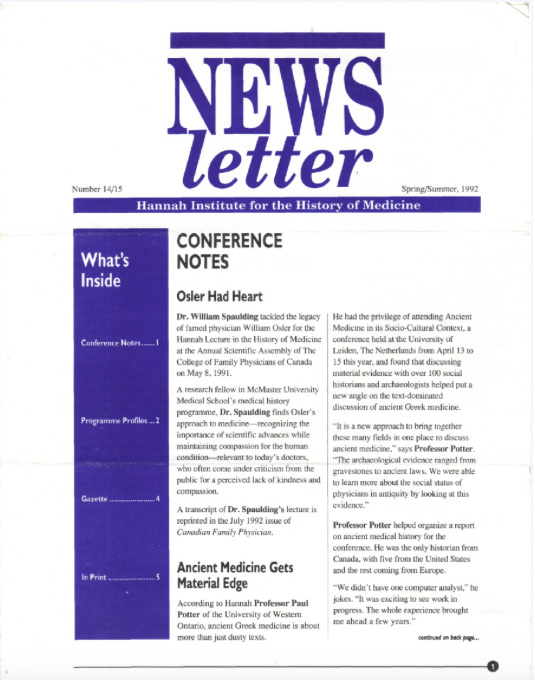
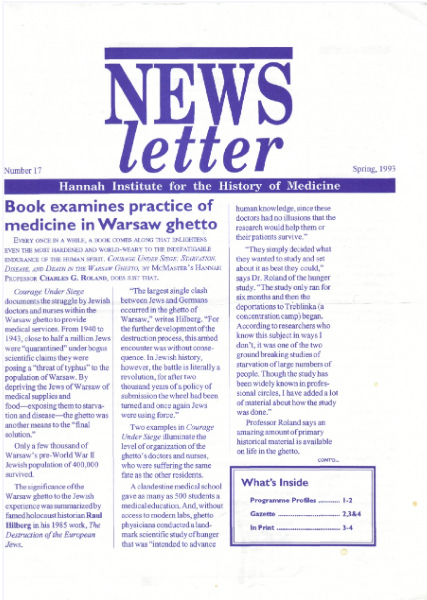
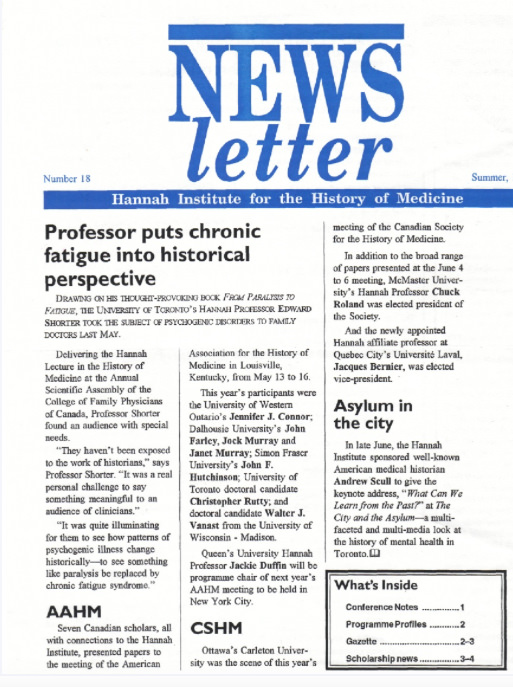
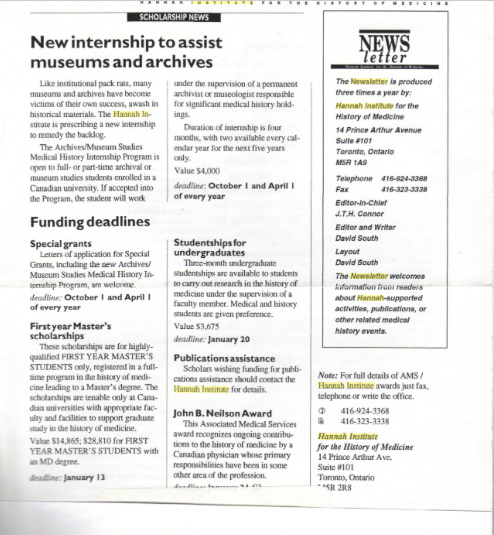
I worked as Editor and Writer for the newsletter of the Hannah Institute for the History of Medicine (under the direction of the Editor-in-Chief and Hannah Executive Director Dr. J.T. H. Connor) in the early 1990s. Located close to the University of Toronto and within a neighbourhood claiming a long association with medical and scientific discovery (Sir Frederick Banting, co-developer of insulin for the treatment of diabetes, lived at 46 Bedford Road,), the goal was to better connect Canada’s medical history community of scholars and raise the profile of the funding resources available to further the study of medical history in Canada.
The Toronto Legacy Project and Heritage Toronto plaque marking the location of Sir Frederick Banting’s former home.
I also revamped the application process for awards, scholarships and grants to make them user-friendly and compatible with word processing software packages of the time.
The Hannah Institute was the adminstrator for the grants and awards funded by AMS (Associated Medical Services). It has had a profound impact on the medical history field in Canada, as the AMS website states:
“As a result of the growth of the discipline and the burgeoning of scholarship, as well as financial support from other funding bodies, in 2006, the AMS Board of Directors decided not to provide new competitive grants and further, decided to bring AMS- administered competitive grants to closure by 2011.
In the 1970’s when the Hannah Chairs and the Hannah Institute were established, the discipline of the history of medicine was an “orphan’ within the Canadian scholarly community. Three decades later with the support of AMS, history of medicine and healthcare continued to thrive in universities and colleges across Canada.”
The archive of newsletters is held at the Wellcome Collection Library in London, UK and at the University of Toronto.“Professor puts chronic fatigue into historical perspective” announced the launch of a new book by the University of Toronto’s Hannah Professor Edward Shorter. Abstracts in Anthropology, Volume 43, Issues 3-4: “… in recent years it has become a pursuit for a growing number of researchers. … Behind much of this growth has been the Hannah Institute for the History of Medicine which has encouraged writing …”.
















 David South Consulting
You must be logged in to post a comment.