Seniors who live in nursing homes and homes for the aged are receiving an inadequate amount of psychiatric care, according to a study conducted by Toronto’s Baycrest Centre for Geriatric Care.
Dr. David Conn, director of psychiatry at Baycrest and an author of the report, says action must be taken to remedy this situation, since at least 80 per cent of elderly long-term care residents suffer from some form of mental disorder.
The issue of psychiatric care for seniors is complex. There are many, often strongly-held, opinions about the nature of this care and what measures will genuinely improve the mental well-being of seniors in institutions.
According to The Senior Citizens’ Consumer Alliance for Long-Care Reform, Ontario has the highest rate of institutionalisation of seniors in the world, with 7.5 per cent of seniors over the age of 65 and 15 per cent over 75 in institutions. The Alliance demanded in its reforms in Ontario that seniors’ mental health problems be taken more seriously and be included in any assessment for care.
Baycrest’s report surveyed 1,148 medical directors and nursing directors in over 500 nursing homes and homes for the aged across Ontario. The 601 who responded reported that 37 per cent of their residents received no psychiatric care, while only 12 per cent received more than five hours per month. The most common psychiatric problems under treatment were depression, agitation, wandering and physical aggression.
“Recognition of significant mental disorders in nursing homes is a recent phenomenon because geriatric psychiatry is a relatively new field,” says Dr. Conn. “The usual approach has been to reach for the prescription pad. We know now that antidepressants have been underused and tranquillizers overused.
“To deliver effective psychiatric care requires more than just psychiatrists – teams of psychiatric nurses can also be involved. Hopefully the staff of these institutions will become better educated as a result of this report.”
Dr. Kenneth Shulman, head of psychiatry at the Sunnybrook Health Sciences Centre, feels the worst neglect occurs in private rest homes.
“There is general lack of accountability when it comes to geriatric psychiatric services.” Schulman advocates a coordinated, comprehensive regional network of services.
Dr. Conn is sensitive to reports of sexual, physical and mental abuse of residents in some institutions. He says staff as well as residents of institutions can benefit from psychiatric consultations. “If more psychiatric consultants were available, the staff could also receive help in working out their problems,” he says. “Unfortunately the fee-for-service system doesn’t include paying for visiting staff.
“Being in an institution is not easy for anyone. It often means being apart from family, living with strangers, loss of freedom and having to live by the institution’s timetable.”
One of the most controversial of psychiatric treatments is electroconvulsive therapy (ECT). ECT involves placing electrodes on the sedated patient’s head and passing 100 to 175 volts of electricity into one of the lobes of the brain to induce grand mal seizure and coma.
Opponents of ECT say the procedure can cause memory loss and confusion, and in some cases proves fatal. A 1985 Ontario government task force report recommended against using ECT in certain cases: “For patients whose work requires a clear and precise memory, ECT is probably contraindicated.”
But many other sources say that while ECT has been abused in the past and, like many other medical procedures, may not be a pretty sight, it is sometimes effective in combating depression.
Dr. Conn confirms that the controversial procedure is still being used on seniors. “ECT is used on very depressed people,” he says. “It is a hospital-based service. The patient is admitted to a psychiatric unit of the hospital. We do it at Baycrest. It is only a last resort and has often been life-saving.”
Don Weitz, a senior citizen and spokesperson for Resistance Against Psychiatry, doesn’t mince words about what he says is the adverse effects of electroshock therapy and psychiatric practice in general. He wears a T-shirt bluntly saying, “Fry rice – not brains.”
“We have known about the adverse effects of shock for years,” says Weitz. “Research from the ‘40s and ‘50s was very clear that there was brain damage.
“What doctors mean by improvement is in fact post-injury euphoria – the brain will overcompensate with giddiness, and this only lasts for two to four weeks. Doctors seldom test people for more than two or three months afterwards.”
“What we know for sure is that within the institutions, they would rather give drugs or shock than talk to seniors. I think this should be called elder abuse – what else could it be? Is it such a mystery why people are depressed in institutions where they are abused? Psychiatrists have a vested interest in billing OHIP for pushing the button.”
But Dr. Shulman disagrees with blaming the atmosphere of institutions. “It is simplistic to think that the environment is responsible for aggressiveness or other problems,” he says. “These people are cognitively impaired – it could be medication-related or something else. These are complicated issues.”
For any nursing home workers who want further advice about psychiatry, Baycrest has produced a “Jargon-free” guide called Practical Psychiatry in the Nursing Home.
Read more of David South’s 1990s health and medical journalism here:
Toronto’s innovative crime-fighting and crime-prevention experiments face elimination if and when the city is swallowed up by the monolithic megacity. And the Annex’s status as one of Toronto’s safest neighbourhoods could be destroyed by the resulting tax increases.
Since the late 1980s, thinking about crime in Toronto has focused on public safety rather than just cops in cars. Taking what can be called a holistic approach, the city has poured millions into public health programs, street lighting, safety audits and social services, and it has led the region in putting cops back on foot patrol.
Carolyn Whitzman, coordinator of the Safe City Committee – founded in 1989 and a symbol of that attitude change – worries many of the services will find their funds cut or their street-level approach altered.
“I don’t know if people in Toronto realize how privileged they are,” she says. “All these programs have led us to be one of the safest cities in the world. There is nothing like the Safe City Committee in surrounding municipalities. There is nothing like it at Metro – though they do fund safety initiatives.”
The Safe City Committee was the first of its kind in North America and subsequently has been copied by other cities. Initiatives funded by the committee include pamphlets on ending sibling violence, self-defense tips for volunteer workers, a youth drop-in centre at Dufferin Mall an community safety audits.
Whitzman also worries the new meagcity will follow the advice of government consultants KPMG, who recommended replacing some police duties with volunteer labour.
“They recommended store fronts (community police booths) and reporting of accidents be run by volunteers. What if you want a police officer?”
Whitzman also doesn’t like plans to encourage police to spend more time in their cars filing reports on laptop computers. She would rather see them out on the beat.
She also fears school safety programs, like extra lighting, will be jettisoned as school boards chase savings. This also applies to the TTC and public housing. (Whitzman says some housing projects have already cut security due to provincial funding reductions.)
Another factor could jeopardize the Annex’s status as one of the safest neighbourhoods in the city. Higher taxes may chase out homeowners, and the Annex many once again become a haven for transient populations living in rooming houses, as it was in the 1960s and 1970s.
According to Joe Page, a crime analyst at 52 Division for the past quarter century, the Annex had the dubious reputation in the late 1970s of being the busiest neighbourhood in Toronto for police.
It’s a different story today. For example, in the portion of the Annex between Avenue Road and Spadina Road from Dupont south to Bloor, there was one murder in 1995 and none in 1996, and major assaults were down from nine in 1995 to five in 1996. There was one murder in the Little Italy area west of Bathurst in 1996.
If there is a good side to rising crime rates in the surrounding municipalities, it’s that councillors there can no longer ignore public safety issues. This could mean greater sympathy for Toronto’s plight from once-smug suburban councillors.
Whitzman sees hypocrisy in the attitudes of many of the satellite cities. “Scarborough has a bad reputation and other municipalities are not immune to safety issues.”
Port-au-Prince – Brand-new four-by-four jeeps in various shapes and sizes bounce over the moon-like craters of Port-au-Prince’s roads. The presence of so many expensive vehicles in a country unable to feed all its citizens is hard to take, but it is not one of the worst paradoxes of Haiti.
The appalling state of the roads – more like occassional stretches of asphalt to break up the monotony of potholes – is an apt symbol of Haiti, a reminder with every jar of the tailbone of the public squalor of the many and the private wealth of the few. The shiny new jeeps are not a sign of recent good times, but reveal who has all the money in this nation of almost seven million: the tiny Haitian elite, thieves, the United Nations and the multitude of non-governmental aid agencies.
When democratically-elected president Jean-Bertrand Artistide, deposed in a 1991 coup, returned to complete his term in office in 1994, many Haitians hoped that this country would at last begin to shake off centuries of exploitation at the hands of a selfish elite backed by American corporate masters and begin to build a democratic future.
The United Nations mission in Haiti, which includes 700 Canadian troops, is intended to support the country’s fledgling democracy. But Haiti’s future remains uncertain – as does the role the UN will play in shaping it.
Despite negotiating a peaceful and democratic transition last February 7 from Aristide – a firebrand former priest and passionate advocate of Haiti’s poor – to successor Rene Garcia Preval, Haiti hasn’t stopped its economic freefall. Economists predict the country won’t match 1991 earning levels until the next century. Political unrest resulting from opposition to the government’s privatization plans could also spell trouble ahead.
The United Nations presence, due to end June 30, has been extended another five months at the request of the Haitian government. The newly-minted UN Support Mission in Haiti, a military force of 600 UN troops supported by 700 soldiers paid through voluntary contributions, is being assembled. It will replace the current force of 1900.
Lousy loans
Meanwhile, the government of Rene Preval is negotiating with the International Monetary Fund (IMF), the World Bank and the United States to get much-needed loans to help balance the budget. Critics say the world’s banks are trying to lock the poorest country in the Western hemisphere further into crippling debt. The Haitian budget is US $750 million, 60 per cent of which the government hopes to raise from loans.
But there is a condition. Haiti must embark on a structural adjustment programme: widespread firings of the public service, privatization of most of the public sector, loosening of controls over foreign capital, adherance to the ethos of global trading blocks espoused by the North American Free Trade Agreement (NAFTA). Some call this neo-liberalism, others neo-conservatism. Either way, it forces this impoverished country to limit how it can address rebuilding a crumbling infrastructure.
The government’s hands are tied, though, as the conditions were part of the deal to return Aristide to power.
A Canadian public relations company, Gervais-Gagnon-Covington Associates, has been paid US $800,000 by the American government to sell the idea of privatization of Haiti’s handful of idle and near-bankrupt state enterprises.
In order to plunge deep into this Haitian quagmire, I pitch up at the legendary Hotel Oloffson – made famous by novelist Graham Greene in The Comedians – and begin interviewing in the languid atmosphere by the pool.
“Aristide has put Haitians in a giant trap with the IMF plan,” says Jane Regan, who runs an independent news service based in Port-au-Prince. “The US $1 billion in loans will double the national debt.
“Haiti used to be self-sufficient in rice – last year they bought US $56 billion in US rice. The roads are worse now than a year ago. Right now the UN mission is of questionable worth and Canadians are getting taken advantage of. They have been sent to clean up after the Americans. These are the same neo-liberal economic policies that hurt Canadian workers – just imagine what Haitians are feeling!”
Regan thinks that, so far, the only people to make any money out of this arrangement are businesses and the more than 800 NGOs operating in Haiti. And on that note, the feisty Regan disrobes and plunges into the Hotel’s pool.
According to Kim Ives, a reporter with the Haitian newspaper Haiti Progres, there are a few cracks in the solidarity between Preval and Aristide: “Aristide is hitting out against privatizations. In a two-hour TV interview, he drew a line between himself and Preval.”
One of the few visible signs of change in Haiti is the dusty Octobre 15 road leading from the airport past former president Aristide’s palatial home on its way to the wealthy suburb of Petionville. It is bordered on one side by Camp Maple Leaf, and on the other by dilapidated shanty towns and desperate street vendors.
Cynics point out the road conveniently serves the interests of the elite once again. It offers a direct and more or less pothole-free route from the secluded mansions of Petionville to the airport – a crucial escape route in a politically volatile developing country. In fact, a development of monster homes that would make a Canadian suburbanite blush is going up near the airport to capitalise on this.
Canadian troops
Caught between the Haitian government and its people is the United Nations, including Canada’s troops. Canadian troops form the first line of defence – along with Preval’s personal secuity guards – to defend the National Palace. They accompany the president wherever he goes, 24 hours a day.
Some fear growing resentment among Haitians for government policies will pitch the population against the soldiers.
At Camp Maple Leaf, the home base of Canada’s military contingent in Haiti, the troops are scrambling to adjust to a new mission sanctioned by the United Nations. As of June 30, they must take a back seat to the troubled Haitian police force as it tries to prove that the intensive training provided by police from around the world has paid off.
In the first week of July, the Canadian soldiers of the Royal 22nd Regiment – the famous Vandoos – receive confusing news about a change in their firing orders or Rules of Engagement. ROEs dictate the tone and behaviour of peacekeepers on a UN mission and, as the experience of Somalia demonstrates, they can be the difference between success and disaster.
As the new mandate starts, the Canadians are first told they will be only able to use deadly force to defend themselves and not Haitians. If a member of the government is assassinated, they must stand by. If a Haitian is clubbed to death before their eyes, they must stand back. It is a qualitative change from their ROEs prior to June 30.
Ottawa military spokesman Captain Conrad Bellehumour says the change is indicative of an evolving mandate. But a military spokesman in Haiti says the old ROEs are now back in force, and Canadians can intervene to save a Haitian’s life.
“Maybe somebody’s been listening to Jean-Luc Picard too much,” quips retired Brigadier-General Jim Hanson, in a reference to TV show Star Trek’s prime directive of non-interference in a culture.
Preval’s police
A large banner hangs over a Port-au-Prince street: “Police + Population = Securite + Paix”. The UN has placed its greatest emphasis on reforming Haiti’s policing and justice system. The Police Nationale d’Haiti (PNH) was formed, and the RCMP and the American Federal Bureau of Investigation (FBI) were asked to provide training. The idea is to break from the past – when the military used policing as an opportunity to terrorize the population – and establish a police force to serve and protect.
But the efforts of the Haitians and their international police advisers have had a mixed success. According to Canadian soldiers, the Haitian police need to be coaxed into conducting routine patrols and have not given up patrolling in large numbers in the back of a pick up truck with rifles at the ready. To be fair, seven police officers have been killed since January, in what many believe is an organized campaign of terror orchestrated by sympathizers of the old dictatorship and drug gangs.
According to Sergeant Serge Martin of the Vandoos, “The PNH use 15 police officers to patrol and don’t talk to anybody.”
“You don’t depend on police to protect you,” claims Regan. “The Haitian government has no control over them. You don’t know if there is going to be a coup tomorrow.”
Jean-Yves Urfie, editor of the pro-democracy Libete newspaper in Port-au-Prince, believes the campaign to kill police goes back to the United States. “I am convinced the coup d’etat was financed by the Republican administration. I believe the Republicans want to destroy things here to show (President) Clinton wasted his time bringing Aristide back.
“The government was forced to incorporate former members of the military into the police force. And it would be terrible if the population develops the impression all cops are bad.”
“They are 10 years away from a viable police force,” concludes Hanson.
A stop at the fourth precinct police station shows just how far things still need to go. At the counter is a lone police officer, sharply turned out in his beige shirt and yellow-striped navy pants, courtesy of the Royal Canadian Mounted Police. But this proves to be a veneer of change. Canadian soldiers ask if everything is alright. They then ask to see tonight’s prisoners. The officer sheepishly leads the troops down a narrow corridor to 9 ‘ by 12 ‘ foot cell stuffed with nine prisoners. It is very hot and the stench from an open drain overflowing with sewage is nauseating.
Outside the Penitencier National in downtown Port-au-Prince, a yellow concrete structure with peeling pain, Haitians lined up to feed the inmates, talk about their frustrations with a justice system that has collapsed. Many complain that only the rich, who can hire lawyers, can enjoy the fruits of democracy. While state-directed beatings and killings have been dramatically reduced, most prisoners rot on remand until they are charged with a crime. Heiner Rosentdahl, the UN representative in Haiti in charge of prison reform, tries to be upbeat. “There have been no changes in conditions in Haiti’s prisons. Treatment of the prisoners is better, though there have been some abuses. We have developed a nation-wide register book of prisoners to help keep track of who is in prison.”
Another mixed blessing, according to Rosendahl, is the new requirement that all prisoners be fed two meal a day. The food is so poor, prisoners have been getting sick.
He is frustrated with the pace of penal reform. “The Haitian prison system hasn’t had a budget since October 1995, because of battles within the parliament,” he says. “The Haitian government didn’t ask for a plan to change this situation despite the minister of justice visiting the prison for the first time.”
According to Rosendahl, it is not the routine killing of thieves by mobs that worries the elite. Nor is it the assassination of police officers, or the untold thousands dying of disease and hunger. The only thing that is beginning to rock their world is a new phenomenon for Haiti: kidnapping and extortion.
Voodoo economics
For such a seriously depressed economy, there is an astonishingly large number of lottery booths – or Borlettes – on Haitian streets. They are so plentiful, they join gas stations as the main landmarks of the streets.
The industrial park which is now home to the remaining American troops stationed in Port-au-Prince, is a good monument to Haiti’s economic problems. Dilapidated and only barely functioning, this facility once supported, directly and indirectly, a large portion of the city’s population. As crummy as the sweatshop jobs were, they provided valuable income for the capital’s poor.
The Haitian economy under Francois Duvalier and his son, Jean-Claude, before the chaos of the late 1980s and 1990s, was based on assembling manufactured goods for the US market. Haiti was the world’s largest producer of baseballs, and ranked as “top three in the assembly of such diverse products as stuffed toys, dolls and apparel, especially brassieres. All told, the impact of international subcontracting was considerable,” according to author Paul Farmer in his book, The Uses of Haiti.
Today, Pierre Joseph, a Haitian-American from New York City, has a new job: he screens the ID cards of Haitian workers as they enter the park. He says there were once over 50 factories operating here; now there are 30.
Evidence of Haiti’s economic collapse is everywhere. On the walls outside the National Palace is scrawled Aba Preval Granhanje – Preval is a liar. Across the wide boulevard in a square are around 75 homeless children. They joke with the Canadian soldiers, especially boyish 2nd Lt. Marc Verret, who looks like a baby in soldiers clothes. The kids beg him for water and money.
In the market area, the piles of garbage, rotting meat and excrement make a muddy devil’s stew. Homeless children sleep on top of the abandoned crates. One small child is curled up in an American flag, asleep.
Desecrating dead
The dead also suffer the indignities of economic ruin. Outside the gates of the Hopital Generale, a man lies dead on a broken trolley in the yard. Others still alive, with limbs missing, are sprawled out on the ground. Chickens and goats roam the grounds. In the back is the main morgue for Port-au-Prince. The odour just 25 feet from the entrance to the morgue is normal for this city strewn with rotting garbage and stewed by a hot sun.
Inside, an overpowering odour like rotten chicken meat is the product of 450 human cadavers. Like rag dolls laid out in a ghoulish toy store, row upon row of children dead from starvation and disease – Haiti’s infant mortality rate is 127 per 1,000 babies born – are stacked almost to the ceiling. There are also adults. Old women, young men badly mutilated for stealing, are strewn out on the dirty concrete floor and on shelves.
There is no refrigeration, and according to military doctor Major Tim Cook, “something really nasty is going to come out of there if they don’t do something.”
Proving peacekeeping
More is at stake in Haiti than the re-building of a politically and economically devastated nation. For Canada’s armed forces, shaken and little stirred by the Somalia scandal, it is an opportunity to make amends. This time around, the peacekeepers are keeping the needs of the local population foremost in their gun sights. When the Vandoos head out on another one of their 24-hour patrols, the atmosphere is friendly and filled with gentle ribbing with the locals. They have the advantage of being able to speak French, a language understood to varying degrees by most of the population.
The approach of the individual soldiers varies widely. On a routine patrol, Alpha Company engaged in good-natured kidding around, with splashing the locals the worst offence. But a day out with Charlie Company, led by Sergeant Serge Martin, proved another story. The two privates assigned to accompany a group of journalists were a couple of operators. The day included a visit to a perfume shop, a trip through the wharf area looking for prostitutes and constant propositioning of the local women.
One Canadian corporal with the Vandoos, Eric Charbonneau, has been trying to make a small difference to the lives of the 400 people living in the community of Cazeau, a shanty town near the international airport. He has started literacy and hygiene lessons and raised money to help the residents build concrete houses to replace the mud dwellings they currently inhabit.
“I was walking along the fence and started to build a relationship with the kids,” he explains. “Some guy approached me and needed some help. It took three weeks to build a relationship. They are too used to white people giving away things for doing nothing. They were surprised when they had to work for it.”
At the gates to Camp Maple Leaf is a spray-painted sign. In Creole, French and English beside a Canadian flag, it says “No More Jobs.” While it could look at home back in Canada, it illustrates how important the presence of soldiers, the United Nations and charities are right now to the economy.
Some observers see the UN presence as part of a slide back into dependency on foreign money, restricting Haiti’s ability to assert itself. But others believe the turn to the international community is Haiti’s last hope of breaking with a past littered with dictatorships and poverty.
According to Captain Roberto Blizzard – an erudite and wise observer of the situation – the base has been stampeded with desperate Haitians looking for work. Blizzard has tried to find work for as many Haitians as he can, even helping them to form a laundry co-operative he hopes will survive long past the Canadians’ stay.
“There is a danger of the Haitian people turning into full-time beggars,” he says with sadness.
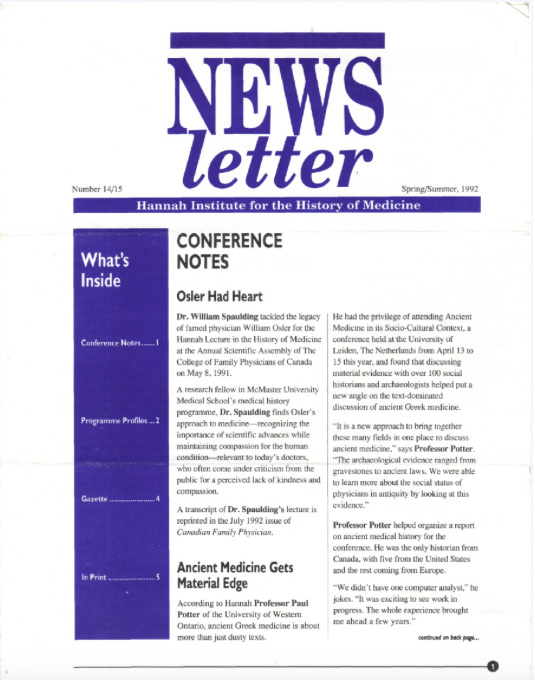
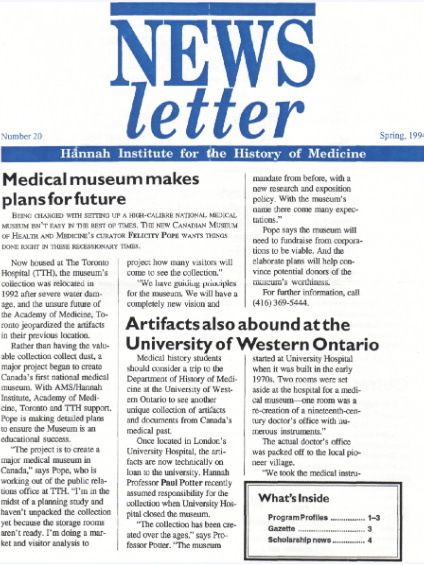
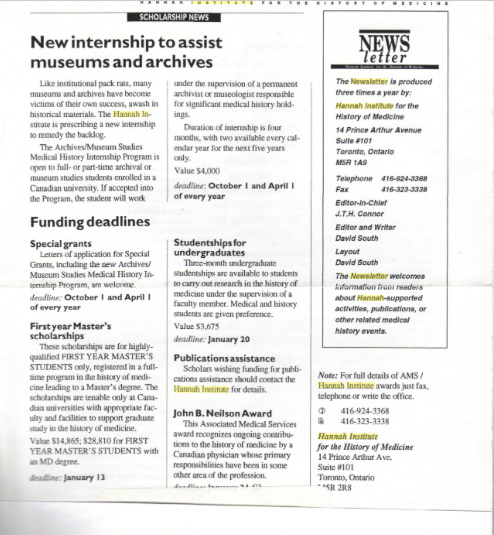
I worked as Editor and Writer for the newsletter of the Hannah Institute for the History of Medicine (under the direction of the Editor-in-Chief and Hannah Executive Director Dr. J.T. H. Connor) in the early 1990s. Located close to the University of Toronto and within a neighbourhood claiming a long association with medical and scientific discovery (Sir Frederick Banting, co-developer of insulin for the treatment of diabetes, lived at 46 Bedford Road,), the goal was to better connect Canada’s medical history community of scholars and raise the profile of the funding resources available to further the study of medical history in Canada.
The Toronto Legacy Project and Heritage Toronto plaque marking the location of Sir Frederick Banting’s former home.
I also revamped the application process for awards, scholarships and grants to make them user-friendly and compatible with word processing software packages of the time.
The Hannah Institute was the adminstrator for the grants and awards funded by AMS (Associated Medical Services). It has had a profound impact on the medical history field in Canada, as the AMS website states:
“As a result of the growth of the discipline and the burgeoning of scholarship, as well as financial support from other funding bodies, in 2006, the AMS Board of Directors decided not to provide new competitive grants and further, decided to bring AMS- administered competitive grants to closure by 2011.
In the 1970’s when the Hannah Chairs and the Hannah Institute were established, the discipline of the history of medicine was an “orphan’ within the Canadian scholarly community. Three decades later with the support of AMS, history of medicine and healthcare continued to thrive in universities and colleges across Canada.”
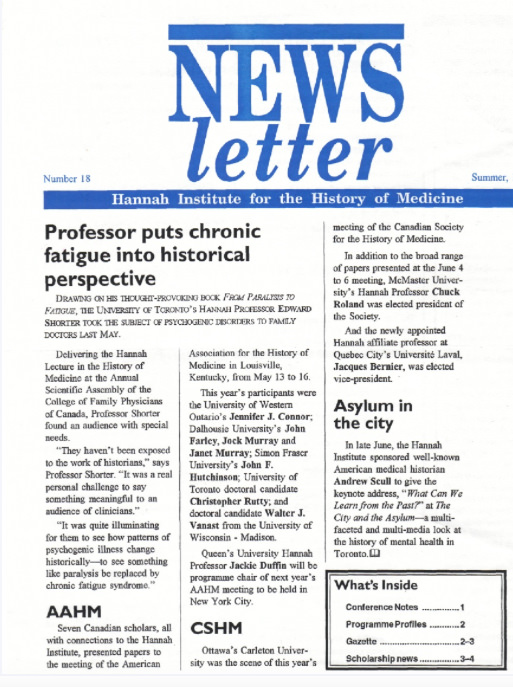
The archive of newsletters is held at the Wellcome Collection Library in London, UK and at the University of Toronto.“Professor puts chronic fatigue into historical perspective” announced the launch of a new book by the University of Toronto’s Hannah Professor Edward Shorter. Abstracts in Anthropology, Volume 43, Issues 3-4: “… in recent years it has become a pursuit for a growing number of researchers. … Behind much of this growth has been the Hannah Institute for the History of Medicine which has encouraged writing …”.





















 David South Consulting
You must be logged in to post a comment.