Tag: 1990s

  • Mongolia Looks to Become Asian IT Leader

    Mongolia Looks to Become Asian IT Leader

    By David SouthDevelopment Challenges, South-South Solutions

    SOUTH-SOUTH CASE STUDY

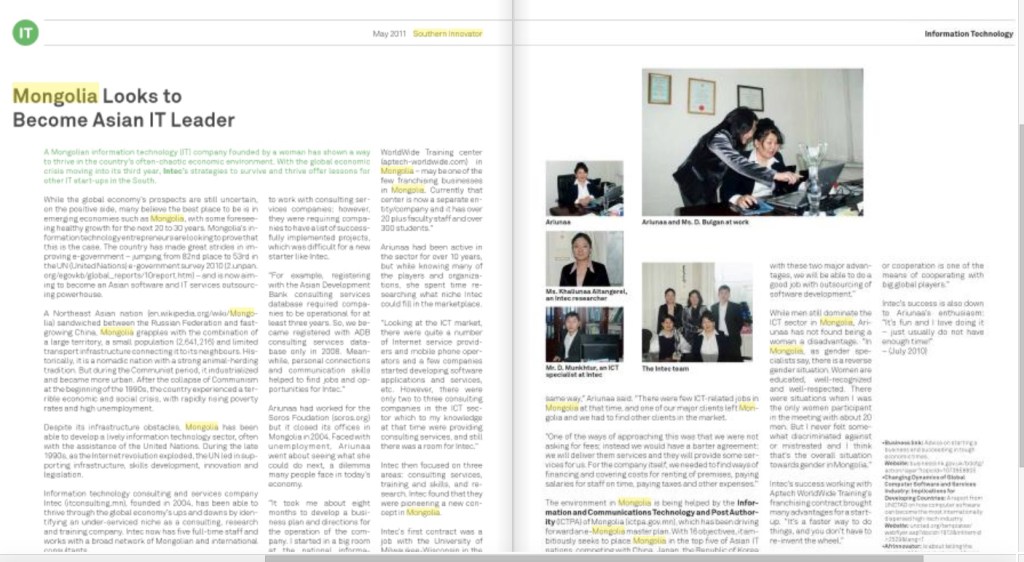
    A Mongolian information technology company founded by a woman has shown a way to thrive in the country’s often-chaotic economic environment. With the global economic crisis moving into its third year, Intec’s strategies to survive and thrive offer lessons for other IT start-ups in the South.

    While the global economy’s prospects are still uncertain, on the positive side, many believe the best place to be is in emerging economies like Mongolia, with some foreseeing healthy growth for the next 20 to 30 years. Mongolia’s information technology entrepreneurs are looking to prove this is the case. The country has made great strides in improving e-government – jumping from 82nd place to 53rd in the UN e-government survey 2010 (http://www2.unpan.org/egovkb/global_reports/10report.htm) – and is now aiming to become an Asian software and IT services outsourcing powerhouse.

    A Northeast Asian nation (http://en.wikipedia.org/wiki/Mongolia) sandwiched between Russia and fast-growing China, Mongolia grapples with the combination of a large territory, a small population (2,641,216) and limited transport infrastructure connecting it to its neighbours. Historically, it is a nomadic nation with a strong animal herding tradition. But during the Communist period, it industrialized and became more urban. After the collapse of Communism at the beginning of the 1990s, the country experienced a terrible economic and social crisis, with rapidly rising poverty rates and high unemployment.

    Despite its infrastructure obstacles, Mongolia has been able to develop a lively information technology sector, often with the assistance of the United Nations. During the late 1990s, as the internet revolution exploded, the UN led on supporting infrastructure, skills development, innovation and legislation.

    Information technology consulting and services company Intec (www.itconsulting.mn) , founded in 2004, has been able to thrive through the global economy’s ups and downs by identifying an under-serviced niche as a consulting, research and training company. Intec now has five full-time staff and works with a broad network of Mongolian and international consultants.

    As is often the case with new businesses, Intec initially found that many doors were closed to start-up enterprises.

    “The major challenges which I faced were to make people understand about the consulting services,” said Intec’s founder, Lkhagvasuren Ariunaa. “The consulting services concept was new to Mongolia and Mongolians at that time and not many organizations were willing to work with consulting services. The international and donor organizations were keen to work with consulting services companies; however, they were requiring companies to have a list of successfully implemented projects, which was difficult for a new starter like Intec.

    “For example, registering with the Asian Development Bank consulting services database required companies to be operational for at least three years. So, we got registered with ADB consulting services database only in 2008. Meanwhile, personal connections and communication skills helped to find jobs and opportunities for Intec.”

    Ariunaa had worked for the Soros Foundation (http://www.soros.org/) but it closed its offices in Mongolia in 2004. Faced with unemployment, Ariunaa went about seeing what she could do next: a dilemma many people face in today’s economy.

    “It took me about eight months to develop a business plan and directions of operation of the company. I started in a big room at the national information technology park building with one table, chair and computer.

    “It has been quite challenging years for bringing a company to the market and finding niches for us. We have franchised the Indian Aptech WorldWide Training center (http://www.aptech-worldwide.com) in Mongolia – may be one of the few franchising businesses in Mongolia. Currently that center is now a separate entity/company and it has over 20 plus faculty staff and over 300 students.”

    Ariunaa had been active in the sector for over 10 years, but while knowing many of the players and organizations, she spent time researching what niche Intec could fill in the marketplace.

    “Looking at the ICT market, there were quite a number of internet service providers, mobile phone operators, a few companies started developing software applications, and services etc. However, there were only two to three consulting companies in the ICT sector which to my knowledge at that time were providing consulting services, and still there was a room for Intec.”

    Intec then focused on three areas: consulting services, training and skills, and research. Intec found they were pioneering a new concept in Mongolia.

    Intec’s first contract was a job with the University of Milwaukee-Wisconsin in the United States to organize a three week course for American students to learn about the digital divide in Mongolia. But the global economic crisis hit Mongolia hard in 2009.

    “It was challenging to survive and continue working the same way,” Ariunaa said. “There were few ICT-related jobs in Mongolia at that time, and one of our major clients left Mongolia and we had to find other clients in the market.

    “One of the ways of approaching this was that we were not asking for fees, instead we would have a barter agreement – we will deliver them services and they will provide some services for us. For the company itself, we needed to find ways of financing and covering costs for renting of premises, paying salaries for staff on time, paying taxes and other expenses.”

    The environment in Mongolia is being helped by the Information and Communications Technology and Post Authority (ICTPA) of Mongolia (http://www.ictpa.gov.mn) , which has been driving forward an e-Mongolia master plan. With 16 objectives, it ambitiously seeks to place Mongolia in the top five of Asian IT nations, competing with South Korea, Singapore, Japan and China.

    Ariunaa believes Mongolia has many competitive advantages. “Mongolia is known for a high-literacy rate and math-oriented training and education, and ICT specialists are targeting to become a software outsourcing country for other countries. Another advantage of Mongolians is that they can easily learn other languages: we are fluent in Russian, English, Japanese, Korean, German and we believe that with these two major advantages, we will be able to do a good job with outsourcing of software development.”

    While men still dominate the ICT sector in Mongolia, Ariunaa has not found being a woman a disadvantage. “In Mongolia, as gender specialists say, there is a reverse gender situation. Women are educated, well-recognized and well-respected. There were situations, when I was the only women participant in the meeting with about 20 men. But I never felt somewhat discriminated or mis-treated and I think that’s the overall situation towards gender in Mongolia.”

    Intec’s success working with Aptech WorldWide Training’s franchising contract brought many advantages for a start-up. “It’s a faster way to do things, and you don’t have to re-invent the wheel.”

    As a Mongolian company, Intec has found it best to play to its local strengths. “National companies have knowledge, expertise and experience of local situations, know players and understand about legal, regulatory matters. … partnership or cooperation are one of the means of cooperating with big global players.”

    Intec’s success is also down to Ariunaa’s enthusiasm: “It’s fun and I love doing it – just usually do not have enough time!”

    Published: July 2010

    Resources

    1)  Advice on starting a business and succeeding in tough economic times. Website:http://www.businesslink.gov.uk/bdotg/action/layer?topicId=1073858805

    2) Changing Dynamics of Global Computer Software and Services Industry: Implications for Developing Countries: A report from UNCTAD on how computer software can become the most internationally dispersed high-tech industry. Website:http://www.unctad.org/templates/webflyer.asp?docid=1913&intitemid=2529&lang=1

    3) Afrinnovator: Is about telling the stories of African start-ups, African innovation, African made technology, African tech entrepreneurship and entrepreneurs. Their mission is to ‘Put Africa on the Map’ by covering these kinds of stories from all over Africa. As their website says, “if we don’t tell our own story, who will tell it for us?” Website:http://afrinnovator.com

    4) TechMasai: Pan-African start-up news and reviews. Website: www.techmasai.com

    5) Ger Magazine Project: Mongolia’s first online magazine pioneered communicating on the web. Website: http://en.wikipedia.org/wiki/Ger_magazine

    Development Challenges, South-South Solutions was launched as an e-newsletter in 2006 by UNDP’s South-South Cooperation Unit (now the United Nations Office for South-South Cooperation) based in New York, USA. It led on profiling the rise of the global South as an economic powerhouse and was one of the first regular publications to champion the global South’s innovators, entrepreneurs, and pioneers. It tracked the key trends that are now so profoundly reshaping how development is seen and done. This includes the rapid take-up of mobile phones and information technology in the global South (as profiled in the first issue of magazine Southern Innovator), the move to becoming a majority urban world, a growing global innovator culture, and the plethora of solutions being developed in the global South to tackle its problems and improve living conditions and boost human development. The success of the e-newsletter led to the launch of the magazine Southern Innovator. 

    Creative Commons License

    This work is licensed under a
    Creative Commons Attribution-Noncommercial-No Derivative Works 3.0 License.

    Launched in 1997 in a major crisis, the UN Mongolia Development Portal (www.un-mongolia.mn) became the country’s largest online bilingual publisher and an award-winning pioneer of web content. It proved Mongolia had the potential to innovate in digital.
    Story featured in the UN E-Government Knowledgebase and E-Government Survey in Media.
    Posted in 2010 on the Unuudur.com (“The latest news of Mongolia in the world”) website.
    Creative Commons License

    This work is licensed under a
    Creative Commons Attribution-Noncommercial-No Derivative Works 3.0 License.

    ORCID iD: https://orcid.org/0000-0001-5311-1052.

    © David South Consulting 2023

  • The Big Dump: CP’s New Operational Plan Leaves Critics With Questions Aplenty

    The Big Dump: CP’s New Operational Plan Leaves Critics With Questions Aplenty

    By David South

    Scan Magazine (Toronto, Canada), June/July, 1997

    Gloria Galloway is one of two Canadian Press staffers holding down the Ontario desk one Friday evening in May. She has the jumpy manner you’d expect from an acting news editor entangled in deadlines at the national wire service. She cheerfully describes how cooperative the Northern Ontario newspapers are in filing stories on the federal election campaign. But the reality driving that cooperation is not so cheery. As a result of staff cuts, the only CP reporters available are tied up covering government announcements at the Ontario legislature.

    It has been nearly a month since CP’s board of directors gave final approval to a plan to revamp the service. The plan caps a crisis-filled year during which many feared the agency would go belly up. But do the changes make CP’s future any more secure?

    On her computer screen, Galloway pulls up a long list of stories filed that day by various member newspapers. It’s an impressive list that suggests the ‘New CP’ concept might work. Certainly Galloway has the stoic, ‘we have to make it work, it’s our job’ attitude that’s common at CP.

    Attitude isn’t everything, though. There are serious gaps in the plan that continue to leave CP vulnerable to a future crisis. The new plan calls for CP to rely on its owners – the nearly 90 member papers – to contribute the bulk of its stories, leaving CP acting more like a traffic cop than a traditional wire service. This Faustian deal means a reduced role for CP as a newsgatherer, with a restricted mandate to cover stories newspaper editors can anticipate, like press conferences and court decisions, as well as breaking news.

    Beyond that, the plan is short on details. It fails to offer any coherant timetable for its implementation, nor does it address the likelihood, due to declining newspaper circulations, of further reductions in the fees CP’s members pay next year. CP already dropped its fees 25 percent for 1997 to keep Southam Newspapers from leaving the cooperative. The rollback precipitated major staff reductions at CP.

    The deal’s most significant achievement is a pledge by all member papers to work with CP to ensure its survival and save everyone money.

    Newspaper editors will have to tell CP a day in advance what stories they are covering and who has been assigned. Using this information, so the theory goes, it will be possible to avoid assigning several reporters from competing papers to cover a story when one will do. A reporter will not only be working for his or her own paper that day, but for every CP paper, and will be expected to file updates throughout the day to a CP editor, who in turn will write the story that is then ‘wired’ to all the members. That way, it is hoped, no superfluous stories will be going out on the wire. Member papers will still file analytical and feature stories to CP but, as is the case now, they are under no obligation to give away their prized family jewels – exclusive stories – to other CP papers.

    In practical terms, the new approach has been creeping into CP’s way of doing things by stealth rather than command. CP has been increasing its reliance on member papers to pick up the slack when CP reporters aren’t available. The most recent example was the federal election campaign: only one CP reporter was assigned full-time to cover the whole campaign. The rest of the coverage was handled by a combination of CP bureau staff and member paper reporters.

    While many smaller papers are dependent on CP for their provincial, national and international stories, the bigger papers, who are the main sources of these stories, can afford to be blase’. Their willingness to co-operate will decide the success or failure of the member-exchange component of CP.

    Southam’s vice-president of editorial, Gordon Fisher, maintains his papers will support the plan because it will save his company approximately $2.5 million a year. “We pay a significant amount of money towards this cooperative,” he maintains. “A member exchange is one of the more efficient ways we can find to deliver news without incurring a huge amount of expense.”

    “What is CP needs a story earlier than a reporter normally files?” asks managing editor Jane Perves of Halifax’s Chronicle-Herald and Mail-Star. “Theoretically, they should be spending all their time doing the story for our paper.”

    Jane Purves is an enthusiastic supporter of CP. Nonetheless she wonders if CP editors will be caught in a contest of wills with editors at member papers. She would like to see a reporter’s CP obligations involve simply calling in a quote or raw data. She would have a problem if a reporter working on a major story for her paper was distracted by CP’s needs.

    The Globe and Mail is conidering hiring a full-time co-ordinator to handle the heavy volume of stories that paper generates for CP. Newspaper managers elsewhere are split on the question of whether the plan will increase workloads. The extent that it does so will be a crucial test of their commitment.

    Not only will editors need to regularly ‘loan’ reporters to CP, they will have to change how they do things on a daily basis if the plan is to work. Editors will have to file an assignment list one day in advance to CP, a task that could get easily overlooked when papers get hit with multiple big stories.

    “It’s pretty minor stuff,” says Perry Beverley, the co-publisher of Brockville’s Recorder and Times. Although the Recorder and Times is an afternoon paper where copy is edited in the morning, Beverley has no plans to switch an editor to an evening shift to fit CP’s deadlines.

    Deadlines are a particularly thorny question in a country that spans six time zones. Newspapers on the East coast can file stories at the end of the day and still meet CP deadlines that are pegged at Toronto time. The problem is with newspapers west of Ontario; they will have to file stories well before the end of the day. In the case of B.C., filing will have to be done in the morning so that stories picked up by CP will be ready in time for East coast papers.

    The copy will have to go out to CP unedited.

    At the Edmonton Sun, editor-in-chief Paul Stanway isn’t sanguine about sending out unedited copy. Stanway had editorial deadlines pushed back to 6 p.m. 18 months ago as part of a re-organization at the paper, but they still mean copy would be sent straight from reporters to CP, where copy needs to be in between 4 p.m. and 9 p.m. Toronto time. Stanway is concerned the CP staff will not have the time to fact-check stories to weed out mistakes, which would reflect poorly on his paper.

    The anticipated deadline crunch has been nicknamed “the big dump” in CP circles: a tidal wave of material hitting the wire service’s desks all at once, leaving editors scrambling to do re-writes before newspapers are put to bed.

    CP general manager Jim Poling, who vacates he job in June, believes this problem will be solved by the restructuring, not exacerbated by it. “The volume of copy has already dropped significantly,” he says. “We are hoping for a wider spectrum of deadlines. Hopefully you are going to get your copy spread out over a longer period, instead of over the course of a couple of hours. You might not need a massive shift of people to a certain time.”

    Poling claims the resolution is in better planning which will result in fewer unwanted stories. Fewer stories, so Poling maintains, means more time for editors to re-write.

    At CP’s Winnipeg bureau, Canadian Media Guild vice-president Scott Edmonds is sceptical. He isn’t convinced the slimmed down CP will have the staff to handle what he sees as an increasing workload.

    “It sounds like the meatgrinder approach to journalism,”says Edmonds. “There is no way these desks are going to be able to cope with any degree of thoughtfulness with this copy. The pressure is going to be too great.”

    Edmonds also sees a bigger problem in staff moral. “The majority of people working for Canadian Press don’t want their career to end up as a re-writer… It will require a lot more attention on the desk for this material, so we will be taking resources away from reporting. In other words, taking somebody away from doing the story to redoing the story.”

    CP’s raison d’etre is its ability to turn out stories written in a homogenous national voice that can be tailored for a specific paper’s readers. Another important asset is the agency’s ability to quickly add knowledge and background to stories, drawing on the experience of its reporters and editors. According to Martin O’Hanlon at CP’s Ontario Desk, cut-backs have compromised this ability. Three business reporters have been poached by the Financial Post, including Ian Jack and Sandy Rubin. Over 40 talented reporters and editors took buyouts in the fall of 1996.

    This means CP isn’t as well equipped as it once was to turn raw copy from reporters into high-quality journalism that can draw the respect and admiration of its subjects.

    “Our reporters are not trained to write for a national audience,” emphasizes Jane Purves in Halifax.

    Scott Edmonds doesn’t believe member contributors are a substitute for CP staff. “I’m very concerned about attempting to replace quality staf-written material that caters to a national audience and is written to uniform standards, with material picked up from newspapers that in some cases may be very good, but in some cases may not be of the same quality.”

    There is a great deal of confusion over when the plan is supposed to kick in. One camp, which includes Jim Poling, sees it more as a gradual, evolutionary change that will take several years to fine tune. There are others who want to see trial runs. Still others believe there will be a date set for a total national switch-over.

    Perry Beverley favours test sites and single switch-over date.

    “Once that D-Day time is chosen for the switch-over into the restructured CP,” she says, “there will be an appointed person in the newsroom responsible for sending the schedule to CP.”

    Purves favours a gradual switch. “A shot-gun approach might backfire. I’d rather have a gradual approach providing we had a starting date and an aim.”

    “We don’t have to have a roll-out day,” says Poling. “But if all the managers and staff rise up and say ‘shit, we need test sites,’ then I will listen. Anybody who is waiting for a date will be disappointed. All of this started a long time ago and is a continuing process that will take a couple of years to get everything in place.”

    Seven regional news committees will co-ordinate and oversee this new approach, each one staffed by representatives from member papers and CP. According to the plan, these regional news committees will act as enforcers for the new regime. They will work out the logistics of member exchange and use fines to penalize papers that miss deadlines or obstruct exchange.

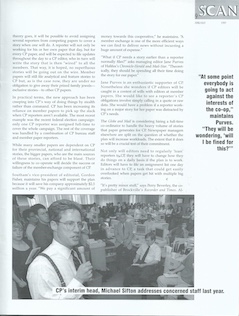
    How such an approach would work in practice is still up in the air. “At some point everybody is going to act against the interests of the co-op,” maintains Purves. “They will be wondering, ‘will I be fined for this?’”

    Nobody contacted by SCAN could tell us what these fines would be, how violations would be investigated or what constituted offences. Purves wondered what deterrence value the fines would have if a paper thought it had acted in its best interests. If paper X decided to hold back a juicy scoop that was supposed to be that day’s CP story, a fine of $2,000 might be worth incurring if it sells more newspapers. It was generally agreed none of these committees would meet until after the federal election at the earliest.

    For now, Poling is generally optimistic (though he won’t around past June and a replacement has yet to be found). He is talking about raising salaries for the first time in five years, about hiring new staff, about stabilizing life at CP.

    The lower fees have lured back one newspaper group, British Columbia’s Sterling. A trial use of CP stories started at the beginning of May. It remains to be seen whether New Brunswick’s Telegraph Journal/Times Globe papers will return, after pulling out of CP in 1993 and hiring more of its own reporters with the money saved. Publisher Jamie Milne remains coy as to his interest in returning to CP, but Poling thinks a deal will be worked out by the fall.

    And what about the mood of the man charged with overseeing CP’s transition? Jim Poling, as some CP staffers like to mention, is losing that cautious reserve managers usually have for talking to the media. He isn’t happy with the state of the print media in Canada.

    “There has been a lot of cutting in this industry,” says an audibly frustrated Poling. “The fact of the matter is this: cutting isn’t the only answer to having an efficient operation. There has to be some money available to allow journalists to walk around a bit. People who walk around and poke at things and stare at things write good stories.”

    With phones ringing all around us, Galloway begins to think out loud about possible wrinkles in the new CP plan: how newspaper reporters at trials will have to keep leaving the courtroom to file updates for CP, how stories written for local papers will translate for national readers, how hard it can be for local, non-CP reporters to cover elections when they don’t know what questions have been asked elsewhere on the campaign trail.

    But Galloway has to get back to work. She has to push the Toronto Star to file a story early so the Hamilton Spectator can pick it up.

    Scan magazine was published for media professionals in Toronto, Canada in the 1990s.
    “The Big Dump”
    Breaking the news to CP staff.

    https://davidsouthconsulting.org/2022/10/21/african-media-changing-to-reach-growing-middle-class/

    https://davidsouthconsulting.org/2021/06/14/case-study-1-investigative-journalism-1991-1997-2/

    https://davidsouthconsulting.org/2021/07/14/freedom-of-expression-introducing-investigative-journalism-to-local-media-in-mongolia-1999-25-january-2016/

    https://davidsouthconsulting.org/2021/05/25/ger-mongolias-first-web-magazine-and-a-pioneering-web-project-for-the-united-nations-12-january-2016/

    https://davidsouthconsulting.org/2022/05/16/high-impact-communications-in-a-major-crisis-undp-mongolia-1997-1999-18-february-2016/

    https://davidsouthconsulting.org/2021/07/25/in-their-own-words-selected-writings-by-journalists-on-mongolia-1997-1999-6-january-2010/

    https://davidsouthconsulting.org/2022/11/01/indian-newspapers-thrive-with-economy/

    https://davidsouthconsulting.org/2022/05/27/media/

    https://davidsouthconsulting.org/2022/11/01/new-journal-celebrates-vibrancy-of-modern-africa/

    https://davidsouthconsulting.org/2021/12/08/new-media-markets-and-screen-finance/

    https://davidsouthconsulting.org/2022/10/04/popular-chinese-social-media-chase-new-markets/

    https://davidsouthconsulting.org/2022/11/23/publications/

    https://davidsouthconsulting.org/2021/01/16/redneck-renaissance-a-coterie-of-journalists-turn-cracker-culture-into-a-leisure-lifestyle/

    https://davidsouthconsulting.org/2021/01/14/from-special-report-nmm-new-media-markets-spotlight-on-the-emergence-of-satellite-porn-channels-in-the-uk/

    https://davidsouthconsulting.org/2020/12/11/top-reporters-offer-military-media-handling-tips/

    https://davidsouthconsulting.org/2020/12/11/undercurrents-a-cancellation-at-cbc-tv-raises-a-host-of-issues-for-the-future/

    https://davidsouthconsulting.org/2022/05/27/undp-travelling-seminar-environment-and-development-mongolia-1998/

    Creative Commons License

    This work is licensed under a
    Creative Commons Attribution-Noncommercial-No Derivative Works 3.0 License.

    ORCID iD: https://orcid.org/0000-0001-5311-1052.

    © David South Consulting 2023

  • Undercurrents: A Cancellation At CBC TV Raises A Host Of Issues For The Future

    Undercurrents: A Cancellation At CBC TV Raises A Host Of Issues For The Future

    By David South

    Scan Magazine (Canada), April/May 1997

    The screensaver on an Undercurrents researcher’s computer terminal bears a maxim that might strike a chord in a lot of CBC units these days: “Only the paranoid survive.”

    The quirky media and technology show will fade to black at the end of March. Its cancellation raises a host of issues for a CBC deeply troubled by budget cuts, an ageing audience, a dearth of alternative programme concepts and an inability to plan for a future.

    In the show’s pilot, Wendy Mesley – Undercurrents’ host and progenitor – set the tone for this accessible look at the relationship among technology, media and society: “Like it or not we are living in a wired world where OJ Simpson, Big Brother, even your bank machine, all converge … we’ll explore all the issues, the undercurrents of the information age.”

    To those who loved it, Undercurrents was a program that satisfied a vital public need, and an ambitious concept for a public broadcaster that some say had grown a little musty. The show promised avant-garde production and investigative journalism that critically explored today’s new media and technology culture. Youngish researchers and producers were hired from outside the CBC. They brought with them experience and new ideas from specialty channels, TV Ontario and CTV. Some came straight out of journalism school.

    Critical reaction to the first programs was mixed. John Doyle, a critic with the Globe and Mail’s Broadcast Week, lauded Undercurrents when it launched, calling it “a superb example of  solid CBC-TV journalism and original reporting.” Others were less flattering. The Toronto Star’s Greg Quill accused the show of “flirting with infotainment.” At the Vancouver Sun, Alex Strachan wasn’t impressed by a report on a weekend conclave of computer geeks in the California desert for a kind of Hackerstock. “It sounds interesting,” he wrote, “but it isn’t.”

    What hurt more was schedulers playing musicial chairs with the show’s slot. Switching Undercurrents from Tuesday at 7 pm to Friday at 7 pm midway through its life left viewers confused and sent ratings plummeting just as network programmers were casting about for places to apply a whopping 30 percent budget cut. As a result, some feel the show never had a fighting chance.

    In the end, it was the show’s precarious financial arrangement that killed it. Undercurrents was never funded from the general current affairs budget. Instead, it drew on a special reserve of cash created by the network. When it came time to mete out the cuts in December, the special funding bubble burst. Rather than cut further into the budgets of flagship current affairs programs, executives chose to drop Undercurrents.

    Executive producer Frances Mary (FM) Morrison acknowledges that gratitude for her program’s special funding obscured a recognition of its fragility. “That was really our Achilles heel,” she says. “We were just this little orphan that didn’t have its own money. We weren’t adopted into the larger family.”

    With the network funding gone, Undercurrents’ budget (rumoured to be over a million dollars per season) was nowhere to be found. Discussions about chasing a corporate sponsor went nowhere because the show needed more money than any sponsor could have provided. “It was never an issue of $100,000 or $200,000,” says Morrison. “It was the issue of our entire budget. [CBC] would still have had to come up with the rest of it.”

    CBC TV’s news, current affairs and Newsworld director Bob Culbert and former current affairs head Norm Bolen both say they wanted the show to stay on the air but couldn’t find a way to fund it withou seriously hurting programs like The Fifth Estate, Marketplace and Venture.

    Bolen, now VP of programming at the History and Entertainment Network, says it came down to choosing between The Health Show and Undercurrents. The Health Show won because it had a “bigger audience, a broader demographic and was bringing in revenue from sales of programming to the specialty channels.”

    Mesley has another theory. “The majority of people who worked on this programme are not traditional CBCers… They can’t bump, they don’t get huge severance packages. Of course, if you want a future, those are the wrong reasons for letting people go.”

    With its intensive focus on issues like the abuse of computer-morphed images, surreptitious “data-mining” of consumer purchase records, or media “freebies,” there’s no question that Undercurrents has met a need in this media-saturated world. But controversy over the cancellation centres on the age-old question of CBC and the youth audience.

    Morrison and Mesley both say they intended the show to appeal to a younger-than-usual CBC audience. But CBC executives weren’t convinced it was an audience the network could, or should, go after. According to Culbert, a youth mandate was something the production team brought to Undercurrents. “It started as a media ethics show targeted at a classic CBC audience. Nobody sat around one day and said ‘let’s invent the show that will go after younger viewers.’”

    Bolen expresses a profound lack of faith in the under-30 audience. “People under 30 don’t watch information programming, okay? Let’s get that straight. I sure wouldn’t spend the rest of my life trying to get an audience that doesn’t watch a certain genre of programming. This is a business where you pay attention to reality. People under 30 watch trashy American sitcoms, which I’m not in the business of doing, and which the CBC isn’t in the business of doing.”

    “I think that’s bullshit,” says Reid Willis, producer and director of CityTV’s Media Television. “People under 30 are interested in what’s going on in the media. The 20 to 30 group is more media savvy than the generation that preceded them.” But Willis thinks the lack of information programming pitched at a young audience is down to a lack of interest from advertisers.

    Mesley and Morrison remain convinced Undercurrents did appeal to a younger audience, but felt it was sabotaged by the schedule shuffling. In the show’s first slot, Tuesdays at 7 pm, its average audience was 499,000. The biggest night came on Sunday, October 22, 1995 when a repeat aired at 9:30 pm got an audience of 865,000. But Undercurrents’ debut in the 96/97 season in its new 7 pm slot on Fridays was demoralizing for the crew. Morrison reports the audience for the season opener at 438,000 and 434,000 for a strong programme the following week.

    She says the numbers built as audiences found the programme’s new location, peaking at 678,000 on December 6. According to CBC audience research figures, average minute audience for the 96/97 season to February 2 stood at 518,000 viewers.

    “Friday at seven was not a good place for Undercurrents,” claims Morrison. “It’s an older audience. In fact the audience for Air Farce [which followed Undercurrents at 7:30] is quite old, surprisingly old. I was actually astonished to find out how old that audience was.”

    CBC audience research bears Morrison out, reporting that the 18-34 demographic for both Air Farce and Undercurrents has been identical this season – a mere 14 percent of the total audience.

    Fridays at seven is also a heavily competitive slot packed with overhyped American tabloid TV shows like Entertainment Tonight, Inside Edition, Hard Copy and A Current Affair. Morrison says focus groups told her that audiences in that time period surf around looking for stories they like and then switch around with no loyalty to a particular programme.

    “People build a menu. We took a leaf out of the tabloid book in terms of our presentation in order to survive in the seven o’clock environment.”

    Undercurrents’ jerky camera work and flashy graphics didn’t endear itself to everyone, a fact the show’s producers recognized early on. “I can point to stories where we sabotaged ourselves with stylistic extremes,” admits Morrison.

    But Mesley bristles at accusations the show was all style and no content, or a clone of Media Television. “We are the antithesis of Media Television. Obviously everyone has adopted their style from rock videos.  But they get nearly all their video as handouts. We are not saying, ‘This is hip.’ We are not saying, ‘This is the latest consumer thing you can add to your collection.’ We are saying ‘Think about this.’”

    Undercurrents’producers express pride in the show’s innovations. They cite its lead role in web page design at the corporation., its efforts at promoting a more playful visual presentation, and its success in promoting an acceptance of media stories elsewhere in news and current affairs. But what seemed to enliven everyone interviewed for this story was a love of the public broadcasting ethos, where stories are told because they are important, not because advertisers say they are important. Many of the young researchers and producers at Undercurrents had done time at the privates, and appreciated the freedom and extensive resources offered by the CBC. But they felt they had come to a CBC whose values were in peril.

    “It will be like C-SPAN here,” quipped an Undercurrents freelancer who has done time at the specialty channels.

    Others who thrived in the upbeat atmosphere at Undercurrents say they’re not too keen to look for work elsewhere in the CBC. One such is 25-year-old researcher Bret Dawson. “It’s not a happy place,” he says.

    It’s not clear what, if any, programming will replace Undercurrents. If the current trend prevails, it looks like any new programming will have to survive on a smaller budget, generate outside income and prove it can draw in viewers in short order. Under those conditions, people at Undercurrents and elsewhere wonder how long CBC’s commitment to innovative new programming  can hold out.

    CBC TV’s Undercurrents host Wendy Mesley. Scan Magazine was published in the 1990s for Canadian media professionals.

    In 2021 Wendy Mesley commented on the story in a Tweet.

    More from Scan Magazine:

    The Big Dump: CP’s New Operational Plan Leaves Critics With Questions Aplenty

    https://davidsouthconsulting.org/2021/02/05/channel-regulation-swedes-will-fight-childrens-advertising-all-the-way/

    https://davidsouthconsulting.org/2021/02/03/do-tv-porn-channels-degrade-and-humiliate/

    https://davidsouthconsulting.org/2021/01/14/from-special-report-nmm-new-media-markets-spotlight-on-the-emergence-of-satellite-porn-channels-in-the-uk/

    https://davidsouthconsulting.org/2022/04/21/nsd-partners-in-bitter-row-over-choice-of-satellite-as-brussels-deadline-nears/

    https://davidsouthconsulting.org/2022/10/27/reality-television-teaches-business-skills-in-sudan/

    https://davidsouthconsulting.org/2020/12/11/tvs-moral-guide-in-question-again/

    https://davidsouthconsulting.org/2021/02/01/uk-laws-on-satellite-porn-among-toughest-in-europe/

    Creative Commons License

    This work is licensed under a
    Creative Commons Attribution-Noncommercial-No Derivative Works 3.0 License.

    ORCID iD: https://orcid.org/0000-0001-5311-1052.

    © David South Consulting 2023

  • Sex Workers’ Savings Help Make a Better Life

    Sex Workers’ Savings Help Make a Better Life

    By David SouthDevelopment Challenges, South-South Solutions

    SOUTH-SOUTH CASE STUDY

    Prostitution is called the world’s oldest profession, and can be found in one form or another in every country and society. And where poverty is rife and women have few economic choices, it flourishes. But it also flourishes in societies and economies undergoing rapid change, and where people move around more and more, as in the South’s fast-growing cities.

    The money to be made trafficking people for the sex trade is huge. Sex trafficking is organized crime’s fastest growing business, with up to two million people worldwide – mostly women and children – trafficked into the sex trade every year (UN). Approximately 80 percent of today’s trafficked people around the world are female, and up to 50 percent are under the age of 18 (The New Global Slave Trade by Ethan B. Kapstein).

    It is difficult to gauge the total number of prostitutes in the South: often, many women drift in and out of the profession for economic reasons. In Cambodia for example, Oxfam (http://www.oxfam.org.uk/) has put the number as high as 300,000 to 500,000, with one third of the sex workers below the age of 18. In India, there are more than 7 million prostitutes (UNICEF). It’s thought more than a third are forced into the sex trade, and most are under the age of 18. Many are between 12 and 15 years old.

    In India, Mumbai’s Kamathipura (http://www.netphotograph.com/viewset.php?id=23) area is called Asia’s biggest home to brothels: over 150,000 prostitutes work there. The women can make as little as 10 rupees (US 23 cents) per customer, and many have been sold by sex traffickers. But prostitutes in Kamathipura are being helped to get out of the poverty trap that leads them into sex work. Population Services International (www.psi.org) has set up bank accounts for the women working as prostitutes in the area so they can start saving to be able to buy their way to a better life. By saving as little as 10 rupees with each deposit, the women are able to set aside money and keep it safe from theft and from the pimps and madams who run the brothels.

    “It has helped a lot,” Reena, who moved to the area from Calcutta, told the Independent newspaper. “Now no one can steal the money.”

    “I was tricked here. I was in love with a man and came here with him. But when I got here he sold me,” said Simla, 42, from Nepal. Simla has two children outside the red light district and the money she saved was for school fees. Simla wants her children to avoid her fate: “I was fooled into this. I will not allow my children to do it,” she said.

    The bank accounts work like this: one of the women walks around the area with an envelope and a notebook. She gathers money from the sex workers, which is then deposited into a single bank account under the Sangini co-operative. When one of the women wants to get some money, it is returned by the cooperative. To date, over 2,500 women have deposited more than US $157,477.

    How does this money-saving help the women? Apart from slowly building up some wealth, it also gives them power; the power to say “no” to a customer who refuses to use a condom or who is abusive. It takes away a bit of the daily desperation that forces so many women to do things they don’t want to just to survive another day.

    And it is important their savings grow if they are to have a better future: competition is getting fiercer as the crisis in India’s rural areas drives more women to the cities. And more turn to prostitution to survive. This has its own market dynamics: younger women become the desired commodity and older prostitutes see their incomes go down – a young woman can charge 100 rupees (US $2.31) for sex, while older women only get 30 rupees (US 69 cents).

    Resources

    • Coalition Against Trafficking in Women – Asia Pacific: international network of feminist groups, organizations and individuals fighting the sexual exploitation of women globally. Websitehttp://www.catw-ap.org/
    • UN.GIFT: Global Initiative to Fight Human Trafficking: this website is packed with resources, including an anti-trafficking toolkit. Websitehttp://www.ungift.org/
    • Anti-Trafficking Alliance: A charity founded in 2005 to prevent, tackle and eliminate forced abduction and trafficking into sexual slavery and to empower survivors. Websitehttp://www.atalliance.org.uk/
    • Trading Women: a documentary about sex trafficking of women in the Thai sex trade narrated by Angelina Jolie. Websitehttp://www.un.org/Pubs/chronicle/2003/issue2/0203p37.html

    More on the role played by sex work in an economic crisis (especially as a survival and/or resilience strategy), or when there are high levels of poverty present in a country:

    Risks and resiliency of women engaged in sex work in Mongolia

    Authored by: Catherine E. Carlson , Laura Cordisco Tsai , Toivgoo Aira , Marion Riedel , Susan S. Witte

    Routledge Handbook of Sexuality Studies in East Asia

    Read more on sex work in the 1990s here: From Special Report: Sexual Dealing: Today’s Sex Toys Are Credit Cards & Cash: A Report On The Sex-For-Money Revolution

    Read more on the development of sex new media in the 1990s here: From Special Report: NMM (New Media Markets) Spotlight On The Emergence Of Satellite Porn Channels In The UK

    Financial Times business card 1995
    As a reporter for two Financial Times newsletters, New Media Markets and Screen Finance, I covered the rapidly growing UK (and Scandinavian) television and new media markets and the expanding film-financing sector in Europe.

    And from the WHO (World Health Organization): Sex Workers: Part of the Solution

    Creative Commons License

    This work is licensed under a
    Creative Commons Attribution-Noncommercial-No Derivative Works 3.0 License.

    ORCID iD: https://orcid.org/0000-0001-5311-1052.

    © David South Consulting 2022