Tag: 1990s

  • Health Care On The Cutting Block: Ministry Hopes For Efficiency With Search And Destroy Tactics

    Health Care On The Cutting Block: Ministry Hopes For Efficiency With Search And Destroy Tactics

    By David South

    Today’s Seniors (Canada), August 1993

    It’s search and destroy time at Ontario’s ministry of health: search out savings and destroy inefficiency and waste. But many remain apprehensive that not all the cuts are going to be logical and fear the province’s health and well-being will be affected. 

    As part of the social contract deal, the Ontario Medical Association must find $20 million in cuts from the list of services covered by OHIP. The OMA and the provincial government are currently haggling over which procedures and examinations will be cut. 

    “We look at services that aren’t medically necessary,” says health ministry spokesperson Layne Verbeek. “Because we were wealthier in the past, we were able to cover some services. We aren’t in that position now. But I don’t see how eliminating medically unnecessary treatments will affect the population.”

    The fallout of the Rae government’s attempts to reign in costs and recover lost revenues may take years to unfold, but it is already apparent that Ontarians will be paying more. 

    “Access to necessary treatment should not depend on a person’s ability to pay,” says health policy critic Carol Kushner. “What disturbs me about any delisting program is that virtually every medical service could be termed medially necessary. There are very few services that are an out-and-out waste of time.

    “We often point to the fact that Ontario spends $200 million a year treating the common cold. Well, most of that is a waste of time. But delisting even that kind of service would be a detriment to the public’s health, because a small group of patients really do need to see a doctor when they have a cold.”

    OMA spokesperson Jean Chow says it’s too early to pin down the exact cuts that will be made. “It’s a little premature to try and speculate what the final list will be.”

    The newly-created Non-Tax Revenue Group is hard at work finding fees, fines and penalities the government can add or hike to boost revenue from this source from $5 billion to $10 billion a year. 

    The spring budget saw the first hit, with the addition of $240 million in non-tax revenue. 

    A radical reshaping of medicare is taking place. Private sector services – for which consumers pay directly or through insurance companies – now make up 34 per cent of Ontario’s health care funding, compared to 42 per cent in the United States, according to a recent study by the Canadian Medical Association. 

    Health minister Ruth Grier has also floated the idea of widespread hospital closures. Both the Toronto and Windsor district health councils (DHCs) are carrying out feasibility studies on “reconfiguration.” The ministry is remaining tight-lipped about which hospitals will get the chop. 

    “One suspects there’s room for efficiency – there are a lot of empty beds in a number of different places,” says ministry spokesperson Verbeek. 

    “All hospitals are being reviewed, with a view to closing one or two hospitals,” says health planner Lisa Paolatto, who is working on a feasibility study on “reconfiguration” for the Essex County District Health Council, along with Toronto’s DHC. 

    Closing hospitals could present a serious political hot potato for the government. In Britain, the Conservative government is still recovering from the bad feelings surrounding proposals to close world-renowned hospitals in the London area. The public feels great loyalty to local hospitals, a feeling that has been further fostered by hospital charities that raise millions a year from the communities’ good will. 

    “This is going to open up new discussions of money between doctors and patients,” says Kushner. “Seniors are a unique group in Canada because they remember what it was like before medicare – what it was like not to be able to pay for the doctor, to forgo treatment that they thought was necessary. They understand the financial hardship that could occur if they were unlucky enough to have a family member who needs expensive medical treatment.” 

    All Posts

    More from Canada’s Today’s Seniors

    Feds Call For AIDS, Blood System Inquiry: Some Seniors Infected

    Government Urged To Limit Free Drugs For Seniors

    Health Care On The Cutting Block: Ministry Hopes For Efficiency With Search And Destroy Tactics

    New Seniors’ Group Boosts ‘Grey Power’: Grey Panthers Chapter Opens With A Canadian Touch

    Seniors Falling Through The Health Care Cost Cracks

    ORCID iD: https://orcid.org/0000-0001-5311-1052.

    © David South Consulting 2021

  • Do TV porn channels degrade and humiliate?

    Do TV porn channels degrade and humiliate?

    By David South

    Financial Times New Media Markets (London, UK), October 26, 1995

    ISSN: 02654717

    OCLC Number / Unique Identifier: 1266447669

    Susan Sontag, the renowned American essayist, described pornography as a “crutch for the pyschologically deformed and brutalisation of the morally innocent.” The Campaign Against Pornography in the UK believes that pornography exploits women and children “in a degrading and humiliating way, often with the message that we enjoy this and want to be abused.”

    The campaign encourages its supporters to take direct action against any distributor of pornographic material as part of its wider campaign to put the industry out of business.

    The porn channels dismiss arguments that they degrade women and encourage male violence against women. Playboy managing director Rita Lewis argues that “women are happy to consume erotic imagery like pin-ups. Women are not hung-up by this anymore, they are not threatened by the fantasy women we show in our programming. We hope Playboy will lead to couples’ making love together.”

    Andrew Wren, financial director of the Adult Channel, also dismisses the link between pornographic programming and sexual violence. “I don’t think there is anything in programmes that would encourage men to go and rape. Women are interested in sex as men are.”

    Television X’s (Deric) Botham says that porn programmes are “a bit of titilation” in the fine, upstanding tradition of the British Carry On films. None the less, he admits that “I wouldn’t want my daughter to get involved in pornography.”

    He says that the women involved in the programmes, some of them housewives, are willing participants and enjoy the opportunity. “I don’t produce anything that is against the law. We speak to the individuals concerned. If you have a reluctant model, it doesn’t work – I just won’t buy the video.”

    The Campaign Against Pornography sees it all rather differently. Ann Mayne, a member of the campaign’s management committee, was particularly critical of two programmes on Television X – Shag Nasty and Mutley and Fly on the Wall.

    She said that Shag Nasty and Mutley, in which a presenter approaches women in the street or in supermarkets and offers them £25 to look at their knickers, or £50 to be filmed having sex with him, gave the message that women were simply objects and that it was acceptable to harass them.

    “It is complete prostitution of female sexuality,” she said. “Botham wants full-on, across-the-board prostitution of women. In his view, every woman must have a price.”

    Mayne said that Fly on the Wall, in which real-life couples are shown having sex, was an open invitation for men to coerce their partners into being filmed, possibly to the point of abuse.


    From Special Report: NMM (New Media Markets) Spotlight On The Emergence Of Satellite Porn Channels In The UK

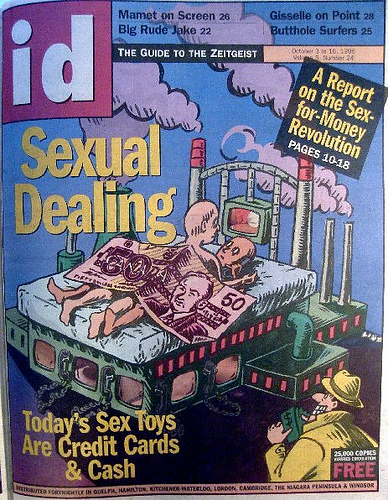
    Read more on the 1990s sex economy here: From Special Report: Sexual Dealing: Today’s Sex Toys Are Credit Cards & Cash: A Report On The Sex-For-Money Revolution

    Update: It is over 20 years since this Special Report was published. The Internet now plays a significant role in the growth of sex content and the sex industry and vice versa. Here is an interesting overview of the situation in 2020. The Internet is for Porn – It always was, it always will be.

    “One of the biggest and most interesting things happening in the consumer web right now is running almost completely under the radar. It has virtually zero Silicon Valley involvement. There are no boastful VCs getting rich. It is utterly absent from tech’s plethora of twitters, fora and media (at least, as they say, “on main”). Indeed, the true extent of its incredible success has gone almost completely unnoticed, even by its many, many, many customers.

    I’m talking, of course, about OnlyFans.” 

    ORCID iD: https://orcid.org/0000-0001-5311-1052.

    © David South Consulting 2023

  • Swing Shift: Sexual liberation is back in style

    Swing Shift: Sexual liberation is back in style

    By David South

    Id Magazine (Canada), October 3-16, 1996

    Deep in the bedrooms (and living rooms) of the home-owning classes, the sexual liberation movement marches on: swingers’ parties are back. Those libidinous libertines many thought were lost in a 70s disco haze, according to a Toronto swinger, are back in greater numbers than in those polyester days. 

    In contrast to the many people (mostly men) looking for the anonymous and on-demand buzz of escort agencies, porn videos and sex toys, it seems to me swinging is the most idealistic camp in the army of sexual liberation. There isn’t any sneaking around behind your spouse’s back – in fact, you bring them along for the good times. 

    Swingers were usually the subject of the porn movies I watched at the base cinema during my army days. They weren’t real people, but some sort of myth from more electric times. 

    Ron Michaels, 41, is an unabashed proselytizer for swinging. A strip-club DJ and erotic and commerical photographer, he’s also co-owner, along with his wife, of swingers’ club Eros. A confident and articulate spokesperson, he has been swinging since he was 17. 

    “We believe honesty is the cornerstone of our lifestyle – that makes it work,” he says. “The people engaging in back-alley sex are being dishonest. It’s the same with having an affair – wanting your cake but not being able to share it with the rest of us. 

    “Swinging is a moral alternative to having affairs.” 

    The divorce rate among swingers, Michaels maintains, is only five per cent, compared to 51 per cent for the general population. The one wrinkle in this impressive “fact” is Michaels’ other admission that many swingers are on their second “married relationship”.

    Interviewing Michaels, I feel like I’m talking to a Rotary Club member or a boy scout leader, not a swinger. The talk is about clubs, memberships ($69 a year per couple), trips. It’s a hobby, sport and lifestyle to many swingers, claims Michaels. 

    “We have regular weekly functions throughout the year. Some of them are organized by the members. We organize trips and holidays. Weekends in the Caribbean. Like any other social club.”

    That can’t be wife/husband swapping he’s talking about, can it?

    Michaels’ Toronto Beaches home leaves no doubt as to its occupant’s lifestyle choices: “If you don’t swing, don’t ring,” says a brass plaque nailed to the door. 

    Michaels is very proud of swinging’s growth in the 90s. His group has grown from 300 member-couples 14 years ago to 1,800 today. Michaels ambitiously estimates that between 100,000 and 200,000 Southern Ontarians are into swinging, between 20 and 25 million across North America. 

    So, how does swinging in the 90s work?

    Michaels says most clubs operate more as matchmaking parties than full-out orgies. Couples get to know each other and make the arrangements to meet away from the club’s party. Michaels is quick to disassociate his club from drop-in style swingers parties. 

    “Canadians are much more conservative than Americans. In New York they are more hardcore, less selective of their partners. When they get there they are more like, ‘let’s find the first available body and get to it,’ whereas people at social clubs want to get to know you. We are talking about four-way compatability here.”

    According to Michaels, the big victory for Canadian swingers took place in 1992. “Our Mississauga club was raided back in ’92 and we took it through the courts for a year. We were acquitted and set a legal precedent, making swingers’ clubs legal.”

    To many men, the whole swinging thing seems like the best of both worlds: you keep your wife and get to taste the fruits of other trees at the same time. But Michaels says this male teenage fantasy doesn’t pan out in reality. 

    “That wears off pretty quickly. Let’s face it, men have a much lower capacity for sex than women do. Men need a longer recovery period and don’t have as many orgasms in a night. Women can just go and go. Guys can’t compete with that. After a while the fantasy wears thin, and it’s the guy that wants to drop out of the lifestyle.” 

    And what about that other most-asked-question: what’s it like to see your spouse having the time of their life with your neighbour?

    “They don’t get into those kinds of comparisons. How can I describe this? It’s not a competitive thing where you try to outperform each other. Most swingers appreciate each other as being unique and different, rather than this is bigger, this is harder, this is faster, this is better. Each new experience is taken at face value, ‘Hey, it’s a good time’. You move on to the next one or you go back to your regular partner.”

    Read more on the 1990s sex economy here: From Special Report: Sexual Dealing: Today’s Sex Toys Are Credit Cards & Cash: A Report On The Sex-For-Money Revolution

    Special Report: Sexual Dealing: Today’s Sex Toys Are Credit Cards & Cash: A Report On The Sex-For-Money Revolution.

    Read more on the 1990s sex economy here: From Special Report: NMM (New Media Markets) Spotlight On The Emergence Of Satellite Porn Channels In The UK

    Update: It is over 20 years since this Special Report was published. It forecast the significant role the Internet was to play in the growth of sex content and the sex industry and vice versa. Here is an interesting overview of the situation in 2020. The Internet is for Porn – It always was, it always will be.

    “One of the biggest and most interesting things happening in the consumer web right now is running almost completely under the radar. It has virtually zero Silicon Valley involvement. There are no boastful VCs getting rich. It is utterly absent from tech’s plethora of twitters, fora and media (at least, as they say, “on main”). Indeed, the true extent of its incredible success has gone almost completely unnoticed, even by its many, many, many customers.

    I’m talking, of course, about OnlyFans.”

    ORCID iD: https://orcid.org/0000-0001-5311-1052.

    © David South Consulting 2021

  • UK laws on satellite porn among toughest in Europe

    UK laws on satellite porn among toughest in Europe

    By David South

    Financial Times New Media Markets (London, UK), October 26, 1995

    ISSN: 02654717

    OCLC Number / Unique Identifier: 1266447669

    UK regulations on what can be shown on sex channels are tougher than in most countries of the European Union. Channels such as the hard-core Swedish TV Erotica and the recently-launched French Rendezvous are licensed in their respective countries and transmit explicit scenes of sexual intercourse, straight and gay, featuring close-up shots of copulating genitals. 

    Graff Pay-Per-View, the experienced US sex channel operator, consciously decided to exclude the UK as a market for its hard-core Eurotica channel which is licensed in Denmark and, like the other hard-core channels, transmits via a Eutelsat satellite. But pirate smart cards for the channel, as for the other channels, are available in the UK in specialist satellite shops. 

    Graff’s seeming respect for the UK regulations may not be unconnected with the fact that it owns the Adult Channel and would be wary of upsetting the ITC. Broadcasting unacceptable material into the UK could provoke the ITC into seeing Graff as a body unfit to hold a licence, thereby threatening the Adult Channel. 

    The ITC’s guidelines on sexually explicit material state that representations of sexual intercourse can be shown only after 9pm and that “the portrayal of sexual behaviour, and of nudity, needs to be defensible in context and presented with tact and discretion.”

    There has been some relaxation of the rule. The ITC will, on an experimental basis, allow the watershed to be broken by a ppv or video-on-demand service. It is not, however, prepared to give this freedom to a porn channel, at least not in the early days, because it does not want to be seen to be licensing pornography. The relaxation will affect only general services. 

    The ITC will also monitor any ppv service to ensure that there are no cases of children accessing the programming before deciding if the programme code should be revised. 

    The transmission of 18-rated films on terrestrial or new-media channels is not permitted before 10pm. Films with a 15-rating are not allowed before 9pm on terrestrial channels such as BSkyB’s Sky Movies or the Movie Channel. These are minimum requirements. Some 15-rated films, for instance those which show scenes of sexual intercourse or drug-taking, would not be deemed suitable for transmission even on an encrypted channel at 8pm. 

    In practice, the ITC does not permit depictions of erect penises, anal intercourse, close-ups of genitalia or ejaculation. 

    Where channels have overstepped the mark and gone abroad to get licences from less strict authorities – the late Red Hot Dutch and TV Erotica – the ITC has recommended that the channels be proscribed, action which has subsequently been taken by the Department of National Heritage. The ITC is now monitoring the Rendezvous channel, which shows a mix of gay and heterosexual hard-core pornography with graphic scenes of sexual intercourse. 

    The DNH issues proscription orders under Sections 177 and 178 of the Broadcasting Act. The orders make it a criminal offence to supply equipment to receive the channels or to market and advertise them. 

    The European Union directive on transfrontier broadcasting lays down that one country cannot prevent the reception of channels licensed by other European Union countries. However, it allows individual governments to take action against any broadcast which could damage the physical, mental or moral development of minors. 

    From Special Report: NMM (New Media Markets) Spotlight On The Emergence Of Satellite Porn Channels In The UK

    https://davidsouthconsulting.org/2021/01/14/from-special-report-nmm-new-media-markets-spotlight-on-the-emergence-of-satellite-porn-channels-in-the-uk/

    https://davidsouthconsulting.org/2021/02/03/do-tv-porn-channels-degrade-and-humiliate/

    https://davidsouthconsulting.org/2021/02/01/playboy-is-not-for-sad-and-lonely-single-men/

    Read more on the 1990s sex economy here: From Special Report: Sexual Dealing: Today’s Sex Toys Are Credit Cards & Cash: A Report On The Sex-For-Money Revolution

    https://davidsouthconsulting.org/2021/01/14/from-special-report-sexual-dealing-todays-sex-toys-are-credit-cards-cash-a-report-on-the-sex-for-money-revolution/

    Update: It is over 20 years since this Special Report was published. The Internet now plays a significant role in the growth of sex content and the sex industry and vice versa. Here is an interesting overview of the situation in 2020. The Internet is for Porn – It always was, it always will be.

    “One of the biggest and most interesting things happening in the consumer web right now is running almost completely under the radar. It has virtually zero Silicon Valley involvement. There are no boastful VCs getting rich. It is utterly absent from tech’s plethora of twitters, fora and media (at least, as they say, “on main”). Indeed, the true extent of its incredible success has gone almost completely unnoticed, even by its many, many, many customers.

    I’m talking, of course, about OnlyFans.”

    ORCID iD: https://orcid.org/0000-0001-5311-1052.

    © David South Consulting 2021