Categories
Archive Development Challenges, South-South Solutions Newsletters Southern Innovator magazine Special Unit for South-South Cooperation United Nations Development Programme United Nations Office for South-South Cooperation

CASE STUDY 7: UNOSSC + UNDP | 2007 – 2016

Expertise: Innovation, innovators, human development, South-South development, United Nations, policy and policy innovation, South-South cooperation, South-South trade, global trends, strategy, online content, global memes, Internet, mobile phones, information technology, global South, resilience strategies, crisis response. 

Locations: London, UK and New York, U.S.A. 2007 to 2016

Consultant, Editor, Writer: David South

Abstract 

Since the start of 2007, global international development and media consultancy David South Consulting (DSC)/David South International (DSI) has been working with the UNDP-associated United Nations Office for South-South Cooperation (UNOSSC) (formerly the Special Unit for South-South Cooperation) to raise the profile of South-South cooperation and the global South in global development through its innovators, as well as influencing the switch to an innovation-led approach to how development is delivered at the United Nations and at the country level. Based in London, UK and with a design studio in Reykjavik, Iceland, DSC/DSI did this with two highly influential media: the monthly e-newsletter Development Challenges, South-South Solutions, and its sister magazine Southern Innovator. 

About

With the global economic crisis unfolding in 2007, we asked “what would inspire people?” What is going on in the global South that would improve human development under these circumstances and make people more resilient?

In 2007, discussing the global South, or solutions from the South, had a far lower profile in international development, the media and with the general public. Being one of the first sources to regularly chronicle the 21st-century world emerging from the crisis, the two publications (e-newsletter Development Challenges, South-South Solutions and its sister magazine Southern Innovator) were able to open up a space for greater coverage of the global South, while drawing attention to a new generation of development innovators. 

“Great economic and business reporting! Very helpful for us.” Africa RenewalAfrica Section, Strategic Communications Division, United Nations Department of Public Information

“I just went over your June newsletter. It’s very well done and far reaching. Congratulations!” Violette Ruppanner, Director, 3D -> Trade – Human Rights – Equitable Economy, Geneva, Switzerland

“Just to let you know I enjoyed the newsletter a lot – it was interesting to learn about things going on that I would never otherwise find out about, and also the listing of future conferences and events proved very useful.” Ian Sanderson, Deloitte, Geneva, Switzerland

“Congratulations on another great newsletter that’s packed with fascinating information! I really enjoy getting it each month.” Whitney Harrelson, Making Cents, Washington D.C.

By adopting a strategy to exploit developments in online and digital media (and the space opened up by the global economic crisis), the reach of the e-newsletter and magazine was far greater than would have been possible just a year prior, back in 2006. This proved useful for reaching the growing number of people in the global South who were being digitally connected either through mobile phones or the Internet, or both. 

The e-newsletter was not only distributed every month to subscribers, it was also simultaneously posted online in many platforms to reach as wide an audience as possible. It was kept simple in its design so as to be easy to access by readers with low bandwidth or high data costs. It exploited new online services to reach an as wide as possible audience.

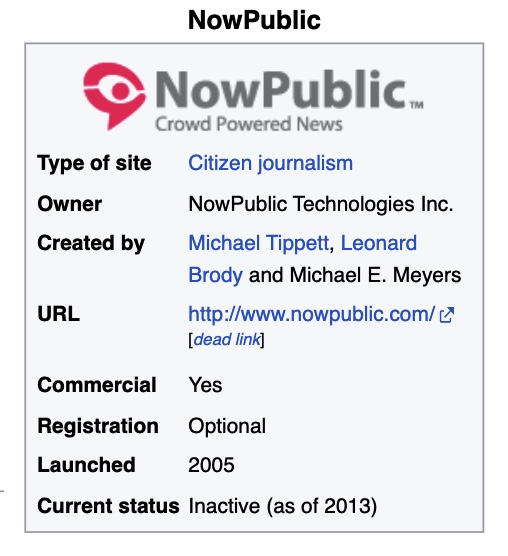
As an example, the arrival of ‘crowd-powered’ media in 2007 allowed for posting of stories to a global audience to test responses and reactions in real time. An experiment from 2008 to 2010 on the innovative Vancouver, Canada-based NowPublic platform proved very effective in developing the right tone for the stories. Many of these stories have been cited in publications and online (please see below for citations).

With 201 Development Challenges, South-South Solutions stories posted on the NowPublic platform, a total of 336,289 views by 2012 had occurred, according to the NowPublic counter. 

Various websites offering publishing and archiving services (Scribd for example) meant it was easy to access the stories from any place, device or platform, bypassing firewalls and censors – a very serious concern in many countries of the global South. And social media such as Twitter made it easy to spread the word to the right people. 

The two publications proved influential on a number of fronts, being early to draw attention to the following: the rising use of mobile phones and information technology in development, the world becoming an urban place, innovative food solutions including the nascent insect food sector (now a big thing), altering perspectives on what is possible in Africa, the use of data science to innovate development, and tracking the growing number of technology hubs and the fast-growing start-up culture in the global South. The publications were cited for shaping the new strategic direction adopted by the United Nations Development Programme (UNDP) (the UN’s leading development organisation) and its first youth strategy, and the development of the Sustainable Development Goals (SDGs). As the world’s first global innovator magazine, Southern Innovator’s design had to be appropriate for a diverse audience. It has drawn praise for being both “beautiful” and “inspiring”, while its use of sharp, modern graphic design and infographics inspired others in the UN to up their game when it comes to design. 

Today, there are many sources for sharing stories on solutions from the global South; in fact, it could be called ‘cool’. South-South cooperation and innovation have now become the key methodology for the UN’s delivery of its programmes and projects. In 2015, China pledged US $2 billion to “support South-South cooperation” and called for the international community to “deepen South-South and tripartite cooperation”. In development parlance, they have been “Mainstreaming South-South and Triangular Cooperation” in their plans.

The current policy vogue for innovation in developing and developed countries can trace its roots back to some of the early work done by these two publications (and which was further amplified by the annual Global South-South Development Expo, which often would feature innovators from the two publications, spreading the innovation message around the world). Both publications had set out to inspire and “champion a global 21st century innovator culture”. And they have done this, as can be seen from concrete evidence and anecdotal responses from individuals and organizations alike.

Crucial to success has been integrity. As was disclosed in arrests made by the Federal Bureau of Investigation (FBI) in October 2015, a news service claiming to be associated with the United Nations (South-South News) had not followed either the letter or the spirit of the UN’s Global Compact. It had received substantial funding from a Macau casino owner featured in a 2010 investigation by International Risk Ltd., which found he “is characterized in the media as a ‘Macau Crime Lord’ and a kingpin of the international slave prostitution trade”. To date, a number of his co-conspirators have been found guilty of various charges and sentenced. He was convicted 28 July 2017 on six counts “for his role in a scheme to bribe United Nations ambassadors to obtain support to build a conference center in Macau that would host, among other events, the annual United Nations Global South-South Development Expo“. He used the news service as a “conduit for bribery and money laundering” at the United Nations, according to the FBI, something admitted to by the various co-conspirators in court and under oath. Read more on this case here: http://www.reuters.com/article/us-un-corruption-idUSKCN0XH2DL. And the conviction here: Chairman of a Macau Real Estate Development Company Convicted on All Counts for Role in Scheme to Bribe United Nations Ambassadors to Build a Multi-Billion Dollar Conference Center

The case of South-South News points to the dangers of cutting corners and the importance of approach and methodology; to not just mouth support for the UN Global Compact but to embrace its letter and spirit as well. As can be seen from this particular case, the reputational damage can be severe if the wrong strategy is pursued. Clients need to be very aware of whom they are working with and conduct due diligence for service provider credentials and also investigate the credentials of potential donors and funders. 

Southern Innovator needed to be true to its ethos of championing genuine innovation that improves human development in the global South. It had to be free to pursue its search without interference. 

To avoid censorship and interference, its editorial operations were based in London, UK and its design studio was based in Reykjavik, Iceland (a high-ranking country in the World Press Freedom rankings and a former top place holder in the UNDP Human Development Index). Using a women-led design studio, it developed a design vision that could communicate across borders using clear graphic design and high-quality images. For example, when it launched in 2011, infographics were rare in development publications and at the UN; now they are commonplace. It also tried to be as a ‘green’ as possible. The studio was powered on 100 per cent renewable energy (in particular, geothermal energy); the hard copy of the magazine is printed on paper from renewable forests. 

To date, five issues of Southern Innovator have been published on key themes identified by the United Nations: mobile phones and information technology, youth and entrepreneurship, agribusiness and food security, cities and urbanization and waste and recycling.

All of the issues collate and explain the trends, innovations and innovators for a large, global audience spanning many countries and regions.

Timeline 

2007: David South Consulting begins work on the e-newsletter Development Challenges, South-South Solutions for the Special Unit for South-South Cooperation at the United Nations.

2008: Reader response experiment begins with crowd-powered news website NowPublic. Initial proposal for the development of book or magazine on innovation. Awarded grant for Cuba study tour by BSHF. 
2009: Adjust e-newsletter content based on reader responses. Begin posting content on Twitter platform.

2010: Begin development of initial concepts for innovator magazine and assemble creative team with Icelandic graphic designer and illustrator Solveig Rolfsdottir and graphic designer Eva Hronn Gudnadottir. 

2011: Attend Global South-South Development Expo in Rome, Italy. Launch first issue of Southern Innovator magazine on mobile phones and information technology. It is called “a terrific tour de force of what is interesting, cutting edge and relevant in the global mobile/ICT space…”. Launch www.southerninnovator.org website and social media including Twitter account @SouthSouth1. 

2012: Attend Global South-South Development Expo in Vienna, Austria. Launch issues 2 (youth and entrepreneurship) and 3 (agribusiness and food security) of Southern Innovator magazine. Called a “Beautiful, inspiring magazine from UNDP on South-South innovation.”

2013: Attend Global South-South Development Expo in Nairobi, Kenya. Launch issue 4 of Southern Innovator magazine (cities and urbanization). Called “fantastic, great content and a beautiful design!” and “Always inspiring.”. 

2014: Attend Global South-South Development Expo in Washington, D.C., U.S.A. Launch issue 5 of Southern Innovator magazine (waste and recycling). The Twitter account @SouthSouth1 called “ one of the best sources out there for news and info on #solutions to #SouthSouth challenges.” Final issues of e-newsletter Development Challenges, South-South Solutions published.  

Testimonials 

“The e-newsletter Development Challenges, South-South Solutions proved to be a timely and prescient resource on the fast-changing global South, tracking the rise of an innovator culture driven by the rapid adoption of mobile phones and information technology … 

“In 2010, work began on the development of the world’s first magazine dedicated to the 21st-century innovator culture of the global South. My goal was to create a magazine that would reach across countries and cultures, meet the UN’s standards, and inspire action. Southern Innovator was the result. Mr. [David] South played a vital role in the magazine’s development from its early conception, through its various design prototypes, to its final global launch and distribution.  

“Both the e-newsletter and magazine raised the profile of South-South cooperation and have been cited by readers for inspiring innovators, academics, policy makers and development practitioners in the United Nations and beyond.  

“I highly recommend Mr. [David] South as a thoughtful, insightful, analytical, creative and very amicable person who has the unique ability to not only grasp complex problems but also to formulate a vision and strategy that gets things done. … ”  Cosmas Gitta, Former Assistant Director, Policy and United Nations Affairs at United Nations Office for South-South Cooperation (UNOSSC) in UNDP 

“I think you [David South] and the designer [Solveig Rolfsdottir] do great work and I enjoy Southern Innovator very much!” Ines Tofalo, Programme Specialist, United Nations Office for South-South Cooperation

Southern Innovator Issue 5 

“@SouthSouth1 is one of the best sources out there for news and info on #solutions to #SouthSouth challenges.” Adam Rogers, Assistant Director, Regional Representative, Europe, United Nations Office for South-South Cooperation (UNOSSC) 

“Btw, I really enjoyed reading them, impressive work & a great resource. Looking forward to Issue 6. My best wishes to you & your team at SI.” 

“… great magazine, nice design.” 

Southern Innovator Issue 4 

“I liked your latest Southern innovator! Always inspiring.” Joana Breidenbach, betterplace.org, Berlin, Germany 

“The magazine looks fantastic, great content and a beautiful design!” 

Southern Innovator Issue 2 

“Thank you David – Your insight into the issues facing us a[s] [a] “global Village” is made real in the detail of your article – 10 out of 10 from the moladi team.” Moladi, South Africa (http://www.moladi.net/index.htm

Southern Innovator Issue 1 

“What a tremendous magazine your team has produced! It’s a terrific tour de force of what is interesting, cutting edge and relevant in the global mobile/ICT space… Really looking forward to what you produce in issues #2 and #3. This is great, engaging, relevant and topical stuff.” Rose Shuman, Founder & CEO, Open Mind and Question Box 

“Looks great. Congratulations. It’s Brill’s Content for the 21st century!” Conan Tobias, Managing Editor, Canadian Business 

What they are saying about SI on Twitter: From @CapacityPlus Nice job RT @ActevisCGroup: RT @UNDP: Great looking informative @SouthSouth1 mag on South-South Innovation; @UNDP Great looking informative @SouthSouth1 mag on South-South Innovation; @JeannineLemaire Graphically beautiful & informative @UNDP Southern Innovator mag on South-South Innov.  

And on Pinterest:

Peggy Lee • 1 year ago

“Beautiful, inspiring magazine from UNDP on South-South innovation. Heart is pumping adrenaline and admiration just reading it”

Impact 

Micro 

  • developed content for highly influential UN e-newsletter Development Challenges, South-South Solutions from 2007 to 2014. The monthly briefing is distributed across the UN and to subscribers
  • developed and launched world’s first global innovator magazine for the United Nations, Southern Innovator
  • contacted and networked with innovators around the world to raise the profile of their work
  • attended global events to champion power of 21st century global innovator culture. Visited United Nations agency headquarters around the world to share the innovator message and distribute the publications
  • cited as a key resource on trends in the global South 

Macro

  • significantly raised profile of global South innovators and 21st century global innovator culture
  • cited as contributor to new strategic plans for UNDP and its switch to an innovation and South-South focus

Citations 

Autonomous Systems in the Intelligence Community: Many Possibilities and Challenges by Jenny R. Holzer, PhD, and Franklin L. Moses, PhD, Studies in Intelligence Vol 59, No. 1 (Extracts, March 2015) 

Beyond Gated Communities edited by Samer Bagaeen and Ola Uduku (Routledge: 2015)

Chile in Transition: Prospects and Challenges for Latin America’s Forerunner of Development by Roland Benedikter and Katja Siepmann (Springer: 2015) 

Decoding the Brand DNA: A Design Methodology Applied to Favela Fashion by Magali Olhats, Universidade Federal de Santa Catarina Florianopolis, 2012 

Edible Insects and the Future of Food: A Foresight Scenario Exercise on Entomophagy and Global Food Security by Dominic Glover and Alexandra Sexton, Institute of Development Studies, King’s College London, Evidence Report No 149, September 2015 

High-level Committee on South-South Cooperation Seventeenth Session: Framework of operational guidelines on United Nations support to South-South and triangular cooperation: Note by the Secretary-General22-25 May 2012, New York 

Innovation Africa: Emerging Hubs of Excellence edited by Olugbenga Adesida, Geci Karuri-Sebina and João Resende-Santos (Emerald Group Publishing: 2016) 

New Directions in Children’s and Adolescents’ Information Behavior Research edited by Dania Bilal and Jamshid Beheshti (Emerald Group Publishing: 2014) 

Propagating Gender Struggles Through Nollywood: Towards a Transformative Approach by Nita Byack George Iruobe, Geonita Initiative for Women and Child Development, 17 July 2015

Recasting ‘truisms’ of low carbon technology cooperation through innovation systems: insights from the developing world by Alexandra Mallett, Innovation and Development, 5:2, 297-311, DOI: 10.1080/2157930X.2015.1049851, Routledge Taylor & Francis Group, 2015

A Sociological Approach to Health Determinants by Toni Schofield (Cambridge University Press: 2015)  

Strategic Framework of the United Nations Office for South-South Cooperation, 2014-2017Executive Board of the United Nations Development Programme, the United Nations Population Fund and the United Nations Office for Project Services, 27 to 31 January 2014, New York

Wearing Your Map on Your Sleeve: Practices of Identification in the Creation and Consumption of Philippine Map T-shirts by Pamela Gloria Cajilig, paper presented at the 6th Global Conference (2014): Fashion: Exploring Critical Issues, Mansfield College, Oxford, United Kingdom, 15th to 18th September 2014

Youth Empowered as Catalysts for Sustainable Human Development: UNDP Youth Strategy 2014-2017United Nations Development Programme, Bureau for Development Policy

DSC web address in green_mini (1)

ORCID iD: https://orcid.org/0000-0001-5311-1052.

© David South Consulting 2025

Categories
Archive United Nations Development Programme

UNDP Mongolia Handbooks And Books | 1997 – 1999

Publisher: UNDP Mongolia Communications Office

UNDP Mongolia Communications Coordinator: David South

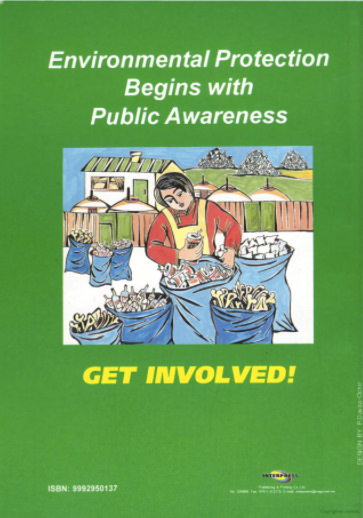
Environmental Public Awareness Handbook: Case Studies and Lessons Learned in Mongolia

Environmental Public Awareness Handbook: Case Studies and Lessons Learned in Mongolia by Robert Ferguson.

The Asian Development Bank (ADB) (2002) said: ENVIRONMENTAL PUBLIC AWARENESS AND THE ROLE OF NGOS The Dutch / UNDP – funded Environmental Public Awareness Project ( EPAP ) has been among the most interesting and possibly effective to be implemented in Mongolia.”

Mongolian Green Book

Mongolian Green Book by Robert Ferguson et al.

More books by Rob Ferguson:

The Devil And The Disappearing Sea: Or, How I Tried To Stop The World’s Worst Ecological Catastrophe (Raincoast Books).

Mongolian Rock and Pop Book

Mongolian Rock and Pop Book: Mongolia Sings its Own Song by Peter Marsh.
Pop music helps fuel Mongolia’s market economy by Oyuntungalag.
As cited in the book Collaborative Nationalism: The Politics of Friendship on China’s Mongolian Frontier by Uradyn E. Bulag (Rowman & Littlefield Publishers, 2010).

Mongolia Update 1998

Mongolia Update 1998 by David South and G. Enkhtungalug.

Other

Wild East: Travels in the New Mongolia

Wild East: Travels in the New Mongolia by Jill Lawless (ECW Press, 2000) is one of many books featuring content and resources resulting from the two-year publishing programme of the UNDP Mongolia Communications Office (1997-1999). 

Wild East: Travels in the New Mongolia by Jill Lawless.
A review of Wild East: Travels in the New Mongolia in the journal Mongolian Studies (2002) by Alicia J. Campi.
“Yet Ulaanbaatar is often ignored or downplayed in Western accounts (see, for example, Croner (1999) and Severin (1991); but see Lawless (2000) for a partial exception). Most Westerners who visit Mongolia seem anxious to get out to the countryside, to see the “real” Mongolia of nomads …” from Truth, History and Politics in Mongolia by Christopher Kaplonski (2004).

In Their Own Words: Selected Writings by Journalists on Mongolia, 1997-1999

In their own words: Selected writings by journalists on Mongolia, 1997-1999 by David South and Julie Schneiderman.

ORCID iD: https://orcid.org/0000-0001-5311-1052.

© David South Consulting 2024

Categories
Archive UNDP Mongolia 1997-1999 United Nations Development Programme UNV News

Freedom Of Expression: Introducing Investigative Journalism To Local Media In Mongolia 1999 | 25 January 2016

By David South, UNV Information Officer

UNV News

05 June 1999

Bonn, Germany: “The training allows us to learn about western theories of journalism,” says Mr. Nyamjav, editor of the Erkh Choloo (Freedom) newspaper. A UNDP project in Mongolia has brought journalists from Ulaanbaatar, Mongolia’s capital, to run an investigative journalist training programme for their colleagues in the rural community of Moron. The programme introducing investigative journalism to students consists of a workshop and various field assignments. Here, I report on day two of the training.

9:00 a.m.

Eleven student journalists and the two trainers, Ms Oyunsetseg and Mr. Batbold from the Press Institute of Mongolia, quickly run through the day’s schedule. The journalists will spend the next two hours interviewing subjects for their stories. All the journalists say this is the first time they’ve explored in detail this sub-category of journalism. Not all the students are experienced journalists, but this is made up for by the quality of the two facilitators, both of whom keep the workshop lively.

11:30 a.m.

The debate begins over the choice of stories. One team has chosen to look at poverty alleviation projects at the Bak (local government) level. They want to write a story looking at poor accountability for loans, the practice of nepotism and the ability of recipients to start small businesses. The team investigating power black-outs wants to conduct further interviews with the poorest people affected by such interruptions.

4:00 p.m.

Back at the offices of the Erkh Choloo newspaper, editor Nyamjav discusses the week’s news with his graphic designer. The skills of the staff impress me. While they have only one computer and barren offices, the paper won an award from the Press Institute for being the best local paper in 1997. The newspaper will be cut off from local government subsidies for printing at the end of this year and is already making plans to find other sources of revenue. Nyamjav is pleased with the results of the UNDP project, saying: “It has noticeably changed our stories – I know how to criticise reporters and push them to be more investigative.”

8:30 p.m.

Outside Ulaanbaatar a petrol shortage has hit hard. At a Moron filling station drivers patiently wait for new supplies to arrive or to receive their ration. Not only is there no fuel, there is also no electricity. On a field assignment the journalists investigating the power black-outs interview Mr. Sukhbaatar the power station director who says 3,500 households owe the utility Tug 27 million (US$27,411). It is the poorest households that are unable to pay in the Ger districts. A Ger is a Mongolian felt tent. Without payment, their power is cut off.

9:00 p.m.

I am asked to conduct a one-hour discussion of my experiences as an investigative journalist in Canada and England. The debate afterwards is lively. A common question is how to deal with pressure from government and corporations to alter the content of stories. The difficulty the regional journalists have in distributing newspapers to remote communities is a common complaint. They ask how international donors could help in this matter, pointing out that in the past the government subsidised newspaper distribution to a greater extent. They would like to be linked with international journalists in some way, preferably through an association.

A useful source of information: www.un-mongolia.mn

“Introducing Investigative Journalism to Local Media in Mongolia”, 03 July 1999, World Volunteer Web.
“Freedom of Expression: Introducing investigative journalism to local media in Mongolia”: UNV News, June 1999.
https://www.google.ca/books/edition/UNVnews/mvglAQAAMAAJ?hl=en&gbpv=1&bsq=unv+news+mongolia+david+south&dq=unv+news+mongolia+david+south&printsec=frontcover
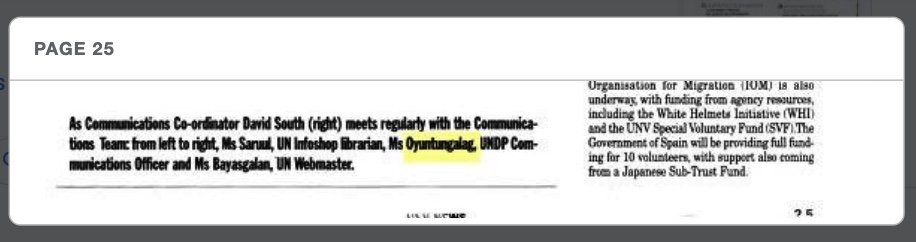
“Communications Coordinator David South (right) meets regularly with the Communications Team.” UNV News 05 June 1999 (page 25).

https://davidsouthconsulting.org/2022/11/23/betterplace-org-hq-photos/

https://davidsouthconsulting.org/2020/12/19/case-study-4-un-undp-mongolia-1997-1999/

https://davidsouthconsulting.org/2022/05/16/high-impact-communications-in-a-major-crisis-undp-mongolia-1997-1999-18-february-2016/

https://davidsouthconsulting.org/2022/04/04/human-development-report-mongolia-1997/

https://davidsouthconsulting.org/2021/07/25/in-their-own-words-selected-writings-by-journalists-on-mongolia-1997-1999-6-january-2010/

https://davidsouthconsulting.org/2021/04/08/making-the-world-a-better-place-for-southern-projects/

https://davidsouthconsulting.org/2020/05/01/a-partnership-for-progress-undp-in-mongolia-1997-19-january-2016/

https://davidsouthconsulting.org/2020/04/26/starting-from-scratch-the-challenge-of-transition/

https://davidsouthconsulting.org/2021/03/20/texting-for-cheaper-marketplace-food-with-sokotext/

https://davidsouthconsulting.org/2021/11/16/undp-in-mongolia-the-guide-1997-1999/

https://davidsouthconsulting.org/2022/05/27/undp-travelling-seminar-environment-and-development-mongolia-1998/

https://davidsouthconsulting.org/2020/11/05/wild-east-17-years-later-2000-2017/

Creative Commons License

This work is licensed under a
Creative Commons Attribution-Noncommercial-No Derivative Works 3.0 License.

ORCID iD: https://orcid.org/0000-0001-5311-1052.

© David South Consulting 2023

Categories
Archive Blogroll Ger Magazine UNDP Mongolia 1997-1999 United Nations Development Programme

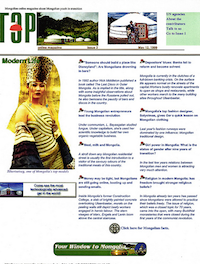
Ger: Mongolia’s First Web Magazine (And A Pioneering Web Project For The United Nations) | 12 January 2016

Ger Magazine was hosted on the http://www.un-mongolia.mn website from 1998.
  • Editor-in-chief: David South (1998-1999)
  • Logo design: P. Davaa-Ochir

“The years 1998 and 1999 have been volatile ones for Mongolia, with revolving door governments, the assassination of a minister, emerging corruption, a banking scandal, in-fighting within the ruling Democratic Coalition, frequent paralysis within the Parliament, and disputes over the Constitution. Economically, the period was unstable and rife with controversies.” Mongolia in 1998 and 1999: Past, Present, and Future at the New Millennium by Sheldon R. Severinghaus, Asian Survey, Vol. 40, No. 1, A Survey of Asia in 1999 (Jan. – Feb., 2000). pp. 130-139 (Publisher: University of California)

Ger Magazine was launched on September 9, 1998 (Ger is the Mongolian word for both the traditional tent dwelling and home). The theme of youth in the transition was explored by a combined team of Mongolian and foreign journalists. The Ger Magazine project had basically three goals: first, raise the quality of journalism in the country, secondly, introduce the country to a wider global audience and, thirdly, by being the country’s first online magazine, prove the internet was an effective way to communicate.

Issue 1

Issue 1 of the magazine investigated what life was like for youth during the transition years (post-1989). Stories tackled the struggle to find work in the free market, the booming pop music scene and how it is leading the way in business entrepreneurship, reproductive health, the basics on Mongolian culture, and vox pop views from Mongolian youth.

Issue 2

Issue 2 of the magazine investigated modern life in Mongolia during transition. The team of journalists were hitting their stride by this issue. Stories probed the proliferation of bars and the problem of alcoholism, corrupt banking practices and the loss of savings, how the young were the country’s leading entrepreneurs, Mongolia’s meat and milk diet, “girl power” and the strong role played by women, the burgeoning new media, the rise and rise of Buddhism, and Mongolia’s dynamic fashion designers (this article inspired foreign fashion designers to embrace the Mongolian ‘look’ in the next season’s designs).

Editor-in-Chief: David South, UNDP Communications Coordinator
EditorA. Delgermaa, UB Post newspaper
TranslationA. Delgermaa
Photography: N. Baigalmaa, David South
Design and layout: B. Bayasgalan, UN Homepage Webmaster

“This is the second issue of Ger. We have chosen the theme “Modern Life” to introduce people outside of Mongolia to the complexities of life in today’s Mongolia – the good, the bad and the ugly as a cowboy film once said. Ger is a project that draws upon the best journalists of this country. Under democracy Mongolia enjoys a flourishing free press, with over 800 officially registered newspapers for a population of 2.4 million! Ger has chosen A. Delgermaa of the UB Post newspaper to edit this issue. The UB Post is one of two English language newspapers in Mongolia and is owned by the Mongol News Company, a publisher of five newspapers, including the daily Today newspaper. Ger is a project to improve the quality of journalism in Mongolia, while introducing the people of the world to Mongolian journalists and this wonderful country. We hope you enjoy this issue of Ger. Please send us your comments. 

Ger is not an official UNDP publication but a project to improve the quality of journalism. Opinions expressed in the magazine do not necessarily reflect the official views or policies of the United Nations Development Programme. Articles may be freely reproduced so long as credit is given and the editors are notified. Ger is published in English and Mongolian. 

Contributors

Ms. A Delgermaa: A reporter with the UB Post English weekly newspaper, which enjoys a good reputation among readers. Delgermaa is a young journalist and started her career in 1997, after graduating from the English Department of the Foreign Service School, Mongolian National University. She is a regular contributor to UN publications and has been published by Inter Press Service. She thinks Mongolia needs more psychologists to give courage to those many who are yearning for a better life. Like many young Mongolians she also wants to study abroad, to learn how journalism is practised in other countries.

Ms. N. Oyunbayar: Also a reporter with the UB Post newspaper, Oyunbayar, is a graduate of Ekaterinburg University in Russia, where she qualified as a Russian language teacher. She left her pupils in Sukhbaatar aimag, where she was born, some years ago and decided to undertake a personal crusade against wrongdoing by becoming a journalist for the UB Post. She is an award-winning journalist and a member of the Mongolian Free Democratic Journalists Association. She loves to cook and enjoys learning about new cuisines. 

Ms. T. Mandala: A historian and journalist, she is a reporter with the “Weekend” weekly newspaper. She has been a journalist for two years, has written several interesting interviews with politicians, including the Mongolian parliamentary speaker R. Gonchigdorj and MPs Da. Ganbold and E. Bat-Uul. She explores issues like life after death and she wants to be a public defender in a court one day. 

She is a successor of her grandfather Khodoogiin Perlee, who is a famous historian in Mongolia. And studies religion, especially Buddhism and Shamanism. 

Mr. D. Dorjjav: A psychologist and a lecturer at the Administrative Management Department of Mongolian National University, he is married and has two girls and a boy. He is currently working on his doctoral thesis. His wish is to help people to open themselves up and discover their abilities. His plan for the future is to contribute to the psychological understanding of life in Mongolia. Dorjjav’s hobby is to talk to people and exchange opinions.

G. Enkhtuya: Born in the year of the pig (there are twelve years in the lunar calendar), a professional in marketing, trading, journalism, she is currently studying law in the Institute of Legal Studies, Mongolian National University. She is also a reporter for Odriin Sonin independent daily newspaper, once the largest state-owned newspaper until the start of 1999. She likes to cook when she is liberated from her official duties.

Jill Lawless: An Honourary Foreign Member of the Mongolian Free Democratic Journalists Association, Jill has been the editor of the UB Post newspaper since 1997. Jill regularly contributes to Agence France-Presse, Far Eastern Economic Review, Deutsche Welle and the Canadian Broadcasting Corporation. She is happiest riding camels in the Gobi desert. 

Michael Kohn: Michael is the editor of the Mongol Messenger and contributed to the first edition of Ger. He is a regular contributor to Associated Press and the Far Eastern Economic Review. Michael is an avid traveler and is an expert on hitchhiking across Mongolia.  

Ms. N. Baigalmaa: Photo journalist for Onoodor (Today) newspaper, the number one independent newspaper for three years. “Photo journalism is always interesting. I really enjoy taking action photos.” She is fed up of taking photos of static photos of people standing or sitting and has devoted her life to photo journalism. One never boring thing for her is her two sons and a girl. Sometimes she loses her sports jacket to her oldest son, now taller than her.”

Stories

Depositors’ blues: Banks fail to reform and become solvent.In the absence of a trustworthy formal banking system, Mongolians are sticking to an elaborate informal banking system driven by pawn shops

by G. Enkhtuya

“Mongolia is currently in the clutches of a full-blown banking crisis. On the surface life appears normal on the streets of the capital. Workers busily renovate apartments to open as shops and restaurants, while other workers march to the many building sites throughout Ulaanbaatar. But there is no doubting the situation is serious.”

Young Mongolian entrepreneurs lead the business revolution

By Michael Kohn

“Under communism, L. Bayasgalan studied fungus. Under capitalism, she’s used her scientific knowledge to build her own organic vegetable business. The 35-year-old is in the vanguard of a budding army of Mongolian entrepreneurs cashing in on the impoverished landlocked country’s nine year transformation from the world’s second oldest communist state to a free-market democracy.”

Meat, milk and Mongolia: 
Misunderstood and often maligned, the Mongolian diet does make sense

By N. Oyunbayar

“A stroll down any Mongolian residential street is usually the first introduction to a visitor of the savoury odours of the traditional meals of this country. If you are invited into somebody’s ger (or traditional tent dwelling) or apartment, you will probably have an opportunity of tasting buuz, khuushuur and bansh.

“These Mongolian national meals are made with minced meat seasoned with garlic or onion (it can be anything from mutton to beef to camel to horse to gazelle) covered with flour and steamed in boiling water, fried in oil and boiled in water. For many visitors to the country the vast quantities of meat consumed can at first be surprising. But it is not long before a visitor finds their favourite Mongolian food, be it buuz, khuushur or a number of other treats. A Canadian living in Ulaanbaatar once told me, “the Mongolian national food contains a lot of meat, but I like the buuz.

“The meat-dependent diet arises from the need for hearty food to stave off the cold and long winters. Traditionally nomadic herders, Mongolians have for centuries been dependent on mostly animal products for their dietary staples. Now after over nine years of transition, the traditional diet has been used as a shield against hunger and for the wealthy, subject to the influence of imported foreign foods and cuisine. When the Russians pulled the plug on Mongolia’s aid in 1991, the economy went into a severe crisis. For many Mongolians it was their first experience of serious hunger. The staple traditional diet of meat, milk and flour saw many people through this crisis, when food imports from the former Soviet Union dropped off.

“Mongolians traditionally have turned to foods that are high in protein and minerals, relying less on more seasonable foods like vegetables and fruits. This means a diet heavy on meat and dairy products, the latter when sour in the summer time thought to clean the stomach. It isn’t just about meat though. Mongolians do also eat cereal, barley and natural fruits and plants native to the country.

“Out of necessity Mongolians have found creative and ingenious ways to use the milk of all five of the domestic animals in the country: sheep, cattle, goats, camels and horses. Orom is the cream that forms on top of boiled milk; aaruul are dried curds and can be seen baking in the sun on top of gers in the summer; eetsgii is the dried cheese; airag is fermented milk of mares (female horses); nermel, is the home-brewed vodka that packs a punch; tarag, is the sour yogurt; shar tos, melted butter from curds and orom, and tsagaan tos, boiled orom mixed with sometimes flour, natural fruits or eesgii. The method of drying the dairy products is common in preparing them. The Mongolians prepare enough dairy products for the long winter and spring.

“The traditions of using, producing and preparing these foods are stronger outside the main cities, where the population is more reliant on the vast herds for food. B. Baljmaa (Mongolians generally use their first names), a dietitian and nutritionist at the National Nutrition Research Centre, says there is a genetic compatability for the food.

‘Before 1992 there wasn’t much research in this area. But now we know from our research that Mongolians are better able to absorb foods with more acid. So, traditional food should be kept in the country.’

“Since 1997 Mongolians have seen a substantial increase in the variety and quantity of imported foods, many of which were only thought of as exotic 10 years ago. Since the start of 1999 the Soviet-style market stalls now compete against western-style supermarkets, with trolleys and shelves proudly saying “Made in Mongolia.” In markets like Dalai Eej, Dorvon Uul, Food Land and Mercury it is possible to buy delicious prepared and canned foods, candies, biscuits, and unknown and unused before by Mongolians, products like oranges, bananas, plums and American chickens.

“On top of the canteens and cafes serving Mongolian food, there are now many restaurants, canteens, bakeries and tea shops which serve meals from Russia, Italy, India, China, Japan, Korea, England, France, Senegal and Turkey. Most of these restaurants are located in the capital, Ulaanbaatar. Mongolians have taken to the new tastes. “I think Mongolians like roasted chicken and fish when they go to the foreign sit-down restaurants, and hot dogs and pizzas in the fast foods shops,” says I. Narantsetseg and her husband J.Battulga. Both were dining in the Seoul restaurant, and are happy they can go out for food: “it is a very good thing that there are opening a lot of restaurants where friends and family can go and enjoy food in comfort.”

“Isobe Hiroshi, manager of Seketei, a high-end Japanese restaurant, told me “only 20 per cent of our customers are Mongolians. The vast majority of our clients are foreign, especially Japanese people who are working and traveling here. I think Mongolians have still not grown used to sushi and sashimi, the raw fish prepared in our restaurant. But I hope we will welcome more and more Mongolians in the future.”

“The traditional diet in the cities is more changed, more european. And with comes its own dangers for Mongolians says the Nutrition Centre’s Baljmaa:

‘There is a big problem of importing poisonous foods and food which probably will cause the nutrition-related diseases common in more developed countries,” she continues.”While the trend around the world amongst health-conscious people is towards natural products for their food, some Mongolians use some food which can cause troubles for their health. For example, fast food made with more oil, salt and sugar are considered the biggest dangers for human health. On the plus side prices for these imported foods are higher and only the wealthiest people can afford them; the poor people can’t buy and eat it no matter how much they desire. This means their poverty is protecting their health. We should boost our efforts to raise awareness on what foods protect your health.’

“Help in improving nutrition awareness a poster portraying a ger details the food habits of Mongolians and the nutritional value of common foods.

“Now I want to present to you recipes of processing and preparing some Mongolian national products and meals:

“From ancient times, Mongolians use abundant and peculiar methods of processing meat and preparing food.. One of the more popular methods of processing the meat is to prepare borts (dried meat) for use in winter. Borts is made from the meat of cows, goats and camels. Here is a recipe for camel borts presented by Dr. Sh. Tserenpuntsag who engages in the research of the meat.

1. Separate the meat from its layer of fat, as fat will spoil in drying.
2. Cut meat into strips about 20-30 centimeters long and two to five centimeters thick.
3. Hang to dry in a well-ventilated room.
4. Leave for four to five months.
5. Cut into small strips for use in any dish you like.

“If soaked in water, the meat will expand up to two and half times in size. It should then be cooked for 18 minutes.

“The main method of cooking the meals of the Mongolians is boiling and steaming, considered the most healthy method in cooking by researchers the world over. Here is a recipe for buuz from the Nutrition Centre. It is considered one of the national meals of the Mongolians and is cooked by steaming and is a good fast food.”

Girl power in Mongolia: What is the status of gender after nine years of transition?

By D. Dorjjav

“As American author Arthur Schlesinger once said, the main breaker of peace in our time is social differentiation. It is unfortunate that, despite developments in human civilisation, modern times have brought only new manifestations of this phenomenon, based on people’s mind, feeling, life style, goals and dreams.”

Money may be tight, but Mongolians are still going online, booting up and sending emails

By Jill Lawless

“Inside Mongolia’s former Construction College, a slab of brightly painted concrete overlooking Ulaanbaatar, murals on the peeling walls still depict beefy workers engaged in heroic labour. The stern visages of Marx, Engels and Lenin loom above the central staircase.

But students these days have neither communism nor construction on their minds. The building is now the School of Computer Science and Management of the Mongolian Technical University.”

The real Mongolian gets the nod from Western fashion designers. Mongolia’s top fashion designer, Solyolmaa, gives Ger a quick lesson on Mongolian clothing

By A. Delgermaa

“Last year’s fashion runways were dominated by one influence: Mongolian traditional design. If a designer wanted to show they were boldly embracing natural fibers and furs, then the refrain ” my show is all Mongolian” would be proudly boasted to the media. The country has become a synonym for sartorial flare and rugged beauty. It also doesn’t hurt that one of Mongolia’s top exports, cashmere wool, is in vogue, from Japan to Europe to the United States. After years of being isolated from the west under the umbrella of the Soviet Union, Mongolian fashion is proudly strutting the catwalks of the world.”

Cashmere is king but Mongolia still struggles to reap the benefit

By A. Delgermaa

A Mongolian cashmere designer once opined that Mongolians are lucky that most goats in the country are capable of producing fine cashmere. And while Chinese cashmere dominates the marketplace, Mongolian cashmere is by far the purest and finest.

About 30 cashmere companies contributes tens of millions of dollars a year to the country’s wealth (though nobody is quite sure how much because most cashmere sales go unreported to the government). But the revenue isn’t what it used to be due to problems in the domestic industry and a drop in the world price. Z. Ayur, chief secretariat of the Gobi company, thinks it doesn’t have to be that way. “Unfortunately we lose half of our raw cashmere to China,” he says.” The Chinese buy cashmere at a high price, not depending on the quality. This means national manufacturers lack raw cashmere to process into garments.” He thinks raw cashmere exports should be banned or subject to a duty of 100 to 150 per cent. Mongolia’s weak infrastructure plays a part as well. It is cheaper for herders to travel to the Chinese border with cashmere than to bring it to the capital, Ulaanbaatar. Often when they are at the border with China, they are subjected to some hard bargaining by Chinese brokers, who exploit the fact herders can’t afford to walk away empty handed. 

Cashmere has always been considered a luxury and expensive. But in the past two years it has lost its fusty image as only for old people. Trendy designs have attracted a vast market of younger cashmere consumers. “I guess in the past it was dear and expensive and designs weren’t very appealing to the younger set,” thinks Gerelmaa, the chief designer of Gobi company. 

The Gobi company is one of the few state enterprises left over from the socialist period that still makes money (and is due for privatization this year – a prime pick for foreign investors). 

In 1972 the United Nations funded projects to experiment with starting a cashmere garment industry in Mongolia. This innovative thinking led to a joint Japanese-Mongolian venture in 1981 to start the first cashmere manufacturer, Gobi. These days it still produces one third of the country’s cashmere products. 

Mongolian Wool and Cashmere Federation head Tsendmaa is optimistic about the drop in the world market price.” It will soon go back up again,” she says with confidence. “The reserve of cashmere in the world will run out soon. What happened with the drop in prices is typical of any industry when it overproduces.” What worries her most is the flood of Mongolian cashmere going to China, where Chinese workers process and knit the garments and reap the job benefits.

While cashmere is still known for its use in classic turtle, crew and v-neck jumpers, things have changed. “Before we mostly exported classic styles in off-white, brown, grey, black, bark, blue or dark red to Japan or Germany,” continues Tsendmaa. “Now Americans order more fashionable cashmere for the young. The designs of short jumpers that expose bare chests and waists are cheap to produce (less material) and suitable for young fashions.” 

Italian, French or Belgian customers are fussier and demand greater variety in designs. These countries determine the vogue for cashmere wear and use the most high tech knitting technology.

Contemporary cashmere fashion in France or Italy can combine fur or silk. Colours have also been revamped, with the young going for light blue, light pink, snow white, off-white and light green. Italians and Americans like metal grey with rose or pink. Mixing up the colours in sporty stripes and lines is also popular.

Cashmere is very practical, warm and light. “It is not suitable for the office,” says Gerelmaa.” Cashmere wear is more suitable to wear for a night out or just for hanging out. But of course it is not for sport!” 

Fashionable Mongolian cashmere is becoming a strong competitor to Chinese, Italian, Scottish or American cashmere. “The raw material is pure and the design is more fashionable.” And a happy Gerelmaa likes the sound the cash register makes in Japan: “In Japan classic Mongolian style is sold for more than US $1,200 in the Takashimaya Store, in GINZA.” Now if more of that kind of hard cash found its way back to Mongolia, the country would definitely be better off. 

Mongolians call them mannequins, but this model has something to say and a good head on her shoulders

Interview by A. Delgermaa

It could be said that there is no girl who does not dream of becoming a model. Many Mongolian girls, particularly Ulaanbaatar city girls, are flocking to attend courses in modeling in the last few years. Some say models are mushrooming in Mongolia, a country known for its fresh-faced people and robust physiques. 

Ger interviewed S. Ikhertsetseg, one of the twin top models of Mongolia.

When did you first appear on the fashion stage?

“When we were 15 we played piano for the state concert on International Women’s Day on March 8. The ( Best Fashion) company was in trouble and they did not have anyone to wear some leather fashions for the show in the concert. It was fortuitous that we were asked to be the models. We kept it secret from our parents until we received a prize from Mongolia’s top fashion show, Goyol (or beauty) , in 1988. That was a year after the state concert. Being a fashion model was not considered so desirable as it is now. We were busy studying at music school and our parents did not know what we were doing.”

What do you think of today’s models?

“In the early days of fashion shows in Mongolia in the 1980s, we did not have many competitors. These days there are many beautiful Mongolian models we have to compete with, but only a few are very good. If someone is lucky, they have the potential to compete at the world level. Personally, I don’t like models who are too trained by courses.”

Do you think becoming famous is pure luck?

“Of course it is luck. But that doesn’t mean it isn’t a lot of hard work. You must send photos to agencies, and then only then, will someone see your photo – that is luck.”

What about design and fashion in Mongolia? Are Mongolians fashion sensitive?

“I can not say Mongolians are sensitive to fashion. I think our designers should work harder. Design is not a dress or a suit. It is everything, the whole cornucopia of details. I do not think we are going to compete with Europe, which has a long history of making clothing, rich in colors or designs. There is a big difference between fashion in the West and in Mongolia.”

Mongolia has a lively free press who sometimes step over the line when it comes to gossip and scandal reporting. These so-called “yellow” newspapers have damaged many people’s reputations. This had also happened to you. Some newspapers called the two of you the Barbie girls in Beijing, earning a lot of money.

“Yes, they did say those bad things. We replied to them.”

Was it before the court?

“No, that is a personal question.”

What was the result?

“The newspapers didn’t do that again.”

What do you do now?

“Both of us keep up the fashion work and also teach piano. Music is our profession and love. We founded the Association of Models of Mongolia to protect their rights and strengthen their position in the society.”

Impact

The stories have been featured in many books on the country, and the magazine was recommended as a good resource by the Lonely Planet guidebook. 

This was not only the first publication of its kind in the UN, it was also a pioneering online venture and remarkable for a country lacking the advantages of wealthier countries.

An online survey of the state of Mongolia’s media and its history (www.pressreference.com/Ma-No/Mongolia.html), had this to say: “An interesting variation from some of the other publications available is Ger Magazine (published online with guidance from the United Nations Development Program, UNDP), which is concerned with Mongolian youth in cultural transition. The name of the magazine is meant to be ironic because a ger is the Mongolian word for yurt—a yurt being traditional nomadic housing—but the magazine is about urbanization and globalization of Mongolian youth.”

Citations

A Complete Guide on Celebrations, Festivals and Holidays around the World by Sarah Whelan, Asteroid Content, 2015

Gale Directory of Publications and Broadcast Media by Jeff Summer, Gale Group, 2001

In Search of Mongolian Barbecue by Debra McCown, Abingdon, Virginia, 2017

Mongol Survey, Issue 8, The Society, 2001

Mongolian Culture and Society in the Age of Globalization by Henry G. Schwarz (editor), Center for East Asian Studies, Western Washington University, 2006

Nations in Transition: Mongolia by Jennifer L. Hanson, Infobase Publishing, 2003

Teen Life in Asia by Judith J. Slater, Greenwood Publishing Group, 2004

World Press Encyclopedia: A Survey of Press Systems Worldwide, Volume 1 by Amanda C. Quick, Gale Group, 2003

Some of the team behind Ger:

Editor-in-Chief: David South

Logo Design: P. Davaa-Ochir

Layout and Online: B. Bayasgalan

Contributors: A. DelgermaaMichael KohnJill LawlessPeter Marsh, and N. Oyuntungalag.

Read the Wikipedia entry here: en.wikipedia.org/wiki/Ger_magazine

Read the full content by searching the www.archive.org wayback machine via the http://www.un-mongolia.mn website: https://web.archive.org/web/19990420090143/http://www.un-mongolia.mn/

Ger Magazine contributor Jill Lawless’ book Wild East: Travels in the New Mongolia here: https://wildeasttravelsinthenewmongolia.wordpress.com

This work is licensed under a Creative Commons Attribution 4.0 International License.

ORCID iD: https://orcid.org/0000-0001-5311-1052.

© David South Consulting 2021