Category: Southern Innovator magazine

  • Kenyan Mobile Phone Innovations

    Kenyan Mobile Phone Innovations

    By David SouthDevelopment Challenges, South-South Solutions

    SOUTH-SOUTH CASE STUDY

    A couple of enterprising Kenyan engineering students are showing how mobile phones are an inventor’s dream. Their two inventions – one a way to re-charge phones while bicycling, the other an aid for catching fish – show the potential for adapting this technology to the needs of the poor.

    The rapid spread of mobile phones across the South is giving rise to a flurry of invention and experimentation. While many of the new mobile phone-users do not have much money, they are often driven by poverty to invent solutions – and in so doing prove the phones offer many ways to generate income.

    According to the International Telecommunications Union (ITU), Africa is the world’s fastest-growing mobile phone market, and the number of subscribers surpassed 300 million in 2008. The number of mobile phone users in the world passed 4 billion in 2008, and the fastest growth was in the South (ITU). The trend towards increasing development of inexpensive handsets means more phones will be reaching even more poor people in the future.

    Kenya has seen blistering growth in mobile phone ownership: from just 200,000 users in 2000, there are now more than 17.5 million people with mobile phones out of a population of 38.5 million

    As powerful as mobile phones are, they need electricity to keep working. The struggle to find a steady supply of electricity vexes many in the South, so finding cheap or free ways to recharge the phones represents a huge market opportunity.

    While mobile phone recharging has become a business in its own right across the South, it is costly as well as time-consuming. Some people spend hours just getting to recharging stations.

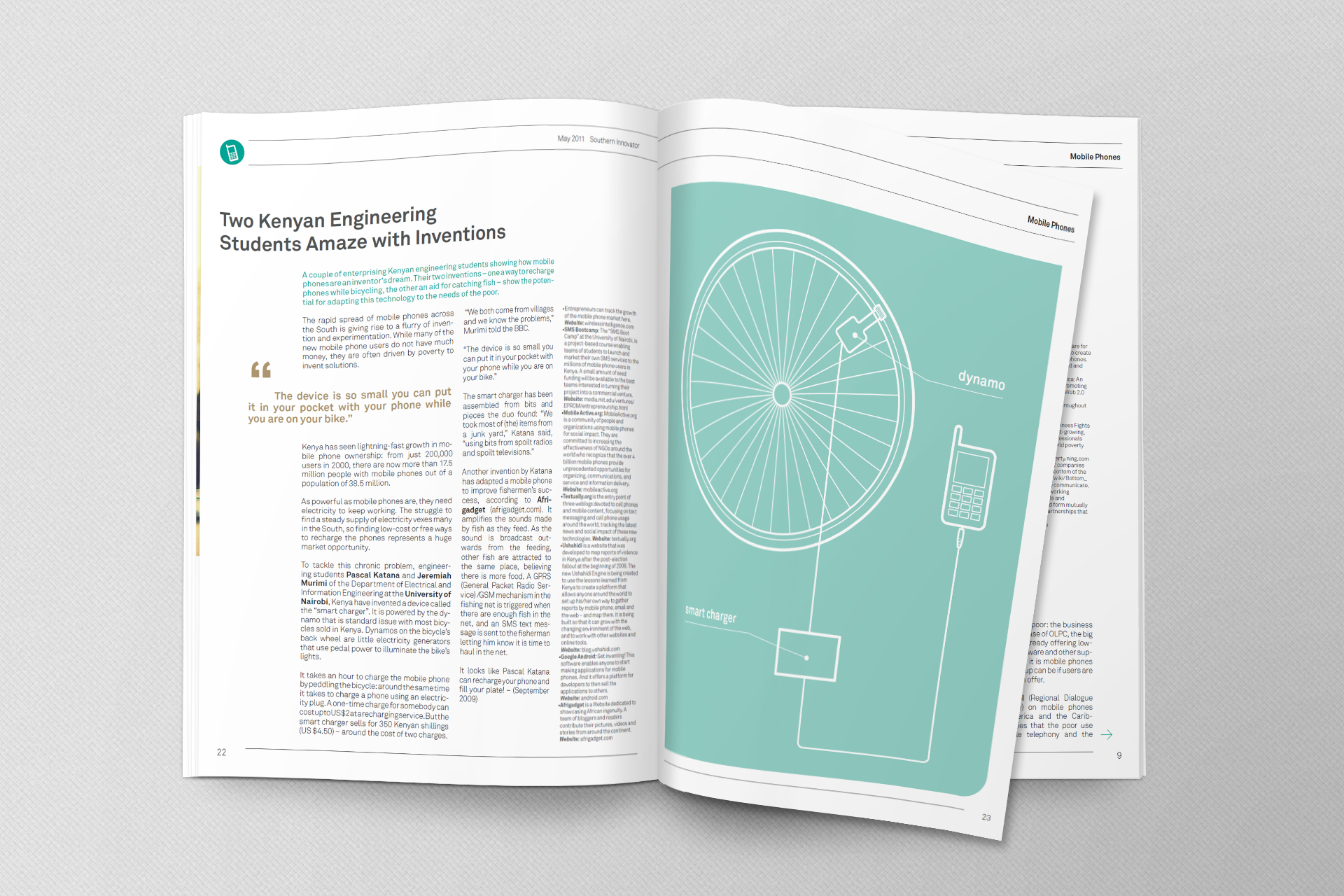
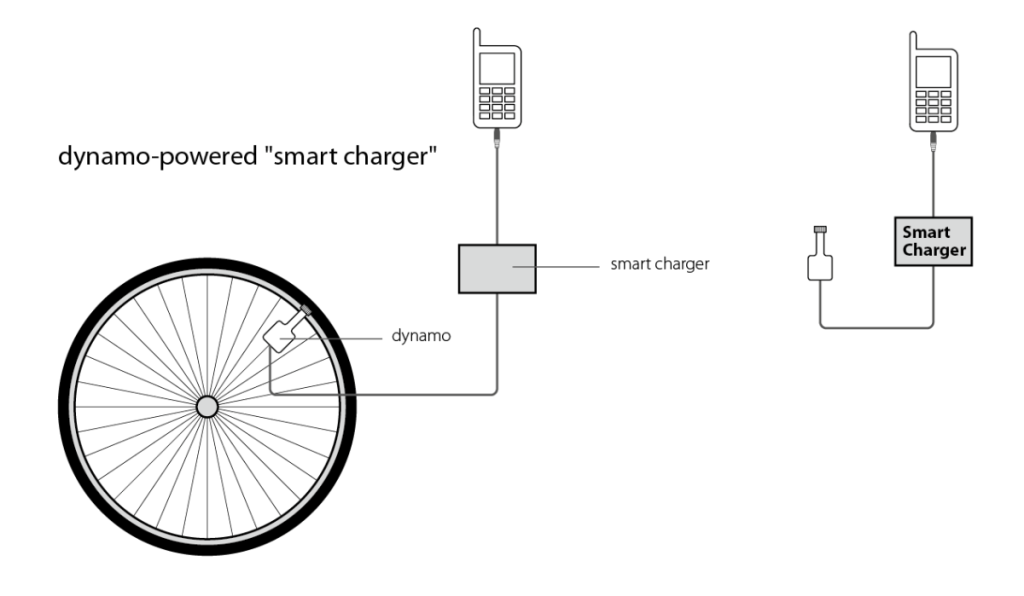
    To tackle this chronic problem, Engineering students Pascal Katana and Jeremiah Murimi of the Department of Electrical and Information Engineering at the University of Nairobi, Kenya (http://uonbi.ac.ke/departments/index.php?dept_code=HE&fac_code=32) have invented a device called the “smart charger.” It is powered by the dynamo that is standard issue with most bicycles sold in Kenya. Dynamos on the bicycle’s back wheel are little electricity generators that use pedal power to illuminate the bike’s lights.

    It takes an hour to charge the mobile phone by peddling the bicycle: around the same time it takes to charge a phone using an electricity plug. A one-time charge for somebody can cost up to US $2 at a recharging service. But the smart charger sells for 350 Kenyan shillings (US $4.50) – around the cost of two charges.

    “We both come from villages and we know the problems,” Murimi told the BBC.

    “The device is so small you can put it in your pocket with your phone while you are on your bike.”

    The smart charger has been assembled from bits and pieces the duo found: “We took most of (the) items from a junk yard,” Katana said. “Using bits from spoilt radios and spoilt televisions.”

    To test the experimental device, workers at the university campus were recruited to have a go.

    “I use a bicycle especially when I’m at home in the rural areas, where we travel a lot,” said campus security guard David Nyangoro. “It’s very expensive nowadays charging a phone. With the new charger I hope it will be more economical, as once you have bought it, things will be easier for you and no more expenses.”

    Kenya’s National Council for Science and Technology (http://www.ncst.go.ke/) has now backed the project and the students are exploring ways to mass-produce the smart charger.

    Another invention by Katana has adapted a mobile phone to improve fishermen’s success, according to Afrigadget (www.afrigadget.com). It amplifies the sounds made by fish as they feed. As the sound is broadcast outwards from the feeding, other fish are attracted to the same place, believing there is more food. A GPRS/GSM (http://en.wikipedia.org/wiki/General_Packet_Radio_Service) mechanism in the fishing net is triggered when there is enough fish in the net, and an SMS text message is sent to the fisherman letting him know it is time to haul in the net.

    It looks like Pascal Katana can re-charge your phone and fill your plate!

    Published: August 2009

    Resources

    1) Entrepreneurs can track the growth of the mobile phones market here. Website: http://www.wirelessintelligence.com

    2) SMS Bootcamp: The “SMS Boot Camp” at the University of Nairobi, is a project-based course enabling teams of students to launch and market their own SMS services to the millions of mobile phone users in Kenya. A small amount of seed funding will be available to the best teams interested in turning their project into a commercial venture. Website: http://eprom.mit.edu/entrepreneurship.html

    3) Mobile Active.org: MobileActive.org is a community of people and organizations using mobile phones for social impact. They are committed to increasing the effectiveness of NGOs around the world who recognize that the over 4 billion mobile phones provide unprecedented opportunities for organizing, communications, and service and information delivery. Website: www.mobileactive.org

    4) Textually.org: is the entry point of three weblogs devoted to cell phones and mobile content, focusing on text messaging and cell phone usage around the world, tracking the latest news and social impact of these new technologies. Website: http://www.textually.org/

    5) Ushahidi: is a website that was developed to map reports of violence in Kenya after the post-election fallout at the beginning of 2008. The new Ushahidi Engine is being created to use the lessons learned from Kenya to create a platform that allows anyone around the world to set up their own way to gather reports by mobile phone, email and the web – and map them. It is being built so that it can grow with the changing environment of the web, and to work with other websites and online tools. Website: http://blog.ushahidi.com/

    6) Google Android: Get inventing! This software enables anyone to start making applications for mobile phones. And it offers a platform for developers to then sell the applications to others. Website: www.android.com/

    7) Afrigadget: is a website dedicated to showcasing African ingenuity. A team of bloggers and readers contribute their pictures, videos and stories from around the continent. Website: http://www.afrigadget.com
    Development Challenges, South-South Solutions was launched as an e-newsletter in 2006 by UNDP’s South-South Cooperation Unit (now the United Nations Office for South-South Cooperation) based in New York, USA. It led on profiling the rise of the global South as an economic powerhouse and was one of the first regular publications to champion the global South’s innovators, entrepreneurs, and pioneers. It tracked the key trends that are now so profoundly reshaping how development is seen and done. This includes the rapid take-up of mobile phones and information technology in the global South (as profiled in the first issue of magazine Southern Innovator), the move to becoming a majority urban world, a growing global innovator culture, and the plethora of solutions being developed in the global South to tackle its problems and improve living conditions and boost human development. The success of the e-newsletter led to the launch of the magazine Southern Innovator. 

    Creative Commons License

    This work is licensed under a
    Creative Commons Attribution-Noncommercial-No Derivative Works 3.0 License.

    ORCID iD: https://orcid.org/0000-0001-5311-1052.

    © David South Consulting 2023
  • Electric Bicycles Become Urban Transport Success

    Electric Bicycles Become Urban Transport Success

    By David SouthDevelopment Challenges, South-South Solutions

    SOUTH-SOUTH CASE STUDY

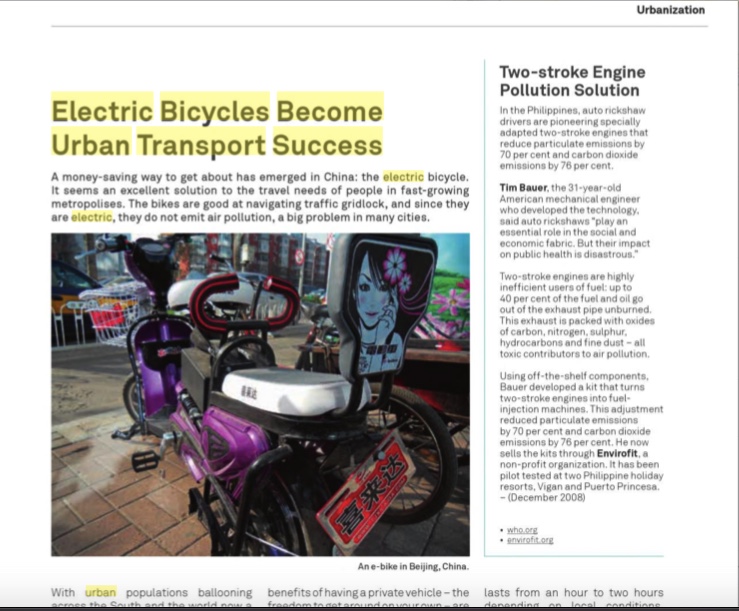
    A money-saving way to get about has emerged in China: the electric bicycle. It seems an excellent solution to the travel needs of people in fast-growing metropolises. The bikes are good at navigating traffic gridlock, and since they are electric they do not emit air pollution, a big problem in many cities.

    With urban populations ballooning across the South – and the world now a majority urban place – the challenge of moving people around economically and cleanly is a big issue. While turning to cars seems an appealing option for people who have raised their incomes, the resulting traffic jams and pollution are a major drawback. Gridlock (http://en.wikipedia.org/wiki/Gridlock) is a daily reality in cities across Asia and Africa.

    The success of e-bikes in China is striking: It is estimated there are four times more electric bikes than cars in the country, 120 million in all. According to the Electric Bikes website (www.electricbikee.com), the number of electric bicycles produced each year has grown from 200,000 eight years ago to 22 million in 2008. It is estimated to be a US $11 billion a year business: a true Southern success story that is going around the world.

    A typical electric bicycle has a rechargeable power pack, with a battery that takes up to four hours to charge and lasts from an hour to two hours depending on local conditions, like hills. The batteries can range from heavy lead acid models (around only 100 charges) to nickel metal to lightweight, long-lasting lithium batteries. The batteries range from 12 volts to 36 volts. How long a battery lasts depends on its energy retention ability, road and temperature conditions and the rider’s weight.

    And while some cities are turning to encouraging more peddle power with human-powered bicycles, this is an unappealing option in hot or humid climates. Who wants to turn up at work hot and sweaty?

    In China, a highly competitive market of manufacturers has sprung up in the last 10 years to provide e-bikes for every taste and need.

    China has a long tradition as a cycling nation: in the 1980s, four out of five commuters used bicycles. But that changed dramatically as people bought cars with their rising incomes.

    In the capital, Beijing, rapid economic development and rising incomes have led to serious traffic congestion. There are over 4 million cars on Beijing’s roads. The pollution in the city is very bad and has led to various campaigns to ban high-polluting vehicles.

    The ensuing traffic gridlock means the benefits of having a private vehicle – the freedom to get around on your own – are eroded as a driver wastes time in long commutes. So, many have turned to the nimble electric bicycles.

    One resident, David Dai, told the BBC “It takes only 10 minutes to ride my electric bike from home to work.”

    “If I took the bus, I’d have to spend time waiting for it, and then I could be trapped in a traffic jam. It could take me half an hour to make the same journey.”

    Competition is fierce in the electric bike market, with shops sometimes sitting side-by-side.

    A manager of a Beijing electric bicycle store, Zhang Zhiyong, puts the success down to this: “Beijing is not like other smaller cities – it’s big. If people ride their bicycles to work, they get really tired. If they drive to work, the roads are often congested,” he told the BBC.

    “But an electric bike is environmentally friendly and convenient. Promoting the use of these bikes would benefit us all.”

    And the price is a definite incentive: just 2,680 yuan (US $390), while cars sell for thousands of dollars.

    The electric bicycles are so successful they are now growing faster than cars in a country that has become the fastest growing car market in the world.

    Some believe the bikes are just a stop gap before people get enough money to buy automobiles. But the bigger trend of growing urban populations and the ensuing traffic jams will ensure they remain a practical option to get around the gridlock.

    Published: April 2010

    Resources

    1) Electric Bike Website: Home to news and links to manufacturers. Also lots of resources on how to convert peddle bikes into electric bikes. Website:http://www.electricbikee.com/

    2) The Luyuan Electric Vehicle Company of Jinhua City in China has been making the bikes for 10 years. They come fully equipped with lights, baskets, fenders and in many colours. Website: http://en.luyuan.cn/?gclid=CJXu_tr576ACFclr4wodG1GsGQ

    3) Empowered Ebikes: An online retailer of e-bikes specializing in urban commuters. Website:http://www.empoweredebikes.com/index.php

    4) Made-in-China.com: A large list of e-bike manufacturers in China and how to contact the dealers and manufacturers. Website: http://www.made-in-china.com/products-search/hot-china-products/E-bike.html

    5) Pedego: An American company making high-end e-bikes. Website: http://www.pedegoelectricbikes.com/index.php

    Development Challenges, South-South Solutions was launched as an e-newsletter in 2006 by UNDP’s South-South Cooperation Unit (now the United Nations Office for South-South Cooperation) based in New York, USA. It led on profiling the rise of the global South as an economic powerhouse and was one of the first regular publications to champion the global South’s innovators, entrepreneurs, and pioneers. It tracked the key trends that are now so profoundly reshaping how development is seen and done. This includes the rapid take-up of mobile phones and information technology in the global South (as profiled in the first issue of magazine Southern Innovator), the move to becoming a majority urban world, a growing global innovator culture, and the plethora of solutions being developed in the global South to tackle its problems and improve living conditions and boost human development. The success of the e-newsletter led to the launch of the magazine Southern Innovator. 

    Creative Commons License

    This work is licensed under a
    Creative Commons Attribution-Noncommercial-No Derivative Works 3.0 License.

    ORCID iD: https://orcid.org/0000-0001-5311-1052.

    © David South Consulting 2023

  • Africa to Get Own Internet Domain

    Africa to Get Own Internet Domain

    By David SouthDevelopment Challenges, South-South Solutions

    SOUTH-SOUTH CASE STUDY

    Africa is in the midst of an Internet revolution that is set only to accelerate. The continent is one of the last places to experience the information technology revolution that has swept the world in the past two decades.

    Africa has been at a disadvantage for several reasons, the most basic of which has been the lack of bandwidth capacity available from the undersea cables that connect other continents to the Internet. A map showing the world’s undersea cable links says it all: the majority of traffic goes between Europe and the United States (http://www.telegeography.com/telecom-resources/telegeography-infographics/submarine-cable-map/).

    But this is changing: a glance at recent developments with the launching of the Seacom, EASSy, MainOne and other cables shows a continent getting better connected by the year (http://manypossibilities.net/african-undersea-cables/).

    With seven out of the 10 fastest-growing economies in the world between 2011 and 2015 projected to be in sub-Saharan Africa, the conditions are ripe to grow African Internet businesses. For example, Ghana, with its booming information technology sector, boasted 13 percent economic growth last year, among the fastest in the world.

    In eight of the past 10 years, sub-Saharan Africa has grown faster than Asia (The Globe and Mail).

    While Africa has come late to the Internet party, the continent can benefit from two decades of experience elsewhere to avoid making the mistakes others have. Africa can upload tried and tested Internet platforms and can also create new, Africa-specific platforms that tackle the continent’s own needs and challenges.

    One of the ways to make the most of the opportunities presented by the Internet is to have an Africa-specific Internet domain name. A domain name (http://en.wikipedia.org/wiki/Domain_name) is the suffix placed after the period in Internet URL (uniform resource locator) (http://en.wikipedia.org/wiki/Uniform_resource_locator) addresses. Common ones familiar to most people who use the Internet include .com (for commercial websites), .org (for non-profit websites and organizations), .co.uk (for British businesses) or .ca (for Canadian organizations).

    The dot Africa (.africa) domain name will be available in the next 15 months according to the Internet Corporation for Assigned Names and Numbers (ICANN) (http://www.icann.org/). It is currently reviewing 500 African organizations that have expressed interest in managing the domain name registrations, and will choose one at the beginning of 2013.

    Countries such as Kenya and South Africa – two places in Africa with booming information technology sectors – are hoping to make the most of the new dot Africa domain name.

    The idea is to use the dot Africa domain name to build a stronger brand for the continent’s Internet that will be bigger than the individual country domain names. Sophia Bekele, executive director of DotConnectAfrica, told CNN the suffixes for individual African countries had proven unpopular during the decade since their introduction.

    Her organization found that 80 per cent of African domain name registrants had opted for “.com” or “.org” suffixes, which were price competitive, reliable to register and had wide recognition.

    The country-level domain names suffered from being “usually owned by governments, and governments are typically not very good at marketing,” she told CNN.

    Bekele’s research found young developers involved in creating local content felt a stronger affinity with the “.africa” suffix than to the “.com” domains. And the new suffix will let companies unify their presence across the continent under a single online brand.

    A major benefit of the “.africa” domain will be that proceeds from African domain registrations remain on the continent, rather than flowing offshore. DotConnectAfrica says it plans to reinvest surpluses into developing the African Internet sector.

    The African Union Commission (http://www.au.int/en/commission) is also looking to register the .afrique (French language websites) and .afriqia (Arabic language websites).

    The AUC’s head of information society, Moctar Yedaly, told CNN the commission’s vision for the .africa domain is not just commercial.

    “It may well be a very good business in terms of money generating. If it may generate some revenue we can use for the development of ICT in Africa, then that is all very good, but that’s not my primary goal,” he told CNN. “My primary goal is to ensure the identity of Africa, the image, the culture are well-maintained.”

    Published: October 2012

    Resources

    1) The Wikipedia page on the .africa initiative. Website: http://en.wikipedia.org/wiki/.africa

    2) ICANN: To reach another person on the Internet you have to type an address into your computer — a name or a number. That address must be unique so computers know where to find each other. ICANN coordinates these unique identifiers across the world.  Website: http://www.icann.org/

    3) DotConnectAfrica, a non-profit organization registered in Mauritius, is one of the is trying win the right to manage the dot africa name space for businesses and individuals across the continent. Website: http://www.dotconnectafrica.org/

    4) Dot.Africa: Dot.Africa is specialised in realising internet access for international organisations with sites in Africa. Website: http://www.dotafrica.com/about/index.html 

    https://davidsouthconsulting.org/2022/11/21/africa/

    https://davidsouthconsulting.org/2022/11/11/african-breakthroughs-to-make-life-better/

    https://davidsouthconsulting.org/2022/11/19/african-culture-as-big-business/

    https://davidsouthconsulting.org/2022/10/26/arab-world-domain-name-opportunity-huge-economic-help/

    https://davidsouthconsulting.org/2022/10/04/the-brck-kenyan-developed-solution-to-boost-internet-access/

    https://davidsouthconsulting.org/2022/11/23/kenyan-farmer-uses-internet-to-boost-potato-farm/

    https://davidsouthconsulting.org/2022/10/17/mapping-to-protect-kenyas-environment-the-emazingira-solution/

    https://davidsouthconsulting.org/2020/11/30/nollywood-booming-nigerian-film-industry/

    https://davidsouthconsulting.org/2021/03/09/the-power-of-the-word-african-blogging-and-books/

    https://davidsouthconsulting.org/2022/03/30/riverwood-kenyan-super-fast-super-cheap-filmmaking/

    https://davidsouthconsulting.org/2022/10/10/wireless-internet-culture-helping-zimbabwe-economy-recover/

    Development Challenges, South-South Solutions was launched as an e-newsletter in 2006 by UNDP’s South-South Cooperation Unit (now the United Nations Office for South-South Cooperation) based in New York, USA. It led on profiling the rise of the global South as an economic powerhouse and was one of the first regular publications to champion the global South’s innovators, entrepreneurs, and pioneers. It tracked the key trends that are now so profoundly reshaping how development is seen and done. This includes the rapid take-up of mobile phones and information technology in the global South (as profiled in the first issue of magazine Southern Innovator), the move to becoming a majority urban world, a growing global innovator culture, and the plethora of solutions being developed in the global South to tackle its problems and improve living conditions and boost human development. The success of the e-newsletter led to the launch of the magazine Southern Innovator. 

    Creative Commons License

    This work is licensed under a
    Creative Commons Attribution-Noncommercial-No Derivative Works 3.0 License.

    ORCID iD: https://orcid.org/0000-0001-5311-1052.

    © David South Consulting 2023
  • Global South Experiencing Transportation Revolution

    Global South Experiencing Transportation Revolution

    By David SouthDevelopment Challenges, South-South Solutions

    SOUTH-SOUTH CASE STUDY

    Away from the news headlines, a quiet revolution has been taking place in public transportation across the global South. As cities have expanded and grown, they have also been putting in place public transport systems to help people get around and get to work.

    One proven, efficient way to move large numbers of people quickly through dense urban areas is to use underground subway or metro systems. Subway systems have a profound effect on local economies and wealth creation. They allow people to quickly cover distances that may once have meant hours stuck in traffic. Once people can move around a city quickly and over large distances, they can change how they work, shop, enjoy themselves. It allows people living in poor outlying neighbourhoods to travel to jobs in the city centre, improving their income prospects.

    As many countries in the global South have enjoyed healthy growth rates despite the global economic crisis, and with the global financial system being flooded with stimulus funds to spur growth, the resources have become available to invest in expensive and long-term public transport solutions such as metro systems. Another factor is the scale of urbanization in the global South, which is driving governments to turn to new solutions that will help in avoiding the mistakes made in the past.

    The world’s first urban underground railway system was built in 19th-century London, England. It was the product of a country that had been experiencing rapid, large-scale industrialization and urbanization unseen before in human history. Since then, the now 150-year-old London Underground (http://www.tfl.gov.uk/modalpages/2625.aspx) has acted as the arteries coursing through the city’s economic body, criss-crossing the city and delivering millions of people to work and play every day. It is now impossible to imagine Britain’s economy functioning without this efficiency tool.

    Now, as the global South engages in the greatest urbanization project in human history, more cities are turning to underground metro systems to keep people, and the economy, moving. Lessons have been learned from the first generation of global South cities, which expanded rapidly in the 1960s, 1970s and 1980s. Many became quickly clogged in traffic and cloaked in pollution, and saw economic opportunity and social mobility slowed down as a consequence.

    Three of the biggest metro systems in the world are now in China – Beijing, Shanghai and Guangzhou (The Economist). Beijing (http://www.explorebj.com/metro/) has a metro system stretching 442 kilometres and is used every day by 5.97 million people. By 2020, Beijing is hoping to boast 1,000 kilometres of metro network in the city. In Shanghai (http://www.shmetro.com/EnglishPage/EnglishPage.jsp), the 423 kilometre metro system carries 5.16 million people every day, while Guangzhou (http://www.gzmtr.com/en/) carries 4.49 million people a day.

    From the 1960s, the building of metros increased around the world. More than 190 cities now have metro systems. In China, Suzhou (http://www.livingsu.com/guide_detail.asp?id=7), Kunming (http://www.urbanrail.net/as/cn/kunming/kunming.htm) and Hangzhou (http://www.urbanrail.net/as/cn/hang/hangzhou.htm) opened metro systems in 2012. Elsewhere in the global South, Lima in Peru and Algiers (http://www.metroalger-dz.com/) in Algeria recently acquired new metro systems. This means Africa now has two cities with metro systems – Algiers and Cairo in Egypt.

    In India, Bangalore opened a metro system two years ago and Mumbai is close to finishing its metro. Bhopal and Jaipur also plan to build metros. In Brazil, the metros in Sao Paulo and Rio de Janeiro are being expanded and new systems are being built in Salvador and Cuiaba. In the Gulf states of the Middle East, Dubai (http://dubaimetro.eu/) opened a system in 2009 and Mecca (http://meccametro.com/) in Saudi Arabia in 2010. Abu Dhabi, Doha, Riyadh and Kuwait City are also working on building metro systems.

    Paraguay’s capital, Asuncion, is working on one, as is Kathmandu in Nepal. Jakarta in Indonesia has attempted to build an underground metro several times and is now trying to getting one built.

    But how are many of these countries funding this splurge on metro systems? According to Roland Berger Strategy Consultants (rolandberger.co.uk), global government stimulus programmes to fight the current financial crisis have increased available funding for rail systems. There are also increased resources available for transport solutions that avoid the high pollution rates that come with automobiles.

    According to Mass Transit Magazine, China is using domestic consumption and increasing urbanization to spur economic growth and is hoping to increase investment in metro systems in the country by 10 per cent per year.

    The target is to spend 280 billion yuan to 290 billion yuan (US $44.91 to US $46.51 billion) on metro systems in 2013, up from 260 billion yuan in 2012.

    The knock-on economic boost will be felt by domestic businesses as trains and train systems are purchased. It is estimated sales of Chinese-made trains will go from 10.9 billion yuan in 2012 to 28 billion yuan by 2017.

    All this new building will expand the country’s metro lines by 846 kilometres in 24 cities.

    Ten Chinese cities are expecting soon to receive permission to begin work on building new metro systems: Xian, Tianjin, Chongqing, Chengdu, Hangzhou, Ningbo, Kunming, Tsingdao, Wuxi and Dongguan.

    In 2013, 12 Chinese cities will complete new metro systems including Harbin, Changsha, Ningbo and Zhengzhou.

    If this trend continues and expands, then the future cities of the global South could be modern, urban places that raise living standards, while avoiding damaging human health with environmental pollution and over-crowding and social exclusion.

    Published: February 2013

    Resources

    1) Life Guangzhou: Guangzhou Awarded World’s Best Metro System. Website: http://tinyurl.com/ajdcsur

    2) Inhabitat: Parisian Building Taps Metro System as a Heat Source.
    Website: http://inhabitat.com/body-heat-from-paris-metro-to-heat-residential-building/

    3) Digital Construction: Top Ten Metro Systems: Design and efficiency in the world of mass transit. Website:http://www.constructiondigital.com/top_ten/top-10-business/top-ten-metro-systems

    4) Six of the world’s best metro systems – in pictures: A look at six metro systems around the world, from the archaeological treasures on display in Athens to the spectacular halls of Moscow’s underground system via continental Europe’s oldest network. Website:http://www.guardian.co.uk/travel/gallery/2013/jan/09/six-worlds-best-metro-systems

    Development Challenges, South-South Solutions was launched as an e-newsletter in 2006 by UNDP’s South-South Cooperation Unit (now the United Nations Office for South-South Cooperation) based in New York, USA. It led on profiling the rise of the global South as an economic powerhouse and was one of the first regular publications to champion the global South’s innovators, entrepreneurs, and pioneers. It tracked the key trends that are now so profoundly reshaping how development is seen and done. This includes the rapid take-up of mobile phones and information technology in the global South (as profiled in the first issue of magazine Southern Innovator), the move to becoming a majority urban world, a growing global innovator culture, and the plethora of solutions being developed in the global South to tackle its problems and improve living conditions and boost human development. The success of the e-newsletter led to the launch of the magazine Southern Innovator. 

    Creative Commons License

    This work is licensed under a
    Creative Commons Attribution-Noncommercial-No Derivative Works 3.0 License.

    ORCID iD: https://orcid.org/0000-0001-5311-1052.

    © David South Consulting 2022