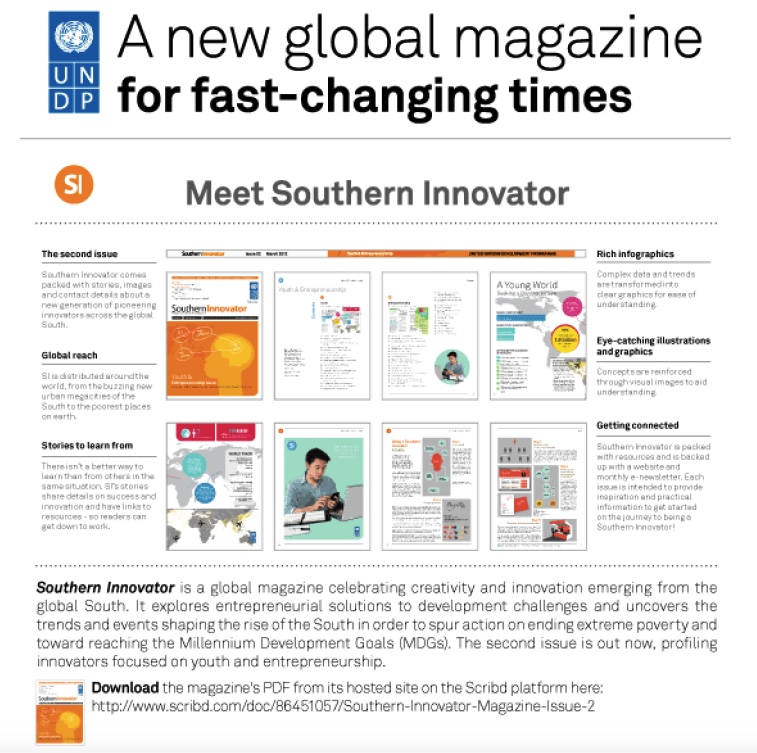
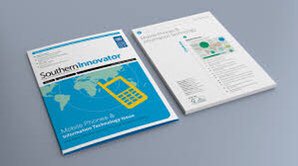
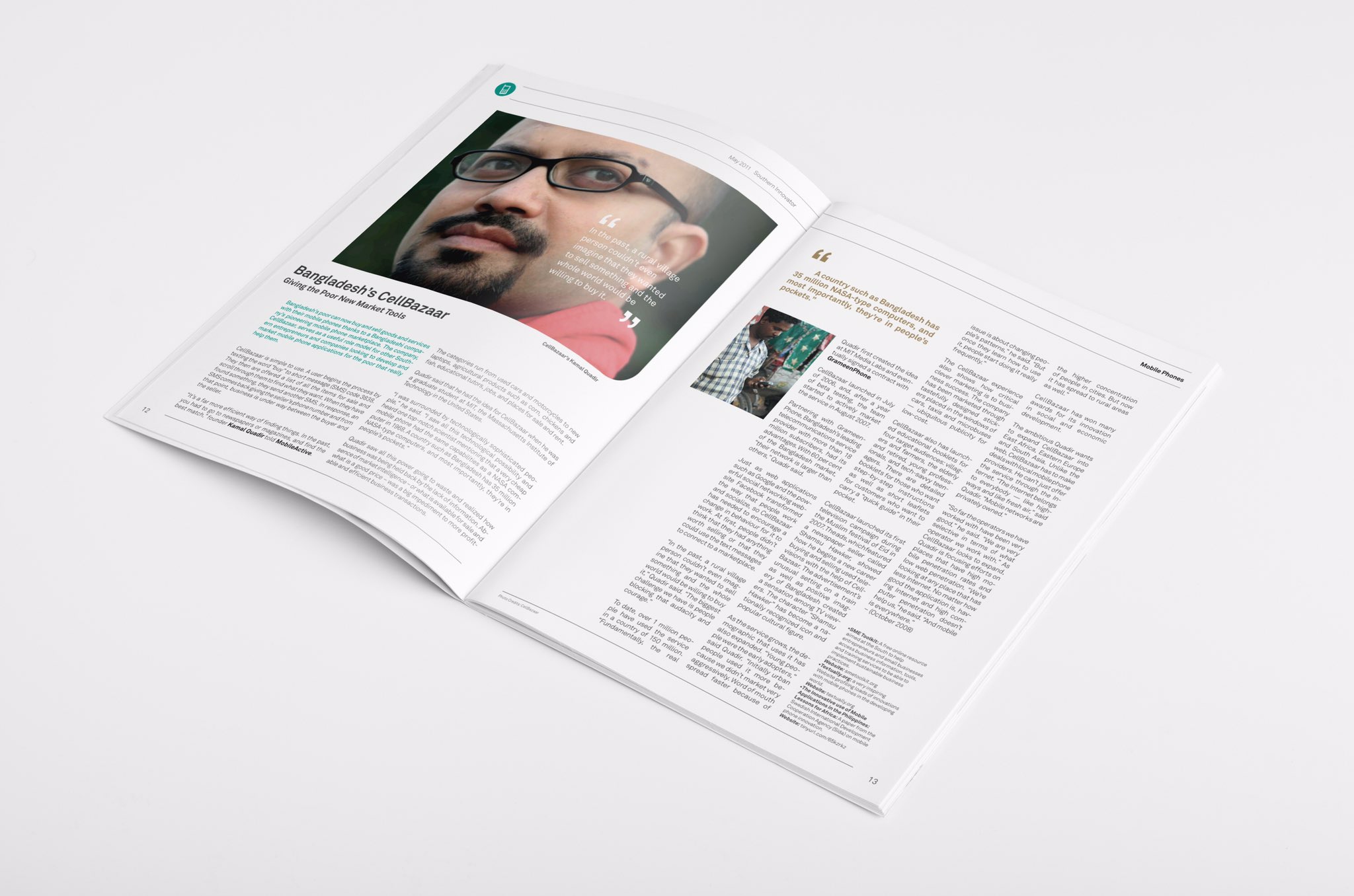
Southern Innovator Magazine was launched at the United Nations General Assembly (UNGA) in New York in 2011 by the United Nations Office for South-South Cooperation (UNOSSC). The first five issues were published between 2011 and 2015. The magazine played an integral role in laying the foundations for the Sustainable Development Goals (SDGs) and strategically positioning the United Nations as it transitioned from the Millennium Development Goals (MDGs) to the SDGs.
“I think you [David South] and the designer [Solveig Rolfsdottir] do great work and I enjoy Southern Innovator very much!”
Ines Tofalo, Programme Specialist, United Nations Office for South-South Cooperation
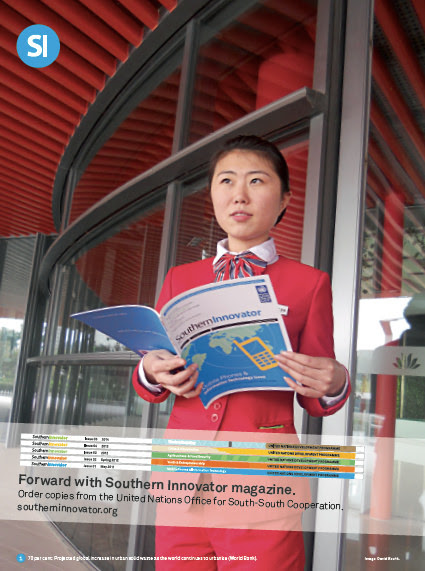
Southern Innovator in Tianjin, China.Issue 5 of Southern Innovator at the Global South-South Development Expo (GSSD Expo) 2014 held in Washington, D.C.Volunteers in Nairobi, Kenya pose with Southern Innovator Issue 4 at the Global South-South Development Expo (GSSD Expo) in 2013.Southern Innovator Editor and Writer David South in Australia.Southern Innovator Graphic Designer and Illustrator Sólveig Rolfsdóttir in Iceland.
Some comments that have come in so far about SI’s first issue:
“What a tremendous magazine your team has produced! It’s a terrific tour de force of what is interesting, cutting edge and relevant in the global mobile/ICT space… Really looking forward to what you produce in issues #2 and #3. This is great, engaging, relevant and topical stuff.”, to “Looks great. Congratulations. It’s Brill’s Content for the 21st century!”
What they are saying about SI on Twitter: From @CapacityPlus Nice job RT @ActevisCGroup: RT @UNDP: Great looking informative@SouthSouth1 mag on South-South Innovation; @UNDP Great looking informative @SouthSouth1 mag on South-South Innovation; @JeannineLemaireGraphically beautiful & informative @UNDP Southern Innovator mag on South-South Innov.
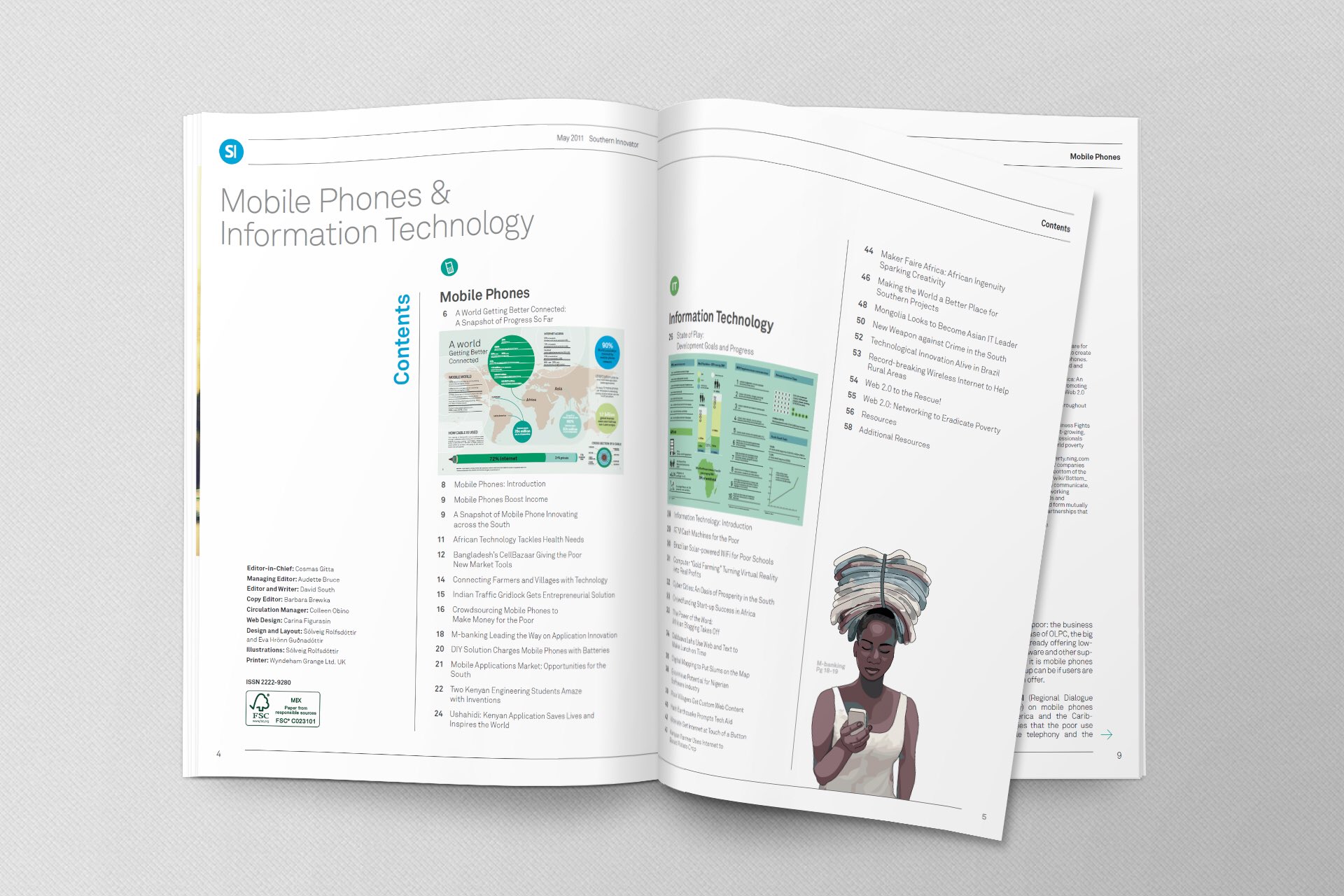
Development Challenges, South-South Solutions was launched as an e-newsletter in 2006 by UNDP’s South-South Cooperation Unit (now the United Nations Office for South-South Cooperation) based in New York, USA. It led on profiling the rise of the global South as an economic powerhouse and was one of the first regular publications to champion the global South’s innovators, entrepreneurs, and pioneers. It tracked the key trends that are now so profoundly reshaping how development is seen and done. This includes the rapid take-up of mobile phones and information technology in the global South (as profiled in the first issue of magazine Southern Innovator), the move to becoming a majority urban world, a growing global innovator culture, and the plethora of solutions being developed in the global South to tackle its problems and improve living conditions and boost human development. The success of the e-newsletter led to the launch of the magazine Southern Innovator.
Mexico is home to the second largest rainforest in the Americas after the Amazon jungle. But the country’s forests face serious threats from logging, cattle ranching and agriculture. As much as 80 percent of Mexico’s original forests have already been lost.
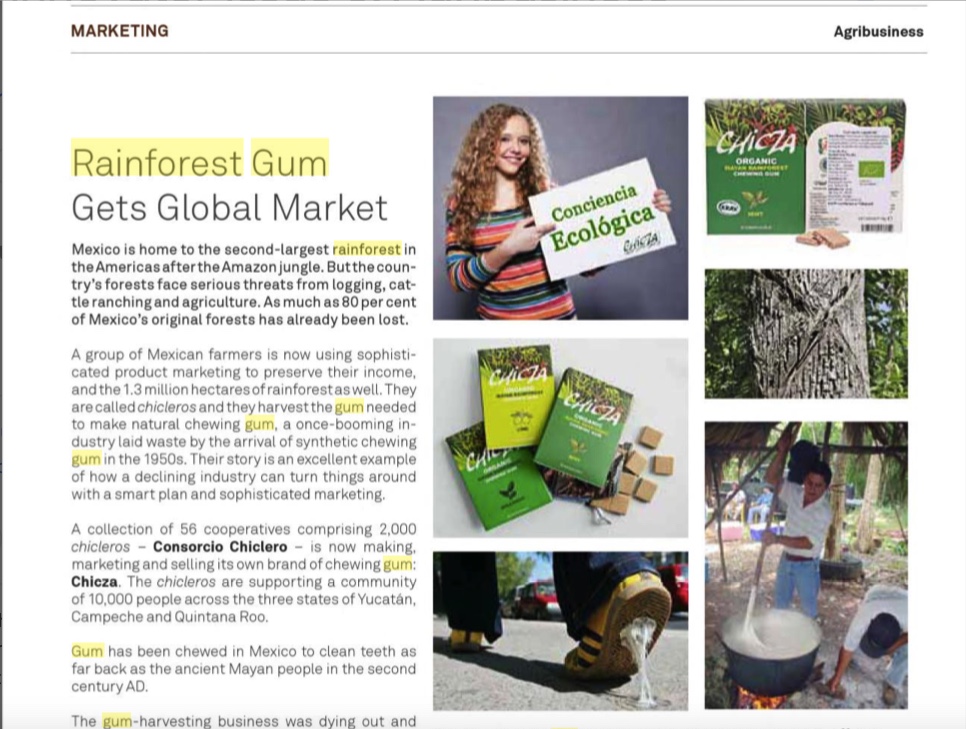
A group of Mexican farmers is now using sophisticated product marketing to preserve their income, and the 1.3 million hectares of rainforest as well. They are called chicleros and they harvest the gum needed to make natural chewing gum, a once-booming industry laid waste by the arrival of synthetic chewing gum in the 1950s. Their story is an excellent example of how a declining industry can turn things around with a smart plan and sophisticated marketing.
A collection of 56 cooperatives comprising 2,000 chicleros – called Consorcio Chiclero – is now making, marketing and selling its own brand of chewing gum: Chicza (http://www.chicza.com/index.php). The chicleros are supporting a community of 10,000 people across the three states of Yucatán, Campeche and Quintana Roo.
Gum has been chewed in Mexico to clean teeth as far back as the ancient Mayan people in the second century AD.
The gum harvesting business was dying out and young people, put off by the low pay, were leaving for jobs elsewhere. The adminstrators of the chiclero co-operative created Chicza Rainforest Gum brand to save the industry. They made a deal with Britain’s Waitrose supermarket chain, which specializes in fair trade products, and the gum is being launched in 100 stores.
The brightly coloured packages of chewing gum are now being sold as organic and a way to preserve the forest. Frustrated by the decades of decline and attendant poverty and community decay, the chicleros decided to take matters into their own hands. Five years ago they decided to avoid the middlemen who would buy their raw gum products, and instead manufacture and market the chewing gum themselves. And it is paying off: by adding value to the raw product, each farmer’s income has grown six times higher than he would earn as a mere provider of raw material.
The gum comes in three flavours: wild mint, heirloom lime and spearmint. Future flavours will blend tropical fruits, herbs and spices.
The Consorcio Chiclero coordinates the production, the logistics, the trade and the finances for the manufacture of gum from the chicozapote tree (Manilkara zapota).
Certified organic, the Chicza gum is completely natural and free of synthetic ingredients and also biodegrades when it is discarded – a boon to city governments who hate the mess and cost of traditional gum left on sidewalks.
The farmers work in the rainforest at the southern end of Mexico’s Yucatan peninsula (http://en.wikipedia.org/wiki/Yucat%C3%A1n_Peninsula), bordering Guatemala and Belize. It is a place with one of the most bio diverse ecosystems in the world, and an environment the farmers are in harmony with. The chicle gum (http://en.wikipedia.org/wiki/Chicle) is harvested from chicozapote trees – some living for more than 300 years – by hacking z-shaped cuts into the bark of the 100 foot trees. The harmless cuts zig zag down the tree and a bucket is placed at the bottom to collect the dripping sap.
Once collected, the sap is boiled, dried and made into a sticky paste, which is then kneaded and shaped into bricks called marquetas. Each marqueta is carefully marked by its maker. Since the sustainable management of their rainforests is certified by FSC (Forest Stewardship Council) (http://www.fsc.org/), these marks contain relevant information that tells the name of the chiclero who harvested it, and the exact location of the harvested tree in the rainforest. Few products offer such perfect traceability.
“I started following my dad around the rainforest when I was 10 and working when I was 12,” farmer Porfirio Banos told The Guardian newspaper. “I am a chiclero to my core.”
Working in a remote area of rainforest jungle with just spider monkeys for company, the chicleros are paid by the amount of chicle harvested
“We don’t kill the trees like farmers do when they clear land to grow corn or graze cattle,” says Roberto Aguilar, 60. “We leave a wound, it’s true, but eight years after it is healed and producing chicle again.”
The chicleros face two main risks while doing the job: falling from the trees if their rope gives out; and being bitten by poisonous snakes.
Chicle was once the basis of all commercial chewing gum. Beginning in New York 141 years ago, it was the only source for chewing gum until the 1950s, when synthetic substitutes destroyed the industry.
It was the economic desperation of a Mexican general, Antonio Lopez de Santa Anna, living in exile in the United States in 1869, that gave birth to gum-chewing as a global practice. Working with a local inventor, Thomas Adams, he tried to use the chicle to make a rubber substitute. But when this failed, Adams added sugar and flavouring, making chewing gum.
Apart from being a great chew, the natural gum’s unique selling point is saving money: local governments tight for cash are looking for other ways to deal with the menace of chewing gum on pavements. A small fortune is spent every year trying to keep streets clean of gum. The British alone spend over UK £150 million every year trying to clean their streets of chewing gum.
And despite the global recession, the chicleros are optimistic they can do well: during the Great Depression of the 1930s, chewing gum was an affordable treat and sold well.
Published: April 2009
Resources
Design that Matters: Timothy Prestero, CEO (Cambridge, MA): Design that Matters (DtM) was founded to help social enterprises in developing countries scale up enterprises more quickly by providing them access to better products designed specifically for their business needs. Website:http://www.designthatmatters.org/
The Fairtrade Labelling Organization sets the standards for fair-trade and is the place to go to receive official certification. Website:www.fairtrade.org.uk
International Cooperative Agricultural Organisation: The ICAO is the democratic organisation representing agricultural co-operatives and farmers worldwide. Website:http://www.agricoop.org/
Waitrose Supermarket: It regularly sources fair trade and organic food products from the global South. Website:http://www.waitrose.com/index.aspx
Development Challenges, South-South Solutions was launched as an e-newsletter in 2006 by UNDP’s South-South Cooperation Unit (now the United Nations Office for South-South Cooperation) based in New York, USA. It led on profiling the rise of the global South as an economic powerhouse and was one of the first regular publications to champion the global South’s innovators, entrepreneurs, and pioneers. It tracked the key trends that are now so profoundly reshaping how development is seen and done. This includes the rapid take-up of mobile phones and information technology in the global South (as profiled in the first issue of magazine Southern Innovator), the move to becoming a majority urban world, a growing global innovator culture, and the plethora of solutions being developed in the global South to tackle its problems and improve living conditions and boost human development. The success of the e-newsletter led to the launch of the magazine Southern Innovator.
Kenya is home to a vibrant innovation culture centred around mobile phones. While not all the services launched will be successful, the flurry of start-ups shows the country has the right combination of technical skills, bright ideas and cash to make a go of new services.
With the number of mobile phone users leaping 28 per cent in 2011, to reach 25 million subscribers out of a population of 39 million (Reuters), the country has a large market for mobile phone-based services. Kenya also has 10 million people with access to the Internet, up from 4 million in 2009.
Two issues critical to the well-being of Kenyans – health services and farming – are being tackled by new mobile phone services. One is a service being run and marketed by a major player in the market, and the other, by a small start-up.
Statistics indicate that in Kenya, one doctor attends to over 10,000 patients. The World Health Organization recommends a ratio of 1:600. There are just over 7,500 licensed medical facilities in the country.
Safaricom, Kenya’s largest telecoms operator, is trying to take the pressure off overstretched medical and health systems with a new mobile health service. Its 24-hour health advice and referral service is called ‘Daktari 1525’ and lets people call and speak with a doctor or an expert to get advice on any health issue. The number 1525 refers to the dialling code which links users directly to the Safaricom call centre. Daktari 1525 is available to the 18 million Safaricom subscribers.
Safaricom has partnered with ‘Call-a-Doc’ to launch the tool. The new service hopes to relieve outpatient departments in government hospitals and health facilities with its advice and referrals. The Daktari 1525 service does not prescribe a treatment to the callers, avoiding the legal risks of remote diagnosis.
It also offers home remedies and health tips on healthy lifestyles. In an emergency, users can also dial Daktari 1525 if there is Safaricom network coverage.
The partnership is divided between Safaricom and Call-a-Doc. Safaricom handles all the mobile phone network infrastructure, the call centre facility and the marketing of the service. Call-a-Doc takes care of recruiting doctors.
But how does the service use the doctors’ time well? The shifts are designed to surge the number of doctors to 15 during peak times, falling to as few as four doctors during off-peak times. The doctors work on a part-time basis and there are currently 50 employed by the service.
Not everyone is convinced the service will work.
“It is a good attempt to venture into the field; however we would like to caution the practitioners involved that they must remain ethical and must at all times uphold professional confidentiality,” Medical Practitioners and Dentist Board Chief Executive Officer Daniel Yumbya told Capital News.
Another new service based in the capital, Nairobi, is trying to shake up the world of farming. Its new mobile phone service, “MFarm: connecting farmers” (http://mfarm.co.ke/) calls itself “a transparency tool for Kenyan farmers”.
It bills itself as a “factory of ideas” looking to find “creative agribusiness solutions.” The service is a paid-for web platform that helps farmers keep track of prices in the capital, Nairobi, and claims to have signed up 3,000 farmers in the first year of operations.
The service offers crop prices by sending a text to the numbers 3535 if the user gives the crop location required. As an example, the user texts “price crop location” “price maize Nairobi”. Users can also sell their crops, or buy farm supplies.
It also allows farmers to group sell their crops by getting together with other small-scale farmers. This is a crucial service because it allows the smaller farmer to sell into the wholesale markets where prices are better. Farmers can also group buy, benefiting from lower prices by buying bulk from suppliers. It cleverly offers several ‘plans’ to suit budgets. There is an ‘Eco Plan’ at the low end, a mid-range ‘Pro Plan’, and a bells-and-whistles option, ‘Biz Plan’.
The service also benefits from its connections with iHub Nairobi (http://ihub.co.ke/pages/home.php), the buzzing “open space for technologists, investors, tech companies and hackers in Nairobi.” It provides a strong support network to turn to when problems arise.
It seems as if it would be a mistake to enter the African market with any new tech solution without first checking out the scene in Nairobi.
Published: January 2012
Resources
1) iHub Nairobi: Nairobi’s Innovation Hub for the technology community is an open space for the technologists, investors, tech companies and hackers in the area. The space has a focus on young entrepreneurs, web and mobile phone programmers, designers and researchers. Website: http://ihub.co.ke/pages/home.php
2) EPROM: Entrepreneurial Programming and Research on Mobiles aims to foster mobile phone-related research and entrepreneurship. Website: http://www.media.mit.edu/ventures/EPROM
Development Challenges, South-South Solutions was launched as an e-newsletter in 2006 by UNDP’s South-South Cooperation Unit (now the United Nations Office for South-South Cooperation) based in New York, USA. It led on profiling the rise of the global South as an economic powerhouse and was one of the first regular publications to champion the global South’s innovators, entrepreneurs, and pioneers. It tracked the key trends that are now so profoundly reshaping how development is seen and done. This includes the rapid take-up of mobile phones and information technology in the global South (as profiled in the first issue of magazine Southern Innovator), the move to becoming a majority urban world, a growing global innovator culture, and the plethora of solutions being developed in the global South to tackle its problems and improve living conditions and boost human development. The success of the e-newsletter led to the launch of the magazine Southern Innovator.
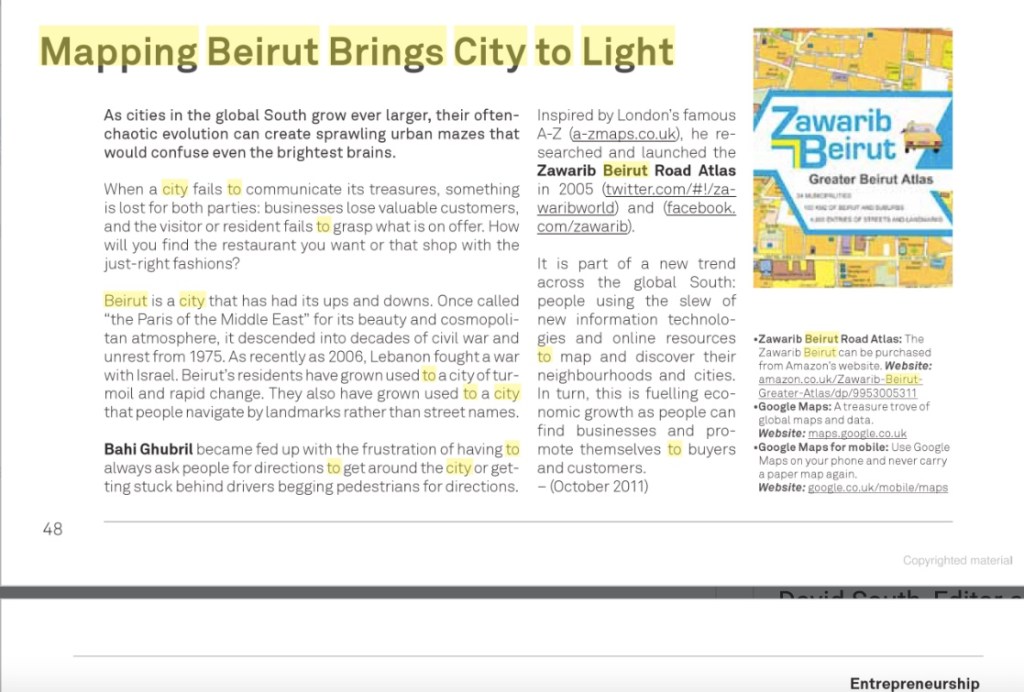
As cities in the global South grow ever larger, their often-chaotic evolution can create sprawling urban mazes that would confuse even the brightest brains.
Streets can be unnamed, unnumbered, twisty, full of dead ends and alleys. Informal settlements can pop up within weeks, whole neighbourhoods are razed to the ground and replaced by gleaming office buildings and apartments within months. Some countries experience political instability and conflict, disrupting daily life and making planning difficult. All this chaos makes business and travel more inefficient, especially to visiting businesspeople looking to trade or tourists simply wanting to look around.
When a city fails to communicate its treasures, something is lost for both parties: the city’s businesses lose valuable custom and the visitor or resident fails to grasp what is on offer. How will you find the restaurant you want, or that shop with the just-right fashions?
Beirut is a city that has had its ups and downs. Once called “the Paris of the Middle East” for its beauty and cosmopolitan atmosphere, it descended into decades of civil war and unrest from 1975, most recently in 2006 it had a war with Israel. Its residents have grown used to a city of turmoil and rapid change. They also have grown used to a city that people navigate by landmarks rather than street names.
Bahi Ghubril grew fed up with the frustration of having to always ask people for directions to get around the city, or getting stuck behind drivers begging pedestrians for directions.
It is part of a new trend across the global South: people using the slew of new information technologies and online resources to map and discover their neighbourhoods and cities. In turn, this is fuelling economic growth as people can find businesses and promote themselves to buyers and customers.
It took Ghubril two years to put together the first guide, gathering street images from satellite photos and then combining them with information collected on foot and from local mayors and cartographers.
“The project was born from a need to organise the city,” he told Monocle magazine, “but also as a socio-political project to open up the city to its residents and visitors.”
As an entrepreneur, Ghubril had no previous experience in publishing. He has been an actor and worked in finance.
During the research for the guide, Ghubril developed a rich knowledge of the city’s structure, its bureaucracy and how people really live their lives. His willingness to do this hard work is paying off.
Zawarib Beirut – which translates as Beirut Alleys – has successfully expanded into editions covering nearby cities, a pocket version, eight versions colourfully decorated by local artists, and the first Beirut bus map.
The service has a database including thousands of street names, landmarks, sectors and districts within the 34 municipal regions making up Greater Beirut. It includes useful phone numbers, car parks and a bus map. During holidays, like the Muslim holy month of Ramadan, it publishes a map of all of Beirut’s mosques.
Ghubril promotes the guide directly to the city’s residents. Wearing blue and black t-shirts asking “Lost? ask me,” young women help to distribute the guide on the streets of Beirut.
Other mapping projects depend on the mobile phones that are more and more part of daily life in the South’s slums – even for the poorest people. With the spread of mobile phones, it is becoming possible to develop a digital picture of a slum area and map its needs and population. It has become possible to undertake digital mapping initiatives to truly find out who is where and what is actually going on.
An NGO called Map Kibera (http://www.mapkibera.org) is working on an ambitious project to digitally map Africa’s largest slum, Kibera in Nairobi, Kenya.
The Map Kibera project uses an open-source software programme, OpenStreetMap (http://www.openstreetmap.org), to allow users to edit and add information as it is gathered. This information is then free to use by anybody wanting to grasp what is actually happening in Kibera: residents, NGOs, private companies and government officials.
The mappers physically travel around the favela and upload information on each individual landmark (restaurants, roads etc.) as they go. They use Nokia N95s mobile phones that are connected to Google Maps (http://www.maps.google.com). The project then uses Wikimapa (http://www.wikimapa.org.br), and Twitter (http://www.twitter.com) to log the information.
Published: October 2011
Resources
1) Zawarib Beirut Road Atlas: The Zawarib Beirut can be purchased from Amazon’s website. Website:http://www.amazon.co.uk/Zawarib-Beirut-Greater-Atlas/dp/9953005311
Development Challenges, South-South Solutions was launched as an e-newsletter in 2006 by UNDP’s South-South Cooperation Unit (now the United Nations Office for South-South Cooperation) based in New York, USA. It led on profiling the rise of the global South as an economic powerhouse and was one of the first regular publications to champion the global South’s innovators, entrepreneurs, and pioneers. It tracked the key trends that are now so profoundly reshaping how development is seen and done. This includes the rapid take-up of mobile phones and information technology in the global South (as profiled in the first issue of magazine Southern Innovator), the move to becoming a majority urban world, a growing global innovator culture, and the plethora of solutions being developed in the global South to tackle its problems and improve living conditions and boost human development. The success of the e-newsletter led to the launch of the magazine Southern Innovator.
















 David South Consulting
You must be logged in to post a comment.