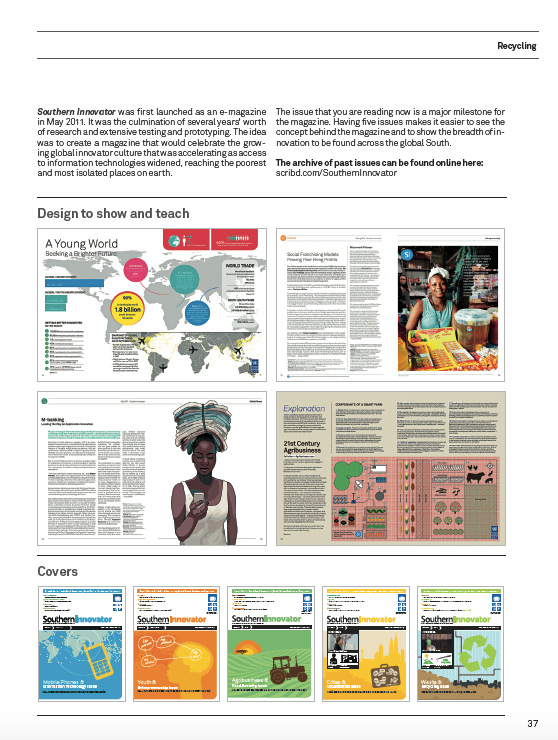
Category: Southern Innovator magazine

  • Model Indian Villages to Keep Rural Relevant

    Model Indian Villages to Keep Rural Relevant

    By David SouthDevelopment Challenges, South-South Solutions

    (Havana, Cuba), November 2008

    SOUTH-SOUTH CASE STUDY

    The world’s rush to urban centres is the great challenge of the 21st century. In 2007, the world became a majority urban place. The consequences of this shift can be seen in the blight of urban poverty, with its slums and squalor, environmental degradation, and rising social tensions. But there are people working on keeping rural areas relevant and pleasant places to live. These rural advocates see a vibrant countryside as part of the solution to the world’s plethora of crises.

    In India, a pioneering initiative is reviving impoverished rural villages. Drawing on self-organizing methods used in India since 1200 BC, the Model Village India (www.modelvillageindia.org.in) is based around India’s democratic system of Panchayats: a village assembly of people stemming back to pre-colonial times.

    “Decentralizing is necessary if development is to reach the grassroots,” said the concept’s founder, Rangeswamy Elango, a head of the village of Kuthampakkam, 20 kilometres (12 miles) from the bustling city of Chennai, and one of the 12,600 Panchayats in the Indian state of Tamil Nadu.

    While all villages have the ability to use the Panchayat system to improve their lives, few are making the most of this system. The model villages are about showing other villages the true power they have at their disposal. And that with a plan and determination, they can increase their income and improve their quality of life, attracting more money from government and other sources to do so.

    The concept has now expanded to 30 model villages. At its core it is about being positive, eschewing griping about problems and instead getting down to work to solve them.

    “We demonstrate the basic infrastructure, sustainable housing, food security,” said Elango. “If the government is not bothering, maybe through the local people’s efforts, we can try to demonstrate a variety of development models.”

    As India’s economy has boomed, its small towns and villages have withered. Home to the majority of the country’s population, they are in crisis, with declining populations and high suicide rates. India’s urban slums are where people are going – they are growing 250 percent faster than the country’s population. India is a country in danger of neither having a viable rural economy, nor viable cities, but just vast tracts of slums.

    Originally left out of the first draft of India’s constitution, Panchayats became legitimized in 1992. They are now elected in every one of the 260,000 villages in India. If they use them, the local Panchayats have extensive powers to transform the destiny of a village, with control of budgets, and decision-making power on how services are to be delivered. This ranges from the provision of clean water, to burying the dead and building roads. The trick is in getting people to realize the power they wield over their destiny and how it can transform their economic situation.

    “The village-level local governments are constitutionally important bodies,” said Elango, “but the way it is implemented is not good. The system is unable to deliver the goods to the people.”

    The model village approach has revived once-declining villages plagued with high unemployment, chronic alcohol abuse, and domestic violence. The residents are involved in the building of new and healthier homes, providing clean drinking water, waste facilities, education services – including an academy dedicated to teaching the skills and lessons leaned by the villagers to other villages – and even trying to break down the barriers between people because of India’s caste social hierarchy.

    “Instead of having a big college, this is a practical people’s model,” Elango said. “It is not done by an academic but by a layman. The learning is spontaneous and emotional.”

    Elango is driven by making his village a model that works, and in turn, becoming a magnet for others wishing to improve their lives and their villages.

    Elango’s village was not able to support itself with its two crop harvests a year and the villagers resorted to illegal alcohol production instead to make a living. Despite being well connected by highway with nearby Chennai, the village was socially and economically dying.

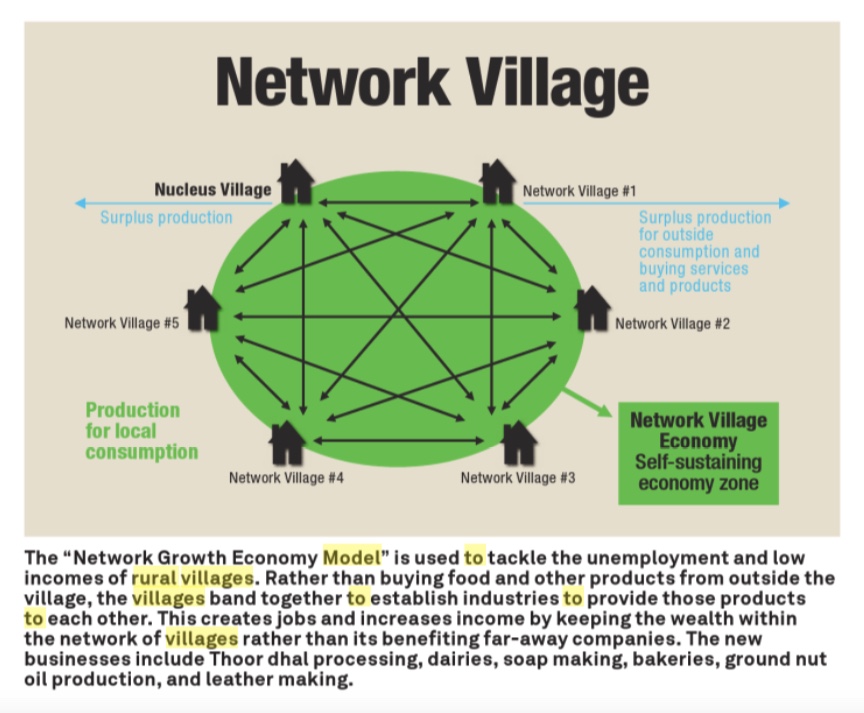
    Like a spreading ink spot, the concept is to create a network of like-minded villages that act as self-reinforcing positive role models, spreading the prosperity and stability outwards. The “Network Growth Economy Model” is a direct challenge to the “special economic zones that benefit only capitalist owners,” said Elango.

    Ambitious, Elango is hoping to draw in 2,000 villages over the next 10 years, until a tipping point is reached, and the model explodes across India.

    A native of the village, Elango became saddened by the community’s decline, including widespread domestic violence against women. The booming city of Chennai’s prosperity had not rippled out to the village, and it was still lacking good infrastructure and sanitation. A trained chemical engineer, he was elected the President of the Kuthambakkam Panchayat in 1996, and set about using his engineer’s perspective to draft the village’s five-year plan from 1996 to 2001.

    But the budget was tight. And he had to turn to innovative solutions: recycling building materials, conserving water and reducing electricity consumption. But the resourcefulness paid off, and the state of Tamil Nadu provided the money to upgrade roads, drains, build a community centre, child care facilities, 200 low cost toilets, and work sheds for the village’s industries. By the end of 2001, most basic needs were being met. He then turned to providing good quality housing for the villagers still living in thatch huts.

    He has used the “Network Growth Economy Model” to tackle the unemployment and low incomes. It works like this: rather than buying food and other products from outside the village, the villages band together to establish industries to provide those products to each other. This creates jobs and increases income by keeping the wealth within the network of villages, rather than it benefiting far-away companies. The new businesses include Thoor dhal processing, dairies, soap making, bakeries, ground nut oil production, and leather making.

    “India was strong when this model was in place – we had strong villages,” said Elango. “Globalization’s trickle down is not working for India.”
    Published: November 2008

    Resources

    • Unleashing India’s Innovation: Toward Sustainable and Inclusive Growth, a report by the World Bank. Website: http://web.worldbank.org/WBSITE/EXTERNAL/COUNTRIES/SOUTHASIAEXT/0,,contentMDK:21490203~pagePK:146736~piPK:146830~theSitePK:223547,00.html
    • NextBillion.net: Hosted by the World Resources Institute, it identifies sustainable business models that address the needs of the world’s poorest citizens. Website:http://www.wri.org
    • CIDEM and Ecosur specialise in building low-cost community housing using eco-materials. They have projects around the world and are based in Cuba. Website: http://www.ecosur.org

    Sponsored by BSHF. BSHF is now called World Habitat and it aims to seek out and share the best solutions to housing problems from around the world.

    https://davidsouthconsulting.org/2022/11/22/bio-ethanol-from-sturdy-and-once-unwanted-indian-plant/

    https://davidsouthconsulting.org/2022/09/29/cheap-indian-tablet-seeks-to-bridge-digital-divide/

    https://davidsouthconsulting.org/2022/10/09/entrepreneurs-use-mobiles-and-it-to-tackle-indian-traffic-gridlock/

    https://davidsouthconsulting.org/2021/08/29/indian-business-model-makes-green-energy-affordable/

    https://davidsouthconsulting.org/2022/10/25/indian-city-slum-areas-become-newly-desirable-places-to-live/

    https://davidsouthconsulting.org/2021/08/28/indian-entrepreneur-brings-dignity-to-poor-women/

    https://davidsouthconsulting.org/2021/03/04/indian-id-project-is-foundation-for-future-economic-progress/

    https://davidsouthconsulting.org/2022/10/18/indian-initiatives-to-make-travel-safer-for-women/

    https://davidsouthconsulting.org/2022/06/15/indian-mobile-phone-application-innovators-empower-citizens/

    https://davidsouthconsulting.org/2022/11/01/indian-newspapers-thrive-with-economy/

    https://davidsouthconsulting.org/2022/10/06/indian-solar-economy-brings-new-vocation-for-women/

    https://davidsouthconsulting.org/2022/10/06/indian-solar-power-pack-powers-villages/

    https://davidsouthconsulting.org/2022/10/25/indian-toilet-pioneer-champions-good-ideas/

    https://davidsouthconsulting.org/2022/10/18/indians-fighting-inflation-with-technology/

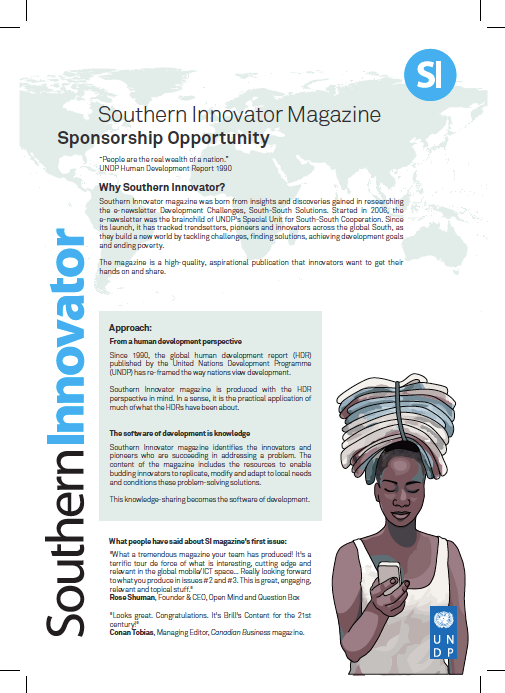
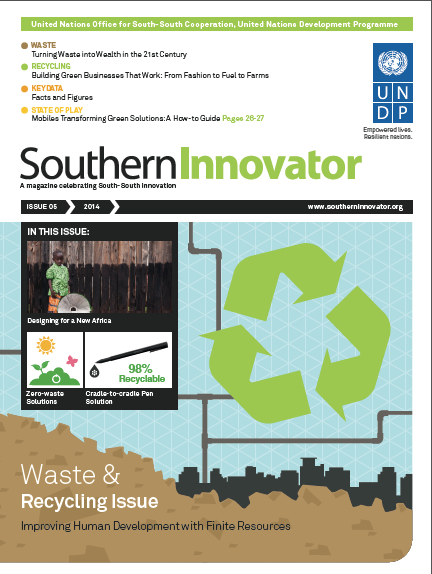
    Development Challenges, South-South Solutions was launched as an e-newsletter in 2006 by UNDP’s South-South Cooperation Unit (now the United Nations Office for South-South Cooperation) based in New York, USA. It led on profiling the rise of the global South as an economic powerhouse and was one of the first regular publications to champion the global South’s innovators, entrepreneurs, and pioneers. It tracked the key trends that are now so profoundly reshaping how development is seen and done. This includes the rapid take-up of mobile phones and information technology in the global South (as profiled in the first issue of magazine Southern Innovator), the move to becoming a majority urban world, a growing global innovator culture, and the plethora of solutions being developed in the global South to tackle its problems and improve living conditions and boost human development. The success of the e-newsletter led to the launch of the magazine Southern Innovator.

    https://davidsouthconsulting.org/2021/03/05/southern-innovator-issue-3/

    Creative Commons License

    This work is licensed under a
    Creative Commons Attribution-Noncommercial-No Derivative Works 3.0 License.

    ORCID iD: https://orcid.org/0000-0001-5311-1052.

    © David South Consulting 2023
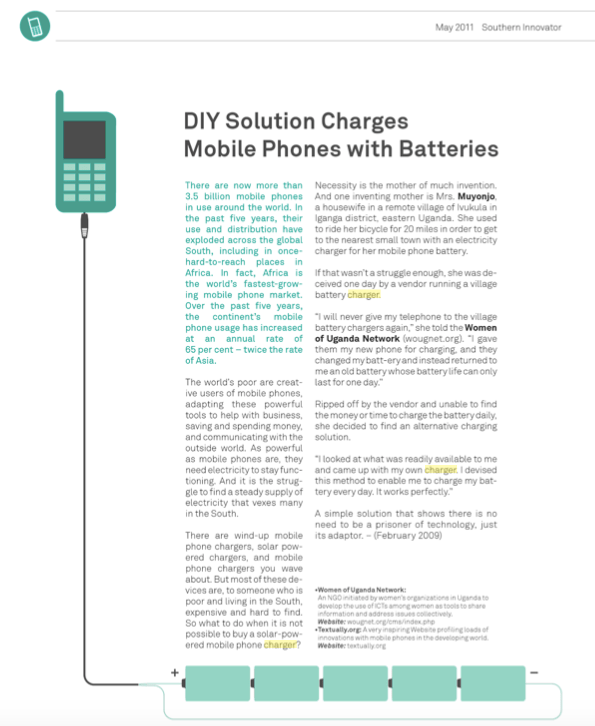
  • DIY Solution Charges Mobile Phones With Batteries

    DIY Solution Charges Mobile Phones With Batteries

    By David SouthDevelopment Challenges, South-South Solutions

    SOUTH-SOUTH CASE STUDY

    There are now more than 3.5 billion mobile phones in use around the world. In the past five years, their use and distribution has exploded across the global South, including in once hard-to-reach places in Africa. In fact, Africa is the world’s fastest growing mobile phone market. Over the past five years the continent’s mobile phone usage has increased at an annual rate of 65 percent – twice the rate of Asia.

    The world’s poor are creative users of mobile phones, adapting these powerful tools to help with business, saving and spending money, and communicating with the outside world. As powerful as mobile phones are, they need electricity to stay functioning. And it is the struggle to find a steady supply of electricity that vexes many in the South.

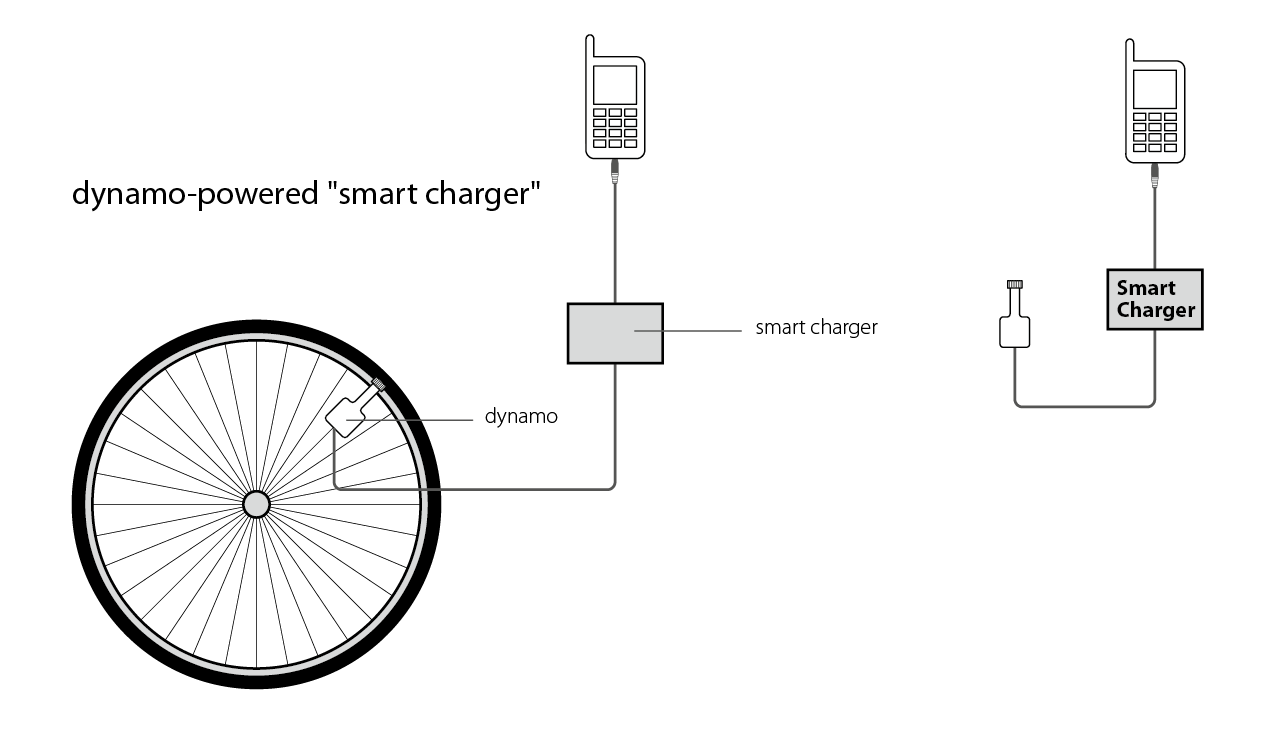
    There are wind-up mobile phone chargers, solar powered chargers (http://tinyurl.com/bg3wac), and mobile phone chargers you wave about. But most of these devices are, to someone who is poor and living in the South, expensive and hard to find. So what to do when it is not possible to buy a solar powered mobile phone charger?

    Necessity is the mother of much invention. And one inventing mother is Mrs. Muyonjo, a housewife in a remote village of Ivukula in Iganga district, Eastern Uganda. She used to ride her bicycle for 20 miles in order to get to the nearest small town with an electricity charger for her mobile phone battery.

    If that wasn’t a struggle enough, she was one day deceived by a vendor running a village battery charger.

    “I will never give my telephone to the village battery chargers again,” she told the Women of Uganda Network (www.wougnet.org). “I gave them my new phone for charging, and they changed my battery and instead returned to me an old battery whose battery life can only last for one day.”

    Ripped off by the vendor and unable to find the money or time to charge the battery daily, she decided to find an alternative charging solution.

    “I looked at what was readily available to me and came up with my own charger. I devised this method to enable me to charge my battery every day. It works perfectly.”

    A simple solution that shows there is no need to be a prisoner of technology, just its adaptor.

    Published: February 2009

    Development Challenges, South-South Solutions was launched as an e-newsletter in 2006 by UNDP’s South-South Cooperation Unit (now the United Nations Office for South-South Cooperation) based in New York, USA. It led on profiling the rise of the global South as an economic powerhouse and was one of the first regular publications to champion the global South’s innovators, entrepreneurs, and pioneers. It tracked the key trends that are now so profoundly reshaping how development is seen and done. This includes the rapid take-up of mobile phones and information technology in the global South (as profiled in the first issue of magazine Southern Innovator), the move to becoming a majority urban world, a growing global innovator culture, and the plethora of solutions being developed in the global South to tackle its problems and improve living conditions and boost human development. The success of the e-newsletter led to the launch of the magazine Southern Innovator.  

    Follow @SouthSouth1

    Google Books: https://books.google.co.uk/books?id=mLKXBgAAQBAJ&dq=development+challenges+february+2009&source=gbs_navlinks_s

    Slideshare: http://www.slideshare.net/DavidSouth1/development-challengessouthsouthsolutionsfebruary2009issue

    Southern Innovator Issue 1: https://books.google.co.uk/books?id=Q1O54YSE2BgC&dq=southern+innovator&source=gbs_navlinks_s

    Southern Innovator Issue 2: https://books.google.co.uk/books?id=Ty0N969dcssC&dq=southern+innovator&source=gbs_navlinks_s

    Southern Innovator Issue 3: https://books.google.co.uk/books?id=AQNt4YmhZagC&dq=southern+innovator&source=gbs_navlinks_s

    Southern Innovator Issue 4: https://books.google.co.uk/books?id=9T_n2tA7l4EC&dq=southern+innovator&source=gbs_navlinks_s

    Southern Innovator Issue 5: https://books.google.co.uk/books?id=6ILdAgAAQBAJ&dq=southern+innovator&source=gbs_navlinks_s

    Creative Commons License
    This work is licensed under a
    Creative Commons Attribution-Noncommercial-No Derivative Works 3.0 License.

    ORCID iD: https://orcid.org/0000-0001-5311-1052.

    © David South Consulting 2023

  • Local Fashions Pay Off For Southern Designers

    Local Fashions Pay Off For Southern Designers

    By David SouthDevelopment Challenges, South-South Solutions

    SOUTH-SOUTH CASE STUDY

    Fashion earns big money around the world: The global clothing industry is estimated to be worth US $900 billion a year. For many decades, strong American brands have been the desired commodity for those looking to be cool and contemporary. People were willing to pay high premium prices to get the cache of American cool that the brands conveyed.

    But the decline in popularity suffered by American brands in recent years has become a boost for local brands. And this is creating a whole new opportunity for canny Southern entrepreneurs. It is being called ‘fashionalism’ or fashion nationalism – a pop culture trend blending patriotism with fashion.

    One of fashionalism’s pioneers is Italian-educated Filipino designer Rhett Eala. He is credited with coming up with the snappy name fashionalism, after launching his My Pilipinas clothing line. Its signature logo is the Philippine archipelago on collared shirts and cotton polo shirts. An experienced designer who has worked in Hong Kong and for a major department store, Eala joined Collezione C2 as creative director two years ago.

    He started with just three styles sporting the map. But now he has expanded the design to cover almost his entire range of clothing.

    “It’s a fun way to show your pride in being Filipino, without a lot of words. Filipinos have today become global citizens,” said Eala.

    Eala’s design talent stretches to pop art paintings as well, with an art exhibit called My Pilipinas Series, 18 Filipino pop art paintings that transcend flag-waving notions of nationalism.

    But Eala is no parochialist: he is very much inspired by global artists and trends. His work is a blend of foreign concepts and patriotic ideals. Common Filipino iconography gets the high-design treatment, as Eala draws inspiration from Damien Hirst, David Hockney and Andy Warhol. He tries to challenge his customers, taking the complicated and oblique Rorschach Test patterns, and blending them with other designs.

    The fashionalist logoed clothing not only sells well domestically, but also amongst the large diaspora of Filipino expatriates around the world.

    “Fashionalism has a very positive impact on our business,” said Joey Qua, the Managing Director of Collezione C2. “We’ve always wanted to highlight the ingenuity of Philippine artistry and what it feels like to be proud to be a Filipino.”

    “More importantly, we want to make Filipinos proud to wear our brand here and abroad, since the Filipinos of today are more global in nature, we have so many Filipinos who are more exposed globally.”

    “We want to make nationalism hip and relevant to today’s generation,” said Eala.

    Supporters of fashionalism say it is about restoring pride in the country’s development and achievements, not in stirring up negative xenophobia and other negative aspects of nationalism.

    Another group of Manila fashion designers, Team Manila and Analog Soul, are marking the 25th anniversary of the death of Filipino nationalist hero, Ninoy Aquino – who was assassinated at the airport after returning to the Philippines from his self-imposed exile in the United States on August 21, 1983. Their t-shirts include sayings like: “I am Ninoy.”

    The clever designers have turned Aquino’s signature old-school eye glass frames into an iconic logo.

    “Ever since our humble beginnings as a Design Studio in 2001, we’ve made it a point to celebrate the Philippines and the Filipino people in our designs,” said Team Manila’s chief operating officer, Nico Bacani. “It was only natural that when we established our clothing and apparel line in 2005, the messages would remain the same – positive messages about the country, the culture and the people, be it explicitly or through subtle means in design.”

    Underground t-shirt designers had been selling yellow Ninoy t-shirts to the young and trendy urbanites. But it is the professional design flair that has taken the trend to the next level and created an industry in its own right, with the fashionalism branding spreading beyond clothes to coffee mugs and other everyday items.

    “We started as a design studio working from our Macs (Macintosh Computers) at home,” said Bacani. “and when we did start selling merchandise, this would be done literally in our garage and obscure spaces throughout the apartment we were renting. We then participated in bazaars, until such time as we raised enough capital and loyal clientele to expand into a stand-alone store.

    “So the obstacles we faced were more towards asset capitalization and recruiting people well-versed in the retail industry. We were, however, luckier than most, as the media would frequently feature our products, which was a big boost.”

    And Bacani hopes for a big payoff for the Phillippines as a whole.

    “We really wouldn’t say there’s anything negative about it, but we would say that it would be quite disappointing if it ended up just being that – wearing the clothes and not living the message. We would be quite pleased if Fashionalism were a trigger, a catalyst for something bigger, such as a more active participation in the development of the country as a whole. And we see that people starting to think and feel proud of being Filipino and representing the Filipino well, whether it be at the workplace here or abroad, or in everyday living around the world.”

    As for other fashion designers thinking of going down the fashionalism path, Eala said: “My advice is being honest with your design. Try to design from your heart and your mind. Be inspired with what’s around you. Design for your environment and if you have a chance, travel to places that you haven’t been to. ”

    More on Andy Warhol at Artsy here: https://www.artsy.net/artist/andy-warhol

    Published: October 2008

    Development Challenges, South-South Solutions was launched as an e-newsletter in 2006 by UNDP’s South-South Cooperation Unit (now the United Nations Office for South-South Cooperation) based in New York, USA. It led on profiling the rise of the global South as an economic powerhouse and was one of the first regular publications to champion the global South’s innovators, entrepreneurs, and pioneers. It tracked the key trends that are now so profoundly reshaping how development is seen and done. This includes the rapid take-up of mobile phones and information technology in the global South (as profiled in the first issue of magazine Southern Innovator), the move to becoming a majority urban world, a growing global innovator culture, and the plethora of solutions being developed in the global South to tackle its problems and improve living conditions and boost human development. The success of the e-newsletter led to the launch of the magazine Southern Innovator.  

    Follow @SouthSouth1

    Slideshare: http://www.slideshare.net/DavidSouth1/development-challengessouthsouthsolutionsoctober2008issue 

    Southern Innovator Issue 1: https://books.google.co.uk/books?id=Q1O54YSE2BgC&dq=southern+innovator&source=gbs_navlinks_s

    Southern Innovator Issue 2: https://books.google.co.uk/books?id=Ty0N969dcssC&dq=southern+innovator&source=gbs_navlinks_s

    Southern Innovator Issue 3: https://books.google.co.uk/books?id=AQNt4YmhZagC&dq=southern+innovator&source=gbs_navlinks_s

    Southern Innovator Issue 4: https://books.google.co.uk/books?id=9T_n2tA7l4EC&dq=southern+innovator&source=gbs_navlinks_s

    Southern Innovator Issue 5: https://books.google.co.uk/books?id=6ILdAgAAQBAJ&dq=southern+innovator&source=gbs_navlinks_s

    Creative Commons License

    This work is licensed under a
    Creative Commons Attribution-Noncommercial-No Derivative Works 3.0 License.

    ORCID iD: https://orcid.org/0000-0001-5311-1052.

    © David South Consulting 2023

  • Crowdsourcing Mobile Phones To Make The Poor Money

    Crowdsourcing Mobile Phones To Make The Poor Money

    By David SouthDevelopment Challenges, South-South Solutions

    SOUTH-SOUTH CASE STUDY

    The proliferation of mobile phones across the global South, reaching even the poorest places on the planet, has given birth to whole new ways of making money. A phenomenon called ‘crowdsourcing’ – in which the power of individuals is harvested to achieve a goal – is now being used to create networks of people earning extra income.

    One technology called Txteagle (http://txteagle.com/index.html), works like this: somebody performs small tasks with their mobile phone, such as translating a document into a local language, and in return receives credits or cash, so-called ‘micro-payments.’ By having many people perform these tasks in their spare time or down time at work, a large project can be completed and people can top-up their income. The secret is that the task must be able to be broken up into bite size chunks: the elephant must be eaten with a small fork.

    For the poor, or people who are just getting by in a poor country, this can be a much-needed survival top-up in hard economic times. It is also an opportunity for people normally frozen out of formal employment opportunities or living in slum conditions.

    Txteagle is being pioneered in Kenya using text messages or a low bandwidth, interactive protocol known as USSD (http://en.wikipedia.org/wiki/USSD) (usually used to check prepaid phone balances).

    The rapid growth in take-up has made mobile phones the big success story of the 21st century. With such reach, finding new applications for mobile phones that are relevant to the world’s poor and to developing countries is a huge growth area. It is estimated that by 2015, the global mobile phone content market could be worth over US $1 trillion: relegating basic voice phone calls to just 10 percent of the way people use mobile phones.

    The technological success story of mobile phones is impressive: China is home to the same number of mobile-phone users (surpassing 650 million in 2009) as the whole of Europe. According to India’s telecoms regulator (http://www.trai.gov.in/Default.asp), half of all urban dwellers now have mobile – or fixed – telephone subscriptions and the number is growing by eight million a month. In Tanzania, mobile phone use grew by 1,600 percent between 2002 and 2008.

    Txteagle is the brainchild of Nathan Eagle of EPROM (Entrepreneurial Programming and Research on Mobiles) (http://eprom.mit.edu/ ). He works on developing new mobile phone applications with computer science departments in 10 Sub-Saharan African countries including: the University of Nairobi (http://www.uonbi.ac.ke/) (Kenya), Makerere University (http://mak.ac.ug/makerere/) (Uganda), GSTIT (http://www.gstit.edu.et/) (Ethiopia), Ashesi University (http://www.ashesi.org/) (Ghana), and the Kigali Institute of Science and Technology (http://www.kist.ac.rw/) (Rwanda).

    Eagle has pioneered Txteagle in Nairobi, Kenya with students at the University of Nairobi. Drawing on his experience in East Africa, where he has lived since 2006, Eagle has a powerful message about mobile phones in the South. “This is their technology. The mobile phone is theirs,” he told a conference in March of this year. “It has had a far greater impact on their lives than it has on ours.”

    Eagle says typical Txteagle users are “literate people in Nairobi who have significant idle time, like taxi drivers, security guards” or high school students. Like many Southern countries, Kenya has a plethora of languages: 62 in all. It can be laborious and costly to translate into all these languages. But by using crowd-sourcing on mobile phones, mobile phone company Nokia’s (www.nokia.com) phone menus have been translated into 15 local languages.

    Already there are more people wanting to earn money this way than there are tasks to do. Eagle has had to cap payments at US $1.50 a day. The service needs to grow, and it is looking to offer people in the United States the opportunity to have easily broken-up tasks done in Kenya. Eagle believes his algorithms (http://en.wikipedia.org/wiki/Algorithm) ensure a 95-percent accuracy rate. One possible market is the US $15 billion medical transcription industry.

    Kenya, a nation of 32 million, relies on its small business sector for most employment. In 2005, the government’s Economic Survey (www.cbs.go.ke/) found the small business sector created 437,900 jobs – mostly because of the boom in mobile phones. According to the Massachusetts Institute of Technology (MIT), adding an additional 10 mobile phones per 100 people boosts a typical developing country’s GDP growth by 0.6 percent. The boost comes from the innovative use of mobile phone technology by local entrepreneurs.

    Kenya is making significant headway on innovating with mobile phones. Already, 30 percent of Kenyans pay for their electricity with their mobile phones instead of waiting in line.

    “We have transformed the majority of phones in East Africa into a platform that people can use to make money,” Eagle told the conference. “There are 15 million Africans ready to start working on their mobile phones.”

    By David South, Development Challenges, South-South Solutions

    Published: July 2009

    Development Challenges, South-South Solutions was launched as an e-newsletter in 2006 by UNDP’s South-South Cooperation Unit (now the United Nations Office for South-South Cooperation) based in New York, USA. It led on profiling the rise of the global South as an economic powerhouse and was one of the first regular publications to champion the global South’s innovators, entrepreneurs, and pioneers. It tracked the key trends that are now so profoundly reshaping how development is seen and done. This includes the rapid take-up of mobile phones and information technology in the global South (as profiled in the first issue of magazine Southern Innovator), the move to becoming a majority urban world, a growing global innovator culture, and the plethora of solutions being developed in the global South to tackle its problems and improve living conditions and boost human development. The success of the e-newsletter led to the launch of the magazine Southern Innovator.  

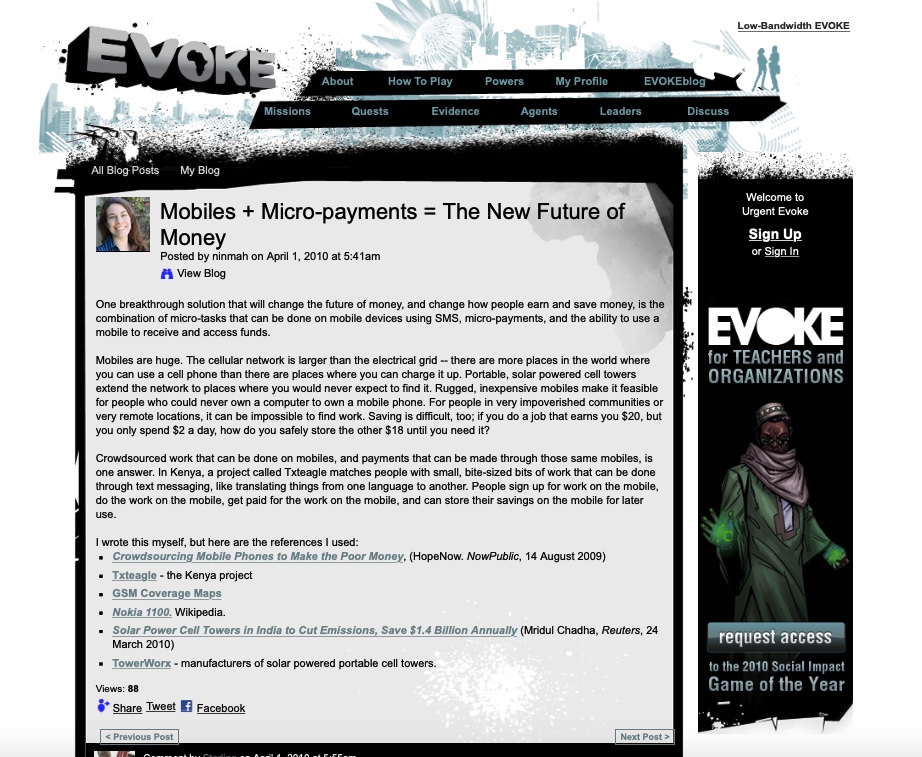
    In 2010 the story was cited in Evoke’s Mobiles + Micro-payments = The New Future of Money (April 1, 2010).

    Follow @SouthSouth1

    Google Books: https://books.google.co.uk/books?id=_bgpEldq9JsC&dq=development+challenges+july+2009&source=gbs_navlinks_s

    Slideshare: http://www.slideshare.net/DavidSouth1/development-challengessouthsouthsolutionsjuly2009issue

    Southern Innovator Issue 1: https://books.google.co.uk/books?id=Q1O54YSE2BgC&dq=southern+innovator&source=gbs_navlinks_s

    Southern Innovator Issue 2: https://books.google.co.uk/books?id=Ty0N969dcssC&dq=southern+innovator&source=gbs_navlinks_s

    Southern Innovator Issue 3: https://books.google.co.uk/books?id=AQNt4YmhZagC&dq=southern+innovator&source=gbs_navlinks_s

    Southern Innovator Issue 4: https://books.google.co.uk/books?id=9T_n2tA7l4EC&dq=southern+innovator&source=gbs_navlinks_s

    Southern Innovator Issue 5: https://books.google.co.uk/books?id=6ILdAgAAQBAJ&dq=southern+innovator&source=gbs_navlinks_s

    Creative Commons License
    This work is licensed under a
    Creative Commons Attribution-Noncommercial-No Derivative Works 3.0 License.

    ORCID iD: https://orcid.org/0000-0001-5311-1052.

    © David South Consulting 2023