Category: Southern Innovator magazine

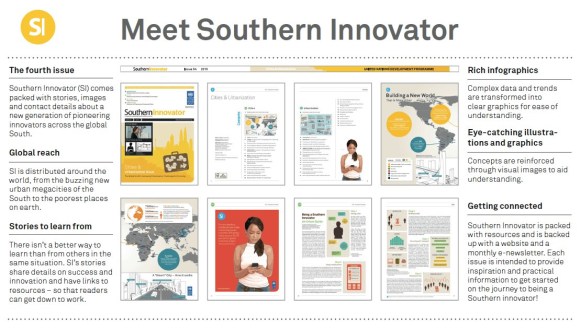
Southern Innovator Magazine was launched at the United Nations General Assembly (UNGA) in New York in 2011 by the United Nations Office for South-South Cooperation (UNOSSC). The first five issues were published between 2011 and 2015. The magazine played an integral role in laying the foundations for the Sustainable Development Goals (SDGs) and strategically positioning the United Nations as it transitioned from the Millennium Development Goals (MDGs) to the SDGs.

  • Filipino Architect wants to Transform Slum with New Plan

    Filipino Architect wants to Transform Slum with New Plan

    By David SouthDevelopment Challenges, South-South Solutions

    SOUTH-SOUTH CASE STUDY

    A clash is occurring across the global South over the future of urban planning and the ever-growing slums of the world’s megacities. This will be a decisive clash of visions: should cities flatten slums and relocate their residents, or work with slum dwellers, acknowledge the role they play in city economies and improve their lives with better dwellings?

    As the world turned into a majority urban place in the 2000s, cities grew at a phenomenal rate. The cities of Africa and Asia are growing by a million people a week, according to some estimates. Megacities and sprawling slums will be the hallmarks of this new urban world, it seems. In sub-Saharan Africa, 72 percent of the population already lives in slum conditions.

    The danger of building unsafe or makeshift homes can be seen in 2010’s devastating earthquake in Haiti, where many buildings collapsed, killing thousands.

    One of the Philippines’ leading architects and urban planners,
    Felino A. Palafox Jr. of Palafox Associates (www.palafoxassociates.com), is passionate about re-making the slums in his country’s capital, Manila. The city is prone to devastating and sometimes deadly flooding. Palafox believes the vulnerability of slum dwellings and poor urban planning are placing lives at risk.

    “We can’t wait for another tragedy,” Palafox told the Philippine Daily Inquirer in 2010. “We have seen how an unprecedented volume of rainfall like what (storm) Ondoy had brought could prove too much for Metro Manila’s river and drainage system. We have also seen what a massive earthquake could do to an unprepared city like Haiti.

    “While there is nothing that we could do to control the destructive power of these natural phenomena, there are steps that we could take to limit the amount of damage.”

    If the rapid growth in urban populations is to be safe and sustainable, then new dwellings will need to be built that meet high standards of durability.

    The UN Challenge of Slums report from 2003 (www.unhabitat.org/pmss/listItemDetails.aspx?publicationID=1156) broke with past orthodoxy that slums must be cleared, arguing that slums should be seen as positive economic forces, incubators for budding entrepreneurs that offer a gateway to better things for new migrants.

    Muhammad Khadim of UN-Habitat summed up the new thinking:

    “Ten years ago, we used to dream that cities would become slum-free,” he said. But “the approach has changed. People see the positives. The approach now is not to clear them but to improve them gradually (and) regularise land tenure.”

    The arguments behind embracing slums come from the economic changes across developing countries since the 1970s. Growing informal economies combined with fewer social provisions and the shift to urban from rural communities have all contributed to the explosion in slums and informal housing.

    Manila is a city of stark and startling contrasts: there are glitzy shopping malls and high-rise office buildings, but also large slums and hungry people begging and selling trinkets on the city’s roads.

    It’s a place where the slum clearance-vs-renovation debate is hot and current. The Philippines is currently in the midst of a campaign to clear slums in Manila and move people back to the countryside.

    “Many of our people are no longer interested in agriculture, so we need to give them incentives to go back,” Cecilia Alba, head of the national Housing and Urban Development Co-ordinating Council, told the New Statesman magazine. “If we had to rehouse the slum-dwellers inside Manila in medium-rise housing, it would cost a third of the national budget.”

    Palafox has a different vision – rebuilding a slum community from top to bottom.

    An architect, environmental planner, urban planner and development consultant, Palafox runs one of the top architecture firms in the Philippines, employing more than 100 staff and consultants.

    Usually occupied with office buildings in the go-go new business centres of the Middle East and Asia, Palafox has turned his attention to Estero de San Miguel, a Manila slum that is home to some 1,200 families, or 6,000 people.

    Families are packed into tiny rooms in a labyrinthine slum complex beside a canal. The rooms are made of wood and floored with linoleum and have to be accessed through a narrow tunnel and tight connecting corridors.

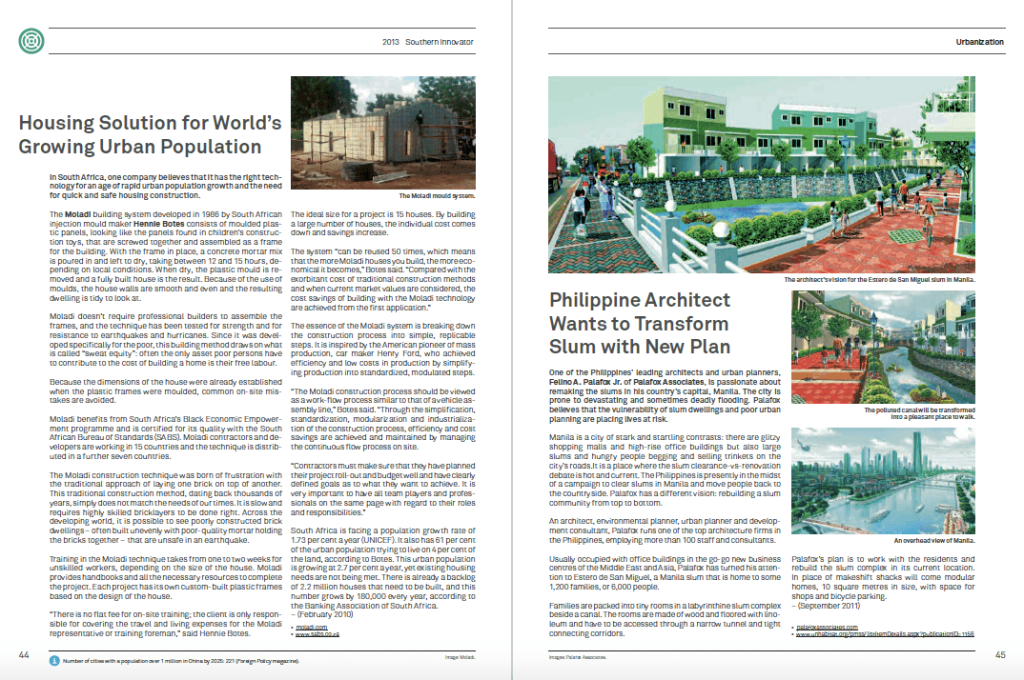
    Palafox’s plan is to work with the residents and rebuild it in its current location. In place of makeshift shacks will come modular homes, 10 square metres in size with space for shops and bicycle parking.

    The design has the homes extend above a walkway, imitating the way the original slum structures were built.

    Palafox is applying innovative thinking to the problem: taking his design direction from the dwellings slum residents build:  “The slum-dwellers,” he explained to the New Statesman, “are experts at live-work space design. They spontaneously do mixed-use! We just have to learn from them.”

    Re-housing the residents on site means they can continue to play their role in the city’s economy, and do not have to make a long commute to jobs and opportunities.

    Palafox also rebuts complaints about the cost of his plan, arguing the scale of corruption in the Philippines costs just as much.

    “OK, the total cost of rehousing slum-dwellers in situ is 30 per cent of GDP (but) I calculate we lose about 30 per cent of the country’s wealth through corruption. If we didn’t have corruption, we wouldn’t need to tolerate slums.”

    Another passionate advocate of working with slum dwellers is Father Norberto Carcellar from the Homeless People’s Federation (http://sdinet.org/countries/philippines.htm).

    “We have to recognize the value of slum-dwellers to the city,” he said. “These are the ones who drive your car, clean your house and run your store. If these people were cleared from the city, the city would die. Slum-dwellers add social, political and economic value to the city.”

    Even in its current form, Estero de San Miguel is a vibrant place, with an Internet café and a volunteer police force.

    A BBC report found it lively and economically viable because it has educational and communication technologies that improve living conditions. The residents make their living working as cheap labour for the city.

    Oliver Baldera, a carpenter, lives with his wife and four children:

    “We’ve been here more than 10 years,” he told the New Statesman. “There’s no choice.

    “It’s easier to get a job here and I can earn 400 pesos a day. I can send the kids to school and they eat three times a day – but it’s not enough. I need more space.”

    Published: September 2011

    Resources

    1) More Urban, Less Poor: The first textbook to explore urban development and management and challenge the notion unplanned shanty towns without basic services are the inevitable consequence of urbanization. Website:http://www.earthscan.co.uk/?tabid=649
    2) Slum Populations in the Developing World: See a breakdown of the urban/slum population in developing nations. Website: http://news.bbc.co.uk/1/hi/5078654.stm
    3) Architecture for Humanity: An NGO to promote architectural and design solutions to global, social and humanitarian crises. Website:http://architectureforhumanity.org/
    5) Building and Social Housing Foundation: The Building and Social Housing Foundation (BSHF) is an independent research organisation that promotes sustainable development and innovation in housing through collaborative research and knowledge transfer. Website:http://www.bshf.org
    6) NGO called Map Kibera began work on an ambitious project to digitally map Africa’s largest slum, Kibera in Nairobi, Kenya. Website: http://www.mapkibera.org
    7) ArrivalCity: The Final Migration and Our Next World by Doug Saunders. Website: http://www.arrivalcity.net
    8) Slum TV: Based deep inside Nairobi’s largest slum, Mathare, they have been seeking out the stories of hope where international media only see violence and gloom. Website: http://www.slum-tv.org
    9) A Kenyan eco-village is helping slum dwellers to start new lives and increase their wealth. The community, Kaputei, is being built by former slum residents – some of whom used to beg to survive – and is providing new homes with electricity, running water and services like schools and parks. By building their own homes, with the help of affordable mortgage loans, the residents are able to make a big upgrade to their quality of life while acquiring real wealth. Website: http://www.jamiibora.org
    8) Cities for All shows how the world’s poor are building ties across the global South. Website:http://globalurbanist.com/2010/08/24/cities-for-all-shows-how-the-worlds-poor-are-building-ties-across-the-global-south.aspx

    https://davidsouthconsulting.org/2021/10/21/cities-for-all-shows-how-the-worlds-poor-are-building-ties-across-the-global-south/

    https://davidsouthconsulting.org/2022/05/23/debt-free-homes-for-the-poor/

    https://davidsouthconsulting.org/2021/11/11/decent-and-affordable-housing-for-the-poor/

    https://davidsouthconsulting.org/2022/02/17/digital-mapping-to-put-slums-on-the-map/

    https://davidsouthconsulting.org/2022/04/28/envisioning-better-slums/

    https://davidsouthconsulting.org/2022/11/16/favela-fashion-brings-women-work/

    https://davidsouthconsulting.org/2022/10/25/indian-city-slum-areas-become-newly-desirable-places-to-live/

    https://davidsouthconsulting.org/2022/10/25/indian-toilet-pioneer-champions-good-ideas/

    https://davidsouthconsulting.org/2022/04/28/innovation-in-the-slums-can-bring-peace-and-prosperity/

    https://davidsouthconsulting.org/2020/12/14/innovation-in-growing-cities-to-prevent-social-exclusion/

    https://davidsouthconsulting.org/2021/11/22/kenyan-eco-village-being-built-by-slum-dwellers/

    https://davidsouthconsulting.org/2021/10/03/a-new-house-kit-for-slum-dwellers-that-is-safe-and-easy-to-build/

    https://davidsouthconsulting.org/2022/11/19/securing-land-rights-for-the-poor-now-reaping-rewards/

    https://davidsouthconsulting.org/2022/10/24/solar-power-bringing-light-and-opportunity-to-the-poor/
    https://davidsouthconsulting.org/2021/03/05/southern-innovator-issue-4/

    https://davidsouthconsulting.org/southern-innovator-scale-up-fundraiser/

    Creative Commons License

    This work is licensed under a
    Creative Commons Attribution-Noncommercial-No Derivative Works 3.0 License.

    ORCID iD: https://orcid.org/0000-0001-5311-1052.

    © David South Consulting 2023

  • Ending Gang Violence While Cleaning the Streets in Haiti

    Ending Gang Violence While Cleaning the Streets in Haiti

    By David SouthDevelopment Challenges, South-South Solutions

    SOUTH-SOUTH CASE STUDY

    The Caribbean nation of Haiti is the poorest country in the western hemisphere, with 80 percent of the population living below the poverty line (CIA World Factbook). The country had been enjoying some positive economic growth since 2005 after decades of economic and political turmoil.

    The country’s political vacuum and economic problems gave rise to violent gang rule on its streets and a collapse in public services, in particular garbage collection. The piles of waste became a source of disease and squalor as well as providing barricades for gangs to wage their street battles.

    Haiti was also hit by four devastating hurricanes in 2008, with heavy damage to the country’s agricultural sector and transport infrastructure.

    But a project by UNDP’s Special Unit for South-South Cooperation (http://ssc.undp.org/Home.118.0.html) has turned around a Haitian neighbourhood by simultaneously cleaning up the garbage, creating employment and income and reducing gang violence and despair. The United Nations has been working in Haiti to restore the economy and bring peace and good government to the country since the 1990s. Its most recent mission, MINUSTAH (http://minustah.org/),has been running since 2004.

    Called ‘Love n’ Haiti’ and located in the Carrefour-Feuilles district (http://www.maplandia.com/haiti/ouest/carrefour-feuilles/) of the capital Port-au-Prince, the project used a ground-up strategy to tackle the problem of waste removal.

    “I know we have a bad image. But the violence is going down in my neighbourhood,” said Gislène La Salle, a widow and a mother of six from Carrefour-Feuilles, to the Indo-Asian News Service (IANS).

    “But when the security situation deteriorated sharply, I could not work in the streets. Luckily, six months ago, I found work in this project. Now, life is more stable. I have a regular income,” she said.

    “The money I earn allows me to feed my family better and send three of my six children to school.”

    The neighbourhood has a population of 150,000. Nine community leaders were identified and a management committee set up called the Committee d’Action Sanitaire de Carrefour Feuilles (CASCAF). The management committee then undertook difficult negotiations with local street vendors to establish garbage collection points. A waste collection plan was drawn up, and around 400 workers were hired to clean the streets and canals and collect the waste.

    The workers were divided up into nine street cleaning teams and three waste collection teams, comprising people who were members of rival groups.

    The project started in 2006 from a very basic point: generating awareness in the population about the dangers of waste and the need for it to be disposed of. The breakdown in public services from decades of political turmoil and poverty had meant a culture of waste disposal no longer existed. The project drew on similar experiences in Brazil and used Brazilian expertise.

    A triage (http://en.wikipedia.org/wiki/Business_Triage)centre was set up to sort the waste into paper, plastic, metal, glass and organic matter for recycling. Two products are made from the waste to earn income: cooking briquettes and fertilizer.

    The cooking briquettes may also help stem Haiti’s horrific deforestation. The country shares its island with the Dominican Republic in the Caribbean, and anyone flying over the island can see a sharp dividing line between the green and lush forests of the Dominican Republic and the almost-barren and dusty Haitian hills.

    By turning the trash into cooking briquettes, people are being offered an alternative to chopping down the forests and burning trees to make charcoal fuel for cooking.

    Income for the waste collectors has increased to US $3 a day and the project has removed 70 percent of the neighbourhood’s waste, making it easier to get around and get things done (another boost to incomes).

    Georginette is also a widow. Like Gislène, this mother of seven is thrilled to find a regular job. “Earlier, only three of my seven children went to school. Many children from the neighbourhood roamed the streets. But since November 2007 when I began working here, I can afford to send five,” she said.

    Prior to the project, the neighbourhood was one of the most dangerous in Port-au-Prince. The project unexpectedly found the history of violence and conflict were quickly overcome when the project began to make quick progress.

    Collecting the waste now earns an income for 380 families. And by gravitating community leadership to nonviolent leaders, relationships between people and groups improved.

    The 50 waste collection points and public garbage bins now contribute to a reduction in common diseases that are rife in other parts of Haiti: leptospirosis, worms, canicola fever, tetanus, yellow fever, typhoid, dengue, and malaria.

    Originally, the government of Haiti appealed to the India, Brazil and South Africa Facility for Poverty and Hunger Alleviation (IBSA Trust Fund) (http://www.indianembassy.org/newsite/press_release/2007/Sept/17.asp) to get to grips with the woeful garbage collection in the capital, while tackling the violence in the slums and lack of economic opportunity.

    The project is also a partnership between Port-au-Prince’s city hall, the Ministry of Public Works and other government ministries, Quisqueya University, UNDP Haiti, IBSA, and the Special Unit for South-South Cooperation. The project is run on the ground by UNDP Haiti.

    Where once the trash made flooding worse by blocking canals, having it removed has prevented the stew of waste that was produced when floods occurred.

    “Impressed by the positive results so far, the Haitian government would like to replicate this model in other regions of the country,” said Eliana Nicolini, the UNDP project coordinator.

    It is hoped the project can be scaled up to reach across Haiti and even be replicated in other countries. The UN Special Envoy for Haiti, former US President Bill Clinton, has been drafted in to help with raising funds for expanding the project.

    The Love n’ Haiti project has been selected by the BBC’s World Challenge contest, which invites the general public to vote for which project they think is the best. Voting takes place on their website:http://www.theworldchallenge.co.uk.The project is number eight in the list on the website.

    “It is not easy to choose who to hire in a place where so many are desperately in need of work. Many people beg us for work but we don’t have vacancies at the moment. If we can hire even 100 more persons, it would solve a lot of problems,” said Patrick Massenat, a local youth heading a committee created to implement activities contributing to waste management and to ensure effective involvement of governmental institutions.

    “Most people in this area never knew real work. Now, they have experienced it. They also have families. The area is cleaner; the women who lost their husbands in gang wars and police firing are happier. It’s a beginning.”

    Published: October 2009

    Resources

    1) A Bangladesh case study on social entrepreneurs turning refuse into wealth. Website:http://proxied.changemakers.net/journal/01may/index.cfm

    2) The Ethical Super Store has a wide range of recycled shopping bags and hand bags made to Fair Trade standards. Website:http://www.ethicalsuperstore.com/search/bag/recycled.htm

    3) A collective of women in the slums of Delhi, India sell fashionable recycled shopping bags online. Website:http://www.theindiashop.co.uk/

    4) Proyecto Alcatraz (Project Alcatraz): This Venezuelan project offers violent gang members the opportunity to go straight and make their way into the economic mainstream with real job opportunities and skills. Website:http://www.proyectoalcatraz.org/home_eng.php

    https://davidsouthconsulting.org/2022/10/24/business-leads-on-tackling-violence-in-mexican-city/

    https://davidsouthconsulting.org/2023/02/03/environmental-public-awareness-handbook-case-studies-and-lessons-learned-in-mongolia/

    https://davidsouthconsulting.org/2021/09/01/haiti-earthquake-prompts-tech-aid/

    https://davidsouthconsulting.org/2021/01/08/haitian-coffee-becoming-a-hit-with-american-connoisseurs/

    https://davidsouthconsulting.org/2021/10/28/milk-co-operatives-help-hungry-haiti/

    https://davidsouthconsulting.org/2022/09/23/opinion-canada-is-allowing-u-s-to-dictate-haitis-renewal-more-news-and-opinion-on-what-the-un-soldiers-call-the-haitian-vacation/

    https://davidsouthconsulting.org/2020/04/22/state-of-decay-haiti-turns-to-free-market-economics-and-the-un-to-save-itself/

    https://davidsouthconsulting.org/2021/01/02/a-undp-success-story-grassroots-environmental-campaign-mobilizes-thousands-in-mongolia-1998/

    https://davidsouthconsulting.org/2021/01/26/u-s-elections-update-clinton-is-using-canada-to-keep-control-of-haiti/

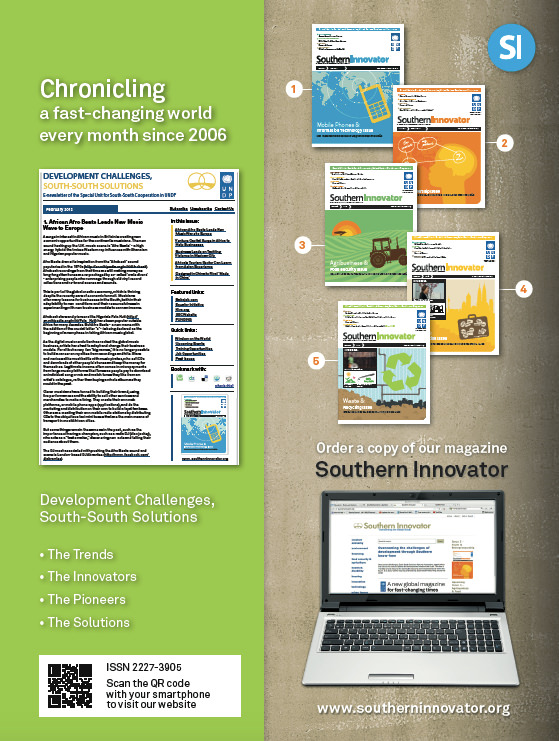
    Development Challenges, South-South Solutions was launched as an e-newsletter in 2006 by UNDP’s South-South Cooperation Unit (now the United Nations Office for South-South Cooperation) based in New York, USA. It led on profiling the rise of the global South as an economic powerhouse and was one of the first regular publications to champion the global South’s innovators, entrepreneurs, and pioneers. It tracked the key trends that are now so profoundly reshaping how development is seen and done. This includes the rapid take-up of mobile phones and information technology in the global South (as profiled in the first issue of magazine Southern Innovator), the move to becoming a majority urban world, a growing global innovator culture, and the plethora of solutions being developed in the global South to tackle its problems and improve living conditions and boost human development. The success of the e-newsletter led to the launch of the magazine Southern Innovator.  

    Follow @SouthSouth1

    Google Books: https://books.google.co.uk/books?id=tRKYBgAAQBAJ&dq=development+challenges+october+2009&source=gbs_navlinks_s

    Slideshare: http://www.slideshare.net/DavidSouth1/development-challengessouthsouthsolutionsoctober2009issue

    Southern Innovator Issue 1: https://books.google.co.uk/books?id=Q1O54YSE2BgC&dq=southern+innovator&source=gbs_navlinks_s

    Southern Innovator Issue 2: https://books.google.co.uk/books?id=Ty0N969dcssC&dq=southern+innovator&source=gbs_navlinks_s

    Southern Innovator Issue 3: https://books.google.co.uk/books?id=AQNt4YmhZagC&dq=southern+innovator&source=gbs_navlinks_s

    Southern Innovator Issue 4: https://books.google.co.uk/books?id=9T_n2tA7l4EC&dq=southern+innovator&source=gbs_navlinks_s

    Southern Innovator Issue 5: https://books.google.co.uk/books?id=6ILdAgAAQBAJ&dq=southern+innovator&source=gbs_navlinks_s

    Creative Commons License

    This work is licensed under a
    Creative Commons Attribution-Noncommercial-No Derivative Works 3.0 License.

    ORCID iD: https://orcid.org/0000-0001-5311-1052.

    © David South Consulting 2023

  • Milk Co-operatives Help Hungry Haiti

    Milk Co-operatives Help Hungry Haiti

    By David SouthDevelopment Challenges, South-South Solutions

    SOUTH-SOUTH CASE STUDY

    The global food crisis has hit the impoverished Caribbean country of Haiti especially hard. Already suffering from decades of food crises brought on by the collapse of domestic farming, the country has become notorious for its people being reduced to eating cakes made of mud to stave off hunger pains. It is the poorest country of Latin America and the Caribbean and one of the poorest in the world.

    Haiti imports some 52 percent of its food, including over 80 percent of its rice. Local food production only covers 43 percent of the country’s demand and food aid supplies only 5 percent of its needs. Of the estimated 9.8 million Haitians, 5.1 million live on less than US $1 a day and 7.6 million on less than US $2 a day. At current prices, one dollar buys only half a meal per day (Source: United Nations Country Team in Haiti).

    Haiti’s problems are made worse by a global food crisis. So-called agflation (agricultural inflation) has seen spiralling food prices around the world, which in turn are causing food shortages, hunger and malnutrition. On international commodity markets, food prices have gone up 54 percent over the last year, with cereal prices soaring 92 percent (FAO – World Food Situation). U.N. Secretary General Ban Ki-moon has called for food production to increase 50 percent by 2030 just to meet rising demand – and right now there are 862 million people worldwide who are undernourished (FAO).

    In Haiti, most agriculture is done on a small scale by about 700,000 family farmers. Few belong to any production association or mechanism to market and distribute their products, and local produce has been pushed out of the market by imports.

    Subsidized U.S. rice began flooding in 30 years ago, becoming so cheap that Haitians began eating it instead of the corn, sweet potatoes, cassava and domestic rice they grew. The U.S. imports drove rice farmers out of business and incited a rural exodus that swelled the slums of the capital, Port-au-Prince. That dependence on imports has caused dangerous food insecurity. Today, the U.S. rice that is the staple of many Haitians’ diet has doubled in price in little more than a year.

    “The problem is that Haiti doesn’t have the land to give every peasant family enough to allow them to make a living,” said Bernard Etheart, head of the National Institute for Agrarian Reform. Etheart estimates that if all arable land was planted, each farmer would have no more than half a hectare, or 1.25 acres.

    A cooperative of dairy farmers is doing its bit to revive domestic production of milk products and reduce the crippling costs of importing milk for Haiti. Importing 85,000 tonnes of milk from Europe and the United States costs Haiti US $40 million a year. A walk through the capital, Port-au-Prince, will reveal how much milk is imported in one form or another: tiny cans of evaporated milk are sold in the street markets, while the wealthy can buy powdered and long-life milk in the air conditioned supermarkets of the upscale neighbourhood of Petionville.

    Dairy production in Haiti was in decline for 20 years until, in 2002, the country ceased to produce any milk at all. The urgent need for milk in Haiti is shown in the average consumption: per child, only 110 ml is consumed per day. In Uruguay, for example, it is 520 ml a day (190 litres per head of population per year).

    Lèt Agogo (Creole for Unlimited Milk) is a cooperative using small-scale farmers to bring milk to the hungry. Founded by the NGO Veterimed six years ago, it now has a network of 13 dairies across the island.

    Lèt Agogo is hoping to get Haiti’s milk production up to 145,000 tons a year from the current 45,000 tons. So far, the product’s single biggest client is the Haitian government. It buys bottles of sterilized milk below cost and distributes them to 130,000 school children in 44 government-funded schools. Dr. Michel Chancy told the Miami Herald that the government would like to expand the distribution to 800 schools.

    “Haiti is a country where we consume a lot of milk,” said Chancy, a veterinarian and one of the visionaries behind Lèt Agogo. “After rice, milk is the second-largest import.”

    At present, Haiti has 500,000 dairy cows out of more than a million head of cattle. The problem came down to marketing and distributing the dairy products. With no structure in place, few farmers bothered milking their animals. But by the end of 2007, 600 farmers had joined the network and 400 producers in dairy product making and grass pasture management. In 2007, they turned 540,000 litres into yoghurt and sterilised milk that can stay on the shelf for six to nine months without refrigeration. Made from sterilized milk, the yogurt comes in 280 ml bottles and sells in stores throughout the country and has a shelf life of nine months.

    The farmers have seen their income almost double, from 4 (US 10 cents) to 8 (US 20 cents) gourdes per litre, from 10 (US 25 cents) to 12 (US 30 cents) gourdes per litre.

    Farmers walk to processing centres with their litres of milk and receive US $2.20 for each US gallon (4.55 litres).

    “The milk is here,” Chancy said, but the lack of roads and electricity in the country pose huge challenges. “The problem is transporting it.”

    Haiti’s president, Rene Preval, has cited Lèt Agogo as an excellent example of how Haiti can recover its domestic food production capability. The scheme won a US $10,000 first prize in the W.K. Kellogg Foundation and Economic Commission for Latin America and the Caribbean Experiences in Social Innovation Award.

    Lèt Agogo believes it will take 100 dairies throughout Haiti’s rugged terrain to truly take over the import market, and would cost US $10 million to set up. ”Normally in five to ten years, a dairy would pay for itself. But you need the investments,” Chancy said.

    “It’s not the production of milk that is important here… It’s accomplishing it together,” said Philippe Mathieu, from Oxfam International in Quebec, Canada, who is working on helping the brand produce cheese, noting that Haiti is at a difficult crossroads with today’s global price hikes. “The goal is to show Haitians there is a way to do things — a way to construct something collectively.

    “Haitian peasants have always taken care of their cattle; tying them, feeding them and giving them water to drink,” Mathieu said. ”The cow has always been their bank book, something they could sell for money during hard times. Now it has become a revenue source for them.”

    Published: August 2008

    Resources

    Development Challenges, South-South Solutions was launched as an e-newsletter in 2006 by UNDP’s South-South Cooperation Unit (now the United Nations Office for South-South Cooperation) based in New York, USA. It led on profiling the rise of the global South as an economic powerhouse and was one of the first regular publications to champion the global South’s innovators, entrepreneurs, and pioneers. It tracked the key trends that are now so profoundly reshaping how development is seen and done. This includes the rapid take-up of mobile phones and information technology in the global South (as profiled in the first issue of magazine Southern Innovator), the move to becoming a majority urban world, a growing global innovator culture, and the plethora of solutions being developed in the global South to tackle its problems and improve living conditions and boost human development. The success of the e-newsletter led to the launch of the magazine Southern Innovator.  

    Follow @SouthSouth1

    Google Books: https://books.google.co.uk/books?id=oEP1Obs4gxYC&dq=development+challenges+august+2008&source=gbs_navlinks_s

    Slideshare: http://www.slideshare.net/DavidSouth1/development-challengessouthsouthsolutionsaugust2008issue

    Southern Innovator Issue 1: https://books.google.co.uk/books?id=Q1O54YSE2BgC&dq=southern+innovator&source=gbs_navlinks_s

    Southern Innovator Issue 2: https://books.google.co.uk/books?id=Ty0N969dcssC&dq=southern+innovator&source=gbs_navlinks_s

    Southern Innovator Issue 3: https://books.google.co.uk/books?id=AQNt4YmhZagC&dq=southern+innovator&source=gbs_navlinks_s

    Southern Innovator Issue 4: https://books.google.co.uk/books?id=9T_n2tA7l4EC&dq=southern+innovator&source=gbs_navlinks_s

    Southern Innovator Issue 5: https://books.google.co.uk/books?id=6ILdAgAAQBAJ&dq=southern+innovator&source=gbs_navlinks_s

    Creative Commons License

    This work is licensed under a
    Creative Commons Attribution-Noncommercial-No Derivative Works 3.0 License.

    ORCID iD: https://orcid.org/0000-0001-5311-1052.

    © David South Consulting 2023

  • Civet Cat Coffee Brews Filipino Opportunity

    Civet Cat Coffee Brews Filipino Opportunity

    By David SouthDevelopment Challenges, South-South Solutions

    SOUTH-SOUTH CASE STUDY

    In the Philippines, one animal’s call of nature has become a business opportunity.

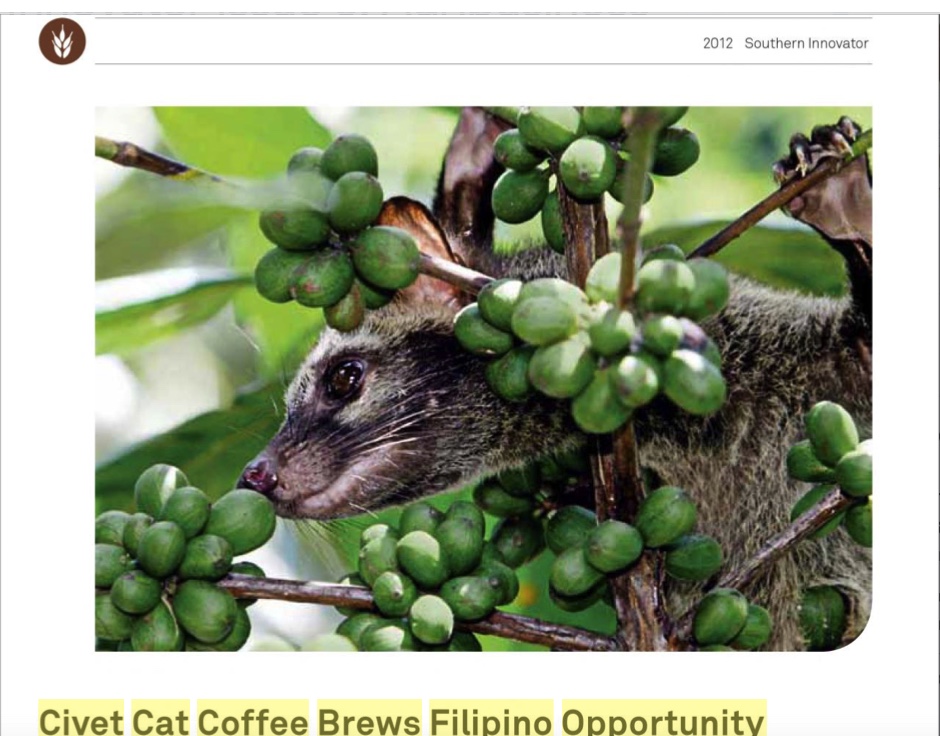
    The civet cat, a member of the mongoose family, ingests the fruit of coffee plants, and expels the beans. This has created an unexpected by-product – a prized beverage for the world’s savvy coffee drinkers seeking the next taste sensation. The partially digested coffee beans are gathered from the faeces of the cat and used to make a much-coveted, smooth-flavoured cup of coffee.

    It is a good example of how value can be added to a product, in this case coffee beans, producing a substantially higher income. The coffee is startlingly expensive: 50 grams cost US $70, 100 grams US $90, and 1 kilogram is a whopping US $870. The coffee is a blend of Arabica, Liberica and Exelsa beans, all of which have passed through the civet cats.

    The highly prized coffee is driving a growing market for these rare beans around the world. But as demand rises, it becomes clear it is a market needing quality control and ethical practices.

    One business that is trying to do this is Coffee Alamid (www.arengga.com), based in Las Pinas in the Philippines. It bills the coffee as the “World’s Rarest Brew. The Philippines’ Pride.”

    Coffee Alamid’s founders, Basil and Vie Reyes, call themselves “coffee entrepreneurs” who started in the business from scratch.

    “When we started Cafe Alamid, we were not even coffee drinkers,” they explain on the company’s website. “We didn’t know anything about coffee at all!”

    Experienced in making Arengga vinegar (http://www.arengga.com/index.php/arengga-pinnata-its-not-just-a-vinegar.mpc), they discovered the civet cats that lived among the sugar palm trees used for making the vinegar. They did some research and were inspired by the Kopi Luwak, the Indonesian variety of civet cat coffee and wondered why they couldn’t do the same thing in the Philippines.

    They consulted with the local forest-dwellers of Indang, Cavite and Batangas, who confirmed they gathered the civet cat droppings to make into coffee, part for personal consumption, with the rest sold in local markets. Gathering the civet droppings provides an income to the forest residents, who collect an average of one kilogram a day.

    Some were sceptical of the idea: why bother with such a time-consuming product? But the Reyeses were inspired by the success of civet coffee in Indonesia and it inspired them to try it in the Philippines. They see themselves as “enlightened entrepreneurs” who believe in marrying business with social development.

    The coffee is made from the wild civet cat droppings harvested from the forest floors of mountains in Malarayat, Lipa, Batangas and Mount Matutum, General Santos and South Cotabato in the Philippines. The beans are roasted and exported to Japan, Taiwan, Korea, Australia, the United States and Italy. The company produces between 1 and 1.5 tons of beans a year.

    A proud moment for the business was becoming the first Filipino firm to participate in the Tea and Coffee World Cup in Geneva, Switzerland in 2007.

    The brand’s name, Alamid, is the local name for the civet cat (Paradoxorus Philippinensis). It belongs to the mongoose family and forages for food at night, eating the ripest and sweetest coffee cherries during the coffee season.

    By morning the civet cats excrete the undigested beans. While inside the cat’s stomach, enzymes and stomach acids go to work on the beans, altering their structure. The beans ‘ferment’ in the cat’s stomach, a process that has been analyzed by Dr. Massimo Marcone, a scientist from Canada’s University of Guelph.

    Marcone traveled to Ethiopia and Indonesia in 2003 to collect the rare coffee beans. He found the beans’ taste – described as “earthy, musty, syrupy, smooth and rich with jungle and chocolate undertones” – was due to the lack of protein in the bean.

    “The civet beans are lower in total protein, indicating that during digestion, proteins are being broken down and are also leaked out of the bean,” Marcone told the Luwak Kopi website. “Since proteins are what make coffee bitter during the roasting process, the lower levels of proteins decrease the bitterness of Kopi Luwak coffee.”

    “Civet beans are typically extensively washed under running water after collection, which dislodges bacteria,” he said.

    Marcone published his research into the beans in the paper “Composition and properties of Indonesian palm civet coffee (Kopi Luwak) and Ethiopian civet coffee.” (http://www.sciencedirect.com/science/article/pii/S0963996904001309)

    The beans are greenish-brown when they come out in the cat faeces. Marcone found the process in the civet cat removes some of the caffeine, giving a strong cup of coffee less kick; this also makes the flavour smoother.

    Supply is tight and this has led to some people forging the coffee or using unethical practices to get their hands on the beans. It is a business that needs to be run in an ethical way to ensure the rich profits are shared with everyone involved.

    Marcone warns against imitations. “About 42 percent of all the kopi luwaks that are presently on sale are either adulterated or complete fakes, unfortunately,” he told the Los Angeles Times.

    Coffee Alamid’s parent company, Bote Central, started as a family-owned company in 2002, with the idea of using agro-forestry products to create sustainable livelihoods and help preserve the environment. It wanted to introduce Fair Trade principles to the Philippines coffee industry.

    Structurally, the company uses community roasting business units (CRBU) across the Philippines, in particular the countryside, to improve the way coffee is sold and make it more profitable for local economies. There are currently 12 such units, and more are planned. The company has put together a guide book on best practice for harvesting Arabica coffee beans based on their first-hand experience. It also explains how they maintain quality control (http://www.scribd.com/doc/19991462/Production-Guide-for-Arabica-Coffee-by-Bote-Central-Inc-Maker-of-Coffee-Alamid).

    The company deals directly with farmers to avoid middlemen gouging profits, and tries to use technology to make the business more efficient and sustainable.

    To keep quality improving, the company has also produced a manual on how to grow and harvest Arabica coffee beans. It is designed to tackle the practical realities of coffee production and show how to improve current methods to produce a better-quality bean. This is critical for the overall business as competition is fierce and quality has to constantly be improved.

    Coffee Alamid has successfully positioned itself as a high-end, high-cost product. It is sold by Japan Airlines and by department stores in Japan and specialty coffee shops around the world.

    Civet cat coffee continues to develop new fans. In Britain, the Birmingham-based Urban Coffee Company (http://www.urbancoffee.co.uk) has started selling the coffee.

    ‘It’s actually really nice,” sales manager Mark Bridgens told the Daily Mail newspaper. “It has a unique, soft taste. I’d definitely buy a cup of it, it’s very different.”

    Published: June 2011

    Resources

    1)Fair Trade Foundation: Fairtrade is about better prices, decent working conditions, local sustainability, and fair terms of trade for farmers and workers in the developing world. Website: http://www.fairtrade.org.uk/

    2) The red dot logo stands for belonging to the best in design and business. The red dot is an internationally recognized quality label for excellent design that is aimed at all those who would like to improve their business activities with the help of design. Website: http://www.red-dot.de

    3) Small businesses looking to develop their brand can find plenty of free advice and resources here. Website: www.brandingstrategyinsider.com

    4) Brandchannel: The world’s only online exchange about branding, packed with resources, debates and contacts to help businesses intelligently build their brand. Website: www.brandchannel.com

    Development Challenges, South-South Solutions was launched as an e-newsletter in 2006 by UNDP’s South-South Cooperation Unit (now the United Nations Office for South-South Cooperation) based in New York, USA. It led on profiling the rise of the global South as an economic powerhouse and was one of the first regular publications to champion the global South’s innovators, entrepreneurs, and pioneers. It tracked the key trends that are now so profoundly reshaping how development is seen and done. This includes the rapid take-up of mobile phones and information technology in the global South (as profiled in the first issue of magazine Southern Innovator), the move to becoming a majority urban world, a growing global innovator culture, and the plethora of solutions being developed in the global South to tackle its problems and improve living conditions and boost human development. The success of the e-newsletter led to the launch of the magazine Southern Innovator.  

    Follow @SouthSouth1

    Google Books: https://books.google.co.uk/books?id=JIKYBgAAQBAJ&dq=development+challenges+june+2011&source=gbs_navlinks_s

    Slideshare: http://www.slideshare.net/DavidSouth1/development-challengessouthsouthsolutionsjune2011issue

    Southern Innovator Issue 1: https://books.google.co.uk/books?id=Q1O54YSE2BgC&dq=southern+innovator&source=gbs_navlinks_s

    Southern Innovator Issue 2: https://books.google.co.uk/books?id=Ty0N969dcssC&dq=southern+innovator&source=gbs_navlinks_s

    Southern Innovator Issue 3: https://books.google.co.uk/books?id=AQNt4YmhZagC&dq=southern+innovator&source=gbs_navlinks_s

    Southern Innovator Issue 4: https://books.google.co.uk/books?id=9T_n2tA7l4EC&dq=southern+innovator&source=gbs_navlinks_s

    Southern Innovator Issue 5: https://books.google.co.uk/books?id=6ILdAgAAQBAJ&dq=southern+innovator&source=gbs_navlinks_s

    Creative Commons License

    This work is licensed under a
    Creative Commons Attribution-Noncommercial-No Derivative Works 3.0 License.

    ORCID iD: https://orcid.org/0000-0001-5311-1052.

    © David South Consulting 2023