Category: Southern Innovator magazine

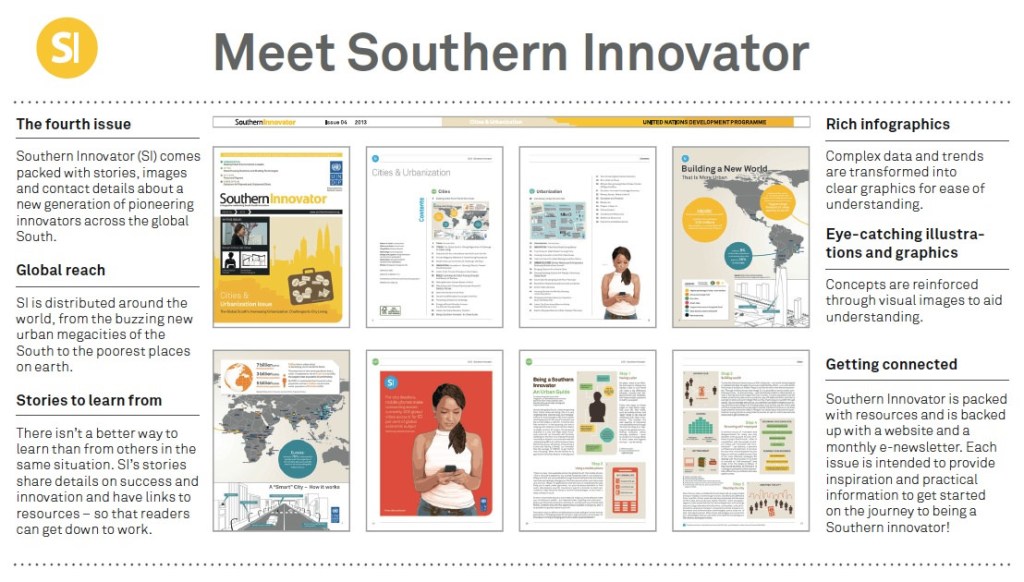
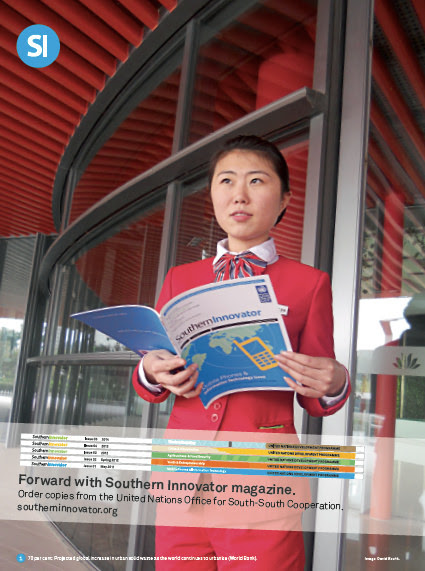
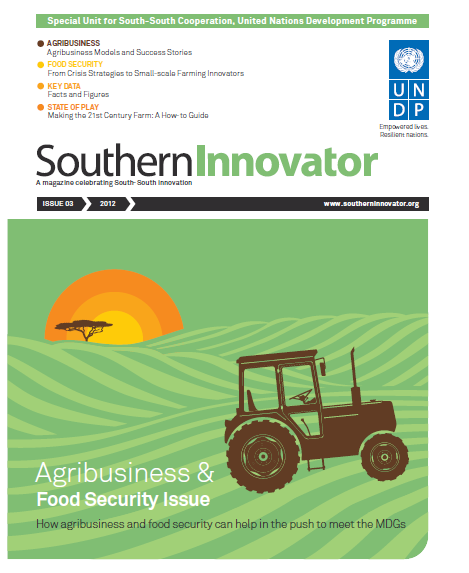
Southern Innovator Magazine was launched at the United Nations General Assembly (UNGA) in New York in 2011 by the United Nations Office for South-South Cooperation (UNOSSC). The first five issues were published between 2011 and 2015. The magazine played an integral role in laying the foundations for the Sustainable Development Goals (SDGs) and strategically positioning the United Nations as it transitioned from the Millennium Development Goals (MDGs) to the SDGs.

  • Urban Farmers Gain from Waste Water

    Urban Farmers Gain from Waste Water

    By David SouthDevelopment Challenges, South-South Solutions

    SOUTH-SOUTH CASE STUDY

    The global food crisis continues to fuel food price inflation and send many into hunger and despair. Around the world, solutions are being sought to the urgent need for more food and cheaper food. U.N. Secretary General Ban Ki-moon has called for food production to increase 50 percent by 2030 just to meet rising demand – and right now there are 862 million people undernourished (FAO).

    One fast-growing solution is bringing farming to urban and semi-urban spaces, where the majority of the world’s population now lives.

    Urban farmers can take advantage of their close proximity to consumers, keeping costs down and profits up. They can also solve one of agriculture’s enduring problems – where to find water for irrigation by using existing waste water. Waste water is plentiful in urban environments, where factories usually pump out waste water into streams, rivers and lakes.

    The amount of urban farmed agriculture is still small, about 10 percent of the world’s agricultural production, but is a potential growth area if handled well. In 53 cities surveyed by the International Water Management Institute, 1.1 million farmers – some 200 million worldwide – are now using recycled or waste water to irrigate their crops.

    In Accra, Ghana, more than 200,000 people depend on food grown with wastewater. In Pakistan, a full quarter of the grown vegetables use wastewater.

    The use of waste water comes with its ups and downs. While the World Health Organization rightfully points out that waste water can be a source of disease and pollution, cities also face a dilemma: diverting fresh water to irrigate crops means less for people to drink. Out of the 53 cities surveyed by the International Water Management Institute, 85 percent dumped their raw sewage and wastewater into streams and lakes. With this in mind, the WHO has altered its stance on wastewater, and now supports its use for irrigating farmland as long as all efforts are made to treat wastewater and that people are warned to thoroughly wash food before eating it.

    Pay Drechsel, who heads the IWMI’s research division based in Accra, Ghana, studying safe and productive use of low-quality water, says sophisticated systems to use waste water have developed in Vietnam, China and India, “where this practice has been going on for centuries.”

    “People know how to avoid health risks, like thorough cooking of vegetables,” he said. “In Vietnam and China, waste from households (fecal waste, solid waste and wastewater from household use) have always been effectively recycled in ‘closed systems’ at a household level where the waste/nutrients are recycled into the food chain and so return for human consumption.”

    Drechsel cites examples like Calcutta, where a large wetland is being used for treating and recycling wastewater for beneficial uses such as fish farming. In Northern Ghana, fecal sludge from septic tanks is spread on fields that are later used to grow cereals.

    “The risk for the consumer is extremely low, a waste product is productively recycled, the farmer has a good harvest and the city gets rid of their waste,” Drechsel said. “A multiple win-win situation.

    “Depending on the local situations such models can be widely used, provided they are documented and the risk factors are controlled,” he added.

    Farmers use various methods to reduce the risk of contamination, including drip irrigation where the water does not touch the crop.

    The risks for both farmers and consumer can be managed with the right protocols. For farmers, Drechsel recommends wearing of rubber boots and careful hand washing to avoid skin diseases. He points out that these farmers usually make more money than those who do not use waste water, and thus can afford the extra cost of precautionary measures, like de-worming tablets. They can quickly get out of poverty by using this water.

    For consumers, the risk is from diarrhoea, typhus or cholera if raw food is eaten unwashed or poorly washed. The best solution is to turn to the WHO’s guidelines and proven local practices and tested techniques developed by researchers.

    “Here more awareness creation on invisible risks through pathogens is needed. Perception studies in West Africa showed that nearly all households wash vegetables but they target visible dirt. Thus, the methods used are not effective. Best would be therefore a combination of risk reducing interventions from farm to fork, as none alone is 100 percent efficient. This is also what the new WHO guidelines promote: a flexible approach, reducing in each country the health risks as far as it is possible and feasible.”

    Drechsel sees an opportunity for water treatment plants to seize: “What is missing so far is a ‘design for reuse.’ If treatment plants would be designed to serve farmers they could be less sophisticated and easier to maintain. Farmers could be involved in this, maybe a win-win situation.

    “The environment benefits too. Spreading wastewater over fields, and allowing it to leach back through the soil into local waterways, turns out to be a reasonable way to purify it. The process filters out all the organic contaminants, and much of the nitrogen and phosphates that would otherwise contribute to algal blooms and dead zones further downstream. It is certainly preferable to dumping wastewater straight into the nearest big river or lake.”

    Published: September 2008

    Resources

    • Vertical farming, where hothouses are piled one on top of the other, is an option being promoted as a solution to the food needs of urban dwellers.
      Website: http://www.verticalfarm.com/
    • Extensive photographs of vertical farm project concepts by Chris Jacobs in cooperation with the grandfather of skyscraper farm concepts: Dr. Dickson Despommier of Columbia University. His ideal: all-in-one eco-towers would actually produce more energy, water (via condensation/purification) and food than their occupants would consume. His mission: to gather architects, engineers, economists and urban planners to develop a sustainable and high-tech wonder of ecological engineering.
      Website: weburbanist.com
    • Urban Gardening News, a news service providing a review of daily news targeting everyone involved in planning & practicing alternative farming in cities. Great updates on how things are progressing across the South.
      Website: http://www.urbanagriculture-news.com
    Follow @SouthSouth1

    Slideshare: http://www.slideshare.net/DavidSouth1/development-challengessouthsouthsolutionsnovember2010issue

    Southern Innovator Issue 1: https://books.google.co.uk/books?id=Q1O54YSE2BgC&dq=southern+innovator&source=gbs_navlinks_s

    Southern Innovator Issue 2: https://books.google.co.uk/books?id=Ty0N969dcssC&dq=southern+innovator&source=gbs_navlinks_s

    Southern Innovator Issue 3: https://books.google.co.uk/books?id=AQNt4YmhZagC&dq=southern+innovator&source=gbs_navlinks_s

    Southern Innovator Issue 4: https://books.google.co.uk/books?id=9T_n2tA7l4EC&dq=southern+innovator&source=gbs_navlinks_s

    Southern Innovator Issue 5: https://books.google.co.uk/books?id=6ILdAgAAQBAJ&dq=southern+innovator&source=gbs_navlinks_s

    Creative Commons License

    This work is licensed under a
    Creative Commons Attribution-Noncommercial-No Derivative Works 3.0 License.

    ORCID iD: https://orcid.org/0000-0001-5311-1052.

    © David South Consulting 2023
  • African Megacity Makeovers Tackle Rising Populations

    African Megacity Makeovers Tackle Rising Populations

    By David SouthDevelopment Challenges, South-South Solutions

    SOUTH-SOUTH CASE STUDY

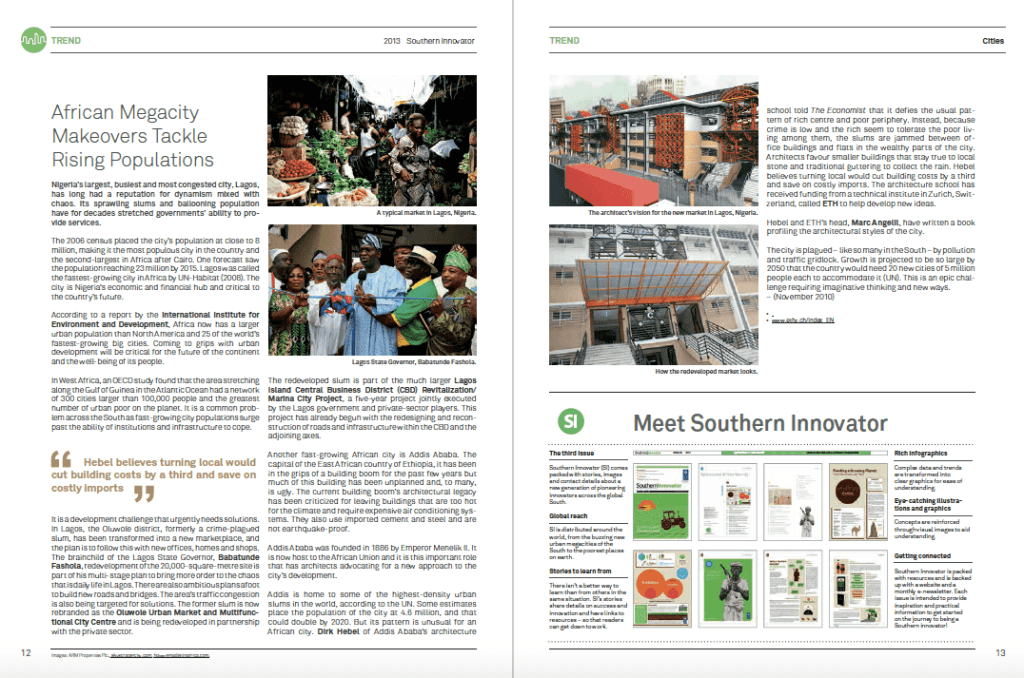
    Nigeria’s largest, busiest and most congested city, Lagos, has long had a reputation for dynamism mixed with chaos. Its sprawling slums and ballooning population have for decades stretched governments’ ability to provide services.

    The 2006 census placed the city’s population at close to 8 million, making it the most populous city in the country and the second largest in Africa after Cairo. One forecast saw the population reaching 23 million by 2015. It was called the fastest growing city in Africa by UNHABITAT (2008). The city is Nigeria’s economic and financial hub and critical to the country’s future.

    According to a report by the International Institute for Environment and Development, Africa now has a larger urban population than North America and 25 of the world’s fastest growing big cities. Getting to grips with urban development will be critical for the future of the continent and the wellbeing of its people.

    In West Africa, an OECD study found the area stretching along the Gulf of Guinea in the Atlantic Ocean had a network of 300 cities larger than 100,000 people and the biggest collection of urban poverty on the planet.

    It is a common problem across the South as fast-growing city populations surge past the ability of institutions and infrastructure to cope.

    By 2025, Asia could have 10 or more cities with populations larger than 20 million (Far Eastern Economic Review).

    It is a development challenge that urgently needs solutions.

    In Lagos, the Oluwole district – formerly a crime-plagued slum – has been transformed into a new marketplace, and the plan is to follow this with new offices, homes and shops. The brainchild of the Lagos state governor Babatunde Fashola (http://en.wikipedia.org/wiki/Babatunde_Fashola), redevelopment of the 20,000 square metre site is part of his multi-stage plan to bring more order to the chaos that is daily life in Lagos. There are also ambitious plans afoot to build new roads and bridges. The area’s traffic congestion is also being targeted for solutions. The former slum is now re-branded as the Oluwole Urban Market and Multifunctional City Centre (http://tinyurl.com/2wmrscq) and is being re-developed in partnership with the private sector.

    The re-developed slum is part of the much-larger Lagos Island Central Business District (CBD) Revitalisation/Marina City Project, a five-year project, jointly executed by the Lagos government and private sector players. This project has already begun with the redesigning and reconstruction of roads and infrastructure within the CBD and the adjoining axes.

    Another fast-growing African city is Addis Ababa. The capital of the East African nation of Ethiopia, it has been in the grip of a building boom for the past few years. But much of this building has been unplanned and, to many, is ugly. The current building boom’s architectural legacy has been criticized for leaving buildings that are too hot for the climate and require expensive air conditioning systems. They also use imported cement and steel and are not earthquake-proof.

    Addis Ababa (http://en.wikipedia.org/wiki/Addis_Ababa) was founded in 1886 by Emperor Menelik II. It is now host to the African Union (http://www.africa-union.org/) and it is this important role that has architects advocating for a new approach to the city’s development.

    Addis is home to some of the highest density urban slums in the world, according to the UN. Some estimates place the population at of the city at 4.6 million people and that it could double by 2020. But its pattern is unusual for an African city. Dirk Hebel of Addis Ababa’s architecture school  (http://www.eiabc.edu.et/managing-board/scientific-director.html) told The Economist it defies the usual pattern of rich centre and poor periphery. Instead, because crime is low and the rich seem to tolerate the poor living among them, the slums are jammed between office buildings and flats in the wealthy parts of the city.

    Architects favour smaller buildings that stay true to local stone and traditional guttering to collect the rain. Hebel believes turning local would cut building costs by a third and save on costly imports.

    The architecture school has received funding from a technical institute in Zurich, Switzerland called ETH (http://www.ethz.ch/index_EN) to help develop new ideas.

    Hebel and ETH’s head, Marc Angelil, have written a book profiling the architectural styles of the city. The city has gone through various phases: during its Marxist period (1974-1991) government buildings mimicked the Soviet Union. During the Italian fascist occupation (1935-1941) they followed the styles favoured by Italian dictator Benito Mussolini. Political problems aside, the architects believe the Italians brought good planning, allowing streets to radiate out from landmark buildings.

    The city is plagued – like so many in the South – by pollution and traffic gridlock. Growth is on projection to be so large by 2050, the country would need 20 new cities of 5 million people each to accommodate it (UN). This is an epic challenge requiring imaginative thinking and new ways.

    Published: November 2010

    https://davidsouthconsulting.org/2022/10/17/ambitious-schemes-hope-to-advance-economic-development/

    https://davidsouthconsulting.org/2020/04/22/artists-fear-indifference-from-megacity/

    https://davidsouthconsulting.org/2020/12/04/big-data-can-transform-the-global-souths-growing-cities/

    https://davidsouthconsulting.org/2022/10/19/chinese-building-solution-for-rapidly-urbanizing-global-south/

    https://davidsouthconsulting.org/2021/10/21/cities-for-all-shows-how-the-worlds-poor-are-building-ties-across-the-global-south/

    https://davidsouthconsulting.org/2020/12/11/cyber-cities-an-oasis-of-prosperity-in-the-south/

    https://davidsouthconsulting.org/2021/11/04/filipino-architect-wants-to-transform-slum-with-new-plan/

    https://davidsouthconsulting.org/2022/03/20/global-south-eco-cities-show-how-the-future-can-be/

    https://davidsouthconsulting.org/2021/11/12/global-souths-rising-megacities-challenge-idea-of-urban-living/

    https://davidsouthconsulting.org/2022/09/28/model-cities-across-the-south-challenge-old-ways/

    https://davidsouthconsulting.org/2022/10/10/more-futuristic-african-cities-in-the-works/

    https://davidsouthconsulting.org/2021/11/12/new-cities-offering-solutions-for-growing-urban-populations/

    https://davidsouthconsulting.org/2017/11/08/smart-cities-up-close-2013/

    https://davidsouthconsulting.org/2021/10/22/south-south-cooperation-for-cities-in-asia/

    https://davidsouthconsulting.org/2020/04/22/will-the-megacity-mean-mega-privatization/

    Development Challenges, South-South Solutions was launched as an e-newsletter in 2006 by UNDP’s South-South Cooperation Unit (now the United Nations Office for South-South Cooperation) based in New York, USA. It led on profiling the rise of the global South as an economic powerhouse and was one of the first regular publications to champion the global South’s innovators, entrepreneurs, and pioneers. It tracked the key trends that are now so profoundly reshaping how development is seen and done. This includes the rapid take-up of mobile phones and information technology in the global South (as profiled in the first issue of magazine Southern Innovator), the move to becoming a majority urban world, a growing global innovator culture, and the plethora of solutions being developed in the global South to tackle its problems and improve living conditions and boost human development. The success of the e-newsletter led to the launch of the magazine Southern Innovator.  

    Follow @SouthSouth1

    Slideshare: http://www.slideshare.net/DavidSouth1/development-challengessouthsouthsolutionsnovember2010issue

    Southern Innovator Issue 1: https://books.google.co.uk/books?id=Q1O54YSE2BgC&dq=southern+innovator&source=gbs_navlinks_s

    Southern Innovator Issue 2: https://books.google.co.uk/books?id=Ty0N969dcssC&dq=southern+innovator&source=gbs_navlinks_s

    Southern Innovator Issue 3: https://books.google.co.uk/books?id=AQNt4YmhZagC&dq=southern+innovator&source=gbs_navlinks_s

    Southern Innovator Issue 4: https://books.google.co.uk/books?id=9T_n2tA7l4EC&dq=southern+innovator&source=gbs_navlinks_s

    Southern Innovator Issue 5: https://books.google.co.uk/books?id=6ILdAgAAQBAJ&dq=southern+innovator&source=gbs_navlinks_s

    https://davidsouthconsulting.org/2021/03/05/southern-innovator-issue-4/

    Creative Commons License
    This work is licensed under a
    Creative Commons Attribution-Noncommercial-No Derivative Works 3.0 License.

    ORCID iD: https://orcid.org/0000-0001-5311-1052.

    © David South Consulting 2022

  • Mongolian Enterprises Target Healthy Urban Lifestyles

    Mongolian Enterprises Target Healthy Urban Lifestyles

    By David SouthDevelopment Challenges, South-South Solutions

    SOUTH-SOUTH CASE STUDY

    In the Northeast Asian nation of Mongolia – landlocked between Russia and China – the traditional diet is based on the nomadic ways of its herders. Rich in meat and milk products, it is a diet that has evolved from the need to survive in a harsh climate doing hard physical labour – winter temperatures can drop below minus 50 degrees Celsius.

    Social changes brought about by Mongolia’s economic journey since embracing free markets and democracy in the early 1990s have led to a growing urban population. The capital, Ulaanbaatar, has seen its population balloon for a variety of reasons – from collapsing rural economies to environmental disasters to the need to find work and opportunities – and is estimated to be over a million, out of a national population of just 2.6 million (World Bank).

    Mongolia is experiencing serious food security problems due to factors including economic inflation and weather-related disasters, and is also confronting problems common to many countries in the age of globalization. According to the World Diabetes Foundation, 10 percent of the population is at risk of the disease, which it calls a lurking catastrophe.

    As the paper “Lessons from a small country about the global obesity crisis” by Kelly D. Brownell and Derek Yach notes: “Globalization changes many features of modern life, including diets. As trade changes, diets can become more secure (hunger becomes less of a problem), but the cheapening of calories, the reliance on imported food, and the influence of food marketing drive up consumption and drive down nutrient density. Obesity, diabetes, and other chronic diseases are not far behind.”

    In response to these problems, increasing awareness of healthy lifestyles has led to some new business ventures in Ulaanbaatar. This past summer, saw the opening of an organic vegetarian restaurant and shop: the Organic Café Shop, reports Green Traveler Guides.

    Started by business partner-sisters  Bayarmaa Jarantai and Enkhmaa Jarantai with nephew Lkhagvasuren, the modest four-table restaurant and shop is a mini-revolution for a country as meat-loving as Mongolia. It serves up organic vegetarian meals and sells certified organic products. The spark of inspiration came when Bayarmaa read three books on the macrobiotic diet translated into Mongolian. The macrobiotic diet (http://en.wikipedia.org/wiki/Macrobiotic_diet) avoids highly processed foods and uses grains, beans and vegetables as its staples.

    The cafe’s menu includes: vegetable salads (shredded cabbage, bell peppers, carrots and seasoning), stir-fried vegetables with tofu and asparagus soup, 10-grain soup, eggplant, and Mongolian vegetarian fried vegetables. Prices range between 2,500 Mongolian tugrug and 4,500 tugrug (US $1.75 and US $3.00).

    The vegetables are sourced locally from Mongolian farmers and gardeners and are chemical-free. While not officially certified as organic, they are effectively that.

    The shop sells certified organic products from China. The products include rice, grains, sugars and jams. (Made-in-Mongolia organic produce is a business opportunity waiting to happen: so far there are no certified organic packaged-product producers in the country).

    The sisters import the products from Lohao City (http://www.lohaocity.com/eshow.asp) organic food market in Beijing, China.

    But despite the Organic Café Shop’s good intentions, it is not immune to the country’s food security issues: Bayarmaa admits to being puzzled about how she will be able to continue to source the fresh vegetables she needs during the harsh winter months. Ulaanbaatar is the coldest national capital in the world and fresh produce has to be imported at considerable expense.

    Another enterprise promoting healthy living in Ulaanbaatar is the Ananda Café and Meditation Centre (http://www.anandacenter.org/), a vegetarian restaurant and yoga (http://en.wikipedia.org/wiki/Yoga) centre. Yoga is the traditional physical and mental discipline from ancient India used to keep physically fit. It is a form of exercise that appeals to a wide age range and can be done pretty well anywhere.

    The Ananda Centre offers courses in yoga and meditation, vegetarian cooking classes and nature retreats.

    Published: November 2010

    Resources

    Creative Commons License

    This work is licensed under a
    Creative Commons Attribution-Noncommercial-No Derivative Works 3.0 License.

    ORCID iD: https://orcid.org/0000-0001-5311-1052.

    © David South Consulting 2023
  • Press Release 3 | Southern Innovator

    Press Release 3 | Southern Innovator

    Press Release for General Distribution

    Southern Innovator’s Fifth Issue Profiles Innovators in Waste and Recycling

    United Nations, New York, USA, 28 April 2014

    • Fifth issue of Southern Innovator tackles ways to improve human development in a world with finite resources
    • 60-page color magazine offers a snapshot of our fast-changing world

    The fifth issue of Southern Innovator (SI) magazine is out now. It explores how innovation can tackle the challenges of improving human development on a planet with finite resources.

    SI researchers identified innovative, low-polluting options to the world’s energy needs. They found that it is possible to alter the way that things are made to reduce or eliminate waste and toxic pollutants harming human health and damaging the environment. And not only that: they also discovered that there are sustainable incomes to be made from the economy of waste reduction and recycling – an opportunity that has yet to be fully realized. The innovations shared here demonstrate that raising living standards in the global South and responsible use of the world’s resources are not necessarily incompatible.

    Some innovators are transforming attitudes towards fashion, proving that it does not have to be a wasteful industry. Others are turning commonly found waste – food waste, or human or animal excrement – into fuel for heating. The link between good design and the efficient use of resources is apparent in many of the innovators’ solutions. If a new, green economy is to work, then it must appeal to people’s aspirations and be something that they want in their lives and are willing to work to achieve.

    Southern Innovator (southerninnovator.org) champions a 21st-century global innovator culture. It is based on intensive research and produced by the United Nations Office for South-South Cooperation in (UNOSSC) in UNDP. UNOSSC also organizes the annual Global South-South Development Expo (southsouthexpo.org), a traveling celebration bringing together Southern innovators, with previous venues in New York, Washington, D.C., Geneva, Rome,Vienna, Nairobi and Doha.

    We hope that you enjoy the magazine and find its content interesting and illuminating, a snapshot of a fast-changing world awash with innovators, creators and doers making their world a better place.

    For information on sponsoring issues of the magazine, either through helping to fund its print run, or through an insert relating to an issue’s theme with pertinent content for our readers, contact Cosmas Gitta at cosmas.gitta@undp.org.

    Online archives: southerninnovator.org; http://www.scribd.com/SouthernInnovator. Follow us @SouthSouth1

    Press Release 2

    Press Release 1

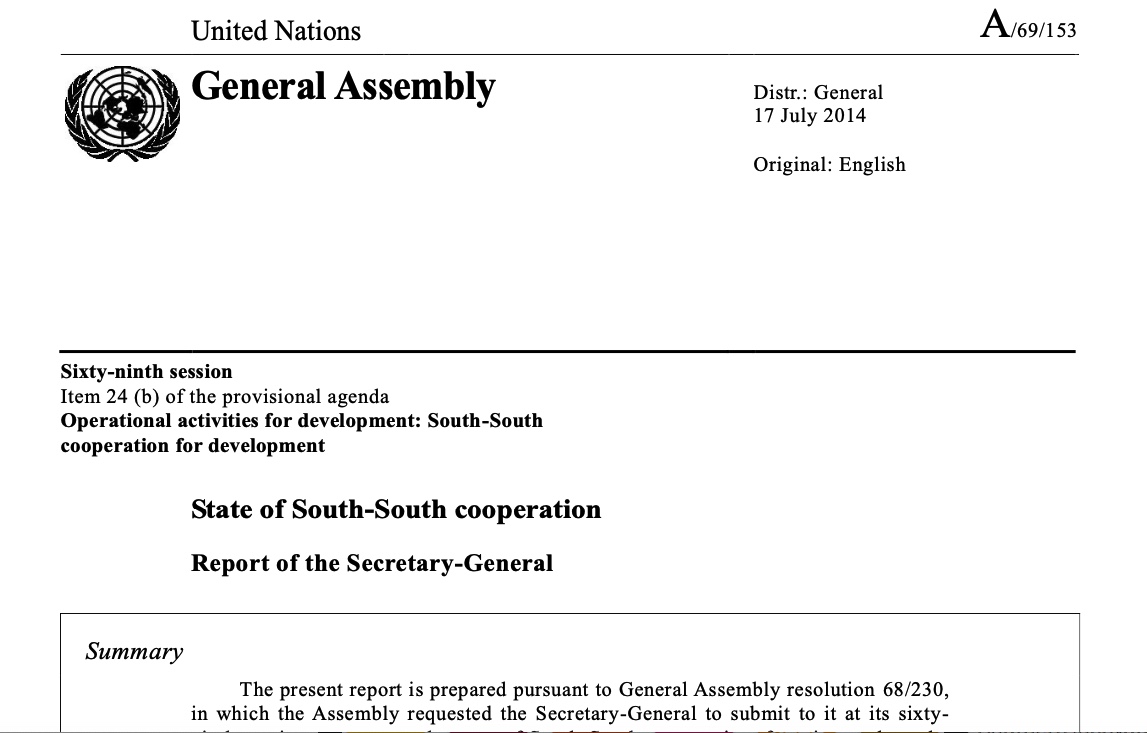
    United Nations General Assembly: Sixty-ninth session, Item 24 (b) of the provisional agenda, Operational activities for development: South-South cooperation for development, 17 July 2014.
    The research informing Southern Innovator Magazine played a part in the formulation of the UN’s post-2015 development agenda, including the Sustainable Development Goals (SDGs).

    https://davidsouthconsulting.org/southern-innovator-scale-up-fundraiser/

    ORCID iD: https://orcid.org/0000-0001-5311-1052.

    © David South Consulting 2022