Category: Southern Innovator magazine

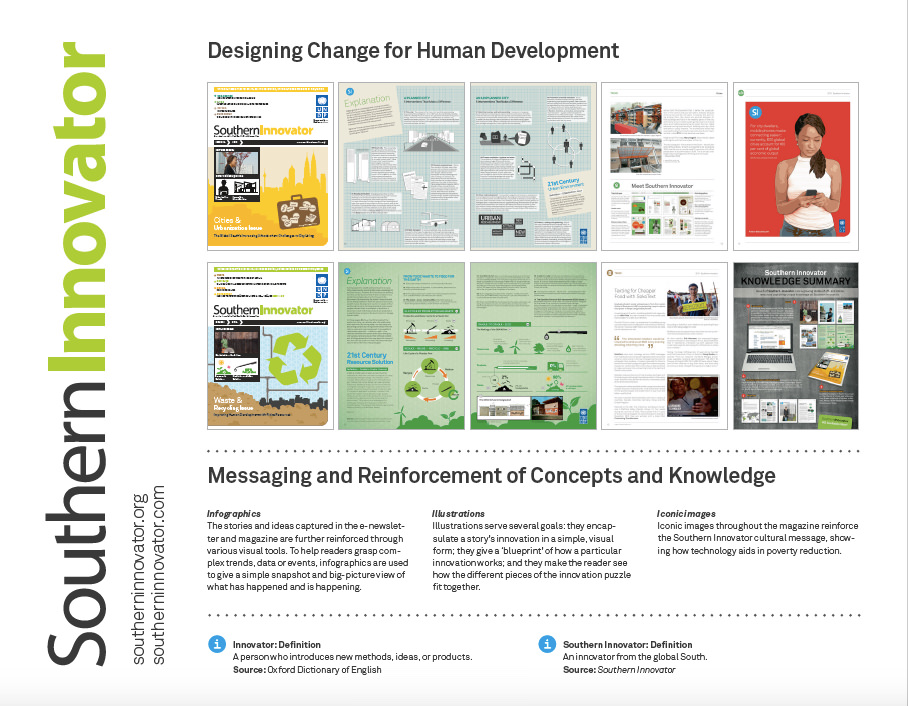
Southern Innovator Magazine was launched at the United Nations General Assembly (UNGA) in New York in 2011 by the United Nations Office for South-South Cooperation (UNOSSC). The first five issues were published between 2011 and 2015. The magazine played an integral role in laying the foundations for the Sustainable Development Goals (SDGs) and strategically positioning the United Nations as it transitioned from the Millennium Development Goals (MDGs) to the SDGs.

  • Global South Eco-cities Show How the Future Can Be

    Global South Eco-cities Show How the Future Can Be

    By David SouthDevelopment Challenges, South-South Solutions

    SOUTH-SOUTH CASE STUDY

    The world is currently undergoing a high-stress transition on a scale not seen since the great industrial revolution that swept Europe in the 19th and 20th centuries. Today’s urban and industrial transition involves many more people and is taking place on a greater proportion of the planet. With rapid urbanization comes a demand for middle class lifestyles, with their high-energy usage and high consumption of raw materials.

    This is stretching the planet’s resources to breaking point. And as many have pointed out, if the world’s population is to continue past today’s 7 billion to reach 9 billion and beyond, new ways of living are urgently required. Radical thinking will be necessary to match the contradictory goals of raising global living standards for the world’s poor with pressured resources and environmental conditions.

    But there are innovative projects already under development to build a new generation of 21st-century cities that use less energy while offering their inhabitants a modern, high quality of life. Two examples are in China and the Middle East.

    Both projects are seen as a way to earn income and establish viable business models to build the eco-cities of the future. Each project is seeking to develop the expertise and intellectual capacity to build functioning eco-cities elsewhere. In the case of the Masdar City project in the United Arab Emirates, international businesses are being encouraged to set up in Masdar City and to develop technologies that can be sold to other countries and cities – in short, to create a green technology hub akin to California’s hi-technology hub ‘Silicon Valley’. Masdar City is also being built in stages as investors are found to help with funding. Both projects hope to prove there is money to be made in being green and sustainable.

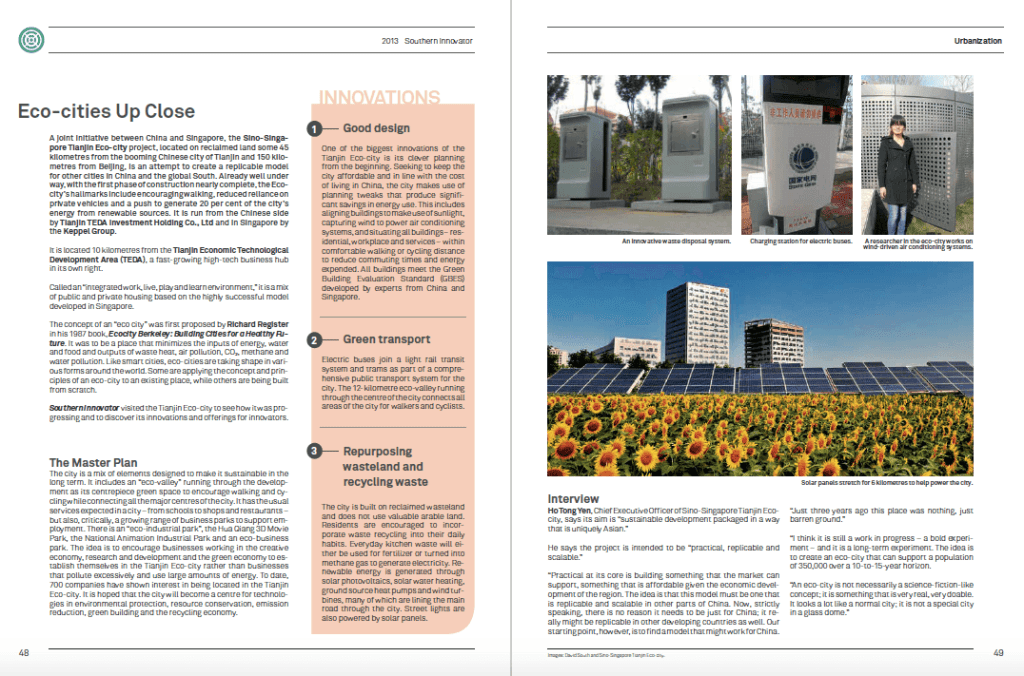
    The Tianjin Eco-city (tianjinecocity.gov.sg) project is a joint venture between China and Singapore to build a 30 square kilometre city to house 350,000 residents.

    Tianjin (http://en.wikipedia.org/wiki/Tianjin) is a large industrial city southeast of China’s capital, Beijing. It is a place that wears the effects of its industrial expansion on the outside. Air pollution is significant and the city has a grimy layer of soot on most outdoor infrastructure.

    China has received a fair bit of criticism for its polluted cities as the country has rapidly modernized in the past two decades. This sprint to be one of the world’s top economic powers has come at a cost to the environment. In this respect, China is not unusual or alone. Industrialization can be brutal and polluting, as Europe found out during its earlier industrial revolution.

    But China is recognizing this can’t go on forever and is already piloting many initiatives to forge a more sustainable future and bring development and high living standards back in line with what the environment can handle.

    Sino-Singapore Tianjin Eco-city is the second large-scale collaboration between the Chinese government and Singapore. The first was the Suzhou Industrial Park (http://www.sipac.gov.cn/english/).The Tianjin project came up in 2007 as both countries contemplated the challenges of rapid urbanization and sustainable development.

    The project’s vision, according to its website, is to be “a thriving city which is socially harmonious, environmentally-friendly and resource-efficient – a model for sustainable development.”

    The philosophy behind the project is to find a way of living that is in harmony, with the environment, society and the economy. It is also about creating something that could be replicated elsewhere and be scaled up to a larger size.

    The city is being built 40 kilometres from Tianjin centre and 150 kilometres from Beijing. It is located in the Tianjin Binhai New Area, considered one of the fastest growing places in China.

    Construction is well underway and can be followed on the project’s website (http://www.tianjinecocity.gov.sg/gal.htm). It will be completed in 2020.

    This year, the commercial street was completed and is ready for residents to move in.

    Residents will be encouraged to avoid motorized transport and to either use public transport or people-powered transport such as bicycles and walking.

    An eco-valley runs down the centre of the city and is meant to be a place for pedestrians and cyclists to enjoy.

    The basic building block of the Eco-city – its version of a city block – is called the Eco Cell. Each Eco Cell measures 400 metres by 400 metres, a comfortable walking distance. Four Eco Cells make a neighbourhood. Several Eco Neighbourhoods make an Eco District and there are four Eco Districts in the Eco-city. It is a structure with two ideas in mind: to keep development always on a walkable, human scale and also to provide a formula for scaling up the size of the Eco-city as the number of residents increases.

    It is a logical approach and seeks to address one of the most common problems with conventional cities: sprawling and unmanageable growth that quickly loses sight of human need.

    Agreement was also reached on the standards that should be achieved for a wide variety of criteria, from air and water quality to vegetation, green building standards, and how much public space there should be per person.

    An ambitious project in the United Arab Emirates is trying to become both the world’s top centre for eco cities and a living research centre for renewable energy. Masdar City (http://www.masdarcity.ae/en/)is planned to be a city for 40,000 people. It is billed as a high-density, pedestrian-friendly development where current and future renewable energy and clean technologies will be “marketed, researched, developed, tested and implemented.”

    The city hopes to become home to hundreds of businesses, a research university and technology clusters.

    This version of an eco-city is being built in three layers in the desert, 17 kilometres from the Emirati capital Abu Dhabi. The goal is to make a city with zero carbon emissions, powered entirely by renewable energy. It is an ambitious goal but there are examples in the world of cities that use significant renewable energy for their power, such as Reykjavik, Iceland in Northern Europe, which draws much of its energy from renewables and geothermal sources.

    Masdar City is designed by world-famous British architect Norman Foster (fosterandpartners.com) and will be 6.5 square kilometres in size.

    The design is highly innovative. The city will be erected on 6 metre high stilts to increase air circulation and reduce the heat coming from the desert floor. The city will be built on three levels or decks, to make a complete separation between transport and residential and public spaces.

    The lowest deck will have a transportation system based on Personal Rapid Transport Pods. These look like insect eyes and are automated, controlled by touch screens, using magnetic sensors for propulsion. On top of this transport network will be the pedestrian streets, with businesses, shops and homes. No vehicles will be allowed there, and people will only be able to use bicycles or Segway (segway.com) people movers to get around. An overhead light railway system will run through the city centre, all the way to Abu Dhabi City.

    “By layering the city, we can make the transport system super-efficient and the street level a much better experience,” Gerard Evenden, senior partner at Foster + Partners, told The Sunday Times. “There will be no car pollution, it will be safer and have more open spaces. Nobody has attempted anything like this.”

    Masdar City is being built in stages as funding comes, with the goal of completion by 2016. It hopes to achieve its aspiration to be the most technologically advanced and environmentally friendly city in the world. As for water supplies in the desert, there is a plan: dew collected in the night and morning and a solar-powered desalination plant turning salt water into drinking water.

    Electricity will come from a variety of sources. Solar panels will be on every roof and double as shade on alleyways. Non-organic waste will be recycled, while organic waste will be turned into fuel for power plants. Dirty water will be cleaned and then used to irrigate green spaces. Because of the design, the planners hope the city will just use a quarter of the energy of a conventional city.

    To keep the city smart and the project on top of developments in renewable energy, the Masdar Institute of Science and Technology (http://www.masdar.ac.ae/) will specialize in renewable energy technology.

    The cost for the city was pegged at US $22 billion in 2009.

    The chief executive of Masdar – Abu Dhabi’s renewable-energy company – is Sultan Al Jaber. He sees the city as a beacon to show the way for the rest of the Emirate to convert from a highly inefficient consumer of energy to a pioneer in green technology.

    “The problem with the renewable-energy industry is that it is too fragmented,” he told The Sunday Times. “This is where the idea for Masdar City came from. We said, ‘Let’s bring it all together within the same boundaries, like the Silicon Valley model (in California, USA).’”

    The project needs to gather much of its funding as it progresses. The United Nations’ Clean Development Mechanism (http://cdm.unfccc.int/) is helping with financing. Companies can earn carbon credits if they help fund a low-carbon scheme in the global South. The sultan is ambitious and sees this as a “blueprint for the cities of the future.” It has been able to bring on board General Electric (GE) and the Massachusetts Institute of Technology (MIT) to sponsor the university.

    It is possible to visit Masdar City and take a tour (http://www.masdarcity.ae/en/105/visit-masdar-city/) and it is also possible to view online what has been built so far (http://www.masdarcity.ae/en/32/built-environment/).

    Published: June 2012

    Resources

    1) Center for Innovation, Testing and Evaluation (CITE): Located in Texas, USA, CITE is a fully functioning city with no residents to test new technologies before they are rolled out in real cities. Website: http://www.pegasusglobalholdings.com/test-center.html

    2) Digital Cities of the Future: In Digital Cities, people will arrive just in time for their public transportation as exact information is provided to their device. The Citizen-Centric Cities (CCC) is a new paradigm, allowing governments and municipalities to introduce new policies. Website: http://eit.ictlabs.eu/action-lines/digital-cities-of-the-future/

    3) Eco-city Administrative Committee: Website: http://www.eco-city.gov.cn/

    4) Sino-Singapore Tianjin Eco-city, Investment and Development Co., Ltd. Website: tianjineco-city.com

    5) ‘The Future Build’ initiative, a new green building materials portal from Masdar City. Website: thefuturebuild.com

    6) UNHABITAT: The United Nations Human Settlements Programme is the UN agency mandated to promote socially and environmentally sustainable towns and cities with the goal of providing adequate shelter for all. Website: http://www.unhabitat.org

    Creative Commons License

    This work is licensed under a
    Creative Commons Attribution-Noncommercial-No Derivative Works 3.0 License.

    ORCID iD: https://orcid.org/0000-0001-5311-1052.

    © David South Consulting 2022

  • Digital Mapping to put Slums on the Map

    Digital Mapping to put Slums on the Map

    By David SouthDevelopment Challenges, South-South Solutions

    SOUTH-SOUTH CASE STUDY

    Mobile phones are more and more part of daily life in the South’s slums – even for the poorest people. One result is that it has now become possible to undertake digital mapping initiatives to truly find out who is where and what is actually going on.

    About one-third of the world’s urban dwellers live in slums, and the United Nations estimates that the number of people living in such conditions will double by 2030 as a result of rapid urbanization in developing countries. How to improve their living conditions and raise their standard of living is the big challenge of the 21st century.

    With just over five years until the 2015 deadline to meet the Millennium Development Goals (http://www.undp.org/mdg/), and the current economic downturn reversing some gains, any tool that can make development decisions more precise has to be a benefit.

    People are now turning to the growing penetration of digital technologies into slums and poor areas to find solutions. With mobile phones available across much of the global South, and plans underway to expand access to broadband internet even in poorly served Africa, it is becoming possible to develop a digital picture of a slum area and map its needs and population.

    Put to the right use, this powerful development tool can fast-track the delivery of aid and also better connect people to markets and government services.

    In November, an NGO called Map Kibera (www.mapkibera.org) began work on an ambitious project to digitally map Africa’s largest slum, Kibera in Nairobi, Kenya .

    The partners behind Map Kibera are Humanitarian OpenStreetMap, JumpStart International, WhereCampAfrica, the Social Development Network, Pamoja Trust, Hands on Kenya and others.

    Estimates place the number of residents in Kibera at one million, but nobody really knows how many live there (UN-HABITAT). The slum is typical of such deprived areas, lacking in health and water resources and plagued by chaotic traffic and housing. Few fully grasp where everything is in the sprawl.

    While data does exist on the slum, it is not shared or collated into one source. The Map Kibera project uses an open-source software programme, OpenStreetMap (http://www.openstreetmap.org/), to allow users to edit and add information as it is gathered. This information is then free to use by anybody wanting to grasp what is actually happening in Kibera: residents, NGOs, private companies and government officials.

    This will literally put Kibera on Kenya’s map.

    The mapping team started with 12 young people recruited in Kibera to start the work in November of this year. They will be trained and also receive support from the growing Nairobi technology community.

    “The project will provide open-source data that will help illustrate the living conditions in Kibera,” said Map Kibera’s Mikel Maron. “Without basic knowledge of the geography of Kibera it is impossible to have an informed discussion on how to improve the lives of residents of Kibera.”

    Workshops will communicate with local residents and show them the findings available from the map. Paper maps will be distributed to residents and then updated as new information comes in. It is critical local people are kept informed to build trust and avoid conflict. As can be seen from the Google Street Views (http://www.google.co.uk/help/maps/streetview/) controversy, nobody likes to be mapped without their permission or consent.

    Like Kenya, Brazil has a long history of sprawling slums sprouting around its cities. Called favelas, they are complex places, with both rudimentary dwellings and elaborate mansions. Walking into a favela can be a journey through the dreams and aspirations of generations of people, often reflected in their dwellings. Favelas have many services, including hospitals, and there are restaurants and coffee shops. In short, while they are not in the official development plans, the favelas are vibrant economic entities and home to hundreds of thousands of people.

    But since they are chaotic and undocumented by official maps, the economic and social development of the favelas is hindered as even basic services like mail delivery are difficult to provide.

    An NGO called Rede Jovem (http://www.redejovem.org.br/) is deploying youths armed with GPS (global positioning system)-equipped (http://en.wikipedia.org/wiki/Global_Positioning_System) mobile phones to map the favelas of Rio de Janerio. To start with, they are mapping five favelas: Complexo do Alemão, Cidade de Deus, Morro do Pavão-Pavãozinho, Morro Santa Marta and Complexo da Maré.

    “The main goal was to mark public interest spots on a map and show places like schools and institutions and hospitals and restaurants,” Natalia Santos, the executive coordinator for Rede Jovem, told MobileActive (www.mobileactive.org) . “We wanted to spread the news about what slums do have, so all the people can get to know that the slum is not just a place for violence and marginality and robbery.”

    The mapping process works like this: the mappers physically travel around the favela and upload information on each, individual landmark (restaurants, roads etc.) as they go. They use Nokia N95s mobile phones that are connected to Google Maps (www.maps.google.com).

    According to Santos, reporters enter the information on the map displayed on the phone, and they can video or photograph to add more detail. They are using Wikimapa (www.wikimapa.org.br), and Twitter (www.twitter.com) to log the information.

    As Rede Jovem recruited young mappers, they discovered an interesting fact: the male reporters (aged between 17 and 25) were frightened to enter a favela with a mobile phone for fear of either being mugged or being stopped by the police. Because of this fact, all the mappers are young women.

    They are ambitious for the future despite their funds running out in December. “We want everyone who has a cell phone with GPS to be a wikireporter,” said Santos .

    How important it is to the favela residents to be recognised like this can’t be overstated. “I think they are very happy because they’re seeing that they exist,” said Santos. “And the mailman says that now he can deliver the mail.”

    Published: December 2009

    Resources

    • Mobile Active.org: MobileActive.org is a community of people and organizations using mobile phones for social impact. They are committed to increasing the effectiveness of NGOs around the world who recognize that the over 4 billion mobile phones provide unprecedented opportunities for organizing, communications, and service and information delivery. Website: http://www.mobileactive.org
    • Google Android: Get inventing! This software enables anyone to start making applications for mobile phones. And it offers a platform for developers to then sell the applications to others. Website: http://www.android.com/
    • Ushahidi: is a website that was developed to map reports of violence in Kenya after the post-election fallout at the beginning of 2008. The new Ushahidi Engine is being created to use the lessons learned from Kenya to create a platform that allows anyone around the world to set up their own way to gather reports by mobile phone, email and the web – and map them. It is being built so that it can grow with the changing environment of the web, and to work with other websites and online tools. Website: http://blog.ushahidi.com/
    • Textually.org: is the entry point of three weblogs devoted to cell phones and mobile content, focusing on text messaging and cell phone usage around the world, tracking the latest news and social impact of these new technologies. Website: http://www.textually.org/
    • Betavine Social Exchange has launched. It’s a matching site for NGOs looking for mobile solutions, and developers who can help build them, all brought to you by Vodafone. Website: http://www.betavine.net

    Citations

    Resilient Urban Regeneration in Informal Settlements in the Tropics: Upgrading Strategies in Asia and Latin America, Publisher: Springer Singapore (2020)

    The story first appeared in the UN e-newsletter Development Challenges, South-South Solutions in 2009. It was simultaneously published on the Vancouver, Canada-based crowd-powered news website, NowPublic. It was then published in the UN magazine Southern Innovator.

    Streets as Tools for Urban Transformation in Slums: A Street-led Approach to Citywide Slum Upgrading, Publisher: United Nations Human Settlements Programme (UN-Habitat) (2012)

    Other Stories on Mapping

    https://davidsouthconsulting.org/2021/08/28/african-entrepreneur-wants-to-bring-order-to-urban-chaos/

    https://davidsouthconsulting.org/2020/12/04/big-data-can-transform-the-global-souths-growing-cities/

    https://davidsouthconsulting.org/2021/03/04/indian-id-project-is-foundation-for-future-economic-progress/

    https://davidsouthconsulting.org/2022/10/31/mapping-beirut-brings-city-to-light/

    https://davidsouthconsulting.org/2022/10/17/mapping-to-protect-kenyas-environment-the-emazingira-solution/

    https://davidsouthconsulting.org/2021/03/31/new-weapon-against-crime-in-the-south/

    By 2014, Southern Innovator had published five issues and become a recognised global innovation brand.

    https://davidsouthconsulting.org/2021/03/05/southern-innovator-issue-4/

    Follow @SouthSouth1

    Slideshare: http://www.slideshare.net/DavidSouth1/development-challengessouthsouthsolutionsnovember2010issue

    Southern Innovator Issue 1: https://books.google.co.uk/books?id=Q1O54YSE2BgC&dq=southern+innovator&source=gbs_navlinks_s

    Southern Innovator Issue 2: https://books.google.co.uk/books?id=Ty0N969dcssC&dq=southern+innovator&source=gbs_navlinks_s

    Southern Innovator Issue 3: https://books.google.co.uk/books?id=AQNt4YmhZagC&dq=southern+innovator&source=gbs_navlinks_s

    Southern Innovator Issue 4: https://books.google.co.uk/books?id=9T_n2tA7l4EC&dq=southern+innovator&source=gbs_navlinks_s

    Southern Innovator Issue 5: https://books.google.co.uk/books?id=6ILdAgAAQBAJ&dq=southern+innovator&source=gbs_navlinks_s

    Creative Commons License

    This work is licensed under a
    Creative Commons Attribution-Noncommercial-No Derivative Works 3.0 License.

    ORCID iD: https://orcid.org/0000-0001-5311-1052.

    © David South Consulting 2022
  • Innovative Stoves to Help the Poor

    Innovative Stoves to Help the Poor

    By David SouthDevelopment Challenges, South-South Solutions

    SOUTH-SOUTH CASE STUDY

    Half of the world’s population cook with a fuel-burning stove, and this figure rises to 80 per cent of households in rural areas in developing countries. Typical fuels burned include wood, coal, crop leftovers and animal dung. The indoor pollution from smoke and carbon monoxide is a top health hazard in the developing world, ranking just behind dirty water, poor sanitation and malnutrition. The World Health Organization (WHO) estimates that 1.6 million people die each year as a result of toxic indoor air.

    A landmark five-year study comparing Guatemalans cooking on open fires, to those using improved stoves, has brought more evidence forward of the damage done by indoor air pollution: “It’s been shown that children living in houses using open fires with solid fuels will have more pneumonia than children living in houses that are using cleaner fuels,” said Dr. Kirk R. Smith, an environmental health scientist at the University of California, Berkeley.

    The research, combined with studies in Asia, suggests additional health problems from indoor air pollution, including higher frequency of cataracts, partial blindness, tuberculosis, low birth weights and high blood pressure. The researchers found that cleaner stoves had larger effects than reducing salt in the diet or lowering blood pressure in women, with the results published last July in Environmental Health Perspectives.

    But Southern innovators are finding practical ways to curb pollution from indoor cooking and the burning of trash in slums.

    In Yunnan Province, China, entrepreneur Hao Zheng Yi’s Yunnan Zhenghong Environmental Protection Co. has been selling clean-burning stoves to rural farmers. One fifth of rural China has no electricity (UN), and 80 per cent rural dwellers burn wood or straw in ovens for heating and cooking. This creates heavy indoor air pollution, damaging health.

    The so-called Efficient Gasification Burning system combines traditional fuel and natural gas: a hybrid that helps low-income households to affordably use the stove and not pollute their indoor air.

    The stoves are sold for a profit in Yunnan Province, and so far 50,000 have been sold. Because the ovens are sold for a profit, Zhenghong had to consult extensively with the farmers in the design phase to make sure the ovens meet their needs.

    The result has been that Zhenghong ovens run for five to eight years using the same amount of wood and hay a conventional oven burns in one year.

    Another source of air pollution is burning trash in slums. The lack of formal trash removal services in slums has two bad consequences: one is the pollution and poison from rotting rubbish leaching into the soil and water table; the other is ad-hoc burning of the trash to get rid of it, which pollutes the air with a toxic, acrid stench. In Nairobi’s Kibera slum – the second biggest in Africa – over 60 per cent of the city’s residents live in the slum, and are bypassed by garage collection services. Garbage is piled up along the muddy roads and paths, or hangs in the trees.

    The Kenyan NGO Umande Trust, which specialises in water and sanitation projects, has developed a home-grown method to burn trash and avoid having to turn to very expensive and complicated incinerators from Europe. The sheer quantity of trash that needs to be burned in the slum means smaller solutions will not be able to handle the problem.

    Its “community cooker” re-uses garbage from the community as fuel for a boiler and oven attached to it. The heat generated by burning the rubbish provides hot water and cooking facilities – and also jobs for unemployed youths who collect the rubbish and stock the incinerator. It was developed by a Kenyan architect, and it is hoped the “community cooker” will be taken up across Africa.

    The community cooker’s inventor, Kenyan architect Jim Archer, took eight years to design and build it: “My thinking was how do we get rid of the rubbish and …how can we induce people to pick it up. Then I thought, well if we can convert it to heat on which people can cook…” he told Australia’s ABC News.

    Similar industrial scale trash incinerators can cost between US $50 million to US $280 million (World Bank) – “…when applying waste incineration, the economic risk of project failure is high…”. The community cooker on the other hand, will sell for US $10,000.

    The idea was to create an incinerator that was simple to use and repair: something that the commercially available, computer-controlled incinerators were not able to do. As the cooker gets up to speed, it will be able to burn 60 per cent of the slum’s trash.

    Local youth go house-to-house collecting trash. They get money from the slum residents for this. Rubbish is then exchanged for cooking time or hot water for washing.

    “The trash has started to help us a bit after the cooker came. There are fewer diseases like diarrhea and the environment has improved. … I think burning the rubbish will bring good health to this community,” said Patricia Ndunge, as she fried onions on the cooker.

    And it looks like the community cooker has a future: Kenya’s largest supermarket, Nakumatt, has pledged to pay for 20 more slum cookers.

    Published: March 2008

    Resources

    • Envirofit: A Shell Foundation supported project to produce 300,000 clean, wood-burning stoves for the developing world (starting with India, Brazil, Kenya and Uganda). Envirofit will offer a variety of sleek ceramic stoves from single to multipot, with and without chimneys, and with colors like apple red, baby blue and gold. The cost is to start at $10 to $20 and run to $150 to $200.
      Website: http://www.envirofit.org/

    Follow @SouthSouth1

    Slideshare: http://www.slideshare.net/DavidSouth1/development-challengessouthsouthsolutionsnovember2010issue

    Southern Innovator Issue 1: https://books.google.co.uk/books?id=Q1O54YSE2BgC&dq=southern+innovator&source=gbs_navlinks_s

    Southern Innovator Issue 2: https://books.google.co.uk/books?id=Ty0N969dcssC&dq=southern+innovator&source=gbs_navlinks_s

    Southern Innovator Issue 3: https://books.google.co.uk/books?id=AQNt4YmhZagC&dq=southern+innovator&source=gbs_navlinks_s

    Southern Innovator Issue 4: https://books.google.co.uk/books?id=9T_n2tA7l4EC&dq=southern+innovator&source=gbs_navlinks_s

    Southern Innovator Issue 5: https://books.google.co.uk/books?id=6ILdAgAAQBAJ&dq=southern+innovator&source=gbs_navlinks_s

    Creative Commons License

    This work is licensed under a
    Creative Commons Attribution-Noncommercial-No Derivative Works 3.0 License.

    ORCID iD: https://orcid.org/0000-0001-5311-1052.

    © David South Consulting 2023

  • Biogas Digester-in-a-Bag Brings Portability

    Biogas Digester-in-a-Bag Brings Portability

    By David SouthDevelopment Challenges, South-South Solutions

    SOUTH-SOUTH CASE STUDY

    Securing energy sources that are cheap (or free) and renewable can significantly reduce the cost of living for the world’s poor. The cost of fuel for essentials such as cooking and lighting can quickly eat up household incomes.

    Gaining access to an inexpensive gas source that is also renewable can help people divert their income into other things, such as education and health care, improving individuals’ well-being and helping boost wealth.

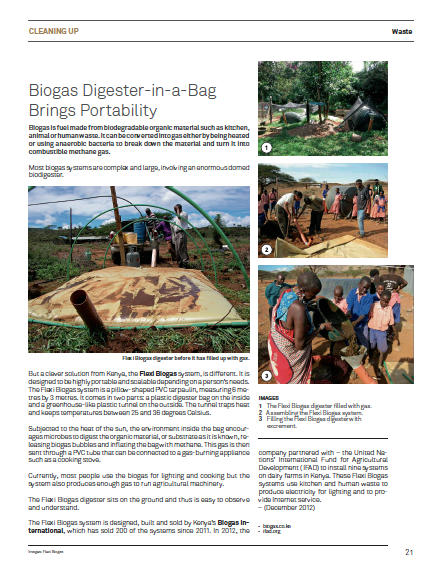
    Biogas (http://en.wikipedia.org/wiki/Biogas) is fuel made from biodegradable organic material such as kitchen, animal or human waste. It can be converted into gas either by being heated or using anaerobic bacteria to break down the material and turn it into combustible methane gas (http://en.wikipedia.org/wiki/Methane).

    Most biogas systems are complex and large, involving an enormous domed biodigester.

    But a clever solution from Kenya, the Flexi Biogas system (biogas.co.ke), is different. It is designed to be highly portable and scalable depending on a person’s needs. The Flexi Biogas system is a pillow-shaped PVC tarpaulin, measuring 6 metres by 3 metres. It comes in two parts: a plastic digester bag on the inside and a greenhouse-like plastic tunnel on the outside. The tunnel traps heat and keeps temperatures between 25 and 36 degrees Celsius.

    Subjected to the heat of the sun, the environment inside the bag encourages microbes to digest the organic material – or substrate (http://en.wikipedia.org/wiki/Enzyme_substrate_%28biology%29) as it is known, releasing biogas bubbles and inflating the bag with methane. This gas is then sent through a PVC tube that can be connected to a gas-burning appliance such as a cooking stove.

    Currently, most people use the biogas for lighting and cooking but it also produces enough gas to run agricultural machinery.

    The Flexi Biogas digester sits on the ground and so is easy to observe and understand.

    The Flexi Biogas system is designed, built and sold by Kenya’s Biogas International, which has sold 200 of the systems since 2011. In 2012, the company partnered with IFAD – the United Nations’ International Fund for Agricultural Development (ifad.org) – to install nine systems on dairy farms in Kenya. These Flexi Biogas systems use kitchen and human waste to produce electricity for lighting and to provide Internet service.

    Cows produce 15 to 30 kilograms of dung a day (IFAD). By placing 20 kilograms of fresh cow dung into a Flexi Biogas digester it is possible to produce 1,000 litres of cooking gas – enough gas for a family of five to seven people. This amount of cow dung could also produce enough gas to run a 5 horsepower engine for one hour. The engine could also be connected to a car alternator to generate electricity to run lights, a computer or a television set.

    A Flexi Biogas system costs US $410, including installation by technicians and all the extras including inlet and outlet pipes and a 15 metre gas pipe.

    The cost of the system increased from the first prototypes. Initially, inexpensive plastic was used for the bags and the total cost for the system was US $180. But the makers encountered a problem with durability – the systems were prone to tearing and needed to be replaced after two years. Since then, they have moved to a more expensive PVC tarpaulin bag designed to last 10 years.

    The makers point out that access to high-quality plastic and rubber in Kenya is difficult and the system’s costs could be brought down if they were manufactured in China or India.

    The makers argue there are several reasons why the Flexi Biogas solution is suited to Africa. One is the difficulty of securing land tenure, necessary for the building of a permanent structure like a biodigester dome. It can also be a challenge to find skilled labour and get access to complex parts such as gas pressure regulators.

    In a comparison between the conventional dome biogas digester and the Flexi Biogas system, IFAD found the average cost in Kenya for a dome system was US $1,000, compared to US $410 for the Flexi Biogas system. A fixed dome takes 21 days on average to set up while a Flexi Biogas system can be set up in a day. The Flexi Biogas system also turns the substrate into biogas faster and can operate at higher temperatures. IFAD found various advantages and disadvantages to the Flexi Biogas solution: it is relatively inexpensive, lightweight (10 kilograms), very portable, quick and simple to set up, and easy to operate. The disadvantages include being costly to make, easy to steal, and a relatively short lifespan.

    Weighing it all up, IFAD still concluded that “the Flexi Biogas system is an affordable solution that provides household energy while making use of waste products that would otherwise add to emissions.”

    Published: December 2012

    LINKS:

    1) The official portal on anaerobic digestion. Website: http://www.biogas-info.co.uk/

    2) REA Biogas: REA Biogas has been championing the cause of anaerobic digestion (AD) and has been the unifying force which has helped to bring the industry forward. Website: http://www.biogas.org.uk/

    3) Practical Action: Various renewable energy solutions including biogas. Website: http://practicalaction.org/biogas_expertise

    4) Future Biogas: Future Biogas specialise in the construction and operation of biogas plants for the UK. Website: http://www.futurebiogas.com/

    https://davidsouthconsulting.org/2022/11/21/africa/

    https://davidsouthconsulting.org/2022/08/02/african-fuel-pioneer-uses-crisis-to-innovate/

    https://davidsouthconsulting.org/2022/11/19/agricultural-waste-generating-electricity/

    https://davidsouthconsulting.org/2022/11/22/bio-ethanol-from-sturdy-and-once-unwanted-indian-plant/

    https://davidsouthconsulting.org/2022/02/11/egyptian-youth-turns-plastic-waste-into-fuel/

    https://davidsouthconsulting.org/2022/10/25/indian-toilet-pioneer-champions-good-ideas/

    https://davidsouthconsulting.org/2023/03/27/pay-for-pee-keeps-indian-town-clean/

    https://davidsouthconsulting.org/2022/06/23/recycling-waste-to-boost-incomes-and-opportunities/

    https://davidsouthconsulting.org/2022/11/19/saving-water-to-make-money/

    https://davidsouthconsulting.org/2022/11/18/successful-fuel-efficient-cookers-show-the-way/

    https://davidsouthconsulting.org/2022/11/18/toilet-malls-make-going-better/

    https://davidsouthconsulting.org/2022/08/13/turning-animal-waste-into-paper/

    https://davidsouthconsulting.org/2021/09/30/turning-human-waste-to-fertilizer-an-african-solution/

    https://davidsouthconsulting.org/2022/02/10/urban-farmers-gain-from-waste-water/

    Follow @SouthSouth1

    Slideshare: http://www.slideshare.net/DavidSouth1/development-challengessouthsouthsolutionsnovember2010issue

    Southern Innovator Issue 1: https://books.google.co.uk/books?id=Q1O54YSE2BgC&dq=southern+innovator&source=gbs_navlinks_s

    Southern Innovator Issue 2: https://books.google.co.uk/books?id=Ty0N969dcssC&dq=southern+innovator&source=gbs_navlinks_s

    Southern Innovator Issue 3: https://books.google.co.uk/books?id=AQNt4YmhZagC&dq=southern+innovator&source=gbs_navlinks_s

    Southern Innovator Issue 4: https://books.google.co.uk/books?id=9T_n2tA7l4EC&dq=southern+innovator&source=gbs_navlinks_s

    Southern Innovator Issue 5: https://books.google.co.uk/books?id=6ILdAgAAQBAJ&dq=southern+innovator&source=gbs_navlinks_s

    Creative Commons License

    This work is licensed under a
    Creative Commons Attribution-Noncommercial-No Derivative Works 3.0 License.

    ORCID iD: https://orcid.org/0000-0001-5311-1052.

    © David South Consulting 2023