Category: Southern Innovator magazine

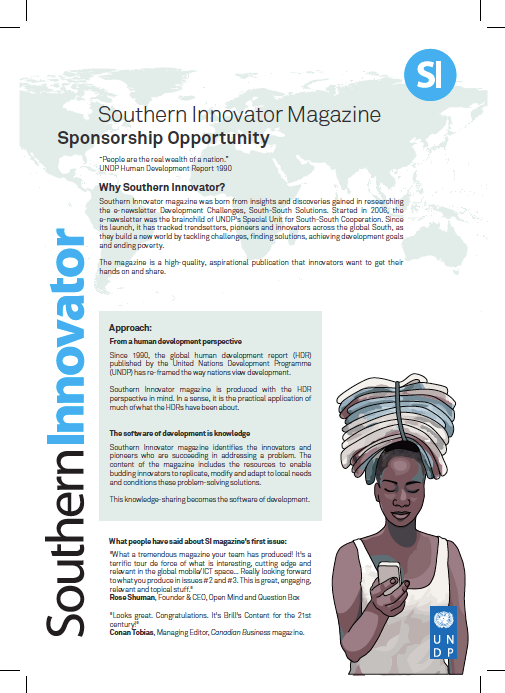
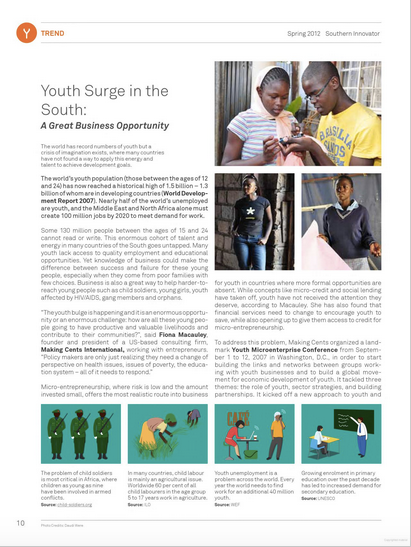
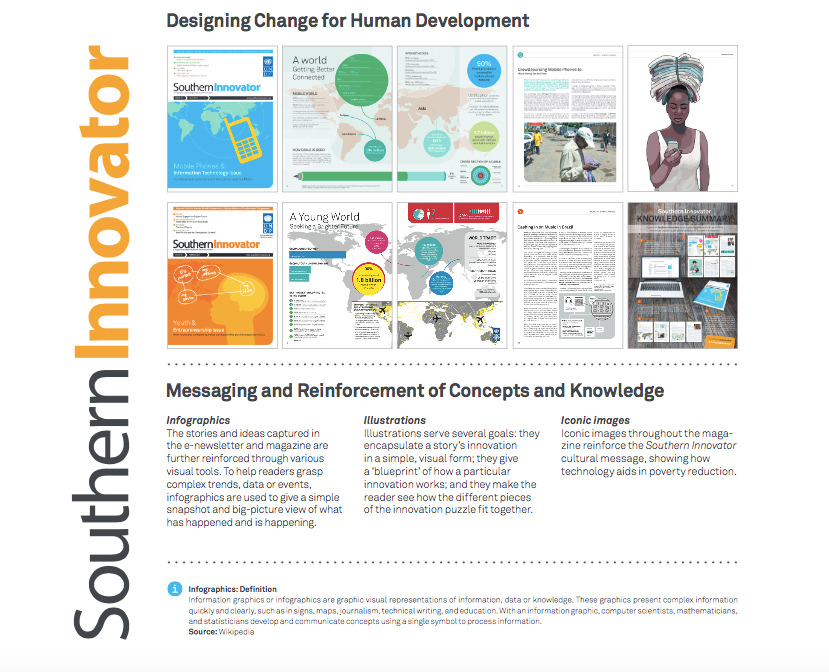
Southern Innovator Magazine was launched at the United Nations General Assembly (UNGA) in New York in 2011 by the United Nations Office for South-South Cooperation (UNOSSC). The first five issues were published between 2011 and 2015. The magazine played an integral role in laying the foundations for the Sustainable Development Goals (SDGs) and strategically positioning the United Nations as it transitioned from the Millennium Development Goals (MDGs) to the SDGs.

  • Social Franchising Models Proving Poor Bring Profits

    Social Franchising Models Proving Poor Bring Profits

    By David SouthDevelopment Challenges, South-South Solutions

    SOUTH-SOUTH CASE STUDY

    The four billion people in the world who live on less than US $2 a day have been described as the bottom of the economic pyramid, or BOP for short. In his book The Fortune at the Bottom of the Pyramid, Indian business consultant and professor CK Prahalad argues that this attitude must be turned on its head: rather than seeing the world’s poor as a burden, only worthy of charity, Prahalad sees nothing but opportunity and unmet needs that business can address. In short, he argues, profits can be married with the goal of eradicating poverty.

    Prahalad has gone so far as to claim this is a market potentially worth US $13 trillion, while the World Resources Institute puts it at US $5 trillion in its latest report, The Next 4 Billion.

    One of the tools business is turning to reach the world’s poor is known as social franchising. The concept borrows from the business world and the highly successful franchise models that are more commonly associated with fast-food restaurants and computer and clothing retailers – wherever rapid expansion and scale are required to reach the biggest market possible. And there is no bigger market, social franchising advocates claim, than the world’s four billion poorest people.

    In the past, most formal business in developing countries chased the small middle class or the even smaller elite or foreign expatriate communities. Traditional poverty eradication strategies have also been criticized for being too narrow, focused on a very small group, or for wasting time and resources replicating what has already been achieved elsewhere, and for ballooning and shrinking depending on aid grants or success at fundraising. Social franchising aims to bypass these weaknesses by finding models that work, making sure they are self-financing, and then quickly scaling them up to reach as many people as possible. It’s a model that is gaining more followers and the serious interest of big and small businesses.

    One example is the Scojo Foundation in India, established to tackle the common problem of blurry vision as people age (presbyopia). Not a disease, the first symptoms occur between the ages of 40 and 50. Low vision affects 124 million people in the world according to the World Health Organization’s Vision 2020 campaign, organizers of World Sight Day 2007 on October 11.

    Blurry vision is a serious disability for weavers, mechanics, goldsmiths and others whose livelihoods depend on near vision. As vision deteriorates, these people are unable to provide for their families. Yet it is easily treatable with a pair of eyeglasses.

    Since, 2002, the Scojo Foundation (the social franchising wing of eyeglasses manufacturer Scojo New York, has launched operations in Bangladesh, Mexico, Guatemala, El Salvador and Ghana. Its largest and fastest growing operation is in India, where it employs more than 560 entrepreneurs in rural villages, and selling more than 50,000 pairs of glasses since 2001.

    It has grown quickly because the business model has been replicated by local staff who work as franchisees. It has followed the franchise model by building a network of “vision entrepreneurs” – low-income men and women, who in turn sell reading glasses directly to rural villagers throughout India. The franchise model enables the “vision entrepreneurs” to earn a good income, and gain respect from other community members.

    Nico Clemminck, co-author of a case study on Scojo, found the price was very competitive with other options in India, and that the higher quality of the glasses made them attractive to villagers.

    “The franchisees, or Vision Entrepreneurs as Scojo calls them, that we met were very involved with Scojo – some of them shifting away their focus from previous occupations to spend the majority of their time on conducting vision screenings and selling glasses. The main reason is that the business is quite profitable to them – they make a US $1 margin per glasses sold, which is very high compared to other retail products. A trend we did notice is that commitment decreases over time, as the entrepreneurs exhaust their immediate circle of relatives or target village populations, and the incremental sale becomes tougher to make.”

    According to Clemminck, Scojo has been able to quickly and successfully expand to other countries by forming partnerships with existing networks that reach into villages.

    The profit hierarchy works like this: the manufacturer charges US $1 for the reading glasses, Scojo charges another US $1, the franchisee a further US $1, and the customer pays US $3 for the glasses. By creating profit at each stage, the model ensures the financial incentives are there to keep the distribution network active.

    Prior to Scojo, it was believed developing infrastructure in rural Indian communities is too high to sustain a franchising model for low-cost products. Scojo found it was possible to succeed with this model, by focusing on profitability and sustainability right from the start, pursuing aggressive growth through partnerships to build economies of scale, blocking competitors by having a strong brand and first-mover advantage, constantly refining the model across regions, and delivering a tangible social benefit, both economic and health.

    On average, franchisees work 20-30 hours per month and earn US $15 to US $20 per month. Considering most franchisees were living on US $1 a day, the extra income is very welcome, Clemminck said.

    “This project gave me insight into the large, untapped market opportunity that exists,” says case study co-author Sachin Kadakia, “and how the concept of ‘Bottom of the Pyramid’ provides a tangible and significant improvement to the quality of life of people in these communities.”

    Another social franchise gaining ground in India is Medicine Shoppe. As a chain of pharmacies, Medicine Shoppe targets underserved communities by offering entrepreneurs franchises. It is an offshoot of the largest franchiser of independent community pharmacies in the US, Medicine Shoppe International Inc.. It can draw on its strong brand and identity to appeal to potential franchises.

    Acumen Fund fellow Nadaa Taiyab, who is working with Medicine Shoppe’s expansion to help the rural and urban poor, found it was important to learn lessons and adapt the model.

    “When I arrived in December (2006),” she said, “we opened the first Sehat Clinic. Last weekend we opened the seventh, with an eighth shortly underway. The model has undergone a tremendous evolution in the past six months. We shifted our site selection strategy from relatively affluent areas with a slum nearby, to locating the clinics right inside slums. We redesigned the process through which we recruit doctors and created an employment package that allows us to hire experienced doctors at a salary we can afford.

    “We also implemented an entirely new concept for Medicine Shoppe called community marketing outreach. Through this program, we hire local women in each area to make daily home visits, refer patients to the clinic, spread health education and awareness, and promote our free health camps and health clinics. In the past four months we have held over 35 health-plus-vision-testing camps, serving over 4,000 people.

    “We have also made some changes to the look and feel of the clinics and shops and put all our marketing materials in the local language, to make our services more appealing to low-income markets.”

    There are critics of the BOP approach, however. Aneel Karnani from the Ross School of Business at the University of Michigan, argues from a for-profit perspective, business would be much better off targeting the needs of the growing middle classes, especially in countries like India and China. He, however, does acknowledge that social franchising businesses like above, where social responsibility is key, are relevant to meeting the needs of the poor.

    Published: August 2007

    Resources

    • A detailed and thorough case study of how the Scojo Foundation model works is found here
    • An excellent set of decision matrices to help budding social entrepreneurs and existing businesses to decide if social franchising is the right solution: www.createproject.org
    • The Social Enterprise Alliance has built a knowledge network and extensive range of resources (including 160 case studies) on social enterprise.
    Creative Commons License

    This work is licensed under a
    Creative Commons Attribution-Noncommercial-No Derivative Works 3.0 License.

    ORCID iD: https://orcid.org/0000-0001-5311-1052.

    © David South Consulting 2023

  • Innovation in the Slums can bring Peace and Prosperity

    Innovation in the Slums can bring Peace and Prosperity

    By David SouthDevelopment Challenges, South-South Solutions

    SOUTH-SOUTH CASE STUDY

    Rioting in Kenya has once again reminded people of the volatility of urban slums and the price to be paid if the dreams of those who live there are not met. As documented by urban development expert Jeb Brugmann, “mismanaged urban migrations have been a central part of political revolutions in our world since the 1960s.” In Kenya, “as elsewhere, these slums have effectively become huge, parallel cities, with their own economies, governance and social dynamics. Two-thirds of Nairobi’s slum dwellers eke a living in the underground informal sector. Ninety per cent of them are tenants. The poverty rate in Nairobi doubled, for instance, between 1992 and 1997.”

    Slums are usually despised by the local urban authorities around the world. They end up either being totally ignored and seen as an embarrassment, or in more extreme circumstances like Zimbabwe’s slum clearance in 2005 – “Operation Clean Up Trash” – they are swept away (only to pop up somewhere else). Recently in Ghana, slums were cleared with flame-throwers, as residents were quickly cleared out of their homes to make way for a football stadium. Schoolteacher Ibrahim Addalah, who lost his home, said: “My school is gone. The community had bought us a blackboard; we had made a small school. It took us a long time to get all those things: the benches, the books. They gave us no time to leave; they just burnt our homes and our future to the ground. Now we are living in the rubble with nowhere to go.”

    Over 900 million people – almost a sixth of the world’s population – now live in urban slums (UN). Improving conditions for these people is a Millennium Development Goal target. And half the world’s population will soon live in cities: already, in developing countries 43 per cent of urban dwellers live in slums – and in the least-developed countries the figure is 78 per cent. The UN has estimated it will take US $18 billion a year to improve living conditions for these people – and most of it will have to come from the people themselves.

    An essential route to improving the situation is to give people living in slums the dignity and respect they deserve as human beings. Initiatives across the South seek to do this and turn the situation on its head: seeing slum dwellers as a valuable asset, not an urban blight.

    The concept of ‘slum networking’ has been developed by Indian engineer Himanshu Parikh of Ahmedabad , a winner of the Aga Khan award for architecture. He starts from the point of believing there is no need for slum conditions to exist in India, but that slums do not need to be moved, just upgraded; and that good change can happen quickly.

    He also sees the residents’ involvement and financial contribution as critical to the sustainability of any improvements. His approach has already helped one million people overall, including 8,703 families (43,515 people) in Ahmedabad in 41 slum communities. Slum networking does not depend on aid funds but is a self-reliant approach, in which residents make a partnership with private suppliers to get access to the most important services first: clean water and hygiene and sanitation.

    Parikh’s approach involves providing channels for sewage, water supply and roadways in existing slum areas by exploiting the natural topography and pattern of development to provide the new infrastructure.

    Parikh makes a detailed survey plan of the existing houses and divides them into groups based on the quality of construction. If they are of reasonable quality, they are left in place. Where possible, slum dwellers are allowed to buy the land they are squatting on. By buying the land, the owner now has a direct stake in its development.

    “Working inside out, i.e. starting with quality infrastructure in the poor areas and working outwards to produce larger networks for the city or village, not only integrates the two levels, but actually produces far cheaper infrastructure at both levels,” Parikh told Architecture Week magazine.

    In the slums of the Indian city of Indore, 181 slums were networked, giving the city 360 kilometres of new roads, 300 kilometres of new sewer lines, 240 kilometres of new water lines, 120 community halls and 120,000 trees. This transformed the two local rivers from open sewers back to water. According to the World Bank, fatal water diseases fell by 90 per cent.

    “No project for their rehabilitation could be successful until they were involved as the capital partners,” Parikh told India’s The Tribune. Upgrading “the civic amenities, including sewerage, roads and water supply, was the need of the hour for better living conditions of the slum dwellers.” In South Africa, the country’s fast-growing tourism trade is being directed towards its slums, not just its game parks, wineries and cities.

    The sprawling Soweto district on the outskirts of Johannesburg – the heart of the struggle against the former apartheid regime – has lured tourists to come and stay with its network of bed and breakfasts (http://www.sowetonights.co.uk/snaccom_vhavenda.htm): home-based places to stay run by families. Like many slums, Soweto is a heady mix of contrasts: from wealthy suburban homes, to makeshift tin shacks to outright squalor and destitution. But the B and Bs ensure tourists stick around and spend more money, creating lasting jobs.

    Over 200,000 visitors a year tour Soweto to see where Nelson Mandela and Bishop Desmond Tutu once lived. And as with all success, it attracts more success: the international hotel chain Holiday Inn has just opened a 48-room hotel in Soweto.
    Giving dignity to the lives of slum dwellers is the work of a do-it-yourself “TV station” in Kenya. Kenya’s dramatic turn to violence after recent elections has led to a myopic view of the country, according to the young filmmakers and photographers behind Slum TV (http://www.slum-tv.info/). Based deep inside Nairobi’s largest slum, Mathare, they have been seeking out the stories of hope where international media only see violence and gloom.

    “We look at what is good and what is bad. We see what is behind the scenes. The international media only shows the negative side,” said Benson Kamau of Slum TV.

    Slum TV is a group of young men in Mathare with only a two-week workshop in the basics of film shooting and editing. They pay their bills by doing odd jobs. A grant from Austria paid for their one camera and a computer.

    They screen their films every month to the residents of Mathare on a giant white sheet hanging over some vacant land. They illegally tap an overhanging electricity line for power – few can afford electricity. The films document everyday life in the slum – a man selling dougnuts, women frying potatoes – and the locals can see their lives recorded and acknowledged.

    Resources 

    1. Shelter Associates: established by Indian architect Pratima Joshi, it is an NGO working on slum rehabilitation. http://www.shelter-associates.org

    2. SPARC: one of the largest Indian NGOs working on housing and infrastructure issues for slum dwellers. http://www.sparcindia.org

    3. Improving the Lives of Slum Dwellers: published by the Millennium Project. http://www.unmillenniumproject.org/reports/tf_slum.htm

    4. For local bed and breakfasts in South Africa, click here sa-venues.com, tourist information at http://www.southafrica.net/

    5. Slum Networking: Innovative Approach to Urban Development by Diane Diacon (editor). Website: http://www.amazon.co.uk

    https://davidsouthconsulting.org/2022/02/17/digital-mapping-to-put-slums-on-the-map/

    https://davidsouthconsulting.org/2022/04/28/envisioning-better-slums/

    https://davidsouthconsulting.org/2022/11/16/housing-innovation-in-souths-urban-areas/

    https://davidsouthconsulting.org/2020/12/14/innovation-in-growing-cities-to-prevent-social-exclusion/

    https://davidsouthconsulting.org/2021/03/05/southern-innovator-issue-4/

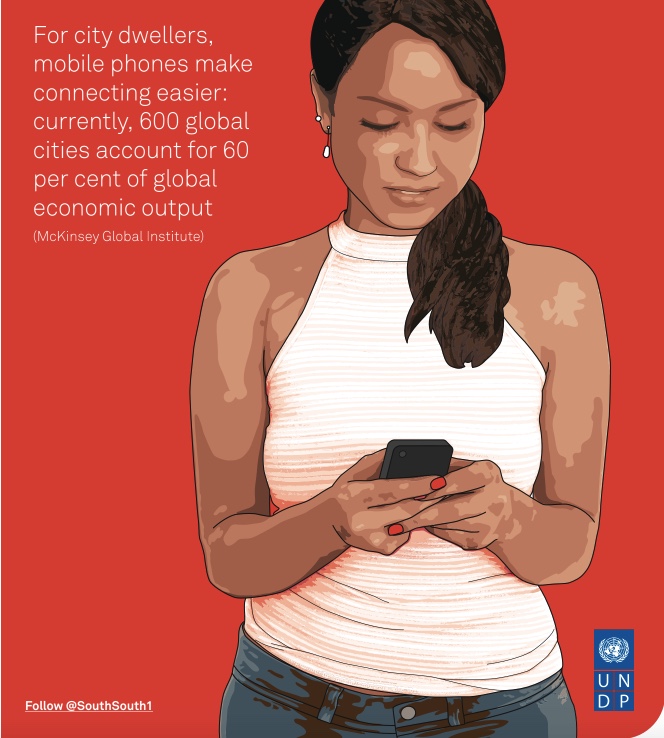
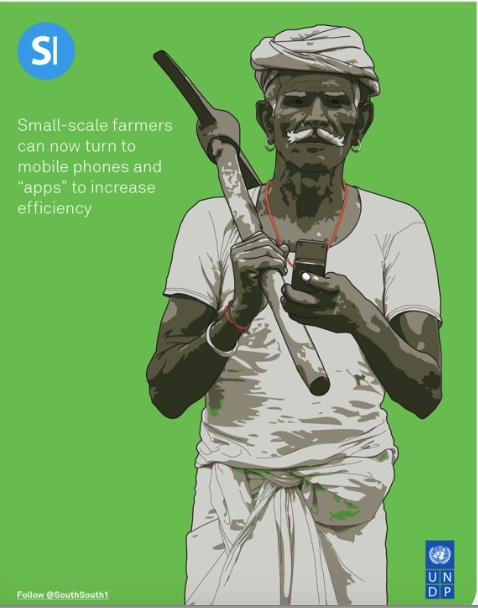
    Development Challenges, South-South Solutions was launched as an e-newsletter in 2006 by UNDP’s South-South Cooperation Unit (now the United Nations Office for South-South Cooperation) based in New York, USA. It led on profiling the rise of the global South as an economic powerhouse and was one of the first regular publications to champion the global South’s innovators, entrepreneurs, and pioneers. It tracked the key trends that are now so profoundly reshaping how development is seen and done. This includes the rapid take-up of mobile phones and information technology in the global South (as profiled in the first issue of magazine Southern Innovator), the move to becoming a majority urban world, a growing global innovator culture, and the plethora of solutions being developed in the global South to tackle its problems and improve living conditions and boost human development. The success of the e-newsletter led to the launch of the magazine Southern Innovator. 

    Creative Commons License

    This work is licensed under a
    Creative Commons Attribution-Noncommercial-No Derivative Works 3.0 License.

    ORCID iD: https://orcid.org/0000-0001-5311-1052.

    © David South Consulting 2023

  • Urban Youth: A Great Source of Untapped Growth

    Urban Youth: A Great Source of Untapped Growth

    By David SouthDevelopment Challenges, South-South Solutions

    SOUTH-SOUTH CASE STUDY

    The world’s growing urbanization means that a whole generation of youth will have a dramatically different life than their parents. The world’s 3.3 billion urbanites now outnumber rural residents for the first time (UNFPA’s State of the World Population 2007 Report). And the vast majority live in slums or periurban areas, places of sprawl, where public services are poor and housing conditions unhealthy. Most young people working in the urban informal sector live in slum areas: for example, 75 per cent in Benin in Africa, and 90 per cent in Burkina Faso, the Central African Republic, Chad and Ethiopia. Most of this work is just bare survival work: according to the International Labour Organization, approximately 85 per cent of all new employment falls into this category.

    Getting youth into quality work and earning more than enough simply to survive is critical to building a healthy society. Young people are bombarded every day with good and bad influences, and as UNFPA found in its Youth Supplement: Growing Up Urban, “the interactions with the urban environment can have an intense impact on the socialization of young people, exposing them to a multitude of influences as they develop, experiment, question, and assume roles in their societies.”

    It is predicted that over the next 10 years, 1.2 billion youths will enter the working-age population (UNFPA). But youth unemployment is a huge problem around the world. Unemployed young people make up almost half (43.7 per cent) of the world’s total unemployed (UNFPA). Young people aged 15 to 19 are more than three times as likely to be unemployed as adults. Young people are the future, a resource no society can afford to waste. If their innate energy and enthusiasm is tapped, countries can see significant economic growth.

    There are youth entrepreneurs who are defying the gloom and coming up with great business ideas. Five finalists for BBC Swahili’s regional entrepreneur competition – Faidika na BBC (Prosper with the BBC) – offer inspiration for youth across the South. Finalists from Burundi, Kenya, Rwanda, Tanzania and Uganda were selected for their bright schemes.

    The overall winner was 24-year-old Burundian student Ashura Kisesa for a plan to build commercial public toilets in the cities and towns of East and Central Africa. Ashura, who entered but failed to reach the Faidika na BBC finals last year, has 12 brothers and sisters and is studying for a degree in agronomy at Burundi University.

    “I am very happy to win the top prize in this competition,” she told the BBC. “The lack of public toilets throughout East and Central Africa is a major problem that needs to be addressed and I hope to make a difference with my business idea. My whole family wanted me to win and they really supported me which makes me especially proud. I cannot wait to get started with my business.”

    On June 26 in Kampala, Uganda, Kisesa was awarded US $5,000 to put towards her business.

    Kenyan national winner, 22-year-old Witness Omoga from Kakamega, wants to make identity cards for schools. Right now he works as a volunteer at his uncle’s photo studio, and hopes to get into Makerere University to pursue a degree in computer science. “I am very excited,” he said to the BBC. “I have never been number one in my life, but now I have emerged first in this competition.”

    The Rwandan winner is a pioneer in the growing field of biomass energy production. A 17-year-old student from Kigali, Rangira Aime Frederick, impressed the panel of judges with his idea to turn domestic waste into energy. The national winner for Tanzania is a private tutor from Dar es Salaam, Apolinary Joseph Laksh. A business education tutor, 23-year-old Apolinary’s idea is to produce charcoal from recycled materials to offer people in rural areas sustainable and affordable cooking fuel.

    Ugandan finalist, 23-year-old Dereick Kajukano, is in his last year at Kampala International University doing a degree in business administration. Dereick’s business idea is to make bags out of plastic trash. He was inspired by last year’s Faidika na BBC winner, David Ssegawa from Uganda: “When I heard him defend his proposal on air, I said to myself, why don’t I do it as well. That’s when it all started, and here I am.”

    Published: July 2008

    Resources

    • 2008 Global Youth Enterprise Conference: Designed as a participatory learning event, this conference aims to support youth enterprise and entrepreneurship programs and policies achieve greater effectiveness around the world.
      Website: www.youthenterpriseconference.org
    • KickStart is a South African project aimed at inculcating a culture of entrepreneurship among young people between the ages of 18 and 35, by promoting business awareness through training, providing grants as start-up capital and providing mentorship and assistance during the setting up phase of the business.
      Website: http://www.sabkickstart.co.za/
    • iDISC – the infoDev Incubator Support Center – is a virtual networking and knowledge-sharing platform for incubators and technology parks leveraging ICT to facilitate entrepreneurship and new business creation in developing countries.
      Website: http://www.idisc.net/en/Index.html
    • Climate Capital Network: this company offers strategic advice, intelligence and assistance with fundraising for low-carbon solutions around the world. They have 2,000 investors looking for projects to invest in.
      Website: http://www.climatecapital.net/
    • Global Entrepreneurship Week: the website for this event in November has many opportunities for youth entrepreneurs to connect with each other through social networking websites.
      Website: http://unleashingideas.org/welcome

    Follow @SouthSouth1

    Google Books: https://books.google.co.uk/books?id=waeXBgAAQBAJ&dq=Development+Challenges+February+2008&source=gbs_navlinks_s

    Slideshare: http://www.slideshare.net/DavidSouth1/development-challengessouthsouthsolutionsfebruary2008issue

    Southern Innovator Issue 1: https://books.google.co.uk/books?id=Q1O54YSE2BgC&dq=southern+innovator&source=gbs_navlinks_s

    Southern Innovator Issue 2: https://books.google.co.uk/books?id=Ty0N969dcssC&dq=southern+innovator&source=gbs_navlinks_s

    Southern Innovator Issue 3: https://books.google.co.uk/books?id=AQNt4YmhZagC&dq=southern+innovator&source=gbs_navlinks_s

    Southern Innovator Issue 4: https://books.google.co.uk/books?id=9T_n2tA7l4EC&dq=southern+innovator&source=gbs_navlinks_s

    Southern Innovator Issue 5: https://books.google.co.uk/books?id=6ILdAgAAQBAJ&dq=southern+innovator&source=gbs_navlinks_s

    Creative Commons License

    This work is licensed under a
    Creative Commons Attribution-Noncommercial-No Derivative Works 3.0 License.

    ORCID iD: https://orcid.org/0000-0001-5311-1052.

    © David South Consulting 2023

  • African Youth Want to do Business in Fast-growing Economy

    African Youth Want to do Business in Fast-growing Economy

    By David SouthDevelopment Challenges, South-South Solutions

    SOUTH-SOUTH CASE STUDY

    Africa’s growing economy is meeting head-on an optimistic young population keen to start businesses. At least that is what a new poll of African youth says, finding that one in five Africans between the ages of 15 and 24 without a current business wants to start one in the next 12 months.

    The Gallup surveys (www.gallup.com) of 27 African countries and areas also found young women were just as keen as young men to start a business.

    Throughout the decade of the 2000s, Africa experienced an average economic growth rate of 5.4 percent (World Bank) – a big gain from the poor growth rates of the 1980s and early 1990s.

    The turnaround in Africa’s economic growth prospects was the product of a number of trends and factors. One has been better policies and easier trade. Other factors include rising tourism, a growing service sector, rising commodity prices, greater demand for African exports in emerging economies and rapidly improving communications: the surge in mobile phone usage during the last five years has surprised many. Africans are also avid spenders on goods and services, spending US $860 billion on them in 2008, more than India’s US $635 billion or Russia’s US $821 billion (Economic Report on Africa 2011).

    The African Development Bank predicts Africa’s growth rate for 2011 will decline to 3.7 percent from 2010’s 4.9 percent, largely as a result of turmoil in North Africa. East Africa is projected to grow the fastest this year at 6.7 percent, with West Africa close behind at 5.9 percent.

    Africa as a continent collectively had a gross domestic product in 2009 of US $1.6 trillion: equal to Brazil’s or Russia’s. The continent is considered among the fastest-expanding economic regions in the world (McKinsey & Company).

    In fact, while economic prospects are grim in many developed countries, Africa joined Asia as the only continents to grow during this recession.

    But major problems still confront the continent, among them youth unemployment. Those between 15 and 24 make up more than 60 percent of the continent’s population and are 45 percent of the total labor force (African Economic Outlook). Sub-Saharan Africa is experiencing a youth explosion, with the proportion of youth there to rise to 75 percent of the population by 2015. Demographers forecast this rising youth trend will not stop for the next 20 years.

    Getting these youth actively engaged in the economy and society is a major challenge for the continent. Already, 133 million African youth are illiterate. They have few skills and are marginalised from more productive sectors of the economy.

    Even those with an education find their skills often don’t match the needs of the labor market. In sub-Saharan Africa, youth unemployment is believed to be 20 percent.

    So even with better economic prospects and growing economies and incomes, youth unemployment looms large.

    The Economic Report on Africa 2011 (www.uneca.org/era2011/) finds the “persistent high youth unemployment rate is a cause of concern and a potential source of political instability.” Job creation is still not adequate: “The growth rates are still below the levels needed to make a significant impact on unemployment and poverty reduction.”

    While Africa will experience higher growth in 2011, for youth it is looking like a “jobless recovery,” according to the report. Overseas investors are mostly throwing their money at the resource sector, which doesn’t create many jobs in the economy.

    But for young Africans looking to start a business, the opportunities are there in sectors such as retailing, telecommunications, banking, infrastructure-related industries, resource-related businesses, and all along the agricultural value chain.

    The booming communications industry has added 316 million new subscribers since 2000, for example. And all those people now connected need new services.

    And once a business is up and running, it is possible to make higher profits in Africa than on other continents, according to the UN. Africa leads the emerging market economies for returns for businesses. This is because competition isn’t as intense and there is still plenty of built-up consumer demand that needs to be met.

    All of this means young people willing to start a business and put in the hard work, will have a better chance of reaping the rewards.

    Published: July 2011

    Resources

    1) iHub Nairobi: iHub Nairobi’s Innovation Hub for the technology community is an open space for the technologists, investors, tech companies and hackers in the area. This space is a tech community facility with a focus on young entrepreneurs, web and mobile phone programmers, designers and researchers. It is part open community workspace (co-working), part vector for investors and VCs and part incubator. Website: http://ihub.co.ke/pages/home.php

    2) The Other Side of Innovation: Solving the Execution Challenge by Vijay Govindarajan, Chris Trimble: On how businesses need to follow through with execution if they really want to innovate. Website: http://hbr.org/product/baynote/an/13219-HBK-ENG?referral=00505&cm_sp=baynote-_-featured_products-_-13219-HBK-ENG

    3) “The Globe: Cracking the Next Growth Market: Africa” by Mutsa Chironga et al, Harvard Business Review. Website: http://hbr.org/2011/05/the-globe-cracking-the-next-growth-market-africa/ar/1

    4) 2011 Global Youth Economic Opportunities Conference: This 5th anniversary conference will provide a learning platform for the world’s leading funders, practitioners, technical assistance providers, policy makers, and academics working to increase and improve economic opportunities for young people. Join 400 professionals from over 60 countries to share lessons learned, promising practices, and innovative ideas through technical workshops, engaging plenary sessions, and interactive networking. The result? Higher-impact programming, breakthrough solutions, and proven approaches. This year’s theme, Breakthroughs, reflects the focus on the innovative ideas, proven practices, and visionary insights that are taking this emerging field to new heights. Website: http://www.youtheconomicopportunities.org/

    5) Dutch Design in Development: DDiD is the agency for fair design, sustainable production and fair trade. They work with Dutch importers and designers and connect them to local producers in developing countries and emerging markets. Together products are made that are both profitable and socially and environmentally sustainable. Website: http://www.ddid.nl/english/index.html

    6) Francophone Africa Hackathon: Taking place on 24 September 2011, a ‘hackathon’ to develop mobile phone applications will take place for Francophone Africans. Website: http://www.mobilehackaf.com/

    By 2012, Southern Innovator had completed its global reader impact study.

    Follow @SouthSouth1

    Google Books: https://books.google.co.uk/books?id=waeXBgAAQBAJ&dq=Development+Challenges+February+2008&source=gbs_navlinks_s

    Slideshare: http://www.slideshare.net/DavidSouth1/development-challengessouthsouthsolutionsfebruary2008issue

    Southern Innovator Issue 1: https://books.google.co.uk/books?id=Q1O54YSE2BgC&dq=southern+innovator&source=gbs_navlinks_s

    Southern Innovator Issue 2: https://books.google.co.uk/books?id=Ty0N969dcssC&dq=southern+innovator&source=gbs_navlinks_s

    Southern Innovator Issue 3: https://books.google.co.uk/books?id=AQNt4YmhZagC&dq=southern+innovator&source=gbs_navlinks_s

    Southern Innovator Issue 4: https://books.google.co.uk/books?id=9T_n2tA7l4EC&dq=southern+innovator&source=gbs_navlinks_s

    Southern Innovator Issue 5: https://books.google.co.uk/books?id=6ILdAgAAQBAJ&dq=southern+innovator&source=gbs_navlinks_s

    Creative Commons License

    This work is licensed under a
    Creative Commons Attribution-Noncommercial-No Derivative Works 3.0 License.

    ORCID iD: https://orcid.org/0000-0001-5311-1052.

    © David South Consulting 2023