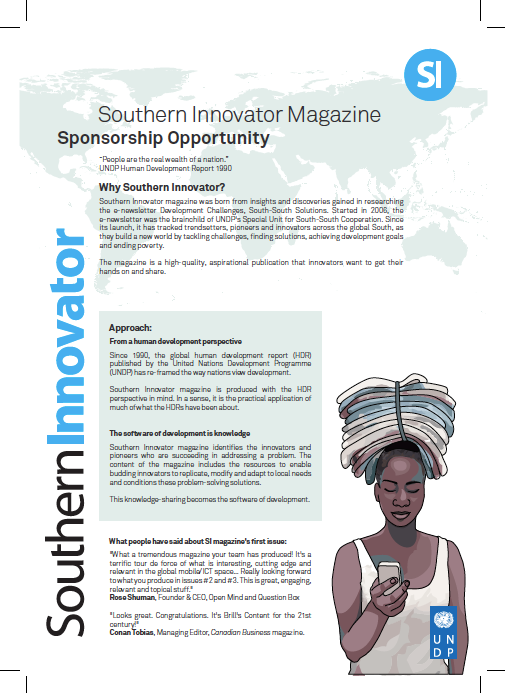
Category: Southern Innovator magazine

  • More Futuristic African Cities in the Works

    More Futuristic African Cities in the Works

    By David SouthDevelopment Challenges, South-South Solutions

    SOUTH-SOUTH CASE STUDY

    It has been well documented that China is undergoing the largest migration in human history from rural areas to cities. But this urbanization trend is occurring across the global South, including in Africa, as well. According to the UN, more than half the world’s population already lives in cities, and 70 per cent will live in urban areas by 2050. Most of the world’s population growth is concentrated in urban areas in the global South.

    These emerging urban areas represent vast opportunities for innovators. Innovators will be needed to build them, and in turn they will provide modern facilities for innovators to operate in and engage with the global economy. And they will connect innovators to 21st-century information technology.

    But while the government in China engages in significant planning and preparation to facilitate movements to urban areas – often building entire cities from scratch (http://www.time.com/time/photogallery/0,29307,1975397,00.html) – that has not been the case in Africa. People in Africa are on the move because they are seeking out opportunities, but much of this movement has been poorly planned and not well thought out.

    But now more and more African governments are grappling with how to call time on chaotic and haphazard development and build sustainable, planned cities that will significantly improve human development and quality of life.

    Across Africa, a host of ambitious new cities and urban developments are in the works.

    Kenya’s Konza Technology City (konzacity.co.ke) is planned as a new centre 60 kilometres from the capital, Nairobi. Calling itself a “world-class technology hub and a major economic driver for the nation”, it offers a high-tech vision full of ultra-modern buildings and houses in order to spur the future growth of Kenya’s technology industry.

    It is hoped Konza will create 100,000 jobs by 2030. There will be a central business district, a university campus for 1,500 students, a residential community, and parks and wildlife in green corridors.

    The groundbreaking ceremony occurred on January 2013 but the Kenyan Ministry of Lands and Housing has halted operations to allow for greater community engagement, according to Urban Africa. A dispute had erupted with the current landowners who wanted to be better consulted about the development and had accused the government of locking them out of the physical planning process.

    Tatu City, Kenya (tatucity.com) bills itself as “by Kenyans, for Kenyans”. It is being built by Rendeavour (rendeavour.com), the urban development division of Moscow-based Renaissance Group (rengroup.com), one of the largest urban developers of land in Africa. It joins Konza Technology City as a flagship project for the government’s Vision 2030, hoping to turn Kenya into a middle-income country and a role model for other countries in East Africa.

    Tatu City is 15 kilometres from Nairobi. It will take up 1,035 hectares and will be completed in 10 phases. Construction began in May 2012 and is scheduled to be completed by 2022.

    It is selling safety and a “beautiful urban environment” just a short journey away from Nairobi’s existing Central Business District. Tatu City wants to be “a model of the African city of the future” as a “dynamic mixed-use, mixed-income environment that will be home to an estimated 70,000 residents and 30,000 day visitors”.

    Just 25 minutes from Jomo Kenyatta International Airport, it promises to be one of “the most modern, well-planned urban developments in East Africa”.

    In Ghana, a number of innovative projects in development reflect the country’s impressive economic growth and information technology achievements in the past decade.

    Two cities are being designed by Rendeavour. One, Appolonia, is being built in the Greater Accra area while the second, King City, is being built on the west coast of the country where there is an oil and gas boom underway.

    Both will have houses, retail and commercial centres, schools, healthcare facilities and other social services.

    “Our objective is to provide the basic infrastructure, planning and necessary management framework in creating satellite cities that reverses the current trend of unplanned development and urban congestion in most of Africa’s growing cities,” Tim Beighton of Rendeavour told CNN.

    These projects are in an advanced stage, with all plans completed and approved by the government, according to their websites.

    Appolonia City of Light near Accra (appolonia.com.gh) – due to break ground in the third quarter of 2013 – capitalizes on Accra’s status as one of Africa’s fastest-growing urban areas. The Appolonia development will be a “planned, sustainable, mixed-use and mixed-income city” to build a “work-live-play” community for 88,000 people living in 22,000 homes.

    It will be built 30 kilometres northeast of Accra’s central business district and will have retail, commercial and industrial space combined with tourism, social and recreation facilities.

    King City in Takoradi (kingcity.com.gh) calls itself “Western Ghana’s new holistic city”. It will offer homes, shops, offices, industries and public places. The plan includes building 25,000 new homes and, importantly, over 30 per cent of the city will be allocated for green space. It will take up 1,000 hectares on the outskirts of Sekondi-Takoradi.

    Elsewhere in Accra, the Hope (Home Office People Environment) City (http://www.rlgghana.com/index.php/2013-02-07-11-25-04.html) is a much more ambitious concept. It is one of a cluster of projects in Africa focused on building the infrastructure for a 21st century, high-tech future. Costing US $10 billion, it will be built outside Accra and is focused on boosting Ghana’s already established reputation in the field of information and communications technology. It will be home to 25,000 people and create jobs for 50,000. There will be six towers including a 75-storey, 270 metre building that hopes to be the highest in Africa.

    It is being financed by RLG Communications, a mix of investors and a stock-buying scheme.

    There will be an assembly plant for high-tech products, business offices an information technology university, a hospital and restaurants, theaters and sports centres.

    The design is hyper-modern and tries to create a vertical office environment that is dense and reduces the amount of time it takes to get around and circulate between businesses in the complex.

    Eko Atlantic on Victoria Island in Lagos, Nigeria (ekoatlantic.com) is a coastal residential and business development that calls itself “The New Gateway to Africa”. To ease pressure in an already crowded city, it is being built on 10 square kilometres of reclaimed land from the Atlantic Ocean. It will be able to house 250,000 people and give work to 150,000.

    The story began in 2003 when the Lagos State government was looking for a solution to protect the Bar Beach area of the city from coastal erosion. Land is being reclaimed from the sea and it will make up an area the equivalent of Manhattan in New York City. Just like Manhattan, it is hoped Eko Atlantic will become the new financial centre for West Africa by the year 2020.

    Kilamba, or Nova Cidade de Kilamba (https://www.facebook.com/media/set/?set=a.231897596836631.80284.228497773843280), 30 kilometres outside Luanda, Angola is being built by the China International Trust and Investment Corporation (http://www.citic.com/wps/portal). It is on a vast scale and is designed to be home to 500,000 people with apartment blocks and commercial spaces. It has cost so far US $3.5 billion and is part of a government pledge to provide a million new homes within four years. Kilamba has come in for criticism for not being affordable enough for ordinary Angolans and for having much of the site unoccupied. With the apartments too expensive for ordinary Angolans, the government has decided to take action and ordered the prices to be reduced and made more affordable, according to Angola Press .

    La Cite du Fleuve in the Democratic Republic of Congo (lacitedufleuve.com) is  a more conventional luxury housing development built on two islands in the capital, Kinshasa. Kinshasa, despite its problems and the turmoil from an ongoing civil war, is one of the continent’s fastest-growing cities. Developed by Hawkwood Properties, La Cite du Fleuve will need to reclaim 375 hectares of sandbanks and swamps to be able to build a collection of riverside villas, offices and shopping centres. It is is planned to take 10 years to complete.

    And finally, Kigali, the capital of Rwanda, wants to transform itself into the “center of urban excellence in Africa”.

    The 2020 Kigali Conceptual Master Plan (http://www.kigalicity.gov.rw/spip.php?article494) hopes to create a regional hub for business, trade and tourism, by building a mix of commercial and shopping districts with glass skyscrapers and modern hotels, parks and entertainment facilities.

    Critics, however, believe these new cities and modern developments are tackling the problems of urban development by bypassing most of the population. They argue they are just developments for those with money who can buy their way out of the chaos and lack of planning of current African cities.

    “They are essentially designed for people with money,” Vanessa Watson, professor of city planning at the University of Cape Town, told CNN. She believes most of the plans are unsustainable “urban fantasies” detached from the reality of African poverty and informal living.

    But while it is easy to criticize these ambitious projects, they reflect not only optimism for the continent’s future but also a clear recognition the continent will not be able to get wealthier without modern cities and infrastructure in keeping with a 21st-century economy.

    Published: August 2013

    Resources

    1) Southern Innovator Issue 4: Cities and Urbanization: SI’s fourth issue goes to the many new cities under construction to build the new 21st century world emerging in the global South. Website: http://www.scribd.com/doc/133622315/Southern-Innovator-Magazine-Issue-4-Cities-and-Urbanization

    2) Urban Africa: Urban Africa is a digital entry point for knowledge sharing, interactive exchange and information dissemination on urbanization in Africa. Website: http://urbanafrica.net/

    3) Arrival City: A third of humanity is on the move. History’s largest migration is creating new urban spaces that are this century’s focal points of conflict and change — unseen districts of rapid transformation and febrile activity that will reshape our cities and reconfigure our economies. Website: http://arrivalcity.net/

    4) Global Urbanist: The Global Urbanist is an online magazine reviewing urban affairs and urban development issues in cities throughout the developed and developing world. Website: globalurbanist.com

    5) Africa Renewal: The Africa Renewal information programme, produced by the Africa Section of the United Nations Department of Public Information, provides up-to-date information and analysis of the major economic and development challenges facing Africa today. Website: http://www.un.org/africarenewal/

    Citations

    Cited in Beyond Gated Communities by Samer Bagaeen and Ola Uduku (2015).
    https://davidsouthconsulting.org/2022/02/09/african-megacity-makeovers-tackle-rising-populations/

    https://davidsouthconsulting.org/2022/10/19/chinese-building-solution-for-rapidly-urbanizing-global-south/

    https://davidsouthconsulting.org/2022/05/23/debt-free-homes-for-the-poor/

    https://davidsouthconsulting.org/2022/10/17/east-africa-to-get-its-first-dedicated-technology-city/

    https://davidsouthconsulting.org/2022/03/20/global-south-eco-cities-show-how-the-future-can-be/

    https://davidsouthconsulting.org/2021/11/12/global-souths-rising-megacities-challenge-idea-of-urban-living/

    https://davidsouthconsulting.org/2022/03/29/model-city-to-test-the-new-urbanism-concept-in-india/

    https://davidsouthconsulting.org/2017/11/08/smart-cities-up-close-2013/

    https://davidsouthconsulting.org/2022/09/26/3d-home-printing-landmark-10-houses-in-a-day/

    https://davidsouthconsulting.org/2022/11/17/tiny-homes-to-meet-global-housing-crisis/

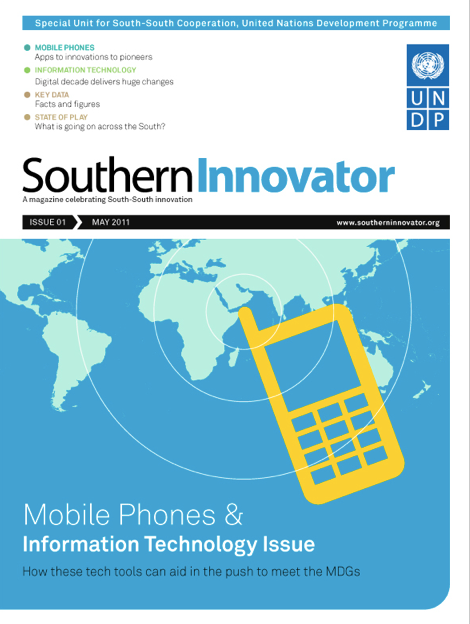
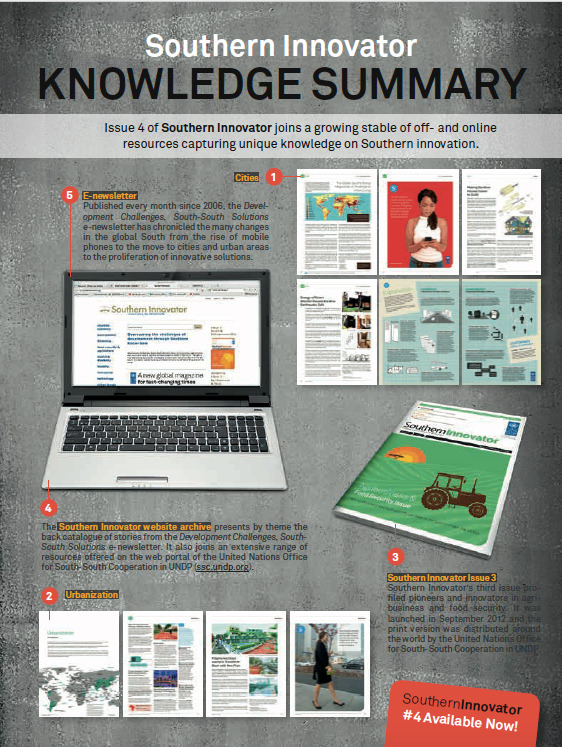
    Development Challenges, South-South Solutions was launched as an e-newsletter in 2006 by UNDP’s South-South Cooperation Unit (now the United Nations Office for South-South Cooperation) based in New York, USA. It led on profiling the rise of the global South as an economic powerhouse and was one of the first regular publications to champion the global South’s innovators, entrepreneurs, and pioneers. It tracked the key trends that are now so profoundly reshaping how development is seen and done. This includes the rapid take-up of mobile phones and information technology in the global South (as profiled in the first issue of magazine Southern Innovator), the move to becoming a majority urban world, a growing global innovator culture, and the plethora of solutions being developed in the global South to tackle its problems and improve living conditions and boost human development. The success of the e-newsletter led to the launch of the magazine Southern Innovator. 

    https://davidsouthconsulting.org/2021/03/05/southern-innovator-issue-4/

    Creative Commons License

    This work is licensed under a
    Creative Commons Attribution-Noncommercial-No Derivative Works 3.0 License.

    ORCID iD: https://orcid.org/0000-0001-5311-1052.

    © David South Consulting 2022

  • A Solution to Stop Garbage Destroying Tourism

    A Solution to Stop Garbage Destroying Tourism

    By David SouthDevelopment Challenges, South-South Solutions

    SOUTH-SOUTH CASE STUDY

    Tourism is an essential source of income for countries across the South. But many put that livelihood in jeopardy when they lose control of garbage collection. A popular tourist spot can represent a ‘paradise’ to visitors, but when it becomes too popular and local garbage collection systems collapse under the burden, ‘paradise’ can soon turn to an environmental hell.

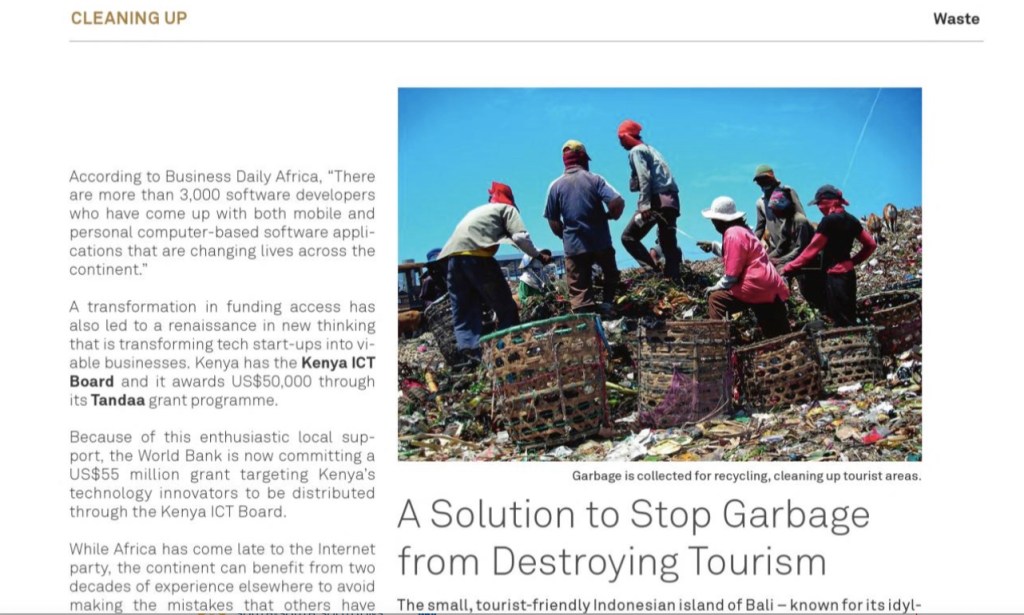
    The small, tourist-friendly Indonesian island of Bali (http://en.wikipedia.org/wiki/Bali) – known for its idyllic pleasures of spas, surf and serenity – is being overwhelmed by garbage. A survey of tourists found two-thirds would not return to the island because of the problem.

    Tourism took off on the island in the 1970s. The economic benefits are clear: the island went from being economically marginal to ranking second only to the country’s capital, Jakarta, in wealth creation. The island received more than 2.38 million tourists in 2009, up 14.5 percent compared with 2008, according to Ida Komang Wisnu, head of the provincial statistics office. But tourism produces on average five kilograms of waste a day per tourist – 10 times what the average Indonesian produces (Bali Fokus).

    In the past, the traditional way of serving food in Indonesia was to wrap it in, or serve it on, a palm leaf: a biodegradable approach. But with the huge expansion in use of plastics and non-biodegradable packaging, the waste disposal problem is out of control.

    In Indonesia, government garbage disposal services tend to collect between 30 and 40 percent of solid waste, most of this from high income communities. The majority poor population are left to fend for themselves when it comes to waste disposal.

    A solution by Yuyun Ismawati, an environmental engineer and consultant, has since 1996 focused on helping poor communities find ways to safely dispose of waste. In 2000, she started her own NGO – Bali Fokus (http://balifokus.asia/balifokus/) – and opened a waste management facility in the Bali village of Temesi. The recycling plant employs 40 people from the village, who sort garbage into recyclables, compost and residual waste. Income from the recycled waste and compost goes to helping local farmers.

    She then expanded her concept to include households around Bali and elsewhere in Indonesia. She concentrated on housewives and targeted reducing the amount of household waste going to dump sites. A core team trains housewives in daily habits that separate waste and compost organic matter like vegetable and fruit scraps. Bali Fokus claims it has been able to reduce waste created by 50 percent in 500 homes. Some of the women sell their compost in local markets; recyclables are turned into sellable items.

    From 2001 to 2003, Ismawati turned this approach into a replicable template called SANIMAS. By 2008, the SANIMAS template was being used in hundreds of communities across Indonesia.

    Her solution to the deluge of tourist waste can be seen in the luxury Jimbaran Bay area of Bali. Traditionally, the area’s hotels would sell their waste to pig farmers. While the pigs feasted on the fancy scraps, the rest of the waste was put in plastic bags and thrown away in mangrove forests.

    “I told hotels: Your job is to sell rooms, not to sell garbage,” Ismawati recalls. “We have to protect Bali or else tourists won’t want to come here anymore.”

    Ismawati cleverly turned the relationship around: rather than a pig farmer paying for scraps, she convinced one of them there was money to be made recycling and sorting garbage. For this, the hotels would pay the farmer.

    A network of 25 hotels now pays to have their garbage taken away and sorted by hand: an important source of full-time jobs.

    The workers sort through paper, plastics, glass, aluminium, food scraps and vegetables. Each week, 140 trucks deliver waste to the facility. Only 10 leave with waste that has to go to a dump site.

    Food leftovers are bought by local pig farmers and grass clippings and other organic matter is composted (http://www.recyclenow.com/home_composting/), and eventually makes its way back to the hotels and is distributed in the flower beds.

    This system has created 400 jobs where the pig farmer once only employed 10 people.

    “If you want a hi-tech solution in a developing country you will wait and wait and wait until you get the money, or big donors to fund it,” Ismawati told the Telegraph newspaper. “And even then it may not work.”

    A graphic example of this is a donated waste recycling machine given by the local government. It can’t be used because the electricity to power it costs too much. Human labour is a cheaper option.

    Bali Fokus’ successful approach has now been replicated in six other sites on the nearby island of Java. And the government of Indonesia has promised to help create 15 more each year.

    In 2009 Ismawati won the Goldman Award (http://www.goldmanprize.org/), which honors grassroots environmental heroes from the six inhabited continental regions: Africa, Asia, Europe, Islands and Island Nations, North America, and South and Central America.

    She is also working on using decentralized grassroots approaches to bringing sewage disposal and clean water to communities.

    Published: March 2010

    Resources

    https://davidsouthconsulting.org/2022/11/19/african-culture-as-big-business/

    https://davidsouthconsulting.org/2022/10/20/african-tourism-leads-the-world-and-brings-new-opportunities/

    https://davidsouthconsulting.org/2022/10/20/africas-tourism-sector-can-learn-from-asian-experience/

    https://davidsouthconsulting.org/2022/11/18/bolivia-grabs-world-media-attention-with-salt-hotel/

    https://davidsouthconsulting.org/2022/02/07/boosting-tourism-in-india-with-surfing-culture/

    https://davidsouthconsulting.org/2022/09/27/caribbean-island-st-kitts-goes-green-for-tourism/

    https://davidsouthconsulting.org/2022/11/20/ecotourism-to-heal-the-scars-of-the-past/

    https://davidsouthconsulting.org/2022/11/21/from-warriors-to-tour-guides/

    https://davidsouthconsulting.org/2022/11/11/havanas-restaurant-boom-augers-in-new-age-of-entrepreneurs/

    https://davidsouthconsulting.org/2022/11/15/indonesia-best-for-entrepreneurs/

    https://davidsouthconsulting.org/2022/11/01/indonesian-food-company-helps-itself-by-making-farmers-more-efficient/

    https://davidsouthconsulting.org/2022/11/15/indonesian-middle-class-recycle-wealth-back-into-domestic-economy/

    https://davidsouthconsulting.org/2021/06/11/indonesian-wooden-radio-succeeds-with-good-design/

    https://davidsouthconsulting.org/2022/11/23/kenyan-safari-begins-minutes-from-airport/

    https://davidsouthconsulting.org/2022/10/26/south-gets-reading-bug-with-more-festivals/

    https://davidsouthconsulting.org/2021/03/05/southern-innovator-issue-2/

    https://davidsouthconsulting.org/2021/03/05/southern-innovator-issue-5/

    https://davidsouthconsulting.org/2022/11/18/tourist-passion-for-quirky-holidays-helps-south/

    Development Challenges, South-South Solutions was launched as an e-newsletter in 2006 by UNDP’s South-South Cooperation Unit (now the United Nations Office for South-South Cooperation) based in New York, USA. It led on profiling the rise of the global South as an economic powerhouse and was one of the first regular publications to champion the global South’s innovators, entrepreneurs, and pioneers. It tracked the key trends that are now so profoundly reshaping how development is seen and done. This includes the rapid take-up of mobile phones and information technology in the global South (as profiled in the first issue of magazine Southern Innovator), the move to becoming a majority urban world, a growing global innovator culture, and the plethora of solutions being developed in the global South to tackle its problems and improve living conditions and boost human development. The success of the e-newsletter led to the launch of the magazine Southern Innovator.  
    Creative Commons License

    This work is licensed under a
    Creative Commons Attribution-Noncommercial-No Derivative Works 3.0 License.

    ORCID iD: https://orcid.org/0000-0001-5311-1052.

    © David South Consulting 2023

  • Bringing the Invention and Innovation Mindset to Young Kenyans

    Bringing the Invention and Innovation Mindset to Young Kenyans

    By David SouthDevelopment Challenges, South-South Solutions

    SOUTH-SOUTH CASE STUDY

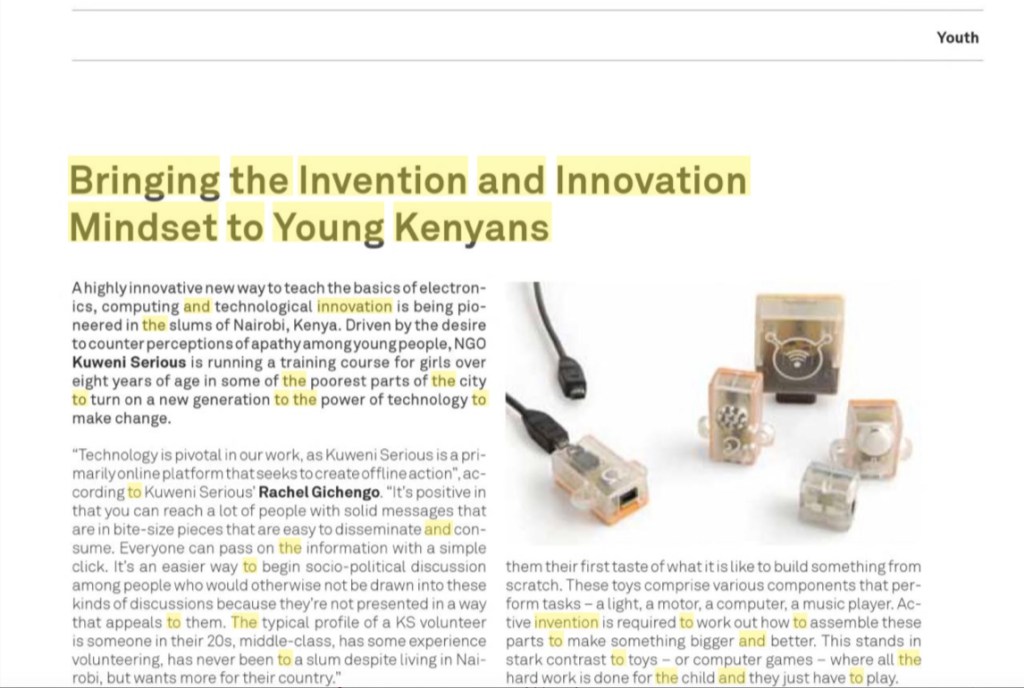
    A highly innovative new way to teach the basics of electronics, computing and technological innovation is being pioneered in the slums of Nairobi, Kenya. Driven by the desire to counter perceptions of apathy among young people, NGO Kuweni Serious is running a training course for girls aged over 8 years in some of the poorest parts of the city to turn on a new generation to the power of technology to make change.

    “Technology is pivotal in our work, as Kuweni Serious is a primarily online platform that seeks to create offline action,” according to Kuweni Serious’ Rachel Gichengo. “It’s positive in that you can reach a lot of people with solid messages that are in bite-size pieces that are easy to disseminate and consume. Everyone can pass on the information with a simple click – it’s an easier way to begin socio-political discussion among people who would otherwise not be drawn into these kinds of discussions because they’re not presented in a way that appeals to them. The typical profile of a KS volunteer is someone in their 20s, middle-class, has some experience volunteering, has never been to a slum despite living in Nairobi, but wants more for their country.”

    The course uses a clever, hands-on approach to teaching. Instructors use a new generation of learning toys that help young people understand how technology works and gives them the first taste of what it is like to build something from scratch. These toys comprise various components that perform tasks – a light, a motor, a computer, a music player. Active invention is required to work out how to assemble these parts to make something bigger and better. This stands in stark contrast to toys – or computer games – where all the hard work is done for the child and they just have to play.

    “We chose tech training because it’s a traditionally under-represented area when it comes to reaching this particular group (underprivileged girls), yet such an important set of skills to be taught in this day and age,” confirms Gichengo. “We want to expand these girls’ thinking – to get them interested in the possibilities of careers in science and tech, rather than perpetuate the idea that all they’ll ever do, based on their circumstances, is tailoring or dance. We hoped to open our girls’ worlds a bit, as well as link them to our Kuweni Serious community of volunteers.”

    Called PicoCrickets (www.picocricket.com), and manufactured by the Canadian Playful Invention Company (PICO), the toys were developed from research and ideas at the Lifelong Kindergarten group (http://llk.media.mit.edu/) at the MIT (Massachusetts Institute of Technology) Media Lab (www.media.mit.edu).

    “Pico Crickets are cool,” continues Gichengo. “They’re a fun way to learn to build things, to learn the connection between hardware and software, to begin to understand what computers can do. They make learning easy, and they make science seem accessible to a group that tends to see it as too hard for them. The kits were paid for by a grant from the Girl Effect (www.girleffect.org).”

    The MIT lab conducted intensive research into creative learning environments for children. One of the first fruits of this research was Lego Mindstorms (http://mindstorms.lego.com), kits that allow children to make and program their own robots.

    Inspired by this work, the PicoCricket places more emphasises on artistic expression. The company created the PicoCricket Kit (www.picocricket.com/whatisit.html) as a way to integrate art and technology to “spark creative thinking in girls and boys 8 years and older,” according to its website.

    A typical kit includes a central PicoCricket that a child then plugs in to various motors, sensors, lights and other devices to make something that can spin, light up or play music. It is intended to give free rein to both technological innovation and artistic expression.

    Kenya experienced violent rioting during the 2007 and 2008 elections. The shock of the events produced a number of initiatives to counter the violence and the social and economic disruption it has caused. One of the most well-known innovations, Ushahidi (www.ushahidi.com), a crisis-mapping platform, has been deployed around the world and led to many other new innovations.

    Kuweni Serious (www.kuweniserious.org) is also a result of this crisis. The NGO sets out to counter the stereotype of Kenya’s youth as a “hedonistic generation of brand-obsessed youth, moving from party to party in the night and congregating on Facebook during the day.”

    Kuweni Serious believes young people in Kenya were shocked into action when violence broke out during the elections. Prices jumped for everything – from fuel to food – and water and power started to be rationed. It was a wake-up call to youth: it was getting harder and harder to ignore what was happening in the country.

    Kuweni Serious was founded by Kenyan youth and asked the question “how do Kenya’s youth feel about all the chaos around us?” It seeks to rally young people to their motto: “Fighting the evil forces of apathy.”

    Their 125/100 program set out to train 125 girls on a 100-day course. It ended with a graduation ceremony on July 2, 2011.

    The program, run by volunteers from the University of Nairobi, has taught basic computer skills, got the children working on Google Maps and making – and inventing – using the PicoCrickets.

    The girls on the course came from Baba Dogo and Kibera, Nairobi’s largest slum.

    The technology training program lasted between three and six hours a week for 12 weeks. The inventions made by the children included merry go rounds, a lamp stand and fan and miniature automobiles. Participants even got to grips with Google Maps and learned how to use mobile phones in citizen journalism. At the end of the course, all the children received a certificate reinforcing their sense of accomplishment and achievement.

    “We hope to continue doing similar projects, scaling up 125/100, and working on developing a corps of everyday change makers among young, educated, middle class Kenyans,” according to Gichengo. “We’re also preparing for the 2012 elections, so we need to have more conversations about what a new election means, given the outcome of our previous one.”

    Another initiative seeking to improve life chances for Kenyan girls is ZanaAfrica (www.zanaa.org). It focuses on educational opportunities for girls, consulting them to find out what would increase their chances of graduation from school. Because of this back-and-forth dialogue with the girls, they have come up with various strategic programs, one example being providing girls with sanitary pads for menstruation (http://en.wikipedia.org/wiki/Menstruation) every month so that they do not skip classes and lose vital class time. ZanaAfrica was born around tackling the issue of lost school days for girls because of poor provision of sanitary pads in Kenya: an estimated 868,000 adolescent girls were missing 3.5 million school days a month, according to ZanaAfrica.  Sanitary pads in Kenya cost twice most people’s daily wage. Just to provide pads to all the school girls in Kenya, they estimated, would cost US $13 million a year, increasing by 5 percent every year.

    Another disadvantage for these girls is finding the right support environment and strong, positive role models. ZanaAfrica’s solution is Empowerment Clubs (www.zanaa.org/empowernet-clubs), places where small groups of 15 to 20 students meet with field officers and tackle difficult topics not discussed at home or in school: drugs, relationships, self-confidence, health and disease. There are already 1,000 students in the Kibera area in these Empowerment Clubs. This approach has also been combined with something called EmpowerNet Clubs: these clubs take place in the schools and combine blogging and tweeting (www.twitter.com) with the discussions on life issues. Already in five schools, the clubs include a field officer and 20 girls meeting once a week.

    ZanaAfrica was started in 2007 by social entrepreneur and Harvard University graduate Megan White, who has been living and working in Kenya since 2001. ZanaAfrica identifies poverty-eradicating, African-led innovations and then tries to build them up and find ways to replicate them and make them sustainable. They look for innovations in the areas of health, education and the environment.

    “Kenyans are definitely early adopters, and are rushing to take advantage of new technologies,” confirms Gichengo. “The Kenyan success stories have been a huge inspiration, largely because they developed localized solutions that could then be exported to the world, rather than the other way around, which tends to be the case. There’s always value in looking further afield to see what else is being done around the world, but the iHub and Ushahidi (and the Kenya ICT Board, Safaricom, etc.) have gone a long, long way in inspiring local innovation.”

    Published: July 2011

    Resources

    1) Make Magazine: “MAKE Magazine brings the do-it-yourself mindset to all the technology in your life. MAKE is loaded with exciting projects that help you make the most of your technology at home and away from home. We celebrate your right to tweak, hack, and bend any technology to your own will.” Website: http://makezine.com/

    2) Lego Mindstorms robot-making kits. Website:http://mindstorms.lego.com/en-us/Default.aspx

    3) Southern Innovator Issue 1: New global magazine celebrating innovation across the global South. Website:http://www.scribd.com/doc/57980406/Southern-Innovator-Issue-1

    4) iHub Nairobi: iHub Nairobi’s Innovation Hub for the technology community is an open space for the technologists, investors, tech companies and hackers in the area. This space is a tech community facility with a focus on young entrepreneurs, web and mobile phone programmers, designers and researchers. It is part open community workspace (co-working), part vector for investors and VCs and part incubator. Website:http://ihub.co.ke/pages/home.php

    5) Maker Faire Africa 2011: MFA 2011 continues to cultivate new and existing maker communities across Africa. As was the case in Accra (‘09) and Nairobi (’10), MFA 2011 will present and spotlight the vibrant and endlessly creative individuals that have come to represent the spirit of ‘making’ throughout the continent. These innovators, artists and tinkerers will be exhibiting a fusion of the informal and formal; ideas, inventions, hacks and designs both low-tech & high-tech.  From cuisine to machines, come see their re-imagining of products, exploration of novel materials, and original solutions for some of the continent’s most important challenges and opportunities. Maker Faire Africa 2011 will be a celebratory showcase of unhindered experimentation and curiosity. Website:http://makerfaireafrica.com/2011/06/09/maker-faire-africa-2011-cairo/

    6) Social enterprise (http://en.wikipedia.org/wiki/Social_enterprise): Learn more about the vibrant world of social enterprise and connect with others. Website: http://www.socialenterpriselive.com/

    Development Challenges, South-South Solutions was launched as an e-newsletter in 2006 by UNDP’s South-South Cooperation Unit (now the United Nations Office for South-South Cooperation) based in New York, USA. It led on profiling the rise of the global South as an economic powerhouse and was one of the first regular publications to champion the global South’s innovators, entrepreneurs, and pioneers. It tracked the key trends that are now so profoundly reshaping how development is seen and done. This includes the rapid take-up of mobile phones and information technology in the global South (as profiled in the first issue of magazine Southern Innovator), the move to becoming a majority urban world, a growing global innovator culture, and the plethora of solutions being developed in the global South to tackle its problems and improve living conditions and boost human development. The success of the e-newsletter led to the launch of the magazine Southern Innovator.  

    Creative Commons License

    This work is licensed under a
    Creative Commons Attribution-Noncommercial-No Derivative Works 3.0 License.

    ORCID iD: https://orcid.org/0000-0001-5311-1052.

    © David South Consulting 2023

  • A New Mobile Phone Aimed at the Poor

    A New Mobile Phone Aimed at the Poor

    By David SouthDevelopment Challenges, South-South Solutions

    SOUTH-SOUTH CASE STUDY

    A low-cost Venezuelan mobile phone aimed at the South’s poor is proving that South-South technological cooperation works. Packed with features and costing no more than US $15 – making it one of the cheapest mobile handsets in the world – the phone is aimed at the fast-growing mobile market across the global South.

    The South is a dynamic market and has seen quick acceptance of mobile phones. The number of mobile phone users in the world passed 4 billion in 2008, and the fastest growth was in the South (ITU). The development of inexpensive handsets means the phones will be able to reach even more poor people. And packing these phones with the latest in multimedia capability means the poor will be able to make a technological leap.

    The Venezuelan phone is being championed as the world’s cheapest mobile phone. It is a bold effort to create an affordable mobile phone packed with features: a camera, WAP internet access (wireless application protocol), FM radio, and MP3 and MP4 players for music and videos.

    The phone uses inexpensive parts from China and is assembled in Venezuela. A quarter of the cost of manufacturing the phone is subsidized by the government. Venezuela often uses the profits from its oil industry to subsidize social goals.

    The phone was launched on Mother’s Day by Venezuela’s president Hugo Chavez with a call to his mother. Chavez boasted to the Guardian newspaper: “This telephone will be the biggest seller not only in Venezuela but the world.”

    With his usual bravado, he said that “whoever doesn’t have Vergatario is nothing” – a statement that has become the marketing slogan for the phone on its website.

    The phone already has a waiting list of 10,000 people. The phones are assembled in western Venezuela by Vetelca, a joint state (85 percent) and Chinese (15 percent) company. Vetelca hope to make 600,000 phones in 2009, and to sell more than 2 million in 2011. Exports will first target the Caribbean and then the world.

    The desire to spark technological innovation at home is also alive in the Southern African country of Mozambique, which is making the bold move to start manufacturing computers for schools in the country. Like other African countries, Mozambique is connecting schools with computers and the internet. By manufacturing the laptop computers within the country, Mozambiquans are increasing the program’s economic benefit to the country, and building advanced technical skills.

    Most Southern African countries rely on importing computers, and Rwanda, South Africa and Ethiopia are getting their school computers from the OLPC (One Laptop Per Child) (www.laptop.org) initiative from the United States.

    The Mozambique laptops are call Magalhael (www.portatilmagalhaes.com) and are made in partnership with the Mozambican Ministry of Science and Technology (www.mct.gov.mz/portal/page?_pageid=615,1&_dad=portal&_schema=PORTAL) and Portugal Telecom (www.telecom.pt/InternetResource/PTSite/PT). They come with a 60 gigabyte (GB) hard drive and 2 GB of RAM (memory) and are entirely built in Mozambique.

    Read these stories on ICT4D from Development Challenges, South-South Solutions:

    Published: June 2009

    Resources

    • Google Android: Android is a software for mobile phones that allows people to create useful applications (apps) for the phones. Website: http://code.google.com/android/and www.android.com
    • Kabissa: Space for Change in Africa: An online African web community promoting and supporting the transition to Web 2.0 services in Africa. Offers lots of opportunities to meet people throughout Africa and learn more.Website: www.kabissa.org
    • Business Fights Poverty: Business Fights Poverty is the free-to-join, fast-growing, international network for professionals passionate about fighting world poverty through good business.Website:http://businessfightspoverty.ning.com/
    • BOP Source is a platform for companies and individuals at the BOP to directly communicate, ultimately fostering close working relationships, and for NGOs and companies to dialogue and form mutually valuable public-private partnerships that serve the BOP. Website:http://bopsource.ning.com/
    • Venezuelan Phone. Website: www.vergatorio.com

    Like this story? Please check out our first issue of Southern Innovator on mobile phones and information technology.

    Development Challenges, South-South Solutions was launched as an e-newsletter in 2006 by UNDP’s South-South Cooperation Unit (now the United Nations Office for South-South Cooperation) based in New York, USA. It led on profiling the rise of the global South as an economic powerhouse and was one of the first regular publications to champion the global South’s innovators, entrepreneurs, and pioneers. It tracked the key trends that are now so profoundly reshaping how development is seen and done. This includes the rapid take-up of mobile phones and information technology in the global South (as profiled in the first issue of magazine Southern Innovator), the move to becoming a majority urban world, a growing global innovator culture, and the plethora of solutions being developed in the global South to tackle its problems and improve living conditions and boost human development. The success of the e-newsletter led to the launch of the magazine Southern Innovator.  

    Creative Commons License

    This work is licensed under a
    Creative Commons Attribution-Noncommercial-No Derivative Works 3.0 License.

    ORCID iD: https://orcid.org/0000-0001-5311-1052.

    © David South Consulting 2023