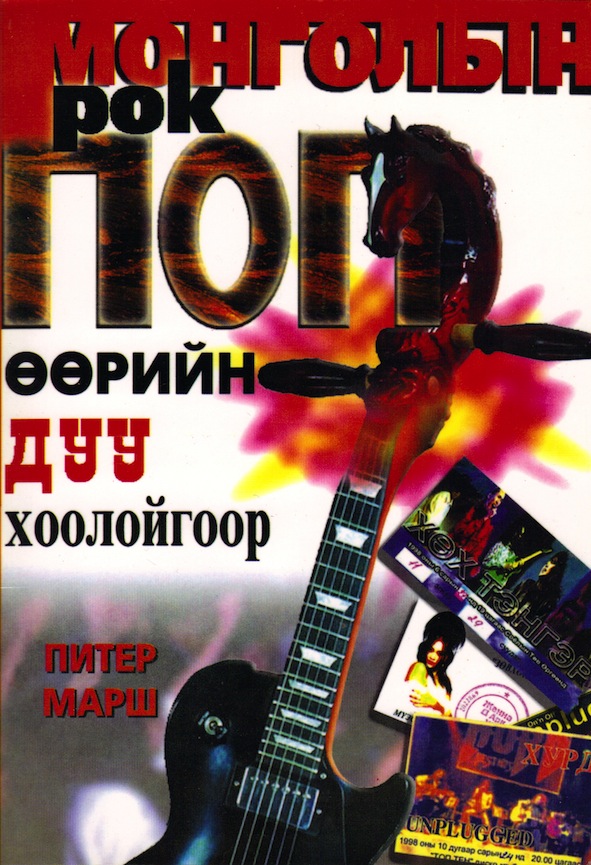
It was the late 1990s. Mongolia was still recovering from “one of the biggest peacetime economic collapses ever” (Mongolia’s Economic Reforms: Background, Content and Prospects, Richard Pomfret, University of Adelaide, 1994). But it was the country’s young musicians who were showing the way out of the crisis, setting an example for entrepreneurship in the new, free-market economy that emerged in the country after 1990.
As UNDP Communications Officer N. Oyuntungalag wrote in the Blue Sky Bulletin (BSkyB) newsletter, “A thriving pop and rock scene has emerged over the last four years. .. The energy of these musicians and singers has not gone unnoticed by the burgeoning advertising market. Pop bands are promoting many things, from face creams to beer. … [but] there has been little serious writing on the business of popular music.”
As the book’s author, American ethnomusicologist Peter Marsh, said in an interview with UNDP’s Blue Sky Bulletin newsletter, “we thought our book would provide important ideas about the direction and nature of the nation’s development.
“My impression about Mongolian pop-rock is that it is a lively, diverse and at times innovative Mongolian art form that closely reflects many of the hopes, fears and aspirations of its primary audience, Mongolian youth.”
The book still stands as an unusual and innovative contribution to thinking around the role played by youth in development and business and in crisis recovery.
Google Books Key Words: авдаг адил аль англи аялан байж байлаа байх байхад байхгүй бараг барууны бас бензин Бид нар бидний биз бизнес бий биш болох бөгөөд бусад бүжиг бүр бүтээлчид бүх гадаад гадаадад
Manila, Philippines – More than 2,500 delegates have gathered in the steamy hot Philippine capital to renew the fight against HIV and AIDS.
Working up a sweat alongside other participants at the Fourth International Congress on AIDS in Asia and the Pacific are nine Mongolians – a first that isn’t going unnoticed.
The Congress opened Saturday (October 25) to the pounding beat of a theme song performed by teenagers, championing defiance of death and celebration of life.
That tone was echoed by Dr Peter Piot, executive director of UNAIDS, the Joint United Nations Programme on HIV/AIDS. He said the epidemic can be slowed down with the right public health measures – a positive message for Mongolia as it grapples with an STD crisis that many believe leaves the country at risk of an HIV/AIDS epidemic.
The magnitude of that epidemic outside Mongolia is startling. Around the world, 23 million people are infected with HIV, the virus that causes AIDS. Between 5 and 7 million of them live in the Asia/Pacific region.
“The point is that prevention is feasible,” Piot told the Congress. “The results can be seen in those countries in the Asia-Pacific region where the epidemic has stalled or is in retreat.
“A good indicator for unsafe sexual behaviour is the STD rate. I am impressed at the sustained decline in STD rates in Australia, Hong Kong, Singapore and Thailand over the past decade.
“But I am concerned actual declines in HIV in this region have occurred only in Australia, New Zealand and Thailand.”
The countries to Mongolia’s immediate south and north are experiencing exploding health crises. In China, HIV/AIDS is increasing at a rapid rate due to factors including growing prostitution, drug use and travel – all by-products of a booming economy. The infected population is estimated at 400,000 and is expected to reach 1.2 million by the year 2000, according to China’s national AIDS committee.
To the north in Russia, a complete collapse in the public health system has dramatically slashed life expectancy and led to an upsurge in many diseases, including tuberculosis and HIV/AIDS.
With many Mongolians doing business in both these countries, there are numerous opportunities for AIDS to enter the country.
A wide range of topics is under discussion at the gathering, with women, youth and STD-control measures of particular interest to the Mongolian delegates.
For the Mongolians, the Congress is an opportunity to learn from other countries’ successes and failures in the fight against AIDS.
Mongolia’s nine-member delegation includes four doctors – Dr K. Davaajav, head of the AIDS/STD Department of the Research Centre for Infectious Diseases, Health Ministry representative Dr S. Enkhbat. Medical University director Dr Lkhagvasuren and Dr Darisuren from the United Nations Population Fund.
Also in the team are Democrat MPs B. Delgermaa and Saikhanbileg, UNICEF’s B. Bayarmaa and two representatives from women’s NGOs: S. Tsengelmaa from the Women’s Information and Research Centre and N. Chinchuluun, executive director of the Mongolian Women Lawyers Association.
On Sunday, several presentations focused on the difficulties of getting people to use condoms.
In Fiji, studies found the majority of the population was aware of AIDS and had access to condoms, but still chose not to use them.
Lisa Enriquez, a Filipino woman who is HIV-positive, gave a sobering speech on the epidemic.
“One of the most important things I’ve learned from the epidemic is human nature. AIDS is such a humanizing disease. It reminds us of being human, complete with all the weaknesses and imperfections of being human.
“Let us not kid ourselves: changing behaviour is not easy. One doesn’t change because somebody tells him or her to do so.
“We will need to get our act together, institutionalize our efforts and continue working harder with passion and perserverance.”
“The Fourth International Congress on AIDS and Asia in the Pacific convened 3,000 scientists, people working in the communities, and people living with HIV/AIDS to discuss the state of AIDS in Asia and the Pacific and how the problem is being addressed now and into the future. The following topics addressed at the Congress are explored: the extent of the HIV epidemic, HIV risk behaviors, women and HIV, clinical manifestations of HIV infection, antiretroviral therapy, and perinatal HIV transmission. HIV is spread differently among these countries and a nation’s wealth largely determines its ability to execute prevention programs and patient access to therapy. Most patients in Asia pay for their own medications. It is hoped that more prosperous and technologically advanced nations will demonstrate stronger leadership and commitment in the fight against AIDS in the region.” Phanuphak P. Fourth International Congress on AIDS in Asia and the Pacific. J Int Assoc Physicians AIDS Care. 1998 Feb;4(2):22-5. PMID: 11365085.
Manila, Philippines – Since HIV is contracted through sex, the disease has always been a difficult subject for the world’s religious leaders. When there is sex to be discussed, no religion can do it without bringing up morality.
This moral debate about bedroom behaviour has tainted discussion of AIDS in many countries. At the extreme end of the spectrum, some evangelical Christian leaders in the US have painted AIDS as an apocalyptic disinfectant for humanity.
Not surprisingly, this attitude has not helped in educating the faithful that AIDS can happen to anyone and its victims should be treated like any other ill person.
The Philippine conference heard that the standoff between the world’s leaders and public health authorities must stop. Dr Peter Piot, executive director of UNAIDS, pointed to the numerous delegates from the world’s religions and called on others to follow their example.
“In Myanmar, the Myanmar Council of Churches, the YWCA and other community-based organizations have joined hands with local authorities, health workers and Buddhist groups for community-based prevention, care and support programmes,” he told the assembly.
“This is the best practice in action.”
Mongolian delegate Dr Altanchimeg thinks a similar approach could work in this country.
“Now every Mongolian goes to see lamas. It’s a good channel to advocate for AIDS education. In Thailand, lamas are very experienced at this. People believe in lamas.”
Like their colleagues in Thailand and Myanmar, Cambodian lamas have been in the forefront of AIDS education.
Lamas there use festivals and ceremonies to raise the issue.
You Chan, a 30-year-old lama from Tol Sophea Khoun monestary in Phnom Penh, likes to raise the issue delicately, by referring to diseases in Buddha’s time.
“I feel it is difficult to speak about sexual methods with a large audience – I will not speak to sexual methods.
“At first, it was very difficult. People would ask why a monk would say such things. But I tried and tried and the people understood who is helping them.
“My message to Mongolia’s lamas is this: you have a moral responsibility to educate the people about AIDS, that it is happening all around the world and there is no medicine to cure it.
“You have to take care in the name of Buddhism to help people in this world.”
You Chan teaches lamas at 15 temples in Cambodia, who pass the message along to other lamas and congregations.
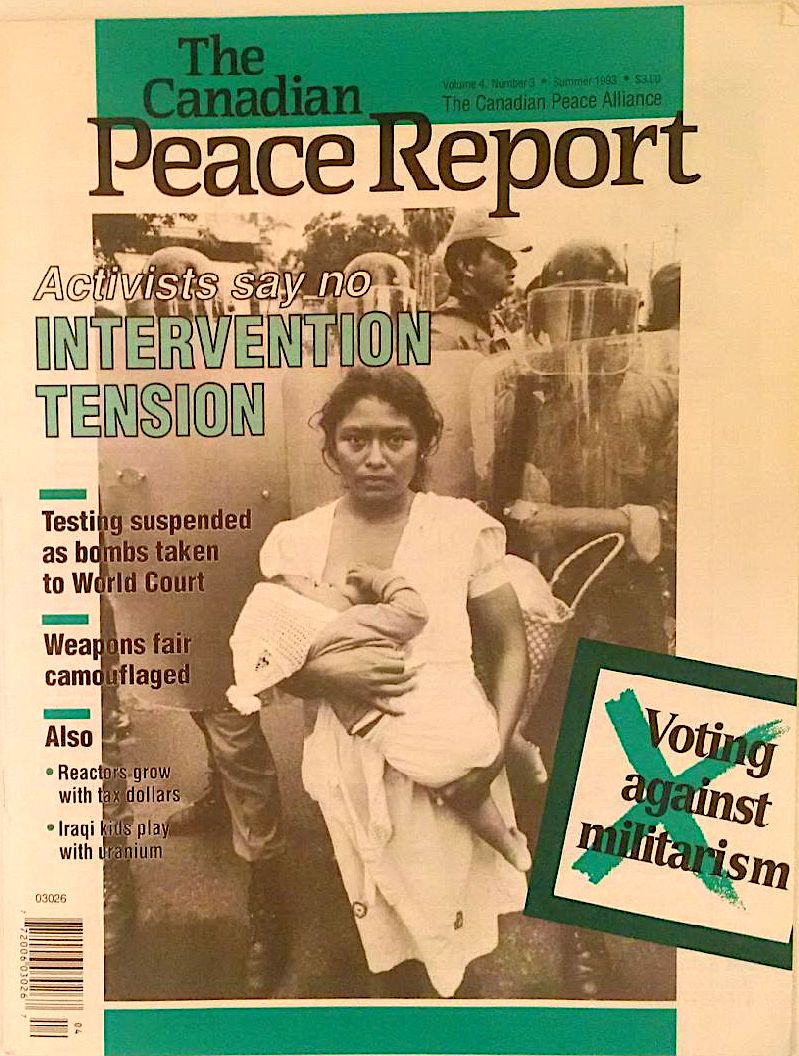
More than 80,000 people swarmed Parliament Hill on May 15 at an Action Canada Network and Canadian Labour Congress rally against free trade and other federal policies. In a paper issued just before, the Canadian Centre for Policy Alternatives criticizes Canadian military spending as “carried over from a cold war that no longer exists. At the same time, our assistance to poor nations is actually falling.”
When a federal election is called, peace groups across Canada plan to be heard. They see the defence department’s $11.3-billion yearly budget – amidst cuts to social programs and calls for even more restraint – as ripe for a hot election battle over government priorities.
A recent Gallup poll conducted for the Canadian Peace Alliance found broad support across all political allegiances for cutbacks to military spending. The CPA also wants daily life demilitarized, with duties like search and rescue turned over to civilian agencies.
Local groups are mostly awaiting a date for the election, expected about late October, but national groups are already planning. Some groups will fight the Conservative Party’s backing of the North American Free Trade Agreement (NAFTA), which they fear will lead to further military integration of Canada and the United States.
The Peace Alliance is working on action and information kits targetting military spending versus social needs, and is developing an election logo. It’s also building up to a national action day.
The idea is to stimulate local and regional activity, coordinator Gideon Forman says. “Kits will help member groups organize actions during the election campaign. They will have information on, among other things, the plan to buy deluxe helicopters, military spending in general and the cost of social needs.
“We will give local groups suggestions for local events and assist with media work.”
Project Ploughshares has produced a short booklet of questions to ask candidates, “but not a repeat of the Election Priorities Project” of the 1988 election, says researcher Bill Robinson. The booklet suggests calling for cuts in military spending, cancelling the EH-101, limiting Canada’s participation in military operations, and abolishing nuclear weapons.
Also nationally, the Action Canada Network (to which the Peace Alliance belongs) met with groups from across the country in Winnipeg in mid-June to finalize election plans, which may include a radio ad campaign. National chair Tony Clarke would like local activists to dog the party leaders across the country, as progressive groups did to Ontario’s Liberals during the province’s 1990 election.
“We will definitely make the link between a range of issues and the (Canada-U.S.) Free Trade Agreement and NAFTA, which we have to get rid of,” says Clarke. “We will be working very hard on jobs and arguing for a job strategy.”
Responding to the Gulf War two years ago (Action Canada Dossier #30), Clarke warned that Canada is “tied in closer than we have ever been before to the permanent war economy” of the U.S.. With a quarter of its output related to the military, the U.S. used militaristic diplomacy to justify maintaining defence budgets, he says. The trade agreements’ guarantees of U.S. access to Canadian energy resources confirm that “we are locking ourselves into what can only be described as Fortress North America.”
Maude Barlow of the Council of Canadians, a network ally, denounced the helicopter purchase during the Peace Alliance’s March 8 lobby of Parliament. Soon after, then defence minister Kim Campbell appeared to waver on the number of helicopters to be bought, but succeeded in winning the Tory leadership without it becoming a major issue. However, Liberal leader Jean Chretien promises to cancel the contract.
At CUSO’s national office, Marc Allain says the development agency will work with the CPA around military spending and the ‘copter purchase.
To Peter Davison of the Halifax Peace Action Network, the stakes are clear and the passion to fight the issues simply awaits a polling date.
“Never has the guns-or-butter issue been more prominent in our society,” says Davison. “Conservative economic policies have been collapsing around the globe. We’re seeing desperate restraint and universal trusts being violated – health care, education, pensions.
“It’s bizarre that we can still conceptualize $6 billion for helicopters to fight submarines – an absurd twist away from meeting human needs.”
Terry Gardner says Science for Peace’s mandate bars entering the election fray, but says the group is planning a high-level panel in the fall on NAFTA and militarization of Canadian culture.
“We’re going to be asking candidates in our area for conversion and reduction in military spending,” says J.J. Verigin of the Doukhobour peace and disarmament committe in British Columbia. He says his MP has been supportive of chopping the choppers.
Verigin found fact sheets helpful and says the CPA does a good job of getting out beyond the urban areas. But he would like the Alliance “to propose something that engages the electorate’s intellect as the gut.”
“We have a general intent to intervene in the election, but we’re not quite clear exactly how,” says North Bay Peace Alliance organizer Brennain Lloyd. “We’re considering a regional information package, something like the Election Priorities Project, that our groups could use.”
Being armed with the facts helps reach the public and pins down candidates, Lloyd says. She applauds the CPA’s idea of producing action kits that her group could integrate into its own.
Toronto’s ACT for Disarmament won’t be working specifically on the election, but may participate in actions, says organizer Maggie Helwig. “Groups have certain things they focus on, and certain ways of operating. Other people do better at elections.”
In Montreal, Judith Berlyn of Westmount Initiative for Peace says, “We will be doing locally what has been developed by the Canadian Peace Alliance as a whole – go to all-candidates meetings, get the mike and ask the questions. We will be raising issues. Last time our candidate had never heard of low-level flying.”
Berlyn feels many people, including activists, often think they don’t know enough to speak publicly. But with information kits, “we know more than the candidates do.”
While approving the CPA’s focus on military spending, Berlyn says it would be a mistake to over-emphasize the helicopters. “Everybody has [already] picked up on that; it’s a good concrete example of insane military spending.”
She also finds the public receptive to informative and succinct pamphlets advocating alternatives to a militarized economy. A Coalition to Oppose the Arms Trade pamphlet is a good model, she says.
“It has four concrete proposals of what the government can do to convert military industries – money that now goes to subsidizing the manufacturing of weapons can be turned into conversion subsidies.”




 David South Consulting
You must be logged in to post a comment.