Category: Blogroll

  • U.S. Elections Update: Clinton is using Canada to keep control of Haiti

    U.S. Elections Update: Clinton is using Canada to keep control of Haiti

    By David South

    Id Magazine (Canada), October 31 to November 13, 1996

    Canadian troops are not only on the frontline of peacekeeping in Haiti but also the frontline of U.S. foreign policy – a policy that is unravelling during the run-up to the November 5 presidential election. While the living standards of Haitians in the poorest country in the Western Hemisphere continue to decline despite free elections, Canadian troops are charged with keeping the island nation peaceful. It’s a task that is proving more and more difficult as Haiti suffers a crime wave and violent political unrest. 

    While American president Bill Clinton tries to snatch another victory from a grumpy U.S. electorate, his advisors are desperately trying to keep the lid on his foreign policy “victories” in Bosnia and Haiti. 

    Things are so bad, Clinton sent his secretary of state, Strobe Talbott, and his national security advisor, Anthony Lake, to Haiti on August 30 in response to high-profile assassinations of right-wing leaders. 

    “The administration are hoping, with fingers crossed, nothing will happen before November 5,” says Larry Birn of the Washington-based Centre for Hemispheric Affairs. “What the United States would like to do is cryogenically freeze all its foreign policy engagements so they don’t produce any problems. But we are losing very valuable time in Haiti because of Washington’s paralysis over negative developments occurring there. 

    “Washington didn’t realize an economic success story had to be bred there in a couple of years. The USAID programme is a scandal waiting for an investigation.”

    There is also another election-year factor: Republicans are not fond of anything that whiffs of a humanitarian approach to Haiti. Since they dominate Congress, this is also Clinton’s problem. 

    Given the history of American support for dictatorships in Haiti, the Clinton administration has chosen a low-key approach. After the 1994 invasion, the Americans pulled out the vast majority of their troops within a year, handing over responsibility for internal security to a UN peacekeeping force. But the U.S. never fully cut itself off from interfering in Haiti, keeping a military base operating in the country’s only industrial park in Port-au-Prince. 

    And Canada is key to U.S. plans because of that sour legacy. Canadians are seen as free from the burden of colonialism, and as a plus, our 700 mostly French-speaking troops can communicate better with the local population. 

    This policy has gone as far as hiring a Canadian public relations company to promote structural adjustment programmes that are conditional upon Haiti receiving any foreign aid from the International Monetary Fund and the World Bank, both based in Washington. 

    Gilles Morin is co-ordinating manager for Montreal firm Gervais-Gagnon-Covington Associates, who won the contract. Morin says, while his company did win the contract, like many other things to do with Haiti, they have heard nothing since Fall 1995 because of disorganization.  

    “On a personal basis there was a strong anti-American feeling among the population because of the past,” says Morin. “A lot of the financial institutions are based in Washington and they needed international support because banks in Washington are seen as American.”

    But there is a risk that a switch in U.S. priorities during the heat of an election will endanger Canadian troops.

    “If the president feels he has political risk in Haiti, he’s not going to take Canadian concerns into consideration,” warns Birns. “The UN mission gets caught up in the wake of U.S. efforts and it’s not able to define an independent course. Right now, the problem really is the USAID mission in Haiti is a total failure. The international donor function, you couldn’t exaggerate how disappointing it’s been in terms of almost no relief. The unemployment rate of 80 per cent is exactly what the unemployment rate was when the UN arrived.”

    On August 28, American troops from the 82nd Airborne plopped down on the streets of Port-au-Prince to spend a week patrolling. Many observers questioned the motives for this intervention. Was it to say to Haitians the UN isn’t the real deal, and if they get out of line, the Americans will kick their butts? Why doesn’t Canada protest the U.S. undermining the credibility of our peacekeeping mission?

    To Birn, sending in the 82nd was the foreign-policy equivalent of fast-food. “Sending in the 82nd Airborne merely aimed at getting a one-day headline,” he says. “The administration’s position has been staked on the fact there has been a number of foreign policy wins. But each of these victories is held together by corn starch and could unravel at any moment.”

    Birn sees an escalation in political violence just around the corner. He fears the current economic crisis will help the formation of a violent left-wing guerrilla movement to rival existing right-wing paramilitaries. 

    “Without former president Jean Bertrand Aristide,” he explains, “there is growing apprehension that president Rene Preval will not be able to project a sufficient leadership to keep the average Haitian, who is sacrificing with no expectation of an improved standard of living, happy.”

    While it has been almost two years since Haiti was the media’s darling, observers point out the cycle of violence has returned to the country’s streets despite the presence of UN peacekeepers and American troops. 

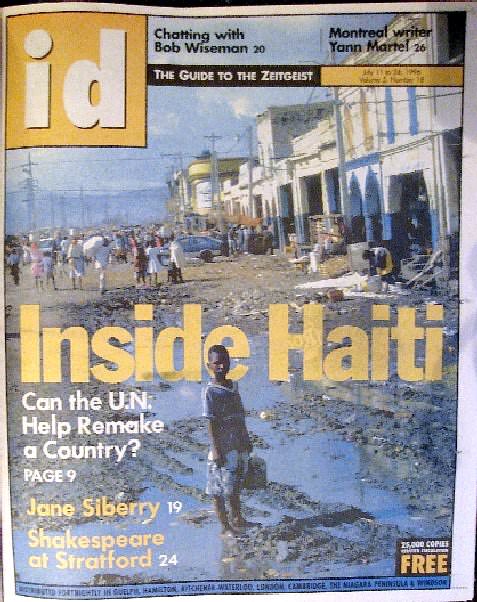
    When id reported from the Haitian capital of Port-au-Prince in July (id July 11 to 24, Number 18), it was obvious no progress had been made to improve the standard of living or rebuild the country’s crumbling infrastructure. 

    In an ironic twist, attempts to step up deportations of Haitian-Americans convicted of crimes in the U.S. has led to an increase in killings in Haiti according to the October 22 issue of New York weekly, The Village Voice

    More and more, the UN troops are propping up an increasingly unpopular government. A government that is seen by many Haitians to be getting its orders from Washington, not Port-au-Prince. Canadian troops lead the UN mission in Haiti and make up 700 of the 1500 soldiers stationed there (the rest are from Pakistan and Bangladesh).

    There is a serious danger Canadian troops will be caught in the crossfire of any uprising or coup attempt, since Canadian troops shadow president Rene Preval 24 hours a day and also guard the National Palace, which was attacked August 20, killing two Haitians.

    “U.S. Elections Update: Clinton is using Canada to control Haiti”.

    Read a 1996 report on the UN mission in Haiti here: State Of Decay: Haiti Turns To Free-Market Economics And The UN To Save Itself 

    ORCID iD: https://orcid.org/0000-0001-5311-1052.

    © David South Consulting 2021

  • Aid Organization Gives Overseas Hungry Diet Food: Diet Giant Slim-Fast Gets Tax Write-Off For Donating Products

    Aid Organization Gives Overseas Hungry Diet Food: Diet Giant Slim-Fast Gets Tax Write-Off For Donating Products

    By David South

    Now Magazine (Toronto, Canada), December 2-8, 1993

    Doling out diet supplements to recipients of food aid may sound bizarre, but that’s what US diet giant Slim-Fast has been doing.

    The company’s cans of powder have been distributed to the conflict-ridden former Soviet republic of Georgia and other parts of the collapsed Soviet Union by the aid agency Americares.

    Critics say Slim-Fast is far from appropriate and is, at best, in bad taste. New York-based food-aid critic and writer Michael Maren says such contributions are simply the result of agencies being used as dumping grounds for tax write-offs.

    As an example, he cites Somalia, where he recenly spent time researching an upcoming book critical of aid programs. Pharmaceutical firms, he charges, are dumping unnecessary drugs in that country.

    “If you want to help people, give them what they need, not the crap we have around here. That a so-called aid agency would bring over Slim-Fast is absurd.

    “The attitude that they should take any shit we give them – it’s arrogance,” says Maren, who believes many donors have a beggars-can’t-be-choosers attitude to people in need of help.

    At Slim-Fast’s corporate headquarters in New York, Adena Pruzansky acknowledges that the donations are tax write-offs, but insists that their product is very nutritious. No one, she says, has complained about their contribution.

    Powdered cure

    “If you look at our powdered products, there is a lot of nutrition in there. Certainly for people who don’t have food, this is something that could be useful to them.”

    A spokesperson for Connecticut-based Americares, which directs surpluses donated by 1,100 firms to relief operations in 80 countries, praises Slim-Fast.

    “They are a fine group of humanitarians,” says Elizabeth Close.

    “Americares was just written up in Money magazine as the most cost-effective nonprofit agency,” she says of the organization, whose donations consist of overstocked, discontinued or obsolete items.

    “We only accept a product for donation when we know we have a home for it. So we are not giving something inappropriate,” she says.

    Close provides no details, however, about Slim-Fast’s participation. “Without their permission, I’m not really supposed to go into any further description of what they donated,” she says.

    But those who see the devastating effects of eating disorders on women say Americares exercises poor judgement when it accepts such diet supplements.

    “I think it’s quite bizarre,” says Merryl Bear of the National Eating Disorder Information Centre. “Many of these diet plans are starvation diets. In many of the diets, the caloric intake is less than or equivalent to what the Nazi concentration camps delivered.”

    Slim-Fast’s chocolate drink powder, for instance, is made of skim milk powder, sugar, whey powder, cocoa, fibre, calcium caseinate, corn oil, fructose, lecithin, salt and carrageenan. It relies on mixing with milk to gets its nutrition.

    Lynne Martin of the Toronto Hospital’s eating disorder clinic says Americares is encouraging dieting among starving people who need calories first.

    “Women need a minimum of 1,800 to 2,100 calories per day – to meet that requirement with Slim-Fast, you would need eight glasses per day,” she says.

    Low calories

    Martin says the low calories available in the supplement become even lower if recipients don’t have access to milk and try to mix it with water.

    “The protein level isn’t given without the milk, so you don’t know how much is in the powder, but certainly the calories would change if one were to mix it with water.”

    At food relief agency CARE in Ottawa, program officer Ivan Connoir says what “the hungry need isn’t Slim-Fast but what is called a human daily ration (HDR).

    “It is prepared in the United States especially for emergencies. It has no pork, so it can go to any country,” he says. “It is a kind of lentil stew and vegetable soup – just add water and it’s ready to eat. You even find bread in it. It can last for years.

    “Of course the best thing is family food parcels that last one month.”

    Now Magazine (Toronto, Canada), December 2-8, 1993.
    Creative Commons License

    This work is licensed under a
    Creative Commons Attribution-Noncommercial-No Derivative Works 3.0 License

    ORCID iD: https://orcid.org/0000-0001-5311-1052.

    © David South Consulting 2022

  • Creating Green Fashion in China

    Creating Green Fashion in China

    By David SouthDevelopment Challenges, South-South Solutions

    SOUTH-SOUTH CASE STUDY

    China is the world’s largest manufacturer (Euromonitor) and the largest clothing maker, producing a quarter of all textiles and clothing. It is a global fashion production hub, and many major global clothing brands have their products made there – whether they admit it or not.

    Although most people probably do not give it a second thought, the fashion and clothing industries can be highly polluting and exploitive. The use of toxic fertilizers to boost cotton yields leaves behind a legacy of contaminated soil and water tables. Dyes used to colour clothing also can be toxic and pollute water. For people working in this industry – many of whom are women – conditions can vary widely and include low pay and high stress.

    According to the Ethical Fashion Forum, “it is difficult for companies sourcing from China to be sure of fair working practices. There have been many reports of low wages, long hours, and unfair working conditions in factories in China.”

    But one innovative fashion brand is out to transform the way the garment business works in China and to develop a template that could be used in other places such as Africa.

    The design duo of Hans Martin Galliker and Amihan Zemp has set up their clothing brand’s studio in one of Beijing’s historic hutong (alley) neighbourhoods – narrow streets of low-rise buildings that were the traditional urban dwelling environments for generations of Chinese people. The NEEMIC (neemic.com) brand, founded in 2011, makes sustainable fashions and champions green production methods in China.

    The business’s belief is that the world has enough fabric already to meet the clothing needs of the population. In response, NEEMIC makes its clothing from a mix of recycled natural materials and new organic materials. According to its website, NEEMIC collaborates “with young designers from London to Tokyo to create a particular metropolitan aesthetic.”

    “We use the finest natural fabrics for a perfectly comfortable feel,” Galliker said. “We pick the finest natural materials from leftovers of the industry, recycle used clothes, and strive to order new fabrics only from certified organic producers.”

    Hans Martin Galliker began as a farming apprentice in his native Switzerland, and brings a practical bent to his approach to fashion. He draws on his knowledge of farming and agriculture to create a unique eco-conscious fashion product in China.

    Galliker got his start in fashion working for a brand in Shenzhen, southern China. He worked with the organic farms there, and this inspired him to explore sustainability in fashion design and ways of introducing the principles of fair trade to the fashion and textile industries in China.

    Galliker is passionate about taking a different attitude to fashion: “There are many fashion brands and many of them are … meaningless,” he told the China Daily newspaper. “They do fashion which looks more or less … the same, which has no creativity and does a lot of harm to the environment.

    “Growing cotton is highly chemicals and labour-intensive, which degrades the soil and pays people very low salaries. And the dyeing and colouring processes pollute rivers and people receive low salaries but have to work long hours. The whole textile industry is really bad for the environment.”

    NEEMIC has completed three collections of clothing since it was founded in 2011.

    “We started selling some of our designs at a boutique in Beijing that focuses on upcycling fashion. People like it and want to buy more,” said Galliker.

    Upcycling is the process of converting waste material into new products (http://en.wikipedia.org/wiki/Upcycling).

    And to counter any negative perceptions that organic cotton clothing can only ever be unfashionable, Galliker is out to prove it is possible to create stylish organic clothing.

    On top of building the brand, Galliker also works to educate the industry and change ways. He is also setting up a branch in China of the Hong Kong Organic Textile Association (http://neemic.asia/organic), which encourages fashion designers to jointly buy organic materials. He also publishes a website on sustainable agricultural practices in China, with details on current policies on organic farming.

    “It is very normal for Chinese farmers to use many fertilizers, but the environment is going bad and consumers do not like this kind of farming,” Galliker points out. “For farmers, it’s not meaningful to produce only to make money to live a decent life. It should be more than that.”

    The NEEMIC operation is lean: the Beijing studio does all the designing of the clothes, programming of the multilingual websites and runs the online shopping and payment sites.

    For now, the goal is to not only increase the use of organically grown materials but also to introduce the fair trade concept into China.

    “In two years we want to do fair trade production,” Galliker said.

    And he has Africa in his sights with his green fashion template.

    “In the long term we will have many successful projects here or non-profit companies … a lot of creative force and investment so that we can help rural regions in Africa to do sustainable agriculture projects.”

    Published: December 2012

    Resources

    1) Ethical Fashion Forum: The Ethical Fashion Forum is the industry body dedicated to a sustainable future for fashion. A not for profit organisation, EFF aims to make it easy for fashion professionals to integrate sustainability at the heart of what they do. Website: http://www.ethicalfashionforum.com/

    2) Hong Kong Organic Textile Association: Its mission is to promote organic textiles in Hong Kong Website: http://www.facebook.com/HKOrganicTextileAssociation

    3) Tips on how to upcycle. Website: http://www.independent.co.uk/property/interiors/the-insider–how-to-upcycle-without-much-effort-2343100.html

    4) How to create a Lookbook for a fashion brand. Website: http://noisetteacademy.com/2011/05/creating-a-lookbook/

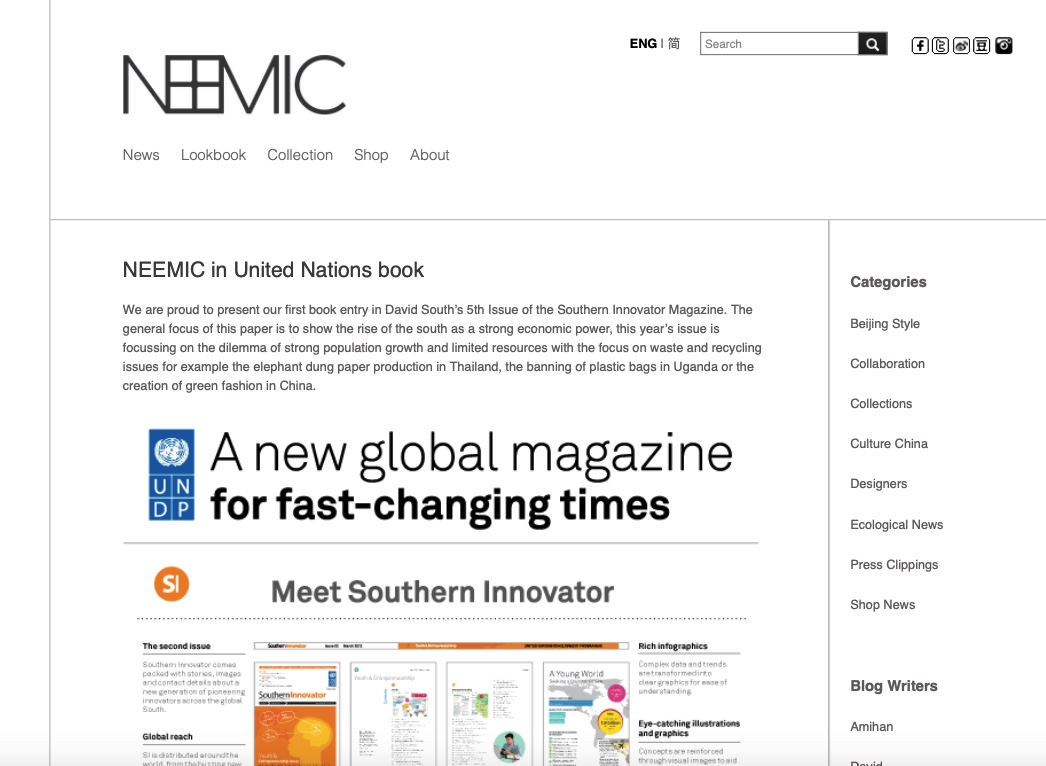
    “We are proud to present our first book entry in David South’s 5th Issue of the Southern Innovator Magazine. The general focus of this paper is to show the rise of the south as a strong economic power, this year’s issue is focussing on the dilemma of strong population growth and limited resources with the focus on waste and recycling issues for example the elephant dung paper production in Thailand, the banning of plastic bags in Uganda or the creation of green fashion in China.” https://neemic.asia/ecological-news/neemic-southern-innovator-book

    https://davidsouthconsulting.org/2021/02/09/african-fashions-growing-global-marketplace-profile/

    https://davidsouthconsulting.org/2021/01/05/afropolitan-african-fashion-scene-bursting-with-energy/

    https://davidsouthconsulting.org/2022/10/09/fashion-closes-gap-between-catwalk-and-crafts/

    https://davidsouthconsulting.org/2022/11/17/fashion-recycling-how-southern-designers-are-re-using-and-making-money/

    https://davidsouthconsulting.org/2022/11/16/favela-fashion-brings-women-work/

    https://davidsouthconsulting.org/2020/04/30/local-fashions-pay-off-for-southern-designers/

    https://davidsouthconsulting.org/2022/10/24/made-in-africa-fashion-brand-pioneers-aim-for-global-success/

    https://davidsouthconsulting.org/2021/10/04/putting-quality-and-design-at-the-centre-of-chinese-fashion/

    https://davidsouthconsulting.org/2021/03/05/southern-innovator-issue-5/

    Development Challenges, South-South Solutions was launched as an e-newsletter in 2006 by UNDP’s South-South Cooperation Unit (now the United Nations Office for South-South Cooperation) based in New York, USA. It led on profiling the rise of the global South as an economic powerhouse and was one of the first regular publications to champion the global South’s innovators, entrepreneurs, and pioneers. It tracked the key trends that are now so profoundly reshaping how development is seen and done. This includes the rapid take-up of mobile phones and information technology in the global South (as profiled in the first issue of magazine Southern Innovator), the move to becoming a majority urban world, a growing global innovator culture, and the plethora of solutions being developed in the global South to tackle its problems and improve living conditions and boost human development. The success of the e-newsletter led to the launch of the magazine Southern Innovator.  

    Follow @SouthSouth1

    Google Books: https://books.google.co.uk/books?id=q1KeBgAAQBAJ&dq=development+challenges+december+2012&source=gbs_navlinks_s

    Slideshare: http://www.slideshare.net/DavidSouth1/development-challengessouthsouthsolutionsdecember2012issue

    Southern Innovator Issue 1: https://books.google.co.uk/books?id=Q1O54YSE2BgC&dq=southern+innovator&source=gbs_navlinks_s

    Southern Innovator Issue 2: https://books.google.co.uk/books?id=Ty0N969dcssC&dq=southern+innovator&source=gbs_navlinks_s

    Southern Innovator Issue 3: https://books.google.co.uk/books?id=AQNt4YmhZagC&dq=southern+innovator&source=gbs_navlinks_s

    Southern Innovator Issue 4: https://books.google.co.uk/books?id=9T_n2tA7l4EC&dq=southern+innovator&source=gbs_navlinks_s

    Southern Innovator Issue 5: https://books.google.co.uk/books?id=6ILdAgAAQBAJ&dq=southern+innovator&source=gbs_navlinks_s

    Creative Commons License

    This work is licensed under a
    Creative Commons Attribution-Noncommercial-No Derivative Works 3.0 License.

    ORCID iD: https://orcid.org/0000-0001-5311-1052.

    © David South Consulting 2023

  • Record-breaking Wireless Internet to Help Rural Areas

    Record-breaking Wireless Internet to Help Rural Areas

    By David SouthDevelopment Challenges, South-South Solutions

    SOUTH-SOUTH CASE STUDY

    Many initiatives seek to bring inexpensive access to the internet to rural and remote regions around the world. One of the most successful ways to rapidly expand access is to offer wireless internet so that anyone can use a laptop computer, a PC or a mobile phone to quickly access the Net. Access to wireless internet is being rolled out in cities around the world with so-called ‘hot spots’, but the thornier issue of improving access in rural or remote regions could get better, thanks to a Venezuelan team.

    The rapid expansion of mobile phones has done much to reduce the digital divide in Africa, for example, where the number has grown from just 15 million in 2000 to more than 160 million by the end of 2006, according to the International Telecommunications Union. This rapid growth has paid off: Morocco, Senegal, Ghana, Gabon and Cote d’Ivoire are in the top ten gainers of the Digital Opportunity Index, 2004-2006 (http://www.itu.int). The proliferation of Wi-Fi-enabled mobile phones combined with the spread of inexpensive wireless access has the potential to close the digital divide between rural and urban areas.

    The issue of inequality in access to the internet has stark consequences for global economic development. Already, according to the World Information Society Report 2007, “Europe has achieved the largest overall gain in digital opportunity over the last two years, followed by the Americas… Asia and Africa have witnessed smaller gains in digital opportunity. The implications for the digital divide are clear: digital opportunity is becoming more sharply divided by region, not less.”

    As the Digital Divide campaign learned, it is more important to keep in mind “Internet kiosks or rental of cell phones and other devices hold great promise for the poor. But shared use is a complement to a strategy that involves giving each person their own wireless device. Eventually, the price of such devices will be low enough so that everyone can have their own device.”

    A Venezuelan team led by Ermanno Pietrosemoli, president of the Latin American networking association Escuela Latinoamericana de Redes, has broken the world record for unamplified broadcasting of a Wi-Fi (wireless internet) signal. The signal was broadcast in June from two mountains 282 kilometres apart in the Venezuelan Andes. Importantly, they did this using equipment costing only just over US $360, while producing a signal strong enough to send video messages. The former record was 220 kilometres set in 2005.

    The consequence of this achievement for entrepreneurs is important: It means inexpensive wireless signals can now reach further into remote and rural regions for a small investment.

    “We we’re able to transmit voice and video with both,” said Professor Pietrosemoli. “280 kilometres is pushing the envelope, but the same technique can be used at distances of some 150 kilometres by people with some basic training provided there is uninterrupted line of sight between the end points. This usually means shooting from hills or using them as repeater points. For distances up to 80 kilometres, towers can be used to provide connectivity even in flat land”

    Pietrosemoli is willing to train people in the techniques he has developed for transmitting wireless over large distances (https://wireless.ictp.it or www.eslareed.org.ve).

    The advantages of this approach include cost and simplicity. The more commercial WiMax technology costs more and is usually installed by large companies. Pietrosemoli’s technique is for people who lack those technical and financial advantages.

    “I have been installing wireless networks for some 20 years,” he continued, “and reckon that wireless is the only viable alternative to ameliorate the digital divide in developing countries. For rural areas, the challenge is to use as little repeater sites as possible, as each repeater adds costs, delay and powering issues.”

    Pietrosemoli said the only other obstacle to setting these networks up is the availability of unlicensed radio frequency spectrum in the 2,4 and 5 Ghz bands. The International Telecommunications Union has recommended that countries make these free for the use of data networks, but some countries are still blocking this.

    Published: July 2007

    Resources

    Southern Innovator Issue 1: Mobile Phones & Information Technology.
    Creative Commons License

    This work is licensed under a
    Creative Commons Attribution-Noncommercial-No Derivative Works 3.0 License.

    ORCID iD: https://orcid.org/0000-0001-5311-1052.

    © David South Consulting 2023