In an effort to diversify its power supply and meet growing electricity demand, Kenya is looking to increase its use of geothermal energy sources (http://en.wikipedia.org/wiki/Geothermal_electricity). Tapping the abundant heat and steam that lurks underground to drive electric power plants offers a sustainable and long-term source of low-cost energy.
Kenya currently gets most of its electricity from hydroelectric projects. This is great until there is a drought, which there now is. With water resources low, the country has had to turn to fossil fuels to power electricity generators. This means relying on imported diesel, which is both expensive and polluting. It is also not generating enough electricity to keep up with demand.
Electricity blackouts have become common in the country and this is harming economic development. This is a particularly damaging setback in a country that has, in the last five years, gained a deserved reputation for its technological advances in mobile phone applications and Internet services – all needing reliable supplies of electricity.
Kenya is Africa’s largest geothermal producer and has geothermal resources concentrated near a giant volcanic crater in the Great Rift Valley with 14 fields reaching from Lake Magadi to Lake Turkana. There are also low temperature fields in Homa Hills and Massa Mukwe (http://www.gdc.co.ke/index.php?option=com_content&view=article&id=191&Itemid=163).
Kenya is expecting its gross domestic product (GDP) to grow by 10 per cent from 2012 onwards. The country hopes to become a middle income country by 2030.
Around 1,400 steam wells will be drilled by companies to meet these goals.
There are also many spin-off opportunities from tapping geothermal heat sources. These include using the steam heat for greenhouses growing plants, for cooling and heating buildings, and for drying and pasteurising foods.
Kenya is currently building a 52-megawatt (MW) geothermal project with funding from the United States government. It is also receiving US$149 million funding from the African Development Bank Group (AfDB) to build the Menengai Geothermal Development Project. This plant will be able to generate 400 megawatts of renewable electricity from the Menengai geothermal sources in the steam field located 180 kilometres northwest of the capital, Nairobi (http://www.gdc.co.ke/index.php?option=com_content&view=category&layout=blog&id=49&Itemid=137).
Speaking at a press conference this month, Gabriel Negatu, AfDB’s Regional Director, said he sees geothermal technology as an important driver of Kenya’s green growth ambition.
“Geothermal generation yields energy that is clean, affordable, reliable and scalable,” he said.
The Geothermal Development Company (GDC) (gdc.co.ke) is a state-owned company in Kenya and recently declared it had tapped steam with a well in the Menengai steam field. GDC started surface exploration in 2009 and has been using two drilling rigs to look for geothermal steam.
The Menengai Geothermal Development Project is slated to be completed by 2016 and will boost the country’s geothermal capability by 20 per cent. It is estimated to be able to power the electricity needs of 500,000 Kenyan households and power the needs of 300,000 small businesses.
Geothermal as a source of energy and electricity can help a country make big development gains. The best example is the Northern European island nation of Iceland. According to Orkustofnun (nea.is/geothermal), Iceland’s National Energy Authority, the country is a successful example of how a small, poor nation (Iceland was one of Europe’s poorest countries in the 20th century), shook off its dependence on burning peat and importing coal for its energy use. By 2007, Iceland was listed in the global Human Development Report as the country with the highest level of human development in the world. And one aspect of this success was the country’s ability to tap its renewable energy resources. Around 84 per cent of the country’s primary energy use comes from renewable resources, and 66 per cent of this is geothermal.
It is estimated Kenya could generate 7,000 megawatts of geothermal power and the Kenyan government is looking to increase the nation’s geothermal capacity from the current 198 MW to 1,700 MW by 2020 and 5,530 MW by 2031.
The Playboy Channel, due to launch in the UK on November 1, is trying to position itself as being a cut above the existing sex channels with which it will compete for subscribers.
The channel, which is running an advertising campaign costing more than £1.5 million, believes that its big budgets and slick production values will attract viewers who have hitherto been uninterested in so-called “adult” entertainment. It hopes to win an audience among women as well as men.
Managing director Rita Lewis dismisses the other sex channels as being aimed at people who are “a bit sad and on their own”. The channels promote “deviant” behaviour.
Playboy hopes to attract happy, heterosexual couples who will treat the channel as an aid to foreplay: “We hope Playboy will lead to couples’ making love,” said Lewis, who believes that women, as well as men “are happy to consume erotic imagery like pin-ups.”
In the USA, according to Lewis, 70 per cent of the audience for the channel comprises couples.
She said that the UK Playboy will run programmes that have more in common with programmes like Channel Four’s The Good Sex Guide. “These days, a whole bunch of people are sampling erotic programming like The Good Sex Guide. It is very sexy programming with mass-market appeal.”
Playboy’s movies would have a high standard of production, she said, very different from what she claims to be the cheap programming made for the other channels, often home videos and often shot with hand-held cameras.
Playboy’s programming will comprise sex films, interviews with “centrefold” models, documentaries on the sex industry and general-entertainment programming such as quiz shows.
The rival channels claim that Playboy will not be a big threat to them. The Adult Channel’s Wren says that all the new channels “hype the market, which helps us.” In any case, adult entertainment consumers have already been weaned on a harder mix of programming and do not want something that offers little more than what Channel Four shows.
The UK Playboy Channel, which is owned by UK programmer Flextech (51 per cent), British Sky Broadcasting (30 per cent) and Playboy Enterprises (19 per cent), will transmit from between midnight and 4am on the Bravo transponder on Astra 1c.
Update: It is over 20 years since this Special Report was published. The Internet now plays a significant role in the growth of sex content and the sex industry and vice versa. Here is an interesting overview of the situation in 2020. The Internet is for Porn – It always was, it always will be.
“One of the biggest and most interesting things happening in the consumer web right now is running almost completely under the radar. It has virtually zero Silicon Valley involvement. There are no boastful VCs getting rich. It is utterly absent from tech’s plethora of twitters, fora and media (at least, as they say, “on main”). Indeed, the true extent of its incredible success has gone almost completely unnoticed, even by its many, many, many customers.
UK regulations on what can be shown on sex channels are tougher than in most countries of the European Union. Channels such as the hard-core Swedish TV Erotica and the recently-launched French Rendezvous are licensed in their respective countries and transmit explicit scenes of sexual intercourse, straight and gay, featuring close-up shots of copulating genitals.
Graff Pay-Per-View, the experienced US sex channel operator, consciously decided to exclude the UK as a market for its hard-core Eurotica channel which is licensed in Denmark and, like the other hard-core channels, transmits via a Eutelsat satellite. But pirate smart cards for the channel, as for the other channels, are available in the UK in specialist satellite shops.
Graff’s seeming respect for the UK regulations may not be unconnected with the fact that it owns the Adult Channel and would be wary of upsetting the ITC. Broadcasting unacceptable material into the UK could provoke the ITC into seeing Graff as a body unfit to hold a licence, thereby threatening the Adult Channel.
The ITC’s guidelines on sexually explicit material state that representations of sexual intercourse can be shown only after 9pm and that “the portrayal of sexual behaviour, and of nudity, needs to be defensible in context and presented with tact and discretion.”
There has been some relaxation of the rule. The ITC will, on an experimental basis, allow the watershed to be broken by a ppv or video-on-demand service. It is not, however, prepared to give this freedom to a porn channel, at least not in the early days, because it does not want to be seen to be licensing pornography. The relaxation will affect only general services.
The ITC will also monitor any ppv service to ensure that there are no cases of children accessing the programming before deciding if the programme code should be revised.
The transmission of 18-rated films on terrestrial or new-media channels is not permitted before 10pm. Films with a 15-rating are not allowed before 9pm on terrestrial channels such as BSkyB’s Sky Movies or the Movie Channel. These are minimum requirements. Some 15-rated films, for instance those which show scenes of sexual intercourse or drug-taking, would not be deemed suitable for transmission even on an encrypted channel at 8pm.
In practice, the ITC does not permit depictions of erect penises, anal intercourse, close-ups of genitalia or ejaculation.
Where channels have overstepped the mark and gone abroad to get licences from less strict authorities – the late Red Hot Dutch and TV Erotica – the ITC has recommended that the channels be proscribed, action which has subsequently been taken by the Department of National Heritage. The ITC is now monitoring the Rendezvous channel, which shows a mix of gay and heterosexual hard-core pornography with graphic scenes of sexual intercourse.
The DNH issues proscription orders under Sections 177 and 178 of the Broadcasting Act. The orders make it a criminal offence to supply equipment to receive the channels or to market and advertise them.
The European Union directive on transfrontier broadcasting lays down that one country cannot prevent the reception of channels licensed by other European Union countries. However, it allows individual governments to take action against any broadcast which could damage the physical, mental or moral development of minors.
Update: It is over 20 years since this Special Report was published. The Internet now plays a significant role in the growth of sex content and the sex industry and vice versa. Here is an interesting overview of the situation in 2020. The Internet is for Porn – It always was, it always will be.
“One of the biggest and most interesting things happening in the consumer web right now is running almost completely under the radar. It has virtually zero Silicon Valley involvement. There are no boastful VCs getting rich. It is utterly absent from tech’s plethora of twitters, fora and media (at least, as they say, “on main”). Indeed, the true extent of its incredible success has gone almost completely unnoticed, even by its many, many, many customers.
Harnessing the power of design to improve products and the way they are manufactured is a critical component of successful economic development. And the high export value of designing and making “computer equipment, office equipment, telecommunication equipment, electric circuit equipment, and valves and transistors” was flagged up as a priority for developing nations back in 2005 at a meeting looking for “New and Dynamic Sectors of World Trade” (UNCTAD).
One country taking up this challenge is China. It now boasts twice as many Internet users as the United States, and is the main global maker of computers and consumer electronics, from toys to games consoles to digital everything.
China is also on course to become the world’s largest market for Internet commerce and computing.
The centre of gravity is very much moving China’s way: One study of 769 firms investing in 2,203 Chinese companies by Stanford University in California, found “the same firms that were successful in Silicon Valley … have transplanted their expertise to China,” according to Marguerite Gong Hancock in The New York Times.
But the country wants to move from ‘Made in China’ to ‘Designed in China’. This is critical because the majority of the profits to be made are actually in the designing, patenting and marketing of products. Manufacturing, as has been shown in the recent media controversy over the products made by Apple (apple.com), is not the main profit centre.
Apple employs 43,000 people in the United States and 20,000 overseas. But through its network of sub-contractors, the number employed overseas in Asia, Europe and elsewhere is around 700,000 (The New York Times). This includes around 200,000 assembly jobs in China. These workers can make US $17 a day or less.
Apple makes hundreds of dollars in profit for each of its iPhones. Apple can do this because it is the designer of the phones and holds the copyright, and it is the branded company that has built up its reputation and developed a highly sophisticated marketing and distribution network around the world. Through clever use of design, Apple created products that look distinctive in the marketplace. And those are the factors that determine the ability to make this profit. As has been noted, it isn’t just cheap wages that keep Apple’s profits high.
Getting consumers to desire and buy your products is a challenge for any company. Design plays a major part in understanding the unique demands of countries and markets, and what people find appealing or repellent.
A product that has both a successful design and is produced efficiently will generate a good profit.
The classic example from the past is Japan. Devastated during World War II, Japan set about re-building its manufacturing prowess from scratch. It brought in American innovators to introduce new concepts in manufacturing.
Japan’s openness to the new ways enabled it to re-fashion its manufacturing industries to exporting to the developed Western nations, in particular the United States. At first, quality control was an issue and Japan was mocked for making cheap quality trinkets, toys, automobiles and motorcycles. But it quickly changed from this to a reputation for making quality, affordable products and moving quickly into the burgeoning micro-electronics and consumer products markets. It also was a pioneer in computer gaming and entertainment.
The recent achievements in supercomputing in China are pointing to where things can go. China has developed the Sunway Bluelight MPP supercomputer (http://en.wikipedia.org/wiki/ShenWei). It is able to do a quadrillion calculations per second: making the Sunway Bluelight one of the 20 fastest supercomputers in the world. It was built with a Chinese-made microprocessor, and importantly, uses lower amounts of power than other supercomputers.
The clever bit is the ratio of computing power to wattage used. Energy-efficient computing is critical if computers are to make the jump to the next level in processing power.
All these trends coming together hint at big changes in the coming years.
In the past two decades, the electronics sector has enabled a number of developing countries to improve trade performance, in particular East and Southeast Asian nations.
Improving education is critical to the growth strategy. Improving education, like encouraging the pursuit of engineering as a profession, as China has done – it now has more than half a million estimated graduates, the most in the world – means new skills and ideas are coming to the industry (engineeringinchina.net).
But this is not enough. New ideas are essentially a creative process and this needs connections to business and the ability to experiment and play with ideas. Start-up incubators have proven a successful way to do this.
Thailand is a good example: Around US $4.5 billion was invested in the country’s electronics industry between 1986 and 2001. This created 300,000 jobs. The sector became so important it made up a third of the country’s exports.
Realizing that much of the work was assembly manufacturing, the government set up the Thailand IC Design Incubator (http://www.nectec.or.th/rd/electronics/be204-45/be204-45.php) to work on hard disk drive development and move up the value chain.
“In 1978, I saw workers stringing together computer memories with sewing needles,” Patrick J. McGovern explained to The New York Times. McGovern is the founder of the International Data Group, which invests in Chinese enterprises.
“Now innovation is accelerating, and in the future, patents on smartphones and tablets will be originated by the Chinese people.”
In the past, China was not able to make significant progress on this development for two main reasons. The first is copyright piracy and theft of intellectual property rights. During China’s economic rise, this theft was rampant and the country developed a reputation for being home to a vast marketplace of knock-offs of major Western brands. And the second reason was the heavy hand of the government, which scared off many entrepreneurs.
But China is re-structuring its industries to focus on innovation. In 2011, China surpassed South Korea and Europe in total patents and was in a neck and neck race with Japan and the United States. As fuel for the innovation rocket,venture capital is critical. And China is now the world’s second largest venture capital market, with the total jumping from US $2.2 billion in 2005 to US $7.6 billion in 2011.
It is this journey up the manufacturing ‘value chain’ that many countries look to with admiration and jealousy. And the secret to being able to move up this value chain is design – savvy product design combined with savvy design of manufacturing methods to continually drive down costs and drive up quality. How long until China has its own Apple and not just an Apple knock-off (http://www.bbc.co.uk/news/technology-14503724)?
Published: February 2012
Resources
1) Red Dot: The red dot logo stands for belonging to the best in design and business. The red dot is an internationally recognised quality label for excellent design that is aimed at all those who would like to improve their business activities with the help of design.Website: http://www.red-dot.de
2) Dutch Design in Development: DDiD is the agency for eco design, sustainable production and fair trade. They work with Dutch importers and designers and connect them to local producers in developing countries and emerging markets. Together products are made that are both profitable and socially and environmentally sustainable. Website: http://www.ddid.nl/english/index.html
3) C3: C3 offers product design and product engineering services in Shanghai, China. Their strong point is managing innovative design processes from scratch (market research) until production: a one shop service: Website: chinacreativecompany.com
4) Dahua: Zhejiang Dahua Technology Co., Ltd. is a partially state-owned publicly traded company based in Hangzhou which sells video surveillance products and services. Leading video surveillance product and solution provider in IP camera, NVR, HD cctv camera, Analog, PTZ and other vertical solutions. Website: https://www.dahuasecurity.com/uk
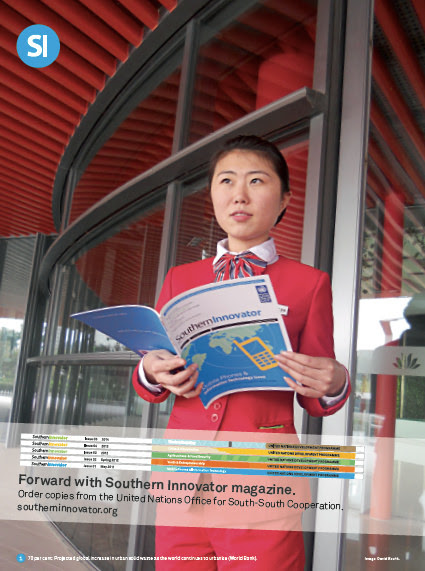
Development Challenges, South-South Solutions was launched as an e-newsletter in 2006 by UNDP’s South-South Cooperation Unit (now the United Nations Office for South-South Cooperation) based in New York, USA. It led on profiling the rise of the global South as an economic powerhouse and was one of the first regular publications to champion the global South’s innovators, entrepreneurs, and pioneers. It tracked the key trends that are now so profoundly reshaping how development is seen and done. This includes the rapid take-up of mobile phones and information technology in the global South (as profiled in the first issue of magazine Southern Innovator), the move to becoming a majority urban world, a growing global innovator culture, and the plethora of solutions being developed in the global South to tackle its problems and improve living conditions and boost human development. The success of the e-newsletter led to the launch of the magazine Southern Innovator.











 David South Consulting
You must be logged in to post a comment.