A pioneering tool for gathering health data now being used in Kenya could herald a revolution in the way diseases are tracked and defeated around the world. It uses mobile phones to better connect patients with medical and health personnel, and allows data to be gathered in real-time and used to track health and improve the delivery of services, especially to remote and under-serviced areas.
In the past couple of years, Kenya has become a hotbed of mobile phone and information technology innovation. The now-famous Ushahidi crisis-mapping platform (www.ushahidi.com) is just one example. Social enterprise Data Dyne (www.datadyne.org) – with offices in Washington DC and Nairobi, Kenya – is offering its EpiSurveyor application (www.episurveyor.org) free to all to aid health data collection. It bills itself as “the first cloud-computing application for international development and global health … Think of it as like Gmail, but for data collection!”
EpiSurveyor claims to have more than 2,600 users around the world and is currently being upgraded to a second version.
“With the touch of a button I can see what’s going on across the country in real time,” Kenyan civil servant Yusuf Ibrahim told Britain’s Daily Telegraph newspaper. “It is amazing.”
Ibrahim works in Nairobi as the Kenyan Ministry of Health liaison to Data Dyne.
He uses maps and charts on mobile phones to track deadly disease outbreaks and vulnerable pregnancies.
The EpiSurveyor application works simply: A user logs into the website and builds and creates the sort of form they want. They then download it to a phone and start collecting data straight away.
Ibrahim gathers this data from mobile phones used by health care workers across the country.
“It used to take days, weeks or even a couple of months to find out about an outbreak of polio on the other side of the country,” he said. “Now we know almost instantly. The speed with which we can now collect information has catapulted healthcare and prevention to another level. It has completely changed healthcare and saved countless lives.”
He proudly points out Kenya’s mobile phone data collection system is “probably better than what they’ve got in the West.”
“Although we are a third world country, I’m pretty sure we’ve done this before
Western countries. While they are still collecting information in hard copy on clipboards, we are getting it instantly.”
Packed with data processing power, mobile phones are capable of an immense range of tasks and applications. Some see phones as key to a revolution in how healthcare is provided: the mobile phone becomes one-part clinic, another part mobile hospital dispensing advice and transmitting vital information back to healthcare professionals and scientists in hospitals and labs.
Despite dramatic improvements to the quality of hospitals in Africa and the number of qualified doctors, the continent’s healthcare services are still a patchwork, with rural and slum dwellers poorly served and the stresses of treating patients with contagious diseases like HIV/AIDS and malaria pushing resources to the limit.
The United Nations has a number of initiatives partnering with mobile phone manufacturers, networks and software developers as part of a global campaign to reduce HIV/AIDS, malaria and deaths in childbirth.
EpiSurveyor is being used by more than 15 countries’ ministries of health and is the adopted standard for the World Health Organization (www.who.int) (WHO) for electronic health data collection.
It began as a partnership with the United Nations Foundation, The Vodafone Group Foundation, WHO and the ministries of health of Kenya and Zambia in 2006 to pilot test the software for EpiSurveyor.
At the United Nations Foundation (www.unfoundation.org), chief executive Kathy Calvin equates the impact of mobile phones on global healthcare to the discovery of the antibiotic penicillin.
“Instead of building clinics and roads to remote towns and villages so that people can access healthcare, we are bringing healthcare directly to the people via mobile phones. You get a lot more healthcare for your money,” Calvin told the Telegraph.
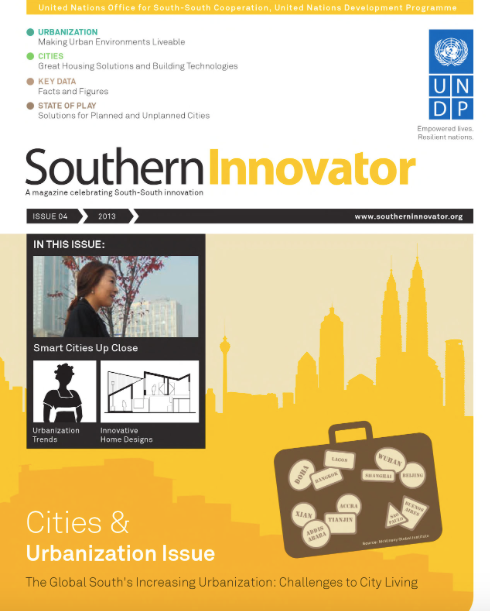
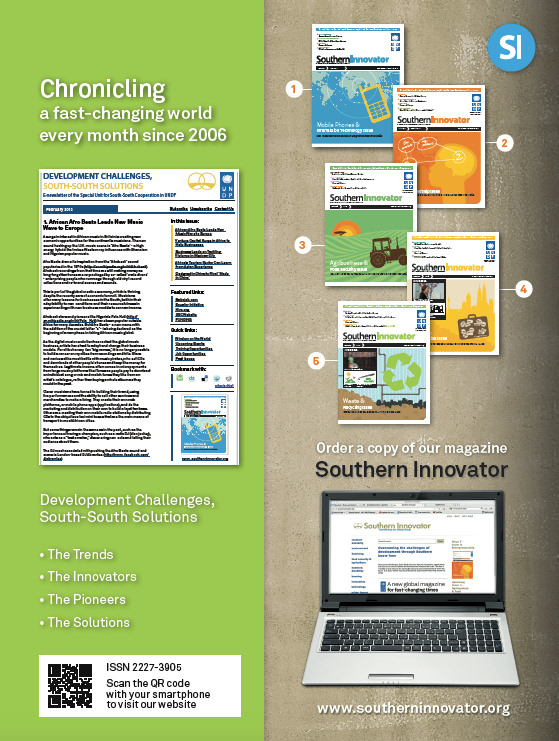
Development Challenges, South-South Solutions was launched as an e-newsletter in 2006 by UNDP’s South-South Cooperation Unit (now the United Nations Office for South-South Cooperation) based in New York, USA. It led on profiling the rise of the global South as an economic powerhouse and was one of the first regular publications to champion the global South’s innovators, entrepreneurs, and pioneers. It tracked the key trends that are now so profoundly reshaping how development is seen and done. This includes the rapid take-up of mobile phones and information technology in the global South (as profiled in the first issue of magazine Southern Innovator), the move to becoming a majority urban world, a growing global innovator culture, and the plethora of solutions being developed in the global South to tackle its problems and improve living conditions and boost human development. The success of the e-newsletter led to the launch of the magazine Southern Innovator.
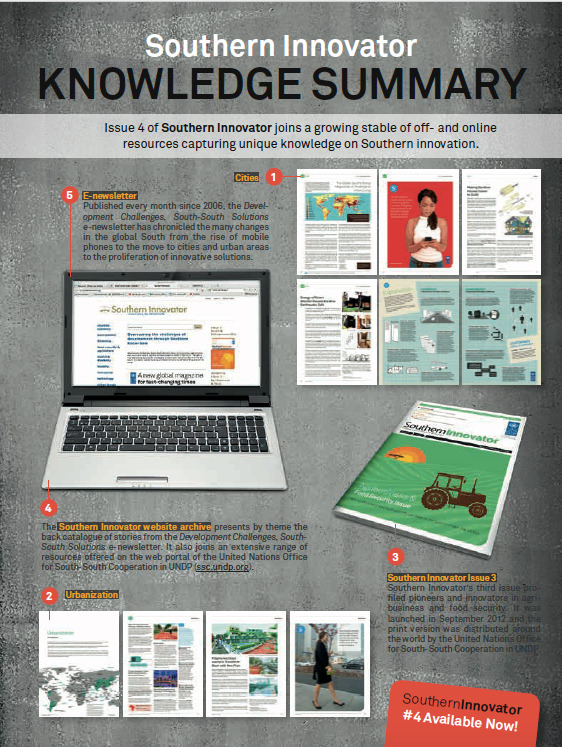
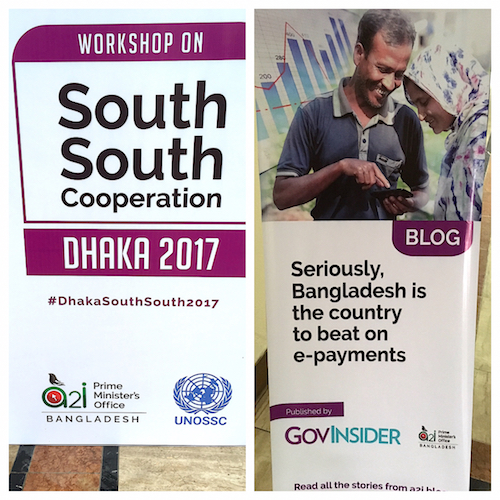
Southern Innovator issues 1 and 5 at the Bangladesh workshop on public service innovation, 9-11 December 2017, and the launch of the South-South Network.
The following blog report does not reflect the views of the UNOSSC or UNDP.
Dateline: Dhaka, Bangladesh (9-11 December 2017) – From 9-11 December 2017, I participated in the Workshop on Innovations in Service Delivery: The Scope for South-South and Triangular Cooperation held in Dhaka, Bangladesh. Hosted by the a2i (access to information) division of the Bangladesh Prime Minister’s Office, the implementing unit for Digital Bangladesh, it was convened by the Government of Bangladesh and the United Nations Office for South-South Cooperation (UNOSSC).
I was asked to do a presentation for the health component of the Workshop on my past experience in public sector digital innovation. This work stretches back to the beginning of the roll out of the Internet in the late 1990s. I chose three projects I have led that had a large and significant impact in the digital public space: the UN Mongolia development web portal I launched and ran for two years (1997-1999), the GOSH Child Health Web Portal I launched and ran for two years (2001-2003) and the Southern Innovator brand I launched for the UNOSSC (2010-2015).
I also joined a panel discussion as Senior Partner representing the David South Consulting/David South International consultancy at the end of the last day (we have worked with the UNOSSC since 2007 and with UNDP since 1997 – a timeframe which saw the rise of the Internet and the mobile and information technology revolution take the global South by storm).
As the Workshop invitation letter says, “The digitization of service delivery, user-centric methodologies, and experimentation geared towards improvement in service delivery, and the data revolution may have originated in developed countries but is now of increasing relevance for the developing world. To respond to rapidly rising expectations of the citizens, governments in both developing and developed countries are embracing approaches and tools to adopt more citizen-centric approaches in their service delivery. These practices are establishing a culture of citizen-centric innovation within governments, breaking silos of operations and helping move towards a whole-of-government planning and execution.”
According to the a2i, Bangladesh has the “world’s largest government web portal” comprising over 25,000 government websites for 43,000 government offices (Bangladesh’s population was over 162 million as of 2016 – World Bank). Bangladesh has one of the highest population densities in the world and is considered the 8th most populace country in the world (Wikipedia). In total, these government websites receive 60 million plus hits a month, according to the a2i, from an online population of 79.7 million people, nearly half the population.
A lot is at stake: According to the World Bank (which has been supporting the country since 1972), “Bangladesh has made substantial progress in reducing poverty, supported by sustained economic growth. Based on the international poverty line of $1.90 per person per day, Bangladesh reduced poverty from 44.2 percent in 1991 to 18.5 percent in 2010, and is projected to decrease to 12.9 percent in 2016.
“The country achieved the MDG 1 on halving poverty five years ahead of time, with 20.5 million people rising out of poverty during the 1991-2010 period. In parallel, life expectancy, literacy rates and per capita food production have increased significantly. Progress was underpinned by strong economic growth, with 6 percent plus growth over the decade and reaching to 7.1 percent growth in 2015/2016. Rapid growth enabled Bangladesh to reach the lower middle-income country status in 2014.
“However, sustained growth has rapidly increased the demand for energy, transport and urbanization. Insufficient planning and investment have resulted in increasingly severe infrastructure bottlenecks.”
Arriving in the capital, Dhaka, on the 9th of December, it was clear to see what the World Bank is highlighting: the “severe infrastructure bottlenecks”. Just like other megacities, Dhaka is clogged with traffic and suffers from the air pollution this causes (one of the worst cities for this in Asia). But these are just the visible signs of success if you think about it (as frustrating as that might be), as booming economies combined with rapid urbanisation, if not planned well, tend to lead to traffic congestion and high levels of air pollution.
The country’s rising living standards since 2000 and impressive gains in the provision of information and mobile technology services and connectivity, reveal a country brimming with potential and capable of getting a handle on its many development challenges. The streets are visibly lined with small and medium enterprises and there are construction projects in various states of completion all around Dhaka. At the airport, glossy posters advertise many real estate developer’s dreams and show-off the heavy construction equipment for sale or lease from China and Russia.
The population no longer suffers from food crises such as the 1974 famine, which killed 1.5 million people (Christian Science Monitor). According to the UN, Bangladesh cut chronic hunger by half since 2000 and is considered one of the success stories from the past 10 years that the rest of the developing world can look to as they push to eliminate hunger by 2030 as part of the SDGs (Sustainable Development Goals) (https://www.csmonitor.com/USA/Foreign-Policy/2015/0617/From-famine-to-food-basket-how-Bangladesh-became-a-model-for-reducing-hunger). Clearly, Bangladesh is a country that can get things done when it draws on the power of its population.
According to Digital Bangladesh, with a deadline of 2021, it has achieved half its goals to get the population online and its economy and government services online. In 2017, the country made US $800 million from exporting ICT (information and communication technologies) products and services. It is currently building 12 hi-tech parks with the ambitious goal to export US $10 billion in ICT services from them by 2030 and make US $5 billion by 2021.
The streets of Dhaka.
Workshop
Sharing ideas at the Workshop.
Speaking at the Workshop, Anir Chowdhury, Policy Advisor to the Access to Information (a2i) Programme of the Prime Minister’s Office, believes the concept of South-South Cooperation (SSC) is about enlightened self-interest but at present there is no framework for SSC in Bangladesh and most cooperation is ad hoc. If global South countries are not cooperating, then they are just re-inventing the wheel, he added. SSC is about avoiding feeling each country has to make it own their own: SSC can facilitate development leapfrogging and prevent leaving country success to chance. However, there needs to be better ways to communicate Southern solutions.
And Bangladesh has a good story to tell to the global South: To date, Bangladesh’s digital public service delivery has saved the country US $2 billion in cost for government services plus 1 billion man days in time spent trying to carry out tasks using government services, according to the a2i. With this success under their belts, the hope is to market Bangladesh as a world leader in innovation. To go from MDGs poster child to leader of the global South.
UNOSSC Director and Envoy of the UN Secretary-General on SSC, Jorge Chediek (https://www.unsouthsouth.org/about/unossc-director/), emphasised the need to tell stories of how South-South is changing the world; the pressing need to change the narrative around the global South in order to be able to achieve the 2030 agenda.
It was an honour to be invited to present my three case studies on public sector digital innovation (GOSH Child Health Portal, Southern Innovator Magazine and the UN/UNDP Mongolia Development Portal). All three share the same characteristics: a public demand for digital resources and a need to create high-quality content on limited budgets and to build public confidence in those resources. These projects were also engaging with enormous complexity and needed to find a way to simplify this for online readers.
I was impressed by the level of debate at the Workshop, and how Bangladesh’s digital initiatives are communicated (the excellent use of infographics and simple step-by-step explanations), and the overall excitement and energy around digital and the digital economy in Bangladesh. But, importantly, the foresight to give attention to the coming wave of automation and robotics (the so-called fourth industrial revolution) and how this will affect Bangladesh.
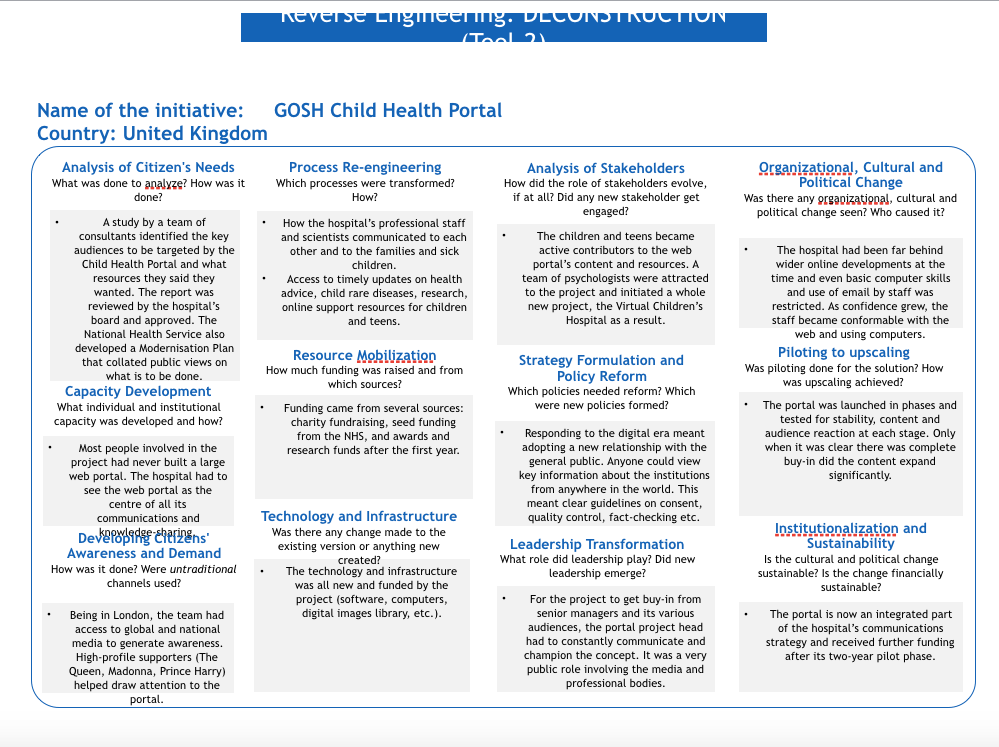
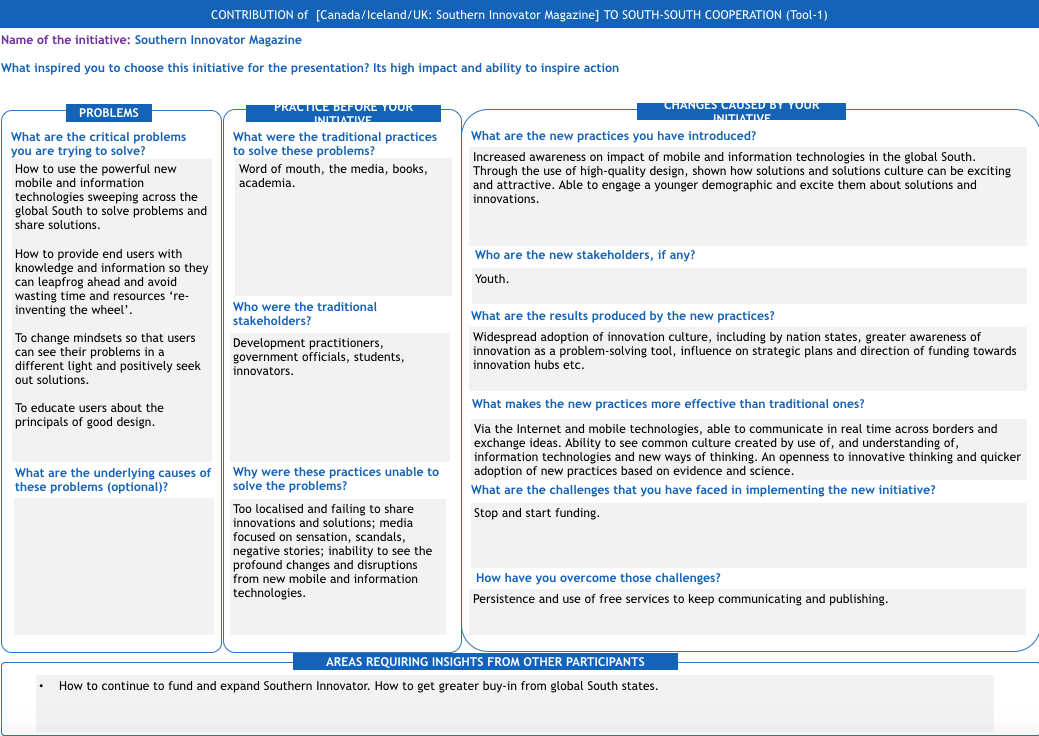
In the health workshop, we shared two projects for the reverse engineering component: the GOSH Child Health Portal and the magazine Southern Innovator (link to PowerPoint). Using the Reverse Engineering tool (see images below), each project was broken down as to how it worked and also what was its contribution to South-South Cooperation.
I shared experience from the early days of digital public innovation in the late 1990s. This has included applying digital to crisis recovery, healthcare modernisation in the early 2000s, and the campaign to achieve the MDGs (Millennium Development Goals), as well as during the mobile/information technology and social media revolution in the global South, which took off after 2007.
Issues discussed here included the recent online fake news scandals and how important it is for the public sector to offer the antidote to this with quality, factual digital information and resources. The GOSH Child Health Portal was one good example, where it entered the crowded online medical and health information marketplace and succeeded in drawing a large online audience by offering high-quality, peer-reviewed resources, thoroughly fact-checked and proofread and presented using high-quality online design. By the end of the project’s two-year timeframe, it was receiving over 7 million hits a month and was acknowledged as a trusted global source in child health. The content is cited in many books and papers, as well.
Reverse engineering GOSH Child Health Web Portal, 2001-2003.
Throughout the Workshop, I heard over and over again about the urgent need for a more cohesive platform for sharing Southern innovations and initiatives. Many complained this was currently very fragmented. While there are many media and development organisations documenting innovations and stories, there is no one-stop shop for countries to go to.
The Southern Innovator brand (incubated and developed by the UNOSSC) is a good example of what can be achieved with a more cohesive and strategic approach. Southern Innovator, first launched in 2011 by the UNOSSC, was able to leverage its limited resources to reach a large global audience via the web and social media. The brand became established with innovators and five issues were published (from 2011 to 2015). An Action Plan for scaling-up the Southern Innovator brand was also developed with the UNOSSC in 2015 (but awaits funding).
The original Southern Innovator website (southerninnovator.org, now southerninnovator.com) did fulfil the role of offering a one-stop shop for stories on global South innovation and these stories were widely cited in websites, papers and books on the global South. But the terrain has shifted radically in the global South – and at the UN – since Southern Innovator’s launch in 2011. With the widespread adoption of mobile and digital technologies, the opportunities to communicate innovator solutions have never been better but require a more sophisticated approach to be effective. In fact, we now exist in a world where the solutions already exist to the major problems affecting the global South (and even the funding is available through many sources). The problem is not the lack of solutions, innovators or technologies and business models to resolve problems (both e-newsletter Development Challenges, South-South Solutions and Southern Innovator proved this) but how people can access these resources and in a format that makes sense to them and is available when they are searching for a solution. With modern computing technologies, this is no longer an unsolvable problem. And the people to connect with to do this also already exist in the global South. What is missing is a coherent and cohesive approach. The multiplicity of development actors in this case are hampering effective action by dissecting and scattering resources, leaving end-users confused and poorly communicated with in many cases. As an example, there was a definite need to assist people in understanding how the 17 SDGs can fit into practical actions and a definite psychological need for simplicity: a problem highlighted by former UNDP head Helen Clark back in 2015 (https://www.theguardian.com/global-development/2015/jul/07/sustainable-development-goals-will-be-hard-sell-for-united-nations).
For UNDP, with its human development approach and presence in most countries, an opportunity exists to rapidly accelerate development gains and shorten the time it takes to recover when disaster or conflict strikes. Something that came out of the Workshop is the presence of excellent examples of global knowledge sharing already underway for decades around the world. Think of the scientific community in general (working on vast projects such as the CERN facility in Switzerland), or aerospace industries, or the global adoption of the principles of air safety managed by IATA in Montreal, Canada, or sport – all proof countries do successfully share knowledge and adopt common, high standards when they feel it is a priority and necessity. No country wants to be frozen out of flight routes, for example.
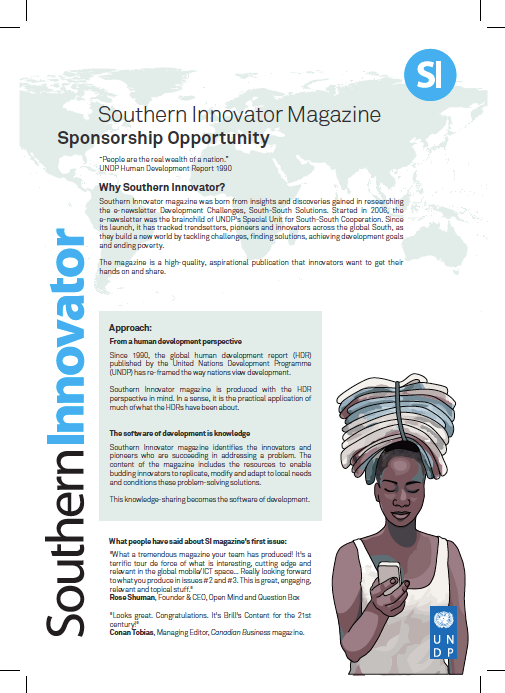
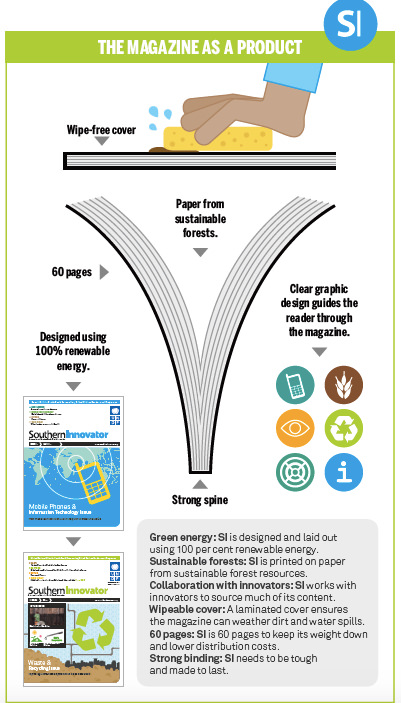
Reverse engineering the Southern Innovator magazine brand, 2010-2015.
Panel Discussion
At the closing panel discussion, I was asked how to engage more donors to be part of the South-South Network. I said there is a need to get people excited and show why the South-South Network is different; how it is related to the Sustainable Development Goals (SDGs). There needs to be a communications strategy and to establish some ambitious first goals that are original: to show that this is part of a clear trend. International aid and development is a crowded space so there is a need to show how the Network would tackle the challenges of the global South in the 21st century head-on, with a more effective solution. And of course, I championed the existing and successful Southern Innovator brand developed by the UNOSSC since 2010 as, potentially, part of this communications strategy.
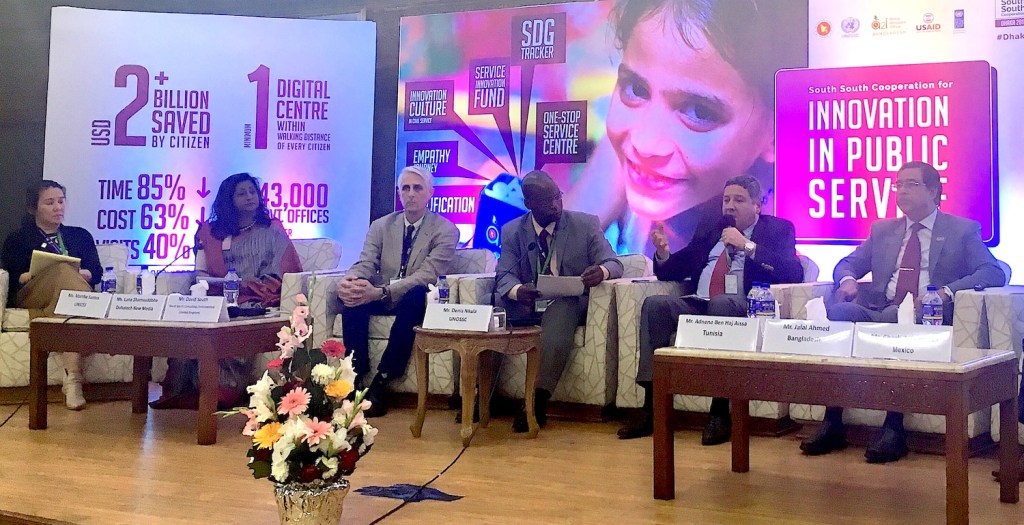
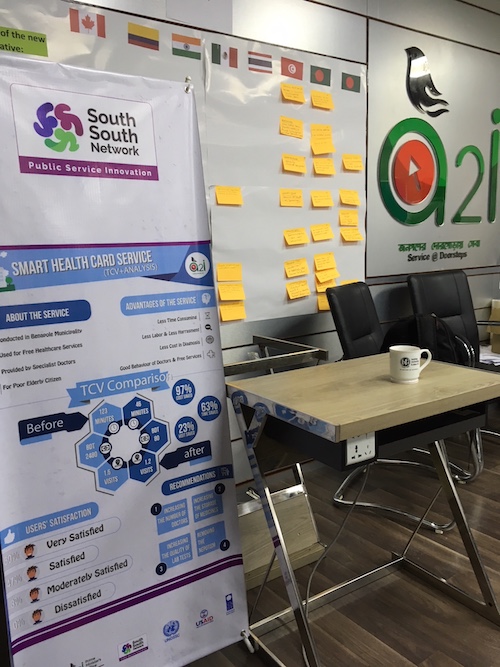
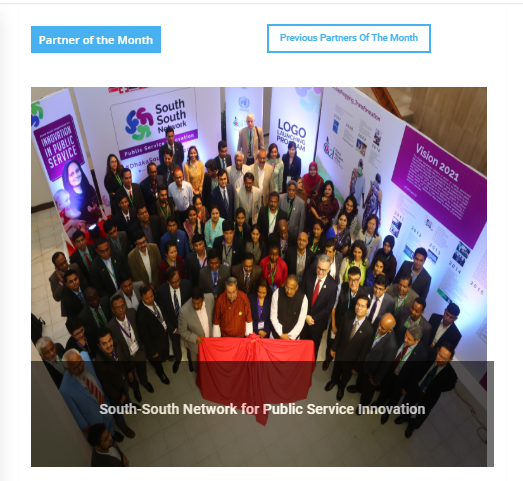
Senior Partner David South is third from the left on the panel. Photo: Yoko Shimura.Senior Partner David South is centre at back with the South-South Network for Public Service Innovation, Dhaka, Bangladesh, 2017.
Finally
This impressive embracing of e-initiatives and all things digital was visibly missing at the airport. On the way in, long lines and then a confusing scramble to buy a visa created confusion for visitors. As the first impression for visitors, this could be a great place to show-off Bangladesh’s digital capabilities.
And finally, as the World Bank says, this all about job creation and increased living standards: “The World Bank has identified job creation as the country’s top development priority. Bangladesh needs to create more and better jobs for the 2.1 million youths entering the job market every year. But to do so, Bangladesh will need to remove the barriers to higher growth posed by low access to reliable and affordable power, poor transportation infrastructure, limited availability of serviced land, rapid urbanization and vulnerability to climate change and natural disasters, among others.”
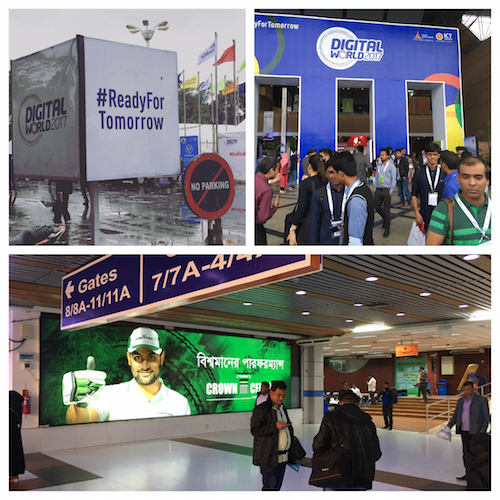
Bangabandhu International Conference Center hosting Digital World 2017 and Dhaka’s Shahjalal International Airport.
A pioneering technology social enterprise has found a way to connect people around the world to the new digital economy, transforming their lives and providing long-term employment opportunities. It is closing the digital divide in a very practical way, teaching new skills and, most importantly, providing income to the poor and vulnerable.
The San Francisco, USA-based non-profit social enterprise Samasource (samasource.org) uses what it calls microwork – a virtual assembly line of small tasks broken down from a larger project so they can be completed over the Internet – to outsource work to its network of workers around the world.
The tasks in this virtual piecework range from writing to transcribing to organizing online content.
The company organizes the projects using its own online work distribution system connecting workers around the world to the SamaHub in San Francisco. Most of the workers are women, youth and refugees. When they complete their task, it is sent back to the SamaHub in San Francisco where the staff check it and assure its quality. Once approved and completed, the project is returned to the client.
The company was founded in 2008 and draws on experts in “distributed work, economic development, and outsourcing.”
The microwork is divided into three areas: content services, data enrichment and transcription.
Content services can include writing descriptions for online business listings, organizing large databases on information or creating brief descriptions of existing content to make it easier for search engines to find it. “Data enrichment” tackles the vast quantity of information on the Internet that needs to be kept up to date and reliable. It also includes ‘tagging’, where text or images on the Internet need to have appropriate ‘tags’ or labels. And finally, transcription services include digitizing paper documents like receipts or books or transcribing audio and video files for the web.
All these tasks are labour intensive and require high attention to detail. And they are critical to any online business’s success if it wants a reputation for accuracy and consistency.
Samasource is optimistic about its future potential because of the sheer size of the market for business process outsourcing: estimated to be worth over US $100 billion. What Samasource does, called ‘impact sourcing’ – outsourcing to people in the developing world living in poor or remote communities – is a market worth US $5 billion, according to Samasource’s website.
It differs from conventional business process outsourcing in a number of respects, including the educational background of the workers. Most conventional outsourcing goes to college graduates in cities in India, China and the Philippines. Impact outsourcing is done by people with at most a high school education.
The digital economy needs these workers to handle the many millions of detailed tasks required to link together information. It is easy to take this for granted because it is hidden from view, but it is what enables the Internet to function and businesses to thrive. Samasource provides outsourcing services including content moderation and data entry to clients like LinkedIn, Intuit and the US State Department.
“We bring dignified, computer-based work to women, youth, and refugees living in poverty,” said Samasource’s founder and chief executive officer, Leila Janah.
Janah has a background in development studies and formerly worked for the World Bank. This experience convinced her that much foreign aid was failing to target what poor people are really looking for: a job that pays well.
Samasource sees what it does as work, and not handouts.
It also believes it is changing perspectives, proving people from the poorest places on earth can become trustworthy, hard-working knowledge workers.
The Internet is a unique medium because it transcends borders and smooths contact between people with varying linguistic, cultural and educational capabilities.
“The Internet reduces the friction of collaboration across all of these centres and time zones, and with a highly distributed workforce,” said Janah.
Samasource claims to have paid out US $1 million in wages to more than 1,500 workers around the world. Ambitiously, it wants to expand this to reach some of the 144 million youth between 16 and 24 living on less than US $2 a day.
Youth are a particular focus for Samasource. Samasource targets young people who are literate and have received an education but still can’t get a job.
As for the many women employed by Samasource, they were either unemployed or earning poverty-level wages doing precarious work in low-level manufacturing and not building their skills.
Samasource currently has 16 partnerships in Haiti, India, Pakistan, Kenya, Uganda and South Africa. Criteria to work with Samasource includes being in a high-poverty region. Another criteria is for most of the money earned to stay within the region where the work is done and adhere to the standards laid down by Samasource.
Samasource’s success means it has attracted further funding. In December 2011, it was given a US $1.5 million grant from Google.org – the Google.com search engine’s charity. It has also raised US $5 million from non-profit investors, including the Ford Foundation, the Rockefeller Foundation and the eBay Foundation. The challenge for the Samasource model will be to prove, with this new funding, that it can scale its operations to pay out more to its workers than it is taking in to meet its operating costs.
Microwork is turning out to be big work indeed!
Published: January 2012
Development Challenges, South-South Solutions was launched as an e-newsletter in 2006 by UNDP’s South-South Cooperation Unit (now the United Nations Office for South-South Cooperation) based in New York, USA. It led on profiling the rise of the global South as an economic powerhouse and was one of the first regular publications to champion the global South’s innovators, entrepreneurs, and pioneers. It tracked the key trends that are now so profoundly reshaping how development is seen and done. This includes the rapid take-up of mobile phones and information technology in the global South (as profiled in the first issue of magazine Southern Innovator), the move to becoming a majority urban world, a growing global innovator culture, and the plethora of solutions being developed in the global South to tackle its problems and improve living conditions and boost human development. The success of the e-newsletter led to the launch of the magazine Southern Innovator.
Like this story? Here is a dirty secret: this website is packed with stories about global South innovators. We spent 7 years researching and documenting these stories around the world. We interviewed the innovators to learn from them and we visited them to see how they did it. Why not use the Search bar at the top and tap in a topic and see what stories come up? As for my work, I have been involved with start-ups and media ventures since the early 1990s. In the years since I have learned a great deal about innovation and digital and have shared these insights in the stories on this website as well as in the 5 issues of Southern Innovator magazine. So, stick around and read some more!
While Southern Innovator’s digital presence has been key to its success and global reach, the hard copy of the magazine was designed with special features. The magazine neded to be robust and able to stand a fair bit of abuse and hard wear. It needed to be easy to read in low light conditions. And it needed to look sharp and eye-catching to reach as wide an audience as possible.
All over the global South, urban and semi-urban areas are growing at a furious pace. Great swathes of mega-regions – places where large cities blend seamlessly into smaller towns and villages creating a giant economic hub – are becoming key economic and opportunity drivers in developing countries. One of the downsides of this rapid growth and economic vitality is the chaos and confusion brought by frenetic change. Into this busy landscape steps the fast-moving new world of everywhere computing, where computers exchange information with almost everything in the environment. A Ghanaian information technology pioneer and entrepreneur is changing perceptions about Africa by using the new technology of Semacodes – and proving a semblance of order can arise from the chaos and bustle of the street.
Semacode – a smart 2D barcode – was developed by Canadian Simon Woodside and is a tool to make everywhere computing a possibility. It works by embedding a web address into a 2D barcode called a tag which can be affixed to buildings, street lamps, and other landmarks. If one would like to know more information regarding the area they are in, all they need to do is find the nearest Semacode and use their internet-enabled camera phone to scan and read the code. A camera phone containing the Semacode’s Software Development Kit (SDK) detects and decodes the tag and sends the user the web address using the phone’s built-in browser. The user quickly learns what businesses and services are in the area and what the current street name is.
With code developed in Ghana called Semafox, one can create Semacodes for objects and contexts using a web browser – (http://sohne.net/semafox/). It is now being adapted by Ghanaian entrepreneur Guido Sohne to solve the common African problem of chaotic cityscapes brought about by rapid change, high turnover of businesses and changing street names. This handy tool has the power to revolutionise how people communicate and do business in the South, and a rival technology using a similar concept – QR code – is already widespread in Japan. Semacode also has its own user-contributed community website, Semapedia, to produce semacodes for any object or building.
*~~~~~~~~~~~~~~~~~~~~~*
Sohne is a computer code developer working for CoreNett – a Ghanaian electronic transaction processing company – and has been working on developing the code underlying the semacodes, and also piloting its application on the streets of Accra, the capital. Sohne (a former Kofi Annan ICT Centre for Excellence developer-in-residence), is an excellent example of how an IT innovator in the South is linking up early in a new technology’s development to help develop and evolve it.“It is rare to find African-created technology being used today in Western cyberspace,” concludes Sohne. It “is indeed a step forward for African technology as well as an indication of the benefits of collaborative development based on liberal software licensing such as open source software.”
Published: June 2007
Resources
You can download the Semacode reader software, here. This includes software for mobile phones and computer servers.
The latest stories and updates on Semacode can be found here.
A thorough explanation of rival technology QR Codes and their impact in Japan and how they work, can be found here. At present, QR Codes are used in a variety of ways, from linking to content and advertising in magazines and newspapers, to food product labels, public transportation signage, and as a way to communicate between people on the street.











 David South Consulting
You must be logged in to post a comment.