Category: data

  • Starting From Scratch: The Challenge Of Transition

    Starting From Scratch: The Challenge Of Transition

    By David South (Canada), UNV Information Officer, UNDP, Mongolia

    UNV News #78 November 97

    After seven years of transition to a market economy, Mongolia – a former satellite of the Soviet Union that has had a democratic government since 1992 – has been profoundly changed. Where it once had a rigid communist government and few contacts with the west, Mongolia has pursued rapid economic, political and social liberalisation. Mongolia has a small population – 2.3 million – spread out over a vast territory wedged between Russia and China.

    Communication has in many ways deteriorated over the past seven years as the old communication networks from the communist era have not been fully replaced by the private sector. More and more it became apparent that government and the private sector were almost working in the dark in understanding how transition has affected Mongolians.

    In partnership with the Mongolian government, UNDP initiated the researching of Mongolia’s first human development report back in the middle of 1996. It was launched on September 5 of this year, with UNVs playing a key role. To lead the team in producing the report, British poverty specialist and UNV Shahin Yaqub was brought in. Only 29-years-old – one of the youngest UNVs in Mongolia – Yaqub joined a rapidly expanding UNV presence in the country. There are now 24 international UNVs and 26 Mongolian UNVs deployed throughout the country in UNDP’s projects.

    The thirst for expertise in Mongolia – a country undergoing the growing pains of transition to a market economy – has placed high demand on UNVs. UNVs occupy senior roles in all of UNDP’s projects.

    The 1997 Mongolian Human Development Report is a prime example of the important goal of capacity building conducted by the UNDP. For Yaqub, the report’s principal author, it was like starting from scratch. A poverty research office had to be set up before the work could begin. A team of Mongolia’s top statistical researchers had to be trained in the latest methodologies for social research.

    Yaqub was excited by the project. He said: ”There was no office when I first came. We had to organise the office to understand who does what and basically create the focal point for poverty analysis in Mongolia”.

    Yaqub also had some of his basic assumptions tested. The small population of this country – only 2.3 million – had meant the previous communist regime was able to build up a large archive of statistics on the population. A good portion of the information was not up to international standards, but it potentially represented a wellspring of data to start from. “Mongolia is number-rich. To even have that kind of data is very rare for a developing country. But unfortunately we found all this information was stored on Russian mainframe computers that didn’t work anymore!”

    During the actual production of the report, Yaqub was joined by three more UNVs: Mustafa Eric, a Turkish journalist working with the Press Institute of Mongolia, Jerry van Mourik, a Dutch journalist now working as the Support Officer to the United Nations Resident Co-ordinator, and UNDP Information Officer David South, a former journalist with the Financial Times in London, England.

    The high-profile role played by media UNVs was crucial if the report was to not end up collecting dust on a government shelf. The report is a repository of essential and new information on the state of human development in Mongolia, including data showing rising poverty rates and serious threats to food security. Like all human development reports produced by UNDP, it was not meant to be a prescriptive tract, but a lubricant for a national debate on sustainable development in Mongolia. This altered the design and presentation of the report.

    Instead of looking academic, the report took on the appearance of a magazine, from its cover to colourful children’s paintings inside. UNV Mustafa not only assisted with the report’s design and production, he also used his contacts in the Mongolian media to ensure the report was distributed across the country. UNV van Mourik assisted with publicity, including producing an emotionally-charged television commercial weaving together vignettes from Mongolia’s recent history to tell the story of human development.

    Already in its second print run in both English and Mongolian, the report has been adopted as their study guide by Mongolians wanting to learn English.

    “Mongolia is a rewarding place to work,” said Yaqub. “As a technical specialist and UNV, what you bring to the job is valued. I researched poverty for five years before coming to Mongolia and I felt I had something to contribute. But I also realised I had something to learn as well. You always have to keep in mind you are bringing your own baggage to the job – be it cultural, emotional or intellectual. Coming from an academic background, I was not afraid to be told I was wrong.”

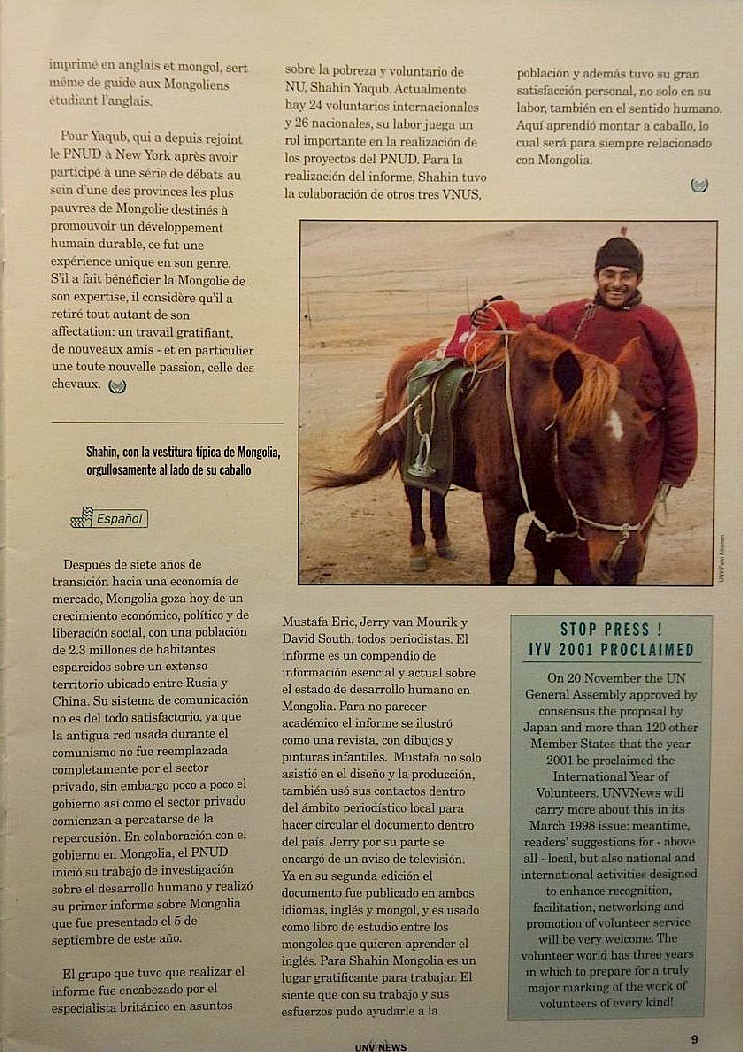
    Yaqub, who had worked in poverty analysis in the Philippines and Bangladesh before coming to Mongolia, will never forget the country that sparked his new passion: horses.

    “You give up things as a volunteer – your time, your income, all the things you took for granted back home. But what you give up is compensated by rewarding work and good friends. When I learned to ride a horse, I can place it directly and clearly to Mongolia – that memory will always be with me.”

    Just before Yaqub left Mongolia for work with UNDP in New York, he participated in a series of public debates in one of Mongolia’s poorest provinces, Khuvsgul aimag. The public debates are used to introduce the report to the grassroots while sparking discussion on sustainable human development.

    Starting from scratch – The challenge of transition

    Résumé en Français

    UNV News #78 November 97

    Sept années de transition vers une économie de marché et une libéralisation rapide tant économique et politique que sociale, ont profondément transformé la Mongolie, vaste territoire à faible densité de population bordé par la Russie et la Chine. Les communi-cations se sont fortement détériorées et ni le gouvernement ni le secteur privé ne se trouvaient manifestement en mesure d’évaluer l’impact de la transition sur la population. En collaboration avec le gouvernement, le PNUD a donc procédé à l’établissement du premier rapport sur le développement humain en Mongolie, publié en septembre de cette année.

    Plusieurs VNU parmi le nombre croissant de volontaires actuellement en poste en Mongolie au sein de projets du PNUD – 24 internationaux et 26 nationaux – y ont pris une part prépondérante, tout particulièrement Shahin Yaqub, spécialiste britannique en recherche sur la pauvreté. Pour Yaqub, puis pour ses trois collègues VNU Mustafa Erik, Jerry van Mourik et David South, le défi consistait à partir de rien – pas de bureau, une base de statistiques existante… mais sur des ordinateurs russes hors service – pour mettre sur pied un rapport riche en informations qui, une fois terminé, n’irait pas dormir sur l’étagère d’un bureau gouvernemental mais servirait de base à une action durable à l’échelon national. Grâce au format adopté – un magazine abondamment illustré – , à sa présentation par les médias – notamment la télévision – et à sa diffusion à travers le pays entier, c’est chose faite. Le rapport, imprimé en anglais et mongol, sert même de guide aux Mongoliens étudiant l’anglais.

    Pour Yaqub, qui a depuis rejoint le PNUD à New York après avoir participé à une série de débats au sein d’une des provinces les plus pauvres de Mongolie destinés à promouvoir un développement humain durable, ce fut une expérience unique en son genre.

    S’il a fait bénéficier la Mongolie de son expertise, il considère qu’il a retiré tout autant de son affectation: un travail gratifiant, de nouveaux amis – et en particulier une toute nouvelle passion, celle des chevaux.

    Starting from scratch – The challenge of transition

    Resumen en Español

    UNV News #78 November 97

    Después de siete años de transición hacia una economía de mercado, Mongolia goza hoy de un crecimiento económico, político y de liberación social, con una población de 2.3 millones de habitantes esparcidos sobre un extenso territorio ubicado entre Rusia y China. Su sistema de comunicación no es del todo satisfactorio, ya que la antigua red usada durante el comunismo no fue reemplazada completamente por el sector privado, sin embargo poco a poco el gobierno así como el sector privado comienzan a percatarse de la repercusión. En colaboración con el gobierno en Mongolia, el PNUD inició su trabajo de investigación sobre el desarrollo humano y realizó su primer informe sobre Mongolia que fue presentado el 5 de septiembre de este año.

    El grupo que tuvo que realizar el informe fue encabezado por el especialista británico en asuntos sobre la pobreza y voluntario de NU, Shahin Yaqub. Actualmente hay 24 voluntarios internacionales y 26 nacionales, su labor juega un rol importante en la realización de los proyectos del PNUD. Para la realización del informe, Shahin tuvo la colaboración de otros tres VNUS, Mustafa Eric, Jerry van Mourik y David South, todos periodistas. El informe es un compendio de información esencial y actual sobre el estado de desarrollo humano en Mongolia. Para no parecer académico el informe se ilustró como una revista, con dibujos y pinturas infantiles. Mustafa no solo asistió en el diseño y la producción, también usó sus contactos dentro del ámbito periodístico local para hacer circular el documento dentro del país. Jerry por su parte se encargó de un aviso de televisión. Ya en su segunda edición el documento fue publicado en ambos idiomas, inglés y mongol, y es usado como libro de estudio entre los mongoles que quieren aprender el inglés. Para Shahin Mongolia es un lugar gratificante para trabajar. El siente que con su trabajo y sus esfuerzos pudo ayudarle a la población y además tuvo su gran satisfacción personal, no solo en su labor, también en el sentido humano. Aquí aprendió montar a caballo, lo cual será para siempre relacionado con Mongolia.

    https://davidsouthconsulting.org/2020/12/19/case-study-4-un-undp-mongolia-1997-1999/

    Citation

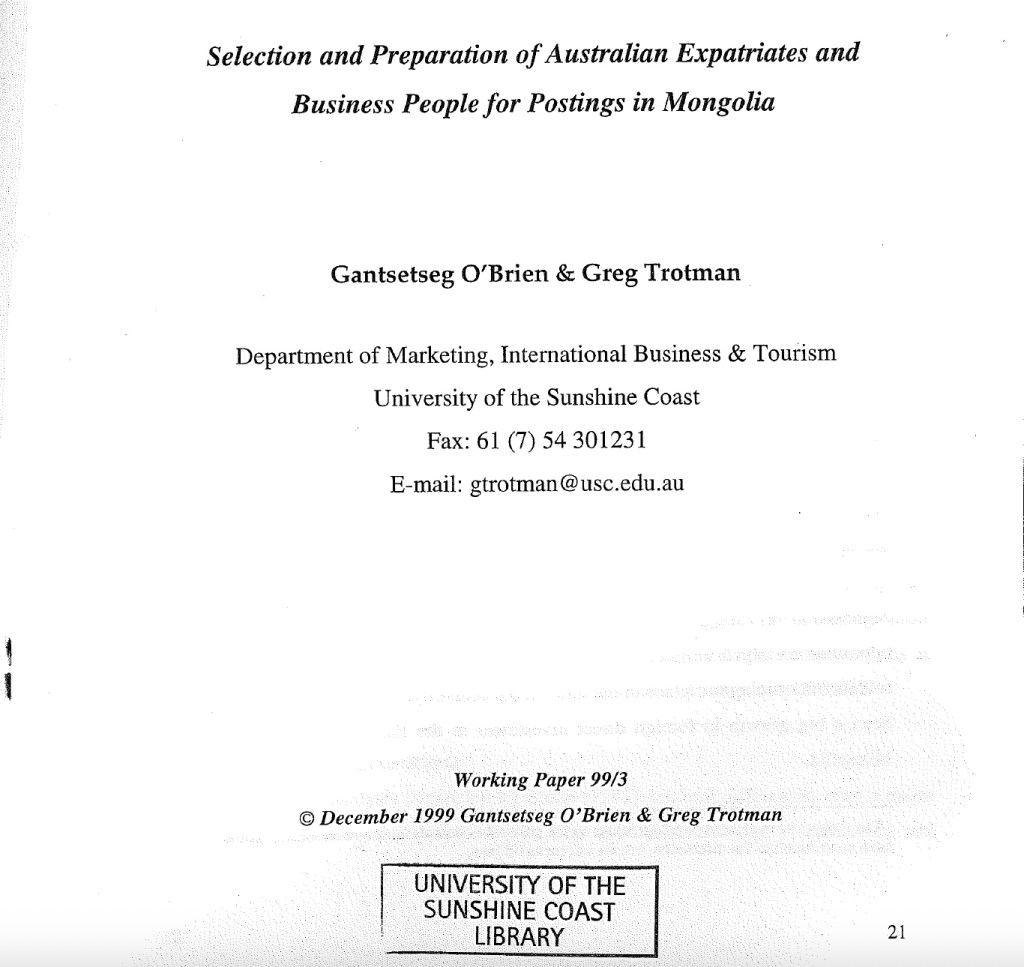
    O’Brien, Gantsetseg and Trotman, Greg (1999) “Selection and Preparation of Australian Expatriates and Business People for Postings in Mongolia,” University of the Sunshine Coast, Department of Marketing, International Business & Tourism, Working Paper 99/3.

    This work is licensed under a Creative Commons Attribution 4.0 International License.

    ORCID iD: https://orcid.org/0000-0001-5311-1052.

    © David South Consulting 2025
  • China Looking to Lead on Robot Innovation

    China Looking to Lead on Robot Innovation

    By David SouthDevelopment Challenges, South-South Solutions

    SOUTH-SOUTH CASE STUDY

    Since the 1950s, science fiction has been telling the world we will soon be living with robots. While robots have emerged, they have been mostly kept to heavy industry, where machines can perform dangerous, hot and unpleasant repetitive tasks to a high standard.

    But China is pioneering the move to mainstream robots in more public spheres. And the country is promising big changes in the coming decade.

    Robots, strange as it may seem, can play a key role in development and fighting poverty.

    If used intelligently, the rise of robots and robotics – itself a consequence of huge technological advances in information technology, the Internet, nanotechnology,artificial intelligence, and mobile communications – can free workers from boring, difficult and dangerous jobs. This can ramp up the provision of public goods like cleaning services in urban areas, or remove the need to do back-breaking farming work.

    Robotics also offers a new field of high-tech employment for countries in the global South who are producing far more educated engineering and science students than they can currently employ. These students can help build the new robot economy.

    China is considered to be in the early stages of competing with robot pioneers such as Japan, Switzerland, Germany, Sweden and the United States. And China still has a low penetration of industrial robots per population. In 2011 estimates placed the number of industrial robots in China at 52,290 (International Federation of Robotics) (ifr.org).

    In the years ahead, China confronts a double demographic problem. It has the world’s largest elderly population, who will need care, and it also has a shrinking number of young people available to work as a result of the country’s one-child policy (http://en.wikipedia.org/wiki/One-child_policy).

    Robots can help solve these problems.

    China started its robotics research in the 1970s and ramped it up from 1985. It has already made significant progress manufacturing domestic robots for cleaning. The Xiamen Lilin Electronics Co., Ltd. (http://cnlilin.en.made-inchina.

    com/) makes vacuum cleaners that are small round robots smart enough to return to their recharging stations when low on power. Another firm, Jetta Company (http://www.jetta.com.hk/home.htm), has built and sells the iRobot Roomba vacuum cleaning and floor-washing robots (http://www.irobot.com/uk/store.aspx?camp=ppc:google:products_roomba:G_790612075_1846279957_iRobot%20roomba:roomba_brand&gclid=CMiezMiG8a4CFc4LtAodYE3MKw).

    For the heavy duty stuff, there is Ningbo’s Dukemen Robot, sold with the slogan “man, technology, robot”. The company manufactures arm-like robots for heavy lifting and lifting in dangerous or uncomfortable environments (dukerobot.com/ks/robot-manufacturers/).

    A company called Quick specializes in making soldering equipment for manufacturing electronic components and sells robots that can do this with high accuracy and speed (quick-global.com/9-new-soldering-robot-1.html).

    Other robotic advances in China include a robot dolphin that swims through the water measuring its quality.

    There are also robots in development to do housework and help people who need assistance in the home like the elderly and the disabled. These robots can monitor a person’s physical condition and provide psychological counselling and search for, and deliver, requested items. One example is called UNISROBO, and is based on the Japanese robot PaPeRo robot (http://www.nec.co.jp/products/robot/en/index.html).

    Still other robots can perform surgical procedures or even play sport, like Zhejiang University’s ping pong-playing robot (http://www.youtube.com/watch?v=4BtHYHi7trA).

    Even more ambitiously, China is developing robots to send to the moon.

    The push to introduce robots into the workplace and wider society is receiving considerable attention in China.

    The Taiwan-based technology company Foxconn – well-known for assembling products for the American company Apple, maker of the iPad and iPhone -has pledged to deploy a million robots in its Chinese factories in the coming years to improve efficiency.

    Some are forecasting that if China starts building robots on the scale it has pledged, then the world’s population of manufacturing robots will grow tenfold in 10 years.

    China is also broaching one of the trickiest aspects of robotics – getting robots to interact with humans.

    The tricky bit in robotics is getting interaction with human beings right and to avoid the experience being intimidating or frightening. One sector that is already ahead in experimenting with this aspect of robots is the restaurant business. One robot being used in restaurants sits on a tricycle trolley laden with drinks. It cycles from table to table in endless rotation allowing customers to choose drinks when they like.

    The first robot restaurant started a trial run in 2010 in Jinan (http://en.wikipedia.org/wiki/Jinan), the capital of Shandong Province. The hot pot restaurant uses six robots to help with the service. The restaurant has also given itself the perfect name for this new approach: Continental Robot Experience Pavilion. Adorned with robot posters, the restaurant is 500 square metres in size and can seat 100 diners.

    Diners at the Continental Robot Experience Pavilion are greeted by two ‘female’ “beauty robot receptionists” dressed in uniforms. Inside, the six robot waiters serve the customers. There are two to deliver drinks and two to serve the small tables and two to serve the big tables.

    The robot comes to the table and takes the customers’ orders for food dishes and drinks. The robots, designed with sensors to stop them moving when they sense something or someone in front of them, are able to handle 21 tables and deal with the 100 customers at a single sitting.

    The robots have proven so effective, the restaurant’s staff can stay focused on administration and providing assistance. The cooking is still done by human beings.

    This trial run is designed to test the concept and the novelty of having robots attracting customers, the restaurant’s manager told the People’s Daily Online.

    The plan is to increase the number of robots to 40 and also to have robots do cleaning and other tasks.

    “They have a better service attitude than humans,” said Li Xiaomei, 35, who was visiting the restaurant for the first time. “Humans can be temperamental or impatient, but they don’t (the robots) feel tired, they just keep working and moving round and round the restaurant all night,” Li said to China Daily.

    Published: March 2012

    Resources

    1) The Robot Report: It boasts compiling more than 1,400 robotics-related links and is about “Tracking the business of robotics”. Website: therobotreport.com

    2) The Robot Shop: Bills itself as “The world’s leading source for professional robot technology” and sells online all the parts, kits, toys, tools and equipment to get any enthusiast or small and medium enterprise working with robotics quickly. Website: robotshop.com

    3) Robot App Store: Sells ‘apps’ or software applications to expand the capabilities of robots. It also operates as a store for application developers to sell their robot apps to others. Also has information and resources on how to get started making robot apps and making money from making robot apps. Website: robotappstore.com

    4) Roboearth: Funded by the European Union, RoboEarth is an online, open source network where robots can communicate with each other and share information and “learn from each other about their behaviour and their environment. Bringing a new meaning to the phrase “experience is the best teacher”, the goal of RoboEarth is to allow robotic systems to benefit from the experience of other robots, paving the way for rapid advances in machine cognition and behaviour, and ultimately, for more subtle and sophisticated human-machine interaction. Website: roboearth.org

    5) Robotland: A blog writing about the “visions, ideas, innovations, awards, trends and reports from leading robotics research and development places in the world”. Website: http://robotland.blogspot.co.uk/

    6) China Hi-Tech Fair: Running from 16-21 November 2012, the Fair is a great way to see the latest developments in robotics in China. Website: chtf.com/english/

    7) Singularity Hub: A cornucopia of robotic resources and news on “science, technology and the future of mankind”. Website: http://singularityhub.com/

    Development Challenges, South-South Solutions was launched as an e-newsletter in 2006 by UNDP’s South-South Cooperation Unit (now the United Nations Office for South-South Cooperation) based in New York, USA. It led on profiling the rise of the global South as an economic powerhouse and was one of the first regular publications to champion the global South’s innovators, entrepreneurs, and pioneers. It tracked the key trends that are now so profoundly reshaping how development is seen and done. This includes the rapid take-up of mobile phones and information technology in the global South (as profiled in the first issue of magazine Southern Innovator), the move to becoming a majority urban world, a growing global innovator culture, and the plethora of solutions being developed in the global South to tackle its problems and improve living conditions and boost human development. The success of the e-newsletter led to the launch of the magazine Southern Innovator.  

    Follow @SouthSouth1

    Slideshare: http://www.slideshare.net/DavidSouth1/development-challengessouthsouthsolutionsnovember2010issue

    Southern Innovator Issue 1: https://books.google.co.uk/books?id=Q1O54YSE2BgC&dq=southern+innovator&source=gbs_navlinks_s

    Southern Innovator Issue 2: https://books.google.co.uk/books?id=Ty0N969dcssC&dq=southern+innovator&source=gbs_navlinks_s

    Southern Innovator Issue 3: https://books.google.co.uk/books?id=AQNt4YmhZagC&dq=southern+innovator&source=gbs_navlinks_s

    Southern Innovator Issue 4: https://books.google.co.uk/books?id=9T_n2tA7l4EC&dq=southern+innovator&source=gbs_navlinks_s

    Southern Innovator Issue 5: https://books.google.co.uk/books?id=6ILdAgAAQBAJ&dq=southern+innovator&source=gbs_navlinks_s

    Citations

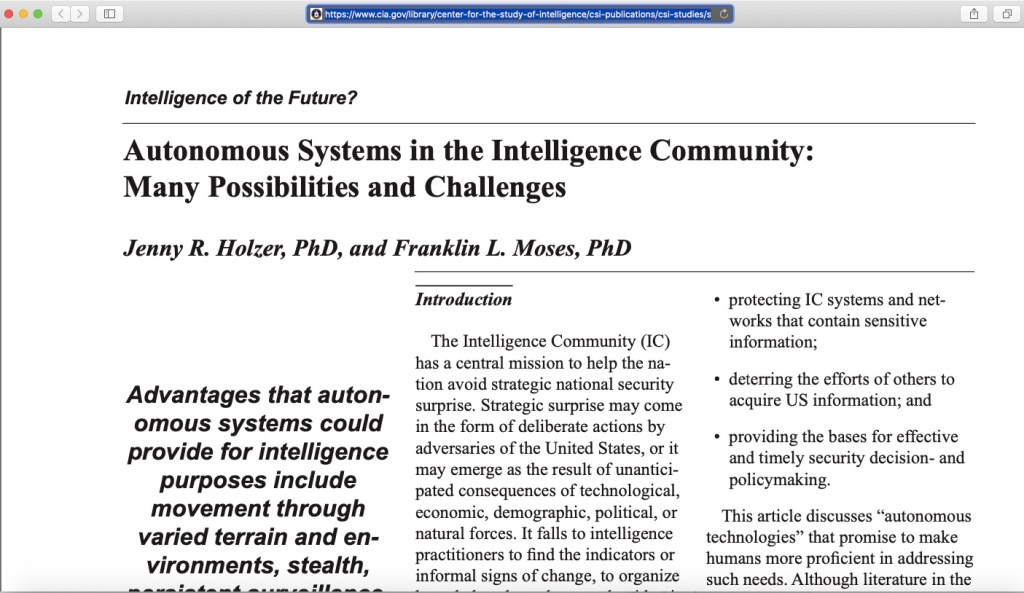
    Cited in Studies in Intelligence, Autonomous Systems in the Intelligence Community: Many Possibilities and Challenges, Vol. 59, No.1 (Extracts, March 2015).

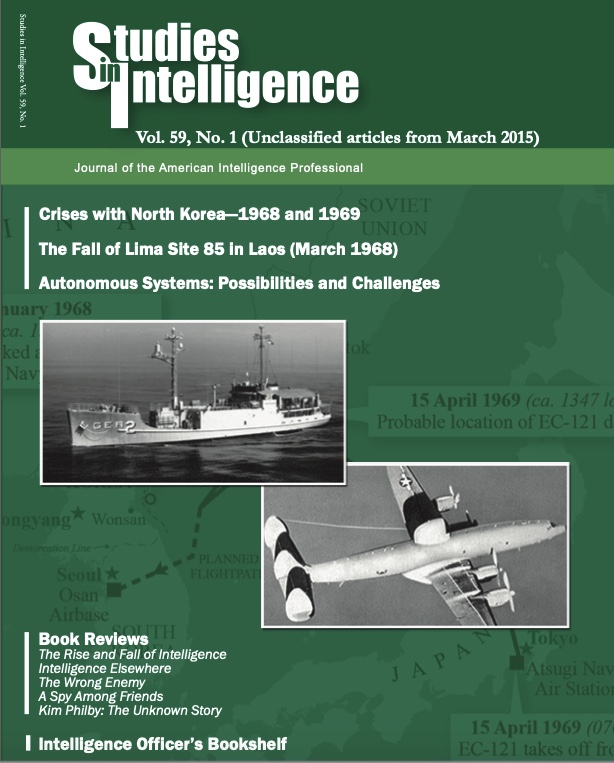
    Studies in Intelligence, Vol. 59, No.1 (Unclassified articles from March 2015).
    Autonomous Systems in the Intelligence Community: Many Possibilities and Challenges by Jenny R. Holzer, PhD, and Franklin L. Moses, PhD in Studies in Intelligence Vol 59, No. 1 (Extracts, March 2015).
    Autonomous Systems in the Intelligence Community: Many Possibilities and Challenges by Jenny R. Holzer, PhD, and Franklin L. Moses, PhD in Studies in Intelligence Vol 59, No. 1 (Extracts, March 2015).
    Link: https://www.cia.gov/resources/csi/studies-in-intelligence/volume-59-no-1/autonomous-systems-in-the-intelligence-community-many-possibilities-and-challenges/.

    More China stories:

    Better by Design in China

    https://davidsouthconsulting.org/2021/12/20/better-by-design-in-china/

    https://davidsouthconsulting.org/2022/10/20/china-consumer-market-asian-perspective-helps/

    China Pushing Frontiers of Medical Research

    https://davidsouthconsulting.org/2020/04/25/china-pushing-frontiers-of-medical-research/

    China Sets Sights on Dominating Global Smartphone Market

    https://davidsouthconsulting.org/2020/12/10/china-sets-sights-on-dominating-global-smartphone-market/

    https://davidsouthconsulting.org/2022/10/04/chinas-booming-wine-market-can-boost-south/

    China’s Outsourced Airliner Development Model

    https://davidsouthconsulting.org/2020/04/29/chinas-outsourced-airliner-development-model/

    https://davidsouthconsulting.org/2021/03/20/computer-gold-farming-turning-virtual-reality-into-real-profits/

    Creating Green Fashion in China

    https://davidsouthconsulting.org/2021/01/25/creating-green-fashion-in-china/

    https://davidsouthconsulting.org/2020/12/11/cyber-cities-an-oasis-of-prosperity-in-the-south/

    Designed in China to Rival ‘Made in China’

    https://davidsouthconsulting.org/2021/01/26/designed-in-china-to-rival-made-in-china/

    https://davidsouthconsulting.org/2022/10/04/popular-chinese-social-media-chase-new-markets/

    https://davidsouthconsulting.org/2021/10/04/putting-quality-and-design-at-the-centre-of-chinese-fashion/

    Rammed-Earth Houses: China Shows how to Improve and Respect Traditional Homes

    https://davidsouthconsulting.org/2021/02/12/rammed-earth-houses-china-shows-how-to-improve-and-respect-traditional-homes/

    Virtual Supermarket Shopping Takes off in China

    https://davidsouthconsulting.org/2020/04/17/virtual-supermarket-shopping-takes-off-in-china/

    Creative Commons License

    This work is licensed under a
    Creative Commons Attribution-Noncommercial-No Derivative Works 3.0 License.

    ORCID iD: https://orcid.org/0000-0001-5311-1052.

    © David South Consulting 2023