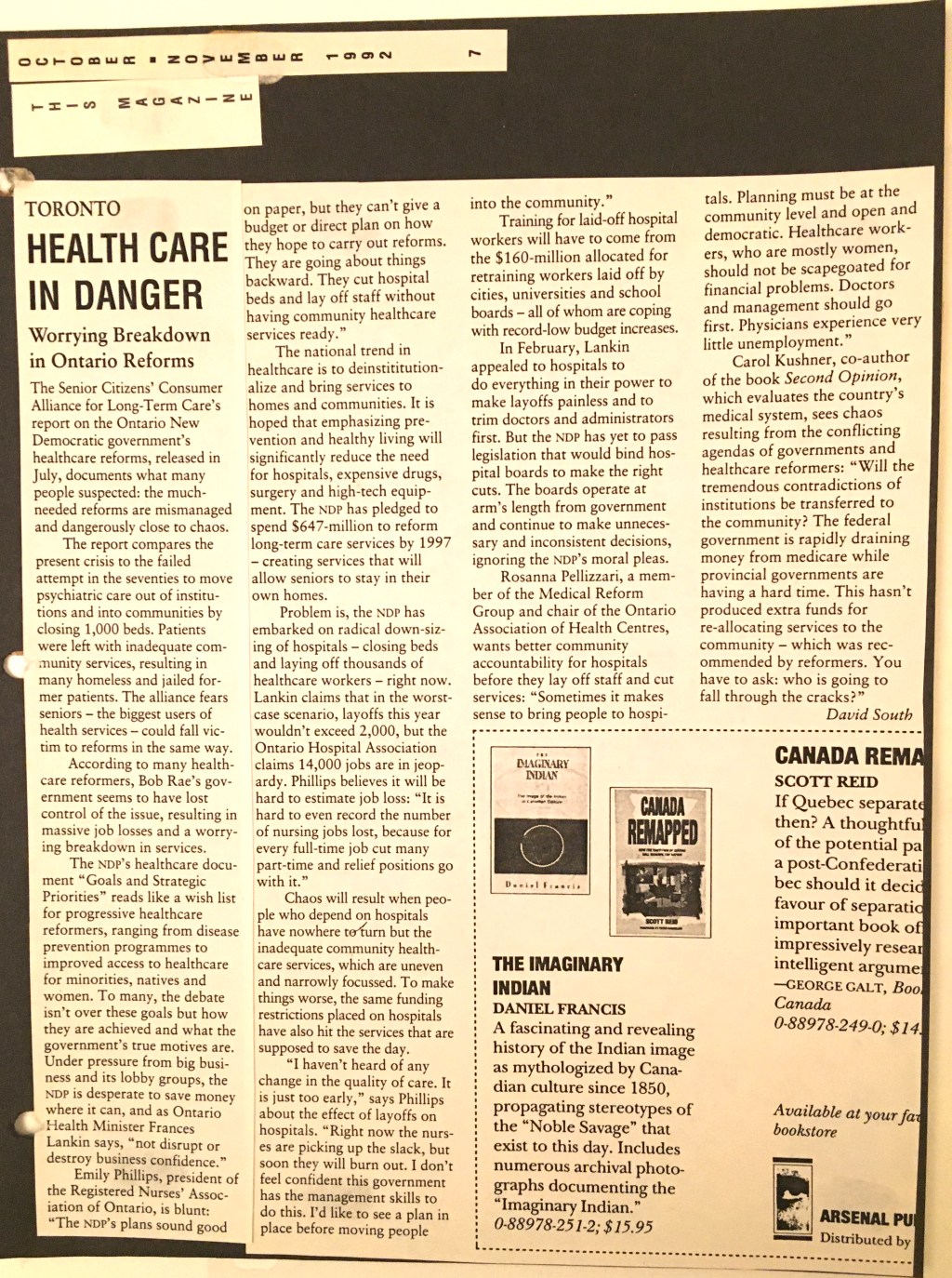
The Senior Citizens’ Consumer Alliance for Long-Term Care’s report on the Ontario New Democratic government’s health care reforms, released in July, documents what many people suspected: the much-needed reforms are mismanaged and dangerously close to chaos.
The report compares the present crisis to the failed attempt in the seventies to move psychiatric care out of institutions and into communities by closing 1,000 beds. Patients were left with inadequate community services, resulting in many homeless and jailed former patients. The alliance fears seniors – the biggest users of health services – could fall victim to reforms in the same way.
According to many health care reformers, Bob Rae’s government seems to have lost control of the issue, resulting in massive job losses and a worrying breakdown in services.
The NDP’s health care document “Goals and Strategic Priorities” reads like a wish list for progressive health care reformers, ranging from disease prevention programmes to improved access to health care for minorities, natives and women. To many, the debate isn’t over these goals but how they are achieved and what the government’s true motives are. Under pressure from big business and its lobby groups, the NDP is desperate to save money where it can, and as Ontario Health Minister Francis Lankin says, “not disrupt or destroy business confidence.”
Emily Phillips, president of the Registered Nurses’ Association of Ontario, is blunt: “The NDP’s plans sound good on paper, but they can’t give a budget or direct plan on how they hope to carry out reforms. They are going about things backward. They cut hospital beds and lay off staff without having community health care services ready.”
The national trend in health care is to deinstitutionalize and bring services to homes and communities. It is hoped that emphasizing prevention and healthy living will significantly reduce the need for hospitals, expensive drugs, surgery and high-tech equipment. The NDP has pledged to spend $647 million to reform long-term care services by 1997 – creating services that will allow seniors to stay in their own homes.
Problem is, the NDP has embarked on radical down-sizing of hospitals – closing beds and laying off thousands of health care workers – right now. Lankin claims that in the worst-case scenario, layoffs this year wouldn’t exceed 2,000, but the Ontario Hospital Association claims 14,000 jobs are in jeopardy. Phillips believes it will be hard to estimate job loss: “It is hard to even record the number of nursing jobs lost, because for every full-time job cut many part-time and relief positions go with it.”
Chaos will result when people who depend on hospitals have nowhere to turn but the inadequate community health care services, which are uneven and narrowly focussed. To make things worse, the same funding restrictions placed on hospitals have also hit the services that are supposed to save the day.
“I haven’t heard of any change in the quality of care. It is just too early,” says Phillips about the effect of layoffs on hospitals. “Right now the nurses are picking up the slack, but soon they will burn out. I don’t feel confident this government has the management skills to do this. I’d like to see a plan in place before moving people into the community.”
Training for laid-off hospital workers will have to come from the $160-million allocated for retraining workers laid off by cities, universities and school boards – all of whom are coping with record-low budget increases.
In February, Lankin appealed to hospitals to do everything in their power to make layoffs painless and to trim doctors and administrators first. But the NDP has yet to pass legislation that would bind hospital boards to make the right cuts. The boards operate at arm’s length from government and continue to make unnecessary decisions, ignoring the NDP’s moral pleas.
Rosana Pellizzari, a member of the Medical Reform Group and chair of the Ontario Association of Health Centres, wants better community accountability for hospitals before they lay off staff and cut services: “Sometimes it makes sense to bring people to hospitals. Planning must be at the community level and open and democratic. Health care workers, who are mostly women, should not be scapegoated for financial problems. Doctors and management should go first. Physicians experience very little unemployment.”
Carol Kushner, co-author of the book Second Opinion, which evaluates the country’s medical system, sees chaos resulting from the conflicting agendas of governments and health care reformers: “Will the tremendous contradictions of institutions be transferred to the community? The federal government is rapidly draining money from medicare while provincial governments are having a hard time. This hasn’t produced extra funds for re-allocating services to the community – which was recommended by reformers. You have to ask: who is going to fall through the cracks?”
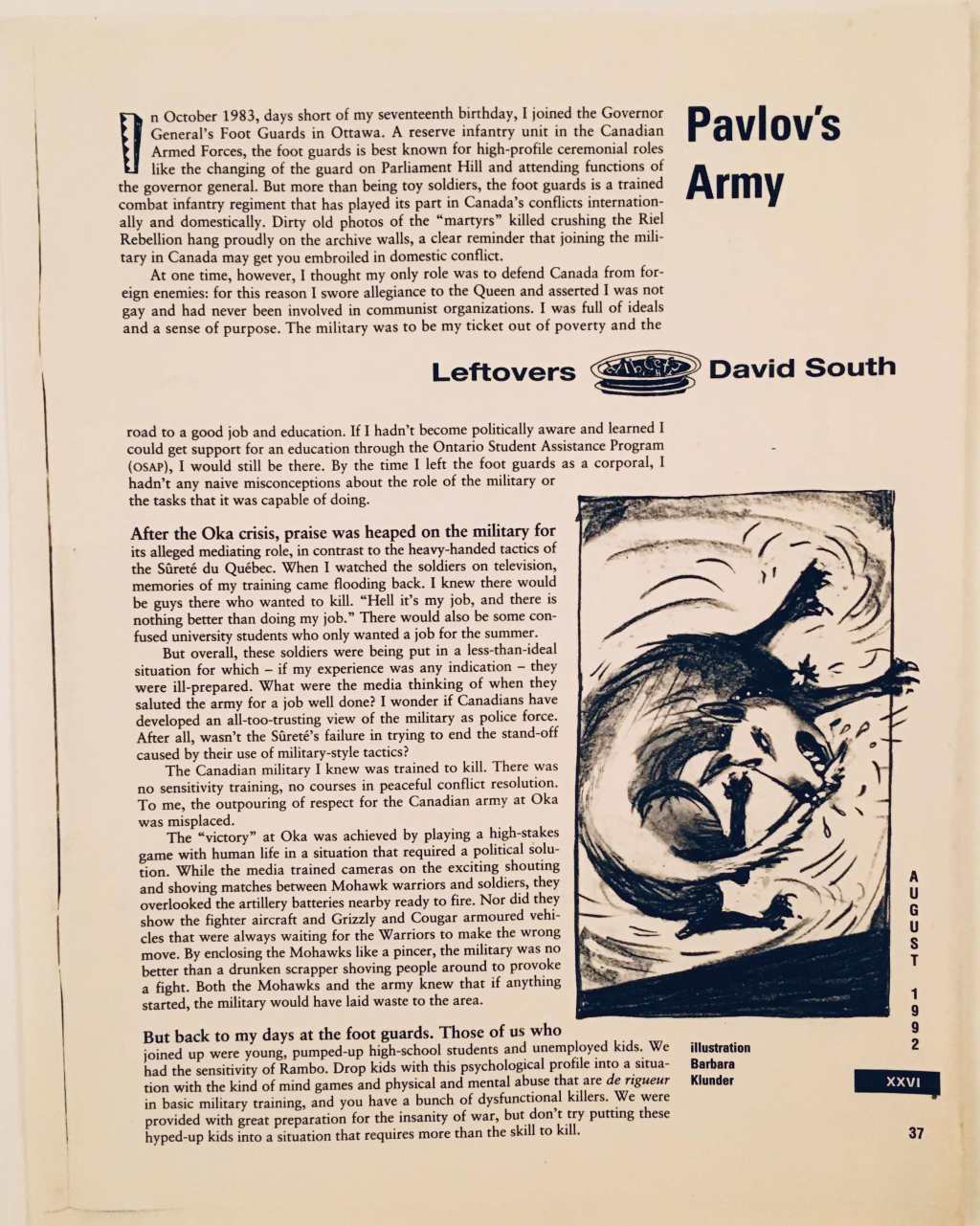
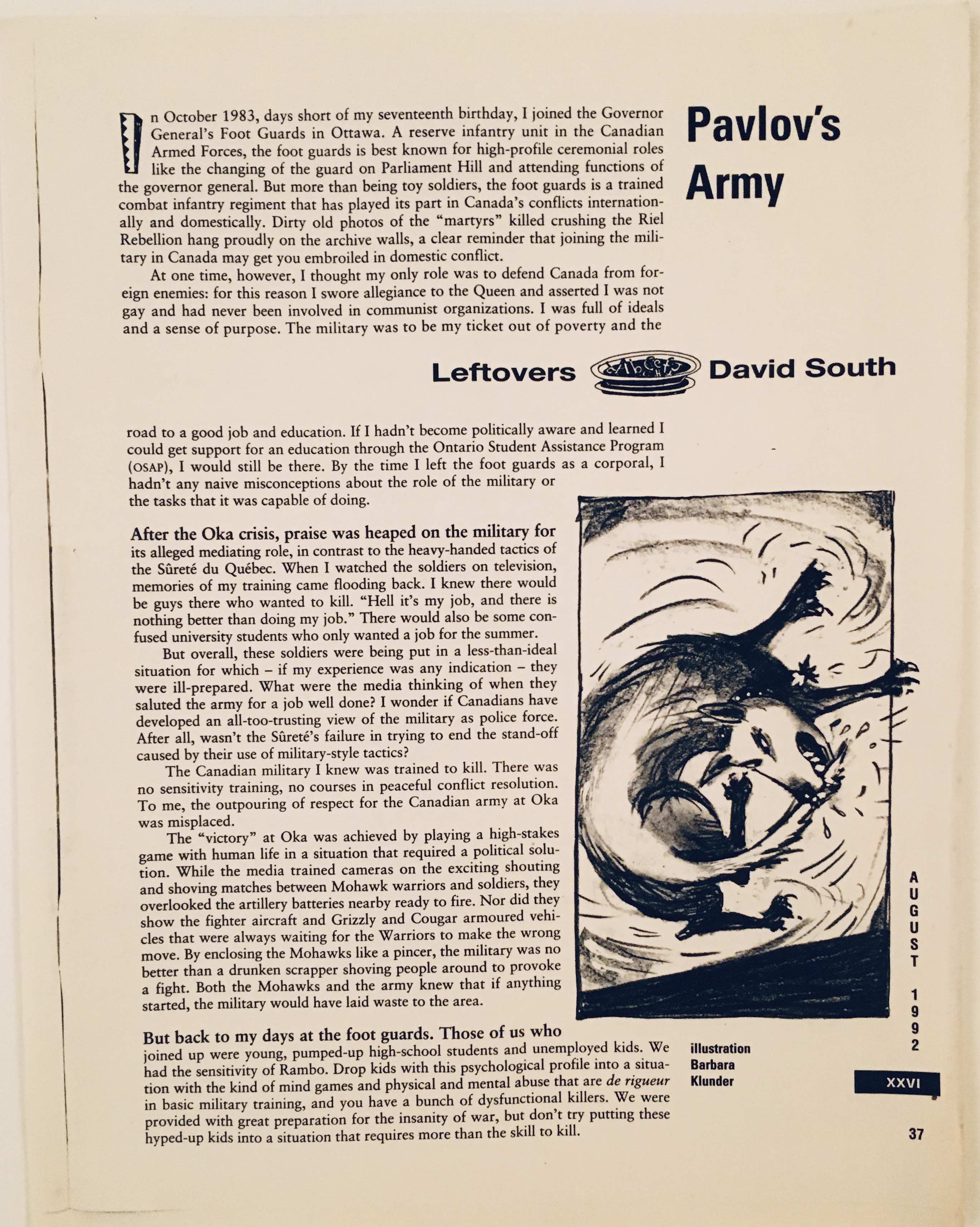
In August 1992 I wrote a feature for Canada’s This Magazine. The country was in the depths of a severe recession and an austerity crisis but this also came with two emergencies requiring the Canadian Armed Forces: the first Gulf War from 1990 to 1991, and at home, the 1990 Oka Crisis. A few years prior (1988) changes were made to the War Measures Act (Canada invoked the War Measures Act in 1970 during the October FLQ Crisis, bringing troops to Canadian streets and mass arrests), replacing it with something called the Emergency Measures Act (EMA) (now Emergencies Act), which was given Royal Assent in 1988. I interviewed various legal experts on this new legislation and its implications and applications in future civil emergencies.
“The EMA WILL be used to suppress civil liberties in various parts of the country,” says Rosenthal. “A thing to keep in mind is that although the War Measures Act was passed during the First World War, it wasn’t used in a terrible way until 1970. The emergencies legislation is on the books. The Public Order Emergency could be used to suppress any kind of legitimate dissent.”
Many critics fear there is potential for manipulation of the EMA in the heat of the moment in the hands of an unscrupulous government.
“Words are very malleable,” says Rosenthal. “It was absurd for Trudeau to claim that there was an apprehended insurrection in Quebec in 1970. As he said the words he knew it was a lie.”
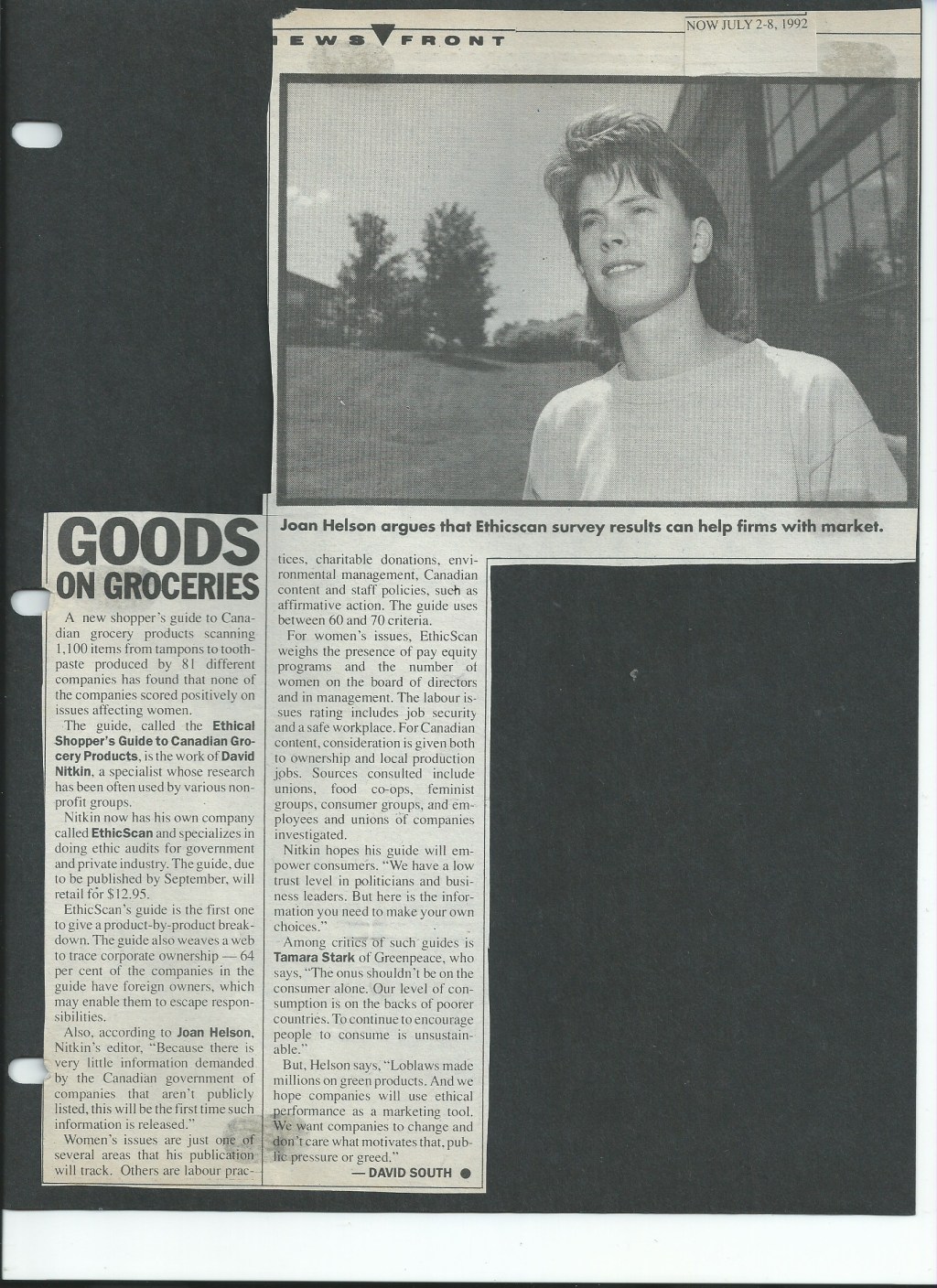
Where social activists have tried and failed to get Canadian corporations to change their behaviour towards the environment, labour, women and minorities, EthicScan Canada – a for-profit consulting and research firm – steps in.
Toronto-based EthicScan acts as a consultant on ethical issues to both government and private businesses and produces a guide for investors. Its latest project hit the bookstores last fall. The Ethical Shopper’s Guide to Supermarket Products rates products according to companies’ ethical performance. “EthicScan is the only company in Canada doing this,” says senior writer Joan Helsen. “Companies respond to us differently because we are – like them – a business. We have a very good reputation for doing strong research and presenting the facts.”
Non-profit groups have produced similar guides. In the US, perhaps the best known is the American Council on Economic Priorities’ Shopping for a Better World. Here in Canada, both Pollution Probe’s Green Consumer Guide and the Ontario Public Interest Research Group’s The Supermarket Tour offer educational information.
But The Ethical Shopper’s Guide is the first guide in Canada to give a product-by-product breakdown, and to detail the web of corporate ownership. It lists more than 1,200 brand-name products from baby food to soft drinks, with the manufacturer’s “grade” for each ethical category. The guide also profiles 87 companies, with an “honour roll” of 37 corporations.
All of this can be confusing. Oxo gets an F for “women’s issues” and F+ for “environmental management,” but scores A+ on “progressive staff policies” and “environmental performance.” (Apparently. “environmental management” has to do with company structures for dealing with environmental issues while “environmental performance” measures how much it actually pollutes.) What aspect of Oxo’s ethical behaviour do you reward or punish?
EthicScan’s approach fits current advertising trends. Nissan tells us it is just trying to build cars we can live with. Loblaws puts “Green” on everything from plastic garbage bags to tubes of shampoo. But once idea-starved ad copywriters move on to the next gimmick, EthicScan may find that the relationship between ethics and profit isn’t as straightforward as its grading system suggests.







 David South Consulting
You must be logged in to post a comment.