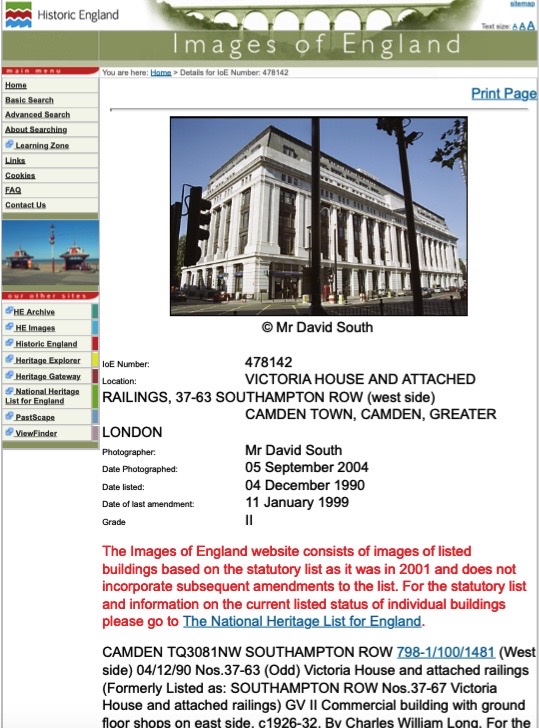
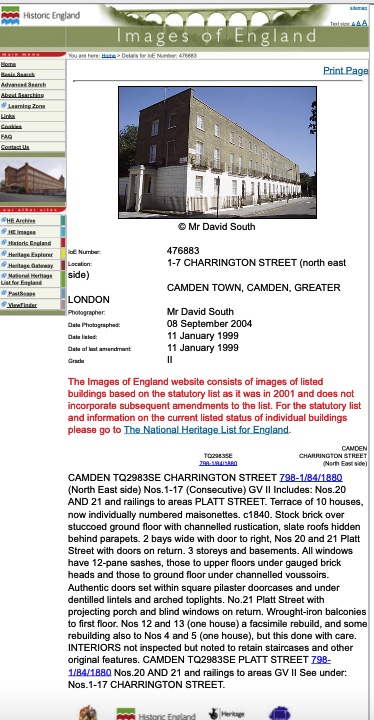
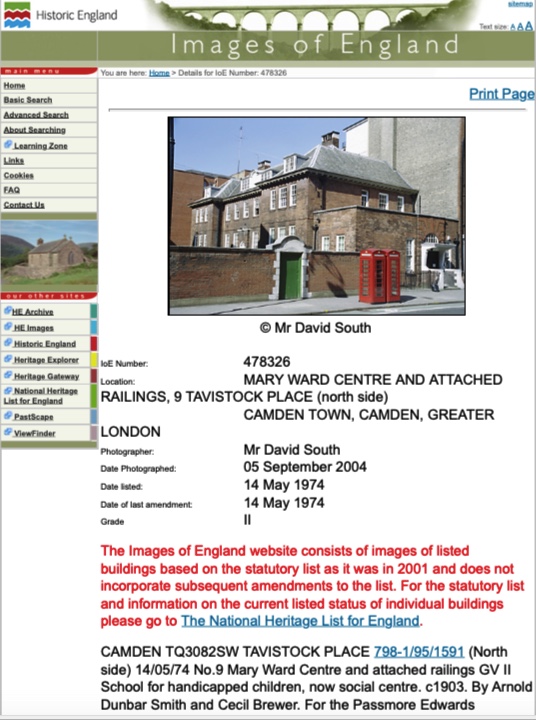
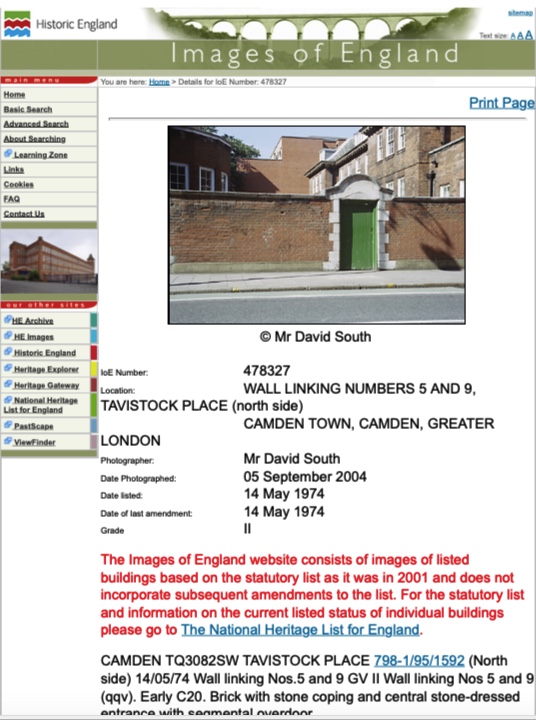
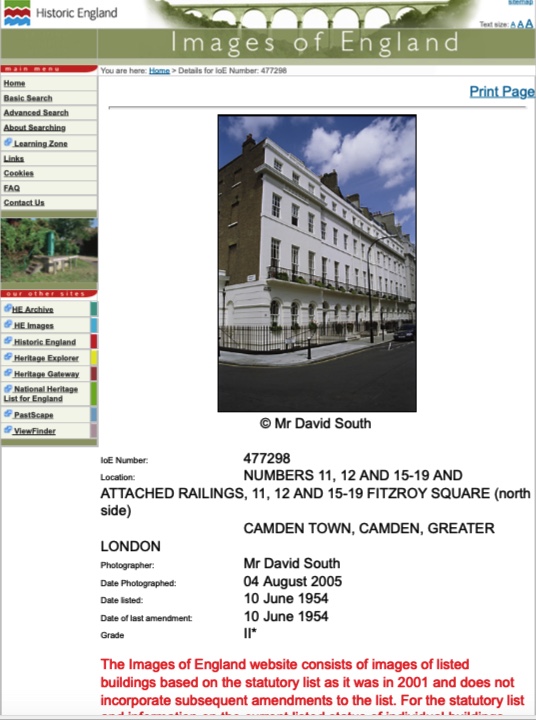
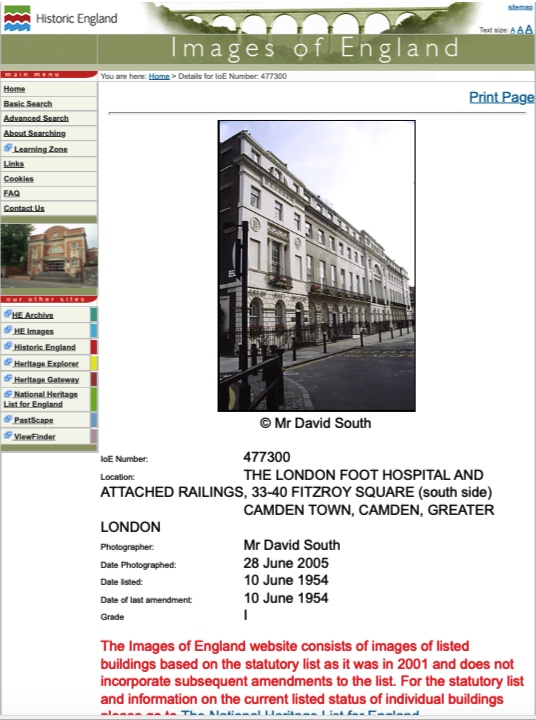
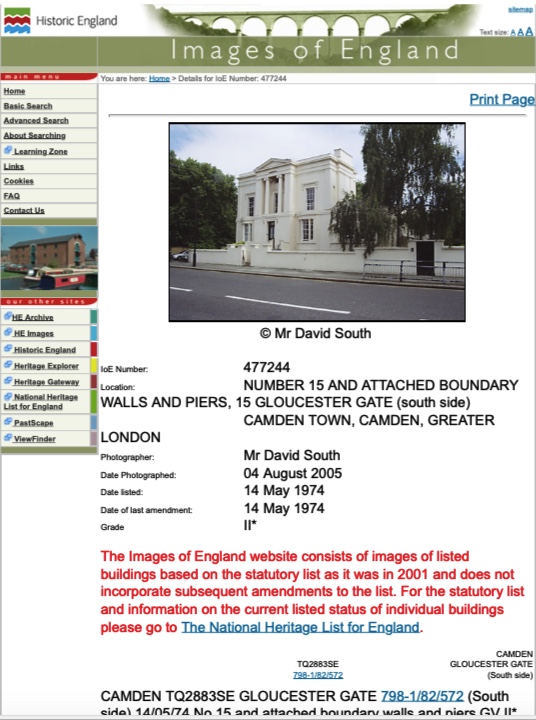
From 2004 to 2005 I participated in an ambitious project to ensure a photographic record of England’s heritage sites and buildings: a visual ‘Doomsday Book’.
“The List is the only official, up to date, register of all nationally protected historic buildings and sites in England.
“The National Heritage List for England (NHLE) is the only official, up to date, register of all nationally protected historic buildings and sites in England – listed buildings, scheduled monuments, protected wrecks, registered parks and gardens, and battlefields.
“Images of England was a photographic record of every listed building in England, created as a snap shot of listed buildings at the turn of the millennium. These photographs of the exterior of listed buildings were taken by volunteers between 1999 and 2008. The project was supported by the Heritage Lottery Fund.”
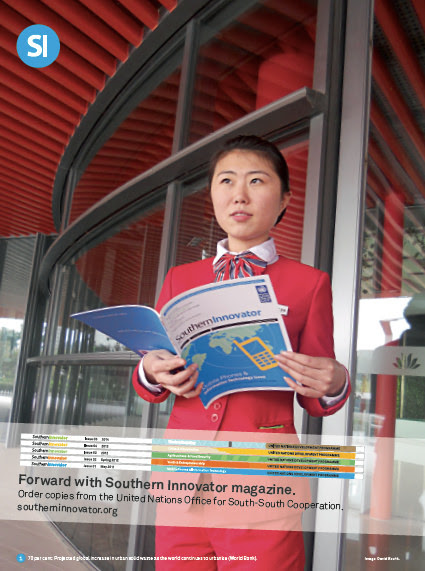
Southern Innovator Magazine Issue 5: Waste and Recycling, Editor and Writer: David South (ISBN 978-0-9920217-1-9) (ISSN 2222-9280) (Online: ISSN 2227-0523): Southern Innovator’s fifth issue tackles the theme of waste and recycling in the global South. It has unearthed radical new ways to use the Earth’s resources while efficiently raising living standards for the world’s majority. Waste no longer needs to pile up and pollute the environment and communities; it can be a source of wealth and provide sustainable livelihoods.
Radical ways to alter how things are made, such as the production model called cradle-to-cradle, have the potential to meet human needs without harming the environment and human health. Effective use of renewable energy technologies and sources also could eliminate energy poverty in the global South, dramatically raising living standards and boosting human development.
“We are proud to present our first book entry in David South’s 5th Issue of the Southern Innovator Magazine. The general focus of this paper is to show the rise of the south as a strong economic power, this year’s issue is focussing on the dilemma of strong population growth and limited resources with the focus on waste and recycling issues for example the elephant dung paper production in Thailand, the banning of plastic bags in Uganda or the creation of green fashion in China.”NEEMIC
“@SouthSouth1 is one of the best sources out there for news and info on #solutions to #SouthSouth challenges.”Adam Rogers, Assistant Director, Regional Representative, Europe, United Nations Office for South-South Cooperation (UNOSSC)
“Btw, I really enjoyed reading them, impressive work & a great resource. Looking forward to Issue 6. My best wishes to you & your team at SI.”
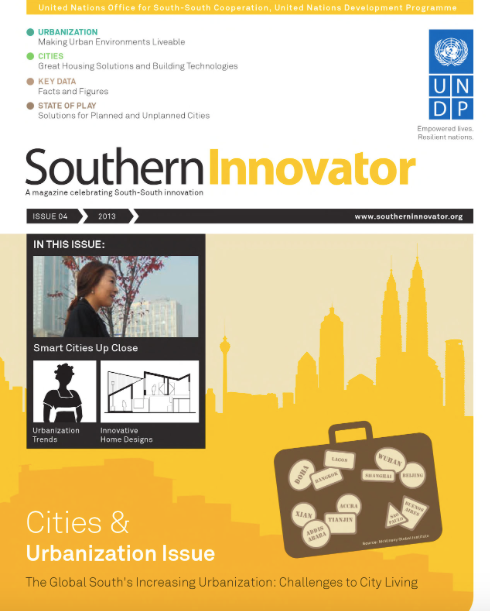
Southern Innovator Magazine Issue 4: Cities and Urbanization, Editor and Writer: David South (ISBN 978-0-9920217-0-2) (ISSN 2222-9280) (Online: ISSN 2227-0523): Southern Innovator’s fourth issue tackled the theme of cities and urbanization in the global South and how innovators are grappling with one of the biggest challenges of our time: the largest migration in history as the world becomes a majority urban place. Southern Innovator profiles new building technologies and innovative designs and also offers social solutions to make living urban better, while improving human development.
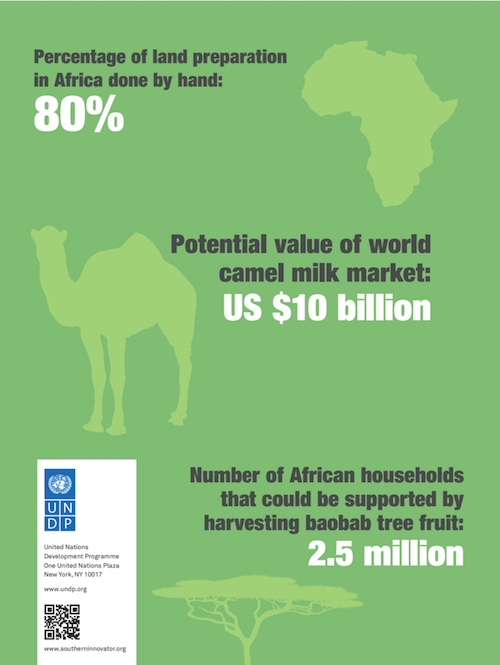
Southern Innovator Magazine Issue 3: Agribusiness and Food Security, Editor and Writer: David South (ISSN 2222-9280) (Online: ISSN 2227-0523): Southern Innovator’s third issue tackled the theme of agribusiness and food security in the global South. It found innovators were proving it is possible to boost farm yields with new techniques that are not costly nor harmful to the environment. It also found the rise of new information technologies, such as mobile phones, offers unlimited options to make farming and food distribution more efficient, profitable and food secure. These information technologies can turn small-scale farmers into agribusinesses if applied correctly.
Southern Innovator Magazine Issue 2: Youth and Entrepreneurship, Editor and Writer: David South (ISSN 2222-9280) (Online: ISSN 2227-0523): Southern Innovator’s second issue tackled the theme of youth and entrepreneurship in the global South. It discovered a growing youth population across the global South and found a disconnect between the enthusiasm and talent of youth and their ability to connect with local economies. This was causing systemic unemployment among youth and wasting a great opportunity to spur growth and innovation in poor countries.
Southern Innovator chronicled various business models that were applicable to young entrepreneurs. Importantly, the business models have been proven to work in developing countries.
“Thank you David – Your insight into the issues facing us a “global Village” is made real in the detail of your article – 10 out of 10 from the moladi team.” Moladi: Building Communities
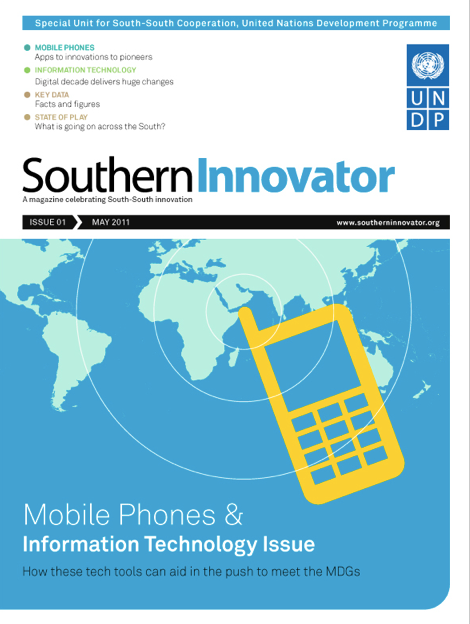
Southern Innovator Magazine Issue 1: Mobile Phones and Information Technology, Editor and Writer: David South (ISSN 2222-9280) (Online: ISSN 2227-0523): Launched in May 2011, the new global magazine Southern Innovator profiles the people across the global South shaping our new world, eradicating poverty and working towards the achievement of the Millennium Development Goals (MDGs). They are the innovators. It chronicles what has been called the Development 2.0 Revolution: the use of innovative new technologies to radically alter the dynamics of development.
Southern Innovator’s first issue tackled the theme of mobile phones and information technology in the global South. It identified mobile phone pioneers and transformative information technologies reducing poverty and boosting human development in the global South. It was one of the first publications to document and capture this trend.
“What a tremendous magazine your team has produced! It’s a terrific tour de force of what is interesting, cutting edge and relevant in the global mobile/ICT space… Really looking forward to what you produce in issues #2 and #3. This is great, engaging, relevant and topical stuff.”Rose Shuman, Founder & CEO, Open Mind and Question Box
“Looks great. Congratulations. It’s Brill’s Content for the 21st century!”Conan Tobias, Managing Editor, Canadian Business
What they are saying about SI on Twitter: From “@CapacityPlus Nice job RT @ActevisCGroup: RT @UNDP: Great looking informative @SouthSouth1 mag on South-South Innovation; @UNDP Great looking informative @SouthSouth1 mag on South-South Innovation; @JeannineLemaireGraphically beautiful & informative @UNDP Southern Innovator mag on South-South Innov.”
“Beautiful, inspiring magazine from UNDP on South-South innovation. Heart is pumping adrenaline and admiration just reading it”Peggy Lee on Pinterest
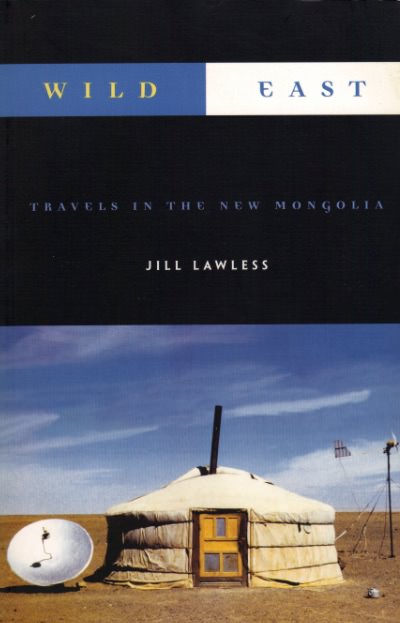
Wild East: Travels in the New Mongolia by Jill Lawless (ISBN 1-55022-434-4): Covering the period of the late 1990s, with Mongolia embroiled in a major economic, social and political crisis, Wild East gives an insightful snapshot of life lived in a country undergoing significant turbulence.
“Jill Lawless’ book is not a scholarly tome per se, yet it is of definite value to the contemporary Mongolian scholar, because it captures a mood flushed out by anecdotal detail of a specific period – detail that only a resident, not a visitor, can really discover. Thus the book provides the researcher with all-important firsthand observations of key social and political events, which give life and context to historical analysis.
“Lawless’ period is 1997-1999, the heart of the tumultuous and ill-spent years of Democratic Coalition Government. These years, not fully representative of Mongolia in the 1990s, were a period of great hopes for democratic flowering and free market enterprise leading the nation to prosperity and progress. The pipe dream was dashed by the immaturity and selfishness of the Coalition party members. Still, those were heady years, and Lawless, as editor of the English language independent newspaper the UB [Ulaanbaatar] Post, was … “Alicia J. Campi, Mongolian Studies, Vol. 25 (2002), pp. 112-114
“As Canadian journalist Jill Lawless points out in the introduction to this engaging portrait of modern Mongolia, the short version of the country’s history is simple: They came thundering out of nowhere, terrorized and conquered most of the known world, and then they went home.
It’s probably not too much of an exaggeration to imagine Mongol warlords at the peak of their power in the 13th century sitting around with Genghis Khan debating the merits of attacking Russia or sacking Burma. Within a space of a few decades they had subdued an area stretching from Korea to Hungary and Vietnam to Afghanistan.
But the empire of the Khan imploded and the world’s consciousness of these fascinating people, and the great grasslands and deserts of their homeland, faded as they disappeared for centuries under the iron-fisted domination of first China and then the Soviet Union.
In Wild East, Lawless brings us up to date. Yes, more than half the population of this Europe-sized country still lives on the steppes in felt tents with their horses, sheep and yaks.
But now you can surf the Internet in Ulan Bator, find Mercedes in the streets, party in Western-style nightclubs and see trendy teens rollerblading around Soviet-era apartment blocks.
Lawless gives us a revealing, and often amusing, account of her journeys through a beautiful country awakening from a tumultuous era that saw it wrenched from feudalism to communism and then into the uncharted future of rampant capitalism, searching for its future in the new millennium.”The Globe and Mail, Laszlo Buhasz, 25 November 2000
Designed in Mongolia
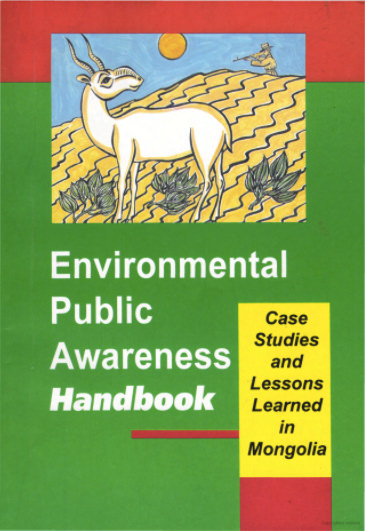
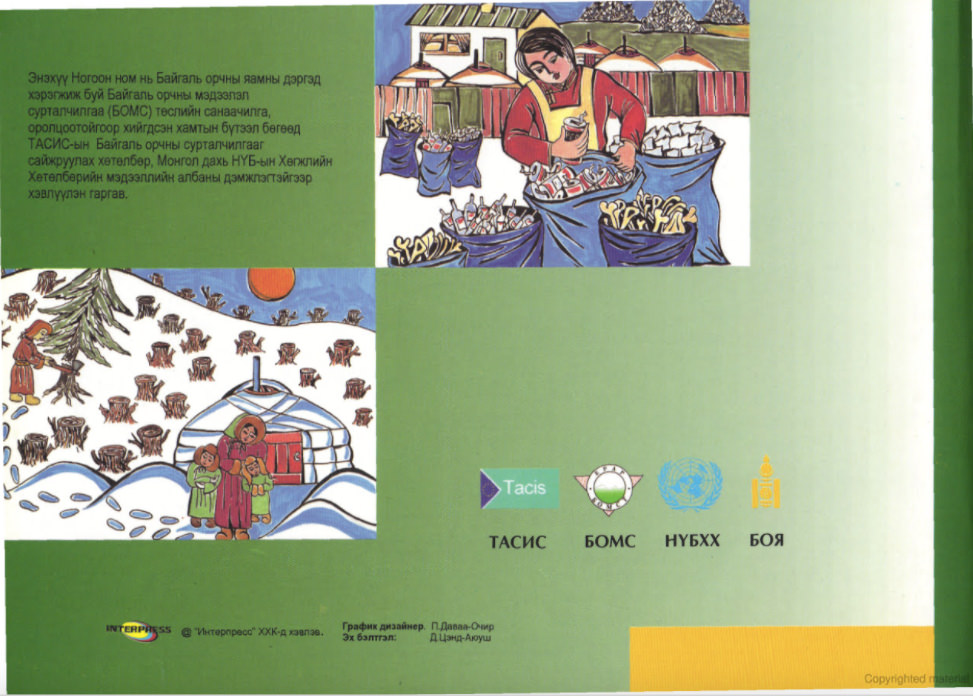
Environmental Public Awareness Handbook: Case Studies and Lessons Learned in Mongolia by Robert Ferguson (ISBN 9992950137): The Environmental Public Awareness Handbook was published in 1999 and features the case studies and lessons learned by UNDP’s Mongolian Environmental Public Awareness Programme (EPAP). The handbook draws on the close to 100 small environmental projects the Programme oversaw during a two-year period. These projects stretched across Mongolia, and operated in a time of great upheaval and social, economic and environmental distress. The handbook is intended for training purposes and the practice of public participation in environmental protection.
In its 2007 Needs Assessment, the Government of Mongolia found the EPAP projects “had a wide impact on limiting many environmental problems. Successful projects such as the Dutch/UNDP funded Environmental Awareness Project (EPAP), which was actually a multitude of small pilot projects (most costing less than $5,000 each) … taught local populations easily and efficiently different ways of living and working that are low-impact on the environment.” Many of these ideas live on in the work of both the World Bank and UNEP in Mongolia.
Designed in Mongolia
Mongolian Rock Pop by Peter Marsh (ISBN 99929-5-018-8): In the Mongolian language, the book explores how Mongolia’s vibrant rock and pop music scene led on business innovation and entrepreneurship in the country during the transition years (post-1989). Written by an ethnomusicologist, it details the key moments and events in this story, while splicing the narrative with first-person interviews with the major players.
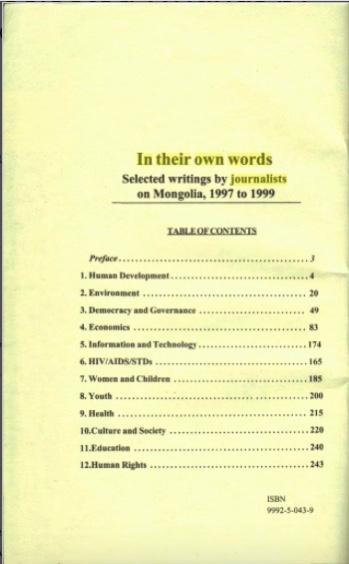
In Their Own Words: Selected Writings by Journalists on Mongolia, 1997-1999, Editor-in-Chief: David South, Research Editor: Julie Schneiderman (ISBN 99929-5-043-9): In their own words compiles by theme the vast number of stories and features by journalists on Mongolia’s transition experience from 1997 to 1999. A rich and unusual resource for a developing country, this book offers the reader a one-stop snapshot of how a country handles the wrenching social, political, cultural, economic and environmental challenges of changing from one political and economic system to another.
An excellent resource for scholars of austerity crises and for those seeking understanding on how to plot a path out of an austerity crisis. In particular, the collection of articles and stories show the impact austerity has on people and their lives. Unadorned by backward-looking historical narratives, these are accounts fizzing with the energy of the moment: a first draft of a tough time for most Mongolians.
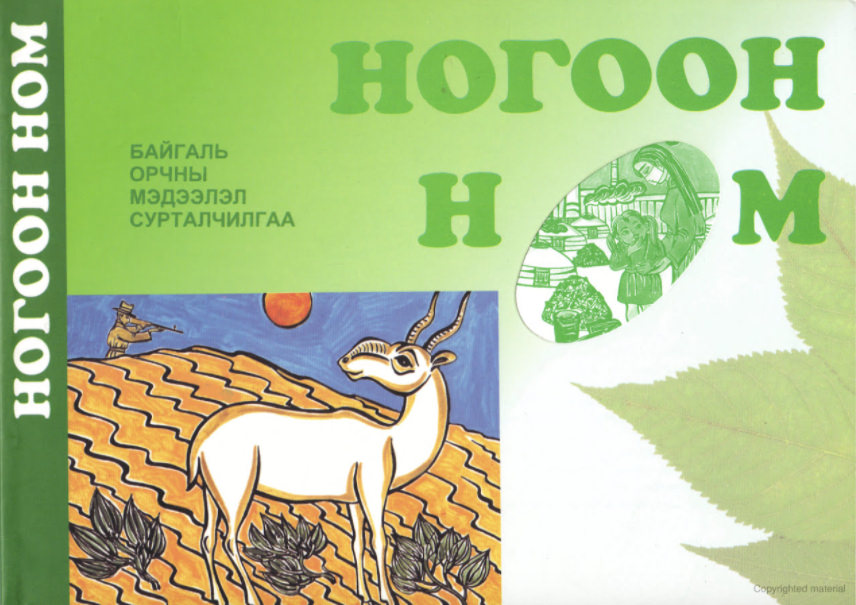
Mongolian Green Book by Robert Ferguson: In the Mongolian language, the book details effective ways to live in harmony with the environment while achieving development goals. Based on three years’ work in Mongolia – a Northeast Asian nation coping with desertification, mining, and climate change – the book presents tested strategies.
Mongolia Update 1998 Book, Editor and Writer: David South, Researcher: G. Enkhtungalug: Whilst in Mongolia as head of the United Nations’ communications (1997-1999), I wrote an update on how Mongolia was coping with hyperinflation, shock therapy, austerity and the Asian economic crisis. The mission simultaneously had to deal with the 1997 Asian Crisis and the worst peacetime economic collapse in post-WWII history.
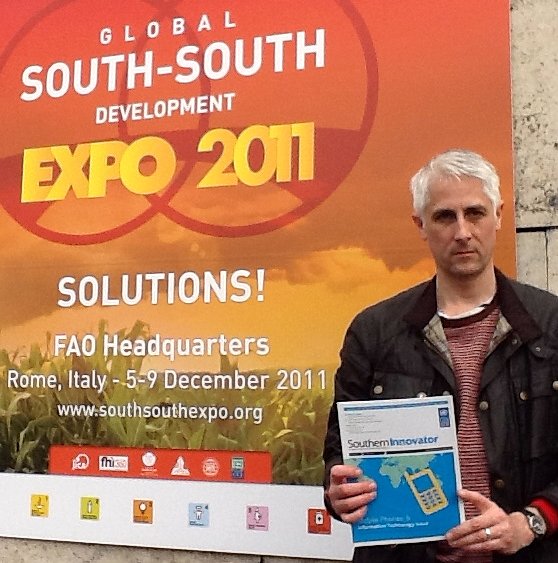
Beginning in 2011 and ending in 2014, each issue of Southern Innovator was launched at the annual Global South-South Development Expo (GSSD Expo) run by the United Nations Office for South-South Cooperation (UNOSSC). The issues (there were five) would connect with that year’s Expo theme and were intended to reinforce the solutions presented at the Expo, as well as those solutions discovered through research for the influential United Nations e-newsletter Development Challenges, South-South Solutions. An Expo was not run in 2015 for the following reason: U.S. Finds Macau Billionaire Guilty in U.N. Bribery Case.
Studies have shown the importance of reading to real change. Not just online, but in paper form. The retention of information and knowledge is greater when a person reads something in a book or a magazine. Another factor is quality design (which makes the published material both attractive and effective). Trashy, gaudy or slap-dash design, while it has its place and context, is not suitable for well-funded, transparent, public organizations seeking to communicate across borders in a professional manner. Southern Innovator was designed following the UN and UNDP design guidelines at the time, while also adhering to the UN Global Compact and the UN Consultants Remuneration Guidelines. The content was also written to follow those guidelines as well as the Plain English Campaign, which seeks to reduce the presence of “gobbledygook, jargon and misleading public information”. On top of this, the magazine benefited from experience: the experience of one of Iceland’s top graphic designers and illustrators, the team based at the UNOSSC in New York who oversaw the editing and proof reading, and the researcher, editor and writer who has led many successful and award-winning publishing ventures, including during “one of the biggest peacetime economic collapses ever”.
“What a tremendous magazine your team has produced! It’s a terrific tour de force of what is interesting, cutting edge and relevant in the global mobile/ICT space… This is great, engaging, relevant and topical stuff.” Rose Shuman, Founder & CEO, Open Mind and Question Box, Santa Monica, CA, U.S.A.
Southern Innovator Issue 1: Mobile Phones and Information Technology was published in 2011 and launched at the Expo in Rome, Italy.
Southern Innovator Issue 2: Youth and Entrepreneurship was published in 2012 and launched at the Expo in Vienna, Austria.Southern Innovator Issue 3: Agribusiness and Food Security was published in 2012 and launched at the Expo in Vienna, Austria.Southern Innovator Issue 4: Cities and Urbanization was published in 2013 and launched at the Expo in Nairobi, Kenya (the first time in Africa).
Issue 6 of Southern Innovator was to be on the theme of science, technology and innovation. Southern Innovator Issue 5: Waste and Recycling was published in 2014 and launched at the Expo in Washington, D.C.
Expertise: Project evaluation, strategy, project management, project delivery, UN system, MDGs, research papers, media strategies and digital media strategies.
Locations: Ulaanbaatar, Mongolia, Kiev, Ukraine, Pretoria, South Africa, Ashgabat, Turkmenistan 2000 to 2006
From 1999, I worked as a consultant for United Nations (UN) missions in Africa, Asia, Central Asia and Eastern Europe, for USAID Mongolia and for a UK-based international development consultancy.
About
Was the United Nations being effective and reflecting the potential for change in the mobile and information technology age? What needed to change? Who were the policy innovators?
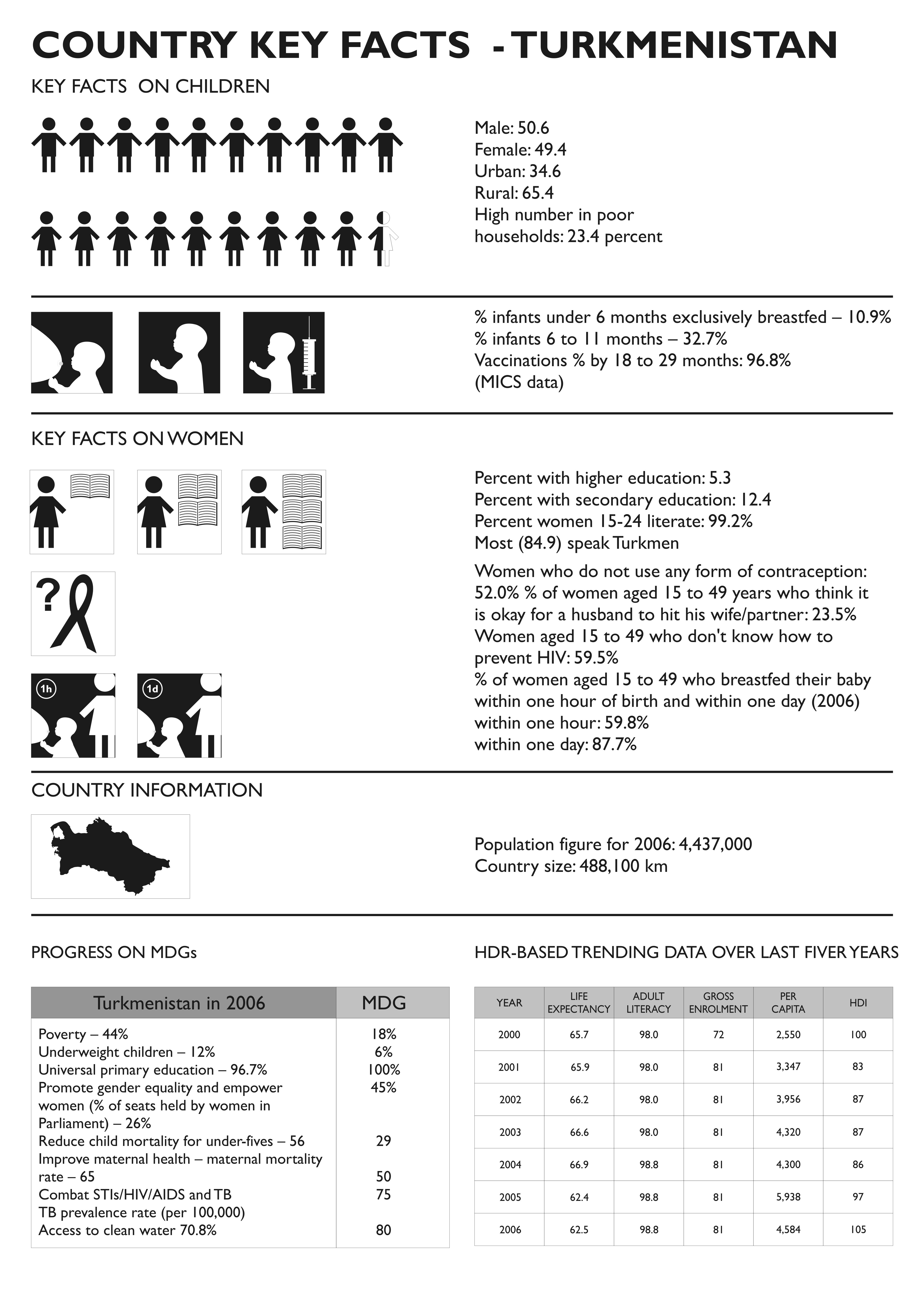
This work included overseeing various digital media projects, including the strategic re-development of the UN Ukraine web portal, aiding in the rolling out of the media campaign for the Millennium Development Goals (MDGs) in Mongolia, including the first use of infographics in the Mongolia UN mission, advising on strategies for youth engagement in development goals in South Africa, and support to the UN mission in Turkmenistan as it finalised its United Nations Development Assistance Framework (UNDAF) with the government and also work with UNICEF there. What I learned during this period proved crucial to the insights and thinking reflected in two highly influential United Nations publications, e-newsletter Development Challenges, South-South Solutions, and Southern Innovator magazine (developed in 2010).
This period was particularly advantageous because I had a front-row seat to the unfolding digital and mobile information technology revolution sweeping across the emerging markets and the global South. I also had insight into what worked and didn’t in international development as well as the UN system. I also learned a great deal about development challenges first-hand in highly varied countries, how the Millennium Development Goals (MDGs) were actually being rolled out, and met amazing people who were challenging existing precepts on how to do development. All of this work proved very useful later on.
I have either travelled to, or worked and lived, in many countries, enhancing my global perspective and affording me a valuable trove of knowledge that has in turn informed my work in international development. I have always paid attention to the level of development in the country, how it has organized itself, the quality of its design, and how it interacts with other countries for trade and relations. The countries visited to date include: Antigua and Barbuda, Australia, Azerbaijan, Belgium, Canada, China, Cuba, Denmark, Domenica, Finland, France, Germany, Greece, Guadalupe, Haiti, Hong Kong, Iceland, Ireland, Israel, Italy, Japan, Kenya, Luxembourg, Malaysia, Mexico, Monaco, Mongolia, Montseratt, Morocco, the Netherlands, Norway, Philippines, Portugal, Russia, Singapore, South Africa, South Korea, Spain, Sweden, Switzerland, Thailand, Tunisia, Turkey, Turkmenistan, Ukraine, the United Kingdom, the United States of America, Vatican City. A fascinating mix of countries – some holders of top place on the UN’s Human Development Index – and others where human development is at its worst. Seeing with your own eyes what works and what does not is highly illuminating, while knowing first-hand how human development can be improved is critical for giving informed advice.
Timeline
1999/2000: USAID Mongolia (design and publicity strategy for business development brochure, US Mongol (Mongolia) Construct and US tour, work with Riverpath Associates in the UK on communications strategies and the drafting of papers for the American Foundation for AIDS Research, the Global Fund to Fight AIDS, Tuberculosis and Malaria, UNCTAD, Harvard Institute for International Development, and the preparation of the report and launch strategy for the World Bank’s Task Force on Higher Education.
2000: UN Ukraine: strategic re-development of the UN Ukraine web portal and incorporation of the Millennium Development Goals (MDGs).
2004: UN Mongolia (media campaign for MDGs) and UN South Africa (evaluation of youth NGO associated with the University of Pretoria and its projects and providing a strategic marketing plan).
2005: UN Mongolia (media campaign for MDGs) and UN Turkmenistan (finalising its United Nations Development Assistance Framework – UNDAF).
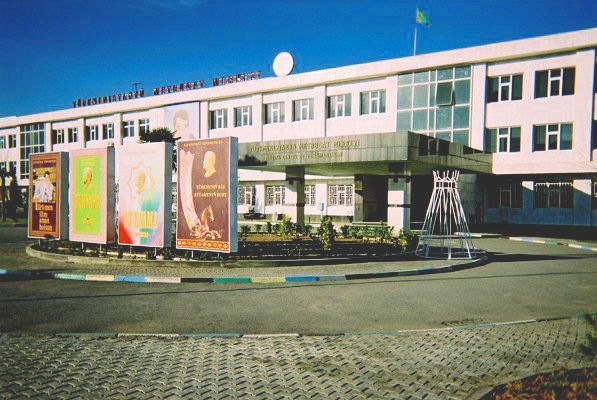
Rukhnama publishers in Turkmenistan’s capital, Ashgabat (2005). Photo: David SouthAn infographic commissioned for UN Turkmenistan MDGs report (2006).
“I highly recommend Mr. David South as a communications consultant who gets results.” Brian DaRin, Representative/Director, USAID Investment & Business Development Project, Global Technology Network/ International Executive Service Corps-Mongolia, 23 September 1999
Impact
Micro
working as a communications consultant for UN missions – Ukraine, South Africa, Mongolia, Turkmenistan
redeveloping mission websites, preparing content, reports, advising on communications strategy
working with local designers on new ways to present development data through inforgraphics (2005/2006)
Macro
in the course of travel and work, seeing the unfolding impact of the global communications revolution, in particular the rapid roll-out and take-up of mobile technologies, and the urgent need for the UN system to take this on board. Also witnessed firsthand the grassroots solutions revolution brought about by information and mobile technologies and the Internet, which needed to be fully embraced by the UN
Resources
A Marketing and e-Marketing Strategy – the New SASVO, Prepared from December 2004 to February 2005 for the Southern African Student Volunteers (University of Pretoria).


























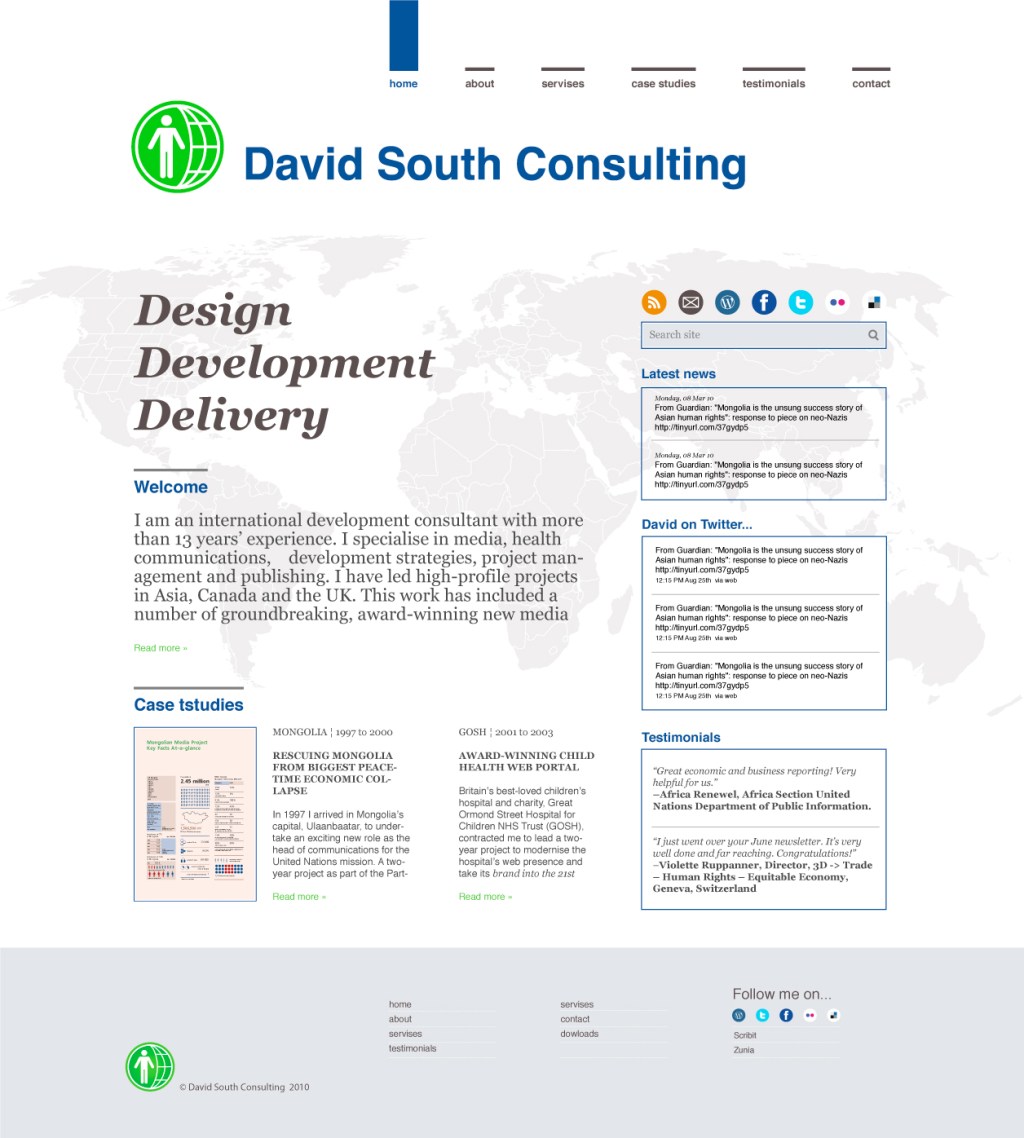




 David South Consulting
You must be logged in to post a comment.