South Africa’s township music is pounding its way into the global music charts. How has music made in the impoverished townships that are a hangover from decades of apartheid – the country’s former racial separation laws, which trapped millions of black South Africans in disenfranchisement and poverty – travelled around the world? By hitching a ride with the country’s ubiquitous taxi drivers.
In the age of digital downloads and rampant pirating of music CDs by bootleggers, musicians in the South face an epic struggle to earn income from their music. It’s estimated 95 percent of digital downloads of music are unauthorized, with no payment to artists and producers (www.ifpi.org).
And for musicians and artists from the world’s poorest places, who are far out of sight of the mainstream music business, life is even harder. The question remains: what on earth do you do to get heard?
Many South Africans are big fans of European House, a type of dance music. An enterprising group of producers living in the townships of Pretoria started to experiment, taking the House they loved and turning it into something more reflective of where they lived. The result, dubbed Township House, blends the school-of-hard-knocks beats of South African hip-hop, Kwaito, with House music’s tempos and electronic sounds.
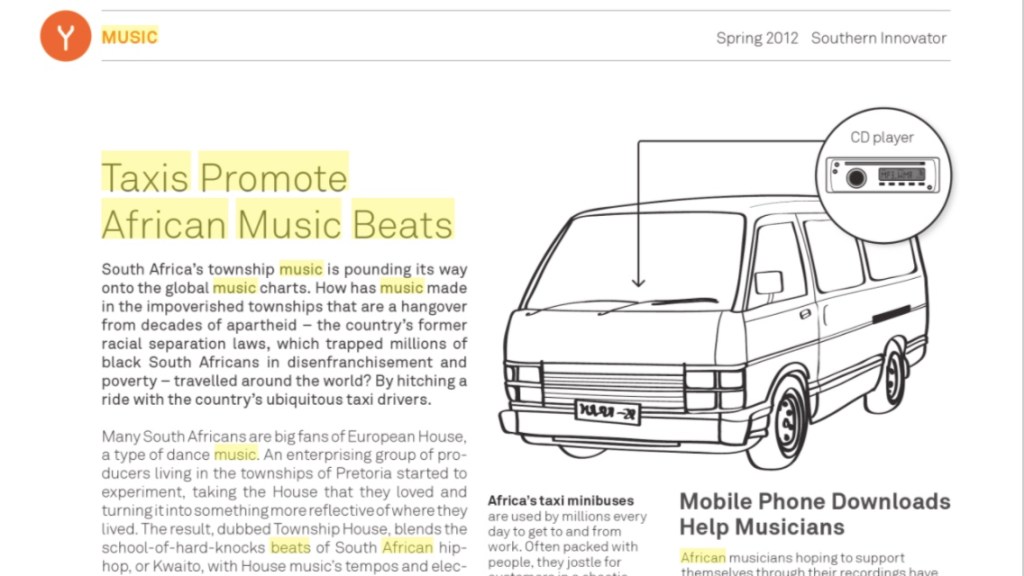
Being from the townships meant the musicians behind Township House were frozen out of the mainstream music industry. And as every artist knows, if you can’t get heard, then your music will go nowhere. Rejected by radio stations and big record labels, they turned to an unlikely outlet: taxis, the ubiquitous small minibuses that are the only alternative form of transportation for people who do not have a car.
They are heavily used: the University of Pretoria (www.web.up.ac.za) estimates between 5 and 10 million people use minibus taxis every day to get to work or get around.
“In South Africa, the easiest way to the people is through the taxis,” musician DJ Qness told CNN.
The vast network of taxis serving the country represent a captive audience of listeners. Many are simply bored as they endure lengthy commutes. The Township House producers handed out compact discs (CDs) of their tracks to taxi drivers to play. They soon had a hit on their hands. But without any presence in record stores people couldn’t buy the CDs they wanted. And a new source of income was born for taxi drivers: selling CDs from their taxi stands or roadside stalls.
With appetites whetted for Township House, it started to outsell imported dance music.
The biggest hit maker of this pioneering group was DJ Mujava, whose track Township Funk was a global dance club hit in 2008.
“These people created a demand. The Mujava’s ‘Township Funk’ blew up on the streets and everything went crazy,” said Qness, who works for record label Sheer Music.
After all this home-grown success, the record labels jumped in. DJ Mujava landed a record deal with the small label Sheer Music. But the township musicians were still just reaching a local audience. However, by putting together a low-budget video using township dancers, and by posting the video on the YouTube (www.youtube.com) video-sharing website, they attracted the attention of British record labels Warp Records and This is Music, who re-mixed the track for clubs.
The model of using taxis as a music distribution vehicle has been copied by others. Pretoria’s Gospel Taxi Club uses the method to promote their religious music. Political parties are also using music CDs to get their message out.
Other Pretorian township successes are making waves as well. They include Bojo Mujo and Tembisa Funk by McLloyd.
“By combining the electronic sound from European House with the hard drum and the raw snare they’ve created something totally unique. You can’t find it anywhere in the world — only in South Africa,” said Qness.
Published: June 2009
Resources
DJ Mujava: Listen to all of DJ Mujava’s tracks at his website. Website:www.myspace.com/mujavaDigiArts Africa: The DigiArts Africa network is a tool to find people working in Digital Arts in Africa and to provide a collaborative working space to promote digital arts in Africa. Website:http://portal.unesco.org/culture/en/ev.php-URL_ID=5346&URL_DO=DO_TOPIC&URL_SECTION=201.htmlAfrican Musicians Profiles: A lively website featuring profiles of African musicians by alphabetical listing and also reviews African films. Website: www.africanmusiciansprofiles.comRecording Industry of South Africa (RiSA): RiSA is the main body representing the South African recording industry. Website: www.risa.org.za
Around the world, traditional music stores selling vinyl records, tapes and CDs (compact discs) are closing down. Digital downloads distributed over the Internet and mobile phones make it unnecessary to build a music collection in these hard formats.
While this has been a revolution that has made acquiring music as simple as firing up a digital download service like iTunes, it has many downsides as well. One of them has been the loss of vast swathes of musical history, as many songs recorded in the past have not made their way into digital downloads. And how can you find music online if you only remember part of a tune or song and can’t remember its title or the musician?
The background and knowledge that was once imparted by an informed person in a music store has been lost in the world of digital downloads.
A Mauritanian music shop is showing how a traditional record store can stay relevant and commercially viable in the 21st century. Entrepreneur Mohamed Vall’s Saphire d’Or store in Mauritania’s capital Nouakchott (http://en.wikipedia.org/wiki/Nouakchott), is a treasure trove of the sort of long-lost recorded songs that normally vex lovers of African music. Pictures of the shop can be seen at the sahelsounds blog (http://sahelsounds.com/?p=887).
Vall has run the shop for three decades and amassed a large collection of rare African music on records and tapes. He has married this trove of African creativity to a clever business model: Vall doesn’t let customers buy the precious records themselves but instead will transfer the songs to a disc or a USB stick (http://en.wikipedia.org/wiki/USB_flash_drive) for US 30 cents each.
He has also used traditional hospitality to create an atmosphere that encourages people to interact and keep coming back.
“I have the biggest collection in Mauritania,” Vall told The Guardian newspaper. “Any music you want from Africa – I mean the kind of music that puts Africa on the map – I have it.”
The shop is down an alleyway in the bustling capital and offers a refuge for music lovers.
The atmosphere encourages friendly conversation and lets customers take their time making a selection. Customers can relax in armchairs while browsing and drink some traditional mint tea or enjoy a snack from a communal bowl.
The shop uses traditional Mauritanian nomadic hospitality to improve the customer experience. It also uses the music it sells to heal rifts between the different cultures that cross Mauritania, as it bridges Arabic-speaking North Africa and the majority black sub-Saharan Africa.
“When you are here, it doesn’t matter who you are,” Vall said. “We get youngsters wanting 1940s ballads and old people whose minds are musical museums. We get toubabs (white people) who heard one song decades ago.”
One of the treasure troves held in the shop is the recordings made by West African orchestras during the post-colonial period.
The shop also acts as an interactive museum and archive of many African musical greats, from Senegal’s Youssou N’Dour to Nigerian afrobeat pioneers, Guinean pop legends and Maliaian and Congolese musicians.
Its collection ranges beyond Africa to take in musical genres from around the world, from blues to salsa to rock.
“The music allows you to travel in your head,” said one customer, teacher Abdoul Kaba.”When I first came to Mauritania from Guinea, I went round and round looking for zouk (West African funk) music that everybody listens to in Guinea until I ended up here.”
The shop also serves as a sanctuary for many from life’s everyday hardships.
“It’s not about the music any more. People come back because in here you can be free. You can listen to music and forget this hard life,” Kaba said.
Published: June 2012
Resources
1) The African Music Encyclopedia: Search by alphabetical listing the continent’s musicians. Website: http://africanmusic.org/
2) African Musicians Profiles: African Musicians Profiles (AMP) is a website for the promotion and publicity of African musicians. Each musician “has a profile, and there are pages on news of recent and future events, special features, recommended CDs, relevant reading (biographies, reference books and magazines) and photos”. Website: http://www.africanmusiciansprofiles.com/
Southern Innovator issues 1 and 5 at the Bangladesh workshop on public service innovation, 9-11 December 2017, and the launch of the South-South Network.
The following blog report does not reflect the views of the UNOSSC or UNDP.
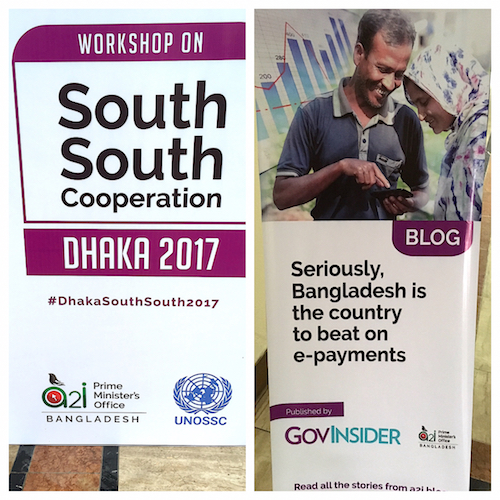
Dateline: Dhaka, Bangladesh (9-11 December 2017) – From 9-11 December 2017, I participated in the Workshop on Innovations in Service Delivery: The Scope for South-South and Triangular Cooperation held in Dhaka, Bangladesh. Hosted by the a2i (access to information) division of the Bangladesh Prime Minister’s Office, the implementing unit for Digital Bangladesh, it was convened by the Government of Bangladesh and the United Nations Office for South-South Cooperation (UNOSSC).
I was asked to do a presentation for the health component of the Workshop on my past experience in public sector digital innovation. This work stretches back to the beginning of the roll out of the Internet in the late 1990s. I chose three projects I have led that had a large and significant impact in the digital public space: the UN Mongolia development web portal I launched and ran for two years (1997-1999), the GOSH Child Health Web Portal I launched and ran for two years (2001-2003) and the Southern Innovator brand I launched for the UNOSSC (2010-2015).
I also joined a panel discussion as Senior Partner representing the David South Consulting/David South International consultancy at the end of the last day (we have worked with the UNOSSC since 2007 and with UNDP since 1997 – a timeframe which saw the rise of the Internet and the mobile and information technology revolution take the global South by storm).
As the Workshop invitation letter says, “The digitization of service delivery, user-centric methodologies, and experimentation geared towards improvement in service delivery, and the data revolution may have originated in developed countries but is now of increasing relevance for the developing world. To respond to rapidly rising expectations of the citizens, governments in both developing and developed countries are embracing approaches and tools to adopt more citizen-centric approaches in their service delivery. These practices are establishing a culture of citizen-centric innovation within governments, breaking silos of operations and helping move towards a whole-of-government planning and execution.”
According to the a2i, Bangladesh has the “world’s largest government web portal” comprising over 25,000 government websites for 43,000 government offices (Bangladesh’s population was over 162 million as of 2016 – World Bank). Bangladesh has one of the highest population densities in the world and is considered the 8th most populace country in the world (Wikipedia). In total, these government websites receive 60 million plus hits a month, according to the a2i, from an online population of 79.7 million people, nearly half the population.
A lot is at stake: According to the World Bank (which has been supporting the country since 1972), “Bangladesh has made substantial progress in reducing poverty, supported by sustained economic growth. Based on the international poverty line of $1.90 per person per day, Bangladesh reduced poverty from 44.2 percent in 1991 to 18.5 percent in 2010, and is projected to decrease to 12.9 percent in 2016.
“The country achieved the MDG 1 on halving poverty five years ahead of time, with 20.5 million people rising out of poverty during the 1991-2010 period. In parallel, life expectancy, literacy rates and per capita food production have increased significantly. Progress was underpinned by strong economic growth, with 6 percent plus growth over the decade and reaching to 7.1 percent growth in 2015/2016. Rapid growth enabled Bangladesh to reach the lower middle-income country status in 2014.
“However, sustained growth has rapidly increased the demand for energy, transport and urbanization. Insufficient planning and investment have resulted in increasingly severe infrastructure bottlenecks.”
Arriving in the capital, Dhaka, on the 9th of December, it was clear to see what the World Bank is highlighting: the “severe infrastructure bottlenecks”. Just like other megacities, Dhaka is clogged with traffic and suffers from the air pollution this causes (one of the worst cities for this in Asia). But these are just the visible signs of success if you think about it (as frustrating as that might be), as booming economies combined with rapid urbanisation, if not planned well, tend to lead to traffic congestion and high levels of air pollution.
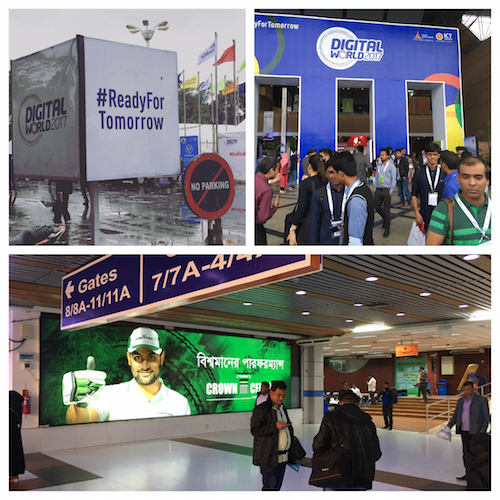
The country’s rising living standards since 2000 and impressive gains in the provision of information and mobile technology services and connectivity, reveal a country brimming with potential and capable of getting a handle on its many development challenges. The streets are visibly lined with small and medium enterprises and there are construction projects in various states of completion all around Dhaka. At the airport, glossy posters advertise many real estate developer’s dreams and show-off the heavy construction equipment for sale or lease from China and Russia.
The population no longer suffers from food crises such as the 1974 famine, which killed 1.5 million people (Christian Science Monitor). According to the UN, Bangladesh cut chronic hunger by half since 2000 and is considered one of the success stories from the past 10 years that the rest of the developing world can look to as they push to eliminate hunger by 2030 as part of the SDGs (Sustainable Development Goals) (https://www.csmonitor.com/USA/Foreign-Policy/2015/0617/From-famine-to-food-basket-how-Bangladesh-became-a-model-for-reducing-hunger). Clearly, Bangladesh is a country that can get things done when it draws on the power of its population.
According to Digital Bangladesh, with a deadline of 2021, it has achieved half its goals to get the population online and its economy and government services online. In 2017, the country made US $800 million from exporting ICT (information and communication technologies) products and services. It is currently building 12 hi-tech parks with the ambitious goal to export US $10 billion in ICT services from them by 2030 and make US $5 billion by 2021.
The streets of Dhaka.
Workshop
Sharing ideas at the Workshop.
Speaking at the Workshop, Anir Chowdhury, Policy Advisor to the Access to Information (a2i) Programme of the Prime Minister’s Office, believes the concept of South-South Cooperation (SSC) is about enlightened self-interest but at present there is no framework for SSC in Bangladesh and most cooperation is ad hoc. If global South countries are not cooperating, then they are just re-inventing the wheel, he added. SSC is about avoiding feeling each country has to make it own their own: SSC can facilitate development leapfrogging and prevent leaving country success to chance. However, there needs to be better ways to communicate Southern solutions.
And Bangladesh has a good story to tell to the global South: To date, Bangladesh’s digital public service delivery has saved the country US $2 billion in cost for government services plus 1 billion man days in time spent trying to carry out tasks using government services, according to the a2i. With this success under their belts, the hope is to market Bangladesh as a world leader in innovation. To go from MDGs poster child to leader of the global South.
UNOSSC Director and Envoy of the UN Secretary-General on SSC, Jorge Chediek (https://www.unsouthsouth.org/about/unossc-director/), emphasised the need to tell stories of how South-South is changing the world; the pressing need to change the narrative around the global South in order to be able to achieve the 2030 agenda.
It was an honour to be invited to present my three case studies on public sector digital innovation (GOSH Child Health Portal, Southern Innovator Magazine and the UN/UNDP Mongolia Development Portal). All three share the same characteristics: a public demand for digital resources and a need to create high-quality content on limited budgets and to build public confidence in those resources. These projects were also engaging with enormous complexity and needed to find a way to simplify this for online readers.
I was impressed by the level of debate at the Workshop, and how Bangladesh’s digital initiatives are communicated (the excellent use of infographics and simple step-by-step explanations), and the overall excitement and energy around digital and the digital economy in Bangladesh. But, importantly, the foresight to give attention to the coming wave of automation and robotics (the so-called fourth industrial revolution) and how this will affect Bangladesh.
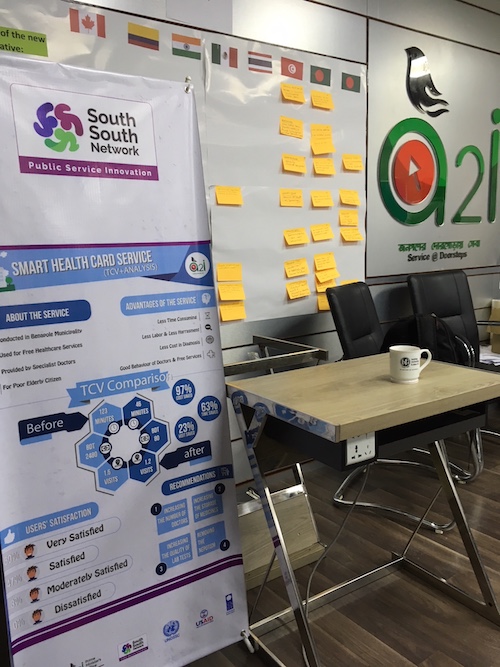
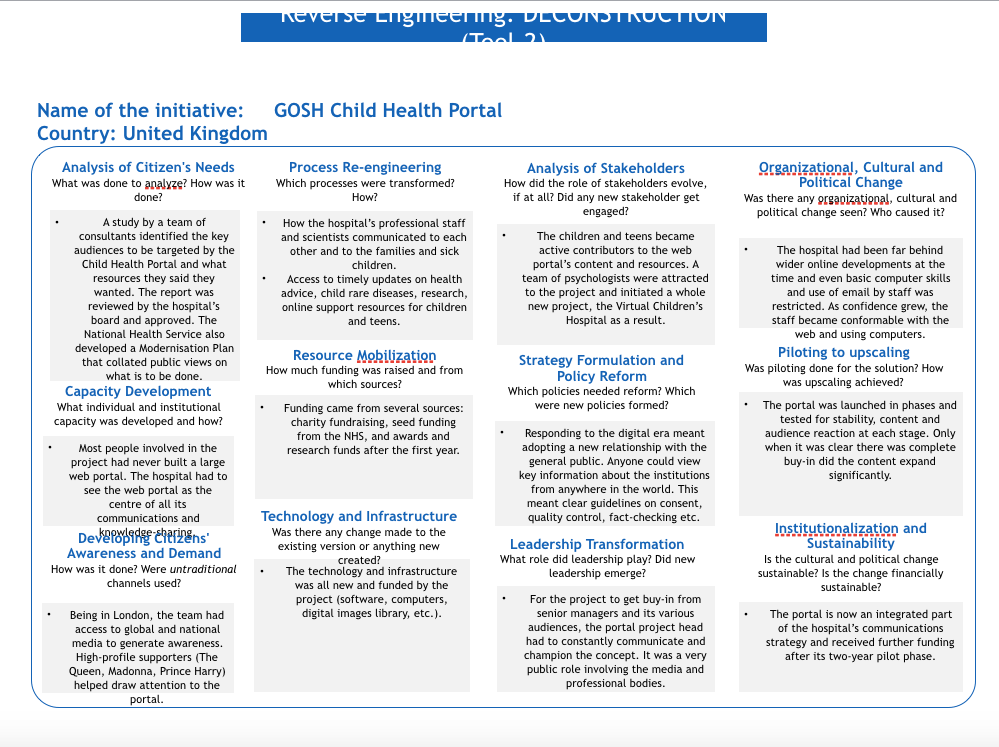
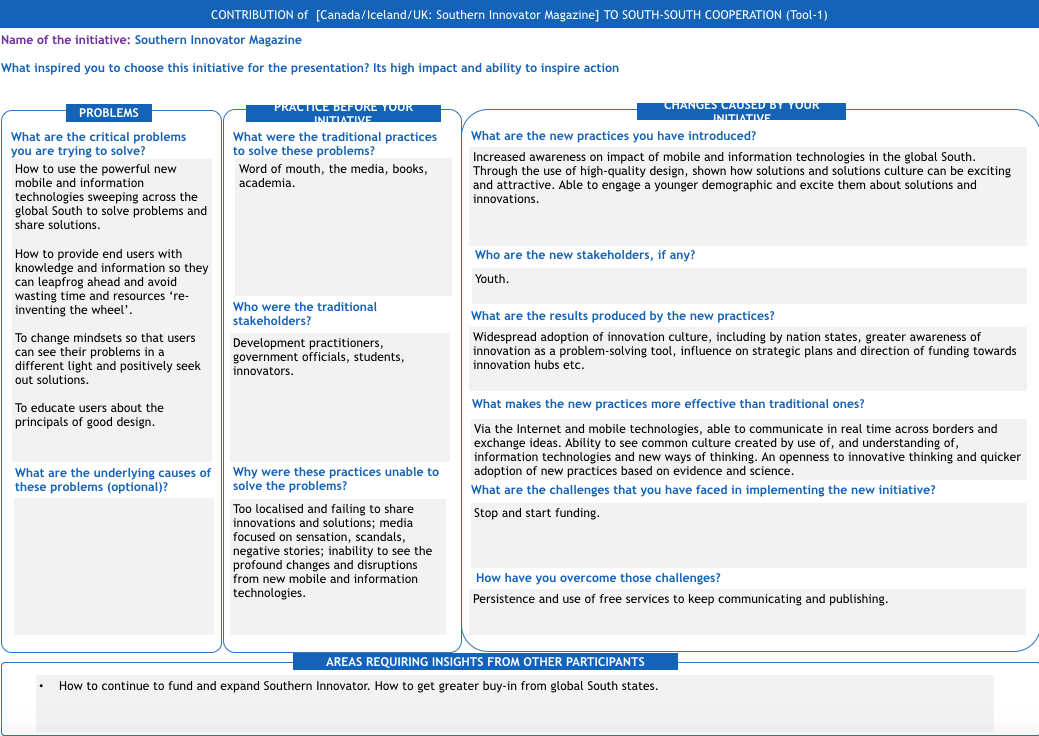
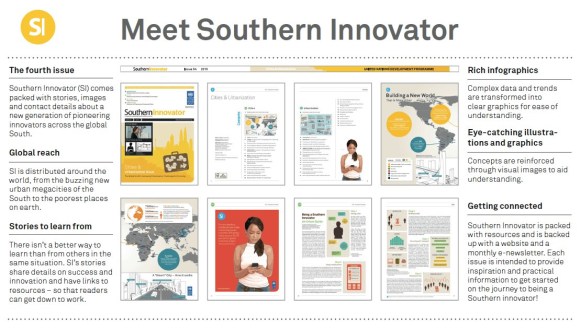
In the health workshop, we shared two projects for the reverse engineering component: the GOSH Child Health Portal and the magazine Southern Innovator (link to PowerPoint). Using the Reverse Engineering tool (see images below), each project was broken down as to how it worked and also what was its contribution to South-South Cooperation.
I shared experience from the early days of digital public innovation in the late 1990s. This has included applying digital to crisis recovery, healthcare modernisation in the early 2000s, and the campaign to achieve the MDGs (Millennium Development Goals), as well as during the mobile/information technology and social media revolution in the global South, which took off after 2007.
Issues discussed here included the recent online fake news scandals and how important it is for the public sector to offer the antidote to this with quality, factual digital information and resources. The GOSH Child Health Portal was one good example, where it entered the crowded online medical and health information marketplace and succeeded in drawing a large online audience by offering high-quality, peer-reviewed resources, thoroughly fact-checked and proofread and presented using high-quality online design. By the end of the project’s two-year timeframe, it was receiving over 7 million hits a month and was acknowledged as a trusted global source in child health. The content is cited in many books and papers, as well.
Reverse engineering GOSH Child Health Web Portal, 2001-2003.
Throughout the Workshop, I heard over and over again about the urgent need for a more cohesive platform for sharing Southern innovations and initiatives. Many complained this was currently very fragmented. While there are many media and development organisations documenting innovations and stories, there is no one-stop shop for countries to go to.
The Southern Innovator brand (incubated and developed by the UNOSSC) is a good example of what can be achieved with a more cohesive and strategic approach. Southern Innovator, first launched in 2011 by the UNOSSC, was able to leverage its limited resources to reach a large global audience via the web and social media. The brand became established with innovators and five issues were published (from 2011 to 2015). An Action Plan for scaling-up the Southern Innovator brand was also developed with the UNOSSC in 2015 (but awaits funding).
The original Southern Innovator website (southerninnovator.org, now southerninnovator.com) did fulfil the role of offering a one-stop shop for stories on global South innovation and these stories were widely cited in websites, papers and books on the global South. But the terrain has shifted radically in the global South – and at the UN – since Southern Innovator’s launch in 2011. With the widespread adoption of mobile and digital technologies, the opportunities to communicate innovator solutions have never been better but require a more sophisticated approach to be effective. In fact, we now exist in a world where the solutions already exist to the major problems affecting the global South (and even the funding is available through many sources). The problem is not the lack of solutions, innovators or technologies and business models to resolve problems (both e-newsletter Development Challenges, South-South Solutions and Southern Innovator proved this) but how people can access these resources and in a format that makes sense to them and is available when they are searching for a solution. With modern computing technologies, this is no longer an unsolvable problem. And the people to connect with to do this also already exist in the global South. What is missing is a coherent and cohesive approach. The multiplicity of development actors in this case are hampering effective action by dissecting and scattering resources, leaving end-users confused and poorly communicated with in many cases. As an example, there was a definite need to assist people in understanding how the 17 SDGs can fit into practical actions and a definite psychological need for simplicity: a problem highlighted by former UNDP head Helen Clark back in 2015 (https://www.theguardian.com/global-development/2015/jul/07/sustainable-development-goals-will-be-hard-sell-for-united-nations).
For UNDP, with its human development approach and presence in most countries, an opportunity exists to rapidly accelerate development gains and shorten the time it takes to recover when disaster or conflict strikes. Something that came out of the Workshop is the presence of excellent examples of global knowledge sharing already underway for decades around the world. Think of the scientific community in general (working on vast projects such as the CERN facility in Switzerland), or aerospace industries, or the global adoption of the principles of air safety managed by IATA in Montreal, Canada, or sport – all proof countries do successfully share knowledge and adopt common, high standards when they feel it is a priority and necessity. No country wants to be frozen out of flight routes, for example.
Reverse engineering the Southern Innovator magazine brand, 2010-2015.
Panel Discussion
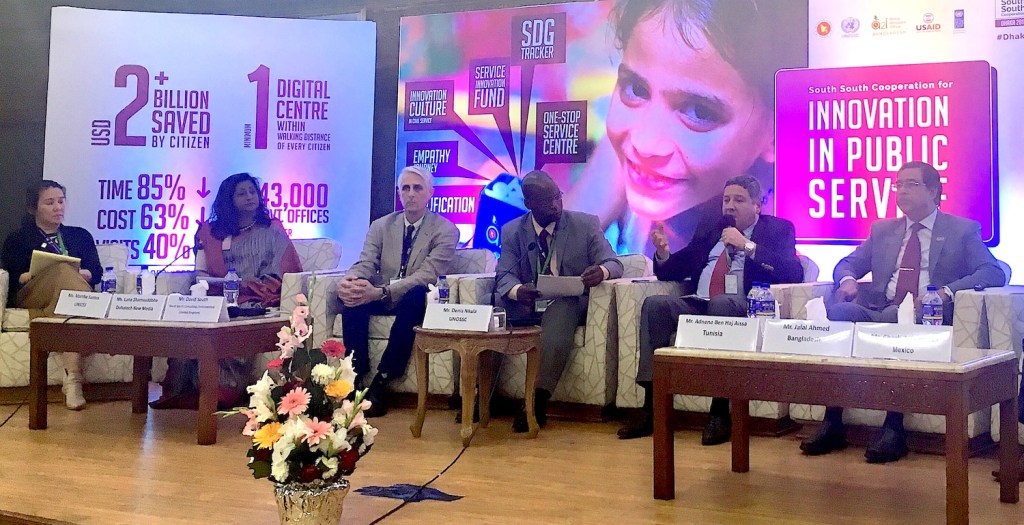
At the closing panel discussion, I was asked how to engage more donors to be part of the South-South Network. I said there is a need to get people excited and show why the South-South Network is different; how it is related to the Sustainable Development Goals (SDGs). There needs to be a communications strategy and to establish some ambitious first goals that are original: to show that this is part of a clear trend. International aid and development is a crowded space so there is a need to show how the Network would tackle the challenges of the global South in the 21st century head-on, with a more effective solution. And of course, I championed the existing and successful Southern Innovator brand developed by the UNOSSC since 2010 as, potentially, part of this communications strategy.
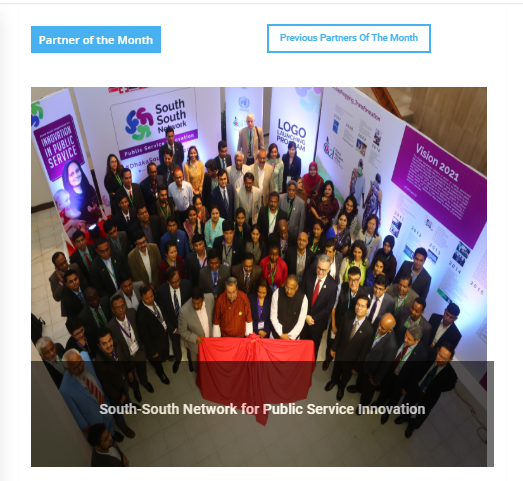
Senior Partner David South is third from the left on the panel. Photo: Yoko Shimura.Senior Partner David South is centre at back with the South-South Network for Public Service Innovation, Dhaka, Bangladesh, 2017.
Finally
This impressive embracing of e-initiatives and all things digital was visibly missing at the airport. On the way in, long lines and then a confusing scramble to buy a visa created confusion for visitors. As the first impression for visitors, this could be a great place to show-off Bangladesh’s digital capabilities.
And finally, as the World Bank says, this all about job creation and increased living standards: “The World Bank has identified job creation as the country’s top development priority. Bangladesh needs to create more and better jobs for the 2.1 million youths entering the job market every year. But to do so, Bangladesh will need to remove the barriers to higher growth posed by low access to reliable and affordable power, poor transportation infrastructure, limited availability of serviced land, rapid urbanization and vulnerability to climate change and natural disasters, among others.”
Bangabandhu International Conference Center hosting Digital World 2017 and Dhaka’s Shahjalal International Airport.
A clash is occurring across the global South over the future of urban planning and the ever-growing slums of the world’s megacities. This will be a decisive clash of visions: should cities flatten slums and relocate their residents, or work with slum dwellers, acknowledge the role they play in city economies and improve their lives with better dwellings?
As the world turned into a majority urban place in the 2000s, cities grew at a phenomenal rate. The cities of Africa and Asia are growing by a million people a week, according to some estimates. Megacities and sprawling slums will be the hallmarks of this new urban world, it seems. In sub-Saharan Africa, 72 percent of the population already lives in slum conditions.
The danger of building unsafe or makeshift homes can be seen in 2010’s devastating earthquake in Haiti, where many buildings collapsed, killing thousands.
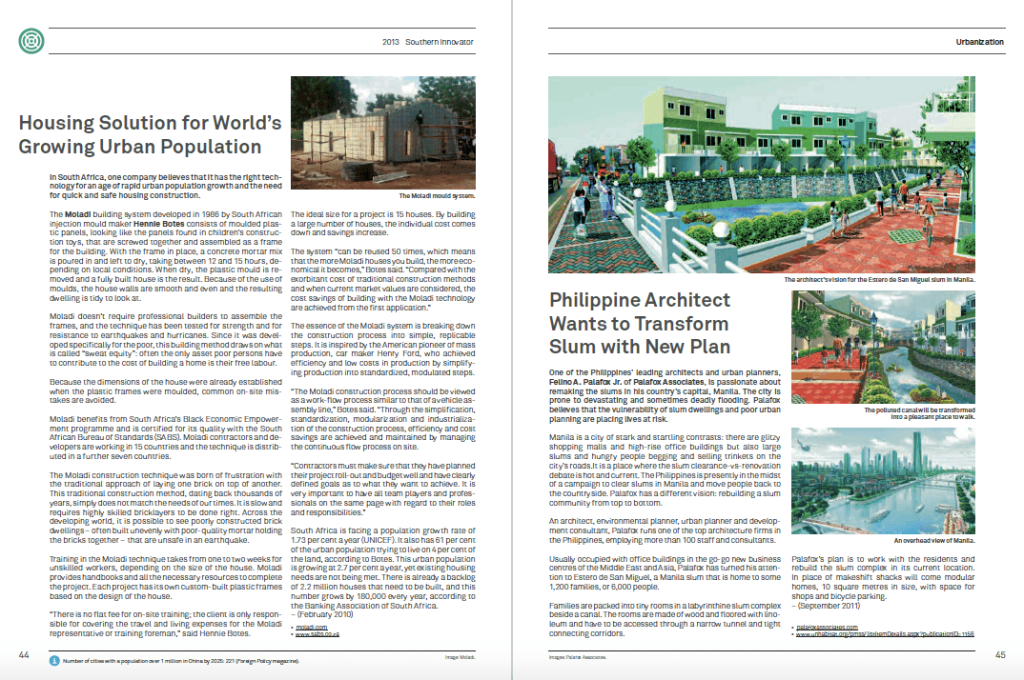
One of the Philippines’ leading architects and urban planners, Felino A. Palafox Jr. of Palafox Associates (www.palafoxassociates.com), is passionate about re-making the slums in his country’s capital, Manila. The city is prone to devastating and sometimes deadly flooding. Palafox believes the vulnerability of slum dwellings and poor urban planning are placing lives at risk.
“We can’t wait for another tragedy,” Palafox told the Philippine Daily Inquirer in 2010. “We have seen how an unprecedented volume of rainfall like what (storm) Ondoy had brought could prove too much for Metro Manila’s river and drainage system. We have also seen what a massive earthquake could do to an unprepared city like Haiti.
“While there is nothing that we could do to control the destructive power of these natural phenomena, there are steps that we could take to limit the amount of damage.”
If the rapid growth in urban populations is to be safe and sustainable, then new dwellings will need to be built that meet high standards of durability.
The UN Challenge of Slums report from 2003 (www.unhabitat.org/pmss/listItemDetails.aspx?publicationID=1156) broke with past orthodoxy that slums must be cleared, arguing that slums should be seen as positive economic forces, incubators for budding entrepreneurs that offer a gateway to better things for new migrants.
Muhammad Khadim of UN-Habitat summed up the new thinking:
“Ten years ago, we used to dream that cities would become slum-free,” he said. But “the approach has changed. People see the positives. The approach now is not to clear them but to improve them gradually (and) regularise land tenure.”
The arguments behind embracing slums come from the economic changes across developing countries since the 1970s. Growing informal economies combined with fewer social provisions and the shift to urban from rural communities have all contributed to the explosion in slums and informal housing.
Manila is a city of stark and startling contrasts: there are glitzy shopping malls and high-rise office buildings, but also large slums and hungry people begging and selling trinkets on the city’s roads.
It’s a place where the slum clearance-vs-renovation debate is hot and current. The Philippines is currently in the midst of a campaign to clear slums in Manila and move people back to the countryside.
“Many of our people are no longer interested in agriculture, so we need to give them incentives to go back,” Cecilia Alba, head of the national Housing and Urban Development Co-ordinating Council, told the New Statesman magazine. “If we had to rehouse the slum-dwellers inside Manila in medium-rise housing, it would cost a third of the national budget.”
Palafox has a different vision – rebuilding a slum community from top to bottom.
An architect, environmental planner, urban planner and development consultant, Palafox runs one of the top architecture firms in the Philippines, employing more than 100 staff and consultants.
Usually occupied with office buildings in the go-go new business centres of the Middle East and Asia, Palafox has turned his attention to Estero de San Miguel, a Manila slum that is home to some 1,200 families, or 6,000 people.
Families are packed into tiny rooms in a labyrinthine slum complex beside a canal. The rooms are made of wood and floored with linoleum and have to be accessed through a narrow tunnel and tight connecting corridors.
Palafox’s plan is to work with the residents and rebuild it in its current location. In place of makeshift shacks will come modular homes, 10 square metres in size with space for shops and bicycle parking.
The design has the homes extend above a walkway, imitating the way the original slum structures were built.
Palafox is applying innovative thinking to the problem: taking his design direction from the dwellings slum residents build: “The slum-dwellers,” he explained to the New Statesman, “are experts at live-work space design. They spontaneously do mixed-use! We just have to learn from them.”
Re-housing the residents on site means they can continue to play their role in the city’s economy, and do not have to make a long commute to jobs and opportunities.
Palafox also rebuts complaints about the cost of his plan, arguing the scale of corruption in the Philippines costs just as much.
“OK, the total cost of rehousing slum-dwellers in situ is 30 per cent of GDP (but) I calculate we lose about 30 per cent of the country’s wealth through corruption. If we didn’t have corruption, we wouldn’t need to tolerate slums.”
“We have to recognize the value of slum-dwellers to the city,” he said. “These are the ones who drive your car, clean your house and run your store. If these people were cleared from the city, the city would die. Slum-dwellers add social, political and economic value to the city.”
Even in its current form, Estero de San Miguel is a vibrant place, with an Internet café and a volunteer police force.
A BBC report found it lively and economically viable because it has educational and communication technologies that improve living conditions. The residents make their living working as cheap labour for the city.
Oliver Baldera, a carpenter, lives with his wife and four children:
“We’ve been here more than 10 years,” he told the New Statesman. “There’s no choice.
“It’s easier to get a job here and I can earn 400 pesos a day. I can send the kids to school and they eat three times a day – but it’s not enough. I need more space.”
Published: September 2011
Resources
1) More Urban, Less Poor: The first textbook to explore urban development and management and challenge the notion unplanned shanty towns without basic services are the inevitable consequence of urbanization. Website:http://www.earthscan.co.uk/?tabid=649 2) Slum Populations in the Developing World: See a breakdown of the urban/slum population in developing nations. Website:http://news.bbc.co.uk/1/hi/5078654.stm 3) Architecture for Humanity: An NGO to promote architectural and design solutions to global, social and humanitarian crises. Website:http://architectureforhumanity.org/ 5) Building and Social Housing Foundation: The Building and Social Housing Foundation (BSHF) is an independent research organisation that promotes sustainable development and innovation in housing through collaborative research and knowledge transfer. Website:http://www.bshf.org 6) NGO called Map Kibera began work on an ambitious project to digitally map Africa’s largest slum, Kibera in Nairobi, Kenya. Website:http://www.mapkibera.org 7) ArrivalCity: The Final Migration and Our Next World by Doug Saunders. Website:http://www.arrivalcity.net 8) Slum TV: Based deep inside Nairobi’s largest slum, Mathare, they have been seeking out the stories of hope where international media only see violence and gloom. Website:http://www.slum-tv.org 9) A Kenyan eco-village is helping slum dwellers to start new lives and increase their wealth. The community, Kaputei, is being built by former slum residents – some of whom used to beg to survive – and is providing new homes with electricity, running water and services like schools and parks. By building their own homes, with the help of affordable mortgage loans, the residents are able to make a big upgrade to their quality of life while acquiring real wealth. Website:http://www.jamiibora.org 8) Cities for All shows how the world’s poor are building ties across the global South. Website:http://globalurbanist.com/2010/08/24/cities-for-all-shows-how-the-worlds-poor-are-building-ties-across-the-global-south.aspx










 David South Consulting
You must be logged in to post a comment.