Category: Archive

An archive of published content for media and clients.

  • Housing Solution for World’s Growing Urban Population

    Housing Solution for World’s Growing Urban Population

    By David SouthDevelopment Challenges, South-South Solutions

    SOUTH-SOUTH CASE STUDY

    Across the South, cities are expanding and urban populations growing at a phenomenal rate — the cities of Africa and Asia are growing by a million people a week. Megacities and sprawling slums will be the hallmarks of this majority urban world. In sub-Saharan Africa, 72 percent of the population already lives in slum conditions.

    How people will be housed is an urgent problem. There are many ways to build a dwelling, from scavenged materials, to labour-intensive and expensive custom-built construction, yet affordable and safe construction techniques for the poor are sorely needed.

    The danger of building unsafe housing can be seen in the recent devastating earthquake in Haiti, where many buildings collapsed, killing an estimated 212,000 people. If the rapid growth in urban populations is to be safe and sustainable, then new dwellings will need to be built that meet high standards of durability.

    In South Africa, one company believes it has the right technology for an age of rapid urban population growth and the need for quick and safe housing construction.

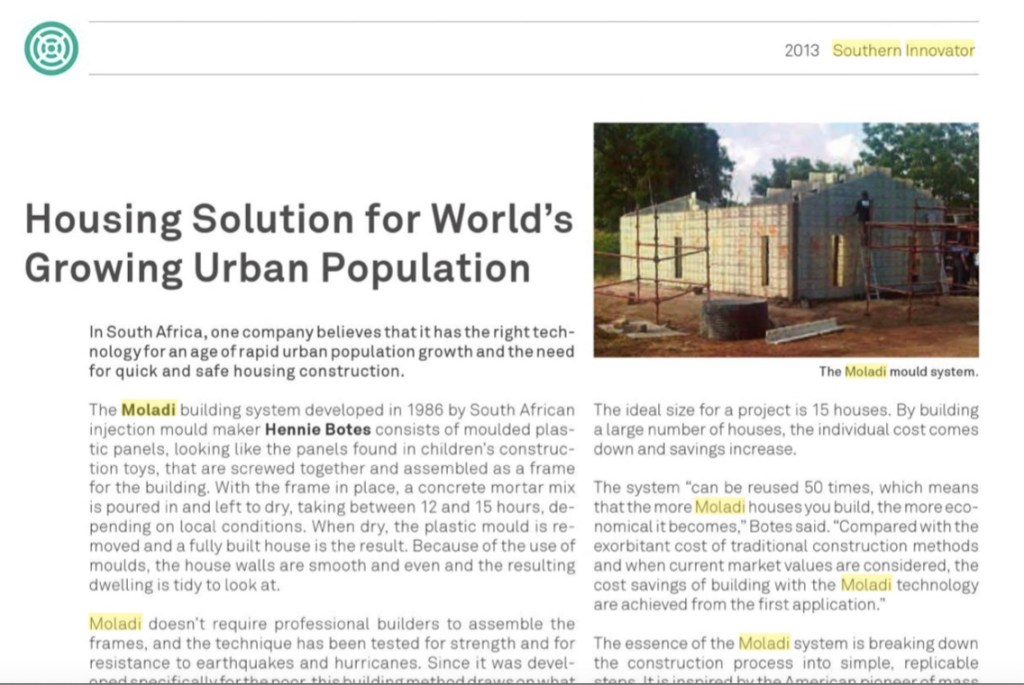
    The Moladi building system (http://moladi.com/) (http://www.moladi.net/default.aspx?AspxAutoDetectCookieSupport=1) developed in 1986 by South African injection mold maker Hennie Botes consists of molded plastic panels, looking like the panels found in children’s construction toys that are screwed together and assembled as a frame for the building. With the frame in place, a concrete mortar mix is poured in and left to dry: depending on local conditions, taking between 12 and 15 hours. When dry, the plastic mold is removed and a fully built house is the result. Because of the use of molds, the home’s walls are smooth and even and the resulting home is tidy to look at.

    Moladi doesn’t require professional builders to assemble the frames, and the technique has been tested for strength and for resistance to earthquakes and hurricanes. Since it was developed specifically for the poor, this building method draws on what is called ‘sweat equity’: often the only asset a poor person has to contribute to the cost of building a home is their free labour.

    Because the dimensions of the home have already been established when the plastic frames were molded, common on-site mistakes are avoided.

    Moladi benefits from South Africa’s Black Economic Empowerment programme (http://www.southafrica.info/business/trends/empowerment/bee.htm) and is certified for its quality with the South African Bureau of Standards (SABS) (https://www.sabs.co.za/). Moladi contractors and developers are working in 15 countries and the technique is distributed in a further seven countries.

    The Moladi construction technique was born of frustration with the traditional approach of laying one brick on top of another. This traditional construction method, dating back thousands of years, just doesn’t match the needs of our times. It is slow and requires highly skilled bricklayers to be done right. Across the developing world, it is possible to see poorly constructed brick dwellings – often built unevenly with poor quality mortar holding the bricks together – that are unsafe in an earthquake.

    Training in the Moladi technique takes from one to two weeks for unskilled workers depending on the size of the home. Moladi provides handbooks and all the necessary resources to complete the project. Each project has its own custom-built plastic frames made based on the home’s design.

    “There is no flat fee for on-site training; the client is only responsible for covering the travel and living expenses for the Moladi representative or training foreman,” said Hennie Botes.

    The ideal size for a project is 15 homes. By building a large number of homes, the individual cost comes down and savings increase.

    The system “can be reused 50 times, which means that the more Moladi houses you build, the more economical it becomes,” Botes said. “Compared with the exorbitant cost of traditional construction methods and when current market values are considered, the cost savings of building with the Moladi technology are achieved from the first application.”

    As the world’s cities grow, and slums become larger and more prevalent, the urgent need for affordable and decent housing will go hand-in-hand with a need for jobs — particularly jobs for unskilled workers. There just won’t be enough skilled workers to go around to build the homes. Even in developed countries, this has become a problem.

    “The recent earthquake disaster in Haiti could benefit from the Moladi system,” Botes said. “Job creation for Haitians is desperately needed and Moladi can immediately facilitate an income for family groups, as over 95 percent of the construction team consists of unskilled labourers. There is no requirement for heavy machinery, or even electricity, and remote areas can be easily accessed; Moladi also allows for the utilisation of building rubble resulting from the earthquake in the construction of new buildings.”

    The essence of the Moladi system is breaking down the construction process into simple, replicable steps. It is inspired by the American pioneer of mass production, car maker Henry Ford (http://en.wikipedia.org/wiki/Henry_Ford), who achieved efficiency and low costs in production by simplifying production into standardized and modulated steps.

    “The Moladi construction process should be viewed as a workflow process similar to that of a vehicle assembly line,” Botes said. “Through the simplification, standardization, modularization, and industrialization of the construction process, efficiency and cost savings are achieved and maintained by managing the continuous flow process on site.

    “Contractors must make sure that they have planned their project roll-out and budget well and have clearly defined goals as to what they want to achieve. It is very important to have all team players and professionals on the same page with regards to their roles and responsibilities.”

    In the beginning, Botes encountered resistance to his innovative production methods. “I was highly motivated and really believed in my idea, but when I presented it to investors, they’d shoot holes in it. … It’s been a 22-year journey, but I always kept the goal in mind. Moses spent 40 years in the desert … I’m quite happy my desert experience was only 20-odd years, though,” he told Men’s Health magazine.

    South Africa is facing a population growth rate of 1.73 percent a year (UNICEF). It also has 61 percent of the urban population trying to live on four percent of the land, according to Botes. This urban population grows at 2.7 percent a year, yet existing housing needs are not being met. There is already a backlog of 2.2 million homes needed to be built, and this grows by 180,000 every year, according to the Banking Association of South Africa (http://www.banking.org.za/default.aspx).

    “Even though the need for housing has always been a fundamental requirement to sustain one’s health and welfare, the advances in this area have been seriously lacking,” said Botes. “The brick and mortar method of construction was recorded as early as 1458 B.C, which means that very little has changed in terms of building structures over a period of almost 3.5 millennia.

    “We cannot expect to resolve the housing crisis in our age with a technique developed for the requirements of society 3468 years ago.”

    With the success of the Moladi building system, Hennie is working on “producing windows, doors, toilet seats, window frames, sinks and washbasins. If I can include these as part of my product, I’ll reduce the total unit cost of the house.”

    Published: February 2010

    Resources

    1) Cradle to Cradle: Remaking the Way We Make Things: This radical concept is about how products, can be used, recycled, and used again without losing any material quality—in cradle to cradle cycles. Website:http://www.mcdonough.com/cradle_to_cradle.htm

    2) Builders Without Borders: Is an international network of ecological builders who advocate the use of straw, earth and other local, affordable materials in construction. Website:http://builderswithoutborders.org/

    3) World Hands Project: An NGO specialising in simple building techniques for the poor. Website:http://www.worldhandsproject.org

    4) CIDEM and Ecosur specialise in building low-cost community housing using eco-materials. They have projects around the world and are based in Cuba. Website:http://www.ecosur.org

    5) The Rural Development Institute focuses on land rights for the poor and has a series of articles on China’s land reforms. Website: http://www.rdiland.org

    6) More Urban, Less Poor: The first textbook to explore urban development and management and challenge the notion unplanned shanty towns without basic services are the inevitable consequence of urbanization. Website:http://www.earthscan.co.uk/

    7) Building and Social Housing Foundation: The Building and Social Housing Foundation (BSHF) is an independent research organisation that promotes sustainable development and innovation in housing through collaborative research and knowledge transfer. Website: http://www.bshf.org/

    https://davidsouthconsulting.org/2022/05/23/debt-free-homes-for-the-poor/

    https://davidsouthconsulting.org/2021/11/11/decent-and-affordable-housing-for-the-poor/

    https://davidsouthconsulting.org/2022/11/16/housing-innovation-in-souths-urban-areas/

    https://davidsouthconsulting.org/2021/02/12/rammed-earth-houses-china-shows-how-to-improve-and-respect-traditional-homes/

    https://davidsouthconsulting.org/2021/02/12/rebuilding-after-chinese-earthquake-beautiful-bamboo-homes/

    https://davidsouthconsulting.org/2022/11/19/securing-land-rights-for-the-poor-now-reaping-rewards/

    https://davidsouthconsulting.org/2022/05/23/solar-bottle-bulbs-light-up-dark-homes/

    https://davidsouthconsulting.org/2022/11/17/tiny-homes-to-meet-global-housing-crisis/

    https://davidsouthconsulting.org/2021/03/05/southern-innovator-issue-4/

    Creative Commons License

    This work is licensed under a
    Creative Commons Attribution-Noncommercial-No Derivative Works 3.0 License.

    ORCID iD: https://orcid.org/0000-0001-5311-1052.

    © David South Consulting 2023

  • Decent and Affordable Housing for the Poor

    Decent and Affordable Housing for the Poor

    By David SouthDevelopment Challenges, South-South Solutions

    SOUTH-SOUTH CASE STUDY

    Urban populations across the South are growing fast: by 2030, some 5 billion people around the world will live in cities. This year will be the first year in which urban dwellers (3.3 billion people) will outnumber rural residents for the first time (UNFPA).

    Africa now has a larger urban population than North America and 25 of the world’s fastest growing big cities. Asia and Africa’s cities are growing by an incredible 1 million people a week, with 72 per cent of the population in sub-Saharan Africa living in slum conditions.

    How well people dwell is integral to their mental and physical health. Most squatters and slum dwellers – a category that includes half the urban population of Africa, a third in Asia and a fourth in Latin America and the Caribbean – live in makeshift homes made from whatever they can get their hands on. These dwellings are usually unsafe and vulnerable to fire, floods, and earthquakes. On top of this, these sprawling slums can be depressingly grim to look at for those living there.

    In Brazil’s Sao Paulo neighbourhood of Heliopolis – the largest of the city’s 400 favelas, or shantytowns – the majority of its dwellings are made from cement and brick. It is stigmatised as the ugliest part of the city, yet a unique initiative has transformed perceptions of the area – and brought pride to its residents. The project offers a model for slum areas looking to make the next leap up the ladder of development. Heliopolis first sprang up in the 1970s, wedged between highways and roads. Plagued by crime, there is a wide spread in incomes and urbanisation among the 120,000 residents packed into the one-and-a-half square mile. Older parts have many services, while newer areas lack basics like plumbing and electricity.

    Well-known Sao Paulo-based Brazilian architect Ruy Ohtake (http://www.geocities.com/capitolhill/3836/saopaulo.html) mobilised the 6,000 residents to use a fixed palette of six colours – from bright yellow to deep purples – to create a look described as akin to an Italian hill town.

    “Ohtake told a newspaper that Heliopolis was the ugliest part of the city, so we went to him and asked him to figure out how to make it beautiful,” Geronino Barbosa, director of the Heliopolis community group UNAS, told the design magazine Dwell.

    Ohtake, famous for his hotel designs and renovating former colonial areas, rose to the challenge: “I believe in beauty as a social function, so what better way to exercise that belief,” he said. To avoid the initiative feeling like something being imposed from on high, the plan did not go ahead until the residents were happy. And to make sure they felt they owned the results, they did all the painting themselves. The result is a river of colour running through a landscape of dreary, unfinished brick homes jammed between streets and factories. The Italian hill town-effect leaves pedestrians experiencing a surprise as they turn through the streets, happening upon hidden plazas and little bars.

    “Our dream is to expand this project to the entire favela,” said Barbosa. “People love their painted houses. One of our participants told me that her house has been transformed into a sort of Carnival parade.”

    “Who doesn’t want to live in a beautiful house?” said UNAS’ head, Joao Miranda, to Dwell. “We want the same things as everyone else.”

    Another architect has tackled the problem of how to create inexpensive but durable and beautiful homes for the poor. Iranian-born architect Nader Khalili (http://www.calearth.org/) has created what he calls ‘super adobe’ dwellings inspired by traditional Iranian rural homes. The cone-shaped homes are made from sandbags piled one on top of the other in a circular pattern. A basic home is three rooms of 400 square feet, and can be built by five people (with only one needing skills), within weeks. Being sandbags, the homes can easily be dismantled and moved or adapted to meet new space needs.

    Khalili first fell in love with the sand adobe homes of Iran in the 1970s. He had been on a journey to find a home design that was both environmentally harmonious and could be built anywhere in the world quickly and cheaply. But while the original Iranian sand adobe is easily destroyed by earthquakes and bad weather, the ‘super adobes’ are earthquake, hurricane and flood resistant. They are now being built across the Americas , Asia and Africa.

    “You can never build one of these that doesn’t look beautiful,” he said. “Just as you have never seen an ugly tree or an ugly flower.”

    Published: January 2008

    Resources

    • Builders Without Borders: Is an international network of ecological builders who advocate the use of straw, earth and other local, affordable materials in construction. Website: http://builderswithoutborders.org/
    • World Hands Project: An NGO specialising in simple building techniques for the poor. Website:http://www.worldhandsproject.org
    • Tsunami-Safe House: A design for Prajnopaya Foundation: a project coordinated by the SENSEable City Laboratory, a new research initiative between the Department of Urban Studies and Planning and the Media Lab at the Massachusetts Institute of Technology in Boston. Website:http://senseable.mit.edu/tsunami-prajnopaya/
    Creative Commons License

    This work is licensed under a
    Creative Commons Attribution-Noncommercial-No Derivative Works 3.0 License.

    ORCID iD: https://orcid.org/0000-0001-5311-1052.

    © David South Consulting 2021

  • “Pocket-Friendly” Solution to Help Farmers Go Organic

    “Pocket-Friendly” Solution to Help Farmers Go Organic

    By David SouthDevelopment Challenges, South-South Solutions

    SOUTH-SOUTH CASE STUDY

    Interest in organic food and farming is high, and organics have become a growing global industry. The worldwide market for organic food grew by more than 25 per cent between 2008 and 2011, to US $63 billion, according to pro-organic group the Soil Association. That is an impressive accomplishment given the backdrop of the global economic crisis, and evidence that people value quality food, even in tough times.

    One Kenyan company is hoping to help farmers benefit from this global surge in interest in organic food. The company is selling a healthy alternative to chemical fertilizers and is hoping it will soon be able to source its products in Kenya, too.

    BioDeposit (http://biodeposit.lv/index.php?page=elixir-3) sells soil conditioner and natural fertilizer made from two ingredients: peat found in marshlands and silt dredged up from lakes, which is called sapropel (http://en.wikipedia.org/wiki/Sapropel). This naturally occurring resource is rich in all the elements required for abundant crops and has the added benefit of not poisoning the soil and water table when used on farmer’s fields.

    It is sold as a solution to the multiple pressures hitting farmers, from chaotic weather patterns to soil damage and decreasing yields. It offers a way to boost farm productivity without damaging the soil in the long term.

    In 2011 the amount of farmland that was organic reached 37.2 million hectares in 162 countries – but this is still just 0.86 per cent of the world’s agricultural land (Research Institute of Organic Agriculture and International Federation of Organic Agriculture Movements). If BioDeposit has its way, Kenyan farmers could help to grow the number of hectares being farmed organically.

    Presenting the solution in October 2013 at the Global South-South Development Expo (southsouthexpo.org) at the headquarters of the UN’s Environment Programme (UNEP) in Nairobi, Kenya, BioDeposit communications and media chief Nelly Makokha (http://ke.linkedin.com/pub/nelly-makokha/29/a08/634), explained that the company is hoping to bring the technology behind BioDeposit to Kenya, if they can get permission.

    At present, the source materials for the products are dredged from lakes in Latvia in Eastern Europe. Because of the political structures of Kenya, it means a long political process is ahead to gain permission to dredge any of the country’s lakes. BioDeposit’s Latvian scientists conducted research on the potential for Lake Naivasha (http://en.wikipedia.org/wiki/Lake_Naivasha) in the Rift Valley and claim it has enough deposits to provide Kenya’s farmers with organic fertilizer for the next 200 years.

    “If the government agrees, the fertilizer is basically cheaper than any other fertilizer the farmer [will] have ever used in a long time,” said Makokha. “It will be pocket-friendly for them. As they earn more money from the more yields, they are spending less on the fertilizer.

    “Our slogan is ‘smart agriculture for health and wealth’  – health in terms of you become organically grown, and if you are looking for organic certification, we will organize that for the certifiers. Right now most countries are looking for organic food and cannot find it.

    “So when you become organic that means you earn more money on your products so it means you are healthy and you are wealthy!”

    The fertilizer comes in 12 milliliter packets that cost 200 Kenyan shillings (US $2.30). A farmer would need two packets for each quarter acre of farmland.

    Based on a Russian discovery from the early 20th century, BioDeposit draws on naturally occurring resources.

    Its products include BioDeposit Agro, described as a “biologically active soil conditioner,” and BioDeposit Elixir, described as a “humic plant growth stimulator.” The Elixir is a “sustainable, water-soluble” concentrate made from peat and can be used to soak seeds prior to planting, increasing the germination cycle. For the farmer, it means more seedlings in a shorter time. It also can be poured on compost piles to boost humic content to speed compost decay. Peat is formed from above-ground marsh plants, either on the surface or under a layer of water.

    BioDeposit Agro is made from sapropel from the sediment at the bottom of freshwater lakes. It is a renewable, naturally-occurring resource as it has been formed from the accumulated settling of plants such as reeds, algae, trees, grasses and animals over time as they decay.

    Unlike other chemical fertilizers, using the BioDeposit product does not require special protective clothing and does not harm human health. Children are also not at risk if they accidentally ingest the product.

    “Most farmers have small farms – quarter acre, half acre, at most three acres,” said Makokha. “For a quarter acre you spend five dollars and you get more yields. Two of them would be approximately five dollars – that’s enough for a whole season – so it is pocket friendly.”

    And if the company is able to harvest the material in Kenya, it would be even cheaper.

    “You can imagine if we dredge here – probably (get the cost down to) a dollar – so it makes more sense for the farmers.”

    The dredging has another positive impact: it helps with managing flooding by making the lake deeper once the silt is dredged out, making life better and safer for people living nearby.

    BioDeposit has been operating in Kenya for a year and, Makokha said, “the response is awesome.”

    BioDeposit organizes workshops for farmers through cooperative societies, helping to guide farmers through the whole process of becoming organically certified.

    The company believes its products will help avert problems such as what happened recently when the European Union prevented some flowers – a major source of overseas income for Kenyan farmers – from entering the EU because of banned pesticides.

    Cleverly, BioDeposit does most of its business digitally through mobile phones. It conducts its business with sales representatives by phone and conducts training by phone as well. All payments and bank transfers are done by phone using the M-PESA system (http://www.safaricom.co.ke/?id=257).

    “It is the easiest way to do business in Kenya,” said Makokha. “Everybody right now owns a mobile phone. When we get the M-PESA, we transfer directly to the account. You get the money and transfer to the bank account and you are done, very easy for everybody … doing wonders for us.”

    Published: March 2014

    Resources

    1) Soil health crisis threatens Africa’s food supply. Website: http://www.newscientist.com/article/dn8929-soilhealth-crisis-threatens-africas-food-supply.html

    2) 2050: Africa’s Food Challenge: Prospects good, resources abundant, policy must improve: A discussion paper from the Food and Agricultural Organization (FAO). Website: http://www.fao.org/wsfs/forum2050/wsfs-background-documents/issues-briefs/en

    3) State of the World 2011: Innovations that Nourish the Planet. Website: http://www.worldwatch.org/sow11

    5) Integrating Ethno-Ecological and Scientific Knowledge of Termites for Sustainable Termite Management and Human Welfare in Africa by Gudeta W. Sileshi et al, Ecology and Society, Volume 14, Number 1. Website: http://www.ecologyandsociety.org/vol14/iss1/art48

    6) Soil Association: The Soil Association was founded in 1946 by a group of farmers, scientists and nutritionists who observed a direct connection between farming practice and plant, animal, human and environmental health. Website: http://www.soilassociation.org/marketreport

    7) Research Institute of Organic Agriculture: FiBL is an independent, non-profit, research institute with the aim of advancing cutting-edge science in the field of organic agriculture.  Website: http://www.fibl.org/en/fibl.html

    International Federation of Organic Agriculture Movements: Since 1972, IFOAM has occupied an unchallenged position as the only international umbrella organization of the organic world, i.e. all stakeholders contributing to the organic vision. Website: http://www.ifoam.org/

    9) BioDeposit on Facebook. Website: https://www.facebook.com/BioDepositAfrica

    https://davidsouthconsulting.org/2022/11/21/africa/

    https://davidsouthconsulting.org/2020/12/14/african-farming-wisdom-now-scientifically-proven/

    https://davidsouthconsulting.org/2022/11/21/agribusiness-food-security/

    https://davidsouthconsulting.org/2022/10/10/cheap-farming-kit-hopes-to-help-more-become-farmers/

    https://davidsouthconsulting.org/2022/11/23/kenyan-farmer-uses-internet-to-boost-potato-farm/

    https://davidsouthconsulting.org/2022/10/31/new-kenyan-services-to-innovate-mobile-health-and-farming/

    https://davidsouthconsulting.org/2021/09/16/small-fish-farming-opportunity-can-wipe-out-malnutrition/

    https://davidsouthconsulting.org/2021/03/05/southern-innovator-issue-3/

    https://davidsouthconsulting.org/2022/11/11/urban-farming-to-tackle-global-food-crisis/

    https://davidsouthconsulting.org/2022/10/18/woman-wants-african-farming-to-be-cool/

    Development Challenges, South-South Solutions was launched as an e-newsletter in 2006 by UNDP’s South-South Cooperation Unit (now the United Nations Office for South-South Cooperation) based in New York, USA. It led on profiling the rise of the global South as an economic powerhouse and was one of the first regular publications to champion the global South’s innovators, entrepreneurs, and pioneers. It tracked the key trends that are now so profoundly reshaping how development is seen and done. This includes the rapid take-up of mobile phones and information technology in the global South (as profiled in the first issue of magazine Southern Innovator), the move to becoming a majority urban world, a growing global innovator culture, and the plethora of solutions being developed in the global South to tackle its problems and improve living conditions and boost human development. The success of the e-newsletter led to the launch of the magazine Southern Innovator.

    Creative Commons License

    This work is licensed under a
    Creative Commons Attribution-Noncommercial-No Derivative Works 3.0 License.

    ORCID iD: https://orcid.org/0000-0001-5311-1052.

    © David South Consulting 2023


  • Ring Tones and Mobile Phone Downloads are Generating Income for Local Musicians in Africa

    Ring Tones and Mobile Phone Downloads are Generating Income for Local Musicians in Africa

    By David SouthDevelopment Challenges, South-South Solutions

    SOUTH-SOUTH CASE STUDY

    African musicians hoping to support themselves through their recordings have always had to contend with the added burden of poor copyright control over their work. While musicians in the West are supported by a highly regulated regime of copyright protection – ensuring some to become the richest people in their respective countries – most African musicians have had to stand back and watch their work being copied, sold and exchanged with little chance of seeing any royalties. Global audiences know of the success of artists like Fela Kuti, Youssou N’Dour, Manu Dibango and Miriam Makeba, but most African musicians can look forward to scant earnings from recording their music.

    Anyone who has walked through the markets of Africa will know there are plenty of pirated CDs for sale, yet it is of no use to a musician who never sees the money. Poverty is endemic amongst African musicians as a result of this loss of income. While music is a global business worth US $40 billion according to the Recording Industry Association of America, pirated music in Africa is rampant – some estimates by the Recording Industry of South Africa put it at over 80 percent of available music. How much money is being lost can be judged from the estimated daily income of a pirate music vendor in Africa, ranging between Euro 762 and Euro 2,744.

    But a solution to this problem is being pioneered in Botswana in southern Africa. A partnership between mobile phone provider Orange Botswana and Small House Records/Mud Hut Studios, ensures musicians get a slice of the profit pie. Managing director Solomon Monyame of Small House Records has signed a contract with Orange to share the profits from ring tone and song downloads to mobile phone subscribers. With more than 76.8 million people currently subscribing to mobile phone services in Africa, and the number growing by about 58 percent each year for the last five years, the potential royalties market for African musicians is vast if this initiative is replicated across the continent.

    In the paper “Development Goes Wireless” to be published in the spring 2007 issue of the journal of the Institute of Economic Affairs, lead researcher Karol Boudreaux of George Mason University’s Mercatus Center and Enterprise Africa!, discovered mobile phones and mobile phone companies can give artists a new way to control royalties for their work. She found that in the absence of effective copyright control mechanisms – as is the case in many African countries – the mobile phone company can step in to save the day.

    “When you walk through the markets there you see so much music available on the street, but there is little intellectual property rights protection,” she said.

    “In other countries, like the UK, you have strong intellectual property rights protection, but this just isn’t the case in much of Africa. The mobile phones are a very good way to get around this problem as long as cell phone providers are willing to make the contracts. Botswana is very lucky in that they have a very good contract environment, but this isn’t necessarily the case in other countries. It is a win-win for music providers and mobile companies.”

    The NetTel@Africa project started by USAID and the Center to Bridge the Digital Divide, in partnership with many African and US universities, is also championing copyright protection strategies.

    How important creative industries are becoming to economic development is slowly being recognized. It is now seen as an important component of modern post-industrial, knowledge-based economies, but equally also a way for economically underdeveloped countries to generate wealth. Not only are they thought to account for higher than average growth and job creation, they are also vehicles of cultural identity and play an important role in fostering cultural diversity. Initiatives like UNESCO’s Global Alliance for Cultural Diversity attempt to document this phenomenon and back it up with hard numbers.

    UNESCO also has a project to establish musicians’ cooperatives across Africa. As such, the musicians are able to pool their production resources, which are individually insufficient to ensure the economic viability of a small or medium-sized business. In Burkina Faso, a co-operative is working with the International Labour Organisation. Click here for more information.

    Festivals like Mali’s annual Festival in the Desert in the oasis of Essakane, 65 kilometers from Timbuktu, is an example of how African musicians are finding their own way to reach audiences. Targeted above all to promote African and Malian Music inside the continent, the Festival has also boosted international tourism to the region and almost 10 percent of last year’s 6,000 visitors came from outside of Africa.

    Another initiative for African musicians is the DigiArts Africa network. It was founded by UNESCO and aims to increase communication between artists, industries and educators, make musicians self-sustainable, use the ICT industries to support and contribute to cultural activities, and better promote African musicians within and outside Africa. Click here for more information.

    Well-known Senegalese musician Thione Seck is blunt about the economic effect of piracy on his income.

    “Were there no piracy, I could have bought an island, seeing the number of songs that I composed in more than 30 years of my career”, he told a local newspaper.

    According to Abdoul Aziz Dieng, president of the Senegal Music Works Association (AMS) and Chairman of the Board of the Senegalese Copyright Office (BSDA) (www.mali-music.com), out of 10 Senegalese artists’ CDs available on the local market, “only two are legal”. For audio cassettes, the ratio is three pirate copies out of every five sold.

    Opportunities to combat piracy and generate income are also not limited to just musicians. Filmmakers in Africa are starting to learn how to exploit the opportunities thrown up by the fast-expanding mobile phone networks on the continent. Already a phenomenon in South Africa (www.filmmaker.co.za), director Aryan Kaganof is in the process of releasing SMS Sugar Man, a feature length movie shot entirely with mobile devices. The movie will be beamed to cell phones in three-minute clips over 30 days.

    What are the effects of Piracy?

    • Artist
      • No royalty payments, no money to live
    • Record companies
      • No return on investments. Staff retrenchments
    • Retailers
      • Cannot compete with low prices. Staff retrenchments
    • Consumers
      • Many copies are of inferior quality. If tracks are missing or the sound quality is poor, no exchange or refunds
      • May be contributing to “organized crime” syndicates which are heavily involved in international music piracy

    Source: Recording Industry of South Africa

    Published: January 2007

    Resources

    Lively website about African musicians

    BBC website on African music

    Further reading from UNESCO: African music: new challenges, new vocations: Click here

    https://davidsouthconsulting.org/2022/10/02/african-afro-beats-leads-new-music-wave-to-europe/

    https://davidsouthconsulting.org/2022/11/11/berber-hip-hop-helps-re-ignite-culture-and-economy/

    https://davidsouthconsulting.org/2022/11/17/cashing-in-on-music-in-brazil/

    https://davidsouthconsulting.org/2022/12/18/disabled-congolese-musicians-become-world-hit/

    https://davidsouthconsulting.org/2021/11/09/mauritanian-music-shop-shares-songs-and-friendship/

    https://davidsouthconsulting.org/2023/02/07/mongolian-rock-and-pop-book-mongolia-sings-its-own-song/

    https://davidsouthconsulting.org/2020/12/17/mongolias-musical-entrepreneurs-led-way-out-of-crisis-2018/

    https://davidsouthconsulting.org/2021/03/05/southern-innovator-issue-1/

    https://davidsouthconsulting.org/2021/03/05/southern-innovator-issue-2/

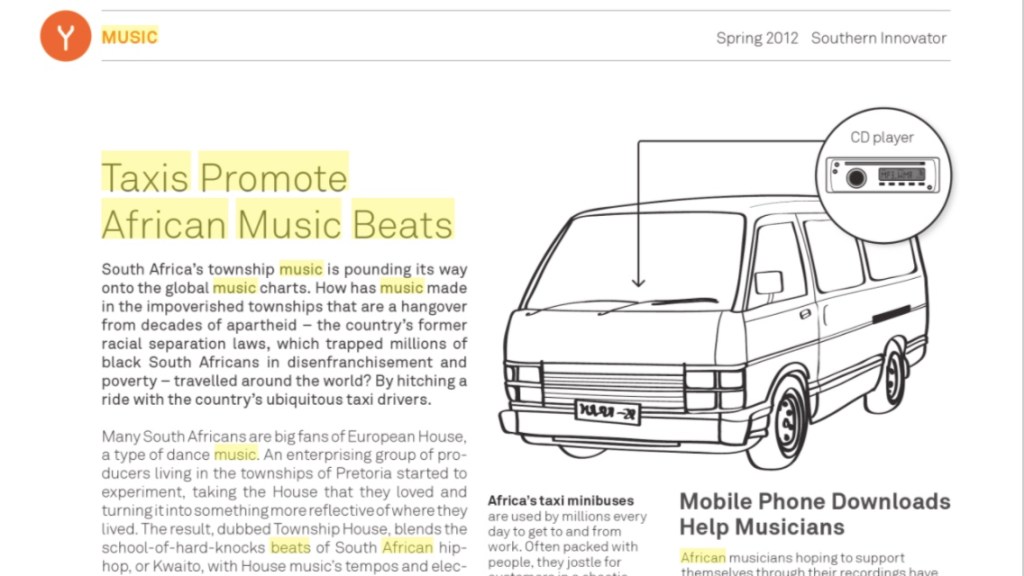
    https://davidsouthconsulting.org/2021/11/09/taxis-promote-african-music-beats/

    Creative Commons License

    This work is licensed under a
    Creative Commons Attribution-Noncommercial-No Derivative Works 3.0 License.

    ORCID iD: https://orcid.org/0000-0001-5311-1052.

    © David South Consulting 2023