Category: Archive

An archive of published content for media and clients.

  • Truckus Maximus: The Big Boys With The Big Toys Do Some Hardcore Pogo At Monster Truck Show

    Truckus Maximus: The Big Boys With The Big Toys Do Some Hardcore Pogo At Monster Truck Show

    “I got laid off too many times. Now, I work harder for less money. But I get to do what I want to do. Not many people get that.”

    By David South

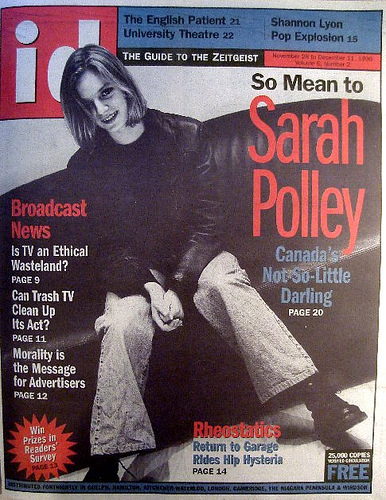
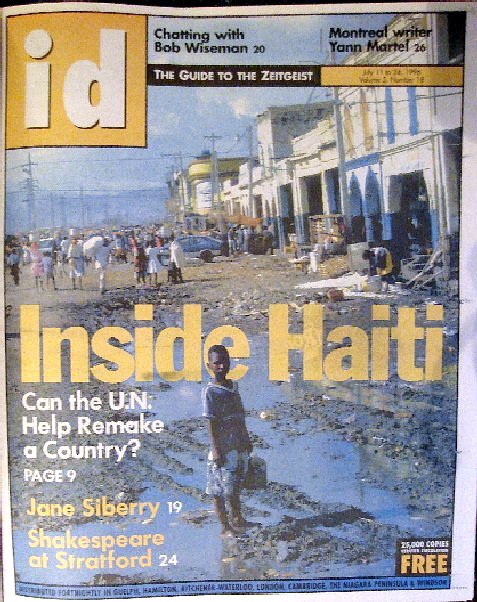
    Id Magazine (Canada), February 6 to 19, 1997

    The little tiger-striped four-by-four is definitely going too fast. In an instant, the diminutive Suzuki stands balanced, its front wheels squashed at 90 degrees. A millisecond later, it’s on its back like a ladybug flipped over by the wind. The cacophony of the crowd reaches a crescendo. But the noise had been building; the Skydome crowd saw the writing on the wall for the little jeep. 

    Frantic helpers pry open the door of the jeep, wrestling free the driver, Dwayne Robichaud. He emerges in an orange jump suit and prances around, looking vaguely like the Oklahoma bomber. The audience lets out an even louder cheer as he walks away, smug and happy. 

    Half an hour earlier, two monster trucks, Young Gun and Samson, line up behind a pile of crushed cars, with a dirt ramp at each end. The methanol engines let out a roar like the mother of all hairdryers. The revving turns into a drag race. The pulsating white noise rattles the cavernous Dome. The effect on the audience is almost sexual: the stomach rattles, the heart skips a few beats. It is a short buzz, but it is good. And the noise? I begin to notice that everyone around me has ear plugs and I realize I’m going to regret this in 20 years. 

    The exhaust fumes are starting to reach toxic levels 40 minutes into the rally. I shake my head and feel the motion a few seconds later. I’m getting a CO2 buzz, too. It’s the USA Motor Spectacular monster truck derby at Toronto’s Skydome. But monster trucks are just a small part of the show, there for the crowd to ogle while they get off on the noise. There is the amateur truck rally involving the tippy Suzuki and other monster-truck wannabees, and a ridiculous car-eating, fire-breathing robot called Robosaurus for the kids. The metal bashing of the demolition derby serves to satiate the audience’s thirst for damage – and is truly the highlight of the night. 

    I can’t get out of my mind comparisons to spectacles in Roman times. Titans of spectacle, the Romans set the benchmark by which all other public entertainment must be judged. On the spectacular scale, Roman bloodsports involving gladiators, wild animals and the sacrificing of Christians definitely rate a 10 – anything else falls below. I figure monster trucks rate about 4. Watching pick-up trucks with over-sized $10,000 tractor tires crush cars can’t match the gore and death of ancient Rome but it will do for now. 

    If monster trucks join professional wrestling and American Gladators as today’s answer to blood sports, why does this spectacle seem to lack that je ne sais quoi? Maybe it’s the sanitization of risk. The cabin of a monster truck coddles the driver. There are cushioned seats, a kidney brace, a five-point racing harness, neck braces, helmet restraints and a roll bar. Several drivers tell me that the job only looks dangerous. At half time, Young Gun’s Saskatoon-based driver, Kevin Weenks, tells me he doesn’t seek out danger. “I think some of those (amateur) guys are nuts and want to do the crowd a big favour [die]. You don’t want to run it hard. A win isn’t worth flipping over.” 

    Derby destruction

    Thirty demolition derby wrecks crawl into the centre of the Skydome. The flag is dropped and an orgy of car crushing begins. It goes on for half an hour. Now I’m not bored. Cars are still driving despite engine fires and rear-ends that stand at 45 degrees. It is down to two cars: one more or less intact, the other driving on its hubs, engine on fire, half its back a mangled piece of crumpled paper. The driver doesn’t give up. His engine stops, then starts again. This is repeated three times until, exhausted, he concedes defeat. 

    After the derby it’s time for Robosaurus. The press release claims the hunk of grey metal stands five stories tall and costs $2.1 million. The driver flicks on the switch on a very expensive stereo system and Robosaurus starts to growl like Godzilla. Two guys with radio headsets help direct the beast onto the floor. It burps and farts for a while before picking up a pre-cut car. It crushes it, drops it to the floor and incinerates it with a flame thrower. The crowd roars.

    It seems things haven’t changed with spectacles. The Romans drew on slaves, freed men, foreigners and the lower social orders to provide fodder for their spectacles. Monster trucks are driven by farmers hired for six months at a time. The amateur drivers are a hodgepodge of laid-off workers, farm labourers and guys who make a meagre living fixing four-by-fours. 

    Wearing a waist-length monogrammed racing jacket is Don Frankish. The shy and patient Alberta grain farmer owns two of the four monster trucks in Canada. He has been racing for seven years and divides his year 50/50 between farming and tours on the monster truck circuit, which mostly takes him through the U.S. 

    He is definitely attracted to the excitement of the stadium, but not necessarily a love of death-defying acts. “It’s the rush of the crowd as they get behind you, talking to the kids who look at you as a superhero,” he says. “I like the speed, the unpredictability. We know the risks. There is a danger to it. But the Monster Truck Racing Association makes sure we have a killer radio to shut off the engines if the truck is out of control. The worst I’ve ever seen is a truck going end over end three times – it just destroyed the truck.” I ask him about insurance and he laughs. “We can’t get insurance!”

    Pit boys

    Down in the pit, the air is thick with exhaust fumes. The pit boys are milling about, patting each other on the back. A sprinkling of pit girls hang around, with hairstyles straight out of Xena: Warrior Princess. The dress for today is black: black t-shirts and black jeans. Don McGuire, 32-year-old partner in the Three Stooges four-by-four shop in Brampton, sports a mischievous grin as he tells me with pride about his chosen vocation: mud bog racing. It’s the messier outdoor version of tonight’s amateur truck rally. McGuire has been a mud bog racer for 10 years and isn’t doing it for the money. “First prize is just $200 – I spring for more money than I would ever win,” he says. “We do this for the pure adrenaline. It’s just heart and soul. It takes bucks per cubic inch to win in this business,” he says resentfully, looking across the Skydome to where the monster trucks are parked. Big Foot’s sponsorship by Ford seems to be a sore point with racers who spend thousands of their own dollars to come here. 

    McGuire gave up a $700 a week job to earn $300 a week and race. “I got laid off too many times. Now, I work harder for less money. But I get to do what I want to do. Not many people get that.”

    “We do this for the pure adrenaline. It’s just heart and soul. It takes bucks per cubic inch to win in this business”

    https://davidsouthconsulting.org/2021/07/20/case-study-3-id-magazine-1996-1997-2/

    https://davidsouthconsulting.org/2020/06/16/casino-calamity-one-gambling-guru-thinks-the-province-is-going-too-far/

    https://davidsouthconsulting.org/2020/11/17/land-of-the-free-home-of-the-bored/

    https://davidsouthconsulting.org/2021/03/17/province-for-sale-step-right-up-for-an-opportunity-to-buy-what-you-already-paid-for/

    https://davidsouthconsulting.org/2021/01/20/pulling-the-plug-on-hate-rock-1996/

    https://davidsouthconsulting.org/2021/01/16/redneck-renaissance-a-coterie-of-journalists-turn-cracker-culture-into-a-leisure-lifestyle/

    https://davidsouthconsulting.org/2021/01/14/from-special-report-sexual-dealing-todays-sex-toys-are-credit-cards-cash-a-report-on-the-sex-for-money-revolution/

    https://davidsouthconsulting.org/2021/02/03/swing-shift-sexual-liberation-is-back-in-style/

    https://davidsouthconsulting.org/2020/04/22/state-of-decay-haiti-turns-to-free-market-economics-and-the-un-to-save-itself/

    https://davidsouthconsulting.org/2020/12/11/tvs-moral-guide-in-question-again/

    Creative Commons License

    This work is licensed under a
    Creative Commons Attribution-Noncommercial-No Derivative Works 3.0 License

    ORCID iD: https://orcid.org/0000-0001-5311-1052.

    © David South Consulting 2023

  • Turning Animal Waste Into Paper

    Turning Animal Waste Into Paper

    By David SouthDevelopment Challenges, South-South Solutions

    SOUTH-SOUTH CASE STUDY

    Animal waste is a messy fact of daily life in rural communities across the global South. This byproduct of life has many uses – but an ingredient for making writing paper is probably not the first that springs to mind.

    But animal dung is cleverly being recycled into high-value products in Sri Lanka and Thailand. Both countries have elephants who are under threat. In Sri Lanka (http://en.wikipedia.org/wiki/Sri_Lanka) the large but endangered elephant population is considered a nuisance. They damage crops and are often killed for this reason. There are upwards of 3,000 elephants in the country – down from 14,000 in the 1800s. Nonetheless, they create vast quantities of excrement. In Sri Lanka, they face many threats: ivory poachers, being killed to protect crops and houses, starvation from drought and deforestation.

    Animal waste (http://en.wikipedia.org/wiki/Feces) has many uses: it can be turned into fertilizer for crops, fuel for cooking, placed in a digester and fermented into bio-gas for heating and cooking, and if from a herbivore animal, into fibrous products like paper and cardboard. Packing boxes can also be made from the excrement.

    As a vegetarian animal, elephants’ excrement and dung is made up of vegetable matter and is rich in cellulose (http://en.wikipedia.org/wiki/Cellulose). And cellulose is what makes up the majority of traditional wood-pulp paper (http://en.wikipedia.org/wiki/Pulp_%28paper%29).

    Re-using the waste is also a good way to make elephants valuable to local people, rather than just being perceived as a nuisance.

    Dung produces a natural, recycled paper. While harvesting trees for paper is an expensive and energy-wasting process, the elephant’s digestive tract does the hard work by breaking down the cellulose, making it ideal for the next stage in becoming a paper product.

    According to the Environmental Paper Network (http://www.environmentalpaper.org/stateofthepaperindustry/confirm.htm), 50 percent of the world’s forests have been destroyed, and 80 percent of the remaining forests are in a degraded state.  By turning to alternative sources to make paper, trees are saved and vast quantities of energy reduced. Traditional paper-making also uses many chemicals in the process, something that is avoided in using animal dung. Vegetable products are used to bind the paper together and water-soluble dyes are used to colour the paper.

    Dung paper has earned some high-profile fans as well. The Turner Prize-winning British/Nigerian artist Chris Ofili (http://en.wikipedia.org/wiki/Chris_Ofili), uses elephant dung paper in his works.

    The Elephant Dung Paper company (www.elephantdungpaper.com) in Thailand was one of the first to pioneer the technique. This business was started by dung paper pioneer Mr. Wan Chai. He tells a story of how he became enchanted by the paper-making process when he walked past a paper factory one day. Later, when he was at the Thai Elephant Conservation Center in Lampang, northern Thailand (http://www.changthai.com), he noticed the elephant dung was rich in fibres like those used in making paper from wood pulp.

    Inspired, he embarked on a process of trial and error using his wife’s food processor to turn elephant dung into a fibrous stew that is then shaped, dyed and dried to make paper (http://www.elephantdungpaper.com/process.html).

    Wan Chai has gone on to be a formative influence in the founding of a sheep dung paper making operation in Britain, Creative Paper Wales.

    Another dung paper business is Mr. Ellie Pooh (http://www.mrelliepooh.com/) in Sri Lanka. Established with the goal of reducing conflict between humans and elephants, it has turned to making paper products to boost local incomes and create a direct economic incentive to protect the elephants. It is setting up handmade paper workshops in rural areas and teaming them with artisans to add value to the products and make them more desirable. Design is critical to making any product – no matter how ethically produced and how green – desirable to consumers.

    The dung products Mr. Ellie Pooh makes include a wide variety of coloured papers, scrapbooks, note boxes, stationery pouches, greeting cards, ‘to do’ list pads, memo books, and a children’s book.

    The process of making elephant dung paper takes about 13 days – three days of sorting, boiling and disinfecting, followed by 10 days to pulp, mix, press and dry the paper. Mr. Ellie Pooh makes about 1,000 sheets a day and 30,000 a month. Each sheet makes six A4-size pieces of paper.

    The company was founded by Dr. Karl Wald and Thusitha Ranasinghe, and is managed by recycled paper firm Ecomaximus (http://www.ecomaximus.com/) based in Colombo, Sri Lanka, with a workshop in Kegalle.

    Ecomaximus was started in 1997 by its Managing Director, Ranasinghe, who was following a family tradition going back three generations of working in printing.

    The business started recycling waste printing paper and then moved into recycling a wide variety of other cellulose waste: rice paddy straw, cinnamon and banana bark. It now employs over 35 people on two sites.

    It is proof that it just takes creativity and a new perspective to turn something considered as waste into wealth: and jobs and sustainable incomes.

    Resources

    1) Creative Paper Wales: Makers of Sheep Poo Paper, this company in Wales uses sheep dung to make a range of paper products. Sheep are plentiful in Wales and are found all over the hills grazing. Website: http://www.creativepaperwales.co.uk/index.aspx

    2) Paper High sells online paper products made from Sri Lankan elephant dung. This includes note books, greeting cards, photo frames, and photo albums. Website: http://www.paperhigh.com/products/srilanka/srilanka.htm?gclid=CKbHrdaZv6YCFQkf4Qod-hzaHg

    3) Red Dot: Red dot stands for belonging to the best in design and business. It champions design in business through awards and events. Website: http://en.red-dot.org/

    Creative Commons License

    This work is licensed under a
    Creative Commons Attribution-Noncommercial-No Derivative Works 3.0 License.

    ORCID iD: https://orcid.org/0000-0001-5311-1052.

    © David South Consulting 2022

  • Design Collaborations Revitalize Traditional Craft Techniques

    Design Collaborations Revitalize Traditional Craft Techniques

    By David SouthDevelopment Challenges, South-South Solutions

    SOUTH-SOUTH CASE STUDY

    Keeping alive traditional craft techniques and methods in the age of globalization is a tricky balance to get right. As countries seek to increase living standards and income, traditional craft-making methods are often jettisoned in favour of attracting manufacturing and other high-value activities – meaning rich and potentially lucrative skills can be lost.

    One promising new initiative is bringing craftspeople in the global South together with established and well-known designers in The Netherlands to create the market incentives to continue using traditional techniques. It is establishing a brand and a business model to sell unique and original craft products into the European marketplace. By doing this, it hopes to open up new markets in Europe – and in time, the rest of the world – for craft makers from the global South so they can continue to earn an income using their traditional skills and techniques.

    The brand is called Imperfect Design (http://www.imperfectdesign.nl/) and was founded in 2011 by Monique Thoonen, formerly the managing director of Dutch Design in Development (ddid.nl) – a matchmaker between Dutch designers, producers in developing countries and European importers. Imperfect Design takes the idea a step further: It is a brand dedicated to creating high-value, well-designed craft products for the European marketplace.

    The idea began to percolate in Thoonen’s mind in 2010. She received a good response from some of the Dutch designers she approached – who were keen to work with craft workers in developing countries – and this gave her the confidence to launch Imperfect Design.

    “We saw that many designers were very interested to work with craftsmen/small workshops in developing countries,” she explained, reflecting on her previous experience working with Dutch Design in Development. “The designers and the crafters learned a lot about the inspiring cooperation and it resulted often in good quality products/collections. However, it was hard to find good sales channels for the products. In 2010 the idea came about to set up an own brand.”

    Thoonen was seeking a business model that could be sustainable and rewarding for all the participants along the value chain (http://en.wikipedia.org/wiki/Value_chain).

    “The cooperation is inspiring for Dutch designers,” Thoonen said. “The craftsmen will learn a lot about product development during the project and will earn money from the orders. The idea is to build up long-term relations with producers in three countries in three continents – each continent one country.”

    For Thoonen, the business model approach is at the core of Imperfect Design.

    “The idea of my business model is not doing good. It must be a profitable business model, otherwise it can’t be sustainable. Making it profitable is a big challenge and also forces us to keep the commercial aspect every day in mind.”

    The criteria for selecting the designers includes a resourcefulness and creativity that can shape a high-quality craft product with the resources and tools at hand for the collaborating craft workers in the developing country. It is also crucial they understand how to shape the craft product into a high-value item that can command a high price back in Europe.

    According to Thoonen, “the products must be differentiated from the market, otherwise it can be copied easily by large producers in China. It is really important to create new things, as the prices are in general higher than from mass production, so the consumer must understand why the price is higher.”

    So far, Imperfect Design has begun working with craftspeople in Vietnam and Guatemala, and it is currently selecting a country in Africa. Craft workers can contact Imperfect Design about collaborating but the number of people it can work with is limited at this stage. Imperfect Design places emphasis in taking the time to build sustainable relationships.

    A common criticism of craft products sold in many markets is their sameness and sometimes poor and inconsistent production quality. Trying to enter an overseas market and understand what consumers want or desire is a very difficult thing for a craft worker to get right. This is where the experience and knowledge of a designer can make a big difference. Designers can help to hone the craft product, improve the production methods and position the product in the overseas marketplace.

    “The workshops have fantastic qualities and materials to work with,” says Thoonen. “When you combine that with the strength of our Dutch designers, you can create products which are commercial, of high quality, and beautiful.”

    One of the first collaborations to bear fruit is between Dutch designer Arian Brekveld (arianbrekveld.com) and craft workers in Vietnam. The collaborations have resulted in lacquer tables, trays and candlesticks, ceramic vases, iPad bags and throw cushions – all made using techniques and materials unique to Vietnam.

    Imperfect Design allows the designers to select which country they would like to work with. Brekveld’s previous experience travelling widely in Asia tipped his interest towards a country in that continent. He appreciated the friendly and welcoming contacts he had made in Vietnam, who showed a strong interest in collaborating.

    Brekveld wanted to bring a “designer’s eye” to the possibilities in Vietnam. He asked: “How could they make the crafts more beautiful and customized for the market in Europe?”

    He found Vietnam was not just an interesting place to work, but also a country undergoing significant change. As a result, he found it critical to go and see what was happening in the country and to see first-hand the working conditions in the workshops.

    This was a contrast to many of the design briefs he normally undertakes in Europe, where there often isn’t the intimacy of working directly with the craft workers in their workshops.

    The time spent in Vietnam was intense and involved visiting multiple workshops to see which would be the best partner.

    “We visited four or five lacquer companies to see what their skills were, looking for possibilities,” he said. “It is very special to see by yourself, to really to take a look by yourself, to see what companies do.”

    Brekveld was surprised to see that concepts that had been discussed and explored earlier in the day would be presented to him as completed works by the end of the day. The quick work pace and precision really impressed the designer, and the project took months to complete in comparison to the years required by some projects he works on in Europe.

    A group of women from the ethnic Catu (http://en.wikipedia.org/wiki/Co_Tu_people) community in central Vietnam weaved the fabrics for the iPad bags and cushions. It was very valuable to work with them in person because he could see what they were – and weren’t – capable of. The fabrics are made into iPad bags and cushions in the capital Hanoi by disabled craftsmen.

    Brekveld said visiting the remote workshop saved a lot of time and frustration.

    “It was a big difference compared to sitting behind a desk and sending designs. You really see all the possibilities that are there.”

    Brekveld is seeking to design products that do not fit in with a clichéd idea of what comes from a developing country.

    “If you look you can see the imperfections but they are not obvious. These designs would not necessarily sell in their own country. We try to design products showing the skills they have, using their techniques – not using patterns they would use for themselves. We look at their process and say ‘you can make that and that’. On the other hand, we don’t want to tell them to do something completely different. We look at the technique – a combination of European design language with their abilities.”

    But what about quality control? Brekveld says that is an issue he looks at right from the beginning of the design process. “I am a maker, try to make myself – try to think about it before hand.”

    He is ambitious for the collaboration to flourish.

    “We hope these relations are long-term relations,” he said. “We hope to expand the collection.”

    He will present the collections during Dutch Design Week at the end of October 2012 in Eindhoven (ddw.nl).

    For Thoonen, success will bring many benefits. “If we manage to sell the collection well in the market, then we can give more orders,” Thoonen said. “In short: it will create work, but also development in quality and design.”

    Published: September 2012

    Resources

    1) An online film showing Arian Brekveld’s trip to Vietnam and the craft collaborations. Website: http://imperfectdesign.nl/index.php?route=product/category&path=72_91

    2) Dutch Design in Development: DDiD is the agency for eco design, sustainable production and fair trade. They work with Dutch importers and designers and connect them to local producers in developing countries and emerging markets. Together products are made that are both profitable and socially and environmentally sustainableWebsite: http://www.ddid.nl/english/

    3) Dutch Design Week: Groundbreaking ideas, mind-blowing experiments and extraordinary forms of collaboration – that’s what it’s all about during DDW. With the boundless creativity of hundreds of renowned designers and young talents, each year the leading event offers a unique look into the future of design (Eindhoven, The Netherlands: 20-28 October 2012). Website: http://www.ddw.nl/

    Creative Commons License

    This work is licensed under a
    Creative Commons Attribution-Noncommercial-No Derivative Works 3.0 License.

    ORCID iD: https://orcid.org/0000-0001-5311-1052.

    © David South Consulting 2023
  • African Fuel Pioneer Uses Crisis to Innovate

    African Fuel Pioneer Uses Crisis to Innovate

    By David SouthDevelopment Challenges, South-South Solutions

    SOUTH-SOUTH CASE STUDY

    Crisis, as the old saying goes, is also a window of opportunity. And there is one African entrepreneur who knows this better than most. Daniel Mugenga has been on a journey of innovation that has led him to become a pioneer in the emerging new field of algae technologies. The story of how he got there is a testament to the power of using business to both solve problems and make profits.

    Kenyan entrepreneur Daniel Mugenga has found a solution to the problem of high fuel costs for the transport sector in his country. He has been making money from turning waste cooking oil and inedible vegetable oil into biodiesel (http://en.wikipedia.org/wiki/Biodiesel). He then discovered that he could boost his production of biodiesel by using marine algae as a source for oil.

    According to the body that represents the algae fuel industry, Oilgae (oilgae.com), algae are “plant-like organisms that are usually photosynthetic and aquatic, but do not have true roots, stems, leaves, vascular tissue and have simple reproductive structures. They are distributed worldwide in the sea, in freshwater and in wastewater. Most are microscopic, but some are quite large, e.g. some marine seaweeds that can exceed 50 m in length.”

    The U.S. Department of Energy has been investigating algae as a fuel source since 1978, and it is being investigated as a potentially transformative fuel source around the world. His business, Pure Fuels Ltd. (http://www.purefuels.co.ke/), is currently seeking venture capital funding for expansion and innovation. Pure Fuels is “a commercial producer of biodiesel and also manufactures biodiesel processors, which we sell to budding entrepreneurs,” says Mugenga.

    The Pure Fuels website educates readers on biodiesel as well as offering opportunities for investors and news updates. Pure Fuels was registered as a business in Kenya in 2010.

    The business was born out of crisis: in 2008 there were frequent fuel shortages in Kenya and prices were volatile. That was bad news for Daniel Mugenga’s job, working for a transport company with a fleet of trucks. Rising or volatile fuel prices can destroy businesses in areas like trucking, where the biggest expense is fuel.

    Mugenga began to do research into fuel alternatives in the crisis and came upon biodiesel. He then set about training in how to produce biodiesel. A period of testing, trials and research ensued between 2008 and 2010, which enabled Pure Fuels to build confidence they had something that was high  quality. The company started producing 120,000 litres of biodiesel in 2010 and increased production to 360,000 litres in 2011 and 700,000 so far in 2012. In 2011, Pure Fuels had revenue of US $230,000 from selling biodiesel.

    “We started off using jatropha oil, but when its price went up it was no longer profitable,” Mugenga told the VC4Africa website blog. “Having invested in the machinery, we switched to the next quickest alternative which is used cooking oil. We source it from several of the tourist hotels along the Kenyan coast.”

    Turning to cooking oil for biodiesel at first was a good idea. The company was able to get enough waste cooking oil from Kenya hotels and tourist resorts to meet demand. But as demand rose, the thorny problem of Kenya’s tourism business being seasonal arose.

    “For about five months of the year, many hotels in Mombasa temporarily shut down or operate at lower capacity. Of course this is affecting the amount of waste cooking oil,” Mugenga said. This is where algae (http://en.wikipedia.org/wiki/Algae) comes in.

    Pure Fuels found a biotechnologist in Kenya to help develop a solution using algae as a source for fuel. While the company is keeping details of its innovation secret, it is currently hunting for investors to help increase the quantity of biodiesel it can make – and in turn, revenues.

    Investor funds would be used to import non-edible vegetable oil and also to continue the company’s work on extracting oil from marine algae.

    Pure Fuels make a bold statement on algae fuel development: it “may actually be Kenya’s next cash crop.”

    Pure Fuels sells several products: there is the biodiesel itself, as well as a processing machine called the GXP-200, which can turn customers into biodiesel manufacturers themselves. The company also builds large, industrial-scale processors that can produce between 1,000 litres and 5,000 litres a day.

    Pure Fuels currently sells fuel to truck, bus and tuk-tuk companies, and also operates biofuel stations.

    The firm has patented its biodiesel and makes all its fuel go through seven quality checks for purity. An in-house laboratory ensures adherence to international standards, and the company is certified by the Kenya Bureau of Standards (http://www.kebs.org/).

    Mugenga is a passionate advocate of biodiesel’s advantages: he believes it is cheaper, and better for engines and for the environment. He admits it does have a disadvantage: it gels below 13 degrees Celsius and must be mixed 50-50 with conventional diesel to stay fluid.

    Pure Fuels encourages others to use biofuels for business, throwing in a home training kit with the biodiesel processors it manufactures and sells, complete with DVDs, manuals and a business plan. The GXP-200 biodiesel processor was developed after years of experience, and Pure Fuels hopes it will be bought by people who then set up businesses – especially youth, women and the disabled. As a further incentive, Pure Fuels promises to buy the biodiesel produced. The GXP-200 was recently awarded “Most Innovative Product 2012” at a small and medium business entrepreneurs event in Nairobi.

    In Israel, there are a number of pioneers working on further developing algae as a biofuel source too. Isaac Berzin of Seambiotic (seambiotic.com) sees algae as a good source for biofuel because it does not compete with food crops like other biofuel sources (sugar, potatoes, corn etc.). Algae is among a group of so-called second-generation biofuels that includes jatropha, wood and castor plants.

    The disadvantage of plant-based fuel sources is they need arable land and water. This seriously holds back their ability to meet the world’s demand for fuel since they would just take up too much land and water. Algae takes up less space and produces a higher yield per acre than conventional crops.

    Seambiotic makes marine microalgae using the CO2 from electric power plant flue gas. It pioneered making large quantities of fuel algae in the United States, creating the first gallons of bio-diesel and bio-ethanol from marine microalgae.

    Seambiotic is also working on a US $10 million commercial microalgae farm in China, partnering with China Guodian (http://www.cgdc.com.cn/), one of the country’s largest power companies. Another Israeli company in this field is UniVerve (http://www.univervebiofuel.com/). Its CEO, Ohad Zuckerman, runs the10-person company in Tel Aviv, Israel. It is developing a new biofuel from a special strain of algae that can grow quickly in a wider range of temperatures.

    Published: July 2012

    Resources

    1) A website with all the details on biodiesel and how to make it. Website: http://www.biodiesel.org/

    2) How to make your own biodiesel. Website: http://journeytoforever.org/biodiesel_make.html

    3) Oilgae is the global information support resource for the algae fuels industry. Website: http://www.oilgae.com/

    4) Algae as a superfood and cancer-fighter: Chlorella. Website: http://en.wikipedia.org/wiki/Chlorella

    Creative Commons License

    This work is licensed under a
    Creative Commons Attribution-Noncommercial-No Derivative Works 3.0 License.

    ORCID iD: https://orcid.org/0000-0001-5311-1052.

    © David South Consulting 2023