Category: Archive

An archive of published content for media and clients.

  • Next Generation of Innovation for the Grassroots

    Next Generation of Innovation for the Grassroots

    By David SouthDevelopment Challenges, South-South Solutions

    SOUTH-SOUTH CASE STUDY

    Taking inspiration from science fiction sagas like the TV show Star Trek, the next generation of innovation is already taking shape in the South. A group of innovative facilities called Fab Labs (short for Fabrication Laboratory) in Ghana, India, Kenya, South Africa and Costa Rica are applying cutting-edge technology to address the everyday needs of people.

    Like the futuristic “replicator” in Star Trek, Fab Labs allow people to design and produce what they need there and then. The labs are mushrooming throughout the South as people get the innovation bug.

    Originally an idea from the Massachusetts Institute of Technology’s Center for Bits and Atoms, which sponsors nine of the labs, Fab Labs let people use digital technology to build physical objects, from eyeglass frames to toys and computer parts. Fab Labs empower local invention by turning education, problem-solving and job creation into a creative process.

    Started by Professor Neil Gershenfeld, Fab Labs use US $20,000 worth of computers, open source design software, laser cutters, milling machines and soldering irons, letting people harness their creativity to build things they need, including tools, replacement parts and essential products unavailable in the local market.

    With minimal training, children and adults are designing and making their own toys, jewellery and even computer circuit boards with the machines. It turns people from consumers into inventors.

    “Instead of bringing information technology to the masses, the Fab Labs bring information technology development to the masses,” said Gershenfeld.

    In Ghana, the Takoradi Technical Institute in the southwest of the country hosts a Fab Lab, allowing a wide variety of people to use the “replicator” – from local street children to tribal chiefs – to make a wide range of products. The Ghana lab has several projects on the go, including antennae and radios for wireless internet networks and solar-powered machinery for cooking, cooling and cutting. The labs have found that the younger the users, the faster the skills are picked up.

    John Silvester Boafo, principal at the Takoradi Technical Institute, is proud of what he calls a fu-fu pounder. “In a Ghanaian home, the main dish is fu-fu,” he told the BBC. “Fu-fu is made of plaintain and cassava, which are cooked. After they are cooked, they are put into a mortar and pounded by hand. People go through hard labour just to get a meal to eat. So, we thought we could fabricate this machine to alleviate the hard labour they use in pounding.”

    They are also working on portable hand-held chargeable solar panels for televisions and refrigerators.

    In Pabal, in the western part of Maharashtra, India, a Fab Lab was established at the Vigyan Ashram in 2002 and is now working on developing agricultural instruments. They are also testing milk for quality and safety, and tuning diesel engines to run more efficiently, especially with bio fuels. Another lab in Bithoor in the state of Uttar Pradesh (operated with the Indian Institute of Technology, Kanpur) is working on 3-D scanning and printing for rural artisans, such as producing wooden blocks used in Chikan embroidery.

    In South Africa, officials are in the process of setting up four labs. The first is in the capital Pretoria, home to Africa’s first “science park”. The second is in the township of Shoshanguve, a very poor community with high unemployment.

    “We have these very high-tech small start-up companies that are excited by the proximity of the lab,” said Sushil Borde, head of the government agency charged with rolling out the four labs. “The companies say, ‘We have these brilliant ideas, we have these business models, but we don’t know how to get these ideas into tangible products.”

    Borde hopes the network of Fab Labs will enable South African entrepreneurs and engineers to test their ideas and “fast track the process of growth and development.”

    Seventeen-year-old Kenneth Chauke has been able to build a robot in the Fab Lab in Pretoria, he told the Christian Science Monitor.

    IT supervisor Nthabiseng Nkadimeng at the Fab Lab in Shoshanguve, has been encouraging South African youth to dream expansively about new technology. “We want to encourage innovation,” she told the Christian Science Monitor. “A lot of the kids, right now, they’re making toys. That’s okay, it’s a start. But eventually we want them to do things that haven’t been done before.”

    “It’s the idea that if you’re somewhere in rural South Africa, and you want something for solar energy, you can go to a Fab Lab and make your own,” said Naas Zaayman, who works for the government on coordinating the Fab Lab strategy.

    Published: October 2007

    Resources:

    • id21 Insights: A series of articles by the UK ’s Institute of Development Studies on how to make technology and science relevant to the needs of the poor:
    • Biography: Professor Neil Gershenfeld
    • eMachineShop: This remarkable service allows budding inventors to download free design software, design their invention, and then have it made in any quantity they wish and shipped to them: Amazing!

    https://davidsouthconsulting.org/2022/02/17/african-digital-laser-breakthrough-promises-future-innovation/

    https://davidsouthconsulting.org/2022/10/05/african-innovation-eco-system-taking-shape/

    https://davidsouthconsulting.org/2021/05/18/african-innovation-helps-make-banking-transactions-safer/

    https://davidsouthconsulting.org/2022/10/10/bringing-the-invention-and-innovation-mindset-to-young-kenyans/

    https://davidsouthconsulting.org/2020/04/25/china-looking-to-lead-on-robot-innovation/

    https://davidsouthconsulting.org/2022/10/24/flurry-of-anti-poverty-innovations/

    https://davidsouthconsulting.org/2021/03/24/frugal-innovation-trend-meets-global-souths-innovation-culture/

    https://davidsouthconsulting.org/2022/10/09/grassroots-entrepreneurs-now-have-many-ways-to-fund-their-enterprises/

    https://davidsouthconsulting.org/2017/10/18/innovation-agenda-and-timeline-2007-2015/

    https://davidsouthconsulting.org/2022/11/11/innovation-cairos-green-technology-pioneers/

    https://davidsouthconsulting.org/2020/04/27/innovation-from-the-global-south/

    https://davidsouthconsulting.org/2020/12/14/innovation-in-growing-cities-to-prevent-social-exclusion/

    https://davidsouthconsulting.org/2022/04/28/innovation-in-the-slums-can-bring-peace-and-prosperity/

    https://davidsouthconsulting.org/2021/03/04/innovation-villages-tackling-mdgs/

    https://davidsouthconsulting.org/2021/10/22/innovations-in-green-economy-top-three-agenda/

    https://davidsouthconsulting.org/2022/10/27/kenyan-mobile-phone-innovations/

    https://davidsouthconsulting.org/2021/03/02/new-3d-technology-makes-innovation-breakthrough-and-puts-mind-over-matter/

    https://davidsouthconsulting.org/2016/04/14/southern-innovator-and-the-growing-global-innovation-culture-14-april-2016/

    https://davidsouthconsulting.org/2022/04/08/technological-innovation-alive-in-brazil/

    https://davidsouthconsulting.org/2022/09/26/3d-home-printing-landmark-10-houses-in-a-day/

    https://davidsouthconsulting.org/2022/09/26/3d-printing-gives-boy-a-new-arm-in-sudan/

    https://davidsouthconsulting.org/2021/01/02/a-undp-success-story-grassroots-environmental-campaign-mobilizes-thousands-in-mongolia-1998/

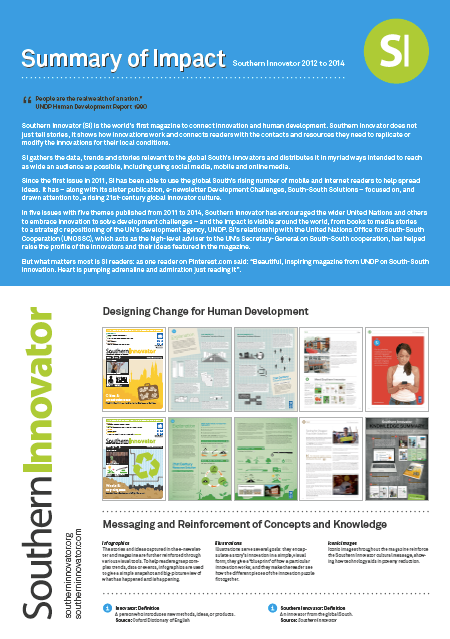
    Development Challenges, South-South Solutions was launched as an e-newsletter in 2006 by UNDP’s South-South Cooperation Unit (now the United Nations Office for South-South Cooperation) based in New York, USA. It led on profiling the rise of the global South as an economic powerhouse and was one of the first regular publications to champion the global South’s innovators, entrepreneurs, and pioneers. It tracked the key trends that are now so profoundly reshaping how development is seen and done. This includes the rapid take-up of mobile phones and information technology in the global South (as profiled in the first issue of magazine Southern Innovator), the move to becoming a majority urban world, a growing global innovator culture, and the plethora of solutions being developed in the global South to tackle its problems and improve living conditions and boost human development. The success of the e-newsletter led to the launch of the magazine Southern Innovator.  

    https://davidsouthconsulting.org/2021/03/05/southern-innovator-issue-1/

    https://davidsouthconsulting.org/2021/03/05/southern-innovator-issue-2/

    Creative Commons License

    This work is licensed under a
    Creative Commons Attribution-Noncommercial-No Derivative Works 3.0 License.

    ORCID iD: https://orcid.org/0000-0001-5311-1052.

    © David South Consulting 2023
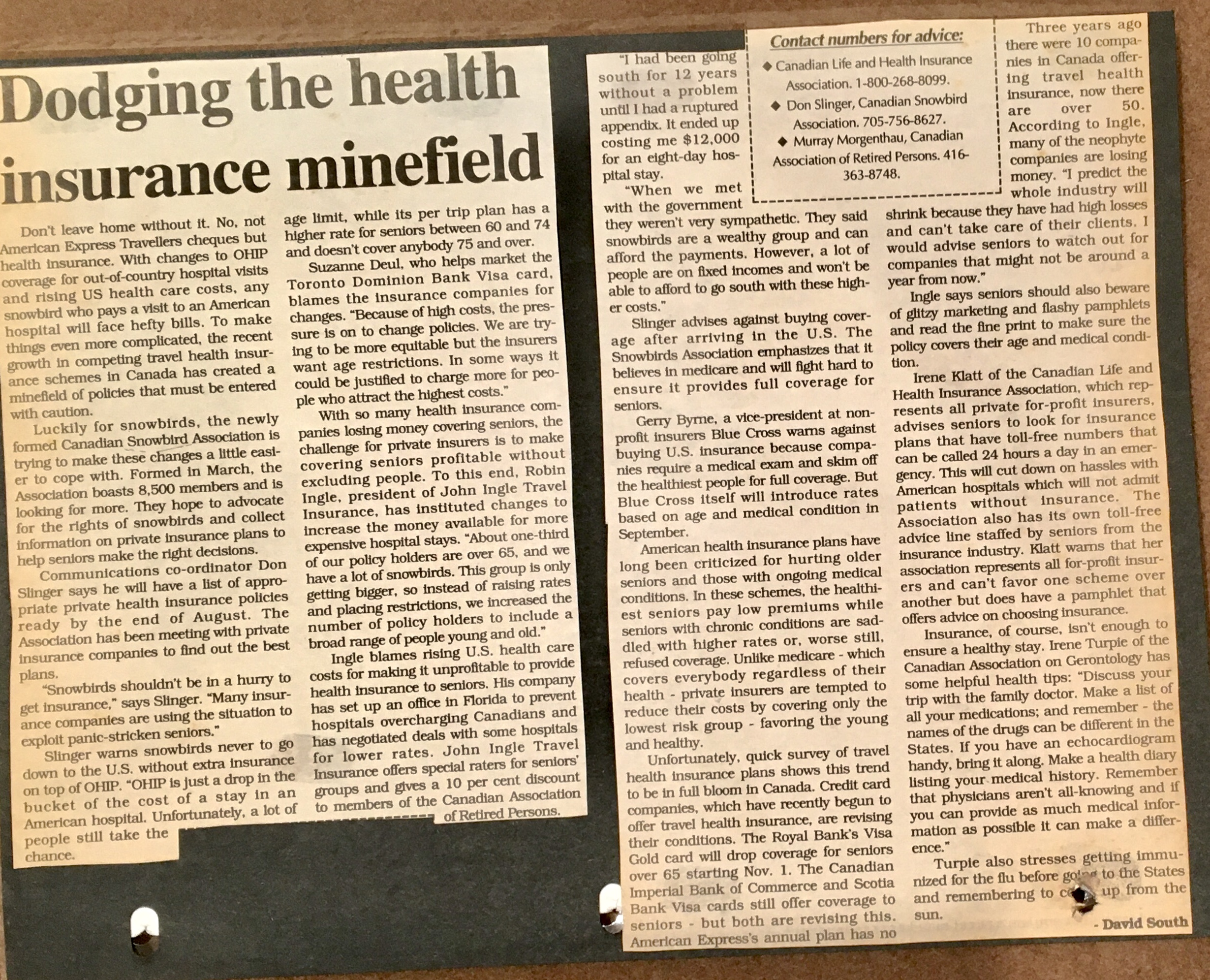
  • Dodging the health insurance minefield

    Dodging the health insurance minefield

    By David South

    Today’s Seniors (Canada), 1992

    Don’t leave home without it. No, not American Express Travellers cheques but health insurance. With changes to OHIP coverage for out-of-country hospital visits and rising U.S. health care costs, any snowbird who pays a visit to an American hospital will face hefty bills. To make things even more complicated, the recent growth in competing travel health insurance schemes in Canada has created a minefield of policies that must be entered with caution.

    Luckily for snowbirds, the newly formed Canadian Snowbird Association is trying to make these changes a little easier to cope with. Formed in March, the Association boasts 8,500 members and is looking for more. They hope to advocate for the rights of snowbirds and collect information on private insurance plans to help seniors make the right decisions.

    Communications co-ordinator Don Slinger says he will have a list of appropriate private health insurance policies ready by the end of August. The Association has been meeting with private insurance companies to find out the best plans.

    “Snowbirds shouldn’t be in a hurry to get insurance,” says Slinger. “Many insurance companies are using the situation to exploit panic-stricken seniors.”

    Slinger warns snowbirds never to go down to the U.S. without extra insurance on top of OHIP. “OHIP is just a drop in the bucket of the cost of a stay in an American hospital. Unfortunately, a lot of people still take the chance.

    “I had been going south for 12 years without a problem until a ruptured appendix. It ended up costing me $12,000 for an eight-day hospital stay.

    “When we met with the government they weren’t sympathetic. They said snowbirds are a wealthy group and can afford the payments. However, a lot of people are on fixed incomes and won’t be able to afford to go south with these higher costs.”

    Slinger advises against buying coverage after arriving in the U.S. The Snowbirds Association emphasizes that it believes in medicare and will fight hard to ensure it provides full coverage for seniors.

    Gerry Byrne, a vice-president at non-profit insurers Blue Cross warns against buying U.S. insurance because companies require a medical exam and skim off the healthiest people for full coverage. But Blue Cross itself will introduce rates based on age and medical conditions in September.

    American health insurance plans have long been criticized for hurting older seniors and those with ongoing medical conditions. In these schemes, the healthiest seniors pay low premiums while seniors with chronic conditions are saddled with higher rates or, worse still, refused coverage. Unlike medicare – which covers everybody regardless of their health – private insurers are tempted to reduce their costs by covering only the lowest risk group – favouring the young and healthy.

    Unfortunately, a quick survey of travel health insurance plans shows this trend to be in full bloom in Canada. Credit card companies, which have recently begun to offer travel health insurance, are revising their conditions. The Royal Bank’s Visa Gold card will drop coverage for seniors over 65 starting Nov. 1. The Canadian Imperial Bank of Commerce and Scotia Bank Visa cards still offer coverage to seniors – but both are revising this. American Express’s annual plan has no age limit, while its per trip plan has a higher rate for seniors between 60 and 74 and doesn’t cover anybody 75 and over.

    Suzanne Deul, who helps market the Toronto Dominion Bank Visa card, blames the insurance companies for changes. “Because of high costs, the pressure is on to change policies. We are trying to be more equitable but the insurers want age restrictions. In some ways it could be justified to charge more for people who attract higher costs.”

    With so many health insurance companies losing money covering seniors, the challenge for private insurers is to make covering seniors profitable without excluding people. To this end, Robin Ingle, president of John Ingle Travel Insurance, has instituted changes to increase the money available for more expensive hospital stays.

    “About one-third of our policy holders are over 65, and we have a lot of snowbirds. This group is only getting bigger, so instead of raising rates and placing restrictions, we increased the number of policy holders to include a broad range of people young and old.”

    Ingle blames rising U.S. health care costs for making it unprofitable to provide health insurance to seniors. His company has set up an office in Florida to prevent hospitals overcharging Canadians and has negotiated deals with some hospitals for lower rates. John Ingle Travel Insurance offers special rates for seniors’ groups and gives a 10 per cent discount to members of the Canadian Association of Retired Persons.

    Three years ago there were 10 companies in Canada offering travel insurance; now there are over 50.

    According to Ingle, many of the neophyte companies are losing money. “I predict the whole industry will shrink because they have had high losses and can’t take care of their clients. I would advise seniors to watch out for companies that might not be around a year from now.”

    Ingle says seniors should also beware of glitzy marketing and flashy pamphlets and read the fine print to make sure the policy covers their age and medical condition.

    Irene Klatt of the Canadian Life and Health Insurance Association, which represents all private for-profit insurers, advises seniors to look for insurance plans that have toll-free numbers that can be called 24 hours a day in an emergency. This will cut down on hassles with American hospitals which will not admit patients without insurance. The Association also has its own toll-free advice line staffed by seniors from the insurance industry. Klatt warns that her association represents all for-profit insurers and can’t favor one scheme over another but does have a pamphlet that offers advice on choosing insurance.

    Insurance, of course, isn’t enough to ensure a healthy stay. Irene Turple of the Canadian Association on Gerontology has some helpful health tips: “Discuss your trip with the family doctor. Make a list of all your medications; and remember – the names of the drugs can be different in the States. If you have an echocardiogram handy, bring it along. Make a health diary listing your medical history. Remember that physicians aren’t all-knowing and if you can provide as much medical information as possible it can make a difference.”

    Turple also stresses getting immunized for the flu before going to the States and remembering to cover up from the sun.

    Creative Commons License

    This work is licensed under a
    Creative Commons Attribution-Noncommercial-No Derivative Works 3.0 License.

    ORCID iD: https://orcid.org/0000-0001-5311-1052.

    © David South Consulting 2022

  • Time Machines

    Time Machines

    By David South 

    Flare Magazine (Toronto, Canada) 1992

    Time Machines

    While many designers are telling us to don platform shoes and love beads, the man behind London-based Hi-Tek watches is looking even further back in time – drawing his inspiration from classic visions of the future. 

    Hi-Tek’s stainless steel timepieces bring to mind early futuristic films such as Lang’s Metropolis and Chaplin’s Modern Times with their grotesque exaggerations of modern machinery. That era’s confusion, fear, or simple wonderment at new technology influenced everything from toasters to steam trains. 

    For the equally economically and technologically turbulent ‘90s, Hi-Tek designer Alexander has captured this sense of techno-wonder with watches, sunglasses, and other hip accessories. One watch looks as if a Cuisinart hit it, leaving gears strewn across the face. Another has a retractable lid like an astronomer’s observatory. Yet another tells time with the blinker of a radar screen. Despite their made-exclusively-for-James-Bond appearance, all cost less than $190. Available at Possessions in Montreal, Body Body in Toronto, and D and R in Vancouver.

    Creative Commons License

    This work is licensed under a
    Creative Commons Attribution-Noncommercial-No Derivative Works 3.0 License.

    ORCID iD: https://orcid.org/0000-0001-5311-1052.

    © David South Consulting 2022

  • Freaky – The 70s Meant Something

    Freaky – The 70s Meant Something

    By David South

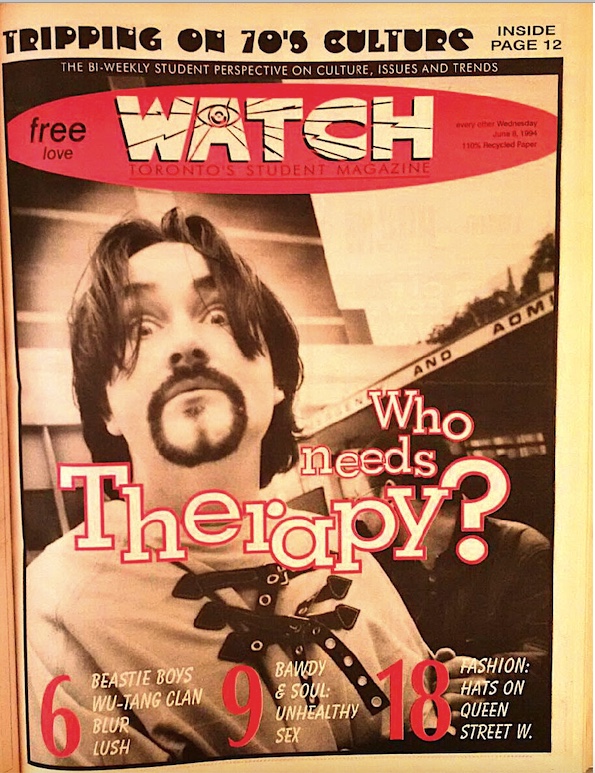
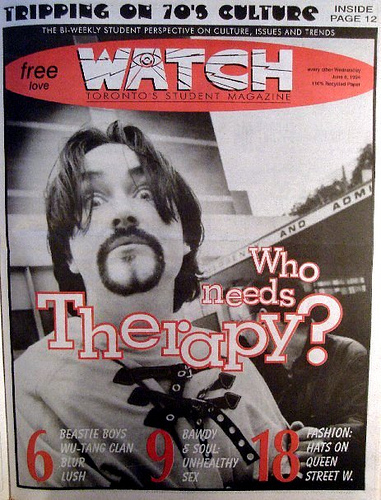
    Watch Magazine (Toronto, Canada), June 8, 1994

    It was the decade of the happy face, bell-bottoms, avocado fridges, disco and the Bay City Rollers; in short, the 70s was a pimple on the ass of history, better evaporated in a pot haze on a waterbed. Not so says 70s-obsessed author Pagan Kennedy, who believes the much-maligned decade is the victim of a bum rap perpetuated by the idolization of the 60s.

    Kennedy says the 70s saw all the radical ideas and culture of the 60s go mainstream and mutate in a way the hippies couldn’t imagine.

    Social relations and culture were profoundly reshaped during this decade as the non-traditional family took form, women flooded the workplace and unions became rich monoliths.

    The social turmoil spawned blue collar red-necks with Confederate flags customizing fuck trucks – vans complete with waterbed, eight-track stereo, bong and sleazy airbrushed exteriors of naked women –  to cruise the nation’s highways enjoying the liberal sexual values while keeping conservative political views. Sexual liberation for these clowns consisted of bumper stickers saying “Ass, gas or grass – nobody rides for free!”. Kennedy remembers it all too well.

    “This was the midst of the energy crisis, so big cars that wasted a lot of gas were really cool,” she says. “I guess it came out of the whole drug culture, sex culture thing. It was like a basement kids have, only it was on wheels – a party on wheels. It’s not just the mattress for the fuck truck, you’re supposed to be doing your bong hits in there – so the police can’t see you.”

    Sex holidays

    “Our lives are much more constrained than they were in the 70s,” continues Kennedy. “I think the 70s must seem like an exotic time to grow up in. One of my favourite parts in Douglas Coupland’s Generation X is when the characters want to take a sex holiday to 1974.

    “There was a lot of obsession in the early 70s with swingers and wife-swapping. It was the one time when suddenly the sexual revolution was kicking in, not just for white, privileged college kids, but for everybody – for the working class. There were discos and orgy clubs. There was Plato’s Retreat in New York City where you would go in and there was an orgy in full progress.”

    In music, the 70s rocketed between extremes. There was nauseating soft rock, concept albums and “progressive” rock. There was the outrageous glam, with artists like Slade and Gary Glitter jacked up on elevator shoes in sequin one-piece flare suits. There was disco and punk. But the sickest phenomena says Kennedy was corporate rock.

    David Cassidy

    “In the 60s, people were just learning how to package rock and make it a big corporate thing. By the 70s they had learned a lot. The Partridge Family was a group that was entirely fabricated. David Cassidy had a bigger fan club than Elvis. This was a guy who didn’t become a rock star until he went on TV. In the 60s, FM was alternative radio – you could play anything. Corporate guys got their hooks into FM by the 70s. They were formatting. It was no longer what the DJ wanted to hear. You were getting playlists. The money came from big rock concerts, so there was a desire to push these mega-groups and superstars.”

    Another truly 70s phenomena was TV as social conscience. Before the 70s, TV variety shows focused on pure entertainment. But now writers, directors and producers schooled in the 60s political milieu were in control.

    Blaxploitation

    “All in the Family, Maude and Good Times were all part of the same world. All in the Family acknowledged the deep rifts in American society – America was at war with itself. Yet it did it in a soft enough way to not offend people.”

    US blacks had been ignored until the civil rights struggle of the 1960s woke up a dopey white America. In the 1970s, blacks were being portrayed like never before in the media and popular culture. But all of this awareness took a twisted turn.

    “I think what happened among blacks was they saw their leaders either killed or put in jail. And that was devastating. Blacks really turned to electoralism in the 70s. A lot of black people started running for office. While trying to change things from outside the system, they realized the price was too high. A lot of black people were involved in making those blaxploitation movies, but so were a lot of white people. Shaft and Superfly are like the bookends of the genre. They were really made by black filmmakers. But then there were all these ripoff versions starring football players – whitebread ideas of what black culture was like.”

    Pagan Kennedy’s latest book, Platforms: A Microwaved Cultural Chronicle of the 1970s, is published by St. Martin’s Press and available in most book shops. She’s got a really cool collection of eight-track tapes and drives a yetch! 1974 Plymouth Valiant.

    Her website is here: https://www.pagankennedy.space/

    “Tripping on 70s Culture”: Watch Magazine was published in Toronto, Canada in the 1990s. “The Bi-Weekly Student Perspective on Culture, Issues and Trends.”

    https://davidsouthconsulting.org/2022/11/16/canadian-magazines-newspapers-1990s/

    https://davidsouthconsulting.org/2021/06/14/case-study-1-investigative-journalism-1991-1997-2/

    https://davidsouthconsulting.org/2021/06/01/case-study-2-watch-magazine-1994-and-1996-2/

    https://davidsouthconsulting.org/2020/12/08/featured-in-new-book-busted-an-illustrated-history-of-drug-prohibition-in-canada-december-2017/

    https://davidsouthconsulting.org/2021/03/25/oasis-has-arrogance-a-pile-of-attitude-and-the-best-album-of-1994/

    https://davidsouthconsulting.org/2022/10/08/time-machines/

    https://davidsouthconsulting.org/2020/11/24/too-black/

    Creative Commons License

    This work is licensed under a
    Creative Commons Attribution-Noncommercial-No Derivative Works 3.0 License.

    ORCID iD: https://orcid.org/0000-0001-5311-1052.

    © David South Consulting 2023