Category: Archive

An archive of published content for media and clients.

  • African Culture as Big Business

    African Culture as Big Business

    By David SouthDevelopment Challenges, South-South Solutions

    SOUTH-SOUTH CASE STUDY

    In the last decade the world’s creative industries (including crafts, fashion and design) have gained greater respect for being the spark that drives economic development and entrepreneurship. They are seen as fast growers and good job creators, and importantly, the lynch pin in cultural identity and cultural diversity. UNESCO, through its Global Alliance for Cultural Diversity, has been in the forefront of helping African countries re-shape their policies to take this into consideration. The promotion of cultural industries also has been incorporated into the New Partnership for Africa’s Development (NEPAD).

    The global clothing industry is estimated to be worth US $900 billion a year. Culture and creativity are big businesses: according to UNESCO, in 2002 the UK exported US $8.5 billion in cultural goods, the United States US $7.6 billion, and China US $5.2 billion. The UK’s Burberry fashion label alone made £157 million in 2006.

    This is good news for Africa’s growing fashion industry, which is finally getting the attention and respect it deserves. Entrepreneurs are tapping into this awareness as a great way to make money. Well-known Nigerian fashion designer Alphadi says the continent’s fashion industry is “giving Africa a chance to show its true self, its solidarity, its huge generosity and its greatness.”

    Africa’s fashion entrepreneurs are showing more and more confidence and striding with pride across catwalks around the world. And despite the problems faced by black models – as highlighted by supermodel Naomi Campbell in her recent press conference in Kenya – some African models have a growing international profile: these include Alek Wek from southern Sudan, and Waris Dirie from Somalia. Campbell has said she plans to set up a modelling agency in Kenya to increase opportunities.

    Just as African music has fans around the world, the continent’s growing fashion scene is gaining fans and more attention. From Hollywood stars to European catwalks, African fashion designers and apparel makers are feeding the industry’s hunger for novelty and new ideas.

    African entrepreneurs, from village craftsmen to ambitious and creative urbanites, are finding ways to cash in on this rising awareness.

    The rising stars of South Africa were on full display at this August’s Cape Town Fashion Week. David Tlale, who produces glamorous haute couture creations, places community empowerment in his hometown of Johannesburg at the centre of his business. Tlale was joined by rising stars Thabani Mavundla, Thula Sindi, and Craig Jacobs.

    Creator and founder of the Fundudzi label of Johannesburg, Jacobs presented a couture collection at Paris Fashion Week in July. A former TV presenter-turned-fashion designer, Jacobs sees a renewed pride in African creativity and a new dialogue about Africa’s place in the world. His motto is: “Africa reworked…Africa re-inspired… Africa renewed”.

    Established in 2004, his clothing company for women strives to be socially and environmentally responsible: “Fundudzi is also an eco-conscious label, utilizing materials such as organic cottons, soy and bamboo as well as cashmere produced in Africa which is not harmful to the environment,” he said. “The message which we want to resonate with the rest of the world is that Africa has always been organic.”

    “Our label has grown out of the desire to help change the perception of our home, Africa, by presenting clothing designed and created here which can compete on the world stage.”

    Jacob benefited from support from various organizations in South Africa to get his business plans sorted out. The country’s tourism body has focused on fashion with its C’est Couture campaign. But he has also struggled with the complexities of exporting his designs and navigating global customs regulations.

    “There has been a lot of interest internationally in our collection, but I am not sure what the rules and regulations are … We need an over-riding body to help assist us young entrepreneurs. My experience in Paris, in July, has been that we do have something new and fresh to say in fashion, and we can produce at the same standard as the rest of the world.

    There was validation of that. But we as Africans need to follow our own signature, look internally to come up with inspiration, and show that to the rest of the world. “The global village environment, and the access that technologies such as the Internet have provided, means that we can tune into the same stimuli in terms of trends and fashion directions to ensure that we are on par with the rest of the planet. I do believe that the world, bored with the same trends they have been exposed to for so long, are looking for a new guard of inspiration – and we need to empower ourselves with the right tools to answer that call.

    “Our positioning is quite simple – our label is dedicated to creating jobs in Africa, thereby reducing our dependency on aid in securing our future …I wanted to create a label which is rooted in Africa, which tells African stories, but which is not tradition or museum curio – rather, intelligent pieces which can fit seamlessly into the global firmament of fashion. The label is focused on redressing the prejudices about the “dark continent” – each collection is designed as a travelogue, informing the world about the rich tapestry of life in Africa.”

    Another hub of dynamism in the African fashion scene is Nairobi, Kenya. Kikoromeo connects its catwalk fashion designs with the principle of community development. The label uses mostly Kenyan materials – cotton, silk and wool – and works with local artisans, including women’s groups. Its bags are woven with Kenyan Sisal by Machakos women’s groups, and the beadwork is done by Maasai women’s groups.

    Anna Trezbinski of Nairobi, who is popular in Hollywood and has contracts to provide items to top designers like Paul Smith, employs 800 people – mostly Masai women in her workshop in the Great Rift Valley.

    This new wave of African fashion designers is proving that anyone with talent, a website and a fan base can puncture the bubble of the European and New York catwalks and make a splash.

    “Africa is a haven of inspiration,” says the Tanzanian-born, Nairobi-based designer and collector Lisa Christofferson, who has clothed Ralph Fiennes, Rachel Weiss and Jane Seymour. “Africa for many years now has been the flavour of fashion,” she says. “It has really opened the door for us.”

    She believes the internet has expanded her business and her brand. It gives clients and boutiques around the world the ability to import her hand-painted, African-inspired cashmere sweaters, bedspreads and throws. Many are ceremonial cloths of the Kuba Kingdom in Congo.

    Another designer based in Kenya, Annabelle Thom, believes changes in the last seven years are responsible: access to TV and film, music channels and a burgeoning middle class with money. “People care more about fashion and if you look around in Nairobi, the average person is beautifully dressed – people are spending money on themselves,” she said.

    Ethiopia has also been identified as a bubbling fashion hot spot for its indigenous raw cotton and potential to produce other natural fibres. Ethiopian designer Guenet Fresenbet launched Ethiopia’s first fashion magazine, Gigi, to help take the lead.

    Published: October 2007
    Resources

    • Afromix: Great links to African fashion designers and fashion events and media.
    • Kikoromeo: Based in Nairobi, Kenya Kikoromeo’s founder and principal apparel designer trained in Rome and Milan and has been in production in Kenya since 1997.
    • South Africa’s leading fashion weeks: Johannesburg Fashion Week or Capetown Fashion Week
    • A video about Kenya’s fashion boom: Click here to view.
    • Uzuri: Premier International African Inspired Fashion Magazine: A quarterly magazine founded in 2005 and based in Texas, it is dedicated to highlighting high fashion in Africa.
    • Dobizo: An excellent website with all the resources necessary for a budding entrepreneur to get started in the fashion business, from step-by-step guides to common mistakes and how to choose a logo.
    • Fashion Nigeria: Newly launched Nigerian fashion magazine.

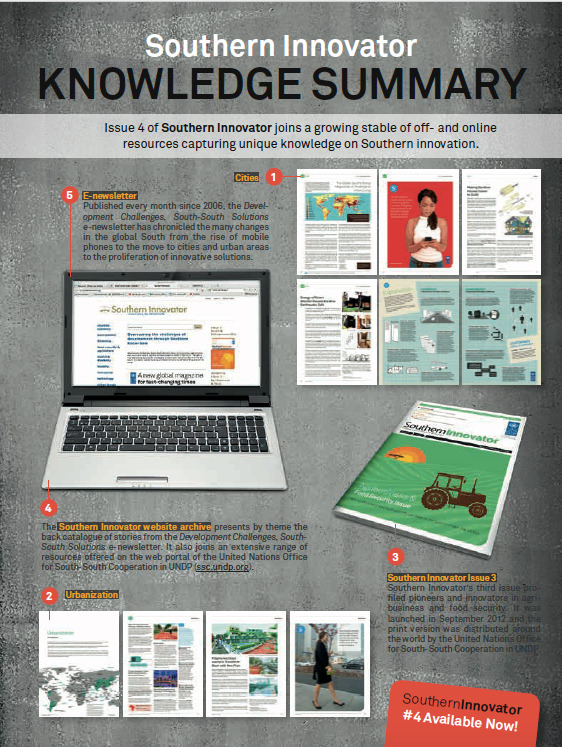
    Development Challenges, South-South Solutions was launched as an e-newsletter in 2006 by UNDP’s South-South Cooperation Unit (now the United Nations Office for South-South Cooperation) based in New York, USA. It led on profiling the rise of the global South as an economic powerhouse and was one of the first regular publications to champion the global South’s innovators, entrepreneurs, and pioneers. It tracked the key trends that are now so profoundly reshaping how development is seen and done. This includes the rapid take-up of mobile phones and information technology in the global South (as profiled in the first issue of magazine Southern Innovator), the move to becoming a majority urban world, a growing global innovator culture, and the plethora of solutions being developed in the global South to tackle its problems and improve living conditions and boost human development. The success of the e-newsletter led to the launch of the magazine Southern Innovator.

    Creative Commons License

    This work is licensed under a
    Creative Commons Attribution-Noncommercial-No Derivative Works 3.0 License.

    ORCID iD: https://orcid.org/0000-0001-5311-1052.

    © David South Consulting 2022
  • Agricultural Waste Generating Electricity

    Agricultural Waste Generating Electricity

    By David SouthDevelopment Challenges, South-South Solutions

    SOUTH-SOUTH CASE STUDY

    Agriculture around the world produces a great deal of waste as a by-product. It can be animal faeces, or the discarded plant husks thrown away when rice, grains or maize are harvested. When this waste meets the urgent need for electricity, something special can happen.

    The number of people still without electricity in the South is vast. The failure of major electricity generating power stations to reach so many people has spurred entrepreneurs to come to the rescue. Power is critical to so many things: small businesses need it, anyone wanting access to computers and the Internet needs it, and modern appliances like refrigerators run on it. During the past 25 years, electricity supplies have been extended to 1.3 billion people living in developing countries. Yet despite these advances, roughly 1.6 billion people, a quarter of the global population, still have no access to electricity and some 2.4 billion people rely on traditional biomass fuels, including wood, agricultural residues and dung, for cooking and heating. More than 99 percent of people without electricity live in developing regions, and four out of five live in rural areas of South Asia and sub-Saharan Africa (International Energy Agency, IEA).

    Power outages in Africa are a serious and frequent problem and a significant force holding back development. With global oil prices on the rise, turning to diesel generators is an expensive option.

    According to the IEA, the lack of electricity leaves poor countries “trapped in a vicious circle of poverty, social instability and underdevelopment.”

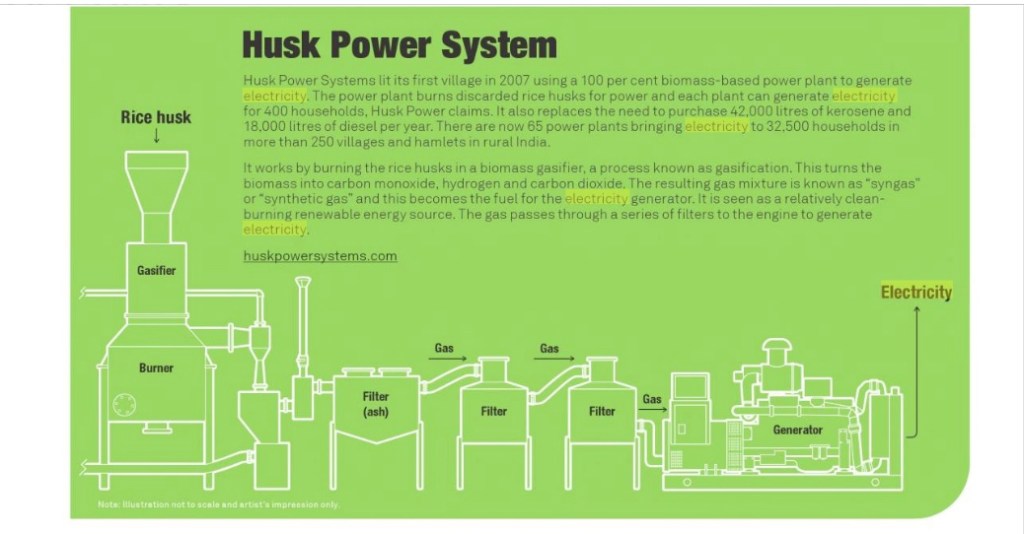
    In India, 80,000 of the country’s half a million villages lack electricity. Two students, Charles Ransler and Manoj Sinha, have started a business providing electricity to some of these villages by turning rice husks – a by-product of rice milling – into gas that then powers an electricity generator.

    Already, two of their rice-burning generators are providing electricity to 10,000 rural Indians. The hope is to rapidly expand the business to hundreds of small village power plants.

    The business, Husk Power Systems, was started while the two were at the University of Virginia’s Darden School of Business.

    While the generator burns the rice husks to make a gas to produce electricity, it also leaves behind a waste product of ash that is sold as an ingredient in cement.

    This technology can provide off-grid power to rural Indian villages of 200 to 500 households. Using the husk-powered mini power plant, the team plans to offset close to 200 tons of carbon emissions per village, per year in India.

    The idea for the rice husk generators was originally conceived by Sinha and Gyanesh Pandey, the third partner in Husk Power, who left an engineering career in Los Angeles to return to India and oversee the rice husk project. Sinha and Pandey went to college together in India and both come from rural Indian villages that struggle with a lack of electricity.

    “We grew up in those areas,” said Sinha. “Our relatives still do not have electricity. We wanted to give back to those areas.” Originally they envisioned refining the generator concept and raising enough money to donate rice-husk generators for two or three villages near where they grew up, said Sinha.

    But instead, after some research, they realised it could be a financially viable business expandable to hundreds of villages. There are 480 million Indians with no power and 350 million of them live in rural villages, concentrated in eastern India’s “Rice Belt,” where the villagers are “rice rich and power poor,” said Ransler.

    The project has already won a fistful of prizes, including US$50,000 from the Social Innovation Competition at the University of Texas.

    They think that each rice husk generator is to break even in about two and a half years.

    And they like to think this is the Starbucks of off-grid electricity generation, potentially as successful as the globe-spanning US coffee shop chain. “You can put one of these in 125,000 locations, hire local people, and turn a raw material into money – just substitute rice husks for coffee beans,” said Ransler.

    Another maker of biomass mini power plants in India is Decentralised Energy Systems India (DESI power). It is a New Delhi-based non-profit company specialising in building a decentralised power network for rural India. It was formed by Development Alternatives, India’s largest sustainable development NGO. It is able to provide a megawatt of electricity to a village for the cost of 44 million rupees, rather than 57 million rupees from the central grid.

    Published: June 2008

    Resources

    https://davidsouthconsulting.org/2022/10/06/battery-business-brings-tanzanians-cheap-electricity/

    https://davidsouthconsulting.org/2023/02/03/environmental-public-awareness-handbook-case-studies-and-lessons-learned-in-mongolia/

    https://davidsouthconsulting.org/2021/02/01/kenya-turns-to-geothermal-energy-for-electricity-and-growth/

    Development Challenges, South-South Solutions was launched as an e-newsletter in 2006 by UNDP’s South-South Cooperation Unit (now the United Nations Office for South-South Cooperation) based in New York, USA. It led on profiling the rise of the global South as an economic powerhouse and was one of the first regular publications to champion the global South’s innovators, entrepreneurs, and pioneers. It tracked the key trends that are now so profoundly reshaping how development is seen and done. This includes the rapid take-up of mobile phones and information technology in the global South (as profiled in the first issue of magazine Southern Innovator), the move to becoming a majority urban world, a growing global innovator culture, and the plethora of solutions being developed in the global South to tackle its problems and improve living conditions and boost human development. The success of the e-newsletter led to the launch of the magazine Southern Innovator.

    https://davidsouthconsulting.org/2021/03/05/southern-innovator-issue-5/

    Creative Commons License

    This work is licensed under a
    Creative Commons Attribution-Noncommercial-No Derivative Works 3.0 License.

    ORCID iD: https://orcid.org/0000-0001-5311-1052.

    © David South Consulting 2022

  • Securing Land Rights for the Poor Now Reaping Rewards

    Securing Land Rights for the Poor Now Reaping Rewards

    By David SouthDevelopment Challenges, South-South Solutions

    SOUTH-SOUTH CASE STUDY

    The hotly debated issue of land rights for the poor has never been more relevant. There is mounting evidence that access to land rights can catapult the poor out of poverty and spur growth for the economy. Experience in India and China is now showing the economic power unleashed when the poor gain full legal rights over their land. But it can be a thornier issue in Africa, where much land is still held under customary law, with people either holding it through their clan or tribe, or being considered as owners of where they live, without formal documents. Many countries are now adapting their laws to switch to a system of formal titles, but the process is very uneven and some question whether western-style property titles are appropriate in an African context.

    While there are many schemes to alleviate or eliminate poverty through micro-credit, grants or aid, some believe the secret is in creating a sound framework of property rights, giving poor people important collateral to raise money against the value of the land on which they live. The Peruvian economist, Hernando de Soto, has calculated that the total value of informal urban dwellings and rural land owned under customary law is around three times greater than Africa’s entire gross domestic product and 100 times greater than its foreign direct investment.

    But the urgency of this problem can be seen in the numbers of rural poor – many of whom will migrate to the world’s fast-growing cities. In China there are 800 million, in India the rural poor number 270 million and 70 percent of Africa’s 888 million (2005,UN) are rural poor.

    The Rural Development Institute (www.rdiland.org), an NGO based in Seattle, Washington, USA – and with offices and projects in India, China, Indonesia, Russia, Africa – uses lawyers to advocate and fight for land rights for the rural poor. To date, RDI has helped provide land rights to more than 100 million poor families worldwide. Their approach is called micro-owning whereby the poor are helped to acquire land assets. These are often small plots of land – sometimes 1/10th acre – that can provide the nutritional needs for a family and help them on the road to the virtuous cycle of long-term, sustainable and generational poverty alleviation.

    “Micro-ownership transforms the lives of the rural poor,” according to Radha Friedman, Associate Director, Development and Communication, just back from visiting RDI’s Indian projects. “Outside Bangalore in the state of Karnataka one woman who was landless worked two shifts a day in the hot sun. She was barely able to feed her children. She was making 8 to 10 rupees a day – when a bottle of water costs 10 rupees. We helped her secure a plot of land to grow jasmine flowers which she sells in the market. She now makes between 85 to 200 rupees a day. She can eat three times a day and her kids can afford to go to school. She said she had not thought about how far she had come, but it clearly showed she had such pride in what she had achieved. A number of Indian states have adopted this program, enabling people to purchase micro-gardens and micro-plots of land. It has been such a success that other Indian states are now showing interest.”

    “All of this didn’t happen overnight,” said Lincoln Miller, Chief Operations Officer at RDI. “We conducted lots of research and surveyed the rural poor. We analyzed how the laws were affecting them. It took a long time to change government attitudes. We hopefully find a voice in the government who will listen to us. They need to recognize that land rights are one of the best routes out of poverty. In Africa we are primarily working in Burundi, Rwanda and Angola. In addition to working with government to change national policy and laws, we also conduct awareness-raising and education at the grassroots level, especially targeting women. Land rights are a political issue. The majority of the world’s poor is rural. By giving them land rights this process can help mitigate migration to the city.”

    The benefits of owning land include improved family status, pride and hope, reduced hunger and improved family nutrition from crops produced on land , increased income from sale of excess production, improved rural health, including reduction in infant mortality and reduction in death from disease or infection due to malnutrition, labor-intensive and productivity-enhancing, investments in land motivated by secure land rights, increased family savings as a result of ability to invest in land improvements, ability of poor to benefit from any market increases in land values, enhanced capacity to conduct micro-enterprise activities, empowerment of women, and decreased pressure to migrate to already crowded urban areas.

    However in South Africa, land rights have been further complicated by the legacy of apartheid. In 1994, 80 percent of farmland was in white hands. The ruling African National Congress (ANC) want to see 30 percent of that transferred to black ownership by 2015. Blacks are also able to claim ownership for land as long as they live on it.

    The strong reaction against past experiments in collectivizing land can be understood in the experience of Zambia. Under President Kenneth Kaunda, everything was nationalized, from copper mines to corner shops. Average annual incomes almost halved in 40 years despite the country receiving more aid per head of population than virtually any other in the world.

    Any organizations or individuals seeking land rights need only to contact the RDI by email to get the legal ball rolling.

    Published: February 2007

    Resources

    • The Centre on Housing Rights and Evictions tracks forcible evictions from land. In its latest global survey of forced evictions from 2003-2006 reveals that nearly 2 million people in Africa and over 2.1 million people in Asia and the Pacific have been forcibly evicted from their homes since 2003. http://www.cohre.org/
    • Based in Cape Town, South Africa, the Shack/Slum Dwellers International targets the plight of people living in semi-urban and urban areas: http://www.sdinet.org/
    • The Cities Alliance: Cities without Slums links together a global coalition of cities and their development partners committed to scaling up successful approaches to poverty reduction: http://www.citiesalliance.org/index.html
    • Rural Development Institute: Email: info@rdiland.org Website: http://www.rdiland.org

    Development Challenges, South-South Solutions was launched as an e-newsletter in 2006 by UNDP’s South-South Cooperation Unit (now the United Nations Office for South-South Cooperation) based in New York, USA. It led on profiling the rise of the global South as an economic powerhouse and was one of the first regular publications to champion the global South’s innovators, entrepreneurs, and pioneers. It tracked the key trends that are now so profoundly reshaping how development is seen and done. This includes the rapid take-up of mobile phones and information technology in the global South (as profiled in the first issue of magazine Southern Innovator), the move to becoming a majority urban world, a growing global innovator culture, and the plethora of solutions being developed in the global South to tackle its problems and improve living conditions and boost human development. The success of the e-newsletter led to the launch of the magazine Southern Innovator.

    Creative Commons License

    This work is licensed under a
    Creative Commons Attribution-Noncommercial-No Derivative Works 3.0 License.

    ORCID iD: https://orcid.org/0000-0001-5311-1052.

    © David South Consulting 2022

  • Farmers Weather Fertilizer Crisis by Going Organic

    Farmers Weather Fertilizer Crisis by Going Organic

    By David SouthDevelopment Challenges, South-South Solutions

    SOUTH-SOUTH CASE STUDY

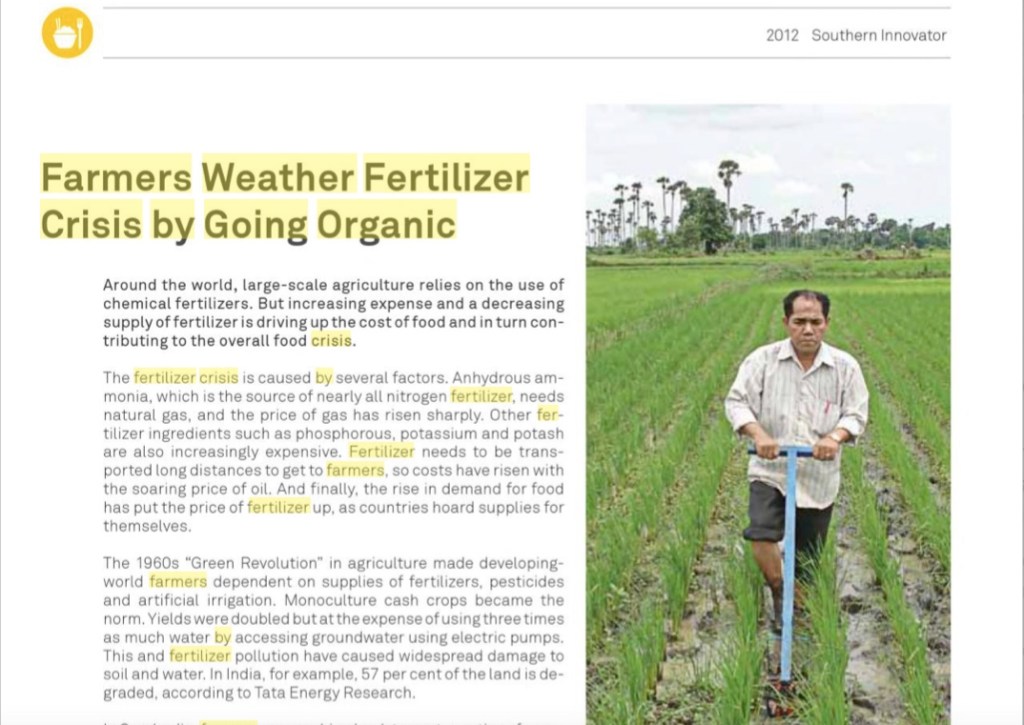
    Around the world, large-scale agriculture relies on the use of chemical fertilizers. But increasing expense and decreasing supply of fertilizer is driving up the cost of food, and in turn contributing to the overall food crisis.

    According to a soon-to-be-released UN report, prices have shot up and will stay high for at least three years. Prices have almost doubled and in some cases risen by 500 percent over 15 months.

    The fertilizer crisis is caused by several factors. Anhydrous ammonia, which is the source of nearly all nitrogen fertilizer, needs natural gas, and the price of gas has risen sharply. Other fertilizer ingredients like phosphorous, potassium and potash are also increasingly expensive. Fertilizer needs to be transported long distances to get to farmers, so costs have risen with the soaring price of oil. And finally, the rise in demand for food has put the price of fertilizer up, as countries hoard supplies for themselves.

    The 1960s ‘Green Revolution’ in agriculture made developing-world farmers dependent on supplies of fertilizers, pesticides and artificial irrigation. Monoculture cash crops became the norm. Yields were doubled, but at the expense of using three times as much water by accessing groundwater using electric pumps. This and fertilizer pollution has caused widespread damage to soil and water. In India, for example, 57 per cent of the land is degraded, according to Tata Energy Research.

    In Cambodia, farmers are reaching back to past practices for answers to the fertilizer crisis. One is to go organic. Taking this approach has many health and environmental advantages – and, best of all for farmers, it keeps costs down.

    Khim Siphay, a Cambodian farmer, has found he gets bigger crops of rice and vegetables while paying a lot less for fertilizers.

    “Using pesticide or fertilizers kills important insects, and causes the soil to become polluted,” he told Reuters. “I use compost and it helps keep the soil good from one year to another. All of my family members help make the compost.”

    The push to organic methods for Cambodia’s 13 million people relying on agriculture for a living comes from a non-governmental organization, the Cambodian Center for Study and Development in Agriculture (CEDAC). It has successfully moved to organic methods, starting from just a handful of 28 farmers in 2000, to the current 60,000 – and received an endorsement from the Cambodian Ministry of Agriculture.

    CEDAC says farms using the organic methods have been able to increase rice yields per hectare, while the seeds needed have fallen by 70 to 80 percent. By using a “System of Rice Intensification”, the mostly small-scale farmers are able to get more out of the land, with less labour. Add to that the fact that organic rice gets a premium price on world markets, and the result for the farmers has been a rise in income from US $58 to US $172 per hectare.

    “The important point of organic farming is that farmers don’t need to spend money on fertilizers and pesticide so they spend less money on farming,” said CEDAC official Yang Saing Koma.

    “They can sell the produce for a higher price. Also they can avoid being infected by pesticides and they will be healthier. It is also good for the environment,” he said.

    Rice and other produce can be used to feed chickens to produce organic poultry and eggs – another bonus for farmers looking to raise the value of their produce.

    “I started doing organic farming outside my rice paddy, but then I noticed production was double, so in the next season, I decided to grow organically on all of my land,” said farmer Ros Meo. “I spend less money now and I can grow more and I am not sick as I was before, my health is now good.”

    Going organic in Cambodia is something that is becoming more attractive to the country’s growing middle class, and the government hopes the country will gain a reputation as an organic producer.

    Another approach to cheap fertilizer comes from Caracas, Venezuala. Marjetica Potrc, an artist and architect who works closely with impoverished communities, has come up with a “dry toilet” which collects human waste and converts it to fertilizer.

    Developed after spending six months in the barrios of Caracas, the dry, ecologically safe toilet was built on the upper part of La Vega barrio, a district in the city without access to the municipal water grid. It is a place where about half the population receives water from municipal authorities no more than two days a week.

    Published: March 2014

    Resources

    • South African company Eat Your Garden: It provides urban dwellers and food businesses with their own food gardens bursting with juicy and tasty foods whilst at the same time reducing carbon footprints, and creating employment and provide training, helping poverty alleviation.
      Website: http://www.eatyourgarden.co.za/
    • Soil Association: The organization that establishes the standards necessary for food to be called organically grown.
      Website: http://www.soilassociation.org/
    • Patrick Kamzitu, a farmer in Malawi, on the impact of fertilizer prices:
      Website: www.guardian.co.uk/environment

    https://davidsouthconsulting.org/2022/11/21/agribusiness-food-security/

    https://davidsouthconsulting.org/2022/11/11/building-an-interactive-radio-network-for-farmers-in-nigeria/

    https://davidsouthconsulting.org/2022/05/30/carbon-credits-can-benefit-african-farmers-thanks-to-new-system/

    https://davidsouthconsulting.org/2022/10/10/cheap-farming-kit-hopes-to-help-more-become-farmers/

    https://davidsouthconsulting.org/2022/11/01/indonesian-food-company-helps-itself-by-making-farmers-more-efficient/

    https://davidsouthconsulting.org/2022/11/23/kenyan-farmer-uses-internet-to-boost-potato-farm/

    https://davidsouthconsulting.org/2022/10/21/a-new-african-beer-helps-smallholder-farmers/

    https://davidsouthconsulting.org/2021/11/09/pocket-friendly-solution-to-help-farmers-go-organic/

    https://davidsouthconsulting.org/2022/10/26/perfume-of-peace-helps-farmers-switch-from-drug-trade/

    https://davidsouthconsulting.org/2022/11/23/putting-worms-to-work/

    https://davidsouthconsulting.org/2022/10/17/small-scale-farmers-can-fight-malaria-battle/

    https://davidsouthconsulting.org/2021/03/05/southern-innovator-issue-3/

    https://davidsouthconsulting.org/2021/03/05/southern-innovator-issue-5/

    https://davidsouthconsulting.org/2022/02/10/urban-farmers-gain-from-waste-water/

    Development Challenges, South-South Solutions was launched as an e-newsletter in 2006 by UNDP’s South-South Cooperation Unit (now the United Nations Office for South-South Cooperation) based in New York, USA. It led on profiling the rise of the global South as an economic powerhouse and was one of the first regular publications to champion the global South’s innovators, entrepreneurs, and pioneers. It tracked the key trends that are now so profoundly reshaping how development is seen and done. This includes the rapid take-up of mobile phones and information technology in the global South (as profiled in the first issue of magazine Southern Innovator), the move to becoming a majority urban world, a growing global innovator culture, and the plethora of solutions being developed in the global South to tackle its problems and improve living conditions and boost human development. The success of the e-newsletter led to the launch of the magazine Southern Innovator.

    Creative Commons License

    This work is licensed under a
    Creative Commons Attribution-Noncommercial-No Derivative Works 3.0 License.

    ORCID iD: https://orcid.org/0000-0001-5311-1052.

    © David South Consulting 2023