In the autumn of 1997, a national contest – Let’s Make Life Better! – was launched to inspire and mobilise Mongolian youth between the ages of 20 and 30. The idea was simple: for youth to come up with the best ideas to “design their own small and local development project.”
Launched with a cross-country advertising campaign, the prize of US $1,000 to implement the winning project (a substantial sum of money at the time) drew 580 project proposals by the contest deadline of December 15, 1997.
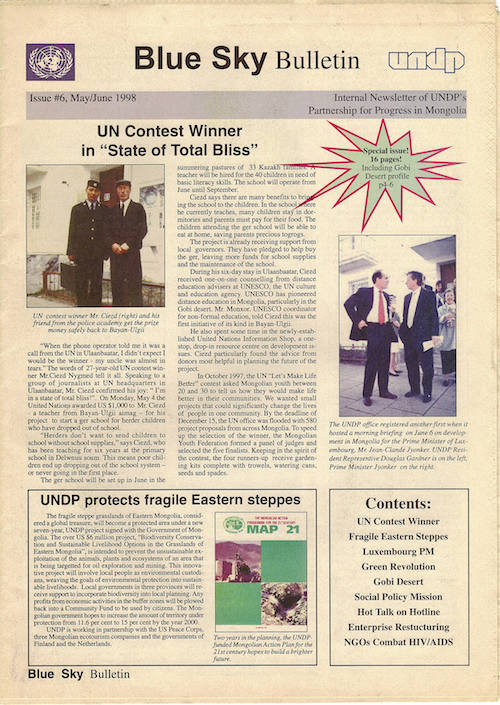
So many of the ideas were excellent, they were later to receive support from either the government, NGOs or international organisations. Read the story in theBlue Sky Bulletinnewsletter about the contest’s winner below:
Editor: David South
Publisher: UNDP Mongolia Communications Office
Published: Blue Sky Bulletin, Issue Number Six, May/June 1998
“When the phone operator told me it was a call from the UN in Ulaanbaatar, I didn’t expect I would be the winner – my uncle was almost in tears.”
The words of 27-year-old UN contest winner Mr. Ciezd Nygmed tells it all. Speaking to a group of journalists at UN headquarters in Ulaanbaatar, Mr. Ciezd confirmed his joy: “I’m in a state of total bliss!”
On Monday, May 4 the United Nations awarded US $1,000 to Mr. Ciezd – a teacher from Bayan-Ulgii aimag – for his project to start a ger school for herder children who have dropped out of school.
“Herders don’t want to send children to school without school supplies,” says Ciezd, who has been teaching for six years at the primary school in Delwnuu soum. This means poor children end up dropping out of the school system – or never going in the first place.
The ger school will be set up in June in the summering pastures of 33 Kazakh families. A teacher will be hired for the 40 children in need of basic literacy skills. The school will operate from June until September.
Ciezd says there are many benefits to bringing the school to the children. In the school where he currently teaches, many children stay in dormitories and parents must pay for their food. The children attending the ger school will be able to eat at home, saving parents precious togrogs.
The project is already receiving support from local governors. They have pledged to help buy the ger, leaving more funds for school supplies and the maintenance of the school.
During his six-day stay in Ulaanbaatar, Ciezd received one-on-one counselling from distance education advisers at UNESCO, the UN culture and education agency. UNESCO has pioneered distance education in Mongolia, particularly in the Gobi desert. Mr. Monxor, UNESCO coordinator for non-formal education, told Ciezd this was the first initiative of its kind in Bayan-Ulgii.
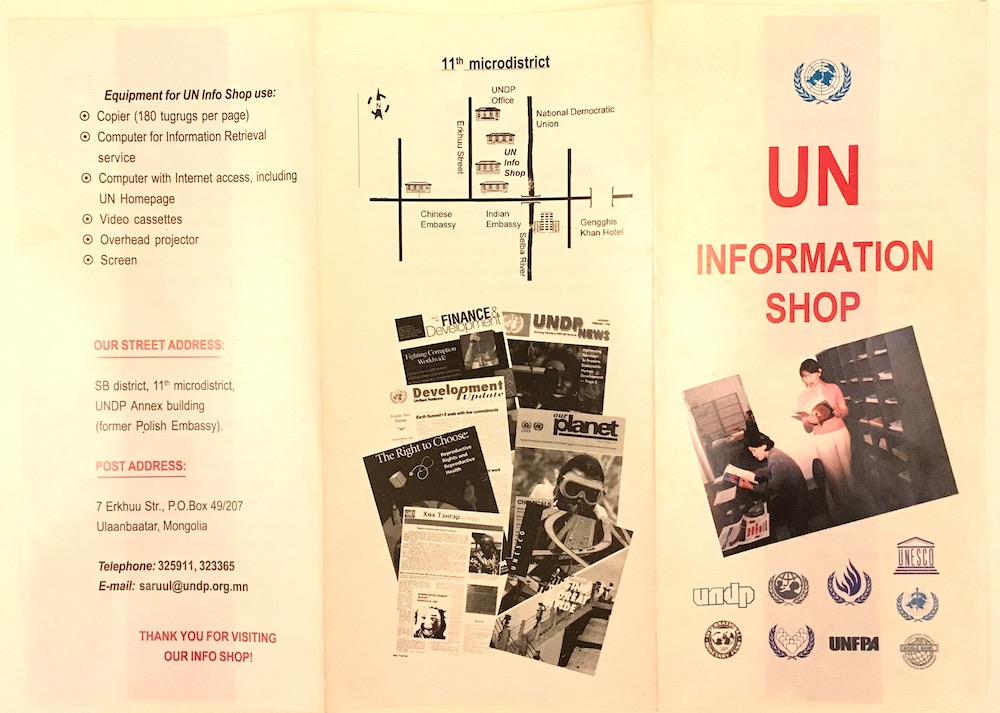
He also spent some time in the newly-established United Nations Information Shop, a one-stop, drop-in resource centre on development issues. Ciezd particularly found the advice from donors most helpful in planning the future of the project.
In October 1997, the UN “Let’s Make Life Better!” contest asked Mongolian youth between 20 and 30 to tell us how they would make life better in their communities. We wanted small projects that could significantly change the lives of people in one community. By the deadline of December 15, the UN office was flooded with 580 project proposals from across Mongolia. To speed up the selection of the winner, the Mongolian Youth Federation formed a panel of judges and selected the five finalists. Keeping in the spirit of the contest, the four runners-up receive gardening kits complete with trowels, watering cans, seeds and spades.
The United Nations Information (UN Info Shop) was established by UNDP Mongolia in 1997 and was managed by the UNDP Mongolia Communications Office. Context is everything. At this time, Mongolia was still recovering from the chaotic and turbulent transition from Communism to free markets and democracy begun at the start of the 1990s, called by some “one of the biggest peacetime economic collapses ever (Mongolia’s Economic Reforms: Background, Content and Prospects, Richard Pomfret, University of Adelaide, 1994)”. There was a thirst for information: access to the Internet was still limited and access to mobile phones was just the preserve of the rich. As a legacy of the past, information, especially that about the outside world and the country’s true economic and social conditions, was restricted. During the years of Communism, even simple travel from one place to the next was strictly regulated.
While today we can take it for granted that the Internet, and mobile and smart phones, deliver the world’s information in seconds, this just was not the case in the late 1990s in Mongolia.
The UN Info Shop quickly became a crucial resource for students (many schools and universities were nearby) and it became a first stop for many wishing to access the Internet. It also substantially raised the profile of the UN in the country as the public could, for the first time, enter the UN building and discover what the UN was doing in the country. They could also visit the UNDP Mongolia Communications Office and meet its team.
P. Dagmidmaa reads the Human Development Report Mongolia 1997 in the UN Info Shop.
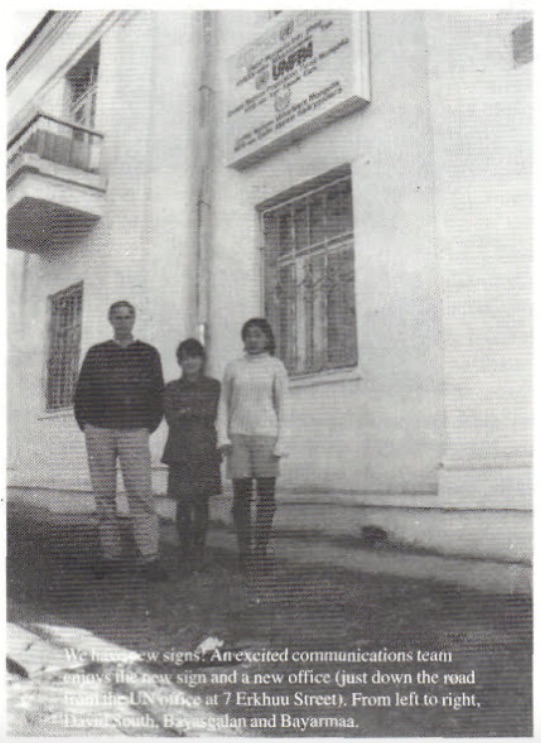
The UNDP Mongolia Communications Office Team 1998 outside the UN Info Shop in the capital, Ulaanbaatar: David South, Bayasgalan and Bayarmaa.
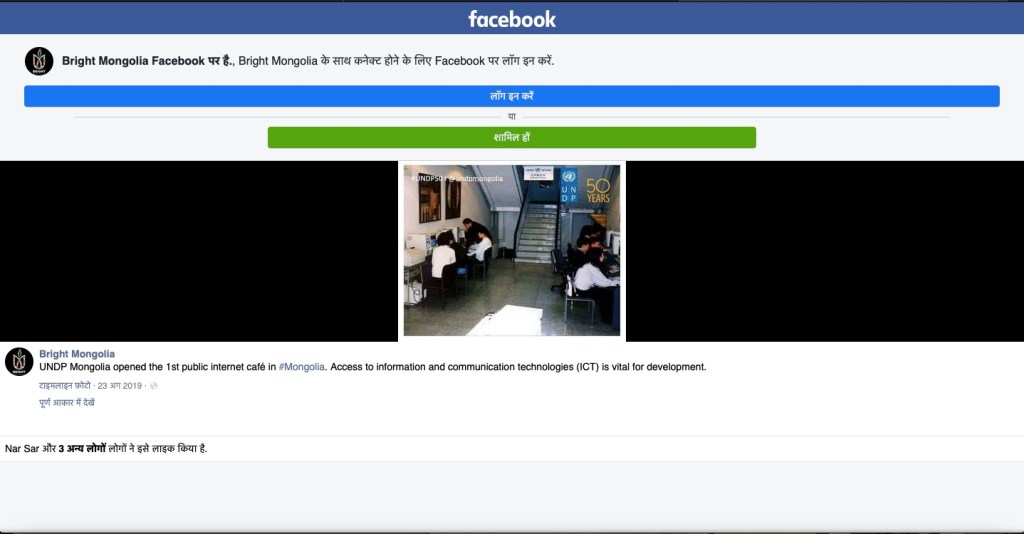
“UNDP Mongolia opened the 1st public internet cafe in Mongolia.” The internet cafe was part of the UN Mongolia Info Shop.
Many initiatives grew from the talented and dynamic UNDP Mongolia Communications Office team. Here are links to some of them:
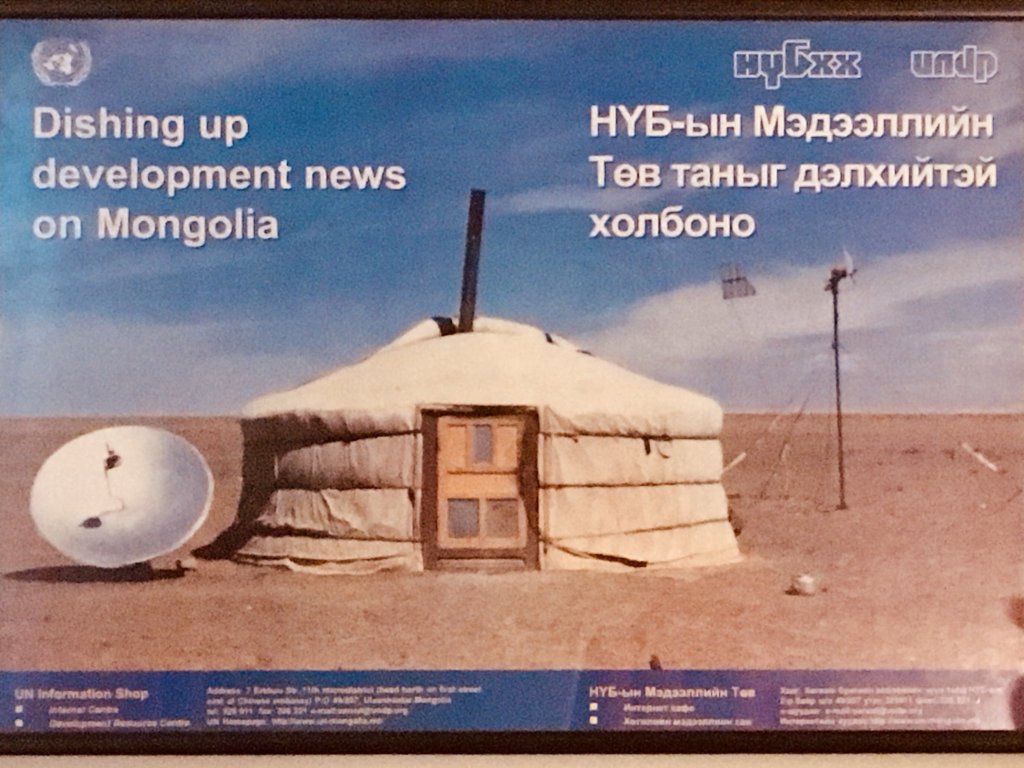
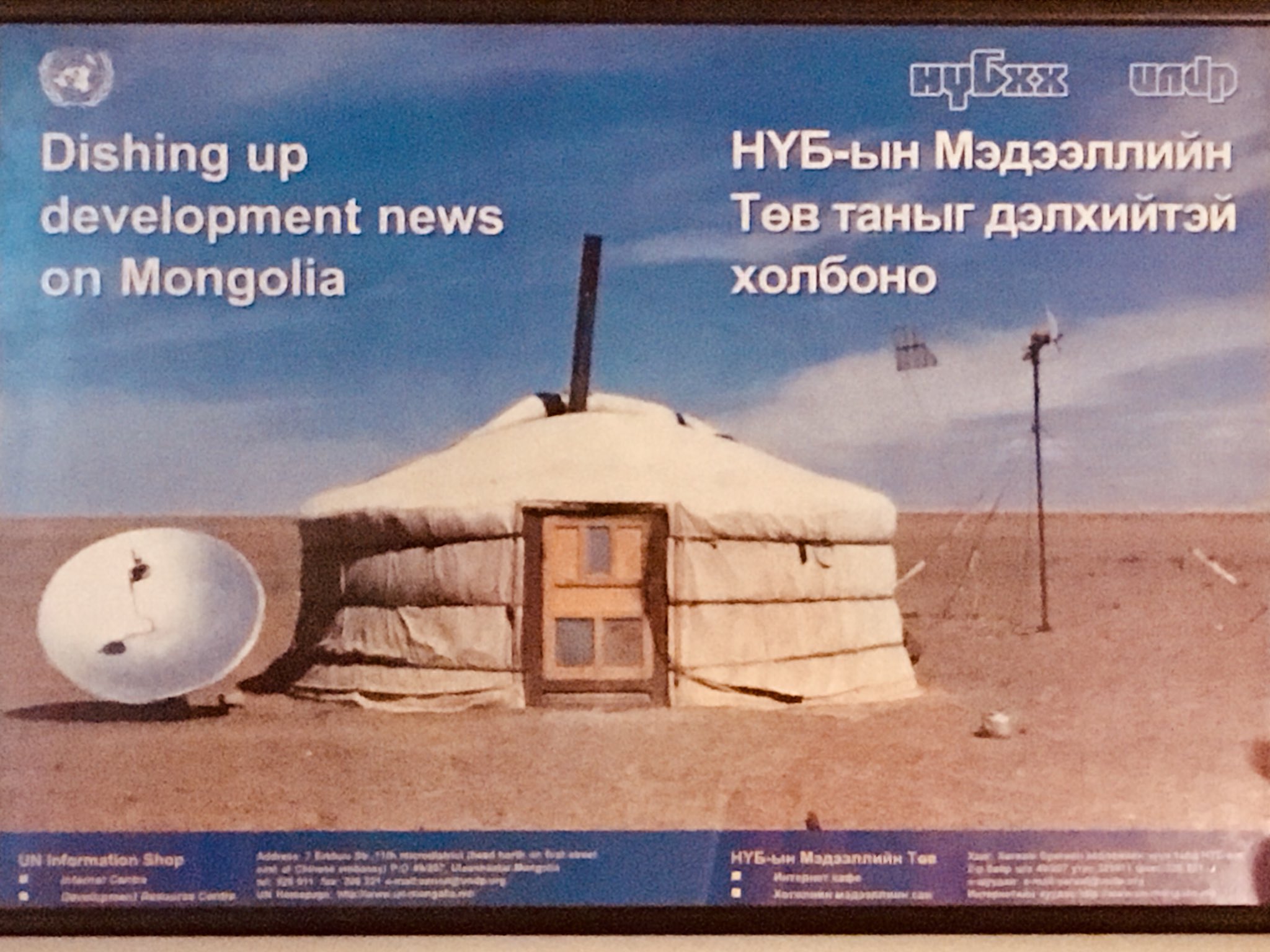
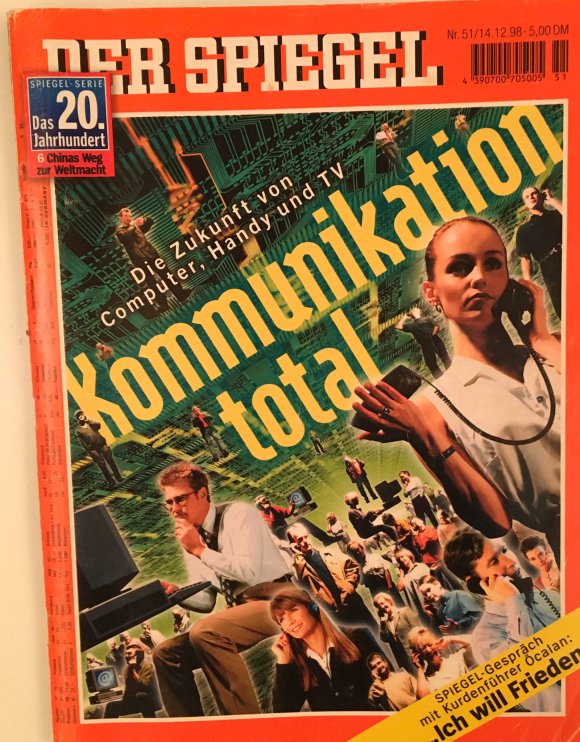
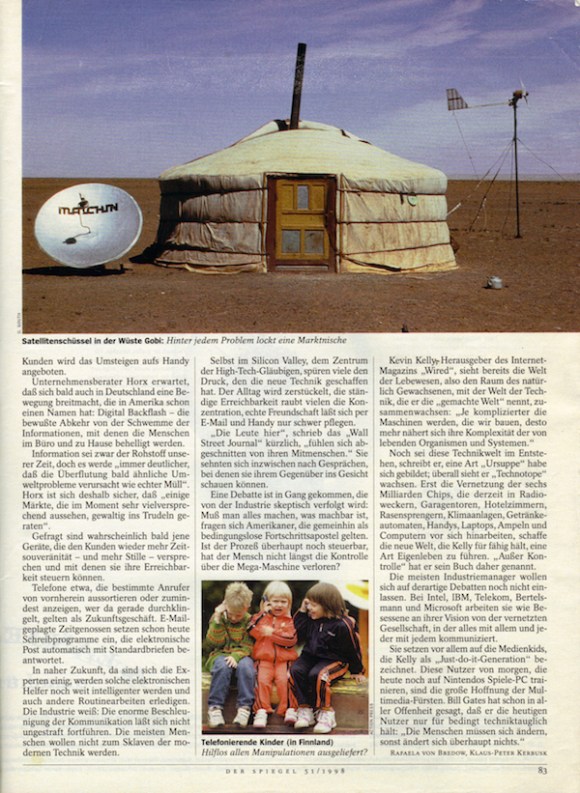
In 1998 Der Spiegel’s “Kommunikation total” issue profiled the global connectivity revolution underway and being accelerated by the Internet boom of the late 1990s. It chose my picture of a satellite dish and a ger in the Gobi Desert to symbolise this historic event.
We were able to identify numerous trends that were at the time being overlooked or under-reported; trends that could radically re-shape international development. This included the rapid rise ofmobile phonesin the global South and their powerful impact on economic development, the rush to cities and urban areas that was turning the world into a majority urban place, and the shift to greater South-South trade, investment and contact. Whereas the past involved people always looking North for inspiration, capital and business and trade relationships, this was shifting to South-South arrangements. And there were plenty of inspirational, modern, 21st century examples of economic, social and human development achievements across the global South to report on. By consistently tracking and chronicling a quiet revolution underway in the global South, the e-newsletter was able to draw attention to a rising 21st-century global innovator culture being shaped by the use of mobile phones and information technologies. Few at the time had grasped how much this was going to reshape the international development paradigm.
To start, the e-newsletterDevelopment Challenges, South-South Solutions(begun in 2006), was used to gather together as many stories, data, trends, and contacts as possible and get this message to as wide a group as possible. Luckily, this coincided with the very moment whole swathes of the global South were coming online, either through connecting with mobile phones or through the Internet. Quickly, it became clear there was not a lack of inspiring stories and innovations and solutions to share, but a lack of resources to communicate them. One solution was to utilise a new publishing tool that emerged in 2007: crowd-powered news services. It became a great way to bypass the stranglehold on news and information held by traditional media. Read more on this here:http://www.scribd.com/doc/251968773/Southern-Innovator-Summary-of-Impact-2011-to-2012
In particular, the e-newsletter caught the eye of those looking for inspiration in the wake of the 2007/2008 global economic crisis:
“Great economic and business reporting! Very helpful for us.” Africa Renewal, Africa Section, Strategic Communications Division, United Nations Department of Public Information
“I just went over your June newsletter. It’s very well done and far reaching. Congratulations!” Violette Ruppanner, Director, 3D -> Trade – Human Rights – Equitable Economy, Geneva, Switzerland
“Just to let you know I enjoyed the newsletter a lot – it was interesting to learn about things going on that I would never otherwise find out about, and also the listing of future conferences and events proved very useful.” Ian Sanderson, Deloitte, Geneva, Switzerland
“Congratulations on another great newsletter that’s packed with fascinating information! I really enjoy getting it each month.” Whitney Harrelson, Making Cents, Washington D.C.
2008: Development work begins on the concept for a book on innovation in the global South. Attend an Africa trade-focused meeting in Switzerland just as the global crisis breaks. Witness attendees dash from the event as they get frantic calls from London and New York. Undertake Cuba study tour with the BSHF.
2009: The book concept becomes a magazine. Attend the UN Conference on the Social and Political Dimensions of the Global Crisis: Implications for Developing Countries in Geneva, Switzerland.
2010: Begin working with graphic designer and illustrator Solveig Rolfsdottir and graphic designer Eva Hronn Gudnadottir in Reykjavik, Iceland on the initial concepts for what would become Southern Innovator. The working title for the new magazine is Creative Sparks.
2014: The fifth issue ofSouthern Innovatoris launched at the Global South-South Development Expo (GSSD Expo) in Washington, D.C.. Southern Innovator has always tried to inspire others to take action and this has turned out to be the case.
“Beautiful, inspiring magazine from UNDP on South-South innovation. Heart is pumping adrenaline and admiration just reading it”
Once blazing a lonely trail, there are now many places to find stories on global South innovation (The Guardian, SciDev, Devex, Business Fights Poverty, Zunia etc.). Mainstream media have also woken up to the energy and change sweeping across the global South, disrupting its regular diet of negative news stories focused around war, disasters and failure (unfortunately, still the majority of what most people see on their TV).
“I liked your latest Southern innovator! Always inspiring.”
“Btw, I really enjoyed reading them, impressive work & a great resource. Looking forward to Issue 6. My best wishes to you & your team at SI.”
“The magazine looks fantastic, great content and a beautiful design!”
Most importantly, it is the young who have told us they ‘get’ Southern Innovator. It portrays a world they know – comfortable with new technologies, looking to solve problems, open to doing things in new ways. And it is that audience that excites us the most: the youth of the global South (Africa’s young population will be a huge contributor to the world’s working-age workforce by 2050): they are shaping the new world we live in and seeking a role in it.
On Twitter, comments included: From @CapacityPlus Nice job RT @ActevisCGroup: RT @UNDP: Great looking informative @SouthSouth1 mag on South-South Innovation; @UNDP Great looking informative @SouthSouth1 mag on South-South Innovation; @JeannineLemaire Graphically beautiful & informative @UNDP Southern Innovator mag on South-South Innov.
The phases of this project have been compiled in two e-books and published online here:
2015: In September 2015 (http://www.bbc.co.uk/news/world-asia-china-34372188), China’s President Xi Jinping announced China would spend US $2 billion on South-South cooperation initiatives. This has been called “a ‘game changer’ in international relations”(http://www.ipsnews.net/2015/11/opinion-chinas-new-south-south-funds-a-global-game-changer/).President Xi also said of South-South cooperation, it is: “a great pioneering measure uniting the developing nations together for self-improvement, is featured by equality, mutual trust, mutual benefit, win-win result, solidarity and mutual assistance and can help developing nations pave a new path for development and prosperity.”
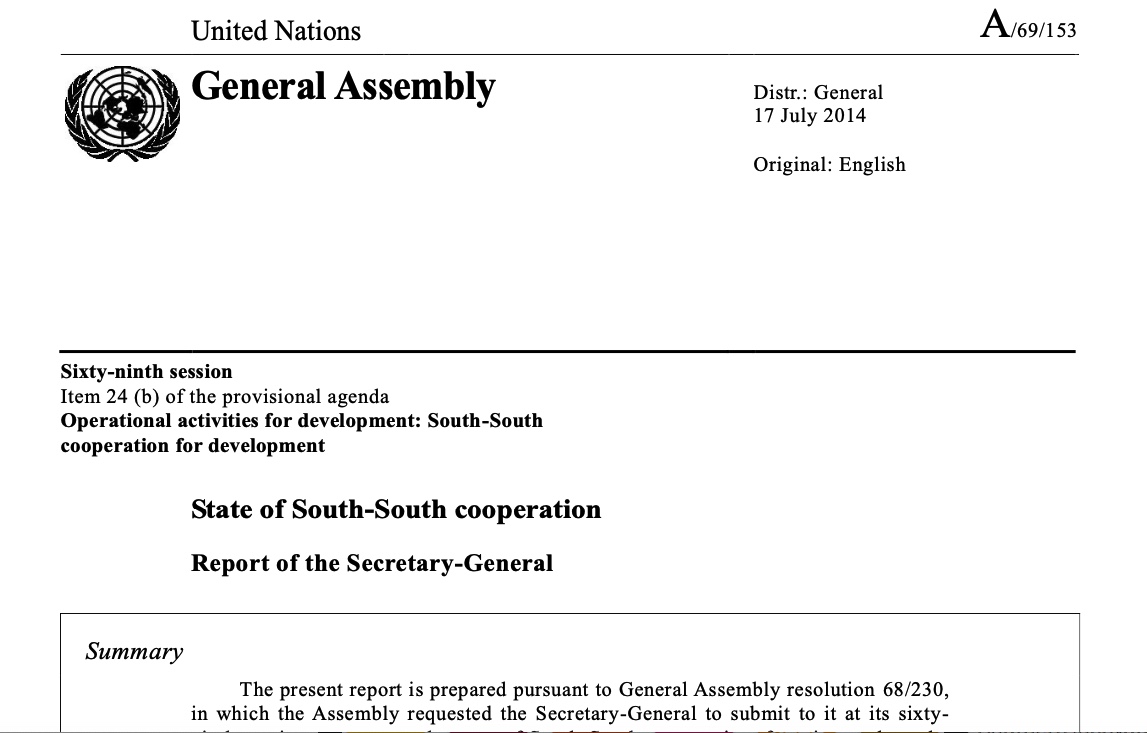
The Southern origins of sustainable development goals: Ideas, actors, aspirations by Sakiko Fukuda-Parr and Bhumika Muchhala (SDG Resource Centre).United Nations General Assembly: Sixty-ninth session, Item 24 (b) of the provisional agenda, Operational activities for development: South-South cooperation for development, 17 July 2014.The research informing Southern Innovator Magazine played a part in the formulation of the UN’s post-2015 development agenda, including the Sustainable Development Goals (SDGs).
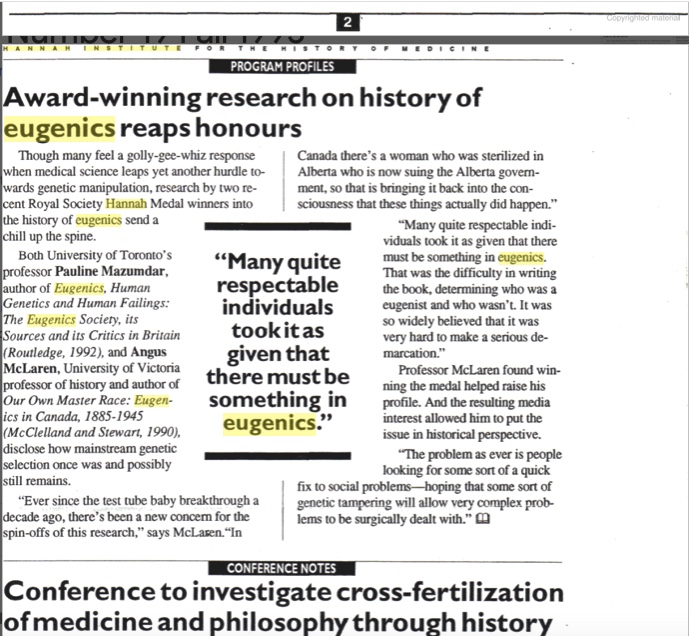
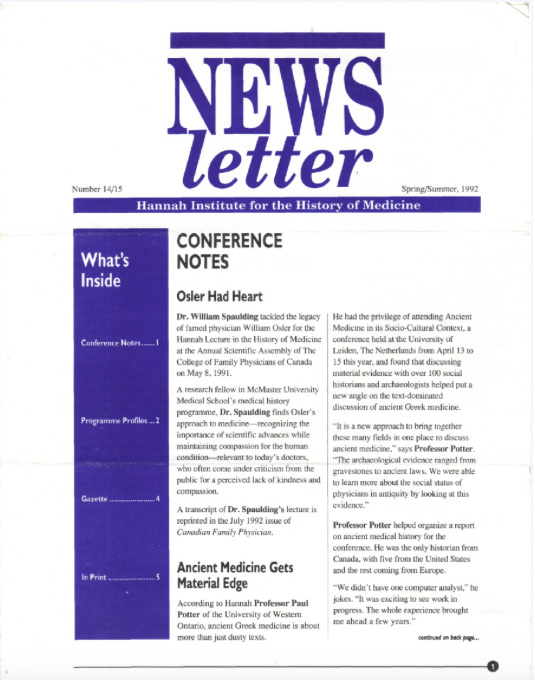
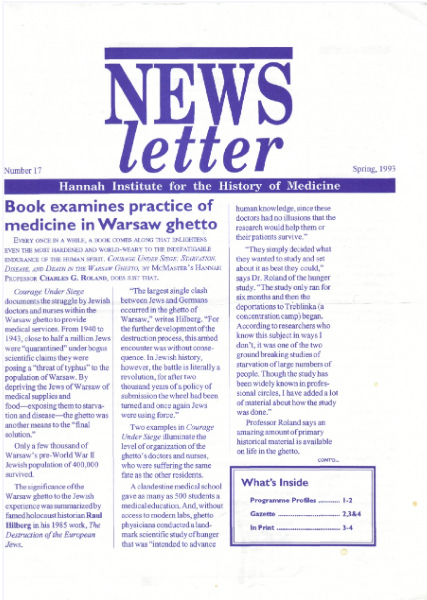
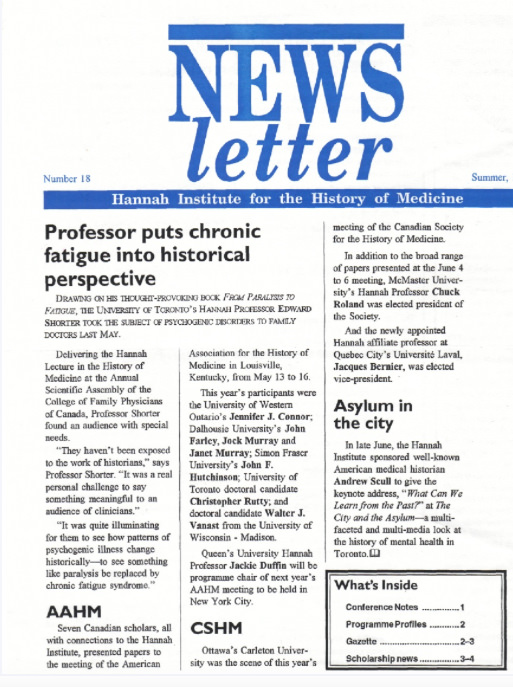
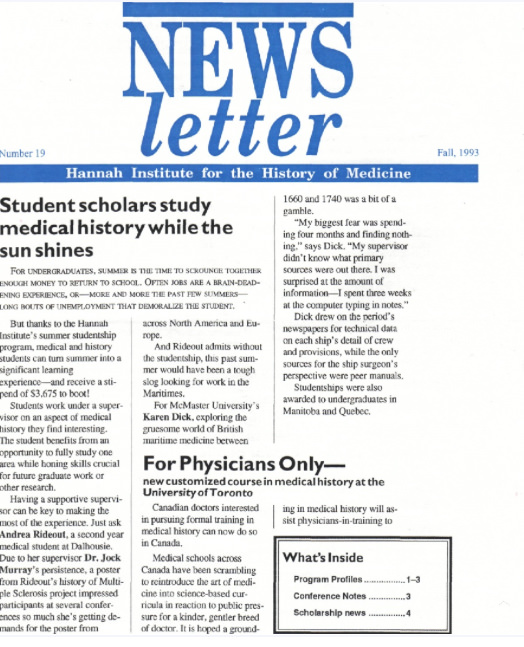
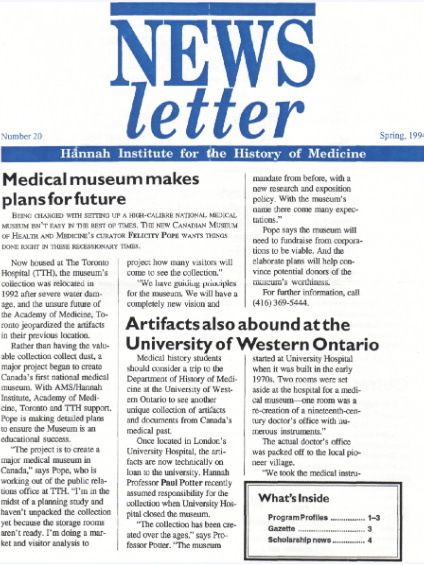
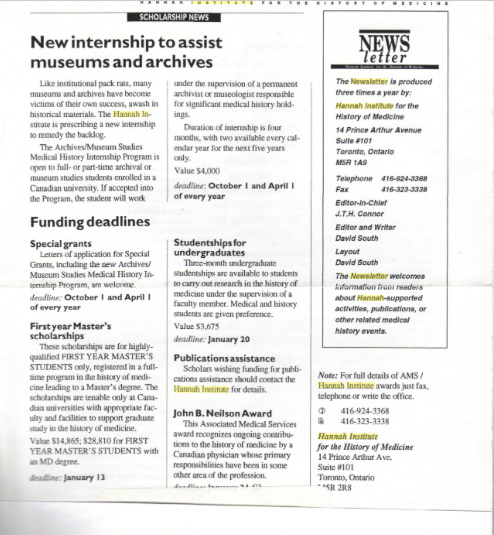
I worked as Editor and Writer for the newsletter of the Hannah Institute for the History of Medicine (under the direction of the Editor-in-Chief and Hannah Executive Director Dr. J.T. H. Connor) in the early 1990s. Located close to the University of Toronto and within a neighbourhood claiming a long association with medical and scientific discovery (Sir Frederick Banting, co-developer of insulin for the treatment of diabetes, lived at 46 Bedford Road,), the goal was to better connect Canada’s medical history community of scholars and raise the profile of the funding resources available to further the study of medical history in Canada.
The Toronto Legacy Project and Heritage Toronto plaque marking the location of Sir Frederick Banting’s former home.
I also revamped the application process for awards, scholarships and grants to make them user-friendly and compatible with word processing software packages of the time.
The Hannah Institute was the adminstrator for the grants and awards funded by AMS (Associated Medical Services). It has had a profound impact on the medical history field in Canada, as the AMS website states:
“As a result of the growth of the discipline and the burgeoning of scholarship, as well as financial support from other funding bodies, in 2006, the AMS Board of Directors decided not to provide new competitive grants and further, decided to bring AMS- administered competitive grants to closure by 2011.
In the 1970’s when the Hannah Chairs and the Hannah Institute were established, the discipline of the history of medicine was an “orphan’ within the Canadian scholarly community. Three decades later with the support of AMS, history of medicine and healthcare continued to thrive in universities and colleges across Canada.”
The archive of newsletters is held at the Wellcome Collection Library in London, UK and at the University of Toronto.“Professor puts chronic fatigue into historical perspective” announced the launch of a new book by the University of Toronto’s Hannah Professor Edward Shorter. Abstracts in Anthropology, Volume 43, Issues 3-4: “… in recent years it has become a pursuit for a growing number of researchers. … Behind much of this growth has been the Hannah Institute for the History of Medicine which has encouraged writing …”.














You must be logged in to post a comment.